
Carole King‘s net worth is estimated at $70 million to $100 million as of November 2026. The fortune rests on one of the deepest song catalogs in American music — 118 songs she wrote or co-wrote reached the Billboard Hot 100 — plus a solo album, Tapestry, that has sold more than 30 million copies worldwide, and a Broadway musical built from her life that grossed over $290 million. No audited figure exists, because King has never disclosed her finances, so the honest number is a range: Celebrity Net Worth puts her at $100 million, while NetWorthSpot and several 2026 roundups land near $70 million.
Carole King: Quick Facts
| Estimated net worth | $70 million – $100 million (range: $70 million to $100 million) |
|---|---|
| Profession | Singer-songwriter, pianist, author |
| Nationality | American |
| Born | February 9, 1942 (age 84) |
| Height | 5 ft 4 in (1.63 m) |
| Primary income sources | Songwriting and publishing royalties, recorded-music royalties, licensing and synchronization, Broadway royalties, live performance |
| Active years | 1958–present |
| Last reviewed | November 2026 |
- Early Life and Background
- Education
- Career Journey
- Rise to Fame
- Main Sources of Income
- Salary and Earnings
- Businesses and Investments
- Brand Deals and Sponsorships
- Houses, Cars and Other Assets
- Awards and Achievements
- Net Worth Growth Over the Years
- Social Media Presence
- Personal Life
- Sources & Reporting
- Frequently Asked Questions
Early Life and Background
Carole King was born Carol Joan Klein on February 9, 1942, in Manhattan, New York City, to Sidney N. Klein, a firefighter, and Eugenia Cammer Klein, a teacher. Her parents had met in an elevator at Brooklyn College in 1936 — her father studying chemistry, her mother English and drama — and the family soon settled in Brooklyn, where King grew up in a two-story duplex on East 24th Street. She started piano lessons at four and was writing melodies before she was old enough to spell the words that would go with them. Her mother, who had studied music herself, drilled her in classical training, while the radio in the house supplied the pop songs King would soon be writing herself.
The Brooklyn childhood matters to the money story because it explains the speed of everything that followed. King was not a late bloomer who learned the business in her twenties; she was a teenager selling songs to the most competitive hit factory in America. By 16 she was cutting demonstration records for other writers, and by 17 she had married the lyricist who would become her first great commercial partner. The piano she learned on as a small child became, within a decade, the instrument behind more than two dozen chart hits written for other people — income that arrived years before she ever stood on a stage as a star in her own right.
King’s grandparents had emigrated from Russia and Poland to Brooklyn, and the family was Jewish, a background she has spoken about lightly but consistently. The practical side of her upbringing shows up in her later financial choices: she bought land and a ranch in Idaho in 1981, fought a multi-year legal battle over a road through her property, and has kept her business affairs private for six decades. She has never courted the celebrity-wealth press, never sold a memoir-style tell-all about her money, and never announced a catalog sale. That privacy is the main reason her net worth is an estimate rather than a documented figure.
Education
King attended James Madison High School in Brooklyn, where her classmates included a young Neil Sedaka — she dated him briefly, and he later wrote songs about her — and Paul Simon, who was already forming the duo that would become Simon & Garfunkel. She went on to Queens College, where she met lyricist Gerry Goffin in 1958. The meeting was the hinge of her early career: Goffin needed melodies for his words, King needed words for her melodies, and within a year they were writing together, dating, and then married. She left college before graduating; the songwriting work had already become a full-time job.
Queens College gave her two things no classroom could have taught as fast: a writing partner and a direct line into the Brill Building system. Don Kirshner’s Aldon Music, the publishing house that employed Goffin and King, paid its writers a weekly draw against future royalties — a modest but steady salary for teenagers in 1959 — and stationed them in small cubicles with pianos, expected to produce a hit a week. King has described the setup as a songwriting school with a paycheck. The discipline of that room — write it, demo it, move on — produced the catalog that still pays her today.
Career Journey
King’s first number one arrived before she could legally drink. “Will You Love Me Tomorrow,” written with Goffin for the Shirelles, topped the Billboard Hot 100 in early 1961, when King was 18. It was the first number one by a Black girl group, and it announced a writing partnership that would dominate the decade. Over the next seven years, Goffin and King wrote more than two dozen chart hits, many of them standards: “The Loco-Motion” for Little Eva in 1962, “Up on the Roof” for the Drifters in 1962, “One Fine Day” for the Chiffons in 1963, “Go Away Little Girl” — a number one first for Steve Lawrence in 1963 and again for Donny Osmond in 1971 — “Pleasant Valley Sunday” for the Monkees in 1967, and “(You Make Me Feel Like) A Natural Woman” for Aretha Franklin in 1967. The count that defines her career as a writer is 118: the number of songs she wrote or co-wrote that charted on the Billboard Hot 100, a total that made her the most successful female songwriter of the second half of the 20th century, according to Billboard researcher Joel Whitburn. She also placed 61 songs on the UK charts, the most by any female songwriter there between 1962 and 2005.
The Brill Building years paid in publishing royalties — mechanical royalties each time a record sold, performance royalties each time a song played on the radio — and those payments never stopped. A song like “Will You Love Me Tomorrow” has been recorded hundreds of times, and every version, every radio spin, every film placement, every stream sends a small payment to the writers’ estates and publishers. Multiplied across 118 charted songs, the catalog became a pension that started paying in 1960 and has compounded for 65 years. That is the structural fact behind the net worth figure: King did not earn her fortune from one album or one tour, but from a catalog that was already enormous before she became famous as a performer.
Her marriage to Goffin ended in divorce in 1968, and King moved to Los Angeles with her two daughters, settling in Laurel Canyon among the musicians who were inventing the singer-songwriter era — James Taylor, Joni Mitchell, Jackson Browne. She had been recording as a solo artist in the 1960s without success, but the Laurel Canyon scene gave her the audience and the collaborators to try again. Her debut solo album, Writer, arrived in 1970 and sold poorly. Eleven months later she released the record that changed everything.
Rise to Fame
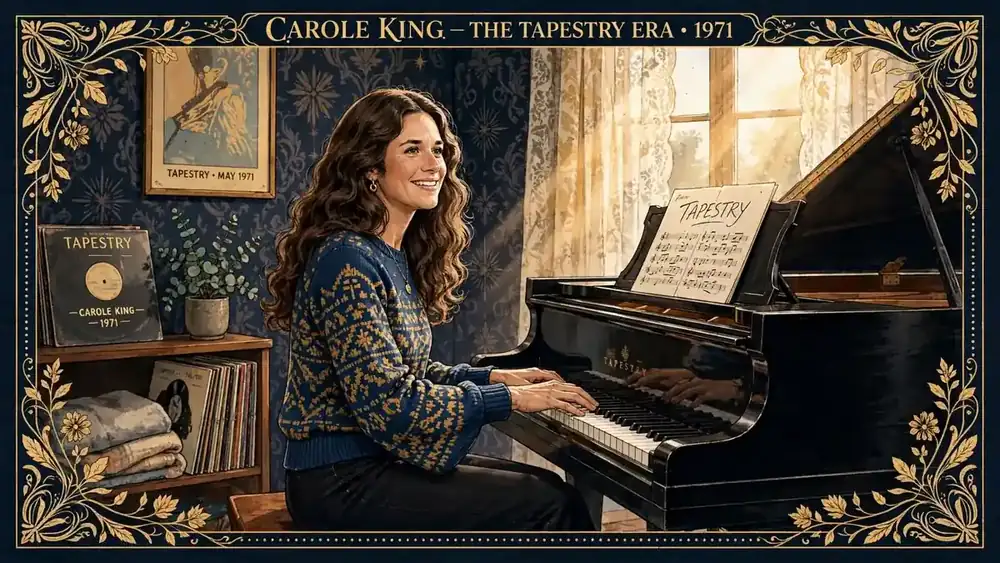
Tapestry, released on February 10, 1971, on Ode Records and produced by Lou Adler, is the commercial spine of Carole King’s fortune. It spent 15 consecutive weeks at number one on the Billboard 200 — a streak that, according to King’s official site in 2026, still stands as the longest ever by a female solo artist, 55 years after release. The album stayed on the Billboard 200 for more than six years, over 300 weeks, and has been certified 14× Platinum by the Recording Industry Association of America, with worldwide sales estimated above 30 million copies. It was the best-selling album by a female artist for a quarter of a century.
The singles carried the same weight. “It’s Too Late,” backed with “I Feel the Earth Move,” spent five weeks at number one on the Billboard Hot 100. “You’ve Got a Friend” — written by King, and a number one the same year for James Taylor — won Song of the Year at the 1972 Grammy Awards, where Tapestry took four Grammys in total: Album of the Year, Record of the Year, Song of the Year and Best Female Pop Vocal Performance. King became the first woman to win Song of the Year as a songwriter. Rolling Stone ranked Tapestry number 25 on its 2020 list of the 500 Greatest Albums of All Time; the album entered the Grammy Hall of Fame in 1998 and was selected for the National Recording Registry.
The follow-up albums kept the run going. Carole King: Music, released in December 1971, reached number one and went platinum, staying on the pop album charts for 44 weeks. Across her career she has released 17 studio albums and 25 solo albums in total, with four platinum and eight gold records, and sold more than 75 million records worldwide. The RIAA counts 19.6 million records sold in the United States alone. Those sales figures matter to the estimate because recorded-music royalties, unlike a tour payday, recur: every reissue, every anniversary edition, every stream of “It’s Too Late” on a playlist pays again.
King never chased the touring treadmill the way her peers did. She toured in the 1970s, then pulled back, and her biggest live payday came decades later: the 2010 Troubadour Reunion Tour with James Taylor, celebrating the 40th anniversary of their first performances at the Troubadour club in Los Angeles, grossed more than $59 million, according to NetWorthSpot’s 2026 reporting. The live album from the tour, Live at the Troubadour, went gold. It was a reminder that King’s catalog could still fill arenas at 68 — and that her earning power had never depended on being on the road.
Main Sources of Income
Five streams feed Carole King’s wealth, and their order matters: publishing royalties first, recorded-music royalties second, licensing third, stage royalties fourth, and live performance a distant fifth. That ranking is unusual for a star of her size — most performers earn most from touring — and it explains why her fortune has held up through decades when she barely toured at all.
Publishing royalties are the foundation. King wrote or co-wrote 118 Billboard Hot 100 songs, and the publishing income from that catalog arrives as mechanical royalties on every sale and stream, performance royalties on every radio play and public performance, and synchronization fees when a song is placed in a film, television show or advertisement. Because she kept ownership of much of her solo catalog and established her own publishing company, Carole King Music, to administer her songs, she retains a larger share of those payments than writers who signed their rights away early. The early Goffin-King songs were written under Aldon Music, so the splits on the 1960s hits are less favorable than on her solo work — a fact that cuts both ways for the estimate, since it means the most famous songs in the catalog are not the most profitable ones for her personally.
Recorded-music royalties flow from more than 75 million records sold worldwide, led by Tapestry‘s 30 million-plus. The album’s 14× Platinum certification in the United States alone represents 14 million units shipped, and the record has never left print: anniversary reissues, vinyl revivals and streaming playlists keep it selling. Carole King: Music added a platinum album, and three further platinum and eight gold albums round out a catalog that earns every time a new generation discovers the 1970s singer-songwriter canon on a streaming service.
Licensing and synchronization is the quiet earner. King’s songs turn up in films, television dramas, commercials and stage productions, and a single high-profile placement can pay a five- or six-figure fee. “You’ve Got a Friend,” “Natural Woman,” “It’s Too Late” and “I Feel the Earth Move” are among the most licensed songs of their era, because they are short, melodic, instantly recognizable and emotionally direct — exactly what music supervisors want. The catalog’s value has risen with the streaming era, because every placement now drives listeners back to the recordings and the publishing.
Broadway royalties come from Beautiful: The Carole King Musical, which opened at the Stephen Sondheim Theatre on January 12, 2014. The show ran 2,418 performances over nearly six years, closing on October 27, 2019, and grossed more than $290 million on Broadway, according to industry reporting. It recouped its $13 million capitalization in about ten months — Playbill reported the recoupment in September 2014, when the show was grossing around $1.3 million a week — and went on to tour North America and open international productions. King benefits from the show through her music rights and her stake in the underlying catalog, and the musical doubled as a marketing engine for the recordings, pushing Tapestry back onto the charts in its 40s.
Live performance has always been the smallest share. Apart from the 2010 Troubadour reunion tour’s $59 million-plus gross, King’s touring has been selective: a 1970s run, occasional benefit appearances, and the 2016 British Summer Time headline show in Hyde Park, her first UK concert in 27 years. She has largely retired from extensive touring, and no major tour is scheduled for 2026.

Salary and Earnings
No salary figure for Carole King has ever been published, and any article that states one is guessing. She is not a salaried employee, she has never filed a public financial disclosure, and her income arrives as royalties, which vary with sales, streams, radio play and licensing deals. The honest way to describe her earnings is by the dated, verifiable milestones that anchor the range.
The first milestone is the Aldon Music draw of the late 1950s and early 1960s: a weekly wage paid to teenage staff writers, modest in itself but the start of a royalty stream that has now run for 65 years. The second is Tapestry. The album’s first-year sales made King a millionaire in 1971 dollars — one aggregator traces her net worth from around $1 million at the album’s release to a multiple of that within a few years, though the underlying royalty rates were never disclosed, so treat that early figure as a rough marker, not an audited fact. The third milestone is the 2010 Troubadour Reunion Tour, which grossed over $59 million across its dates; King’s share of a co-headlined tour gross is not public, but even a conservative artist split puts her take in the millions for a single tour.
The fourth milestone is Beautiful. A Broadway show capitalized at $13 million that grosses $290 million and runs 2,418 performances generates royalty and profit participation for its rights holders over many years, and the touring and international companies extend the payments further. King’s exact share is private, but the scale of the gross is public, and it is the single largest commercial event of her later career. One outlet, Social Life Magazine, estimates her annual royalty income at $5 million to $8 million a year; that figure is unverified and we cite it only as a circulating estimate, not a fact. The safer statement is that her catalog generates low single-digit millions annually in royalties — enough to sustain a fortune in the $70 million to $100 million range without any new work at all.
The growth table below uses only published estimates and dated milestones, and marks every figure as an estimate. The pattern it shows is the point: slow, steady accumulation from a catalog that never stops paying, punctuated by two windfalls — Tapestry in 1971 and Beautiful in 2014 — rather than the spike-and-fade shape of a touring star.
Businesses and Investments
King’s business footprint is small and deliberate. She founded Carole King Music, her own publishing company, to control and administer her compositions — the decision that matters most to her wealth, because it keeps a larger share of every royalty with the writer rather than a third-party publisher. She has never built a fashion line, a beauty brand, a restaurant chain or a venture portfolio, and she has never announced a catalog sale. That last point deserves emphasis: in an era when Bob Dylan, Bruce Springsteen and Neil Young sold their catalogs for hundreds of millions of dollars, King has kept hers. The catalog is therefore both her main asset and an unrealized one — its market value, if she ever sold it, would likely exceed her current estimated net worth, because buyers pay a multiple of annual royalties, and hers have run for six decades.
Her memoir, A Natural Woman, published by Grand Central in April 2012, became a New York Times bestseller and added book royalties and a paperback cycle to her income. She has also earned as a co-producer and rights holder on projects built from her life and songs, including the Beautiful musical and its touring companies. Beyond music, her public work has been activism rather than business: she has campaigned for years for wilderness protection in Idaho, including the Northern Rockies Ecosystem Protection Act, and has supported environmental and animal-welfare causes. None of that generates income, but it explains where her time and money go — she has described herself as an activist first and a performer second in her later years.
What King has not done is equally telling. There is no record of a major real-estate flipping business, no startup portfolio, no endorsement empire. Her investments, as far as public reporting shows, are her catalog, her ranch, and her privacy. That concentration is why the $70 million to $100 million range is wide: a catalog’s value depends on royalty multiples that only a buyer and seller can settle, and King’s has never been tested by a sale.
Brand Deals and Sponsorships
Carole King has no meaningful endorsement career, and that is a deliberate choice rather than a missed opportunity. She has never fronted a fashion campaign, a cosmetics line or a consumer brand, and her name does not appear on the endorsement rosters that fill other stars’ income statements. The closest she has come to commercial partnerships are the natural ones: the Beautiful musical, the Troubadour reunion tour, and the reissue campaigns for Tapestry‘s anniversaries, all of which sell her own work rather than someone else’s product.
This absence is a gap opportunity for our estimate rather than a hole in it. Competitor articles that list “brand deals” as a major income source for King are padding — there is nothing to list. Her fortune was built without them, which is itself a useful fact for readers: a songwriter who owns her catalog does not need a sneaker deal. The one commercial relationship that does matter is with Sony/ATV Music Publishing, which has administered parts of her catalog, and with Ode Records and its successors for her recordings. Those are publishing and recording relationships, not sponsorships, and they pay royalties, not fees.

Houses, Cars and Other Assets
Public reporting on Carole King’s personal assets is thin, and we will not invent a property portfolio. One holding is well documented: Robinson Bar Ranch, a 128-acre property in central Idaho, near Stanley in the Sawtooth National Recreation Area, which King bought in 1981 and used as her home for 35 years. The compound includes a restored 7,337-square-foot lodge, an owner’s residence overlooking Warm Springs Creek, a caretaker’s home, guest cabins, equestrian facilities, a greenhouse and a professional recording studio, with mineral and adjudicated water rights. The ranch was later listed for sale through Hall and Hall; no sale price was publicly disclosed in the listing materials we reviewed, so we do not state one.
King’s earlier homes tell the same story of a life lived away from the spotlight: a Laurel Canyon house in the early 1970s, a cabin in Idaho with no running water or electricity in the late 1970s — she bathed in a hot spring and hauled water by the bucket, according to her memoir — and then the Robinson Bar ranch, where she fought a multi-year legal battle over a private road through the property. She has never publicized a car collection, a jewelry collection or a second home in Los Angeles or New York, and no reliable source lists one. Readers looking for a fleet of luxury cars will not find one here, because the record does not support it.
The asset that matters is not a house but the catalog: 118 Hot 100 songs, 61 UK hits, 17 studio albums, and the publishing rights that generate royalties every day. If King sold that catalog tomorrow, the price would be set by a multiple of its annual royalties — and with streaming, licensing and the Beautiful franchise still paying, that multiple would be substantial. Until such a sale happens, the catalog sits on her balance sheet at an estimated, not a realized, value, which is exactly why the published net worth figures are a range.
Awards and Achievements
King’s honors list is one of the longest in popular music, and it is also a commercial asset: every induction and prize renews interest in the catalog and drives sales. She has won four Grammy Awards, all for Tapestry in 1972, and Tapestry itself entered the Grammy Hall of Fame in 1998. She was inducted into the Songwriters Hall of Fame in 1987, received its Johnny Mercer Award in 2002, and was inducted into the Rock and Roll Hall of Fame twice — in 1990 as a songwriter, alongside Goffin, in the non-performer category, and in 2021 as a performer, inducted by Taylor Swift. She is the first person inducted into the Rock Hall separately as a songwriter and as a performing artist, and the only person inducted both as a non-performer and as a performer.
The other honors fill out the picture: the Library of Congress Gershwin Prize for Popular Song in 2013, where she was the first woman to receive it; the Kennedy Center Honors in 2015; a star on the Hollywood Walk of Fame on December 3, 2012; MusiCares Person of the Year in 2014; and the National Academy of Songwriters’ Lifetime Achievement Award in 1988. Tapestry was selected for preservation in the National Recording Registry, and Rolling Stone placed it at number 25 on its 2020 ranking of the 500 Greatest Albums of All Time. In 2026, her official site noted that Tapestry‘s 15-week run at number one remains the longest ever by a female solo artist — a record that has now stood for 55 years.
For comparison with her peers in our own profiles, the scale is striking: Lou Adler, who produced Tapestry, is profiled by us at $250 million, and hitmaker David Foster at $150 million — both fortunes built in part on the same ecosystem of songs, studios and publishing that King helped create. E Street drummer Max Weinberg sits at $45 million in our profile, and Mick Jagger‘s fortune, built on touring as much as writing, runs far higher. King’s $70 million to $100 million places her between the session elite and the stadium headliners — exactly where a songwriter’s fortune should sit.
Net Worth Growth Over the Years
| Year | Estimated net worth | What drove it |
|---|---|---|
| 1961 | Under $1 million (estimate) | First number one, “Will You Love Me Tomorrow”; Aldon Music draw and early royalties |
| 1971 | About $1 million (estimate) | Tapestry released; 15 weeks at number one; four Grammys in 1972 |
| 1978 | $5 million – $10 million (estimate) | Catalog royalties compounding; Tapestry and follow-up albums still selling |
| 1990 | $20 million – $30 million (estimate) | Rock and Roll Hall of Fame induction; catalog reissues on CD |
| 2010 | $50 million – $70 million (estimate) | Troubadour Reunion Tour grosses over $59 million; Live at the Troubadour goes gold |
| 2014 | $70 million – $85 million (estimate) | Beautiful opens on Broadway; recoups $13 million in about ten months |
| 2021 | $70 million – $100 million (estimate) | Second Rock Hall induction; Tapestry 50th anniversary reissues |
| 2026 | $70 million – $100 million (estimate) | Celebrity Net Worth $100 million; NetWorthSpot $70 million; streaming and licensing steady |
Two things stand out in that table. First, the growth is slow and steady, not spiky — a catalog compounding over 65 years. Second, the range widens rather than narrows over time, because the catalog’s market value grows with streaming and licensing while no sale ever sets a price. The $800 million figure that appears on one aggregator page, attributed to Forbes, has no basis in any Forbes reporting we could find, and the $250 million and $500 million figures on thin content-farm pages carry no named source at all. We excluded all three. The $30 million figure on one recent UK blog is an outlier at the low end that conflicts with the $59 million single-tour gross and the $290 million Broadway gross that sit behind it. The credible cluster is $70 million to $100 million, and that is the range we publish.
Social Media Presence
King keeps a light footprint on social media for a star of her stature. Her official site, caroleking.com, is the hub for news — including the 2026 note that Tapestry still holds its Billboard record — and her verified social accounts post sparingly, usually around anniversaries, reissues and advocacy work. She does not run a daily content operation, sell products through social channels, or monetize her following in the way younger artists do, and no reliable source attributes meaningful income to her social media. That restraint fits the rest of her career: the catalog does the talking, and the accounts exist to point fans toward it.
For readers, the practical point is that King’s social channels are a source of news, not of money. Announcements about Tapestry anniversaries, Beautiful productions and her Idaho conservation work appear there first, and they are worth following for that reason. They are not a revenue line, and no estimate of her net worth should count them as one.
Personal Life
King has been married four times and has four children. She married Gerry Goffin in August 1959, at 17, and they divorced in 1968; their daughters are Louise Goffin, born March 23, 1960, and Sherry Goffin Kondor, born March 3, 1962, both musicians. She married bassist Charles Larkey in 1970, and they divorced in 1976; their children are artist Molly Larkey and Levi Larkey. Her third husband, Rick Evers, married her in 1977 and died of a drug overdose in 1978; King has written candidly about the abuse in that marriage in her memoir. Her fourth husband, Rick Sorenson, married her in 1982, and they divorced in 1989. She is not currently married, and her present relationship status is private.
Her children have stayed close to music and art: Louise Goffin is a singer-songwriter, Sherry Goffin Kondor has worked as an actress and musician, Molly Larkey is a visual artist, and Levi Larkey is a musician. King moved her family to Idaho in the late 1970s, first to a remote cabin and then to the Robinson Bar ranch, where she has lived for most of the past four decades. She is 84 as of November 2026, alive and living in Idaho, and her public appearances in recent years have been selective — benefit concerts, award ceremonies and advocacy events rather than tours.
King’s memoir, A Natural Woman, is the fullest account of this life in her own words, and it is candid about the parts that were painful: the early marriage, the divorce, the Idaho years, the road dispute, and the decision to keep making music on her own terms. Readers who want the personal story should start there rather than with the gossip pages, which have recycled the same four-marriage summary for years without adding anything new.
Sources & Reporting
Celebrity Net Worth — the $100 million estimate, the most widely cited figure, and the biographical baseline (born February 9, 1942; height 5 ft 4 in; four marriages). Reporting window: profile updated June 2025.
NetWorthSpot — the $70 million estimate for 2026, the 75-million-records figure, and the $59 million Troubadour Reunion Tour gross. Reporting window: updated October 1, 2026.
Carole King (official site) — Tapestry‘s 15-week number-one run still the longest by a female solo artist, 14× Platinum certification, 30-million-plus worldwide sales, four 1972 Grammys. Reporting window: 2026.
Wikipedia — 118 Billboard Hot 100 songs, 61 UK hits, 17 studio albums, 25 solo albums, Rock and Roll Hall of Fame inductions in 1990 and 2021, Gershwin Prize 2013, Kennedy Center Honors 2015. Reporting window: accessed November 2026.
Playbill — Beautiful recouped its $13 million capitalization in September 2014, weekly grosses of about $1.3 million, 2,418 performances and the October 27, 2019 closing. Reporting window: 2014–2019.
Broadway News — producer Paul Blake on Beautiful‘s run, the six-to-seven-times return on the show, and the touring and international productions. Reporting window: October 2019.
ShoreFire Media — King’s official biography: 118 chart hits, Tapestry 14× Platinum and 30 million sales, second Rock Hall induction in 2021 by Taylor Swift. Reporting window: accessed November 2026.
Gold Radio — birth details, family background, four marriages and four children, Laurel Canyon move. Reporting window: updated October 2023.
Hall and Hall — Robinson Bar Ranch listing details: 128 acres, 7,337-square-foot lodge, 35-year residence, purchased 1981. Reporting window: listing accessed November 2026.
Estimates disagree, so we publish a range and name who says what. Celebrity Net Worth says $100 million; NetWorthSpot says $70 million; other 2026 roundups cluster between $70 million and $80 million. No outlet cites an audited statement, a filing or a statement from King, and figures of $250 million, $500 million and $800 million found on thin aggregator pages carry no named source and were excluded. Reporting window for this article: November 2026.
Frequently Asked Questions
What is Carole King’s net worth in 2026?
Carole King’s net worth is estimated at $70 million to $100 million as of November 2026. Celebrity Net Worth puts her at $100 million, while NetWorthSpot and several 2026 roundups land near $70 million. The range reflects the fact that King has never disclosed her finances, so every figure is an estimate built from her catalog, record sales and Broadway earnings.
How did Carole King make her money?
Mostly from songwriting and publishing royalties. She wrote or co-wrote 118 songs that charted on the Billboard Hot 100, and those songs have paid mechanical and performance royalties for more than 60 years. Recorded-music royalties from 75 million-plus records sold, licensing fees, and royalties from the Broadway musical Beautiful make up the rest. Touring has always been a small share of her income.
How many copies did Tapestry sell?
Tapestry has sold more than 30 million copies worldwide and is certified 14× Platinum by the RIAA in the United States. It spent 15 consecutive weeks at number one on the Billboard 200 in 1971 — still the longest run ever by a female solo artist — and stayed on the chart for more than six years.
Is Carole King still alive?
Yes. Carole King is alive and living in Idaho. She turned 84 on February 9, 2026, and has largely retired from extensive touring, making selective appearances for benefits, anniversaries and advocacy work instead.
Who was Carole King’s husband?
King has been married four times: to lyricist Gerry Goffin (1959–1968), bassist Charles Larkey (1970–1976), Rick Evers (1977–1978, who died of an overdose), and Rick Sorenson (1982–1989). She is not currently married. She has four children: Louise and Sherry Goffin, and Molly and Levi Larkey.
How many Grammy Awards has Carole King won?
Four, all for Tapestry at the 1972 Grammy Awards: Album of the Year, Record of the Year for “It’s Too Late,” Song of the Year for “You’ve Got a Friend,” and Best Female Pop Vocal Performance. She was also inducted into the Rock and Roll Hall of Fame twice, in 1990 as a songwriter and in 2021 as a performer.
How much money did the Beautiful musical make?
Beautiful: The Carole King Musical grossed more than $290 million on Broadway across 2,418 performances from January 2014 to October 2019. It recouped its $13 million capitalization in about ten months and went on to tour North America and open international productions, generating royalties for King through her music rights.
Where does Carole King live now?
Carole King lives in Idaho, where she has lived for most of the past four decades. She bought the 128-acre Robinson Bar Ranch near Stanley in 1981 and lived there for 35 years, and she remains based in the state, where she campaigns for wilderness protection.
Final Thoughts
Carole King’s $70 million to $100 million fortune is the purest songwriter’s fortune in popular music: no catalog sale, no endorsement empire, no endless touring — just 118 charted songs, one immortal album, and a Broadway show that turned her life into a $290 million gross. The range is wide because the asset at its center has never been priced by a sale, and that is a choice King made. She kept the catalog, kept the ranch, and kept her privacy, and the royalties have kept coming for 65 years. Any estimate that gives you a single exact number is pretending to know more than the record supports. The honest figure is the range, and the range is built on the most durable income stream in the business: songs people never stop playing.
Published on November 20, 2026. Last reviewed November 2026. Found an error? See our corrections policy.