
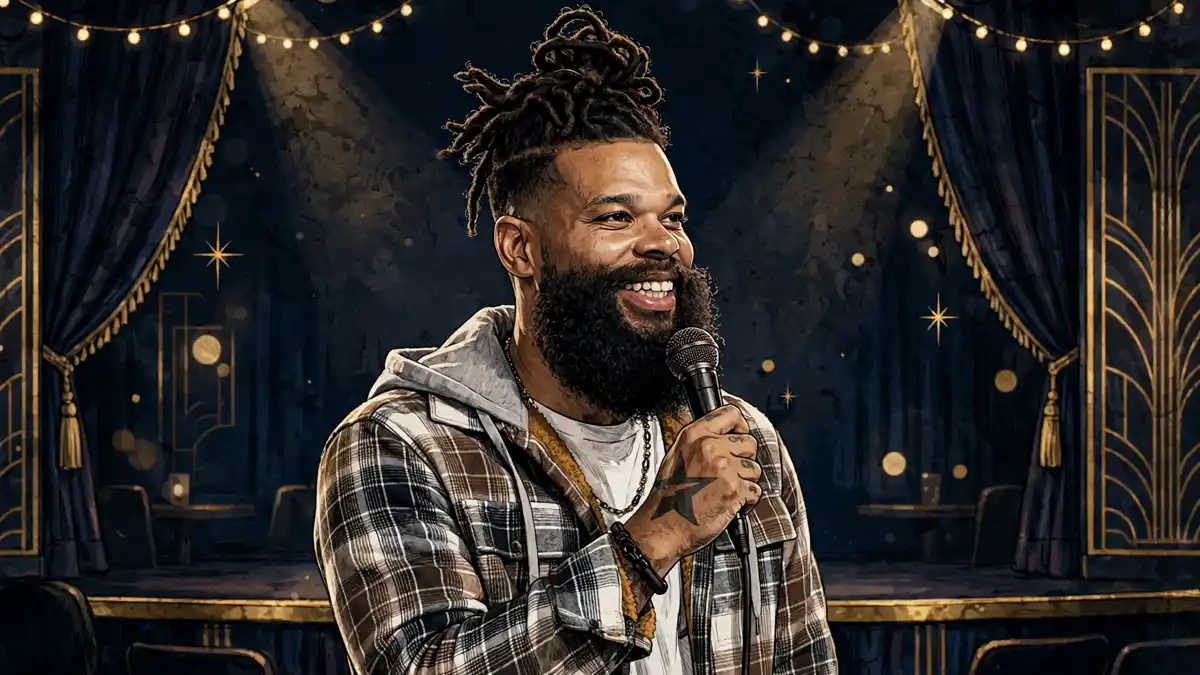
Damon Darling‘s net worth is estimated at $2 million to $5 million as of November 2026. The Ohio stand-up comedian and creator built it without a television break, a film franchise, or a record deal: first on oil rigs and factory floors, then on TikTok with his “Got a Dollar?” street clips, then on comedy-club stages across the United States, and since 2025 with his own coffee brand, Meemaw Fuel Coffee. Celebrity Net Worth puts the figure at $2 million, the most widely repeated estimate in the field, while several other trackers stretch the same career to $5 million. The honest answer sits inside that range, and the spread itself tells a story about how little hard financial data exists for an independent touring comedian.
Damon Darling: Quick Facts
| Estimated net worth | $2 million (range: $2 million to $5 million) |
|---|---|
| Profession | Stand-up comedian, content creator, entrepreneur |
| Nationality | American |
| Born | Urbana, Ohio (birth year reported as 1986 or 1987; exact date not confirmed by a primary source — age about 39–40 in 2026) |
| Height | Not publicly confirmed |
| Primary income sources | Live comedy touring, social media advertising and creator revenue, merchandise, brand partnerships, Meemaw Fuel Coffee |
| Active years | 2018–present (stand-up); posting video online since the early 2020s |
| Last reviewed | November 2026 |
- Early Life and Background
- Education
- Career Journey
- Rise to Fame
- Main Sources of Income
- Salary and Earnings
- Businesses and Investments
- Brand Deals and Sponsorships
- Houses, Cars and Other Assets
- Awards and Achievements
- Net Worth Growth Over the Years
- Social Media Presence
- Personal Life
- Sources & Reporting
- Frequently Asked Questions
- Final Thoughts
Early Life and Background
Damon Darling grew up in Urbana, Ohio, a small city about 45 miles west of Columbus, and the town still frames almost everything he talks about on stage: shift work, tight money, church, family, and the particular humor of people who have to laugh because the alternative is worse. His mother raised five boys on her own while working as a nurse, according to a 2026 profile by LA Story, and Darling has said on podcasts that growing up poor — and, as one of very few Black children in his neighborhood, feeling visibly different — shaped both his insecurity and his comic timing. He learned early that a joke could defuse a room, win over strangers, and buy a little social room to breathe.
His twenties were rough in ways he does not soften on stage or in interviews. Darling has spoken openly about alcohol addiction that cost him stability and, for a stretch, his housing; a 2023 appearance on the Locked In with Ian Bick podcast traced the spiral back to the poverty of his childhood, and a 2026 testimony video repeats the arc in plain terms — from living in his car to rebuilding his family life. He has said the turning point was sobriety: he marks ten years sober in December 2025, a date repeated across multiple 2026 profiles, which puts the start of his sobriety in December 2015. That date matters to the money story, because it predates his comedy career by more than two years. The discipline that later let him post daily, tour relentlessly, and run a small business was built first in recovery, not in show business.
Before comedy, Darling worked the jobs his hometown offered. Profiles consistently list oil-rig work, industrial labor, and a stint as a correctional officer, sometimes described as a prison guard. The oil-rig detail has since hardened into a persona — hard hat, work boots, blue-collar punchlines — and it has also generated the most repeated misunderstanding about him: Darling worked on oil rigs; he never owned one, and no reporting ties him to any ownership stake in the oil and gas industry. The distinction matters because several net-worth blogs imply an energy fortune that does not exist. His money came after he left those jobs, not from them.
One more early-life fact needs the same care. Darling’s exact birth date is not settled in public sources. Some trackers give January 28, 1986; others give January 28, 1987; at least one gives November 4 with no year. His age is therefore reported here as about 39–40 in 2026, and his height is not stated at all, because no reliable source confirms it. A profile that prints a confident birthday and height for Darling is guessing, and this one will not.
Education
Darling attended local schools in Urbana, according to biographical profiles, and no college, university, or formal comedy training appears in any credible account of his life. That absence is itself part of the story: his training ground was not a classroom but the night shift, the rig, the correctional facility, and later the open-mic list at a Dayton comedy club. Where other comedians cite improv schools or university comedy societies, Darling cites work. His material draws on the same well — the authority of someone who has actually clocked in, been broke, and been laughed at — and audiences recognize the difference between a performed blue-collar bit and a lived one.
It is worth being precise about what “no formal education on record” does and does not mean. It does not mean Darling is uneducated about his craft; his crowd work, which depends on reading a stranger in seconds and steering a conversation toward a laugh without humiliating anyone, is a skill most trained performers never master. It means only that no institution claims him, and no profile should invent one. His real education, by his own telling, was sobriety, fatherhood, and eight years of stage time.
Career Journey
Darling took the stage for the first time at 31 years old, at an open mic at Wiley’s Comedy Club in Dayton, Ohio, in 2018. That late start is the single most unusual fact in his career, and the one competitors most often rush past. Most stand-ups who headline nationally began in their late teens or early twenties and spent a decade failing upward through the club system. Darling began after addiction, after marriage, after children, and after a decade of manual labor — which meant he arrived with a finished life to talk about rather than a persona still being assembled. The trade-off was time: he had less of it, and he spent the next years making up the difference with volume.
The early club years were, by every account, unglamorous. He performed in small Ohio rooms, often for little or no pay, building a set out of his own biography: the rigs, the drinking, the recovery, the marriage, the kids. He launched a YouTube channel under the Damon Darling TV name in 2014, per one profile, but the channel only found its audience years later, once short-form video gave his street material a distribution system that clubs never could. The pandemic-era shift to phone-shot video was the break his club career alone would not have delivered: a 60-second clip could reach more people in a day than a year of weekend sets.
By the mid-2020s the two tracks had merged. Online clips drove ticket sales, and ticket sales proved to clubs that the online numbers were real people who would pay to sit in a room. Venue listings from 2026 show the result: a working headliner routing through Funny Bone clubs, Helium clubs, City Winery rooms, and independent theaters, with multi-night stands and couple’s-package upsells — the infrastructure of a comedian who no longer needs to explain who he is to a booker. He had opened for bigger names earlier in the climb, according to Helium’s venue copy, and by 2026 he was the name on the marquee.
Darling’s career also includes a deliberate second act inside the first one: philanthropy as content. His best-known clips do not end on a punchline aimed at a stranger; they end on generosity — handing over cash, paying for groceries, turning a prank setup into a kindness payoff. That format, repeated hundreds of times, built an audience that trusts him in a way pure prank creators rarely achieve, and it gave brands and venues a reason to book a “prank comedian” without worrying about the next headline. It also gave him a story that television could not have manufactured: a man who once needed help now films himself giving it.
Rise to Fame
The engine of Darling’s fame is a single, endlessly repeatable format: “Got a Dollar?” He approaches a stranger, asks for a dollar, and lets the interaction go wherever it goes — sometimes a joke, sometimes a conversation, sometimes a gift in the other direction. The series, also written “Gotta Dollar?” in some profiles, is the bit most profiles name first, and for good reason: it compresses everything that makes Darling watchable into under a minute. He is disarming rather than confrontational, quick rather than cruel, and the stranger is a collaborator rather than a target. One profile puts the series’ combined views above 700 million; his own promotional copy has claimed more than 500 million views and 4.5 million followers; a 2026 ticketing page pushes the totals to 13 million followers and more than 1 billion views. Those numbers cannot all be true at the same time, and the honest reading is that they were captured at different moments, on different platform combinations, with followers and video likes sometimes counted interchangeably. The direction of travel is unambiguous even if the exact total is not: up, fast, and sustained across TikTok, Facebook, Instagram, and YouTube at once.
What made the format spread was not production value — it has almost none — but recognition. Viewers saw their own towns, their own gas stations, their own awkward encounters with strangers, and a comedian who treated ordinary people with a warmth that the prank genre had trained them not to expect. The algorithm rewarded completion and sharing; the audience rewarded the feeling that the joke was never on the stranger. Darling then converted that attention the hard way, by touring: every viral clip ended, in effect, with an invitation to a room where the same energy happened live, with crowd work that could not be faked in editing.
Two 2026 episodes show how the fame now works. In April 2026, a clip of Darling walking up to a police officer and asking him to check whether he had any warrants went viral, ending — as his clips tend to — without a sting. And in 2026, according to Elevar Magazine, Darling was banned for life from an Ohio Walmart after staff said he had repeatedly violated store policy through disruptive filming. Both stories, true or not in their details, describe the same tension: a creator whose act depends on filming in public places will eventually collide with the places being filmed. The Walmart story is reported by a single outlet and should be read as reported, not confirmed, but it captures a real cost of his format that no earnings table shows.
Crucially, Darling’s rise involved no talent-show moment. One profile states the point explicitly — his fortune did not come from a lucky break on a talent show — and no record of an America’s Got Talent appearance or similar television launch exists for him. Searchers who assume a TV break are confusing him with other viral comedians. His break was the phone in his own hand.
Main Sources of Income
Darling’s income arrives through five channels, and their order matters: live touring first, social and creator revenue second, merchandise third, brand partnerships fourth, and his coffee business fifth and rising. That ranking is the opposite of what a casual follower might guess. The phone made him famous, but the room pays him. A comedian who can fill a 200-seat club for two shows a night, several nights a week, for most of the year, earns more from ticket splits and guarantees than from any single platform’s ad pool — and he keeps a larger share of it than a creator dependent on one algorithm.
Touring is also the most durable channel. A TikTok account can be throttled, a platform can change its payout, and a format can tire; a mailing list of people who have already paid to see a comedian live survives all three. Darling’s 2026 calendar — Funny Bone clubs in Des Moines and Kansas City in November, Helium in St. Louis the same month, Funny Bone Orlando in December, City Winery Atlanta in October — reads like a headliner working the proven club circuit rather than chasing one-off viral spikes. The venues are mid-size rooms where a sold-out weekend is both plausible and profitable, and where the two-item minimums and couple’s packages add per-head revenue beyond the ticket itself.
Social revenue is the second leg, and it works in two directions at once: platforms pay for views, and views sell tickets. A 2026 estimate by LA Story puts his annual social-media monetization at roughly $163,000 to $224,000, based on engagement metrics and platform payout rates. That is a modeled figure, not a disclosed payout, and it should be read as a floor for the digital side rather than a total: it excludes brand deals, ticket conversions, and merchandise clicks that the same videos generate. Its value is that it anchors the digital income in six figures without pretending to precision no one has.
Merchandise and direct sales form the third leg. Darling sells branded goods tied to his catchphrases and persona through his own storefront, the model every touring comedian now depends on, because a T-shirt sold after a show carries a margin no platform takes a cut of. One profile also associates him with Dope Clothing, though the nature of that association — partnership, collaboration, or simple endorsement — is not documented in reliable reporting, so it is noted here rather than asserted as a business stake. The coffee brand, covered below, is the attempt to turn that direct-sales muscle into something that sells while he is asleep.

Salary and Earnings
Darling has no publicly disclosed salary, per-show guarantee, or annual earnings statement, and any article that prints one as fact is inventing it. What can be established is the shape of the money: ticket prices, room sizes, and the modeled platform income above. That shape is enough to test the net-worth range without fabricating a paycheck.
Ticket prices for his 2026 dates cluster in the club-comedian band. City Winery Atlanta listed tickets from $36 in October 2026; Funny Bone Orlando listed $48 to $203 for December 5, 2026; Vivid Seats listed his tickets starting around $33, with resale and premium listings running far higher — one resale aggregator showed figures in the hundreds for prime seats, which reflect secondary-market markups rather than what Darling or the venue charges. A headliner at this level typically works on a guarantee plus a share of ticket sales after costs, or a straight door split; the exact split is a private negotiation between Darling, his agent, and each room. What the prices prove is that he is priced as a proven club headliner, not a local opener and not an arena act. Multiply a $40 average ticket by a few hundred seats across multiple shows per weekend, across a touring year, and the touring gross reaches seven figures before costs — and costs are heavy: travel, lodging, an opener, a merch seller, agency commission, taxes, and the content operation that keeps the clips flowing between dates.
That arithmetic is why the $2 million to $5 million range is plausible and the $15 million to $17 million claims are not. To be worth $15 million, Darling would need either arena-level touring income, a major brand or television deal, a valuable business sale, or a large investment portfolio — and no reporting shows any of those. His documented assets are a touring business, a young coffee brand with undisclosed revenue, and a content library. Those are real and growing, but they are not $15 million assets in 2026. The lower end of the range, $2 million, fits a comedian a few years into national headlining with a young business; the upper end, $5 million, fits the same comedian after a strong touring year plus a coffee brand that found its audience. Either way, the number is an estimate built from career shape, not a balance sheet.
One more earnings point deserves emphasis because competitors skip it: Darling’s early years paid almost nothing. Open mics pay nothing, small clubs pay little, and the first years of posting pay less than the time they consume. His wife, by his own telling, paid the household bills while he built the career — a fact repeated across profiles and central to his public story. The fortune, such as it is, is back-loaded: most of it was earned in the last three to four years, not spread evenly across his life. That back-loading also explains why older estimates sit lower — $500,000 to $1 million in a 2025 profile, $1.5 million to $3 million in another — and why the 2026 consensus moved up. The money followed the audience, and the audience arrived late.
Businesses and Investments
Meemaw Fuel Coffee is Darling’s only documented business, and it is the most interesting line in his financial story because it is the first one that could outlive his touring schedule. Founded in 2025, according to multiple 2026 profiles, the brand is tied to his comedy persona and to the mother and grandmother figures he credits with shaping him — “Meemaw” being the family name for a grandmother in much of the American South and Midwest. It sells coffee direct to consumers, the standard creator-brand playbook: an audience that already trusts the person buys a consumable product with repeat-purchase potential, and every bag sold carries a margin that a T-shirt or a ticket does not repeat.
What is not known about Meemaw Fuel Coffee matters as much as what is. The company is privately held, and no revenue, profit, valuation, ownership split, or retail distribution deal has been disclosed. Profiles describe it as a going concern with an online storefront, not as a funded startup or a national retail brand. Any valuation attached to it in a net-worth total is therefore speculative, and this estimate treats it conservatively: as a promising small business with real brand equity and unproven scale, worth something but not the millions a national coffee launch would imply. If the brand lands retail distribution or a major wholesale deal, the upper end of Darling’s range becomes easier to defend; until then, it is potential, not proof.
Beyond coffee, no investment portfolio, property company, or second business is documented for Darling. He is not reported as an angel investor, a franchise owner, or a real-estate investor, and no stock, crypto, or business-sale windfall appears in any profile. That absence is normal for a touring comedian at his stage: the business is himself, the asset is the audience, and the investment is the next tour. Competitors that pad his portfolio with generic “investments and real estate” language are filling space, not reporting facts.
The one business-adjacent question that does arise is the Dope Clothing association mentioned by one biography site. Without a press release, a storefront listing, or a statement from either party, this article records the association as reported by a single low-authority source and does not count it as a revenue stream. If a partnership is later documented, it belongs in the brand-deals section below, not in a valuation.
Brand Deals and Sponsorships
Darling’s brand work follows the creator pattern rather than the celebrity-endorsement pattern: no national television campaign, no seven-figure shoe deal, no car commercial has been reported. Instead, his commercial value lies in sponsored social content and venue-linked promotions — the kind of deals where a brand pays for access to an audience of millions that trusts the creator’s voice, in short bursts, across TikTok, Instagram, and Facebook. Rates for creators at his follower level commonly run into five figures per sponsored post or package, but no specific Darling deal or fee has been disclosed, and this article does not invent one.
The structure of his content helps and hurts him with brands in equal measure. The “Got a Dollar?” format is inherently brand-safe in its payoff — kindness, humor, ordinary people — which makes it easy for family-friendly advertisers to sit next to. The filming-in-public element, by contrast, is a compliance headache for any brand that needs location releases and controlled environments. The reported 2026 Walmart ban, if accurate, is the cautionary version of that tension. The net effect is a brand portfolio that is real but modest, and that is exactly how this estimate treats it: a supporting income line, not a fortune-maker.
Touring sponsorships and venue promotions add a second, smaller brand layer. Comedy clubs promote headliners with package deals — the Helium St. Louis listing’s couple’s package, with premium seats and a food-and-beverage credit, is a typical example — and those packages raise per-head revenue for the room and, through the headliner’s split, for Darling. Ticketing platforms also monetize his name through resale and affiliate listings, though that revenue flows to the platforms, not to him. The distinction is worth keeping straight when reading inflated earnings claims: a $869 resale listing is not Darling’s paycheck.

Houses, Cars and Other Assets
No property record, mortgage filing, or verified home purchase has been published for Darling, and this article will not assign him a house, a city, or a price tag on the basis of a tour stop. He is from Urbana, Ohio, and his touring base is the American club circuit; where he lives now, and whether he owns or rents, is not a matter of public record. Profiles that describe an Ohio mansion or a luxury property portfolio for Darling are inventing the asset class most net-worth articles use as padding. His visible assets are the ones his own content shows: vehicles, merchandise stock, coffee inventory, and the content library itself.
On vehicles, the record is anecdotal rather than documentary. A 2026 testimony video describes him going from living in his car to owning multiple vehicles, and one profile notes that he gave his wife a Tahoe as a Christmas gift. Both are consistent with a touring comedian’s life — reliable cars matter when the job is driving between clubs — but neither is a title, a registration, or a purchase price, and they are reported here as his own account and a fan-community report respectively, not as a verified garage inventory. The honest summary is that Darling’s lifestyle now includes the comfortable, unflashy markers of a working headliner — family cars, travel, the ability to give generously on camera — without the supercar collection or property empire that higher net-worth claims imply.
The most valuable asset Darling owns may be the least visible: his video library. Hundreds of clips, some with tens of millions of views, continue to earn advertising revenue and to convert new viewers into ticket buyers long after they were posted. Unlike a house, that library cannot be appraised from a public record, but its earning power is real and compounding. It is also fragile in a way property is not — a platform policy change or an account problem could dent it overnight — which is one more reason the coffee brand and the touring business matter: they diversify an income that began as pure platform dependence.
Awards and Achievements
Darling has no major industry award — no Emmy, Grammy, or televised comedy prize — on the public record, and claiming one would be fabrication. His achievements are measured in the currencies of his field: audience, rooms, and longevity. The milestones that can be documented are a national headlining tour under the “Nobody’s Perfect” banner, a second touring brand, “Having It Large,” on the road in early 2026 according to Briefly News, multi-night stands at established clubs including Funny Bone and Helium rooms, and a social audience measured in the millions across four platforms with hundreds of millions of views. For a comedian who started at 31 with no industry connections, those are substantial achievements, and they are the reason the touring income exists at all.
Two less formal achievements belong in the same list. The first is ten years of sobriety, reached in December 2025, which Darling himself treats as the foundation of everything else; audiences treat it the same way, and it is the reason his recovery story carries weight rather than sounding like a routine. The second is the format itself: “Got a Dollar?” is one of the few prank formats that improved the genre’s reputation rather than exploiting it, and its imitation by other creators is a backhanded measure of its success. Neither comes with a trophy, and both are worth more to his earning power than a trophy would be.
Net Worth Growth Over the Years
The published estimates for Darling trace a steep, late curve, and the curve itself is evidence about how his career actually unfolded. The table below collects the figures as reported, with the source type noted, so readers can see which numbers carry weight and which are echoes.
| Year | Reported estimate | What it reflects |
|---|---|---|
| 2024 | About $2 million | Early national-touring estimates; the figure most trackers still cite |
| 2025 | $1.5 million to $3 million | Conflicting tracker ranges during his breakout touring year; one profile gave $500,000 to $1 million |
| 2026 | $2 million to $5 million | Current consensus; Celebrity Net Worth anchors at $2 million, several trackers reach $5 million |
| 2026 (outliers) | $15 million to $17 million | Unsourced claims on low-authority blogs; no deal, sale, or asset supports them — discounted here |
Read the table as a story, not a bank statement. The 2024 to 2026 rise matches the touring record: club headliner to national headliner, single-platform clips to a four-platform audience, no business to a coffee brand. The 2025 disagreement — $500,000 at the low end, $3 million at the high — shows trackers guessing at different moments in the same climb, with different assumptions about tour income. The 2026 outliers show what happens when a guess gets copied without its caveats: a number with no source behind it acquires authority purely by repetition. This article’s range, $2 million to $5 million, keeps the anchor that has survived the most scrutiny and the ceiling that the touring and business record can support, and no more.
What would move the number next is also clear. A documented television special, a streaming deal, a retail rollout for Meemaw Fuel Coffee, or a theater-level tour — rooms of 1,000 seats rather than 200 — would each justify revising the range upward. A year off the road, a platform ban, or a failed product launch would push it the other way. As of November 2026, none of those triggers has been reported, and the range stands.
Social Media Presence
Darling’s audience is spread across four platforms, and the counts differ by source because they were taken at different times and sometimes mix followers with likes. The most specific recent breakdown comes from Celebrity Net Worth, which reported in August 2026 roughly 3.4 million followers on TikTok, more than 5 million on Facebook, and roughly 2.6 million on Instagram, for more than 10 million combined. Elevar Magazine, writing in September 2026, gave a lower TikTok figure of 2.7 million and a combined view count above 700 million. His own promotional copy has claimed more than 4.5 million followers and 500 million views. A 2026 ticketing page claimed 13 million followers and more than 1 billion views, and a Helium venue page cited more than 18 million TikTok likes — likes, not followers, being the larger number by design. None of these is “wrong” in isolation; together they describe an audience somewhere in the high single millions to low teens of millions, depending on what is counted and when.
The platform mix matters to the money. Facebook’s older, broader audience converts well to club ticket buyers; TikTok’s younger audience drives discovery and clip velocity; Instagram sits between the two; YouTube, where his Damon Darling TV channel carries longer crowd-work and stand-up clips, pays the best per view and hosts the library that keeps earning. A creator diversified across all four is harder to hurt with a single algorithm change than one dependent on a single feed, and Darling’s income reflects that resilience. His handle across platforms is built around the Damon Darling TV name, and his official site promotes the tour directly, cutting out the middleman for his most valuable transaction: the ticket.
One caution applies to every follower count in this section. Follower totals are marketing numbers, not audited circulation, and they are routinely inflated by inactive accounts, duplicates, and platform recounts. They are useful here as a relative measure — Darling’s audience is large, multi-platform, and still growing in 2026 — and unreliable as an input to any precise earnings formula. Any net-worth article that converts followers to dollars with a fixed multiplier is performing arithmetic, not reporting.
Personal Life
Darling is married, and his wife is the person he credits most often for his career existing at all. By his own telling, she paid the household bills while he worked open mics for nothing, held the family together through his drinking years, and stayed through the rebuild. That story is consistent across profiles and across his own videos, and it is the emotional core of his stage act: a man who knows exactly who carried him, saying so in public, repeatedly.
The details beyond that core are where reporting gets messy, and honesty requires saying so. Most profiles name his wife Stephanie Nicole Darling; at least one major biography site, Briefly News, names her Amanda Darling instead. Most profiles that count his children describe three sons; Legit.ng, in a 2026 profile, says five children and a tenth wedding anniversary in May 2026. A separate 2026 article notes nine years of marriage in May 2025, which would also point to a 2016 wedding. These accounts cannot all be reconciled from public sources, and Darling himself keeps his family largely off camera — his wife appears as a voice or a partial figure rather than a public personality, and his children are kept out of the frame. The responsible summary is this: Darling is married, a father, and private about his family’s details, and the exact names and numbers in circulation should be treated as reported rather than settled. Any profile that prints one version without noting the conflict is choosing convenience over accuracy.
His faith is a public part of his identity in a way his family details are not. Profiles describe him as a God-fearing comedian whose material stays clean enough for family audiences, and his testimony videos frame sobriety and success as acts of faith. That positioning is commercially significant as well as personal: clean, faith-friendly comedy plays rooms and audiences that edgier acts cannot, and it keeps his brand partnerships in family-safe territory. He also uses the platform for giving — the kindness payoffs in his clips, and, according to his testimony video, financial help to others and support that allowed him to retire his mother. The retirement claim comes from his own testimony account rather than a financial record, and it is reported here on that basis.
Sources & Reporting
Celebrity Net Worth — the $2 million anchor figure; August 2026 follower breakdown (TikTok ~3.4M, Facebook 5M+, Instagram ~2.6M); Meemaw Fuel Coffee as a business line. Reporting window: profile updated 2026.
Tuko.co.ke — the $2 million to $5 million range; Meemaw Fuel Coffee founded 2025; the “Got a Dollar?” series; the oil-rig correction (former worker, not owner). Reporting window: 2026.
Legit.ng — $2 million estimate; marriage and five-children account; tenth anniversary in May 2026; February 2026 “My Wife’s First Prank” video. Reporting window: 2026.
LA Story — born 1986 in Urbana; mother raising five boys as a nurse; oil-rig, industrial and correctional work; homelessness and addiction account; 2023 Ian Bick podcast quote; modeled $163,000–$224,000 annual social income; April 2026 police-officer clip. Reporting window: 2026.
Elevar Magazine — Dayton-area upbringing; first open mic at Wiley’s at 31 in 2018; 2.7M TikTok followers and 700M+ views; the $5 million to $17 million range (reported here and discounted as unbacked); 2026 Ohio Walmart lifetime-ban report. Reporting window: September 2026.
Briefly News — “Having It Large” tour on the road in January 2026; sobriety beginning 2015; the conflicting “Amanda Darling” spouse name; poverty and fitting-in account from the Ian Bick interview. Reporting window: 2026.
Vivid Seats — 2026 tour routing (City Winery Atlanta, Funny Bone clubs); ticket prices starting around $33; 13M+ followers and 1B+ views promotional totals. Reporting window: 2026 listings.
Bandsintown — City Winery Atlanta October 17, 2026 and Funny Bone Des Moines November 12, 2026 dates; 500M+ views and 4.5M followers promotional totals. Reporting window: 2026 listings.
Helium Comedy Club St. Louis — November 18–19, 2026 dates; couple’s package pricing; “opened for some of the biggest names” and headlining-tour copy; 18M+ TikTok likes. Reporting window: 2026 listings.
Outlets consulted and discounted: WorthEva, Belle de Couture, Asap Land, Marco Republic, Shani Levni, Aura Expose, Planet News Update, My Magazine Hub and Republic Magazine — tracker estimates in the $500,000 to $15 million span, used here only to show the spread of published guesses, not as anchors. No primary financial document (filing, contract, or sale record) for Darling was located; every money figure in this article is therefore labeled an estimate, and the $15 million to $17 million claims are explicitly not adopted.
Frequently Asked Questions
What is Damon Darling’s net worth in 2026?
Damon Darling’s net worth is estimated at $2 million to $5 million in 2026. Celebrity Net Worth, the most widely cited tracker, puts it at $2 million. Claims of $15 million to $17 million circulate on low-authority blogs but have no deal, sale, or asset behind them, so this article does not adopt them.
How did Damon Darling make his money?
Through live stand-up touring first, then social media advertising and creator revenue, merchandise, brand partnerships, and since 2025 his Meemaw Fuel Coffee brand. Before comedy he worked oil rigs, industrial jobs, and as a correctional officer — he earned his fortune after leaving those jobs, not from owning any of them.
What is Damon Darling famous for?
His “Got a Dollar?” street series, in which he asks strangers for a dollar and turns the encounter into a joke, a conversation, or an act of kindness. The clips, spread across TikTok, Facebook, Instagram, and YouTube, built the audience that now fills his comedy-club tours.
How old is Damon Darling?
About 39–40 in 2026. Sources disagree on his birth year — some give January 28, 1986, others January 28, 1987, and one gives November 4 with no year — so no exact birth date is confirmed here. He began stand-up at 31, with his first open mic at Wiley’s Comedy Club in Dayton in 2018.
Is Damon Darling married?
Yes. He credits his wife with paying the household bills while he built his comedy career and with standing by him through addiction and recovery. Profiles differ on her full name and on the couple’s number of children, and Darling keeps his family largely off camera, so this article reports those details as disputed rather than settled.
Does Damon Darling own an oil rig?
No. He worked on oil rigs before comedy, and the blue-collar persona comes from that experience, but no reporting ties him to ownership of a rig or any stake in the oil and gas industry.
What is Meemaw Fuel Coffee?
A coffee brand Darling founded in 2025, named for the grandmother figures in his life and sold direct to consumers online. It is privately held and its revenue has not been disclosed, so it is counted here as a promising small business with unproven scale, not as a valued asset.
Is Damon Darling still touring in 2026?
Yes. His 2026 calendar includes City Winery Atlanta in October, Funny Bone clubs in Des Moines and Kansas City and Helium in St. Louis in November, and Funny Bone Orlando in December, under his “Nobody’s Perfect” tour banner, with club tickets generally starting in the $33–$48 range.
Final Thoughts
Damon Darling’s fortune is best understood as a late, hard-earned, still-growing one. He did not inherit it, win it on television, or strike it in energy. He earned it the slow way — sobriety first, then an open mic at 31, then years of small rooms, then a phone format that finally let the rooms find him — and the $2 million to $5 million range reflects exactly that shape: a working headliner with a real audience, a real tour, and a young business, rather than a mogul. The inflated $15 million figures say more about how net-worth blogs copy each other than about Darling’s bank account, and the low early estimates say more about how recently the money arrived than about its current size.
What happens next depends on the same three levers that built the range: whether the tour grows from clubs into theaters, whether Meemaw Fuel Coffee grows from a creator storefront into a retail brand, and whether the audience that found him on a phone keeps buying tickets in a room. Any one of those breaking upward would justify a higher estimate; none has yet been documented. Until then, $2 million anchored, $5 million at the optimistic end, and a career that is still the most interesting part of the story, is the honest account — and it is, for a man who once lived in his car, a remarkable one on its own terms.
Published on November 1, 2026. Last reviewed November 2026. Found an error? See our corrections policy.