
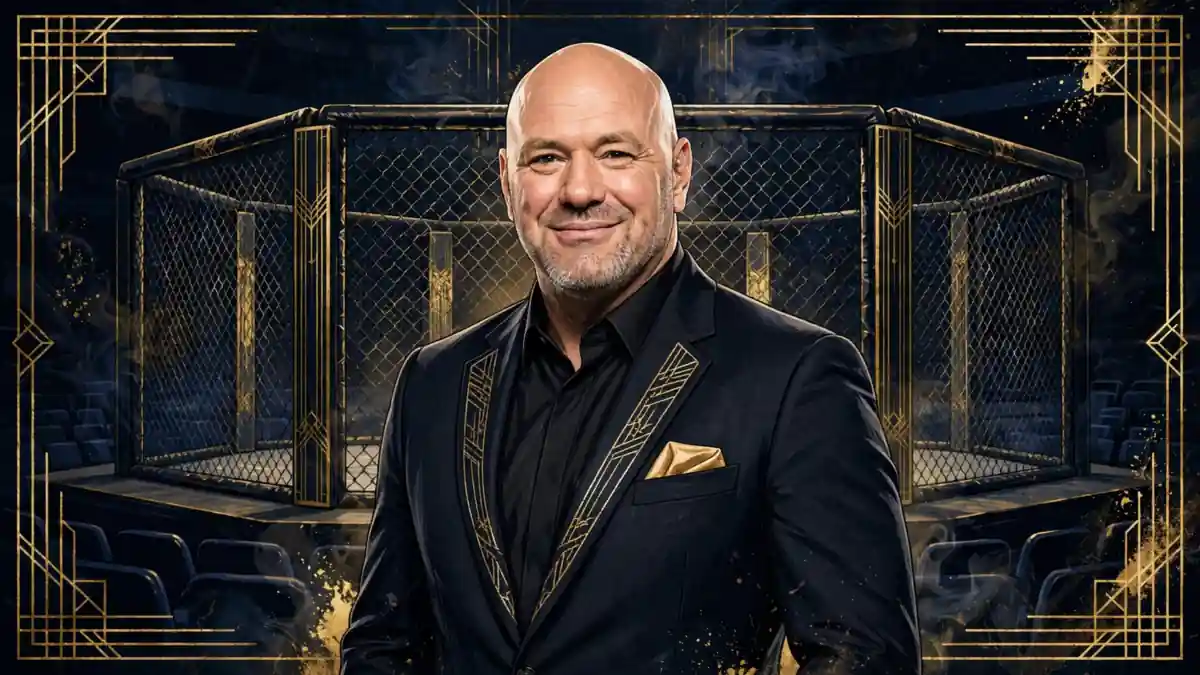
Dana White‘s net worth is estimated at $500–600 million as of November 2026. The fortune traces to one decision above all others: in January 2001, White persuaded his childhood friends Frank and Lorenzo Fertitta to buy a failing fight promotion for $2 million, took a minority stake as its president, and spent the next 15 years turning it into a business that sold for $4.025 billion. Since then he has kept earning at the top of the sport — a reported salary of around $20 million a year as UFC chief executive, a seat on Meta’s board, and new ventures in slap fighting and boxing — while spending with a freedom that has made his blackjack sessions almost as famous as his fight cards.
Dana White: Quick Facts
| Estimated net worth | ~$550 million (range: $500–600 million) |
|---|---|
| Profession | Sports promoter and businessman; president and CEO of the UFC |
| Nationality | American |
| Born | July 28, 1969 (age 57) |
| Height | 5’10” (178 cm) |
| Primary income sources | UFC executive compensation, 2016 UFC sale proceeds, Power Slap, Zuffa Boxing, Meta board compensation |
| Active years | 2001–present |
| Last reviewed | November 2026 |
- Early Life and Background
- Education
- Career Journey
- Rise to Fame
- Main Sources of Income
- Salary and Earnings
- Businesses and Investments
- Brand Deals and Sponsorships
- Houses, Cars and Other Assets
- Awards and Achievements
- Net Worth Growth Over the Years
- Social Media Presence
- Personal Life
- Sources & Reporting
- Frequently Asked Questions
- Final Thoughts
Early Life and Background
Dana Frederick White Jr. was born on July 28, 1969, in Manchester, Connecticut, to June and Dana White Sr. He is of Irish descent, and his sister Kelly shared a childhood shaped mostly by their mother and her family. His mother worked as a nurse, and when White was in third grade the family moved to Las Vegas, where nursing paid better wages. That move, made for a practical reason, put the future UFC boss in the city where he would eventually build his empire — and where, decades later, he would buy up a whole corner of a gated neighbourhood and rebuild it to his own design.
White spent part of his youth in Ware, Massachusetts, and attended Bishop Gorman High School in Las Vegas, where he first met Lorenzo Fertitta. The two were not close friends at school; the friendship that would change combat sports formed years later, after a chance reunion. What school did give White was boxing. He started boxing at 17, and through the gym he met former Golden Gloves champion Peter Welch, a relationship that pulled him toward the fight business for good. He has often described boxing as his first love, a detail that matters now that he is back in the sport as a promoter with Zuffa Boxing.
After leaving school, White worked the kind of jobs that leave no paper trail of wealth: bouncer, bellman, road paver. He started a boxing gym in Boston with Welch and taught boxercise classes — boxing drills set to aerobics — aimed partly at keeping local kids off the street. The classes taught him two things that would matter far more than any punch he threw: how to sell a room full of people on an idea, and how to run a small business week after week. He decided against turning professional himself after seeing a punch-drunk boxer and worrying about the same damage, a decision that redirected his ambition from the ring to the business around it.
The reunion that changed everything came at a mutual friend’s wedding, where White reconnected with Lorenzo Fertitta after roughly a decade without speaking. By then White was managing fighters, including future UFC Hall of Famers Tito Ortiz and Chuck Liddell, whom he had met training jiu-jitsu under John Lewis in Las Vegas alongside the Fertitta brothers. When White learned that Semaphore Entertainment Group owner Bob Meyrowitz was looking to sell the UFC, he called Lorenzo. Within weeks, the Fertittas had a deal on the table.
Education
White graduated from Hermon High School in Maine in 1987. He started college twice — once at Quincy College and once at the University of Massachusetts Boston — and left during his first semester both times. There is no degree, no business-school credential, and no apprenticeship on his record. His education in the fight business came from gyms, not classrooms: running boxercise classes in Boston and Las Vegas, managing fighters, and sitting in on the economics of small promotions where a bad gate meant nobody got paid.
That gap in formal education is part of the story, not a footnote to it. White’s pitch to the Fertittas was not a spreadsheet exercise; it was a fighter manager telling two casino heirs that a banned, debt-ridden promotion could be rebuilt as a regulated sport with television money behind it. Lorenzo Fertitta brought the casino-industry discipline and the Nevada regulatory contacts — he had served as a commissioner of the Nevada State Athletic Commission — and White brought the fight-world credibility and the willingness to be the public face. The combination, not any single credential, is what the $2 million bought.
Career Journey
White’s working life divides cleanly into three acts. Act one, roughly 1987 to 2000, is the gym years: boxercise coach, gym operator, and then manager of Ortiz and Liddell, two fighters who would become early UFC stars. Managing fighters taught him the sport’s central economic problem at the time — talent had no reliable stage, and the stage had no reliable money. Act two, 2001 to 2016, is the Zuffa build: president of a company that lost money for years, then became the dominant force in mixed martial arts. Act three, 2016 to the present, is the harvest and the second build: a nine-figure sale payday, a long executive contract, a public listing through TKO Group Holdings, and fresh bets on slap fighting, jiu-jitsu, and boxing.
The January 2001 purchase is the hinge. Lorenzo and Frank Fertitta bought the UFC for $2 million through Zuffa LLC, and White was installed as president with a minority stake reported at the time as 10 percent. What they actually acquired, White has said repeatedly, was little more than the UFC name: the previous owners had sold off assets, the promotion was banned from pay-per-view in many places, and it carried the public reputation of “human cockfighting” — a phrase Senator John McCain had used in his campaign against it. Cable operators would not carry it, advertisers would not touch it, and state athletic commissions would not sanction it.
The turnaround took regulation first and television second. Zuffa worked state by state to get mixed martial arts sanctioned under unified rules, with weight classes, rounds, gloves, and drug testing — the unglamorous groundwork that made the sport insurable and broadcastable. The company bled money through those early years; the Fertittas have said they came close to walking away. Then came the bet that saved it. In 2005, with the company reportedly down to its last $10 million, Zuffa put that money into The Ultimate Fighter, a reality series on Spike TV in which aspiring fighters lived together and fought for a UFC contract. The live finale on April 9, 2005 — Forrest Griffin against Stephan Bonnar, a back-and-forth war that ran the full three rounds — drew an audience that surprised even Spike, and the show became the promotion’s shop window. Fighters became characters, characters became stars, and stars sold pay-per-views.
From there the media-rights ladder climbed fast. A Spike TV deal gave way to a seven-year Fox agreement announced in 2011, reported at around $100 million a year. In 2018 the UFC signed a five-year, $1.5 billion deal with ESPN. In August 2025 came the largest step yet: a seven-year, $7.7 billion domestic media-rights agreement with Paramount, taking effect in 2026, putting all 43 annual UFC events on Paramount+ with select events on CBS and ending the traditional US pay-per-view model for most cards. Each step repriced the company — and each step repriced White’s compensation, because his deals were tied to the promotion’s revenue.
The sale that made White rich arrived in July 2016, when a consortium led by WME-IMG (now Endeavor), with Silver Lake, KKR, and MSD Capital, bought the UFC for $4.025 billion — then the largest sale in sports history. White’s stake, reported as 9 percent by then after a 2009 investment by Flash Entertainment diluted the original holders, was worth about $360 million before taxes. ESPN estimated his new five-year contract under the buyers could pay around $18 million a year to start, tied to profits. He stayed on as president, signed a seven-year extension in 2019, and in September 2023 moved with the UFC into TKO Group Holdings, the listed company formed by merging UFC with WWE, where he serves as UFC chief executive. In December 2025 he signed a further five-year extension keeping him in the role through 2031, according to 2026 reporting — a sign that TKO still sees White himself, along with the brand, as part of the asset.
Rise to Fame
White did not become famous as a fighter, and he did not become famous as an owner in the usual sense. He became famous as the sport’s frontman — the bald, profane, straight-talking president who appeared in pre-fight video blogs, announced fights on social media, and argued with critics in public. In a business where promoters had traditionally worked backstage, White made himself the most recognisable executive in combat sports, and that visibility became a commercial asset: his announcements moved tickets, his feuds generated coverage, and his presence at a press conference guaranteed cameras.
The second engine of his fame was Dana White’s Contender Series, launched in 2017, in which prospects fought for UFC contracts in front of White himself, who awarded deals on the spot. The format turned White into a talent-show judge and gave the UFC a year-round pipeline of new names. A third was the Mayweather–McGregor spectacle of August 2017, when White co-promoted the boxing match between Floyd Mayweather Jr. and UFC star Conor McGregor. The fight became one of the richest boxing events ever staged, and it put White, a mixed martial arts executive, at the centre of a boxing story — a rehearsal, in hindsight, for Zuffa Boxing.
Fame also brought scrutiny that other executives avoid. White’s public spats with fighters over pay became a recurring news cycle, sharpened by the UFC’s antitrust litigation, in which court testimony revealed details of the promotion’s business model. In 2023 the UFC agreed to pay $375 million to settle one class-action case brought by former fighters — a figure that said more about the promotion’s economics than any press release. White has consistently defended the UFC’s pay structure, pointing to performance bonuses, a growing roster, and the promotion’s revenue growth. The dispute has not dented his position: TKO kept extending his contract, and the Paramount deal priced the UFC higher than ever.
By 2025, White’s fame had crossed into corporate America. Meta elected him to its board of directors, announced on January 6, 2025, formalising a relationship with Mark Zuckerberg, a noted mixed martial arts fan. Sportico reported his initial Meta grant as 1,999 restricted stock units, worth about $1.28 million at the time. In January 2026, Meta bought the naming rights to the UFC’s Las Vegas production facility, renamed the Meta Apex, under a reported five-year deal. And in June 2026, White staged a UFC card on the South Lawn of the White House as part of America’s 250th anniversary celebrations — the first professional sports event staged there, and an event that no other sports executive could have delivered. Whatever one thinks of the politics, the card was a measure of how far White’s personal brand had travelled from a Boston boxercise gym.
Main Sources of Income
White’s income has never looked like a celebrity’s. There are no film salaries, no record royalties, no fashion lines. The money comes from four streams, in descending order of importance. First, the 2016 sale: roughly $360 million before taxes for his 9 percent stake, the single event that created the fortune. Second, executive compensation: a reported salary of around $20 million a year, with bonuses tied to UFC revenue and pay-per-view performance, paid continuously from 2001 to the present — a stream that, compounded over two decades, rivals the sale itself. Third, equity and board compensation: whatever stake he retained or received in the Endeavor and then TKO eras, plus his Meta restricted stock units. Fourth, his own ventures: Power Slap, Zuffa Boxing, and reported investments in drinks brands.
That mix explains why the estimates disagree. A tracker that counts only the sale proceeds, taxed, plus a decade of salary lands near $500 million. A tracker that also credits TKO equity appreciation, Meta stock, and the value of his venture stakes lands above $600 million. DaveManuel.com’s October 2026 model, which prices the sale proceeds after an assumed 23.8 percent federal capital-gains tax at about $274 million and adds a decade of executive pay, investment returns, and TKO and Meta equity, lands at $514 million, inside a $440–600 million range. Forbes, which does not publish a breakdown, lands above $600 million. The truth sits inside that spread, and it moves with TKO’s share price — which is why a single fixed number would be dishonest.
One more stream deserves a note because it is often misreported: gambling. White is a famous high-stakes blackjack and baccarat player, and his wins and losses are real money, but they are not a business. He has claimed a $26 million baccarat win at Caesars Palace between January and March 2024, and he has also spoken of losing $8 million in a single night during the same run. Neither figure is audited, and neither belongs in a net worth calculation as income. They belong in the story of how he spends — and sometimes loses — the money the UFC made him.
Salary and Earnings
The best-documented salary figure in White’s career is the simplest: around $20 million a year as UFC president and chief executive, a number cited by Parade, Celebrity Net Worth, and multiple business outlets. Some 2026 trackers put total annual compensation at $20–25 million once bonuses and equity awards are included. The figure has been remarkably stable in reporting for a decade, which is itself informative: White’s pay did not jump with each media deal, because much of his upside was already captured in equity and profit-sharing rather than base salary.
Earlier in his career the numbers were smaller and the structure different. MoneyNation’s contemporary analysis of the 2016 sale put White’s UFC salary at $17 million a year by 2016, with lifetime UFC salary earnings of about $142 million since 2001. ESPN’s estimate at the time of the sale put his new deal at roughly $18 million a year to start, tied to profits. Put together, the picture is of an executive who earned roughly $140–200 million in salary and bonuses across the Zuffa and Endeavor years, before tax and before his own spending — a sum that, on its own, would place him among the best-paid sports executives alive, even without the sale.
The sale arithmetic is worth doing slowly, because it is where most profiles get sloppy. Nine percent of $4.025 billion is $362.25 million, matching the widely reported “about $360 million” for White’s share before taxes. After federal capital-gains tax — DaveManuel.com models 23.8 percent, or roughly $86 million — the after-tax proceeds land near $274 million. Some older profiles quote “$360 million after taxes,” which conflates the pre-tax share with the post-tax outcome; the pre-tax figure is the one the reporting supports, and the post-tax figure depends on White’s personal tax position, which is private. Our estimate uses the taxed figure, and it is one reason our anchored number sits below Forbes.
Board pay is a footnote by comparison. White’s Meta grant of 1,999 restricted stock units was worth about $1.28 million when Sportico reported it in January 2025 — meaningful to most people, rounding error in a $550 million fortune. Its importance is strategic, not financial: a Meta directorship puts White inside one of the world’s largest technology companies, and the Meta Apex naming deal shows the relationship flowing back into the UFC’s business. Directors also typically receive annual stock grants, so the Meta position will compound quietly while he holds the seat.
Businesses and Investments
Power Slap is White’s most personal venture. He founded the slap-fighting promotion in 2022 after spotting slap videos from Russia and Poland on Instagram, funding it with $1 million of his own money and, by his own account, $1 million each from the Fertitta brothers, with a further $10 million invested in the first season of its television show, according to Bloody Elbow’s 2025 reporting. The league, in which competitors strike each other across the face in turn, drew criticism over safety and curiosity in equal measure — and it made money from its first event, White has said, with its reality show drawing roughly 50 million YouTube views. Power Slap was folded into the UFC’s Paramount agreement in 2026, giving it distribution alongside the promotion that made White rich. Its value to White personally is undisclosed, and no public filing prices his stake, so we count it as an unpriced upside rather than a number.
Zuffa Boxing is the bigger bet. Announced in March 2025 in partnership with Turki Alalshikh, chairman of Saudi Arabia’s General Entertainment Authority, and backed by TKO Group Holdings and the Saudi entertainment company Sela, the venture applies the UFC playbook — a single league, contracted fighters, centralised promotion — to boxing, a sport White has called broken. Its first numbered event, Zuffa Boxing 01, took place in January 2026 at the Meta Apex in Las Vegas, headlined by Callum Walsh against Carlos Ocampo, and a five-year Paramount+ agreement announced in September 2025 made the platform its exclusive US, Canada, and Latin America home, with selected events eligible for CBS simulcast. SportsPro reported that deal at around $100 million a year for 12 events, with Sela holding 60 percent and TKO 40 percent, and the Saudis paying TKO $10 million a year to run day-to-day operations. White’s personal economics in Zuffa Boxing run through TKO, not a separate disclosed stake, so again the value shows up in TKO’s performance rather than a line item we can price.
UFC BJJ, the promotion’s Brazilian jiu-jitsu league launched in 2025, and the UFC Performance Institute, opened in Las Vegas in 2017, sit in the same category: businesses inside the UFC machine that strengthen White’s position as its chief executive without adding a separately reportable fortune. Outside combat sports, Bloody Elbow’s 2025 survey of White’s investments lists stakes in drinks brands — Howler Head bourbon and the Phorm Energy drink, launched in partnership with Anheuser-Busch and 1st Phorm — alongside Power Slap. None of these stakes is publicly priced, and White has never disclosed what he paid or what they are worth. A profile that assigned them a dollar value would be inventing one.
What can be said with confidence is the shape of the portfolio: one enormous, realised gain (the 2016 sale), one long, well-paid executive career, a listed-company equity position that moves with TKO, a small Meta position, and a set of private venture stakes whose value is real but unpriced. That shape is why the range, not a point estimate, is the honest answer — and why White’s own public line, that he spends freely and does not expect to reach billionaire status, is worth taking seriously. A fortune built on one sale and a salary, however large, grows slowly unless a new equity event arrives.
Brand Deals and Sponsorships
White does not carry endorsement deals in the celebrity sense, and that absence is itself a data point. He is not paid to wear a watch or drink a soda on camera; his commercial value is exercised through the UFC’s sponsorship machine, which he runs, rather than through his own image. The UFC’s sponsor roster — Monster Energy, Crypto.com, and, in the Paramount era, new partners including Polymarket and DoorDash named in TKO’s 2025 annual report — generates revenue for the promotion, and White benefits through his compensation and equity, not through a personal cheque from each brand.
The closest White comes to a personal brand deal is the Meta relationship: a board seat, a stock grant, and then a naming-rights deal for the UFC Apex. It is a corporate partnership negotiated between two companies, with White on both sides of the table in different capacities — a position that would be a conflict in some industries and is, in sports entertainment, simply how the business works. The same pattern holds for his drinks investments: White lends his name and distribution instincts to Howler Head and Phorm Energy, and his return comes as an investor, not as a paid endorser.
For readers comparing White with fighters he promotes, the contrast is the point. A champion’s wealth is built from fight purses, pay-per-view points, and personal endorsements — income that stops when the career stops. White’s wealth is built from owning a slice of the promotion and then being paid to run it — income that continued, and grew, after he sold. That is why his fortune survived the 2016 sale instead of ending with it, and why his net worth chart looks like an executive’s, not an athlete’s.

Houses, Cars and Other Assets
White’s real estate story is a Las Vegas story, told in property records by the Las Vegas Review-Journal. In 2006 he bought a house in the Tournament Hills enclave of Summerlin from Frank Fertitta III for $1.95 million, a roughly 6,000-square-foot home. Then, in the months after the UFC sale, he bought three neighbouring houses: a 7,700-square-foot home for $1.8 million in October 2016, a 5,500-square-foot home for $2.4 million in January 2017, and a 4,700-square-foot home for $2 million in March 2017 — about $6.2 million in total. Demolition permits were issued for four homes in the area, including his original residence, and at least one had been torn down by May 2017, according to a local agent quoted at the time.
What rose in their place is a resort-style compound described by Virtual Globetrotting as a nine-bedroom complex with a garden of cabanas, two swimming pools, a spa, a gym, a basketball court, and an arcade. Sports Illustrated’s Athlete Lifestyle section described the Las Vegas residence as worth $50 million in October 2024. That figure is a reported estimate, not a sale price or an official valuation, and it should be read that way: the documented purchase prices total about $8.15 million for the four plots, and the rest of the value is construction, landscaping, and the premium a combined compound commands. The compound is also a statement of intent — White did not buy a bigger house in a new neighbourhood; he bought his neighbours’ houses and rebuilt his own street.
His car collection, as reported in lifestyle profiles, runs to American muscle and Italian exotica side by side: a 1969 Chevrolet Camaro, a 1971 Plymouth Barracuda, and a 1969 Ford Bronco, reported at a combined $228,000; a Ferrari F430 Spider, reported at $217,000, previously featured on the television show Entourage; a Bentley reported at $72,000; a custom Land Rover Defender V8 reported at $180,000; a Range Rover and a Cadillac Escalade ESV for family use; and a UFC-decaled Ducati 999R motorcycle. One purchase became a story in itself: a Smart car bought, by his own telling, while drinking, for $112,000, purely for fun. These are reported figures from lifestyle coverage, not a verified inventory, and they matter less as a total — perhaps $1–2 million across the collection — than as evidence of how White spends: fast, American, and with a sense of humour about it.
Gambling is the spending habit that most often gets mistaken for an asset. White plays blackjack and baccarat at stakes few people can imagine — $75,000 a hand at blackjack is his own stated starting figure, rising to $300,000–400,000 a hand at baccarat where casinos allow it. The Palms Casino cut his blackjack limits after a run of wins, and White has said he was effectively shown the door at several Las Vegas properties; his own framing is precise — “it’s not that I’m banned from casinos, it’s just that they don’t want me to play there.” He has denied counting cards, denied a 2025 report of a $25–30 million casino debt, telling The Hollywood Reporter the story was “pure clickbait,” and he has also publicised his wins, including the claimed $26 million Caesars baccarat run in early 2024. The honest summary is that gambling moves millions in both directions for White, that none of it is audited, and that it has not visibly dented a fortune built on a $360 million sale and two decades of $20 million salaries.
Awards and Achievements
White’s trophy cabinet is not the point of his career, and the record reflects that: his achievements are corporate milestones, not medals. The Fighters Only World MMA Awards honoured him as promoter of the year multiple times during the UFC’s rise, when the promotion was still fighting for legitimacy. The more durable honours are institutional. He took a promotion that had been banned from pay-per-view and sold it for $4.025 billion. He presided over its move into a listed company, TKO, alongside WWE. He negotiated the three largest media deals in the sport’s history — Fox, ESPN, and Paramount — each roughly an order of magnitude larger than the last. And in 2025 he joined the board of Meta, one of the world’s largest companies, a recognition that travels well beyond sports.
Two achievements deserve emphasis because competitors routinely underplay them. The first is regulatory: getting mixed martial arts sanctioned state by state under unified rules, without which there would be no television money, no sponsors, and no sale. The second is the creation of a star-making system — The Ultimate Fighter and then the Contender Series — that turned unknown fighters into pay-per-view draws on a repeatable basis. Promoters before White bought stars; White built a machine that manufactured them. That machine is what Paramount paid $7.7 billion to distribute, and it is the closest thing in combat sports to a durable competitive advantage.
The White House card of June 2026 belongs in the same list, not as a political statement but as a logistical one: staging a professional fight card on the South Lawn of the White House, with fighters walking out of the Oval Office and weigh-ins at the Lincoln Memorial, is an event no previous sports executive had delivered. Whether it adds to White’s personal fortune is doubtful — the card’s economics run through the UFC, not his pocket — but as a marker of influence it is unmatched in his career.
Net Worth Growth Over the Years
White’s wealth curve is not a steady climb; it is a flat line, a cliff, and then a long slope. For the first decade of the UFC, his net worth was modest — a salary, a minority stake in a company losing money, and no liquid fortune to speak of. The 2016 sale created the fortune in a day. Everything since has been the slow work of salary, bonuses, and equity appreciation on top of that base, with spending — houses, cars, casinos — pulling in the other direction.
| Year | Milestone | Estimated net worth |
|---|---|---|
| 2001 | Fertittas buy UFC for $2 million; White becomes president with a minority stake | Under $1 million |
| 2005 | The Ultimate Fighter finale transforms the UFC’s fortunes | Low single-digit millions |
| 2011 | Fox television deal announced, reported at around $100 million a year | Tens of millions |
| 2016 | UFC sold for $4.025 billion; White’s 9 percent stake worth about $360 million before taxes | ~$300 million after tax modelling |
| 2019 | White signs seven-year UFC extension; ESPN deal in force | ~$400 million |
| 2023 | UFC and WWE merge into listed TKO Group Holdings | ~$500 million |
| 2025 | Forbes estimates above $600 million; Meta board seat; Paramount deal signed | $500–600 million |
| 2026 | Paramount era begins; Zuffa Boxing launches; White House card staged | $500–600 million |
The flattening after 2023 is the most interesting part of the table, and the part most profiles skip. White’s fortune has not grown much in three years, despite the Paramount deal, because the Paramount money flows to TKO, not to White personally, and because his personal spending is famously high. The next step-change in his wealth, if one comes, will need a new equity event — a Power Slap valuation, a Zuffa Boxing sale, or a major TKO appreciation — rather than another year of salary. That is also why the Forbes and DaveManuel.com estimates can differ by nearly $100 million without either being obviously wrong: they are pricing different assumptions about the same private stakes.
Social Media Presence
White runs his social media the way he runs press conferences: personally, constantly, and without a filter. His Instagram account, @danawhite, is his main broadcast channel — fight announcements, behind-the-scenes clips from UFC events, Contender Series results, and, increasingly, announcements made on Instagram Live rather than through press releases. His X account, also @danawhite, carries the same material in shorter form, including the January 2026 video announcing the Meta Apex naming deal. He does not employ the polished, agency-managed voice of most executives; the roughness is the brand.
That directness has commercial value. When White announces a fight on Instagram Live, it reaches fans without a media intermediary, and the UFC’s own channels amplify it within minutes. It also creates risk that a traditional chief executive would avoid: White’s posts have started feuds, ended negotiations in public, and drawn criticism that a listed company would usually prefer to manage through a press office. TKO has evidently decided the trade is worth it. White’s following — millions across Instagram, X, and YouTube — is an owned distribution channel for the UFC, and it costs the company nothing.
One social-media episode deserves a factual note because it is often misreported: White’s gambling content, including filmed blackjack sessions with YouTuber SteveWillDoIt, is entertainment content, not evidence of income. Sessions in which White is shown down $520,000 at a table are real money, but they are also content, and they should not be added to or subtracted from a net worth estimate without audited records that do not exist.
Personal Life
White has been married to Anne White since 1996. The couple have three children: sons Dana III and Aidan, and daughter Savannah. The family is based in Las Vegas, in the Tournament Hills compound described above, and White’s public life is unusually intertwined with his family life — his children have appeared in UFC content, and his son Dana III has worked in combat sports media. Anne White keeps a low public profile, and the couple’s private life is mostly visible through White’s own posts rather than interviews.
Two episodes in White’s personal life are part of the public record and belong in an honest profile. The first is his health overhaul in 2022, when White said doctors had warned him he had roughly a decade to live if he did not change course, and he began working with human biologist Gary Brecka on sleep, diet, and training, losing significant weight and speaking publicly about sleep apnoea. The account is White’s own, not a medical record, and it is best read as his explanation for a visible physical transformation. The second is a New Year’s Eve incident in Cabo San Lucas in 2022, when video showed a physical altercation between White and his wife at a nightclub; White apologised publicly, saying there was no excuse for his actions. Both episodes are documented in mainstream reporting, and neither has any established bearing on his finances.
White’s mother, June, published an unauthorised biography, Dana White, King of MMA, in 2011, after a public falling-out with her son. White has rarely discussed the book. It is mentioned here because it is the only book-length account of his early life, and because its existence explains why some early-life details in circulation come from a hostile source and should be treated with care. The verifiable outline — Manchester birth, Las Vegas move in third grade, Bishop Gorman, Hermon High School graduation in 1987, two short-lived college attempts — is consistent across neutral sources and is what this article relies on.
Sources & Reporting
Forbes — February 2025 estimate putting White’s net worth above $600 million; 2014 interview material on the UFC’s early struggles; salary reporting around $20 million a year. Reporting window: 2014–2025.
Celebrity Net Worth — current $600 million listing; 9 percent stake and roughly $360 million sale proceeds, after taxes, from the 2016 sale; reported $20 million annual salary. Reporting window: 2016–2026.
Parade — January 2026 profile confirming the $500 million Celebrity Net Worth figure, the $2 million 2001 purchase, the $360 million after-tax sale figure, the reported $20 million salary, and White’s Meta board seat. Reporting window: January 2026.
DaveManuel.com — October 30, 2026 independent model at $514 million inside a $440–600 million range; after-tax sale-proceeds modelling at 23.8 percent federal capital-gains tax; Meta grant of 1,999 restricted stock units worth about $1.28 million via Sportico; Zuffa Boxing and White House event timeline. Reporting window: October 2026.
ESPN — July 2016 sale coverage estimating White’s new five-year deal at around $18 million a year to start, tied to profits, and his $360 million pre-tax share. Reporting window: July 2016.
Bloody Elbow — 2017 Las Vegas Review-Journal property reporting (2006 purchase, three 2016–2017 purchases totalling about $6.2 million, demolition permits); 2025 survey of White’s post-sale investments including Power Slap funding, Howler Head, and Phorm Energy. Reporting window: 2017–2025.
Sportico — Meta board compensation reporting (1,999 restricted stock units, about $1.28 million) via DaveManuel.com’s citation. Reporting window: January 2025.
SEC — TKO Group Holdings 2025 annual report: seven-year, $7.7 billion Paramount domestic media-rights agreement, 43 annual events on Paramount+ with select CBS events, and Zuffa Boxing’s multi-territory Paramount+ deal. Reporting window: 2025 annual report.
Wikipedia — biographical spine (born July 28, 1969, Manchester, Connecticut; Hermon High School 1987; Quincy College and UMass Boston attempts; boxing at 17; Peter Welch gym; John Lewis jiu-jitsu training; Ortiz and Liddell management; January 2001 purchase; Power Slap founding 2022; Meta board 2025; Zuffa Boxing 2025; first Zuffa Boxing event January 2026). Used only where consistent with press reporting. Reporting window: accessed November 2026.
The Hollywood Reporter — White’s denial of a reported $25–30 million casino debt as “pure clickbait.” Reporting window: 2025.
Where sources conflict — most importantly on the headline number, where Forbes exceeds $600 million, Celebrity Net Worth lists $600 million, and DaveManuel.com models $514 million — this article publishes the range and names who says what, rather than picking a winner. Where a figure is one outlet’s report rather than a verified fact (the $50 million compound valuation, the $26 million claimed casino win, individual car prices), the article says so in the text.
Frequently Asked Questions
What is Dana White’s net worth in 2026?
Dana White’s net worth is estimated at $500–600 million as of November 2026, anchored around $550 million. Forbes put him above $600 million in February 2025, Celebrity Net Worth lists him at $600 million, and an independent October 2026 model landed at $514 million — the range reflects different assumptions about his private stakes and TKO equity, not a disagreement about the core facts.
How much did Dana White make from selling the UFC?
White’s 9 percent stake in the UFC was worth about $360 million before taxes when the promotion sold to a WME-IMG-led consortium for $4.025 billion in July 2016. After federal capital-gains tax, modelled at 23.8 percent, the proceeds land near $274 million. Some older profiles quote $360 million after taxes, but the pre-tax figure is the one the reporting supports.
What is Dana White’s salary?
White is reported to earn around $20 million a year as UFC president and chief executive, with some 2026 trackers putting total annual compensation at $20–25 million once bonuses and equity awards are included. ESPN estimated his post-sale deal in 2016 at roughly $18 million a year to start, tied to profits, and his reported salary reached $17 million a year by 2016.
Is Dana White a billionaire?
No. At $500–600 million, White is roughly $400–500 million short of billionaire status, and he has said publicly that he spends freely and does not expect to reach it. A new equity event — a Power Slap valuation, a Zuffa Boxing sale, or a major TKO appreciation — would be needed to close that gap, since his salary alone cannot.
How did Dana White get rich?
White got rich by persuading Frank and Lorenzo Fertitta to buy the UFC for $2 million in January 2001, taking a minority stake as its president, and building the promotion over 15 years into a business that sold for $4.025 billion. His 9 percent stake produced about $360 million before taxes, and he has since earned a reported $20 million a year running the UFC under its new owners.
Does Dana White still own the UFC?
White sold his reported 9 percent Zuffa stake in the 2016 sale, but he stayed on as president and now serves as UFC chief executive inside TKO Group Holdings, the listed company formed by merging UFC with WWE in September 2023. His exact current equity position in TKO is undisclosed, so no public source can state precisely how much of the UFC he still owns.
What businesses does Dana White own besides the UFC?
White founded the slap-fighting promotion Power Slap in 2022 and co-founded Zuffa Boxing in 2025 with Turki Alalshikh, backed by TKO and Sela. He also sits on Meta’s board of directors, a seat he took in January 2025 with a reported grant of 1,999 restricted stock units, and he has reported investments in drinks brands including Howler Head bourbon and Phorm Energy.
How old is Dana White and who is his wife?
Dana White was born on July 28, 1969, making him 57 years old as of November 2026. He has been married to Anne White since 1996, and the couple have three children: sons Dana III and Aidan, and daughter Savannah. The family lives in Las Vegas.
Final Thoughts
Dana White’s fortune is best understood as two fortunes joined at a single date. Before July 2016, he was a well-paid executive with a minority stake in a company that had nearly died twice. After July 2016, he was a man with roughly $274 million after tax from one transaction, plus the best job in combat sports, plus the freedom to spend both without asking anyone’s permission. The $500–600 million range we publish today is that fortune a decade on: salary and equity gains on one side, houses, cars, and casino tables on the other, and a set of private venture stakes — Power Slap, Zuffa Boxing — that could still move the number in either direction.
The comparison that flatters White least, and instructs most, is with the fighters he promotes. A champion’s wealth peaks and then fades; an owner’s wealth compounds. White understood that distinction in 2001, when he took equity instead of a bigger salary, and everything since — the television deals, the sale, the TKO listing, the Paramount agreement — has been that decision paying out. If Zuffa Boxing becomes what the UFC became, the range in this article will look conservative. If it does not, White will still be, by any honest measure, one of the richest executives in sports history — a boxercise coach from Boston who talked two casino heirs into buying a banned fight promotion for $2 million, and was right.
Published on November 5, 2026. Last reviewed November 2026. Found an error? See our corrections policy.