
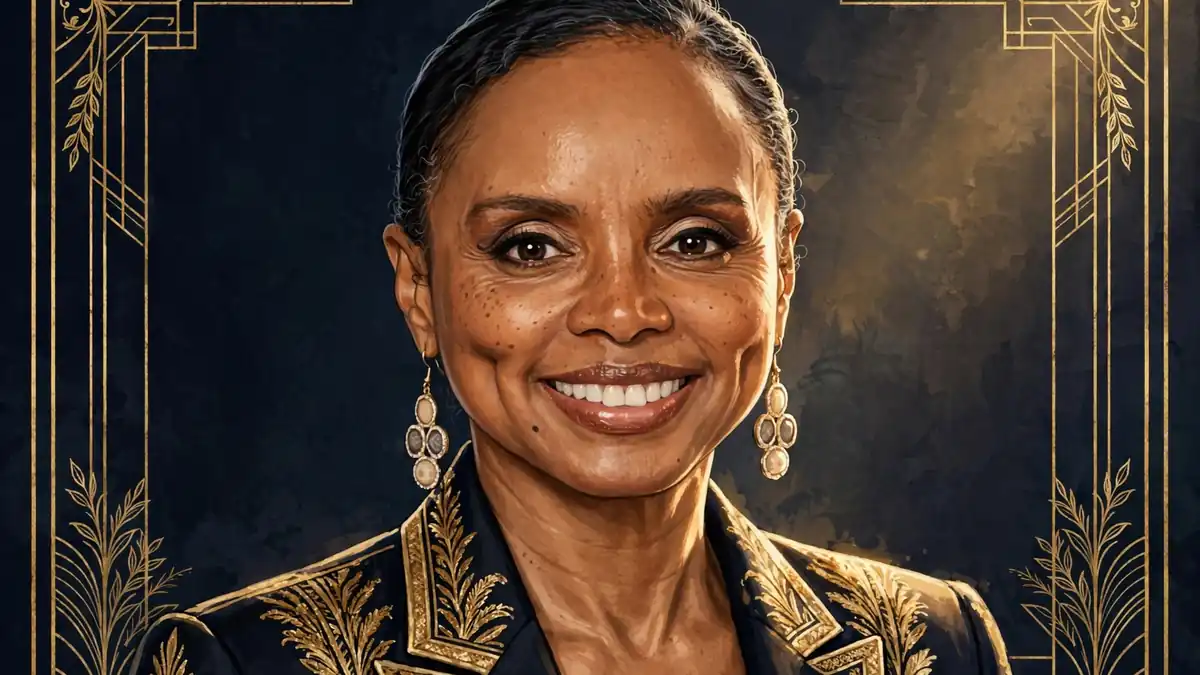
Debbi Morgan‘s net worth is estimated at $12 million to $12.5 million as of October 2026. That figure reflects a 55-year screen career built the slow way: three decades playing Dr. Angie Hubbard on All My Children, a career-defining film turn in Eve’s Bayou that won her an Independent Spirit Award, and a late-career surge as the villainess Olivia Bellarie in Tyler Perry’s Netflix hit Beauty in Black, whose second season part 2 premiered March 19, 2026.
Debbi Morgan: Quick Facts
| Estimated net worth | ~$12.5 million (range: $12 million to $12.5 million) |
|---|---|
| Profession | Actress (film and television), author |
| Nationality | American |
| Born | September 20, 1956 (age 69; some databases list 1951) |
| Height | 5 ft 1 in (some databases list 5 ft 6 in) |
| Primary income sources | Television salaries, film roles, book royalties, residuals |
| Active years | 1971–present |
| Last reviewed | October 2026 |
- Early Life and Background
- Education
- Career Journey
- Rise to Fame
- Main Sources of Income
- Salary and Earnings
- Businesses and Investments
- Brand Deals and Sponsorships
- Houses, Cars and Other Assets
- Awards and Achievements
- Net Worth Growth Over the Years
- Social Media Presence
- Personal Life
- Sources & Reporting
- Frequently Asked Questions
Early Life and Background
Debbi Morgan was born Deborah Ann Morgan on September 20 in Dunn, North Carolina — a small town in Harnett County — to Lora Morgan, a teacher, and George Morgan Jr., a butcher. She grew up with a younger sister, Terry, and the family moved to the Bronx when she was still a child, a move that put her at the center of the city’s theater world from an early age.
Two facts in her biography carry a caveat every serious profile should print. Wikipedia’s entry gives her birth year as “1951 or 1956,” noting a conflict in the sources, while most entertainment databases — and the majority of her profile pages — use 1956. Similarly, her height is listed as 5 feet 1 inch in some biographies and 5 feet 6 inches in others. We use the more common figures and flag both disputes rather than smoothing them over.
Morgan’s childhood was marked by domestic violence she later made the subject of her work. In a 1997 interview with People, she revealed that her father was an abusive alcoholic; he never physically harmed his daughters, but she remembered her mother running from him often. George Morgan Jr. died of leukemia in 1975. Two decades later, those memories became the spine of her memoir, The Monkey on My Back, and the one-woman stage play she adapted from it.
The Bronx years shaped her professionally, too. Raised in New York rather than Los Angeles, she came up through community theater and school productions before she ever read for a camera — a stage-first path that explains her decades of steady, workmanlike employment in a business that discards most newcomers within five years.
Education
Morgan attended parochial school and then Aquinas High School in the Bronx, where she performed in school plays and fell in love with acting. Profiles generally report her graduating in the early 1970s — the Free Dictionary’s encyclopedia entry says 1974 — after which she chose the stage over college and launched a professional career in 1971.
Her formal training continued at two institutions that mattered enormously for Black actors of her generation: the Negro Ensemble Company and the New Federal Theatre in New York. Both were central to the 1970s Black theater movement, and Morgan’s apprenticeship there — culminating in the Broadway production of What the Wine Sellers Buy in 1974, per TV Insider — gave her the stage credentials that made casting directors take her seriously.
Notably, she started working professionally in 1971 while still a teenager, choosing the stage over a college application — a gamble that paid off because New York’s Black theater scene was expanding just as she arrived. That stage-first path meant she hit the 1980s with Broadway credit, an off-Broadway network, and the kind of voice-and-movement training that daytime television, which shoots a full episode a day, quietly rewards.
That theater foundation is a recurring theme in her earnings story. Actors who can do stage, daytime, primetime, and film without a learning curve stay employed longer, and Morgan has been employed, nearly continuously, for over half a century.
Career Journey
Morgan’s first film role came in 1975 with the plantation melodrama Mandingo, followed by guest and recurring work that reads like a map of 1970s television. She played recurring roles on Good Times and What’s Happening!! (as Diane Harris), and in the 1979 ABC miniseries Roots: The Next Generation she played Elizabeth, Alex Haley’s aunt — a prestigious network miniseries credit at a time when the original Roots was still the biggest ratings event in television history.
The 1980s layered in hosting and prestige TV movies. Morgan co-starred with Dorian Harewood in The Jesse Owens Story (syndicated, 1984), headlined the CBS TV movie Guilty of Innocence: The Lennel Jeter Story (1986), and — a less-remembered but steady paycheck — hosted the syndicated music series New York Hot Tracks from 1984 to 1986, according to TV Insider. Her first regular series role was on the CBS drama Behind the Screen, where she played an aspiring soap actress — an irony the genre would not waste.
It was in daytime drama that she found the steadiest income of her life. Morgan debuted as Dr. Angie Hubbard on ABC’s All My Children in the early 1980s, and the role anchored her career for three decades. Paired romantically onscreen with Darnell Williams as Jesse Hubbard, the couple became one of the first Black couples to headline a major soap love story — a milestone that mattered on screen and, because it kept her contractually employed across the show’s peak years, off screen too.
The film work that made her a critics’ favorite arrived in 1997. Director Kasi Lemmons cast Morgan as Mozelle Batiste-Delacroix, the clairvoyant aunt in Eve’s Bayou, opposite Samuel L. Jackson, Jurnee Smollett, and Meagan Good. The performance won her the Independent Spirit Award for Best Supporting Female and the Chicago Film Critics Association Award — and it repositioned her from “soap actress” to a performer film critics took seriously, opening the door to The Hurricane (1999) opposite Denzel Washington, Love & Basketball (2000), Woman Thou Art Loosed (2004), and Coach Carter (2005).
Television kept paying throughout. Morgan played the Seer in the fourth and fifth seasons of Charmed (2002–2003, eight episodes), starred as District Attorney Lora Gibson on For the People (2002–2003, 18 episodes), recurred on Boston Public, The Bold and the Beautiful (14 episodes as DA Jennifer Tartaro), and spent 2011–2012 as a series regular on The Young and the Restless (43 episodes as Harmony Hamilton). From 2014 to 2020 she recurred on Starz’s Power as Estelle Green and continued into its spinoff Power Book II: Ghost through 2021. In 2021 she co-starred on Fox’s Our Kind of People as Patricia “Aunt Piggy” Williams.
Her credit list across those decades is long enough to merit a condensed look. The table below covers the roles that mattered most to her earnings — contract roles and recurring parts, not one-off guest spots.
| Years | Title | Role | Billing |
|---|---|---|---|
| 1976–1977 | Good Times | Recurring role | Recurring |
| 1982–1990, 2008–2011, 2013 | All My Children | Dr. Angie Hubbard | Series regular |
| 1984–1986 | New York Hot Tracks | Host | Series regular |
| 1993–1995 | Loving | Dr. Angie Hubbard | Series regular |
| 1995–1997 | The City | Dr. Angie Hubbard | Series regular |
| 1997 | Eve’s Bayou | Mozelle Batiste-Delacroix | Feature film |
| 1999 | The Hurricane | Supporting role | Feature film |
| 2000 | Love & Basketball | Supporting role | Feature film |
| 2002–2003 | Charmed | The Seer | Recurring, 8 episodes |
| 2002–2003 | For the People | DA Lora Gibson | Series regular, 18 episodes |
| 2005 | Coach Carter | Supporting role | Feature film |
| 2006–2007 | The Bold and the Beautiful | DA Jennifer Tartaro | Recurring, 14 episodes |
| 2011–2012 | The Young and the Restless | Harmony Hamilton | Series regular, 43 episodes |
| 2014–2020 | Power | Estelle Green | Recurring |
| 2020–2021 | Power Book II: Ghost | Estelle Green | Recurring |
| 2021 | Our Kind of People | Patricia “Aunt Piggy” Williams | Series regular |
| 2024–present | Beauty in Black | Olivia Bellarie | Series regular, Netflix |
The current chapter is her biggest commercial platform in years. In 2024 Tyler Perry cast her as Olivia Bellarie, the ruthless matriarch of the Bellarie cosmetics family, in the Netflix drama Beauty in Black. Season 2, part 2 premiered on March 19, 2026, per ScreenRant, and Netflix ordered a third season before the part-2 premiere even aired (Blex Media). Eurweb reported that a fourth season had also been ordered — the exact count is still moving, but the direction is unmistakable: Morgan is an active, contracted Netflix lead well into 2026.
The role has also given her a pop-culture footprint few 69-year-olds enjoy. BlackGirlsBond’s 2025 coverage of her Beauty in Black work noted that Olivia’s scenes generate devoted online followings, with fans dissecting her every move — a late-career visibility that feeds directly back into her casting value and, by extension, her earning power.
Rise to Fame
Morgan’s rise happened in two distinct waves, separated by nearly two decades. The first was All My Children. Debuting in the early 1980s, she turned Dr. Angie Hubbard into one of daytime’s most durable characters, earning two Daytime Emmy nominations and the 1989 trophy for Outstanding Supporting Actress in a Drama Series — making her the first African American performer to win that category.
What followed was unusual in soap history and financially significant. Rather than leaving Angie Hubbard behind, Morgan carried the character across networks: after departing AMC she played Chantal Marshall on NBC’s Generations, then reprised Angie on ABC’s Loving (1993–1995), its spinoff The City (1995–1997), and Port Charles and General Hospital (as a different character, Dr. Ellen Burgess, 1997–1998), before returning to All My Children itself from 2008 to 2011 and again in 2013. Few soap actors in history have monetized a single character across that many contracts.
The second wave was Eve’s Bayou. In 1997, at an age when most actresses watch their options narrow, Morgan delivered the performance of her career and walked away with two major critics’ awards. That reset the market’s perception of her — and her quote. The 2000s and 2010s then rewarded her with premium-cable and streaming work (Power, Power Book II: Ghost, Beauty in Black), a platform upgrade from the daytime grind to higher per-episode economics.
The through line: she never had one big payday. Morgan’s wealth is the product of near-continuous employment since 1971 — daytime contracts in the 1980s and 1990s, film and primetime in the 2000s, premium cable in the 2010s, and Netflix in the 2020s — a compounding schedule that explains why her net worth sits in the low eight figures without a single blockbuster check.
Main Sources of Income
Morgan’s income divides into four streams, and the proportions have shifted across the decades.
Television salaries are the foundation. Daytime contracts paid for her 1980s and 1990s; primetime guest and recurring work (Charmed, Boston Public, For the People, The Bold and the Beautiful) filled the 2000s; Starz and Fox and Netflix work carries the 2010s and 2020s. Fifty-five years of screen credits with barely a gap is the single biggest line item in the fortune.
Film roles contribute the second stream. Eve’s Bayou was the prestige peak, but The Hurricane, Love & Basketball, Coach Carter, and Woman Thou Art Loosed were all theatrical releases with standard SAG-scale-plus paydays for supporting players, plus ongoing residuals.
Book royalties and stage work form a smaller but real third stream. Her 2015 memoir The Monkey on My Back (Strebor Books, 432 pages) has remained in print in paperback and ebook editions, and she adapted it into a one-woman play that premiered at the 2015 National Black Theater Festival — both generate royalties and performance fees that competitors’ net-worth writeups routinely miss.
Residuals are the fourth. Decades of episodes across syndicated, cable-repeated, and now streaming-licensed series (Charmed, Good Times, Roots: The Next Generation) keep paying in smaller increments. For a performer with 70-plus credits, the tail of residual checks is genuinely material — thousands of small payments a year, every year.

Salary and Earnings
No contract of Morgan’s has ever been made public, so honest coverage means context rather than invented pay stubs. Daytime soap stars at her level typically earn $1,000 to $5,000 per episode, with top-billed veterans above that band — the scale PennBookCenter cites when breaking down her earnings. Multiply that by a soap’s shooting schedule (daytime dramas produce roughly 250 episodes a year) and the arithmetic of a 30-year daytime career becomes clear: it is the highest-volume, steadiest-earning segment of American acting.
Her streaming economics look different. ThrillNG’s 2026 ranking of the Beauty in Black cast notes the Tyler Perry production model: seasons are shot in roughly two to three weeks, and actors receive lump-sum deals for the block. Perry has publicly said he tries to pay actors more than they have ever earned and raise their industry “quote” for future jobs. That means Morgan’s Netflix paycheck is best understood as a strong lump sum for weeks of work rather than a traditional per-episode salary — and, as ThrillNG notes, it is the largest per-project payday of her recent career, ahead of her Power recurring work.
One site, CreebHills, claims an annual salary figure of $1 million; no other outlet corroborates it, and we report it as that site’s claim, not a verified number. What is verifiable is the trajectory: she was continuously employed in paid series-regular or recurring roles in every decade from the 1970s through the 2020s, a record almost no peer matches.
Her peer standing is telling. In ThrillNG’s cast ranking, Morgan’s estimated $12.5 million puts her “at the top of the list… and it isn’t even close” among the Beauty in Black ensemble. MediaTraffic’s 2026 ranking of Tyler Perry’s TV stars lists her at approximately $12 million — a figure that also places her ahead of younger ensemble castmates but well below Perry himself, whose personal fortune the same article puts at roughly $1.4 billion. The comparison cuts both ways: Morgan earns like a veteran lead among streaming-drama actors, but her fortune is a career-earnings story, not an ownership one — she was paid for her work, not for a stake in anything.
One more structural fact matters for her earnings math. Morgan’s decades on daytime television predate the streaming era’s lump-sum model entirely. On All My Children, Loving, The City, and The Young and the Restless she earned under traditional episodic contracts with annual renewals — paychecks that compounded year after year without renegotiation risk. On Power, Our Kind of People, and Beauty in Black she earns under modern streaming lump-sum deals. Very few actors have careers long enough to have been paid under both regimes; that she thrived under each is the quiet engine behind the $12 million figure.
Businesses and Investments
Here the honest record diverges from the celebrity-net-worth template: there is no public evidence that Morgan built product lines, launched businesses, or ran side companies. Unlike peers who branched into cosmetics or production banners, she reinvested the only way the record shows — in property and in her own intellectual property.
The intellectual-property asset is her memoir. The Monkey on My Back: A Memoir, published June 23, 2015 by Strebor Books (432 pages, original list price $25.99), remains in print in paperback and ebook editions — Atlantic Books still lists it, and Google Play carries the ebook edition sold by Simon & Schuster. She further monetized the material by adapting it into a one-woman play that premiered at the 2015 National Black Theater Festival, where she co-chaired the event with her All My Children co-star Darnell Williams, and by appearing on Oprah Winfrey’s Where Are They Now? that same year to promote it. Book royalties and stage fees are modest next to Netflix money, but they are income streams that most net-worth profiles of Morgan simply ignore.
On the investment side, the public record is thin: no real-estate portfolio press releases, no startup equity, no production company. Her wealth is an earned-acting fortune, not a diversified business portfolio — and a net-worth estimate should reflect that concentration rather than invent ventures that don’t exist.
Brand Deals and Sponsorships
Morgan’s public profile carries no major brand endorsements, ambassadorships, or sponsored partnerships — another spot where the standard celebrity template doesn’t fit. Her public-facing commerce is essentially her acting and her book.
What she does maintain is a direct-audience channel: her Instagram account, @therealdebbimorgan, which RarelyRadiant confirms as her active profile, featuring career updates, personal reflections, and memories from her decades in entertainment. At a reported 200,000-plus followers, it is a real audience asset in an era when streamers weigh social reach — relevant to her casting economics, if not a line item on a balance sheet.
Her official site, debbimorgan.org (listed on her Wikipedia page), rounds out a modest digital footprint: a working actress’s presence rather than an influencer’s empire.

Houses, Cars and Other Assets
Public records of Morgan’s property holdings are sparse, but one piece of hard evidence exists: Home and Design Magazine featured “Debbie Morgan’s Stylish Home” in 2015, with the actress describing the house as her “sanctuary” — “tranquil, peaceful, like a warm hug.” A home substantial enough to merit a design-magazine spread is a genuine asset signal, and the profile also noted her plans for a two-story addition with a sunroom and loggia.
One biography site, WikiBious, reports residences in Los Angeles and a vacation home in Florida; that claim stands alone and uncorroborated, so we treat it as reported, not verified. No car collections, private aircraft, or other luxury assets appear in the public record. The honest read: her principal tangible asset is real estate centered on a well-appointed primary home — consistent with an earner who made her money steadily rather than suddenly.
Awards and Achievements
Morgan’s trophy case is historically significant. The centerpiece: the 1989 Daytime Emmy Award for Outstanding Supporting Actress in a Drama Series for All My Children, making her the first African American to win the category — a barrier-breaking moment she has cited in interviews across the decades, and the achievement that anchors every biography of her.
The film awards followed her 1997 Eve’s Bayou performance: the Independent Spirit Award for Best Supporting Female and the Chicago Film Critics Association Award for the role. The Chicago critics’ win is worth naming because most net-worth profiles omit it — but it was the regional-critics validation that moved her from “soap actress who did a film” to a nationally recognized screen performer.
The rest of the shelf: a second Daytime Emmy nomination for All My Children, an NAACP Image Award nomination for Outstanding Actress in a Daytime Drama Series (1996, for The City), and the NAACP Image Award for Outstanding Supporting Actress in a Drama Series (2002, for Soul Food). TheBiography.org reports she has won 10 of 24 career award nominations — a win rate that reflects how consistently peers and critics have recognized her work.
One number in the awards record deserves a second look: that 1989 Emmy was not just a personal trophy. Daytime television had been on the air for four decades, and no Black performer had ever won Outstanding Supporting Actress. Morgan’s win — for a character who was herself a barrier-breaker, one of the first Black heroines of a major soap — landed at a moment when daytime was finally integrating its central love stories. The industry achievement and the cultural one arrived in the same envelope.
The industry achievement that matters most to her bottom line is less photogenic: she is one of a handful of actors to have played a regular or recurring role on television in six consecutive decades, from Good Times in the 1970s to Beauty in Black in the 2020s. Longevity is the asset.
Net Worth Growth Over the Years
Published estimates for Morgan cluster tightly — the spread between the highest and lowest credible 2025–2026 figures is only half a million dollars. That agreement is itself data: when seven outlets land within a 4% band, the number is worth trusting. The table below uses only published, named-source figures.
| Year | Published estimate | Source |
|---|---|---|
| 2023 | $12.5 million | CreebHills |
| 2025 | $12.5 million | PennBookCenter |
| 2025 | $12 million | WikiBious |
| 2026 | $12.5 million | ThrillNG |
| 2026 | $12 million | RarelyRadiant |
| 2026 | $12 million | MediaTraffic |
The stability of the number over four years tells the story: Morgan is not a fortune-riser anymore; she is a fortune-holder, with her Beauty in Black Netflix contract providing active income that offsets the spending and taxes that erode static celebrity wealth. A couple of lower-quality sites have published single-digit-million figures — one put her at $9 million for 2026 — but they stand alone against six named outlets, and we treat them as stale outliers rather than data.
One caveat the estimate range already absorbs: celebrity net-worth figures are directional, not forensic. Morgan has never disclosed a balance sheet, and the outlets above don’t publish their working. What they do share is a consistent methodology — decades of reported screen credits, no known debts or legal judgments, and an active high-paying contract in 2026 — and they land within half a million dollars of each other. For a figure of her profile, that is about as solid as a public estimate gets.
Social Media Presence
Morgan’s social presence is modest and authentic rather than brand-managed. Her Instagram, @therealdebbimorgan, carries career updates, relationship celebrations, and behind-the-scenes material from Beauty in Black — and it has become a gathering point for fans of her soap era, who dissect her decades-old storylines alongside her current work. She is also on X as @debbimorgan, per WikiBash’s profile.
Unlike many celebrities of her generation, she has not converted that following into sponsored content or product ventures. The accounts read as a working actress’s direct line to her audience — which, in an industry where streamers increasingly weigh an actor’s reach at casting time, is arguably worth more than a follower-count vanity metric.
Personal Life
Morgan has been married four times: to actor Charles Weldon (1980–1984), to actor and director Charles S. Dutton (1989–1994), to Donn Thompson (1997–2000), and since 2009 to Jeffrey Winston. The Dutton marriage, between two prominent Black actors of the era, drew the most press; the Winston marriage has been the longest, running into its seventeenth year.
She has written and spoken about how her father’s abuse shaped her relationships — it is the central theme of her memoir, which frames three generations of women in her family. She has no children in the public record. Her official site, debbimorgan.org, remains the hub for her book, stage work, and appearances — a working artist’s home base rather than a celebrity brand machine.
The memoir also documents the turning point she credits for her later stability: therapy, self-examination, and the decision to write publicly about what she had witnessed. “The book helped me come to the realization that I was actually stronger than I gave myself credit for,” she told Home and Design Magazine in 2015. That personal arc — from a Bronx household marked by violence to a 70-year-old working lead on a hit Netflix series — is the context behind the fortune, not just a footnote to it.
She has also used her platform to encourage the same work in others. In the 2015 press around the memoir she said she hoped the book would encourage women to seek therapy — a public-advocacy stance that sits alongside, rather than beneath, the career. It is one more reason her public profile has aged into respectability rather than nostalgia: she is known for something beyond the roles.
Sources & Reporting
Coverage map. Every figure in this article was cross-checked against multiple publications; where they disagreed, the range above reflects it.
Net worth estimates: ThrillNG ($12.5M, plus the Tyler Perry lump-sum pay model), MediaTraffic (~$12M, 2026 Tyler Perry stars ranking), RarelyRadiant ($12M, plus bio details and Instagram handle), CreebHills ($12.5M, plus early-life detail), PennBookCenter ($12.5M, plus daytime salary scale), NetWorthRanker ($12.5M overview), WikiBious ($12M, plus memoir and height data), TheBiography.org ($12.5M+, plus award and career data). Reporting window: 2023–2026.
Career and biography: Wikipedia (career chronology, Emmy history, marriage record); TV Insider (stage credits, New York Hot Tracks, The Jesse Owens Story); TheFreeDictionary encyclopedia entry (television credit table, including For the People, Charmed, The Young and the Restless episode counts).
Current work: ScreenRant (Season 2, part 2 premiere date, March 19, 2026); Blex Media (third-season renewal); Eurweb (season 3 coverage).
Memoir, home, personal: Atlantic Books (memoir publication details); Home and Design Magazine (2015 home feature, memoir quote); People (1997 interview on her father’s abuse, via Wikipedia citation).
Frequently Asked Questions
What is Debbi Morgan’s net worth in 2026?
Debbi Morgan’s net worth is estimated at $12 million to $12.5 million as of October 2026. Seven celebrity-finance publications from 2023–2026 land inside that narrow band: ThrillNG, CreebHills, PennBookCenter, and NetWorthRanker say $12.5 million, while MediaTraffic, RarelyRadiant, and WikiBious say $12 million. No official figure has been disclosed, so this remains a media estimate.
How old is Debbi Morgan?
Debbi Morgan was born on September 20, 1956, in Dunn, North Carolina, making her 69 years old as of October 2026. Note that some databases, including Wikipedia, note a conflict listing her birth year as 1951 instead — the 1956 date is used by the majority of entertainment databases.
What was Debbi Morgan’s role on All My Children?
Morgan played Dr. Angie Hubbard on ABC’s All My Children, debuting in the early 1980s. Paired onscreen with Darnell Williams as Jesse Hubbard, the couple became one of daytime television’s first Black love stories. She won the 1989 Daytime Emmy for Outstanding Supporting Actress for the role — the first African American to win that category — and played Angie across multiple soaps (Loving, The City) before returning to All My Children from 2008–2011 and in 2013.
What awards has Debbi Morgan won?
Her major wins are the 1989 Daytime Emmy Award for Outstanding Supporting Actress in a Drama Series (the first African American winner in that category), the Independent Spirit Award for Best Supporting Female, and the Chicago Film Critics Association Award — both for her 1997 performance as Mozelle in Eve’s Bayou. She also won the 2002 NAACP Image Award for Outstanding Supporting Actress in a Drama Series for Soul Food, and TheBiography.org reports 10 wins from 24 career nominations.
Is Debbi Morgan in Beauty in Black?
Yes. Morgan plays Olivia Bellarie, the ruthless matriarch of the Bellarie cosmetics family, in Tyler Perry’s Netflix drama Beauty in Black, which premiered in October 2024. Season 2, part 2 premiered March 19, 2026, and Netflix has ordered a third season — Morgan remains an active contracted lead on the series.
Who is Debbi Morgan’s husband?
Debbi Morgan has been married four times. Her current husband is Jeffrey Winston, whom she married in 2009. Her previous marriages were to Charles Weldon (1980–1984), Charles S. Dutton (1989–1994), and Donn Thompson (1997–2000).
Did Debbi Morgan write a book?
Yes. Her memoir, The Monkey on My Back: A Memoir, was published June 23, 2015 by Strebor Books. The 432-page book traces three generations of women in her family and her decision to break a cycle of domestic violence she witnessed as a child. She later adapted it into a one-woman play that premiered at the 2015 National Black Theater Festival.
What is Debbi Morgan’s Instagram?
Her Instagram username is @therealdebbimorgan. The profile features career updates, personal reflections, relationship celebrations, and memories from her five decades in entertainment.
Final Thoughts
Debbi Morgan’s $12–12.5 million net worth is the financial portrait of a working actor done right: no windfall, no scandal, no boom-and-bust — just 55 years of showing up. From the Bronx stage to All My Children‘s Pine Valley, from an Independent Spirit Award for Eve’s Bayou to a Netflix villainess at 69, she converted talent into contracts in every decade since 1971, and contracts into a fortune that none of her Beauty in Black co-stars can match.
The number is also an outlier among her peers for a reason the data makes plain. Most actresses who debut in their teens burn out by forty; Morgan’s earnings kept compounding because she stayed castable across six decades of television, treated a memoir and a stage play as assets rather than vanity projects, and — with Beauty in Black renewed and her Netflix contract active — is still cashing checks when most contemporaries have retired. That is the whole formula: longevity, versatility, and a reputation the industry trusts.
Published on October 17, 2026. Last reviewed October 2026. Found an error? See our corrections policy.