
Don King‘s net worth is estimated at $150 million to $200 million as of November 2026. The 95-year-old boxing promoter built one of the largest fortunes in fight history — Forbes valued him at $350 million in 2006 after more than $1 billion in cumulative boxing revenue — and in 2026 his empire is being sold off piece by piece, with a Florida court auctioning the 53-acre jai alai property his late wife bought in 1999.
Don King: Quick Facts
| Estimated net worth | $150 million – $200 million (range: $150 million to $200 million) |
|---|---|
| Profession | Boxing promoter, businessman |
| Nationality | American |
| Born | August 20, 1931 (age 95) |
| Height | 6 ft 1 in (1.85 m) — some biographies list 6 ft 2 in |
| Primary income sources | Boxing promotion, pay-per-view and television rights, site fees, fighter management, real estate |
| Active years | 1972 – present |
| Last reviewed | November 2026 |
- Early Life and Background
- Education
- Career Journey
- Rise to Fame
- Main Sources of Income
- Salary and Earnings
- Businesses and Investments
- Brand Deals and Sponsorships
- Houses, Cars and Other Assets
- Awards and Achievements
- Net Worth Growth Over the Years
- Social Media Presence
- Personal Life
- Sources & Reporting
- Frequently Asked Questions
Early Life and Background
Donald King was born on August 20, 1931, in Cleveland, Ohio, the fifth of Clarence and Hattie King’s six children. The family lived in a working-class Black neighborhood in a Cleveland still shaped by segregation, and King has described his childhood as poor in money and rich in street education. His father worked in a steel mill, and the young King learned early how cash moved through his neighborhood — who held it, who needed it, and what people would pay for a chance at more of it.
After graduating from John Adams High School in 1951, King married his first wife, Luvenia Mitchell, the same year. The marriage ended in divorce, and little is publicly documented about it. What is documented is the path King took next: he became a numbers runner, taking illegal bets on the streets of Cleveland. The numbers game — an underground lottery that paid out on daily figures — was a fixture of Black neighborhoods in mid-century America, and King ran it with a talent for arithmetic and risk that would later define his promotional career. By his early twenties he was operating his own bookmaking and gambling houses.
That world turned violent twice. On December 2, 1954, King shot and killed Hillary Brown, a man he said was trying to rob one of his gambling houses. The killing was ruled a justifiable homicide, and King walked free. Twelve years later, in August 1966, King beat an employee, Sam Garrett, to death after Garrett owed him $600. King was convicted of second-degree murder in 1967; the conviction was later reduced to nonnegligent manslaughter, and he served three years and eleven months at the Marion Correctional Institution in Ohio. He was released in 1971, and in 1983 Ohio Governor Jim Rhodes granted him a full pardon, backed by letters from Jesse Jackson, Coretta Scott King, Cleveland mayor George Voinovich, Cleveland Browns owner Art Modell, and baseball executive Gabe Paul, among others.
The prison years matter to the money story for two reasons. First, King used the time in the prison library to read widely — history, law, business — and he emerged with a self-taught command of contracts and negotiation that startled the lawyers and network executives he later faced across the table. Second, the pardon and the support letters gave him a political network in Ohio that he drew on for the rest of his career. He has never hidden the conviction; his famous line about it, repeated for decades, is that it happened “only in America,” the catchphrase that became his brand.
King also bought a farm while he was away, and the widow who lived there, Henrietta Renwick, became his second wife. They married in 1959 and stayed together until her death on December 2, 2010, at the age of 87. Henrietta was not a bystander in the business: she bought the Palm Beach jai alai property in 1999 that would become the center of King’s 2026 bankruptcy, and she ran much of the company’s back office for decades. The couple had one biological daughter, Deborah, and two adopted sons, Carl and Eric. King has five grandchildren.
Education
King’s formal education ended, on paper, with his 1951 graduation from John Adams High School in Cleveland. He enrolled at Kent State University afterward but dropped out, and the numbers business became his classroom instead. That is the whole of his schooling in the conventional sense — and it is worth stating plainly, because the contrast with what he later negotiated is the point. A high-school graduate with no college degree sat across from HBO, Showtime, casino executives, and foreign heads of state and routinely walked away with the better end of the contract.
What filled the gap was the prison library at Marion Correctional Institution, where King spent nearly four years reading everything he could reach, and the numbers game itself, which taught him odds, cash flow, credit, and collections at street level. Former HBO Sports president Seth Abraham, quoted in Forbes’ 2006 profile, called King the most brilliant business mind he had ever encountered and said he was “formidable in his sleep.” Former MGM Grand president Alex Yemenidjian told the same profile that King “could have been CEO of a major corporation.” The education section of this profile is short because King’s real credential was the deal table — and the record of what he extracted from it over 33 years.
Career Journey
King entered boxing in 1972, at the age of 41, with no money and no connections in the sport. He convinced Muhammad Ali to fight a charity exhibition in Cleveland to raise funds for a local hospital in financial trouble, with singer Lloyd Price helping to broker the introduction. The exhibition worked, the hospital got its money, and King had his first taste of the fight business. Two years later he founded Don King Productions, and in 1974 he staged the fight that made him: the Rumble in the Jungle, Ali against George Foreman in Kinshasa, Zaire.
The 1970s belonged to King. After the Rumble came the Thrilla in Manila in 1975, Ali against Joe Frazier for the third time, and a run of heavyweight title fights that made Don King Productions the dominant force in the sport. A Sports Illustrated reporter wrote in 1990 that “boxing is run out of King’s right-hand drawer,” and for a stretch in the 1980s the line was close to literal: at one point, everyone contending for the heavyweight championship was promoted or managed by King. He built his own television network, the Don King Sports and Entertainment Network, in 1982 — the first promoter to own one — and in 1984 he stepped outside boxing entirely to promote the Jacksons’ Victory Tour, featuring Michael Jackson and his brothers.
The 1990s brought the Mike Tyson era, the most lucrative and the most damaging chapter of King’s career. Tyson, the youngest heavyweight champion in history, signed with King after the death of his manager Jim Jacobs and the departure of trainer Kevin Rooney, and King promoted the run that made Tyson the biggest pay-per-view draw on earth. Tyson earned more than $140 million in a two-year stretch under King, including a $20 million fee for the 91-second demolition of Michael Spinks in 1988. The partnership ended in a $100 million lawsuit in 1998, settled for $14 million in 2004, and the details of that falling-out are covered in the earnings section below.
King’s peak as a volume promoter came in 1994, when he promoted 47 title fights in a single year. Forbes’ April 2006 investigation, “The King and His Sport, at Twilight,” counted at least 600 championship bouts over 33 years, more than $1 billion in cumulative boxing revenue, seven of the ten largest pay-per-view events in boxing history to that point, and a stable of 113 fighters from 27 countries. His company represented or promoted dozens of world champions, including Ali, Foreman, Frazier, Larry Holmes, Evander Holyfield, Roberto Durán, Julio César Chávez, Félix Trinidad, Roy Jones Jr., and Christy Martin.
The decline was slow and then, in the 2020s, fast. Heavyweight boxing’s center of gravity moved to other promoters, casino site fees dried up, and King’s own company shrank: a 2012 court filing in a lawsuit by former IBF bantamweight champion Joseph Agbeko claimed King had fired nearly all his staff and “may be closing down” Don King Productions, though the company denied it and said it retained 14 employees across Florida and Ohio. King kept promoting small cards out of Deerfield Beach, Florida, and as late as 2024 he was in talks with Canadian promoter Dan Otter about staging a WBC cruiserweight title bout. But the business that once generated nine-figure fight nights was, by 2025, a small staff in a warehouse headquarters — and in July 2025 that warehouse itself was sold for $11 million after a foreclosure action. The 2026 Chapter 11 filing over the jai alai property, detailed below, is the latest chapter of that unwind.
Rise to Fame
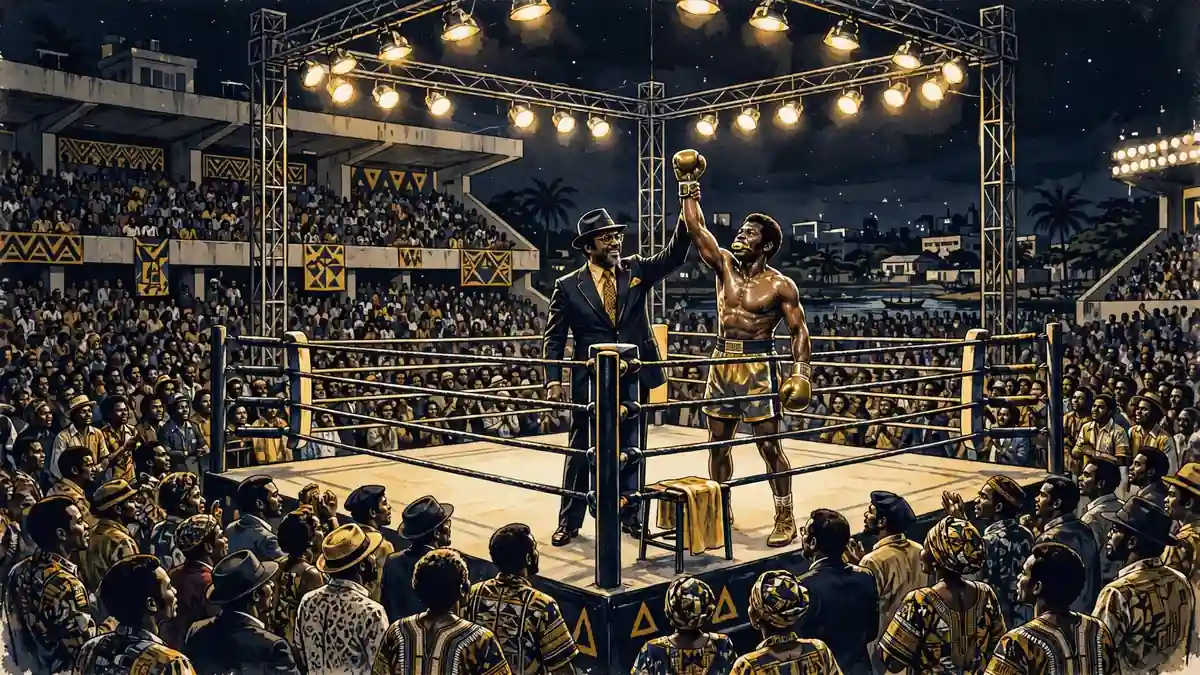
The Rumble in the Jungle is the single event that explains Don King’s fortune, and the numbers still startle half a century later. In 1974, King promised Ali and Foreman $5 million each — twice what any fighter had ever earned — for a heavyweight title fight, without having the money. Both men signed contracts that said they would fight for him if he could raise the purse. King then went looking for a country willing to pay for it.
He found one in Zaire. President Mobutu Sese Seko agreed to host the fight in Kinshasa, putting up the purse money and the 20th of May Stadium, in exchange for the prestige of staging the biggest sporting event on African soil. King arranged a three-night music festival at the stadium beforehand — the Zaire 74 festival, with James Brown, B.B. King, Miriam Makeba, Bill Withers, and the Fania All-Stars — and the fight itself, on October 30, 1974, drew 60,000 people to the stadium and an estimated 50 million viewers on closed-circuit television worldwide, with total television audiences reported at around one billion. The fight grossed an estimated $100 million in worldwide revenue, worth roughly $650 million to $700 million in today’s dollars. Ali, the 4–1 underdog, knocked out the undefeated Foreman in the eighth round with his rope-a-dope strategy, and King was famous.
What made the Rumble a business breakthrough, beyond the spectacle, was the structure King invented for it. He had no money of his own in the deal; he assembled a consortium — including Hemdale Film Corporation and Video Techniques Inc. as official co-promoters, Panamanian investment vehicle Risnelia, and, by King’s own account in a television interview, an early involvement from Libyan leader Muammar Gaddafi — and he sold the fight as a national prestige project rather than a sporting event. The host country paid the purses; the closed-circuit and television money flowed back through the promoters. It was a template King reused for the rest of his career: find someone else’s money, attach it to a fight the world wanted to see, and keep the promotion fee.
The Thrilla in Manila, on October 1, 1975, confirmed that the Rumble was not a one-off. Ali and Frazier split a $14 million purse for their third meeting, and the fight sold more than 500,000 pay-per-views — a record at the time — in a bout still argued over as the greatest heavyweight fight ever staged. King had sold the event to Philippine President Ferdinand Marcos the same way he had sold the Rumble to Mobutu: as a national showcase. Two years after entering the business, a former numbers runner from Cleveland was staging fights for heads of state.
Main Sources of Income
King’s money came from five streams, and their relative weight shifted over five decades. The first and largest was promotion fees: as the promoter, King took a percentage of each event’s gross — ticket sales, closed-circuit receipts, television license fees, and pay-per-view revenue — before the fighters were paid. On a $100 million gross like the Rumble in the Jungle, even a modest promoter’s share ran into eight figures, and on the Tyson pay-per-view events of the late 1980s and 1990s the numbers were larger still. Forbes put his cumulative boxing revenue above $1 billion by 2006, and while that is gross revenue rather than personal profit, it is the scale on which his fees were calculated.
The second stream was television and pay-per-view rights. King was early to understand that the broadcast was worth more than the gate. His 1982 launch of the Don King Sports and Entertainment Network made him the first promoter with his own television outlet, and his deals with HBO and Showtime — the two premium cable networks that bankrolled big-time boxing for three decades — were the backbone of his income through the 1990s. His company produced seven of the ten largest pay-per-view events in boxing history as of 2006, and each one carried a promoter’s cut of the buy rate.
The third stream was site fees: money paid by casinos and host cities to stage a fight in their venue. Las Vegas casinos, Atlantic City, and later international hosts paid millions for the right to host a King-promoted title fight, because a championship weekend filled hotel rooms and casino floors. King was the master of the site-fee auction, playing venues against each other and against foreign governments.
The fourth stream was fighter management. King promoted his fighters and, in many cases, managed them too, which entitled him to a manager’s percentage on top of the promoter’s fee — a dual role that later became the center of the lawsuits against him. The most valuable version of this was the Tyson relationship, where King controlled promotion, management, and, Tyson later discovered, a share of his endorsement and image rights. The fifth stream was everything else: the Jacksons’ Victory Tour in 1984, the Call & Post newspaper he bought in 1998, a library of roughly 7,000 fight tapes he hoped to turn into a boxing cable channel, and the rights to an advertising robot technology he owned, all reported by Forbes in 2006.
What is striking, set against the $350 million Forbes valuation, is how little of the money was recurring. Promotion is a deal-by-deal business: no fight, no fee. When the big fights stopped coming in the 2000s, the income stopped with them, while the costs — lawyers, staff, property taxes on a 53-acre vacant site — kept running. That mismatch is the story of the last twenty years of King’s finances.
Salary and Earnings
King never drew a salary in the ordinary sense; his earnings were the promoter’s share of each event, and the record of those events is the record of his pay. The table below gathers the best-documented figures, each tied to its source, and the pattern is unmistakable: enormous grosses in the 1970s and 1990s, with King’s own take rarely disclosed and frequently disputed by the fighters on the other side of the contract.
| Event | Year | Documented figure |
|---|---|---|
| Rumble in the Jungle — Ali vs. Foreman | 1974 | $5 million purse each; ~$100 million gross revenue |
| Thrilla in Manila — Ali vs. Frazier III | 1975 | $14 million combined purse; 500,000+ pay-per-view buys, a record then |
| Holmes vs. Cooney | 1982 | $10 million purse each |
| Tyson vs. Spinks | 1988 | $20 million fee for Tyson; Tyson earned $140 million+ in two years with King |
| Tyson vs. Holyfield II (“the bite fight”) | 1997 | More than $110 million generated, the biggest of King’s career |
| Witherspoon vs. Bruno | 1986 | HBO paid King $1.7 million; Witherspoon’s contracted $500,000 purse became $90,000 after deductions |
The Witherspoon case, reported by Forbes from the fighter’s own account, is the clearest window into how King’s economics worked at the fighter’s expense. HBO paid King $1.7 million for the 1986 title defense against Frank Bruno. Witherspoon’s contract called for a $500,000 purse. After deductions — training expenses, management fees, and other charges controlled by King’s company — Witherspoon said he received $90,000. That gap, between what the network paid and what the fighter took home, is where King’s fortune was built, and it is also where the lawsuits came from.
The Tyson numbers are the largest in the file. Tyson earned more than $140 million in a two-year period alongside King, including the $20 million fee for the Spinks fight in June 1988. In March 1998, Tyson sued King for $100 million in U.S. District Court in Manhattan, alleging King had cheated him out of tens of millions over more than a decade through underreported purses, excessive management fees, and secret control of his endorsement income. Tyson discovered the scale of King’s control, by his own account, only when he signed a deal with the WWF for WrestleMania 14 and found that King held his image rights and was entitled to a cut of the $3.5 million fee. The suit was settled on June 26, 2004, for $14 million — $8 million upfront, $3 million in January 2005, and $3 million in January 2006 — and the money went largely to Tyson’s creditors, including the IRS, as part of his bankruptcy plan. Tyson later said King had done “more bad to black fighters than any white promoter ever in the history of boxing.”
Ali sued first. In 1982, Ali sued King for $1.1 million, alleging King had underpaid him for the 1980 fight against Larry Holmes. The suit was settled for $50,000 in cash. Holmes himself later said King owed him $10 million for their years together, and settled a $300,000 suit of his own for $100,000. The pattern repeated across King’s roster: a fighter would allege millions missing, sue, and settle for a fraction. The settlements were a cost of doing business — and, for the fighters, usually the only money they ever recovered.
King was also acquitted in federal court. In July 1998, a Manhattan jury acquitted him of nine counts of wire fraud in his second trial on charges of attempting to defraud Lloyd’s of London out of $350,000 over the cancellation of a Julio César Chávez fight. He was never found guilty of tax evasion or insurance fraud, despite indictments, and he has always denied fixing fights or rankings.
For a sense of scale against his peers, the table below uses reported estimates from Celebrity Net Worth for fellow promoters. These are third-party estimates, not verified fortunes, and they are included for comparison only.
| Promoter | Reported net worth | Notes |
|---|---|---|
| Don King | $150 million – $200 million | Forbes peak $350 million (2006); 600+ title fights |
| Bob Arum | ~$300 million | Top Rank founder; promoted Ali, Pacquiao, Mayweather early |
| Oscar De La Hoya | ~$200 million | Golden Boy Promotions founder; former fighter |
| Eddie Hearn | ~$50 million | Matchroom Boxing; current era’s biggest promoter |
The comparison makes the point plainly: King once stood at the top of this table, and his 2006 Forbes valuation of $350 million was the largest promoter fortune of its era. Twenty years later, after legal settlements, a shrinking fight business, and the real-estate collapse documented below, he sits in the middle of it — and falling.
Businesses and Investments
Don King Productions is the business, and it has been since 1974. The company promoted more than 600 championship bouts, represented 113 fighters from 27 countries at its peak, and for two decades was the most powerful promotional outfit in boxing. It still exists, operating out of Deerfield Beach, Florida, with a small staff — but the 2025–2026 record reads like a liquidation. In July 2025, an affiliate of Boca Raton construction firm Straticon paid $11 million for King’s Deerfield Beach warehouse, the building that had served as his headquarters, after a foreclosure action by an affiliate of Miami-based Blueprint Capital Partners over an alleged default on a $5.3 million loan. The sale covered the debt, according to reporting at the time, but the headquarters was gone.
King’s most important investment outside boxing was real estate, and it is now his biggest liability. The centerpiece is the former Palm Beach Jai Alai fronton at 1415 45th Street in Mangonia Park, Florida — a 52-to-53-acre site that accounts for nearly half of the tiny municipality’s 108 acres. Henrietta King bought the property in 1999 for $6.3 million, dreaming of a sports and entertainment complex. The fronton itself was built in the 1950s, rebuilt after a fire in the late 1970s, and closed in December 1994 after Florida expanded its gambling options and a long jai alai players’ strike killed the sport’s commercial base. The Kings never found a development partner or county funding, and the site has sat vacant for more than three decades.
The financing of that site is a case study in how high-interest debt consumes an asset. According to court reporting by The Real Deal and Boxing Insider, King took out a $22.3 million loan in 2023 at 13.9 percent annual interest, requiring monthly interest-only payments of $260,000; a second $9 million loan followed in 2024 at 18.5 percent, with monthly interest-only payments of $138,750; and a third loan of $800,000 at 2 percent. Taylor Made Lending, a Pompano Beach hard-money lender, alleged King stopped paying the $9 million loan in September and failed to repay the $800,000 loan at maturity in December. A Palm Beach County judge entered a $42.5 million foreclosure judgment in favor of a Taylor Made affiliate — reported elsewhere as $43 million including fees and costs — and the property was scheduled for a foreclosure auction on May 18, 2026.
Three days before that auction, on May 15, 2026, DK Arena, Inc., the King-linked entity holding the property, filed for Chapter 11 bankruptcy protection in the U.S. Bankruptcy Court for the Southern District of Florida (case No. 9:26-bk-16307), listing liabilities of $50 million to $100 million. The filing halted the auction. King’s Boca Raton bankruptcy attorney, Robert Furr, told The Real Deal the goal was not a conventional reorganization but a structured exit: a marketing plan to sell the property through competitive bidding within 90 days. On October 9, 2026, Judge Erik P. Kimball approved bidding procedures, with Palm 50 Acres LLC — an affiliate of Taylor Made Lending and the principal secured creditor — approved as stalking-horse bidder at $55 million. The auction was scheduled for October 30, 2026, with a sale hearing expected on November 4. The site had been relisted in April 2025 without a stated asking price, with sources telling The Real Deal that King’s team was seeking offers around $100 million, or roughly $2 million per acre. Palm Beach County recently approved about $5 million toward connecting water and sewer infrastructure to the property, which had been a longstanding barrier: Mangonia Park’s drinking-water system is already operating at about 75 percent capacity, and nothing can be built on the parcel until a larger water storage tank is funded. Potential uses discussed publicly include multifamily and workforce housing, an arena or entertainment venue, and transit-oriented development next to the Tri-Rail station, part of the site already serving as station parking.
King’s other reported investments were smaller and older. In 1998 he bought the Cleveland-area African-American newspaper the Call & Post for $700,000. He owned the rights to advertising technology described by Forbes as a robot that moves freely around malls and public areas. And he owned a library of about 7,000 tapes of fights, press conferences, and boxing events, which he hoped to build into a cable channel devoted to boxing and other entertainment. None of these produced a second fortune, and none is documented as a current income stream in 2026 reporting.
Brand Deals and Sponsorships
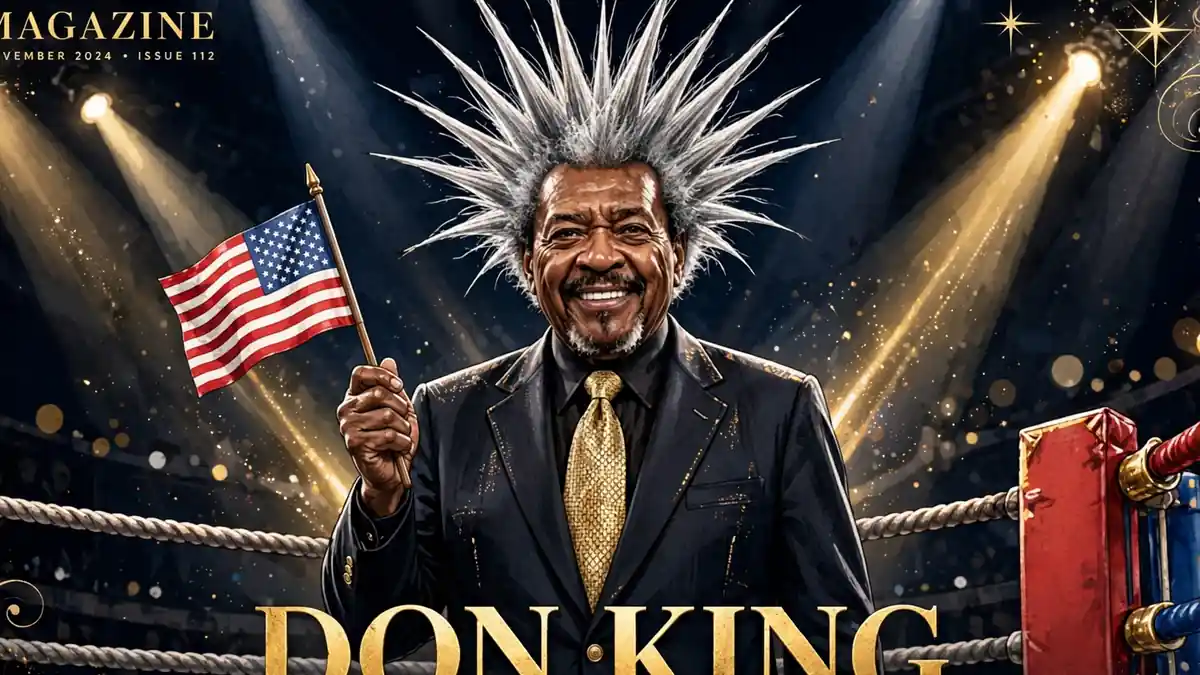
King’s brand was himself: the hair, the flags, the “Only in America!” catchphrase shouted at press conferences. He waved miniature American flags at weigh-ins and public appearances so often that the flag became part of the logo of his persona, and the phrase became the title of both Jack Newfield’s unauthorized biography, “Only in America: The Life and Crimes of Don King,” and the 1997 HBO film “Don King: Only in America,” in which Ving Rhames won a Golden Globe for playing him. King was portrayed again in the 2001 film “Ali,” by Mykelti Williamson, and in the 1995 HBO film “Tyson,” by Paul Winfield.
His biggest non-boxing deal was the Jacksons’ Victory Tour in 1984, which he promoted with Michael Jackson and his brothers at the height of Jackson’s “Thriller” fame. The tour was one of the highest-grossing concert tours of its era, and it also drew litigation: concert promoter Frank Russo sued King, the Jacksons, and MCA chief Irving Azoff for $40 million, claiming he had been promised the tour. King kept the promotion. The tour proved he could sell an arena outside boxing, but he never repeated the feat at that scale.
His sponsorship relationships were institutional rather than personal: HBO and Showtime paid him license fees, casinos paid site fees, and closed-circuit operators paid for distribution rights. He did not carry the consumer endorsement portfolio of a modern athlete — no shoe deal, no beverage contract — because his product was the event, and his face was the advertisement for it. In later years he became a visible supporter of Donald Trump, appearing at rallies and events, a relationship that kept him in the news long after his fight cards had shrunk. He also remained a fixture of the fight-week media circuit, turning up at Florida cards and press conferences into his nineties.

Houses, Cars and Other Assets
King’s asset list in 2026 is dominated by one property and one archive. The property is the Mangonia Park jai alai site: 52 to 53 acres of vacant land with a 282,800-square-foot fronton built in 1973, bought for $6.3 million in 1999 and now the subject of a bankruptcy sale with a $55 million stalking-horse bid. Whether that bid holds, and what King actually nets after the $43 million foreclosure judgment and the $50 million to $100 million in listed liabilities, will decide how much of his published net worth survives 2026. A $55 million gross sale against $50 million-plus in liabilities leaves little equity — which is why the range in this article runs down to $150 million and why some outlets have begun to question whether even that figure still holds.
His working base is Deerfield Beach, Florida, where Don King Productions operated and where King lives now, working with a small staff. The Deerfield Beach warehouse that served as his headquarters was sold in July 2025 for $11 million after the Blueprint Capital Partners foreclosure action. His Cleveland roots remain part of the story — the Call & Post newspaper he bought in 1998 for $700,000 is a Cleveland institution — but there is no public record of a grand King residence in the style of a modern sports mogul’s mansion, and this profile does not invent one. Unlike the fighters he promoted, whose houses and car collections were photographed and catalogued, King’s wealth was held in companies, contracts, and land, not in a display garage. No verified reporting documents a car collection, a yacht, or a private jet in his name, and we do not list any.
The archive is the quieter asset: roughly 7,000 tapes of fights, press conferences, and boxing events, which Forbes reported in 2006 as the basis for a planned boxing cable channel. The channel never launched. The tapes’ value in 2026 — in a market where classic fight footage is licensed by the minute — is real but unquantified, and no sale or valuation has been reported. The same applies to the advertising-robot technology rights Forbes mentioned. Both sit in the “worth something, amount unknown” category, which is why they support the top of our range rather than a precise figure.
One more asset deserves a line because it explains the shape of King’s fortune: his name. Don King Productions still holds promotional rights and contracts tied to a catalog of historic fights, and the Don King name still opens doors in boxing and in Florida politics. That reputational capital is not on any balance sheet, but it is the reason a 95-year-old with a shrinking company could still be in talks over a WBC cruiserweight title bout in 2024.
Awards and Achievements
King was inducted into the International Boxing Hall of Fame in 1997, the formal recognition of a career that had already staged the two most famous heavyweight fights of the century. In 2008 he was elected to the Gaming Hall of Fame, a nod to the casino site-fee business he helped invent. The New York Times listed him among the 100 African-Americans who helped shape the country’s history during the 20th century. Ving Rhames won a Golden Globe for playing him in “Don King: Only in America,” which is an award for the portrayal rather than the man — but it says something about the scale of the persona that it took a Golden Globe performance to capture it.
The numbers are the real honors roll. At least 600 championship bouts promoted over 33 years, per Forbes. Seven of the ten largest pay-per-view events in boxing history as of 2006. Forty-seven title fights promoted in a single year, 1994. A stable of 113 fighters from 27 countries. King himself has said he turned at least 90 fighters into millionaires — a claim reported by BoxRec that should be read as his own account, and one his fighters’ lawsuits give a complicated context. Two fights he promoted, the Rumble in the Jungle and the Thrilla in Manila, are fixtures on every list of the greatest fights ever staged, and the Rumble is regularly called the greatest sporting event of the 20th century.
There is also an achievement his critics rarely grant him: he changed what fighters were paid. Before King, no fighter had earned $5 million for a single night; after the Rumble, $5 million became the floor for a superfight, and the purses climbed from there — $10 million each for Holmes and Cooney in 1982, $14 million combined for Ali and Frazier in 1975, $20 million for Tyson against Spinks in 1988. The money did not always reach the fighters in full, as the lawsuits show, but the ceiling King broke stayed broken, and every heavyweight who has earned eight figures since owes something to the precedent he set in Kinshasa.
Net Worth Growth Over the Years
King’s fortune has a clear arc: a steep climb from nothing, a long plateau at the top, and a slow decline that accelerated in the 2020s. The table below is built from the documented anchor points — the 2006 Forbes valuation, the fight grosses, and the 2025–2026 court filings — with the intervening years marked as NetWorthCraft estimates. Treat the early figures as informed estimates, not audited values; nobody published King’s balance sheet in 1974.
| Year | Estimated net worth | What drove it |
|---|---|---|
| 1972 | Under $1 million | Numbers business; first Ali charity exhibition |
| 1975 | ~$10 million | Rumble in the Jungle and Thrilla in Manila grosses |
| 1985 | ~$50 million | Holmes–Cooney purses, Victory Tour, TV network |
| 1995 | ~$200 million | Tyson pay-per-view peak; 47 title fights in 1994 |
| 2006 | $350 million (Forbes) | Forbes investigation; $1 billion+ cumulative revenue |
| 2015 | ~$200 million | Fight business shrinking; legal settlements accumulating |
| 2020 | ~$150 million | Few major cards; real-estate carrying costs rising |
| 2026 | $150 million – $200 million | Range: most outlets $150 million; Celebrity Net Worth $200 million; DK Arena in Chapter 11 |
Three things stand out in that arc. First, the peak was real and documented: Forbes does not hand out $350 million valuations lightly, and the 2006 profile was a cover story built on months of reporting. Second, the decline was not a single event but a slow bleed — fewer big fights, settlements with Tyson and others, and fixed costs on property that earned nothing. Third, the 2026 bankruptcy may mark the bottom or the beginning of a steeper fall: if the jai alai site sells at the $55 million stalking-horse bid, the proceeds go largely to creditors, and King’s remaining equity in his largest asset could be close to zero. That is why this article publishes a range and flags the bankruptcy prominently, rather than repeating a single stale number.
Social Media Presence
Don King has no verified personal social media presence of any scale. There is no verified King account on X, Instagram, or Facebook that he operates himself, and Don King Productions maintains only a minimal online footprint. His official website, donking.com, is the company’s public face. That absence is itself a data point: King built his fame in the era of the press conference and the closed-circuit broadcast, and he never migrated to the platforms that now carry a promoter’s brand. His public appearances — at Florida fight cards, at political rallies, at the occasional press conference — are covered by boxing media rather than posted by him.
For readers looking for current news about King, the reliable sources are the boxing press and the Florida business press: The Real Deal and the Palm Beach Post for the bankruptcy and property story, Boxing Insider and SPE Specialists for the court filings, and the trade outlets for any future fight announcements. A social-media account claiming to be King, or selling access to him, should be treated with skepticism; none is verified.
Personal Life
King married Henrietta Renwick in 1959, and she was his partner for 51 years until her death on December 2, 2010, at 87. She bought the Palm Beach jai alai property in 1999, ran much of the company’s administration, and was, by every account, the steady center of an operation famous for chaos. Their children are daughter Deborah and adopted sons Carl and Eric, and King has five grandchildren. His first marriage, to Luvenia Mitchell in 1951, ended in divorce and is barely documented.
Health has been a public question since September 2024, when King was admitted to hospital with an undisclosed illness that reportedly required a blood transfusion. He was 93 at the time. Reporting since then describes him living in Deerfield Beach, Florida, working with a small staff, and appearing occasionally at boxing cards in the state. He turned 95 on August 20, 2026. Despite the hospital stay and the bankruptcy, he has not announced a retirement, and as of 2024 he was still discussing new promotions.
King’s public persona — the electrified hair, which he has said rose on its own by divine intervention in 1974, the flags, the torrent of rhyming catchphrases — has often overshadowed a private man who is, by the account of people who have negotiated with him, disciplined, funny, and relentlessly focused on the deal in front of him. He has spoken often about his faith and about America as a land of second chances, a theme that runs through his own biography: a man convicted of manslaughter, pardoned by a governor, who went on to promote the most famous fights in history. Whether that story reads as redemption or as a caution depends, like most things about Don King, on who is telling it — the fighters who got rich with him, or the fighters who sued him.
Sources & Reporting
Forbes — April 2006 cover investigation “The King and His Sport, at Twilight”: the $350 million valuation, $1 billion-plus cumulative boxing revenue, 600 championship bouts, 7 of the 10 largest pay-per-view events, 113 fighters from 27 countries, the Call & Post purchase ($700,000, 1998), the 7,000-tape library, and the Witherspoon–Bruno payment breakdown (HBO $1.7 million; Witherspoon received $90,000 of a $500,000 purse).
Celebrity Net Worth — current $200 million estimate; summary of the Forbes 2006 figures and the 2026 DK Arena bankruptcy; roster of champions promoted.
The Real Deal — May 20, 2026: the DK Arena Chapter 11 filing, the $43 million foreclosure judgment, liabilities of $50 million to $100 million, the 1999 purchase price of $6.3 million, and the ~$100 million asking range.
SPE Specialists — October 2026 bankruptcy-watch update: case No. 9:26-bk-16307, Judge Erik P. Kimball’s October 9, 2026 bidding-procedure approval, the $55 million stalking-horse bid by Palm 50 Acres LLC, the October 30, 2026 auction date, and the November 4 sale hearing.
Boxing Insider — May 2026: the foreclosure timeline, the $22.3 million loan at 13.9 percent, the $9 million loan at 18.5 percent, the $800,000 loan, the $11 million Deerfield Beach warehouse sale, and the fronton’s history.
Sports Business Journal — April 2006 summary of the Forbes profile; July 1998 report of King’s wire-fraud acquittal and the Tyson $100 million suit.
Wikipedia and BoxRec — biographical spine: birth date and place, the 1954 and 1966 killings, the 1967 conviction and 1983 pardon, the 1972 Ali exhibition, the 1997 International Boxing Hall of Fame induction, and the claim of 90 fighters made millionaires.
Bloody Knockout — the five biggest King-promoted fights: Holmes–Cooney $10 million purses, the Thrilla in Manila $14 million purse and 500,000-plus pay-per-views, Tyson’s $140 million two-year run and $20 million Spinks fee, and the $110 million-plus Tyson–Holyfield II.
Celebrity Net Worth, Just Richest, and The Famous People — corroboration of the $150 million current estimate, the 2006 Forbes figures, family details (Henrietta, Deborah, Carl, Eric, five grandchildren), and the September 2024 hospitalization. Reporting window: October–November 2026, with the bankruptcy record current to the October 30, 2026 auction date.
Frequently Asked Questions
What is Don King’s net worth in 2026?
Don King’s net worth is estimated at $150 million to $200 million as of November 2026. Most outlets, including African Business Review and Just Richest, put him at $150 million, while Celebrity Net Worth lists $200 million. Forbes valued him at $350 million in 2006, so the current range reflects two decades of decline — and the 2026 bankruptcy of his DK Arena property may push the true figure lower still.
How did Don King make his money?
King made his money as a boxing promoter, taking a share of each event’s gross — tickets, closed-circuit and television rights, and pay-per-view revenue — plus site fees from casinos and host cities and management percentages from fighters he also managed. Forbes counted more than $1 billion in cumulative boxing revenue by 2006. He also earned from the Jacksons’ Victory Tour in 1984, a newspaper purchase, and real estate.
Is Don King still alive?
Yes. Don King is alive at 95, having turned 95 on August 20, 2026. He lives in Deerfield Beach, Florida, where Don King Productions still operates with a small staff. He was hospitalized in September 2024 with an undisclosed illness that reportedly required a blood transfusion, and he still appears occasionally at boxing cards in Florida.
How old is Don King?
Don King is 95 years old. He was born on August 20, 1931, in Cleveland, Ohio. He entered boxing at 41, promoted the Rumble in the Jungle at 43, and was still discussing new promotions at 93 in 2024.
What was the Rumble in the Jungle worth?
The Rumble in the Jungle, Muhammad Ali vs. George Foreman on October 30, 1974, in Kinshasa, Zaire, grossed an estimated $100 million in worldwide revenue — roughly $650 million to $700 million in today’s dollars. King promised each fighter $5 million, twice any previous purse, and persuaded Zaire’s President Mobutu to host and fund the event. About 50 million people watched on closed-circuit television.
How much did Don King steal from Mike Tyson?
Tyson sued King for $100 million in March 1998, alleging King had cheated him out of tens of millions over more than a decade through underreported purses, excessive fees, and control of his endorsement income. The case settled in June 2004 for $14 million — $8 million upfront and $3 million in each of the following two Januaries — with most of the money going to Tyson’s creditors. The $100 million was Tyson’s allegation, not a court finding.
Why did Don King go to prison?
In August 1966, King beat his employee Sam Garrett to death after Garrett owed him $600. He was convicted of second-degree murder in 1967; the conviction was reduced to nonnegligent manslaughter, and he served three years and eleven months at Marion Correctional Institution. Ohio Governor Jim Rhodes pardoned him in 1983, backed by letters from Jesse Jackson, Coretta Scott King, and others. An earlier 1954 killing, of Hillary Brown, was ruled justifiable homicide.
What happened to Don King’s Florida property in 2026?
DK Arena, Inc., the King-linked entity holding the former Palm Beach Jai Alai fronton in Mangonia Park, Florida, filed for Chapter 11 bankruptcy on May 15, 2026, listing $50 million to $100 million in liabilities after a $43 million foreclosure judgment. The 53-acre site, bought by King’s late wife for $6.3 million in 1999, went to a court-supervised sale with a $55 million stalking-horse bid; the auction was scheduled for October 30, 2026.
Final Thoughts
Don King’s fortune is a story in three acts, and the third is still being written in a Florida bankruptcy court. The first act was the climb: a Cleveland numbers runner with a prison record who talked his way into boxing at 41 and, within two years, staged the most famous fight of the century on money he did not have. The second was the peak: 600 championship bouts, more than $1 billion in revenue, seven of the ten biggest pay-per-view events in history, and a Forbes valuation of $350 million in 2006. The third is the unwind: the lawsuits, the shrinking cards, the $11 million warehouse sale, and now the Chapter 11 filing over a vacant jai alai fronton bought for $6.3 million in 1999 and carrying $50 million to $100 million in liabilities.
The honest estimate for November 2026 is $150 million to $200 million, and the range matters more than the number. At the top sits the Celebrity Net Worth figure, built on the long tail of a historic career. At the bottom sits the $150 million most outlets now use, with the bankruptcy pointing lower. What is not in doubt is the scale of what he built: no promoter before him had turned a fight into a $100 million global event, and no promoter after him has matched the volume of championship nights he staged. King changed what fighters could earn, even as his own fighters sued him over what they were actually paid. That contradiction — the man who made 90 fighters millionaires and was sued by the greatest of them — is the whole of Don King, and it is why his net worth will be argued over long after the Mangonia Park land is sold.
Published on November 8, 2026. Last reviewed November 2026. Found an error? See our corrections policy.