
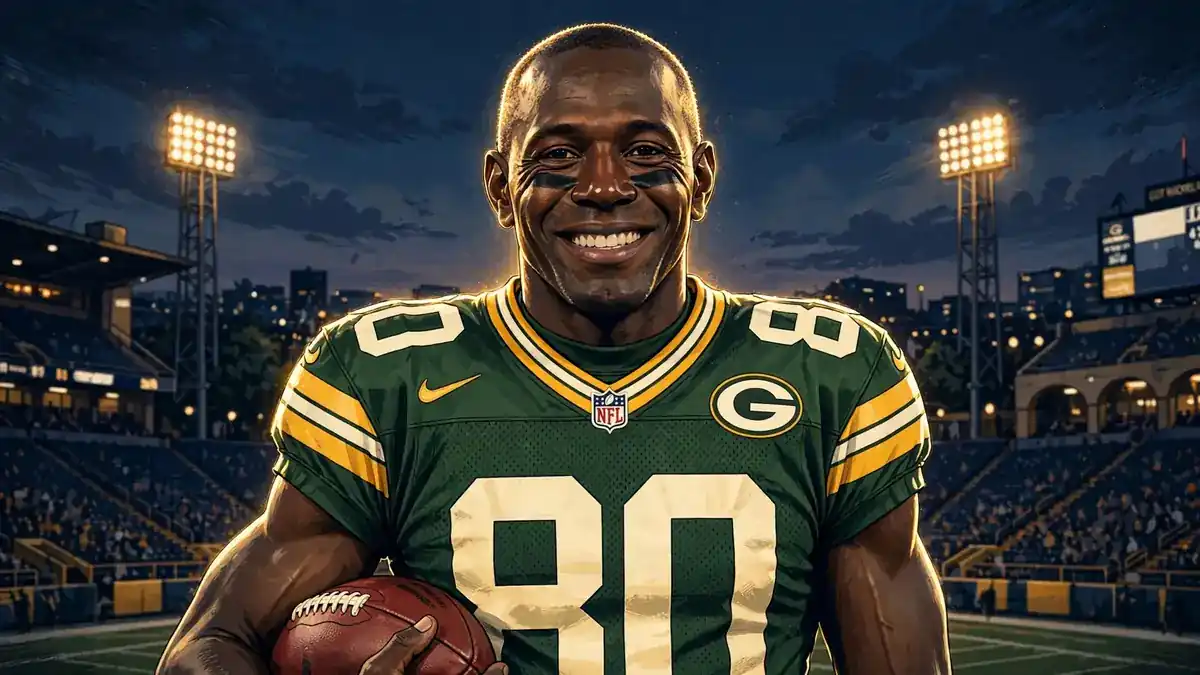
Donald Driver‘s net worth is estimated at $16–$25 million as of November 2026, with the most current trackers clustering near $20–$22 million. Celebrity Net Worth still lists the older $16 million figure from its 2015 update, The Asset Peak put the number near $20 million in 2023, and The Most 10’s 2026 update lands at $22 million — a spread that says more about stale databases than about Driver’s bank account. What the paper trail proves outright: roughly $40–$46 million in career NFL earnings across 14 seasons with one team, a Super Bowl ring, the Green Bay Packers’ all-time receiving records, a Dancing with the Stars mirrorball trophy, and a second career as an author, speaker, and nonprofit founder that started before he ever left the field.
Donald Driver: Quick Facts
| Estimated net worth | ~$20 million (range: $16–$25 million) |
|---|---|
| Profession | Former NFL wide receiver, author, television host, motivational speaker |
| Nationality | American |
| Born | February 2, 1975 (age 51) |
| Height | 6 ft 0 in (1.83 m) |
| Primary income sources | NFL salary, endorsements, book sales, television, speaking, business ventures |
| Active years | 1999–2012 (NFL); 2013–present (media, books, philanthropy) |
| Last reviewed | November 2026 |
- Early Life and Background
- Education
- Career Journey
- Rise to Fame
- Main Sources of Income
- Salary and Earnings
- Businesses and Investments
- Brand Deals and Sponsorships
- Houses, Cars and Other Assets
- Awards and Achievements
- Net Worth Growth Over the Years
- Social Media Presence
- Personal Life
- Sources & Reporting
- Frequently Asked Questions
Early Life and Background
Donald Jerome Driver was born on February 2, 1975, in Houston, Texas, to Marvin Driver Jr. and Faye Gray. The date itself carries a small footnote for anyone cross-checking sources: Celebrity Net Worth lists 1974, while the Green Bay Packers’ own Hall of Fame biography and Wikipedia both give February 2, 1975. The Packers’ record is the primary source here, and 1975 is the date Driver himself uses.
His childhood in Houston was hard in ways that later became the spine of his public story. The family spent stretches living in a U-Haul trailer, and Driver has spoken openly — first in interviews, then in detail in his 2013 memoir Driven — about stealing cars and selling drugs with his brother as a teenager. Two high school teachers at Milby High School refused to give up on him, and their persistence, plus his own athletic talent, pulled him toward a different path. He has never hidden the rough years; he built his post-football brand on them, and the honesty is part of why the story still gets told. The Donald Driver Foundation, which he started with his wife in 2004, works with homeless mothers and underprivileged children — the exact population he once belonged to.
Football was not the only sport that carried him out of Houston. Driver was a serious track athlete as well, and the speed he showed on the track — he ran the 100 meters in the 10.3-second range in high school, by contemporary accounts — stayed with him into the NFL, where his ability to separate from defenders deep downfield became a signature. The combination of football and track made him recruitable, even if the biggest college programs never came calling.
Education
Driver attended Alcorn State University in Lorman, Mississippi, a historically Black university, from 1995 to 1998. He lettered in both football and track and field, and he graduated as a first-generation college student with a degree in accounting — a detail that matters when you look at how he handled money later, because Driver has repeatedly said the accounting background shaped the way he thought about contracts, taxes, and saving during his playing career.
On the field, Alcorn State was not a winning program during his four years there; Driver never played on a winning team in college, according to the Packers’ own history. He still finished his college career with 88 receptions for 1,993 yards and 17 touchdowns, averaging 19.7 yards per catch. His senior season was his best: 1,128 receiving yards and 10 touchdowns. The numbers were strong, but the school’s profile was small, and NFL scouts were not exactly lining up in Lorman. That is the context for what happened next — one of the great draft steals in modern NFL history.
Career Journey
The Green Bay Packers selected Driver in the seventh round of the 1999 NFL Draft, with the 213th overall pick — the team’s last pick of the last round. He has said he could not find Green Bay on a map when he was drafted. The Packers kept him, but the first three seasons were a slow grind: 37 receptions, 520 yards, and three touchdowns combined across 1999, 2000, and 2001, starting only four of 35 games. Most seventh-round picks wash out in that window. Driver did not.
The breakthrough came in 2002. Driver caught 70 passes for 1,064 yards and nine touchdowns, made his first Pro Bowl, and became Brett Favre’s most reliable target — the only receiver on the roster who had ever caught a pass from Favre in a regular-season game when he arrived, and by 2002 the one Favre trusted most on third down. The Packers rewarded him that November with a five-year contract: ESPN reported a $4 million signing bonus and about $14 million in new money, after Driver had turned down a three-year, $3 million offer from Kansas City to stay in Green Bay for $563,000 the previous season. He chose loyalty and fit over a quick payday, and the decision paid off many times over.
From 2002 on, Driver was a fixture. He played 205 games and started 155 for Green Bay, missing only eight games outside his rookie season across a 14-year career — a durability record that front offices notice when they write checks. He caught a pass in 133 consecutive games, a franchise record, and posted seven seasons with more than 1,000 receiving yards. In the playoffs he added 49 catches for 675 yards and three touchdowns in 15 games.
Rise to Fame
Driver’s best statistical season was 2006, when he caught 92 passes for 1,295 yards and eight touchdowns, including a career-best 191 yards against the Minnesota Vikings on November 12, 2006, on an 82-yard touchdown. He finished in the top five in the league in receiving yardage that year and earned a Pro Bowl spot. He made the Pro Bowl four times in all — 2002, 2006, 2007, and 2010.
The records fell in his final seasons. On October 18, 2009, Driver passed Sterling Sharpe to become the Packers’ all-time leader in receptions with his 596th catch. On September 18, 2011, a 10-yard pass from Aaron Rodgers against the Carolina Panthers moved him past James Lofton as the franchise’s all-time receiving yardage leader. He retired with 743 receptions for 10,137 yards and 61 touchdowns — both franchise records, and still standing more than a decade later. For scale, the only wide receiver in NFL history with materially bigger career numbers is Jerry Rice, whose 1,549 receptions and 22,895 yards sit in a different universe; Driver’s achievement was doing it all for one franchise, drafted 213th overall.
The ring came in the 2010 season, when the Packers beat the Pittsburgh Steelers in Super Bowl XLV. Driver finished second on that team in receiving with 51 catches for 565 yards, behind Greg Jennings. He announced his retirement on January 31, 2013, on ESPN2’s Mike & Mike in the Morning, and the Packers held a public retirement ceremony at Lambeau Field on February 6, 2013. The mayor of Green Bay presented him with a key to the city, the downtown receiver statue was refurbished to wear a No. 80 Driver jersey, and the street leading to it was renamed in his honor. On July 22, 2017, he entered the Green Bay Packers Hall of Fame.
Retirement lasted about four months before the second act began. In February 2012 — while still an active player — Driver had been announced as a contestant on season 14 of ABC’s Dancing with the Stars, paired with professional dancer Peta Murgatroyd. On May 22, 2012, they were declared winners. The mirrorball trophy did something his football career never had: it put him in front of a national audience that had never watched a Packers game, and it turned a regional sports hero into a mainstream television personality. That audience is the reason his books sold, his speaking fees held up, and his foundation’s galas filled rooms for the next decade.
Main Sources of Income
Driver’s wealth rests on four legs, and the order matters. First, NFL salary: roughly $40–$46 million in career earnings, the foundation of everything else. Second, endorsements, which ran through his playing career and into retirement — national brands early, Wisconsin regional brands later. Third, books and media: a New York Times bestselling memoir, three children’s books, a fitness book, a long-running Wisconsin television show, and a co-hosting role on the Oprah Winfrey Network. Fourth, business and speaking work after retirement, including corporate roles that trade on his name and story.
One thing worth stating plainly: Driver never had a single mega-contract. His peak season paid him about $6.1 million, per Celebrity Net Worth’s season-by-season table, and his biggest multi-year deal was worth $17 million over four years. Compare that with today’s wide receivers, who sign $30 million-a-year deals, and the $20 million net worth looks less like a windfall and more like the residue of steady earning, careful spending, and a decade of post-career income. He played in the wrong era for receiver money and still retired comfortable — which is the real story of this estimate.
Salary and Earnings
Driver’s contract history reads like a case study in a player earning his money in installments, with the team upgrading his deal almost every time he outperformed it. The rookie contract that came with the 213th pick paid little — Celebrity Net Worth’s season table lists $290,700 for 2000-01 and $404,100 for 2001-02, the kind of money that disappears fast after taxes and agent fees. Then came the deals that built the fortune.
| Contract / season | Reported terms | Source |
|---|---|---|
| November 2002 extension | Five years, about $14 million in new money, $4 million signing bonus | ESPN |
| 2006 extension | Four years, $17 million (agent Jordan Woy) | 247Sports / NFLPA data |
| August 2007 extension | About $11 million in new money; average salary rose to about $5.75 million per year | Milwaukee Journal Sentinel via NFLPA data |
| August 2010 extension | Two years, terms unreported; kept him under contract to age 38 | National Football Post / Milwaukee Journal Sentinel |
| May 2012 restructure | One year, $2.3 million; $1.1 million base salary plus $1.2 million roster bonus | Green Bay Press-Gazette (Rob Demovsky) |
The season-by-season money, as tabulated by Celebrity Net Worth, shows the climb: $571,100 in 2004-05, $1.4 million in 2005-06, $5.3 million in 2006-07, $4.1 million in 2007-08, $5.2 million in 2008-09, and a peak of $6.1 million in 2009-10. NBC Sports, working from a league source in May 2009, put his total 2009 compensation at about $5.9 million once roster bonuses and a $206,720 workout bonus were counted — and noted that his 2010 potential compensation exceeded $7 million. The 2007 extension is the most revealing document in the file: the Milwaukee Journal Sentinel reported, from NFL Players Association data, that the new money was worth almost $11 million and lifted his average yearly pay to about $5.75 million, with $7.2 million of it sitting in an extra year he might never reach because he would be 35 when it came due. He reached it anyway, and kept playing.
What did it all add up to? The Asset Peak estimates about $40 million in salary across the 14 seasons. BVM Sports, citing Spotrac, puts career earnings at $46 million. The gap between those two numbers is the difference between base salary and total cash — signing bonuses, roster bonuses, workout bonuses, and playoff shares — and the honest figure is a range: $40–$46 million in career NFL earnings. After federal and Wisconsin taxes, agent fees of roughly 3 percent, and 14 years of living costs, a $16–$25 million net worth is the plausible remainder, with endorsements, books, and speaking income filling the gap that taxes took out.
Two details from the contract file deserve a spotlight because no competitor’s net worth page explains them. First, Driver spoke out publicly about being underpaid before the 2006 season, and the Packers responded by adding two years to his contract and raising its value to $17 million over four years — a rare case of a player negotiating in the press and winning. Second, the 2012 restructure: Driver was due more than $5 million at age 37, took a pay cut to a $2.3 million deal with $1.2 million guaranteed, and secured his roster spot and his one-team retirement in exchange. He traded money for legacy, knowingly, in his final season.
Businesses and Investments
Driver’s post-football business life is quieter than the headline-grabbing portfolios of some of his peers — no tequila brand, no crypto exchange, no franchise empire — but it is real, and it is still growing. The center is the Donald Driver Foundation, which he and Betina started as a private foundation in 2000 and took public in 2002. The foundation’s work with homeless mothers and underprivileged children in Wisconsin and Texas is the through-line of his public life, and in March 2014 he created the Donald Driver Driven to Achieve Awards, which have since honored 18 recipients and given away more than $1 million in scholarships and support.
The commercial ventures sit under the “Driven” brand. Driven Elite runs community health and wellness clubs, and the Driven All-Girls Sports Initiative works with female athletes on coaching and mindset — both listed on his official website, donalddriver80.com. In 2021 he was appointed Chief Impact Officer for Listeners On Call, a Dallas-based mental-health support company, a role Texas Lifestyle Magazine covered at the time. The freshest development is also the most interesting for anyone tracking his 2026 income: on November 17, 2026, Driver was named the first chief motivation officer for SURGE by BSN Sports, a new program aimed at keeping girls in youth sports. The announcement, carried by BSN Sports’ partners that day, puts a serving NFL-era name on a youth-sports initiative at a moment when girls’ participation is a live public debate — and it is a paid corporate role, not a ceremonial title.
He also serves as cultural ambassador for Milwaukee’s Marcus Center for the Performing Arts, and he co-hosts The Hero Effect on the Oprah Winfrey Network, a series profiling people making a difference in their communities. Since 2004 he has co-hosted Inside the Huddle with Donald Driver, a statewide Wisconsin Packers analysis show on WLUK-TV, and he holds a weekly Thursday slot on Wisconsin’s Afternoon News with John Mercure on AM 620 WTMJ. The television work pays modestly next to an NFL salary, but it has kept his name in front of Wisconsin audiences for two decades — and in Wisconsin, that name still opens doors.
On property, the one verified transaction is striking: in 2022 Driver bought a $3 million Milwaukee loft from fellow Wisconsin athlete Jabari Parker, according to reporting cited by Wikipedia. He splits his time between Texas — the family home is in Flower Mound — and Milwaukee. No public record supports claims of a large real estate portfolio beyond those two homes, and this article does not invent one.
Brand Deals and Sponsorships
Driver’s endorsement file is thinner than a modern star’s, because he played before athletes carried personal brands on social media — but it is documented. The Asset Peak lists Nike, Pepsi, and GMC among the brands he endorsed during his career. Wikipedia’s biography adds the Wisconsin regional campaigns that paid him after he became a local institution: McDonald’s, AirTran Airways, Kwik Trip, Goodwill, Jani-King, and Time Warner Cable.
The regional deals are the telling part. National brands pay for reach; Wisconsin brands paid for trust. A Kwik Trip or Goodwill campaign in Green Bay is not a vanity deal — it is a company betting that the most liked man in the state will move product in its stores. Those deals ran for years, and they explain why Driver’s endorsement income kept flowing after retirement while many players’ deals stop the day they stop playing. No reliable source puts a dollar figure on his total endorsement earnings, and this article does not guess at one; the safe statement is that endorsements were a meaningful second income stream, not the main one.

Houses, Cars and Other Assets
Driver’s asset picture is modest by celebrity standards, and that modesty is part of the story. The family home is in Flower Mound, Texas, where he has lived with Betina and their three children since his playing days. The second home is the $3 million Milwaukee loft purchased in 2022 from Jabari Parker, which anchors his Wisconsin life — the foundation work, the Marcus Center role, and the television commitments all run out of Milwaukee and Green Bay.
On cars, there is no verified public record of an exotic collection, and several net worth pages that claim one are copying each other rather than citing a source. What is documented is that Driver’s spending habits leaned toward family and foundation rather than display: his memoir describes growing up with nothing, and his public statements about money have consistently stressed saving and giving. The $3 million loft is the single largest documented purchase of his post-career life, and it reads less like a splurge than a base of operations — a place to live while running the Wisconsin side of his work.
His books are an asset of a different kind. Driven (2013), written with Peter Golenbock, became a New York Times bestseller. The three Quickie children’s books — Quickie Handles a Loss, Quickie Makes the Team, and Quickie Goes to the Big Game — gave him a second shelf in bookstores, and he has said Nickelodeon discussed turning the series into a television show. The 3D Body Revolution (2017), a health and fitness book with 25 recipes and 36 exercises, rounded out the shelf. Book advances and royalties for a bestselling sports memoir run into the hundreds of thousands of dollars, not millions — real money, and a durable income stream, but a supporting act next to the NFL earnings.
Awards and Achievements
| Year | Honor |
|---|---|
| 2002, 2006, 2007, 2010 | Pro Bowl selection (4×) |
| 2011 (2010 season) | Super Bowl XLV champion, Green Bay Packers |
| 2012 | Dancing with the Stars season 14 winner (with Peta Murgatroyd) |
| 2013 | AMVETS Humanitarian of the Year; memoir Driven becomes a New York Times bestseller |
| 2017 | Inducted into the Green Bay Packers Hall of Fame |
| Career | Packers all-time leader: receptions (743), receiving yards (10,137); 133 consecutive games with a reception; seven 1,000-yard seasons |
One honor Driver does not have is worth naming because readers ask about it constantly: he is not in the Pro Football Hall of Fame in Canton. The Packers Hall of Fame induction in 2017 is a franchise honor, not the national one, and the case for Canton — one-team loyalty, franchise records, a ring — runs into a crowded field of receivers with bigger raw numbers. That distinction belongs in any honest profile, and it does not diminish the rest of the list.
Net Worth Growth Over the Years
| Year | Estimated net worth | What was happening |
|---|---|---|
| 2010 | ~$10–$12 million | Peak earning years; Super Bowl XLV season; $6.1 million peak salary |
| 2015 | $16 million | Celebrity Net Worth’s figure, published after retirement; DWTS win and Driven royalties banked |
| 2019 | $16 million | PlayersWiki repeats the $16 million estimate; foundation and speaking work steady |
| 2023 | ~$20 million | The Asset Peak’s estimate; Milwaukee loft purchase; Driven Elite and All-Girls Sports Initiative active |
| 2026 | $16–$25 million (~$20 million) | The Most 10: $22 million; The Indian Architecture: $20–$25 million; SURGE chief motivation officer role added |
The shape of the table is the point: slow, steady growth after retirement, not a spike. Driver’s wealth did not jump when he left football — it compounded. The 2015–2019 plateau at $16 million reflects how stale most net worth databases are for retired athletes; the 2023–2026 move toward $20 million and beyond reflects the newer trackers catching up with a decade of book, television, speaking, and business income. A reader comparing him with peers should note the contrast: Emmitt Smith and Deion Sanders both built far larger post-career business empires, and their estimates show it. Driver’s fortune is smaller and quieter — and, by every available account, honestly earned and carefully kept.
Social Media Presence
Driver’s social media presence is modest for a man with his resume, and it fits a player who retired before athletes were expected to be content creators. His X account, @Donald_Driver80, carried about 713,000 followers in the last public audit tracked by SpeakRJ, with a bio that reads like a resume in miniature: husband, father of three, New York Times bestselling author, Super Bowl champion, Packers all-time leading receiver, 2012 DWTS champion, Packers Hall of Fame, Wisconsin Hall of Fame. His Instagram handle is @donald_driver80, listed in that same bio. He posts about the foundation, the Driven to Achieve Awards, Packers alumni events, and family — not about luxury, and not often about himself. The accounts are a distribution channel for his charity and business work, not a revenue stream in their own right, and this article does not treat follower counts as income.
Personal Life
Driver is married to Betina Driver, and they have three children: Cristian, Christina, and Charity. The family lives in Flower Mound, Texas, with the Milwaukee loft as their Wisconsin base. Betina has been a partner in the foundation work since the start — the couple founded it together in 2004 — and Driver has said his wife wanted him to retire so he could be present for their children’s childhoods, a conversation he recounts in Driven after a hospital stay that made him think his career was over.
He is a member of the Alpha Phi Alpha fraternity, and every year he holds the Donald Driver Football Camp for local kids in Cleveland, Mississippi — the town near Alcorn State, at Cleveland High School’s football field — a commitment that has run for years without much publicity. The camp, the foundation, and the Driven to Achieve Awards are the same story told three ways: a man who grew up with nothing, spending the second half of his life making sure other kids get the break he got from two teachers in Houston.
Sources & Reporting
Green Bay Packers — Hall of Fame biography and draft history: birth date, Alcorn State career, 213th overall pick, franchise records (743 receptions, 10,137 yards), Pro Bowl years, 133-game reception streak, 205 games played. Reporting window: Packers history pages, updated 2022–2023.
Celebrity Net Worth — $16 million net worth estimate and season-by-season salary table (peak $6.1 million, 2009-10); last updated October 2015, treated here as a stale floor rather than a current figure.
ESPN — November 2002 five-year contract reporting: $4 million signing bonus, about $14 million in new money, and the rejected Kansas City offer.
NBC Sports — May 2009 report on 2009 compensation (about $5.9 million total, $3.9 million base plus bonuses) from a league source.
Milwaukee Journal Sentinel — August 2007 extension reporting via NFL Players Association data (about $11 million in new money, $5.75 million average salary) and the 2010 extension terms, as cited by National Football Post.
247Sports — 2006 four-year, $17 million extension terms via agent Jordan Woy.
BVM Sports — career earnings of $46 million per Spotrac, in a 2022 “where is he now” profile.
The Most 10 — 2026 net worth estimate of $22 million.
The Asset Peak — 2023 estimate near $20 million, career salary estimate of about $40 million, and endorsement brands Nike, Pepsi, and GMC.
The Indian Architecture — 2026 estimate band of $20–$25 million.
Wikipedia — career statistics, Dancing with the Stars win, book list, Driven to Achieve Awards ($1 million+ given), $3 million Milwaukee loft purchase (2022), foundation history, and Wisconsin regional endorsement campaigns.
Carthage College — 2022 campus visit report: business ventures in fitness and marketing, The Hero Effect on OWN, first-generation graduate with an accounting degree.
Texas Lifestyle Magazine — 2021 profile: Chief Impact Officer role at Listeners On Call and Donald Driver Foundation’s mental-health focus.
Freshness note: Driver’s appointment as the first chief motivation officer for SURGE by BSN Sports was announced November 17, 2026, the day this article was written, and is included as the most current item in the record. Where sources conflict — the birth year (1974 vs 1975), career earnings ($40 million vs $46 million), and the net worth band itself — this article publishes the range and names who says what, rather than picking a single number and hiding the disagreement.
Frequently Asked Questions
What is Donald Driver’s net worth in 2026?
Donald Driver’s net worth is estimated at $16–$25 million as of November 2026, with most current trackers clustering near $20–$22 million. Celebrity Net Worth’s older $16 million figure dates to 2015; The Most 10 puts the 2026 number at $22 million, and The Indian Architecture gives a $20–$25 million band.
How much did Donald Driver earn in the NFL?
Driver earned roughly $40–$46 million across his 14-season NFL career. The Asset Peak estimates about $40 million in salary, while BVM Sports, citing Spotrac, puts total career earnings at $46 million. His peak season paid about $6.1 million in 2009-10, per Celebrity Net Worth’s season-by-season table.
What is Donald Driver doing now?
Driver runs the Donald Driver Foundation, hosts television work in Wisconsin, writes, and speaks. His newest role, announced November 17, 2026, is chief motivation officer for SURGE by BSN Sports, a program keeping girls in youth sports. He also serves as cultural ambassador for Milwaukee’s Marcus Center and co-hosts The Hero Effect on the Oprah Winfrey Network.
Did Donald Driver win Dancing with the Stars?
Yes. Driver won season 14 of Dancing with the Stars in May 2012, partnered with professional dancer Peta Murgatroyd. He competed while still an active NFL player, and the win made him a national television personality after retirement.
How many Super Bowls did Donald Driver win?
Driver won one Super Bowl: Super Bowl XLV, when the Green Bay Packers beat the Pittsburgh Steelers to close the 2010 season. He finished second on that team in receiving with 51 catches for 565 yards.
Is Donald Driver in the Pro Football Hall of Fame?
No. Driver was inducted into the Green Bay Packers Hall of Fame in 2017, which is a franchise honor, not the Pro Football Hall of Fame in Canton. He holds the Packers’ all-time records for receptions (743) and receiving yards (10,137), but Canton has not called.
Who is Donald Driver’s wife?
Donald Driver is married to Betina Driver. They have three children — Cristian, Christina, and Charity — and founded the Donald Driver Foundation together in 2004. The family lives in Flower Mound, Texas, with a second home in Milwaukee.
How old is Donald Driver and how tall is he?
Donald Driver was born February 2, 1975, in Houston, Texas, making him 51 years old as of November 2026. He is 6 feet tall (1.83 m) and played at about 194 pounds. Note that Celebrity Net Worth lists his birth year as 1974; the Packers’ own Hall of Fame biography gives 1975.
Final Thoughts
Donald Driver’s $16–$25 million fortune is the least flashy kind of wealth in sports: no single jackpot, no viral business, no nine-figure contract. It is the sum of a seventh-round pick who never missed a check, never left his team, and never stopped working after the cheering stopped. The $40–$46 million in career earnings did the heavy lifting; the books, the television work, the endorsements, and the speaking fees kept the line moving upward for a decade after retirement. The number that matters most in his file is not a dollar figure at all — it is 213, the draft slot where Green Bay took a chance on a kid from Alcorn State who could not find the city on a map, and 743, the receptions that made him the best receiver the franchise ever had. Everything else, including the money, followed from those two numbers.
Published on November 17, 2026. Last reviewed November 2026. Found an error? See our corrections policy.