
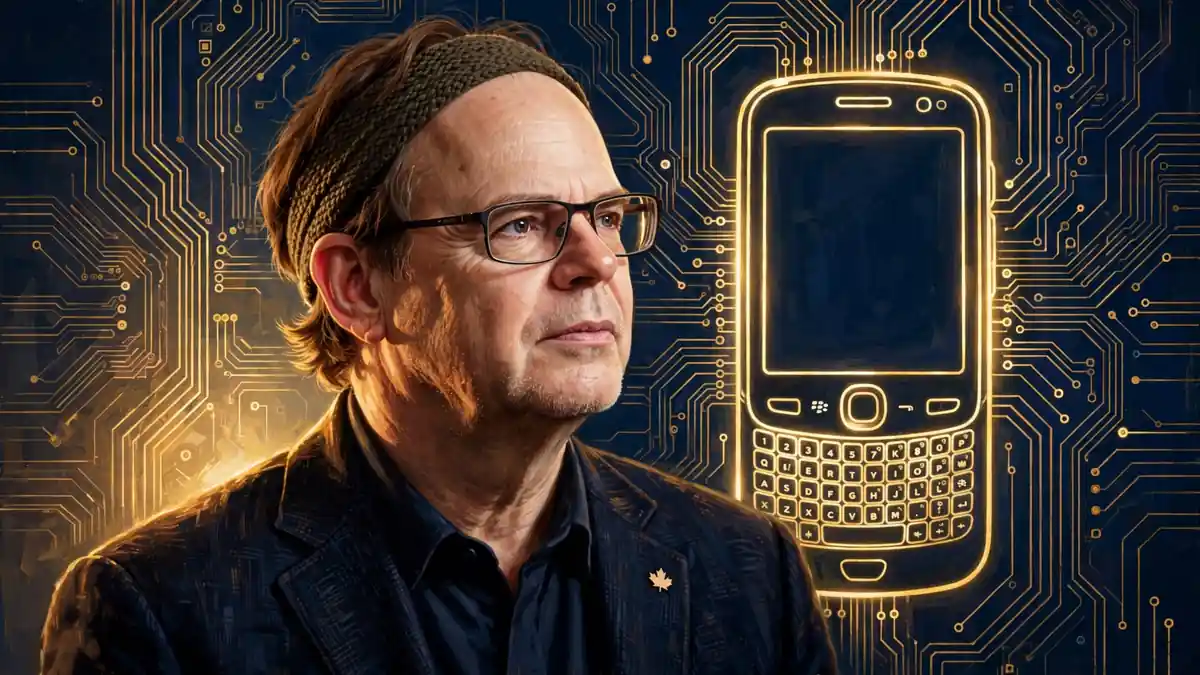
Douglas Fregin‘s net worth is estimated at $1 billion to $1.5 billion as of October 2026. He made nearly all of it as the low-key engineer who co-founded Research In Motion — the company that became BlackBerry — alongside his childhood friend Mike Lazaridis in 1984. Fregin designed the circuit boards inside the first BlackBerry devices, held a 2% stake worth roughly $1.3 billion when he retired in May 2007, then sold everything within months of the first iPhone’s launch — sidestepping the 90% collapse in RIM’s share price that shredded the fortunes of his fellow executives. He then reunited with Lazaridis to seed Quantum Valley Investments with $100 million of their own money and has spent his retirement racing cars and funding charity projects from Waterloo to rural Uganda.
Douglas Fregin: Quick Facts
| Estimated net worth | $1B–$1.5B (range: $1 billion to $1.5 billion) |
|---|---|
| Profession | Entrepreneur, engineer, investor |
| Nationality | Canadian |
| Born | 1960, Windsor, Ontario, Canada (age 66) |
| Height | Not publicly disclosed |
| Primary income sources | Research In Motion share sales (1984–2007), Quantum Valley Investments |
| Active years | 1984–2007 (operating career); investor and philanthropist since |
| Last reviewed | October 2026 |
- Early Life and Background
- Education
- Co-Founding Research In Motion
- The BlackBerry Boom
- Main Sources of Income
- The Billion-Dollar Exit of 2007
- The Three BlackBerry Fortunes, Compared
- Quantum Valley Investments
- Philanthropy
- Houses, Cars and Other Assets
- Awards and Recognition
- Net Worth Growth Over the Years
- Public Profile and Media Presence
- Personal Life
- Sources & Reporting
- Frequently Asked Questions
Early Life and Background
Douglas Edgar Fregin was born in 1960 in Windsor, Ontario, the city directly across the river from Detroit where Canada’s automotive industry met America’s. It was an apt birthplace for a boy who would spend his life around machines. Fregin met Mike Lazaridis in grade school — the two became fast friends around the fifth or sixth grade — and the friendship was sealed by a shared obsession with taking things apart. Long before either could drive, they were building radio-controlled models and tinkering with rudimentary electronics, the kind of basement experiments that, in the 1970s, looked like harmless play and in hindsight look like the first draft of a business plan.
The two teenagers’ complementary instincts showed up early. Lazaridis was the dreamer who could see where technology was going; Fregin was the hands-on builder who could make the pieces work. Friends from that era remember Fregin as the steadier of the pair, more interested in the workshop than the spotlight — a temperament that never changed. When the money finally arrived, in amounts that would have made most people insufferable, Fregin kept working on race cars and stayed out of the news. That early-life pattern — build the thing, let someone else take the bow — explains almost everything about how his fortune was made and kept.
Education
Fregin studied electrical engineering at the University of Windsor, earning his bachelor’s degree there. While he was in Windsor and Lazaridis was down the road at the University of Waterloo, the two friends kept talking, kept tinkering, and eventually started talking about starting a company. Fregin’s engineering training gave him the specific skill that would make RIM possible: the design of printed circuit boards and the evaluation of the materials and fabrication technologies that let wireless hardware shrink from lab equipment to pocketable devices.
Decades later, the universities came back into his life as institutions rather than classrooms. The University of Waterloo awarded him an Honorary Doctorate of Engineering on June 19, 2022, recognizing the BlackBerry work, and he has since funded quantum and nanotechnology research on the same campus where Lazaridis once studied. It is a tidy circle: the school that trained his partner became the beneficiary of the fortune they built together.
Co-Founding Research In Motion
In 1984, Fregin and Lazaridis founded Research In Motion — RIM — to commercialize a device they had been developing for video signaling. The company set up in Windsor and, in February 1985, received a $15,000 loan from Ontario’s New Ventures program, a modest sum that the pair treated like a fortune. RIM’s first product, the Budgie, was a digital display unit for advertisements. It was bulky and hard to sell, and the company soon pivoted to what it could actually do well: building circuit boards and computerized digital displays for other companies, keeping the lights on one contract at a time.
Fregin’s role as Vice President of Operations put him in charge of the unglamorous core of the business — manufacturing, logistics, and quality assurance. While Lazaridis chased the vision and, later, Jim Balsillie chased the deals, Fregin made sure the hardware actually worked. His fingerprints were all over RIM’s early technical wins. The company developed the DigiSync film reader, which sharply cut post-production time in film editing; that work earned RIM both an Emmy and a technical achievement award from the Academy of Motion Picture Arts and Sciences. Separately, Fregin shared a Technology and Engineering Emmy Award in 1994 with Eastman Kodak and the National Film Board of Canada for the “Development of a Keycode Reader” — a piece of film-technology hardware that had nothing to do with phones and everything to do with Fregin’s habit of solving the engineering problem in front of him.
The company’s trajectory changed in 1992, when Fregin and Lazaridis accepted a $125,000 investment from Jim Balsillie, who famously mortgaged his home to raise it. Balsillie became co-CEO alongside Lazaridis and supplied the salesmanship RIM had lacked. Fregin stayed in operations, building the manufacturing infrastructure that would soon have to scale to millions of units. When RIM went public in 1997, valued at roughly $470 million, Fregin’s 5% stake was worth about $23.6 million — serious money, and merely the opening chapter.
The BlackBerry Boom
RIM’s pivot to wireless communication produced the product that defined an era. In 1999 the company released the first BlackBerry, a wireless handheld that put secure mobile email in the pockets of executives, politicians, and lawyers. The push-email feature turned the device into a compulsion — the press dubbed it the “CrackBerry” — and RIM went from niche wireless contractor to the company that invented the smartphone category years before the word existed.
Fregin’s engineering sat at the center of that rise. He designed and oversaw the production of the first circuit boards used in RIM’s wireless technology, evaluating the materials and fabrication processes that made the devices reliable at scale. Through the dot-com boom and the early 2000s, the value of his stake compounded ferociously. By 2000 his holdings were being estimated in the high hundreds of millions; Canadian Business put his net worth at $651 million on its 2006 Rich 100 list. In 2005 he still owned 2.7% of the company, valued at $396 million — and the stock had much further to run. Between 2005 and mid-2007, RIM shares roughly tripled as BlackBerry became the default device of corporate life. Fregin, who had started with a $15,000 government loan, was about to become a billionaire several times over.
Main Sources of Income
Fregin’s fortune has essentially one source: the equity he built at Research In Motion over 23 years and the way he liquidated it. Unlike modern founders who diversify early, Fregin rode a single concentrated position from the 1984 founding through the 2007 exit. His compensation as Vice President of Operations was real but rounding error next to the equity — the money came from the shares, sold in stages as the company matured and then in full during 2007.
Since 2013, his capital has worked through Quantum Valley Investments, the fund he co-founded with Lazaridis. The pair seeded it with C$100 million (about US$98 million at the time) of their own money to commercialize breakthroughs in quantum computing from the Waterloo research ecosystem. As a private fund it discloses little about returns, but quantum computing’s surge through the 2020s — with the field drawing billions in global investment — has likely lifted the value of that commitment. There are no public records of other major income streams: no salary since 2007, no endorsement deals, no book, no speaking circuit. The wealth was made once, made completely, and has been compounding quietly ever since.

The Billion-Dollar Exit of 2007
This is the chapter that made Fregin’s reputation among investors — and the reason his net worth survived while so many tech fortunes from that era did not. On January 9, 2007, Steve Jobs walked onto a stage and introduced the iPhone. Inside Research In Motion, the reaction was dismissive: the battery life would be terrible, the touchscreen keyboard could never work for serious users, the networks weren’t ready. A few months later, in May 2007, Doug Fregin did something that puzzled outsiders. He retired.
There was no long goodbye and no extended transition. He stepped away from the company he had co-founded 23 years earlier, holding roughly 2% of its shares — valued at about $1.3 billion at the time. Then, through the rest of 2007, he sold. The timing was close to perfect: the first iPhone reached customers on June 29, 2007, and Fregin liquidated his entire RIM position around that moment. When the dust settled, Canadian Business estimated his net worth at $1.72 billion in November 2007.
For about a year, the exit looked like a mistake. On June 19, 2008, RIM shares hit an all-time high of $147.55, pushing the company’s market value to roughly $84 billion. Had Fregin still held his 2.7% stake at that peak, it would have been worth around $2.3 billion — and his original 5% IPO stake would have translated to roughly $4.2 billion. But that June 2008 peak was the top. Over the following years, as the iPhone and Android dismantled BlackBerry’s dominance, RIM’s share price collapsed by roughly 90%. The executives who held on watched their paper fortunes evaporate; Lazaridis and Balsillie, both still heavily exposed, saw their wealth cut by more than half. Fregin’s, converted to cash before the fall, stayed intact. He is the rare founder whose fortune was preserved not by picking the winner but by refusing to ride the loser down.
Quantum Valley Investments
In March 2013, Fregin teamed up with Lazaridis again — this time not to build hardware, but to fund the science that might replace it. The pair launched Quantum Valley Investments (QVI), a private fund seeded with C$100 million (about US$98 million at 2013 exchange rates) of their own money. The mandate: provide financial and intellectual capital to commercialize breakthroughs in quantum information science emerging from Waterloo’s research cluster — the Institute for Quantum Computing, the Perimeter Institute for Theoretical Physics, and the Waterloo Institute for Nanotechnology, all at or near the University of Waterloo.
The ambition was explicit. Lazaridis told the Wall Street Journal at the launch that the goal was to turn Waterloo into “Canada’s Quantum Valley,” in the same way that discoveries at Bell Labs had seeded Silicon Valley. In press statements around the launch, the partners argued that quantum computing would do to classical computing what their own wireless work had done to the landline — and that the research capability built up in Waterloo over the previous decade gave the region a genuine shot at leading the global race. QVI is headquartered in Waterloo, and Fregin serves as a Managing Partner.
The same year, the pair briefly considered a far more dramatic move: buying BlackBerry itself. As the company’s fortunes crumbled, Fregin and Lazaridis explored a takeover bid, engaging Goldman Sachs and Centerview Partners to review their options, as reported by the Financial Post and The Guardian in October 2013. The bid never materialized — Fairfax Financial’s competing proposal won out — but the episode confirmed that Fregin’s connection to the company ran deeper than his sold shares. He had cashed out of the stock, not out of the story.
Philanthropy
Fregin’s charitable record is unusually deep for someone so allergic to publicity, and it started well before the billions arrived. In 2000, when his RIM stake was still climbing, he donated $10 million to help found the Perimeter Institute for Theoretical Physics in Waterloo — a gift that predates his billionaire status and suggests the philanthropy was conviction, not image management.
His current giving runs through two main channels. He has made donations to the Nanotechnology Initiative and the Quantum-Nano Centre at the University of Waterloo, as well as to the Perimeter Institute, keeping his money close to the scientific ecosystem he helped fund. Separately, he devotes significant time and resources to the Salama Shield Foundation, an African AIDS relief agency, supporting the development of a vocational school in rural Uganda — a project about as far from the smartphone wars as a billionaire can get. Fregin is also a Member of the Order of Canada and a recipient of the Queen Elizabeth II Diamond Jubilee Medal, national honors that reflect the public record of his contributions.

Houses, Cars and Other Assets
Almost nothing about Fregin’s property holdings is on the public record — he has never courted the real-estate press, and Waterloo’s quiet money tends to stay quiet. What is documented is the hobby. Fregin is a serious car enthusiast and a fixture in pro-am racing circuits, including the Ferrari Challenge and Toyota’s charitable Pro/Celebrity Race at the Grand Prix of Long Beach. Racing at that level is not a cheap pastime: a Ferrari Challenge car, the team to run it, and a season of competition run into the hundreds of thousands of dollars, which for Fregin amounts to a rounding error.
There is a pleasing symmetry in the choice of hobby. A man who spent his career obsessing over the precision of circuit boards now spends his weekends obsessing over the precision of racing lines — engineering at 200 miles per hour, in a helmet that makes him unrecognizable, which may be the whole point. Beyond the cars, his documented assets are financial: the proceeds of the 2007 share sales, the QVI fund commitment, and whatever the intervening 18 years of quiet compounding have produced. No superyacht, no private jet on the public record, no trophy real estate portfolio splashed across listings. The asset list of a man who got rich and decided the money was the means, not the message.
Awards and Recognition
Fregin’s trophy shelf predates the BlackBerry fortune and says a lot about what he valued. In 1994 he shared a Technology and Engineering Emmy Award with Eastman Kodak and the National Film Board of Canada for the “Development of a Keycode Reader” — the DigiSync work that also earned RIM a technical achievement award from the Academy of Motion Picture Arts and Sciences. These were engineers’ awards, given for solving hard problems in film post-production, and Fregin collected them while RIM was still a scrappy wireless contractor.
The later honors are the establishment kind: Member of the Order of Canada, the Queen Elizabeth II Diamond Jubilee Medal, and the Honorary Doctorate of Engineering from the University of Waterloo, awarded June 19, 2022. Then came the strangest recognition of all — Hollywood. The 2023 film BlackBerry, directed by Matt Johnson, cast Johnson himself as Fregin: the headband-wearing, morale-boosting heart of the early RIM engineering team, set against Jim Balsillie’s corporate aggression. The film was a critical hit, and it did something two decades of press releases never had — it made the general public learn Doug Fregin’s name. The real Fregin, characteristically, has said little about it in public.
Net Worth Growth Over the Years
Fregin’s wealth curve is a study in concentration and timing — almost all of it was made in one asset, and the decisive move was selling it. The table below tracks the public milestones.
| Year | Milestone | Estimated value |
|---|---|---|
| 1985 | RIM founded on a $15,000 Ontario New Ventures loan | $0 (startup) |
| 1997 | RIM IPOs at ~$470M valuation; Fregin holds 5% | $23.6M |
| 2005 | 2.7% stake as BlackBerry goes mainstream | $396M |
| 2006 | Canadian Business Rich 100, rank 70 | $651M |
| May 2007 | Retires as VP Operations with ~2% stake | $1.3B |
| Nov 2007 | Canadian Business peak valuation after share sales | $1.72B |
| 2013 | Co-founds Quantum Valley Investments (C$100M fund) | Billionaire (private) |
| 2026 | NetWorthCraft estimate | $1B–$1.5B |
How does that compare with the other two men who built BlackBerry? Celebrity Net Worth currently estimates Mike Lazaridis at about $600 million — a figure held down by hundreds of millions in charitable giving to the Perimeter Institute and the Institute for Quantum Computing — and Jim Balsillie at roughly $500 million. Both stayed exposed to RIM/BlackBerry shares through the collapse; Fregin’s 2007 exit is the entire reason he remains the wealthiest of the three by most measures. The comparison is the point: in wealth preservation, when you sell matters as much as what you built.
The Three BlackBerry Fortunes, Compared
Fregin’s exit only looks brilliant next to the alternative — and the alternative has names. The three men who built RIM took three different paths with their equity, and the outcomes diverge exactly the way the 2007–2008 chart would predict.
| Founder | Peak wealth moment | 2026 estimate (Celebrity Net Worth) |
|---|---|---|
| Doug Fregin | $1.72B (Nov 2007, Canadian Business) | $1B |
| Mike Lazaridis | CA$2.9B (2009, Canadian Business) | $600M |
| Jim Balsillie | Multi-billion at the 2008 peak | $500M |
The pattern is instructive. Lazaridis stayed as co-CEO until 2012 and held his shares through the collapse — and then gave away hundreds of millions to the Perimeter Institute and the Institute for Quantum Computing, which is why his current estimate sits far below his peak. Balsillie, who bought in for $125,000 in 1992, stayed exposed through the same crash and has since rebuilt as an investor and policy figure (a major shareholder and director of MDA Space). Fregin is the only one of the three whose wealth was converted to cash at the top. Note the honest caveat: rich-list estimates for all three men differ across outlets and years — Canadian Business’s historical figures and Celebrity Net Worth’s current ones are the most-cited public benchmarks, and we use both where named.
Public Profile and Media Presence
Doug Fregin has no public social media presence to speak of — no verified X account, no Instagram, no LinkedIn posts, no Substack. In an era when billionaires livestream their opinions, Fregin’s absence is almost a statement. The few public traces of him are third-party: his managing-partner bio on the Quantum Valley Investments site, his Wikipedia entry, and the occasional photograph from a charity race. He gives no interviews.
That privacy is precisely why the 2023 film BlackBerry mattered so much to his public profile. Matt Johnson’s portrayal — headband, warmth, engineering-first ethics — became the public’s image of a man most Canadians had never seen. The film’s success drove a wave of “where is he now” coverage (The Cinemaholic’s 2023 piece is typical of the genre), all of it landing on the same conclusion: he is alive, well, wealthy, racing cars, and not talking to anyone about it. For a net-worth researcher, the privacy is a feature, not a bug — it means the estimate has to be built from filings, rich lists, and fund commitments rather than lifestyle claims, which is the honest way to build it.
Personal Life
Details of Fregin’s family life are not publicly documented, and — in keeping with the man’s entire approach to fame — we will not speculate. What is known is that he has remained rooted in the Waterloo, Ontario region, the community where RIM grew up and where his philanthropy is concentrated. He has been friends with Mike Lazaridis since grade school, a relationship that survived co-founding a company, a legendary corporate breakup of the industry around them, and a second act together at Quantum Valley Investments. Four decades of partnership, from a $15,000 startup loan to a $100 million quantum fund, is the through-line of both men’s lives.
The personal detail the record does offer is the racing. Fregin competes in the Ferrari Challenge series and has taken part in Toyota’s charitable Pro/Celebrity Race, the Long Beach event that pairs professional drivers with celebrities to raise money for children’s charities. It is the one place he reliably appears in public — in a race suit and helmet, at speed, anonymous in plain sight.
Sources & Reporting
- Celebrity Net Worth — current $1 billion estimate; the detailed 2007 exit narrative (May retirement, gradual share sales through 2007, the June 2008 $147.55 peak math); racing hobby; Lazaridis (~$600M) and Balsillie (~$500M) comparisons. Reporting window: 2024–2026.
- Wikipedia — stake history (5% at the 1997 IPO worth $23.6M; 2.7% in 2005 worth $396M; ~2% at May 2007 retirement worth $1.3B), $10M Perimeter Institute founding donation (2000), May 2007 retirement, Emmy 1994, honorary doctorate June 2022. Citations trace to Canadian Business, The Globe and Mail, and the Financial Post.
- Canadian Business — $1.72 billion net-worth estimate (November 2007); $651 million Rich 100 listing (2006); “Douglas Fregin — The Other RIM Guy” profile (2005). The richest historical valuations on record.
- Quantum Valley Investments — Fregin’s managing-partner bio: RIM vice president of operations until 2007, circuit-board design work, University of Windsor engineering degree, 1994 Technical Emmy, Order of Canada, Queen Elizabeth II Diamond Jubilee Medal, Salama Shield Foundation / Uganda vocational school philanthropy, Waterloo nanotechnology and Perimeter Institute donations.
- Fast Company — March 2013 QVI launch via Mike Lazaridis’s Wall Street Journal interview: $100 million fund, first deal already in the pipeline.
- CrackBerry — March 2013 QVI announcement details: C$100M (~US$98M) fund, Waterloo headquarters, “Canada’s Quantum Valley” mission, target institutes (IQC, Perimeter, Waterloo Institute for Nanotechnology).
- The Guardian — October 2013 reporting on Fregin and Lazaridis considering a BlackBerry takeover bid, with Goldman Sachs and Centerview Partners engaged.
- The Cinemaholic — biographical background (Windsor upbringing, grade-school friendship with Lazaridis, Budgie first product, Balsillie’s $125,000 investment in 1992, May 2007 retirement and full share sale).
- Western Business — biographical summary and FAQ set (birth circa 1960, ~$1B estimate, Quantum Valley Investments explainer).
Frequently Asked Questions
What is Douglas Fregin’s net worth?
Douglas Fregin’s net worth is estimated at $1 billion to $1.5 billion as of October 2026. Celebrity Net Worth puts the figure at $1 billion. His wealth peaked on paper at an estimated $1.72 billion in November 2007, according to Canadian Business, after he sold his Research In Motion shares. He made his fortune as the co-founder of RIM (BlackBerry) and preserved it by selling his entire stake in 2007, just as the iPhone era began.
How did Doug Fregin make his money?
Fregin made his money as the co-founder of Research In Motion, the company behind BlackBerry. He and Mike Lazaridis founded RIM in 1984 with a $15,000 Ontario government loan. Fregin served as Vice President of Operations and designed the circuit boards in the company’s early wireless devices. When RIM went public in 1997, his 5% stake was worth about $23.6 million; by his May 2007 retirement, his remaining 2% stake was worth roughly $1.3 billion, which he then sold.
When did Doug Fregin leave BlackBerry?
Doug Fregin retired from his role as Vice President of Operations at Research In Motion in May 2007, months after the iPhone was announced in January 2007. He then sold all of his RIM shares through the rest of 2007, around the time the first iPhone launched on June 29, 2007. The timing meant he avoided the roughly 90% collapse in RIM’s share price that followed over the next several years.
Is Doug Fregin still a billionaire?
Yes — by most estimates, Doug Fregin remains a billionaire. Celebrity Net Worth estimates his current net worth at $1 billion. Because he converted his RIM stake to cash in 2007 before the company’s stock collapsed, his fortune was largely preserved, unlike fellow BlackBerry figures who stayed exposed to the shares. His later investment through Quantum Valley Investments, the $100 million Canadian quantum-computing fund he co-founded with Mike Lazaridis in 2013, makes up the rest of his portfolio.
What is Quantum Valley Investments?
Quantum Valley Investments (QVI) is a private investment fund co-founded by Doug Fregin and Mike Lazaridis in March 2013. The pair seeded it with C$100 million (about US$98 million at the time) of their own money to fund the commercialization of quantum computing breakthroughs from Waterloo’s research institutes — the Institute for Quantum Computing, the Perimeter Institute for Theoretical Physics, and the Waterloo Institute for Nanotechnology. Fregin serves as a Managing Partner, and the fund is headquartered in Waterloo, Ontario.
What is Doug Fregin doing now?
Since retiring in 2007, Doug Fregin has lived a deliberately private life. He serves as a Managing Partner of Quantum Valley Investments, devotes time and money to philanthropy — including the Salama Shield Foundation’s vocational school project in rural Uganda and donations to Waterloo’s quantum and nanotechnology institutes — and pursues his passion for auto racing, competing in pro-am circuits like the Ferrari Challenge and Toyota’s charitable Pro/Celebrity Race. He maintains no public social media presence and rarely gives interviews.
Who played Doug Fregin in the BlackBerry movie?
Doug Fregin was portrayed by actor and director Matt Johnson in the 2023 biographical film BlackBerry. Johnson also directed the film. His portrayal presents Fregin as the headband-wearing, morale-boosting heart of RIM’s early engineering team, in contrast to the aggressive corporate tactics of co-CEO Jim Balsillie. The film was a critical success and introduced Fregin’s story to a wide audience.
Are Doug Fregin and Mike Lazaridis still friends?
Yes. Fregin and Lazaridis have been friends since grade school in Windsor, Ontario, and their partnership has now spanned four decades — from founding Research In Motion in 1984 to co-founding Quantum Valley Investments together in March 2013, where both serve as Managing Partners. Their continued collaboration on the quantum fund is the clearest evidence the friendship survived the BlackBerry era intact.
Final Thoughts
Doug Fregin’s $1 billion to $1.5 billion fortune is a reminder that in technology, the exit is the investment. He built something real — the circuit boards inside the devices that created the smartphone era — and then did the thing most founders cannot: he walked away at the top. Retiring in May 2007 and selling through the iPhone’s arrival, he converted a 2% stake into generational wealth months before a 90% drawdown erased the paper fortunes of everyone who stayed.
What came after is just as telling. No victory lap, no memoir, no pivot to punditry. Instead: a $100 million Canadian bet on quantum computing with the same childhood friend, a $10 million head start on a theoretical physics institute, a vocational school in Uganda, and weekends at racing speed in a helmet. The 2023 film BlackBerry finally gave the public a version of him — headband, warmth, engineering first — and the real man went right back to being unreachable. In a business that rewards noise, Doug Fregin got rich by being the quietest person in the room, and stayed rich by leaving it before the music stopped.
Published on 2026-10-18. Last reviewed October 2026. Found an error? See our corrections policy.