
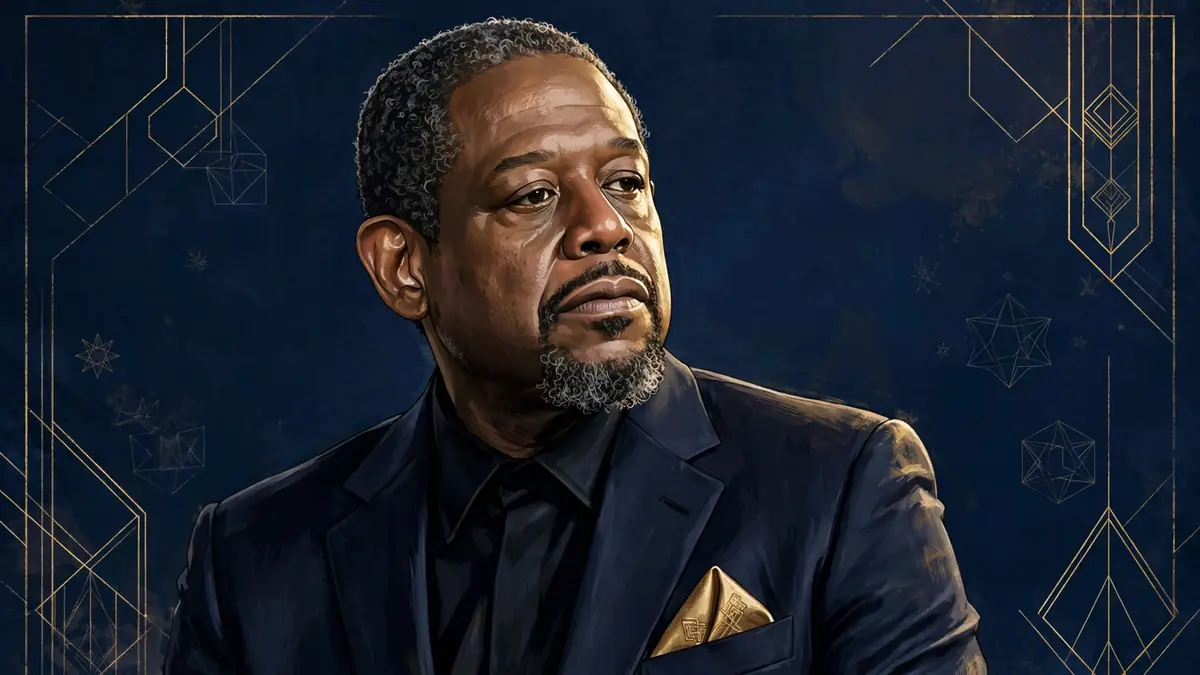
Forest Whitaker‘s net worth is estimated at $25 million to $40 million as of November 2026. The Oscar-winning actor built that fortune across four decades of film work — from a breakout turn in Platoon to an Academy Award for The Last King of Scotland, a directing career that produced the $81 million hit Waiting to Exhale, and a producing company whose first feature, Fruitvale Station, turned a budget of roughly $900,000 into more than $16 million at the box office. His most reliable paycheck in recent years has come from television, where he stars in and executive-produces Godfather of Harlem, now four seasons deep on MGM+.
Forest Whitaker: Quick Facts
| Estimated net worth | $25 million (range: $25 million to $40 million) |
|---|---|
| Profession | Actor, director, producer |
| Nationality | American |
| Born | July 15, 1961 (age 65) |
| Height | 6 feet 2 inches (1.88 m) |
| Primary income sources | Film acting, television acting and executive producing, directing, producing through Significant Productions |
| Active years | 1982–present |
| Last reviewed | November 2026 |
- Early Life and Background
- Education
- Career Journey
- Rise to Fame
- Main Sources of Income
- Salary and Earnings
- Businesses and Investments
- Brand Deals and Sponsorships
- Houses, Cars and Other Assets
- Awards and Achievements
- Net Worth Growth Over the Years
- Social Media Presence
- Personal Life
- Sources & Reporting
- Frequently Asked Questions
Early Life and Background
Forest Steven Whitaker was born on July 15, 1961, in Longview, Texas, and raised in Carson, California, after his family moved west while he was still a child. He grew up as one of four children in a working-class household — his father, Forest Whitaker Jr., worked in insurance sales, and his mother, Laura Francis Smith, taught special education. Money was tight enough that the move to California was itself a search for steadier ground, and Whitaker has spoken in interviews about a childhood shaped by church, school, and sport rather than by any connection to the entertainment business.
Carson, a city in Los Angeles County, put him within reach of Hollywood without putting him inside it. At Carson High School he played football and sang in the choir, two pursuits that pulled in opposite directions and both stayed with him. He graduated in 1979. The football side of him earned a scholarship to California State Polytechnic University, Pomona, and for a while the plan was athletics. The choir side pointed somewhere else entirely: he transferred to the University of Southern California intending to train as an opera singer before switching to the drama conservatory, where he earned a Bachelor of Fine Arts in acting in 1982.
Two details from those years still show up in his work. The first is the physical discipline — Whitaker later earned a black belt in Kenpo karate and studied eskrima, the Filipino martial art, a background that fed directly into the coiled, contained physicality of roles like Ghost Dog and Saw Gerrera. The second is the voice: the soft, deliberate delivery that became his signature started in choir stalls and opera training, not in an acting class. Casting directors noticed it early. His first screen credit, as a high-school football player in Fast Times at Ridgemont High (1982), used the athlete; everything after it used the voice.
His younger brother Kenn Whitaker followed him into acting, appearing in films including Most Wanted and Last Days, and the two have been confused for each other often enough that Kenn’s career became a minor footnote in Forest’s own press coverage. Their older brother Damon Whitaker also acted. The family connection matters to the money story in one narrow sense: Whitaker entered the business with no inherited wealth and no industry relatives to open doors, so the fortune he built came entirely from fees earned role by role over 44 years.
One more fact from his early life explains a question that follows him everywhere. Whitaker was born with ptosis, a condition in which the muscle controlling the left eyelid does not fully lift it, leaving the eye partly closed. He has said he considered corrective surgery mainly to improve his vision, and has never hidden the condition. It became part of his screen identity — directors from Clint Eastwood to Ryan Coogler have used that half-lidded gaze as a storytelling tool — and it is the single most-searched physical detail about him, ahead of even his height.
Education
Whitaker’s education ran through three institutions, and each one left a mark on how he earns. California State Polytechnic University, Pomona, gave him the football scholarship that paid for his first years of college; he has credited the discipline of team training with teaching him how to prepare for a role the way an athlete prepares for a game. The University of Southern California gave him the formal credential — a BFA in acting from its School of Dramatic Arts in 1982 — and the network of working actors and directors that produced his first auditions. After USC he studied at the Drama Studio in London, adding classical stage training to an American film education.
That London year matters more than it looks on a résumé. British stage training in the early 1980s was built around voice, text, and stillness, and Whitaker’s screen acting has always been defined by stillness — long pauses, minimal gesture, emotion carried in the eyes and the voice. It is the quality that made him convincing as the jazz saxophonist Charlie Parker in Bird and as Idi Amin in The Last King of Scotland, and it is also the quality that kept him employable when leading-man looks faded: he was never selling youth or glamour, so aging cost him less work than it costs most film stars.
He has stayed connected to education as a funder rather than a student. Through the Whitaker Peace & Development Initiative, the nonprofit he founded in 2012, he has financed youth training and education programs in Uganda, South Sudan, Mexico, and the United States, and in 2011 UNESCO named him a Goodwill Ambassador, a role focused on keeping young people out of cycles of violence. The initiative is a charity, not a business, and it draws on his income rather than adding to it — a distinction worth keeping straight when other net-worth pages list his foundation work alongside his companies as if both were revenue streams.
Career Journey
Whitaker’s career breaks into four clear phases, and each one paid differently. The first, from 1982 to 1988, was the working character actor phase: small parts in big films, steady employment, modest fees. Fast Times at Ridgemont High (1982) put him on screen for the first time. Martin Scorsese cast him in The Color of Money (1986) opposite Paul Newman and Tom Cruise. Oliver Stone put him in Platoon (1986), which won the Academy Award for Best Picture, and Barry Levinson cast him in Good Morning, Vietnam (1987) alongside Robin Williams. None of these roles made him rich. All of them made him known to every major director in Hollywood, which is the currency that pays later.
The second phase, 1988 to 1995, was the leading-man experiment. Clint Eastwood cast him as Charlie Parker in Bird (1988), and Whitaker won Best Actor at the Cannes Film Festival for it — his first major award, and the performance that proved he could carry a film. He followed it with The Crying Game (1992), a film that earned six Oscar nominations and grossed more than $62 million worldwide on a small budget, and with the Jim Jarmusch hitman film Ghost Dog: The Way of the Samurai (1999), which became a cult favorite and still sells on streaming. During this stretch he also started directing, with A Rage in Harlem (1991) and the television film Strapped (1993), building a second income stream behind the camera before most actors his age had thought about one.
The third phase, 1995 to 2006, was the director-producer phase, and it changed his earning profile. Waiting to Exhale (1995), his second feature as a director, grossed $81 million worldwide and proved he could deliver a commercial hit from the director’s chair. Hope Floats (1998) and First Daughter (2004) followed. As an actor he worked constantly — Phenomenon (1996), Smoke (1995), Panic Room (2002), in which he played the burglar opposite Jodie Foster in a film that grossed $196 million worldwide — but the directing fees and, later, producing fees meant he was no longer dependent on a single acting paycheck in any given year.
The fourth phase began in 2006 and has never really ended. The Last King of Scotland won him the Academy Award for Best Actor in February 2007, and the Oscar reset his market value overnight. The years after it brought the biggest commercial films of his career: The Butler (2013), which grossed $176 million worldwide; Arrival (2016), $203 million; Rogue One: A Star Wars Story (2016), $1.06 billion; and Black Panther (2018), $1.35 billion. He joined the Marvel and Star Wars franchises as a supporting player — Zuri in Black Panther, Saw Gerrera in Rogue One and later in the Disney+ series Andor — roles that pay well, keep paying through residuals and merchandising participation, and keep an actor visible to new generations of viewers without demanding the schedule of a lead.
Television became the anchor of this fourth phase. He played Lieutenant Jon Kavanaugh in seasons five and six of The Shield (2006–2007), a run that earned him an Emmy nomination, hosted and narrated the 2002 revival of The Twilight Zone, and led the CBS series Criminal Minds: Suspect Behavior in 2011. Since 2019 he has starred as Ellsworth “Bumpy” Johnson in Godfather of Harlem, a role he also executive-produces through his company Significant Productions. The show ran four seasons on Epix and then MGM+, with the fourth season premiering in April 2025 and a two-hour series finale announced in July 2026. In 2024 he added a second MGM+ series, Emperor of Ocean Park, playing Judge Oliver Garland, and in 2025 he appeared in the Netflix action film Havoc alongside Tom Hardy and returned as Saw Gerrera in the second season of Andor. At 65, he is working as steadily as at any point in his career — and a working actor in his sixties with two franchise roles and a hit cable drama is an actor with income that does not depend on any single project.
Rise to Fame
Whitaker’s rise did not follow the usual pattern of a single breakout that turns a young actor into a star. He was 27 when Bird won him Cannes Best Actor, 45 when the Oscar arrived, and 52 when The Butler put him at the top of the box office. Each step raised his fee, but none of them made him a tabloid celebrity, and that has shaped his finances in a specific way: he never commanded the $20 million salaries of the era’s biggest stars, and he never suffered the spending and lifestyle inflation that comes with that kind of sudden money either.
The Oscar is the hinge. Before The Last King of Scotland, Whitaker was a respected character actor whose name on a poster signaled quality. After it, he was an Academy Award winner, and that title carries a measurable market effect: agents use it to negotiate higher quotes, studios use it to justify casting an older actor in a prestige part, and streaming services use it to market a series. The film itself cost about $6 million to make and grossed $48 million worldwide — a strong return, but the real payout for Whitaker was the decade of better offers that followed, including The Great Debaters (2007) opposite Denzel Washington, The Butler, and the franchise roles.
The Butler deserves a closer look because it is the film that best explains his current wealth band. Whitaker played Cecil Gaines, a White House butler who served eight presidents, in a film that cost about $30 million and grossed $176 million worldwide. He was the lead, and leads in a film that grosses nearly six times its budget are paid accordingly — not in the $20 million range, but in the low seven figures plus a share of the film’s success. The same logic applies to Arrival, where he played Colonel Weber in a $47 million film that grossed $203 million and earned eight Oscar nominations. These were not lottery paydays. They were the steady accumulation of well-paid work in profitable films, and that is the shape of Whitaker’s whole career.
What competitors routinely miss is the second half of the rise: the move behind the camera. By the time the Oscar arrived, Whitaker had already directed a $81 million hit and run a production company. The fame that most profiles treat as a single acting story was, by 2006, two parallel careers — one in front of the camera, one behind it — and the behind-camera career is the one that kept paying during the years when acting offers slowed. His production company, Significant Productions, co-founded with Nina Yang Bongiovi in 2010, produced Ryan Coogler’s debut Fruitvale Station (2013), which won the Grand Jury Prize at Sundance and grossed $16 million on a budget reported at about $900,000. A producer’s fee and backend participation on a film with that return profile is real money, and it arrived in the same years his acting fees were rising.
Main Sources of Income
Whitaker’s income comes from five streams, and their balance has shifted over time. Acting fees remain the largest single source — film roles, television series-regular pay, and voice work in animation and video games. Producing fees and backend participation through Significant Productions form the second stream, and it has grown steadily since 2010. Directing fees form a third, smaller stream, paid per project rather than per year. A fourth stream, residuals and royalties from a filmography of more than 160 credits, pays every time an old film or episode airs, streams, or sells — and with Star Wars, Marvel, and The Butler in the catalogue, that stream is unusually durable. A fifth, minor stream comes from endorsements and public appearances, which have never been a large part of his income.
Film acting is the stream most people picture, and it is worth breaking down honestly. Whitaker has never publicly disclosed a per-film salary, and no trade publication has ever reported one for him. What can be said with confidence is that his quote rose sharply after the Oscar and that his most lucrative film work has come as a supporting player in giant franchise films. A supporting role in a billion-dollar Marvel or Star Wars film pays a strong seven-figure fee for a few weeks of work, and it also carries participation in merchandising and home-video revenue that a smaller film cannot offer. Rogue One grossed $1.06 billion and Black Panther $1.35 billion; even a modest participation slice on films of that scale is meaningful money, and it recurs every time the films are re-released or re-licensed.
Television is the stream that changed most in the last decade. A series-regular role on a premium cable drama pays per episode, and Whitaker has now done four seasons and 40 episodes of Godfather of Harlem as both star and executive producer — two paychecks for one job, since the producing fee sits on top of the acting fee. Premium cable and streaming dramas in the 2020s pay established stars well into six figures per episode, and an Oscar winner who also executive-produces commands the top of that range. His second MGM+ series, Emperor of Ocean Park, added a further series-regular income line in 2024. For an actor of 65, two concurrent series-regular roles is a rare position, and it is the main reason his wealth has held its level rather than declining in the years since his last major film lead.
Directing paid him earlier and differently. Waiting to Exhale was the standout: a film budgeted at about $16 million that grossed $81 million worldwide, with a soundtrack that sold millions of copies. Directors on a hit of that size earn a fee plus a share of the film’s profits, and Whitaker directed it at 34, before his acting fees peaked. Hope Floats (1998) grossed about $81 million worldwide on a $30 million budget, and First Daughter (2004) was a smaller commercial result. He has not directed a feature since First Daughter, so directing is now a dormant stream — but the residuals from the films he did direct continue to pay.
Producing is the stream with the most upside. Significant Productions, founded in 2010 with Nina Yang Bongiovi, was built around a clear idea: films and television led by underrepresented storytellers, made at budgets where a modest box-office result still returns a profit. Fruitvale Station is the textbook case — about $900,000 to make, $16 million grossed, festival prizes at Sundance and Cannes, and a career launched for director Ryan Coogler. The company followed it with Dope (2015), Sorry to Bother You (2018), and Godfather of Harlem itself, and in July 2019 Amazon Studios signed Significant Productions to a first-look deal to develop television series for Prime Video. First-look deals pay an annual overhead fee to the production company plus development funding per project, which turns producing from a per-film gamble into a salaried business. That deal is one of the least-covered facts in Whitaker’s financial story, and one of the most important: it means his company is paid to develop shows whether or not every one of them gets made.

Salary and Earnings
No reliable source has ever published Whitaker’s salary for a single film, and this article will not invent one. Content farms that list exact figures — “$10 million for The Equalizer“, a film he was never in — are recycling invented numbers, and the honest answer is that his pay is private. What the public record does support is a clear picture of how his earnings grew, built from box-office results, budget figures, and the known economics of each stage of his career.
In the 1980s, Whitaker was a working character actor. Roles in Platoon, Good Morning, Vietnam, and The Color of Money paid solid professional fees — enough to live on in Los Angeles, not enough to build wealth. The Cannes Best Actor award for Bird in 1988 lifted him into leading roles, and leading roles in studio films pay several times what supporting roles do. The 1990s added directing fees on top of acting fees, and Waiting to Exhale in 1995 was his first real windfall: a director’s fee plus profit participation on a film that grossed five times its budget.
The Oscar year reset the scale. The Last King of Scotland cost about $6 million and grossed $48 million worldwide, and Whitaker’s awards sweep — the Academy Award, the BAFTA, the Golden Globe, and the Screen Actors Guild Award for Best Actor — made him one of a small group of actors whose names studios attach to prestige projects. The films that followed were the best-paid of his career: The Great Debaters (2007), The Butler (2013), Southpaw (2015), Arrival (2016), Rogue One (2016), and Black Panther (2018). None of these paid a headline $20 million salary, because Whitaker was a supporting player or an ensemble lead rather than the sole box-office draw — but a supporting fee on a $1.35 billion film, with participation attached, is a far better deal than a lead fee on a $30 million film that flops.
Television is where the numbers become most concrete, even without a disclosed figure. Godfather of Harlem has run for 40 episodes across four seasons, and Whitaker is paid twice on it: once as the star and once as an executive producer. Established dramatic leads on premium cable in the 2020s commonly earn six figures per episode, and a star-producer earns more. Over 40 episodes, that is the single largest earnings block of his career — larger than any one film, and spread across six years, which is exactly the kind of income that sustains a net worth rather than spiking it. His work on Emperor of Ocean Park and the second season of Andor in 2025 added further series fees on top.
Residuals deserve their own paragraph because they are the income stream most net-worth pages ignore and the one that most separates a 160-credit veteran from a one-hit star. Every time Platoon, Ghost Dog, Panic Room, The Butler, Rogue One, or an episode of ER or The Shield is streamed, broadcast, or licensed, Whitaker is paid under the Screen Actors Guild’s residual rules. A filmography this deep, with several titles that never leave circulation, produces a steady annual payment that continues whether or not he takes a new role. It is the closest thing in acting to a pension, and it is a large part of why his wealth has stayed flat at $25 million rather than falling after his film-lead years ended.
One more earnings fact is worth recording because it corrects a figure that circulates widely. Several low-quality sites claim Whitaker earned $10 million for The Equalizer (2014). He did not appear in that film — Denzel Washington starred in it — and the claim appears to have been copied from one invented list to another. The same sites list him at $80 million or $85 million, figures that trace back to a single unsourced page and contradict Celebrity Net Worth, the only tracker that publishes a methodology and updates its figure. When a number has no source, the right response is to say so and to use the sourced range instead.
Businesses and Investments
Significant Productions is the center of Whitaker’s business life. He co-founded it with producer Nina Yang Bongiovi in 2010, and its slate reads like a deliberate strategy: back first-time directors with something to say, keep budgets low enough that a modest audience still means a profit, and let festival prizes do the marketing. Fruitvale Station (2013) was the proof of concept — Ryan Coogler’s debut, made for roughly $900,000, won the Grand Jury Prize and the Audience Award at Sundance, and grossed $16 million worldwide. Dope (2015) and Sorry to Bother You (2018) followed the same model, and the company’s television arm produced Godfather of Harlem and the documentary By Whatever Means Necessary: The Times of Godfather of Harlem (2020). The July 2019 first-look deal with Amazon Studios turned the company from a project-by-project producer into a funded development business, with Amazon paying for the right to see its television ideas first.
Before Significant Productions, Whitaker ran two earlier companies that show how his business thinking developed. JuntoBox Films, launched in the early 2010s, was an attempt to crowdsource film development: fans and filmmakers submitted ideas, the community voted, and the company produced the winners. It approved five projects before closing — an interesting experiment that did not survive as a business, and a useful reminder that not every venture in a celebrity portfolio makes money. His directing career, meanwhile, was itself a business: Waiting to Exhale and Hope Floats were commercial successes that paid him as a director and kept him employed behind the camera during years when acting offers were thinner.
On investments beyond entertainment, the public record is thin, and that thinness is itself informative. Whitaker has never been linked to a restaurant chain, a fashion label, a spirits brand, or a tech startup investment — the four businesses that content farms routinely invent for wealthy actors. He has not appeared on any rich list’s investment pages, filed no public investment disclosures, and given no interview describing a portfolio. The honest statement is that his wealth sits in the ordinary places for a working actor of his generation: property, residuals, and his production company. The Whitaker Peace & Development Initiative, founded in 2012, is a nonprofit that spends money on youth programs in conflict-affected regions; it is philanthropy, not an investment, and listing it as a business asset — as several competitor pages do — is a category error.
His most visible business relationship outside his own companies is with the United Nations system. UNESCO named him a Goodwill Ambassador in 2011, and he later served as a United Nations Sustainable Development Goals Advocate. These are unpaid honorary roles, but they carry real commercial value: they put him in rooms with heads of state, foundation leaders, and corporate sponsors, and they are the reason his production company can attach itself to international co-productions and development funding that a purely commercial company could not reach. It is soft power as a business asset, and it is the kind of asset that never appears on a balance sheet.
Brand Deals and Sponsorships
Brand deals have never been a major income line for Whitaker, and the contrast with his peers is striking. Where actors of similar stature sign watch, car, and fragrance contracts worth millions, Whitaker’s public record shows almost no commercial endorsement work. He has appeared in public-service campaigns — most visibly with PETA, promoting a vegetarian diet — but those are unpaid advocacy appearances, not sponsorships.
There are two reasons for the gap, and both are structural rather than personal. First, Whitaker built his career as a character actor and director, not as a marquee idol, and endorsement money in Hollywood flows overwhelmingly to actors whose faces sell products to young consumers. Second, his public image has always been tied to serious dramatic work and to peace activism, which makes him a natural fit for institutional and nonprofit partnerships and a less obvious fit for consumer brands. The result is that endorsements contribute little to his net worth — a fact that actually strengthens the estimate, because it means his fortune was built from fees for work rather than from licensing his face.
One endorsement-adjacent income line does exist: voice work. Whitaker has voiced Saw Gerrera in the animated series Star Wars Rebels and in video games, and voice roles in franchise properties pay well and carry their own residuals. He has also narrated documentaries, including work connected to his own production company. None of this is a brand deal in the usual sense, but it is commercial work that uses his most distinctive asset — the voice — and it pays at franchise rates.

Houses, Cars and Other Assets
The best-documented asset in Whitaker’s portfolio is a Hollywood Hills compound, and its paper trail is unusually complete. In 2003 he bought two neighboring properties for a combined $2 million and merged them into a single estate: 1.66 acres, more than 8,000 square feet of living space, 11 bedrooms, and 10.5 bathrooms, with two private driveways. He listed the compound in 2017 at $6 million, cut the price to $4.3 million, and sold it in January 2020 for $3.85 million. The sale price, reported by Celebrity Net Worth from property records, is $1.85 million more than he paid — a solid return over 17 years, though well short of the $6 million he originally asked.
That sale tells a larger story about his asset mix. Unlike actors who trade up through a series of ever-larger homes, Whitaker held one main property for nearly two decades and sold it at a modest profit. There are no public records of other major property purchases in his name, and no reporting of a car collection, a yacht, or a private jet — the assets that usually inflate a celebrity’s paper wealth. His cars, when they appear in coverage at all, are ordinary luxury vehicles rather than a fleet. The absence of a flashy asset trail is consistent with the rest of his profile: a working actor who earned steadily, spent carefully, and kept his wealth in the work itself rather than in display.
What he does own, beyond property, is harder to price but more valuable: a production company with a funded development deal, a filmography that generates residuals every year, and two franchise roles — Saw Gerrera in Star Wars and Zuri in the Marvel universe — that keep his likeness in circulation. Franchise participation, merchandising, and licensing are the assets that separate a $25 million actor from a $5 million actor with the same number of credits. They are also the assets that are hardest to value from outside, which is one reason the published estimates span from $25 million to $40 million rather than settling on a single number.
On the other side of the ledger, his divorce is the one known event that reduced his wealth. Whitaker married Keisha Nash in 1996, and after 22 years of marriage he filed for divorce in December 2018; the divorce was finalized in 2021. The terms were never made public, and no outlet has reported a settlement figure, so this article will not guess at one. What can be said is that a divorce after a 22-year marriage in California — a community-property state — typically involves a division of assets acquired during the marriage, and that the Hollywood Hills compound was sold in January 2020, in the middle of the proceedings. The timing suggests the sale was connected to the settlement, though neither party has ever confirmed it. It is the most likely explanation for why his net worth has stayed flat at $25 million on Celebrity Net Worth since 2019 rather than rising with his television income.
Awards and Achievements
Whitaker’s trophy record is the strongest of any actor in his wealth band, and it matters financially because awards are what keep a character actor’s quote rising after the age of 50. The centerpiece is the Academy Award for Best Actor, won in February 2007 for The Last King of Scotland. He won the same role’s BAFTA, Golden Globe, and Screen Actors Guild Award, completing the four major Best Actor prizes in a single season — a sweep that only a handful of actors have ever achieved. He also won Best Actor at the Cannes Film Festival in 1988 for Bird, and he has been nominated for two Primetime Emmy Awards, for his guest work on ER and for his season-long role in The Shield.
The awards list runs far beyond the headline prizes. He has won the National Board of Review’s Best Actor award, the New York Film Critics Circle Award, and the Los Angeles Film Critics Association Award, and he received a star on the Hollywood Walk of Fame in 2007, the same year as the Oscar. As a producer he shared in the awards won by Fruitvale Station, including the Grand Jury Prize and Audience Award at the 2013 Sundance Film Festival, and as a director he won the NAACP Image Award for Waiting to Exhale. In 2021 the Cannes Film Festival honored his humanitarian work alongside his acting, and UNESCO’s appointment of him as a Goodwill Ambassador in 2011 remains one of the few such honors given to a working actor.
Put beside his peers, the awards record explains why his wealth sits where it does — high for a character actor, modest beside the franchise leads. Keanu Reeves, whose fortune is built on the Matrix and John Wick franchises, sits far above him, and Kevin Hart, who turned stand-up into a production and touring empire, does too. Jamie Foxx, another Oscar winner who crossed over into music and television hosting, sits above him as well. Dave Chappelle, whose Netflix specials reset the market for stand-up, sits in a similar band. Whitaker’s career was built on prestige rather than on franchise-leading paydays, and the numbers reflect that choice.
| Actor | Defining work | Reported net worth (approx., per Celebrity Net Worth) |
|---|---|---|
| Forest Whitaker | The Last King of Scotland, Godfather of Harlem | $25 million–$40 million |
| Keanu Reeves | The Matrix, John Wick | $380 million |
| Jamie Foxx | Ray, Django Unchained | $170 million |
| Kevin Hart | Stand-up, Jumanji, Hartbeat Productions | $450 million |
| Dave Chappelle | Chappelle’s Show, Netflix specials | $70 million |
The table makes the point plainly: Whitaker earned less than the franchise leads and the comedy moguls, but he earned it across more disciplines — acting, directing, and producing — than almost anyone else on the list. That breadth is also why his wealth has proved durable: when film leads dried up, television and producing carried him, and when television slows, the residuals and the production company will keep paying.
Net Worth Growth Over the Years
Whitaker’s wealth grew slowly, in steps that track his career phases rather than in sudden jumps. The 1980s and early 1990s were the accumulation years: steady work, modest fees, and the first directing paychecks. The Oscar in 2007 was the step change, lifting his quote and putting him in franchise films. The 2010s added producing income and the first long television run. The 2020s have been the plateau years: high, steady television income balanced by the costs of a divorce and the sale of his main property.
The published estimates tell the same story in numbers. Celebrity Net Worth has listed him at $25 million since its profile was first published in 2019 and still listed him there in its June 2024 update. NetWorthPost, in May 2026, put him at $40 million. Other outlets have published figures from $15 million to $100 million, but those numbers come from pages with no stated methodology and, in several cases, from text that is visibly copied from other sites. The table below records only the estimates that can be traced to a named outlet and a date.
| Year | Reported estimate | Source |
|---|---|---|
| 2019 | $25 million | Celebrity Net Worth (profile first published) |
| 2024 | $25 million | Celebrity Net Worth (profile updated June 2024) |
| 2026 | $25 million | TushStories (October 2026 profile) |
| 2026 | $40 million | NetWorthPost (May 2026 profile) |
| 2026 | $25 million–$40 million | NetWorthCraft estimate (this article) |
Two things stand out in that table. First, the $25 million figure has been stable for seven years, which is unusual for a working actor and suggests it is a cautious, well-sourced number rather than a guess that drifts with each repost. Second, the $40 million figure comes from a single outlet in 2026, which is why we publish a range rather than adopting it outright. If his Godfather of Harlem producing fees and the Amazon first-look deal are worth what the trade press implies, the top of the range is plausible; if the divorce settlement divided the assets acquired during his marriage, the bottom of the range is the safer reading. Either way, the honest answer in November 2026 is $25 million to $40 million, and any site that prints a single precise number for Whitaker is guessing.
Social Media Presence
Whitaker keeps a lower social-media profile than most actors of his standing, and his accounts reflect the same priorities as his career: work first, advocacy second, personal life barely at all. His verified Instagram account, under his own name, mixes set photos from Godfather of Harlem and Andor with posts about the Whitaker Peace & Development Initiative and its youth programs in Africa and the Americas. His X account carries a similar mix of project announcements and peace-building work, and his Facebook page is used mainly to share trailers and interviews.
Follower counts in the hundreds of thousands put him well behind the social-media stars of his generation — Kevin Hart, for example, has tens of millions of followers and monetizes them directly — and Whitaker has never pursued sponsored posts or paid partnerships on his accounts. That is a deliberate choice with a financial consequence: social media earns him almost nothing, but it also costs him nothing in the way of controversy or brand risk. For an actor whose income comes from studios and networks rather than from advertisers, a quiet feed is a rational trade.
The one place his online presence does pay is in the streaming afterlife of his work. Clips from Ghost Dog, The Last King of Scotland, and Godfather of Harlem circulate constantly on video platforms, introducing him to viewers who were not born when Bird won at Cannes. That discovery loop is what keeps older films earning residuals and what keeps casting directors calling an actor in his mid-sixties. It is not a line on a balance sheet, but for a working actor it functions like one.
Personal Life
Whitaker married actress Keisha Nash in 1996, after meeting her on the set of Blown Away. They had two children together, Sonnet and True, and raised two more from their previous relationships — Ocean, from Whitaker’s earlier relationship, and Autumn, from Nash’s. The marriage lasted 22 years before Whitaker filed for divorce in December 2018, citing irreconcilable differences; the divorce was finalized in 2021. The settlement terms were never disclosed, and neither party has spoken publicly about the financial details.
His daughter True Whitaker has followed him into the business, appearing in Godfather of Harlem as Sandra, and his son Ocean has worked as an actor. His brother Kenn Whitaker, often mistaken for him, built his own acting career in the 1990s and 2000s. The family is close and largely private: Whitaker rarely discusses his children in interviews, and his social media keeps them at a distance from the publicity around his roles.
Outside work, Whitaker is a vegetarian and has campaigned with PETA on the health and ethical case for the diet. He practices yoga, holds a black belt in Kenpo karate, and studies eskrima. He has spoken about meditation and contemplation as part of his preparation for roles — a habit that interviewers have noticed in person, including a 2025 profile in which he closed his eyes and fell silent for several moments mid-interview while considering a question about his work. It is the same stillness that defines his acting, and at 65 it is also the discipline that keeps him working: he takes the roles that interest him, produces the stories he believes in, and spends the rest of his time on the peace-building work that has become the second half of his public life.
Sources & Reporting
Celebrity Net Worth — the anchor source for the estimate: $25 million, with the career, real-estate, and divorce facts used throughout this article; profile first published December 2019, updated June 2024. Its Hollywood Hills figures ($2 million purchase in 2003, $6 million listing in 2017, $3.85 million sale in January 2020) are drawn from property records.
NetWorthPost — the $40 million figure that sets the top of our range; profile published May 2026.
Wikipedia — filmography, television credits, and production-company history, including Significant Productions’ founding in 2010, the Amazon first-look deal of July 2019, and the Godfather of Harlem fourth-season dates (premiered April 13, 2025; two-hour finale announced July 2026).
TheWrap — the April 2018 announcement that Whitaker would star in and executive-produce Godfather of Harlem for Epix, with Nina Yang Bongiovi executive-producing through Significant Productions.
Haute Living — the April 2025 cover profile on Whitaker’s career, his Godfather of Harlem role, and his return as Saw Gerrera in Andor season two.
TushStories — October 2026 biography profile corroborating the $25 million estimate and his age and career details.
MovieMeter — 2024 profile citing Celebrity Net Worth’s $25 million figure and noting that per-film salary details remain private.
Reporting window: October–November 2026. Box-office figures are the widely reported worldwide grosses for each film. Where sources disagreed on the net worth, this article publishes the range and names the outlets behind each end of it rather than picking a single number. No per-film salary figure appears in this article because no reliable source has ever published one for Whitaker; claims found on content farms (including a $10 million fee for a film he never appeared in) were checked and excluded.
Frequently Asked Questions
What is Forest Whitaker’s net worth in 2026?
Forest Whitaker’s net worth is estimated at $25 million to $40 million as of November 2026. Celebrity Net Worth, the most-cited tracker, lists him at $25 million, a figure it has held since 2019 and reaffirmed in June 2024. NetWorthPost put him higher, at $40 million, in May 2026. We publish the range because no filing or interview has ever disclosed his actual finances.
How much did Forest Whitaker make for The Last King of Scotland?
His exact salary for the film has never been publicly disclosed. The film cost about $6 million to make and grossed $48 million worldwide, and Whitaker’s performance won him the Academy Award, BAFTA, Golden Globe, and Screen Actors Guild Award for Best Actor. The real payout was the career that followed: the Oscar reset his market value and led to his best-paid decade, including The Butler, Rogue One, and Black Panther.
How much does Forest Whitaker make per episode of Godfather of Harlem?
His per-episode pay has never been disclosed. He is paid twice on the show — once as its star and once as an executive producer through his company Significant Productions — and he has now done 40 episodes across four seasons, making it the largest single earnings block of his career. Established dramatic leads on premium cable commonly earn six figures per episode, and a star-producer earns more, but no outlet has reported his specific figure.
What is Forest Whitaker’s salary?
There is no single published salary figure for Whitaker because he is paid per project, not on a fixed wage. His income comes from film acting fees, television series-regular pay, executive-producer fees, directing fees, producing income through Significant Productions, and residuals from a filmography of more than 160 credits. His most reliable recent income has been Godfather of Harlem, where he stars in and executive-produces the series.
What happened to Forest Whitaker’s eye?
Whitaker was born with ptosis, a condition in which the muscle that lifts the left eyelid does not work fully, leaving the eye partly closed. He has said he considered corrective surgery mainly to improve his vision. The condition has become part of his screen identity — directors have used that half-lidded gaze as a storytelling tool — and it is one of the most-searched facts about him.
Is Forest Whitaker married?
No. Whitaker married actress Keisha Nash in 1996, and after 22 years of marriage he filed for divorce in December 2018. The divorce was finalized in 2021. The couple had two children together, Sonnet and True, and raised two more from previous relationships. The settlement terms were never made public.
How old is Forest Whitaker?
Forest Whitaker was born on July 15, 1961, in Longview, Texas, which makes him 65 years old as of November 2026. He has been acting professionally since 1982, when he appeared in Fast Times at Ridgemont High, and he remains active with Godfather of Harlem, Emperor of Ocean Park, and the Star Wars series Andor.
How tall is Forest Whitaker?
Forest Whitaker is 6 feet 2 inches tall (1.88 m). His height, combined with his stillness and his distinctive voice, has been part of his screen presence since his early roles in Platoon and Bird, and it helped him play physically imposing figures from Idi Amin to the Harlem crime boss Bumpy Johnson.
Final Thoughts
Forest Whitaker’s fortune is the product of patience rather than of any single payday. He never had the $20 million salary, the fragrance contract, or the viral moment that makes other actors rich overnight. What he had instead was 44 years of uninterrupted work, an Oscar that lifted his quote at 45, a directing career that paid him from the other side of the camera, and a production company that turned a $900,000 film into a $16 million success and then into a funded development deal with Amazon. The $25 million to $40 million range reflects a real disagreement between the two outlets that have actually looked at his finances, and it reflects a real life event — a 22-year marriage that ended in divorce — that divided the assets he had spent decades building.
What stands out, after a full look at the record, is how little of his wealth depends on any one thing. If the film offers stop, the television work continues. If the television work stops, the residuals continue. If both stop, the production company continues. That is a more durable kind of wealth than a single blockbuster salary, and it is why his net worth has held its level for seven years while other actors’ fortunes have risen and fallen with each release. At 65, with a hit cable drama, a second MGM+ series, and a Star Wars role still in play, he is not winding down — he is collecting from four decades of work at once.
Published on November 14, 2026. Last reviewed November 2026. Found an error? See our corrections policy.