
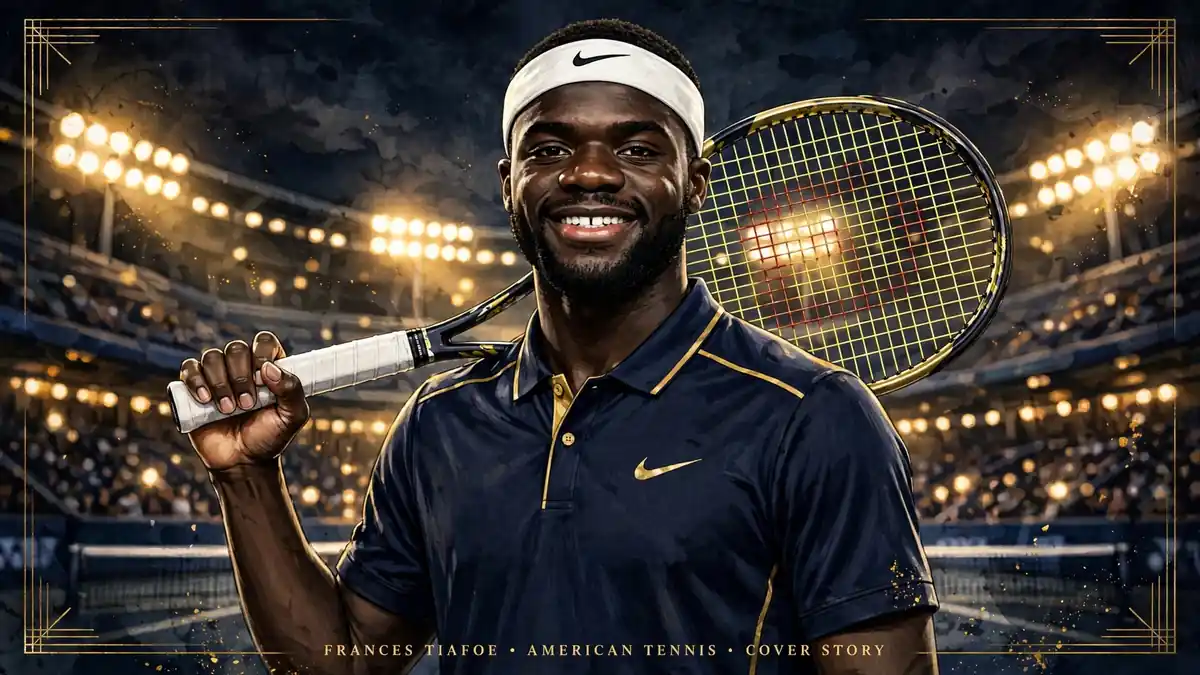
Frances Tiafoe‘s net worth is estimated at $8 million as of November 2026. The American tennis star has banked more than $21 million in official ATP prize money, and Forbes reported he earned $15.2 million in a single year to August 2025 — $3.2 million on court and about $12 million off it. His third US Open semifinal, in 2026, pushed his career earnings past $20 million and made him one of the highest-paid American men in the sport.
Frances Tiafoe: Quick Facts
| Estimated net worth | $8 million (range: $6 million – $10 million) |
|---|---|
| Profession | Professional tennis player |
| Nationality | American |
| Born | January 20, 1998 (age 28) |
| Height | 6 ft 2 in (188 cm) |
| Primary income sources | ATP prize money, endorsements (Lululemon, Yonex, TAG Heuer, Cadillac), appearances and exhibitions |
| Active years | 2015 – present |
| Last reviewed | November 2026 |
- Early Life and Background
- Education
- Career Journey
- Rise to Fame
- Main Sources of Income
- Salary and Earnings
- Businesses and Investments
- Brand Deals and Sponsorships
- Houses, Cars and Other Assets
- Awards and Achievements
- Net Worth Growth Over the Years
- Social Media Presence
- Personal Life
- Sources & Reporting
- Frequently Asked Questions
- Final Thoughts
Early Life and Background
Frances Tiafoe Jr. was born on January 20, 1998, in Hyattsville, Maryland, alongside his twin brother Franklin, who is older by minutes. His parents, Constant “Frances Sr.” Tiafoe and Alphina Kamara, had immigrated to the United States from Sierra Leone — his father in 1993, his mother in 1996 — after fleeing the civil war in their home country. The family story is the foundation of everything that followed, and it is also the reason Tiafoe’s rise reads so differently from the academy-polished path of most top-20 players.
In 1999, when Frances was still a baby, his father took work as a day laborer on the construction crew building the Junior Tennis Champions Center (JTCC) in College Park, Maryland. Constant stayed on after the building opened, becoming the center’s head of maintenance, while Alphina worked as a nurse, often on night shifts. The family lived in a spare office at the JTCC, and the twins effectively grew up inside a tennis facility — hitting balls on courts that were empty after hours, sleeping a few steps from the front desk, and learning the game by watching the juniors who trained there every day.
That upbringing gave Tiafoe two things money cannot buy: unlimited court time and a sense of belonging to a sport that, for a Black kid from a working-class immigrant family, rarely felt like it belonged to him. He picked up a racket as a small child and, from the age of eight, was coached by Misha Kouznetsov, who worked with him for nine years and shaped the loose, athletic, forehand-heavy game that still defines him. Kouznetsov’s long run with Tiafoe is unusual in junior tennis, where coaches change with every ranking jump, and it gave the young player a stable technical base through his teens.
The JTCC years also explain Tiafoe’s public image. He plays with visible joy — the chest pumps, the crowd interaction, the grin after a running forehand winner — because the court was his childhood playground before it was his workplace. Sponsors noticed that energy early, and it later became one of the most valuable assets in his portfolio: brands pay for reach, and Tiafoe’s personality travels further than his ranking alone would suggest.
By his mid-teens, the raw material was obvious. He won the 2013 Orange Bowl junior title at 15, becoming the youngest boys’ champion in the tournament’s history, and he reached the semifinals of the 2014 US Open boys’ event. The USTA took notice and brought him into its development system, a move that would take him away from Maryland and into the national training structure in Florida.
Education
No public record details Tiafoe’s formal schooling, and that gap is worth stating plainly rather than filling with guesswork. What is documented is his tennis education: nine years with Kouznetsov at the JTCC, followed by a move to the USTA National Training Center in Boca Raton, Florida, where he trained as a teenager while his twin brother Franklin remained in Maryland.
The Boca Raton move was the fork in the road. The USTA center put him on daily courts with the best American juniors of his age group, full-time fitness and physio support, and a tournament schedule that took him around the world before he could legally drive. It also meant leaving the only home he had known — the tennis center where his father still worked — and living the itinerant life of a touring junior.
Tiafoe turned professional in 2015 at 17, skipping the traditional college route entirely. The decision was a financial calculation as much as a sporting one: his family had no safety net, and the pro tour, with its prize money at every level from Futures to Challengers, was the only route that paid. He spent his first two professional seasons grinding the Challenger circuit, winning his first Challenger title in 2016 and learning, match by match, how thin the margins are between the top 100 and the players ranked 200th who fly economy and share hotel rooms.
That early grind matters to the money story. Players who come through the Challenger circuit understand the cost side of tennis — coaching, travel, hotels, stringing, physio — in a way that academy graduates with family funding never have to. Tiafoe has spoken about those years as the reason he treats prize money as working capital, not winnings, and it shows in the way his career has been managed since: steady coaching relationships, a small trusted team, and no public record of the extravagant spending that has sunk other young stars.
Career Journey
Tiafoe’s professional career breaks into four clear phases, and each one moved the money needle in a different way. The Challenger years (2015–2017) built the ranking; the first title and the top-50 breakthrough (2018–2021) built the prize money; the US Open semifinal of 2022 built the fame; and the 2023–2026 run — two more titles, a career-high ranking inside the top 10, and a second and third US Open semifinal — built the endorsement portfolio that now earns him more than his tennis does.
He won his first ATP title at the Delray Beach Open in February 2018, beating Peter Gojowczyk in the final. The win made him the youngest American man to win an ATP title since Andy Roddick in 2002, and it carried a first-prize check that, at that level, runs into six figures. More valuable than the check was the signal: American tennis had a new face, and sponsors started calling. He finished 2018 ranked inside the top 40 and reached the quarterfinals of the 2019 Australian Open, his first Grand Slam quarterfinal, losing to Rafael Nadal.
The pandemic years were uneven. Tiafoe’s ranking drifted in 2020 and 2021, and his prize money reflected it — solid six-figure seasons, but nothing that would move a net worth estimate. The turning point came at the 2022 US Open. He beat Rafael Nadal in the fourth round, ending the Spaniard’s 22-match Grand Slam winning streak that year, and rode the wave all the way to the semifinals, where he lost a five-set classic to Carlos Alcaraz. Heading into that tournament, his career prize money stood at a little more than $6 million, according to Celebrity Net Worth; the New York run alone was worth well over $1 million in prize money, and the fame it generated was worth far more in the sponsorship market.
2023 confirmed the breakthrough was real. Tiafoe won the U.S. Men’s Clay Court Championship in Houston and the Stuttgart Open on grass, his first two titles on different surfaces in the same season, and in June 2023 he reached a career-high ranking of world No. 10 — the first time he had cracked the top 10, and the first time an American man had held that spot in the post-Big-Three era with such a distinctive, crowd-first style. He also reached the US Open quarterfinals that year and played a leading role for Team World at the Laver Cup.
The 2024 season brought his second US Open semifinal, a run that ended against Taylor Fritz in five sets, and a career-high single-tournament check of $1,000,000 for reaching the last four in New York, per EssentiallySports. His 2024 prize money topped $3.3 million, the best single-season total of his career at that point. In 2025 he reached the French Open quarterfinals, won nearly $500,000 for that run alone, and banked $2,114,536 in prize money for the season. Then came the coaching change: after working with David Witt through 2024 and 2025, Tiafoe hired Dr. Mark Kovacs ahead of the 2026 Australian Open, betting that a sports-science-led approach could extend his prime.
The bet paid off quickly. In 2026 he won the Halle Open on grass, beating Taylor Fritz in the final for his first ATP 500 title and the biggest trophy of his career, reached the Cincinnati Masters final, and then produced a third US Open semifinal in New York — beating former champion Daniil Medvedev and staging a comeback from two sets down against Alex Michelsen in the quarterfinals. By the start of that US Open his career prize money had reached $18.7 million, per the ATP; the quarterfinal win alone guaranteed him another $1.45 million, taking his career on-court earnings past $20.15 million, according to Celebrity Net Worth. By November 2, 2026, the ATP’s official total stood at $21,198,072.
Rise to Fame
Tiafoe’s fame arrived in a single fortnight in September 2022, and it arrived the old-fashioned way: by beating a legend on the biggest stage in American tennis. The fourth-round win over Nadal at the US Open was watched by a prime-time Arthur Ashe Stadium crowd, and the image of Tiafoe dropping to his knees after match point became the defining picture of that tournament. He followed it by beating Andrey Rublev in the quarterfinals, and though Alcaraz stopped him in the semifinals, the fortnight changed his commercial value overnight.
The Laver Cup a few weeks later sealed it. Playing for Team World in London, Tiafoe partnered Jack Sock to beat Roger Federer and Rafael Nadal in Federer’s final professional match — a doubles contest that drew a global audience far beyond tennis — and then clinched the cup for Team World with a win over Stefanos Tsitsipas. He was, in the space of a month, the player who had beaten Nadal at a Slam and helped end Federer’s career on a winning note for the other team. No marketing campaign could buy that kind of introduction.
What has kept the fame alive since is consistency at the tournament that made him. Three US Open semifinals — 2022, 2024 and 2026 — is a record no other American man of his generation can match, and each run has come with a prime-time slot, a full stadium, and a fresh round of profiles about the kid from the tennis center. The 2026 run was the most lucrative of the three: the US Open paid $1.45 million to losing semifinalists that year, with $2.8 million for the runner-up and a record $5.5 million for the champion, per Celebrity Net Worth.
Fame has also come with a platform. Tiafoe is one of the most visible Black American men in a sport that has historically had few, and he has used that visibility — in interviews, in his fashion choices, in his work with the JTCC — without turning it into a brand in itself. The authenticity reads as real because it is: the tennis center story is not a narrative constructed by an agency, it is where he lived. That is why the Lululemon deal, the Cadillac ambassadorship and the TAG Heuer partnership all lean on his personality rather than just his ranking; brands are buying the person as much as the player.
His ranking has held up through the fame. He was ranked world No. 12 in August 2026, per bet365 News, climbed to No. 9 in October 2026, per Worthsum’s reporting, and his career high remains No. 10 from June 2023. The gap between his ranking and his earning power is the central fact of his finances: he earns like a top-five player while ranked in the teens, because his off-court income is driven by marketability, not by the ranking computer.
Main Sources of Income
Tiafoe’s income comes from four streams, and their balance has flipped over the course of his career. In his early years, prize money was nearly everything. In 2025, the balance tipped decisively the other way: Forbes reported he earned $15.2 million in the twelve months ending in August 2025, of which $3.2 million came on court and about $12 million came off court — endorsements, appearances, exhibitions and other commercial activity. Tiafoe himself confirmed the Forbes total was correct, according to Celebrity Net Worth, which makes it the single most reliable earnings figure ever published about him.
Prize money is the documented bedrock. The ATP publishes every dollar, and Tiafoe’s official career total reached $21,198,072 on November 2, 2026. That figure is gross: it is paid before taxes, before his agent’s percentage, before coaching salaries, travel, hotels and physio. Players at his level typically spend a substantial share of gross prize money on the team around them — a full-time coach, a physio, flights and hotels for 25-plus weeks a year — which is why $21 million in career prize money does not translate into $21 million of wealth. The net worth estimate of $8 million reflects that reality: gross earnings are not net worth, and the gap between the two is the cost of staying on tour.
Endorsements are now the larger stream. The Forbes estimate of about $12 million in off-court earnings for the year to August 2025 is nearly four times his tournament earnings over the same span, and it is built on a portfolio that spans apparel, rackets, cars, watches, drinks and trading cards. The deals are multi-year, which gives him income stability that prize money — dependent on winning matches every week — never can. A first-round loss at a Masters event pays a few tens of thousands of dollars; a Lululemon contract pays whether he wins or loses.
Appearances and exhibitions fill the gaps between tournaments. Top-20 players command appearance fees for exhibition events, sponsor obligations and off-season showcases, and Tiafoe’s crowd-friendly style makes him a natural booking. Forbes counted appearances and exhibitions inside that $12 million off-court figure, and the Laver Cup — where he has been a Team World regular — carries its own appearance and prize structure on top of the ranking points.
Investments are the smallest stream so far, and the least documented. His one confirmed holding is a stake in the New York Atlantics of the Pro Padel League, taken in 2025. The size of the investment and his ownership percentage were not disclosed, so it cannot be valued — and this article does not try. What it signals is intent: at 28, Tiafoe has started moving money from income into assets, the step that separates players who retire comfortable from players who retire rich.
The American tennis context matters here. Coco Gauff, the leading American woman, earns far more off court than on it, and the same commercial logic applies to Tiafoe: American players with big personalities and a home Grand Slam in New York are worth more to US brands than their rankings alone suggest. His US Open runs are not just sporting achievements; they are annual auditions in front of the sponsors who pay his largest checks.

Salary and Earnings
Tennis players do not earn a salary, so the honest way to read Tiafoe’s income is year by year, tournament by tournament, against the ATP’s published prize-money records. The table below uses only figures that are documented by the ATP or reported by named outlets; where two sources give different snapshots of the same total, the difference is the date of the snapshot, not a disagreement.
The career arc is steep. Heading into the 2022 US Open, Tiafoe had earned a little more than $6 million in ATP prize money, per Celebrity Net Worth. Four years later, that figure had more than tripled. The 2022 US Open run was the hinge: the semifinal appearance, the Nadal win, and the prime-time exposure converted a $6 million career into a $10 million-plus career within two seasons, and the endorsement income that followed did the rest.
His best single seasons tell the story of a player peaking late. In 2024 he earned more than $3.3 million in prize money, per EssentiallySports, including the $1,000,000 check for reaching the US Open semifinals — his biggest single-tournament payday. In 2025 he earned $2,114,536, per EssentiallySports’ comparison with Ben Shelton, a season built on a French Open quarterfinal worth almost $500,000 and steady deep runs rather than one headline result. In 2026, through November 2, he had already banked $4,413,210 in prize money for the year, per the ATP via Worthsum — his best season ever by a wide margin, driven by the Halle title, the Cincinnati final and the US Open semifinal.
The per-tournament math is what makes Grand Slams so valuable. The 2026 US Open paid $1,450,000 to each losing semifinalist, $612,340 to the losing finalist at Cincinnati, and six-figure sums for quarterfinal runs at the French Open. A player ranked in the teens who reaches the second week of a Slam three times a year can bank $3 million-plus in prize money without winning a title — and Tiafoe did exactly that in 2026, with a title on top.
Against his closest American peer, the numbers are revealing. Ben Shelton, the younger American star, has earned $15,061,439 in career prize money, per EssentiallySports, against Tiafoe’s $18,705,046 at the same snapshot in September 2026 — a gap of more than $3.6 million that reflects Tiafoe’s longer career and his three New York semifinal runs. Yet both men are estimated by Celebrity Net Worth at the same $8 million net worth, which shows how little career prize money alone explains wealth: Shelton’s 2025 season ($5,672,734 in prize money) dwarfed Tiafoe’s ($2,114,536), and his endorsement trajectory is steeper. The two are the twin faces of the American men’s game, and their finances will be compared for the next decade.
Taxes take a large share before any of this becomes wealth. Tiafoe is based in Florida, which levies no state income tax — a real advantage for a player whose endorsement income is paid in the United States — but he still pays federal tax, and prize money won abroad is taxed where it is earned. The often-repeated claim that Florida residency is worth “a 10% raise” overstates the case, since endorsement income is typically sourced and taxed in complex ways, but the absence of state income tax on his US-based earnings is a genuine, if unquantifiable, tailwind.
| Period | Prize money | Source |
|---|---|---|
| Career total, start of 2022 US Open | A little more than $6,000,000 | Celebrity Net Worth |
| 2024 season | More than $3,300,000 | EssentiallySports |
| 2024 US Open semifinal | $1,000,000 (single tournament) | EssentiallySports |
| 2025 season | $2,114,536 | EssentiallySports |
| 2026 season, through Nov 2, 2026 | $4,413,210 | ATP, via Worthsum |
| 2026 US Open semifinal | $1,450,000 (single tournament) | Celebrity Net Worth |
| Career total, start of 2026 US Open | $18,705,046 | ATP, via EssentiallySports |
| Career total, Nov 2, 2026 | $21,198,072 | ATP, via Worthsum |
One caution belongs here, because most net worth articles get it wrong: the $8 million estimate is not the sum of the figures above. Prize money is gross income spread over a decade, taxed in multiple countries, and reduced by the cost of a touring team. The $12 million off-court year Forbes documented is likewise gross, and it is a single-year figure, not an annual guarantee. The estimate is a judgment about what remains after all of that — which is why we publish it as a range, and why the range is wide.
Businesses and Investments
Tiafoe’s business life is still in its early chapters, and the public record is thin — which is itself informative. Unlike players who launch clothing lines or restaurants in their twenties, he has so far made one confirmed investment and kept the rest of his focus on the court and the endorsement portfolio. That restraint is arguably the smart play: his earning window is still open, and the highest-return investment available to a 28-year-old top-20 player is usually his own game.
The confirmed holding is the New York Atlantics, a franchise in the Pro Padel League. Tiafoe joined an investor group backing the team in 2025, per Celebrity Net Worth. Padel — the fast-growing racket sport that blends tennis and squash — has attracted a wave of athlete investors, and the Pro Padel League is its North American beachhead. No figure was disclosed for Tiafoe’s stake, and no valuation of the franchise is public, so the holding cannot be added to a net worth calculation with any honesty. What can be said is that it aligns with his profile: a racket-sport athlete investing in a racket-sport league, in a city where he plays every year.
Two other investment claims circulate on lower-quality sites and deserve a direct answer. Some outlets report that Tiafoe holds stakes in a tech startup and a tennis apparel venture, together worth an estimated $3 million to $5 million. Those claims trace to a single EssentiallySports article from 2025, and neither the companies nor the figures are named anywhere in the reporting. We do not count them in the estimate, and readers should treat them as unverified: a stake with no company name and no dollar figure attached by a named source is a rumor, not an asset.
The same discipline applies to the “combined net worth” stories about Tiafoe and his girlfriend, Ayan Broomfield. One outlet reports a combined figure of $9–$10 million for the couple, built by adding an unsourced $1 million estimate for Broomfield to Tiafoe’s $8 million. Net worth is not combined across two unmarried people, and Broomfield’s figure has no source behind it. This article does not repeat the combined number as fact, and the estimate above is Tiafoe’s alone.
Looking ahead, the investment story to watch is what happens when the endorsement deals start to expire. The Lululemon contract, signed in January 2025, is multi-year; the Yonex, TAG Heuer and Cadillac relationships are long-term. As those deals renew — or don’t — in his early thirties, Tiafoe will face the same choice every athlete faces: keep selling his image, or start buying assets that pay without him. The padel stake suggests he has started thinking about the second option. The next five years will show whether he pursues it seriously.
Brand Deals and Sponsorships
The endorsement portfolio is where Tiafoe’s money story separates from his ranking, and it is also where the reporting is strongest — because Forbes put a number on it. About $12 million in off-court earnings in the twelve months to August 2025, per Forbes, against $3.2 million on court. That ratio, nearly four to one, is the profile of a marketing asset, not just an athlete, and it is built on a portfolio that has been assembled carefully over a decade.
Lululemon is the headline deal. In January 2025, Tiafoe ended a near-decade-long apparel relationship with Nike and signed a multi-year deal with Lululemon, becoming one of the company’s highest-profile tennis ambassadors, per Celebrity Net Worth. EssentiallySports reported the deal as a three-year agreement, and he debuted it at the 2025 Australian Open in a custom kit: a “Passionate Pink” Metal Vent Tech tee, Pace Breaker shorts and a “DMV Made” Sojourn windbreaker that nodded to his Washington, D.C.-area roots. The switch was a genuine gamble — Nike is the default apparel home for American tennis stars, and leaving it meant betting that Lululemon’s smaller tennis roster would give him more attention, more creative input and, eventually, more money. He has since helped design custom match kits for the brand, a role that goes beyond wearing the logo.
Yonex supplies his rackets and has been a long-term partner through the Nike years and into the Lululemon era. Racket deals for top-20 players typically include a base payment plus bonuses tied to ranking and Grand Slam results, along with equipment and stringing support. Yonex also sponsors Ben Shelton, which makes the two Americans stablemates as well as rivals — and gives the brand a lock on the most marketable young American men in the game.
TAG Heuer, the Swiss luxury watchmaker, and Cadillac (with parent General Motors) are the two premium ambassadorships that signal how far his brand has travelled beyond tennis. Both are the kind of deal that pays for image rather than results: a watch on the wrist in a photoshoot, a car in a commercial, a presence at a launch event. They are also the deals most sensitive to reputation, which is another reason Tiafoe’s clean public image matters commercially.
The supporting cast is deep: Stella Artois (through parent Anheuser-Busch InBev), Evian, Grey Goose, Nesquik (Nestlé), Mondelez International and Topps, the trading-card company, have all been named as sponsors by Celebrity Net Worth or the Times of India. The drinks and food brands fit his profile — sociable, fun, American — and the Topps deal, signed as trading cards surged in value, puts his image on a product that appreciates rather than being consumed.
Two things the reporting does not support should be said plainly. First, no reliable source publishes the per-deal value of any of these contracts, so any article that states “Lululemon pays him $X million a year” is guessing; the only hard number is Forbes’ $12 million aggregate for off-court income. Second, some sites claim AfroTech estimated each of his two big apparel deals at $2 million to $4 million a year — that figure is AfroTech’s own speculation, clearly labelled as an estimate in their article, and we do not treat it as a reported fact. The honest summary is the Forbes aggregate, plus the named brands, plus the fact that the portfolio has grown every year since 2022.
Peer context sharpens the picture. Jannik Sinner and Carlos Alcaraz earn far more in prize money, but their endorsement income is tied to dominance; Tiafoe’s is tied to personality and to the American market, which is why he can rank No. 12 and still sit ninth on Forbes’ list of the world’s highest-paid tennis players, per Sportskeeda’s reporting of the Forbes ranking. That ninth-place finish — on a list dominated by Grand Slam champions — is the single best measure of his commercial standing.

Houses, Cars and Other Assets
Public information about Tiafoe’s property and possessions is limited, and the limits are worth respecting. He keeps his primary home and training base in Orlando, Florida, per EssentiallySports, a city that puts him close to the USTA facilities and to the hard-court swing that defines his season. Some reports describe a Florida mansion; no address, purchase price or property record has been published by a reliable outlet, so this article does not invent one. A home in Orlando is an asset; a “lavish mansion” with a price tag attached by an anonymous site is a story, not a fact.
The same caution applies to the car. Tiafoe owns a black Porsche 911, which multiple outlets describe as his favorite car, and one site claims he paid around $99,200 for it. The car itself is well documented in interviews and social posts; the price is not, and $99,200 is below the typical list price of a new 911, which suggests the figure is either for a used car or simply wrong. We report the car and drop the price.
What can be said with confidence is that his asset base is modest relative to his income, and that is normal for a 28-year-old athlete still in his earning prime. The wealth of a tennis player at this stage sits mostly in bank balances, investment accounts and the future value of endorsement contracts, not in a property portfolio. The padel league stake is the only confirmed illiquid holding, and its value is undisclosed. Readers looking for a real-estate empire will not find one in the public record — and articles that describe one are filling a gap with imagination.
The Florida base does carry one real financial benefit: the state levies no personal income tax, which matters for endorsement income paid in the United States. It also puts him in a training hub — Orlando hosts USTA facilities and a deep pool of practice partners — so the choice is sporting as well as financial. He has also spent long periods training in Boca Raton, where the USTA National Training Center is based, and his early professional years were split between Florida and Maryland.
For a peer comparison on lifestyle, the contrast with the previous generation is instructive. Rafael Nadal built a hotel and academy portfolio over two decades; Tiafoe, at 28, has built a single sports-league stake. The difference is time, not judgment: asset portfolios compound after the playing career ends, when the income keeps coming from deals signed during it. Tiafoe’s next decade will determine whether his $8 million becomes $20 million or stays where it is.
Awards and Achievements
Tiafoe’s trophy cabinet is modest by the standards of the all-time greats and impressive by the standards of everyone else. Four ATP singles titles, three Grand Slam semifinals, a career-high ranking of No. 10, and a Laver Cup winners’ medal is a career most professionals would trade for — and it is the foundation of every dollar in the estimate above.
The titles, in order, are Delray Beach 2018, Houston 2023, Stuttgart 2023 and Halle 2026. The Halle title is the most valuable of the four: an ATP 500 event on grass, won by beating Taylor Fritz in the final, and the biggest trophy of his career. The two 2023 titles matter because they came on different surfaces — clay in Houston, grass in Stuttgart — in the same season, proving the game travels. The Delray Beach title matters because it announced him: the youngest American man to win an ATP title in 16 years.
The Grand Slam record is the heart of his case. US Open semifinals in 2022, 2024 and 2026; a French Open quarterfinal in 2025; an Australian Open quarterfinal in 2019. The 2022 run included the win over Nadal, the 2024 run included a five-set semifinal against Fritz, and the 2026 run included wins over Medvedev and Michelsen, the latter from two sets down. No other American man of his generation has reached three semifinals at his home Slam.
Team honors include the 2022 Laver Cup with Team World, where his doubles win with Jack Sock over Federer and Nadal, followed by his singles win over Tsitsipas to clinch the cup, is one of the most-watched sequences in the event’s history. He has also represented the United States in Davis Cup competition, the team event that carries no prize money but matters for national standing and sponsor perception.
Junior honors deserve a line, because they explain the early investment in him: the 2013 Orange Bowl boys’ title at 15, the youngest champion in the event’s history, and a US Open boys’ semifinal in 2014. The ranking milestones — first top 100 in 2017, first top 50 in 2018, first top 10 in June 2023, and a return to the top 10 in the autumn of 2026 — track the money milestones almost exactly, because in tennis, ranking is revenue.
Net Worth Growth Over the Years
The estimate has moved slowly and then, after 2022, quickly — but the public record only supports a few firm anchor points, and this section sticks to them rather than inventing a smooth curve. Celebrity Net Worth has listed Tiafoe at $8 million across both 2025 and 2026, and EssentiallySports, AfroTech, bet365 News and Glimmer Sports all repeat the same figure in the same period. The stability of the number is itself a signal: no outlet has found evidence of a big asset purchase, a major business exit or a lifestyle splurge that would move it.
What changed underneath the flat estimate is the income. Career prize money rose from a little more than $6 million at the start of the 2022 US Open to $18.7 million at the start of the 2026 US Open and $21.2 million by November 2026. Off-court income, which was a footnote in 2021, reached about $12 million in a single year by August 2025, per Forbes. If the $8 million estimate looks low against those flows, the explanation is the one given in the method box: a decade of gross income, taxed in several countries and reduced by the cost of a touring team, leaves a fraction as net worth — and the fraction is smaller than fans assume.
The growth table below therefore tracks the documented income milestones, not a fabricated net worth curve. The honest version of the story is that Tiafoe’s wealth is growing faster now than at any point in his career, because his best prize-money season (2026, $4.4 million through November) coincided with his peak endorsement years. If he holds a top-15 ranking through 2027 and the Lululemon deal renews on better terms, the estimate should move up; if injuries or a ranking slide cut the prize money, the endorsement income cushions the fall in a way it could not have done five years ago.
| Year | What happened | Money marker |
|---|---|---|
| 2018 | First ATP title, Delray Beach; first Grand Slam quarterfinal the next January | Career prize money building from Challenger level |
| 2022 | US Open semifinal; beat Nadal; Laver Cup champion with Team World | Career prize money a little over $6 million at US Open start |
| 2023 | Titles in Houston and Stuttgart; career-high ranking No. 10 | Prize money and sponsor interest jump after top-10 debut |
| 2024 | Second US Open semifinal; $1,000,000 single-tournament check | Prize money over $3.3 million for the season |
| 2025 | French Open quarterfinal; Lululemon deal; padel league investment | $2,114,536 prize money; about $12 million off court (Forbes) |
| 2026 | Halle title; Cincinnati final; third US Open semifinal | $4,413,210 prize money through Nov 2; career $21,198,072 |
Peer comparison puts the trajectory in context. Ben Shelton, at 24, has already banked $15.1 million in career prize money and matches Tiafoe’s $8 million estimate, per EssentiallySports and Celebrity Net Worth — a reminder that the next American generation is catching up fast. Serena Williams, the standard-bearer for American tennis wealth, built a fortune an order of magnitude larger, but she did it over a 27-year career with 23 Grand Slam singles titles; Tiafoe’s path to that scale would need a Slam title and a decade more at the top. The realistic comparison is with his own generation: among American men, he and Shelton are the two commercial leaders, and the gap between them is measured in hundreds of thousands of dollars, not millions.
Social Media Presence
Tiafoe’s social media presence is a genuine commercial asset, not an afterthought, and it is one of the reasons his endorsement income runs ahead of his ranking. His Instagram account, @bigfoe1998, is the main channel: match-day posts, behind-the-scenes training clips, fashion shoots from the Lululemon partnership, and the courtside moments that sponsors pay to be near. His audience there approaches one million followers, a figure that puts him among the most-followed American male players despite a ranking outside the top 10 for much of his career.
He is also active on X (formerly Twitter) as @FTiafoe, where his post-match reactions and interactions with fans travel widely during Grand Slams, and his content regularly appears on the ATP Tour’s own channels, which amplifies his reach beyond his own following. The engagement matters more than the raw count: Tiafoe’s posts draw replies and shares at a rate that reflects a real fanbase rather than a bought one, and brands track that engagement when they price a deal.
His girlfriend, Ayan Broomfield, is a social media creator in her own right, with a large following built on tennis, fashion and lifestyle content, and the couple’s joint appearances — at tournaments, at fashion events, on each other’s feeds — extend both of their audiences. The relationship is public and long-standing, and it is part of the package sponsors buy: a tennis couple with a shared, camera-friendly life.
For readers who want to follow him, the verified accounts are the only safe route: impersonator accounts are common for athletes at his level, and any account asking for money, offering “investment opportunities” or promoting giveaways in his name is a scam. His official presence is limited to the accounts named here and the ATP Tour’s coverage of his matches.
Personal Life
Tiafoe is not married. He has been in a long-term relationship with Ayan Broomfield, a Canadian former professional tennis player and social media creator, since around 2015; the couple went public in 2018. Broomfield played collegiate tennis at UCLA, where she won an NCAA doubles championship, and she is a regular presence in his player box at major tournaments — most visibly when she surprised him on court after his Houston title in 2023.
Family remains central. His parents, Constant and Alphina, still live in the Washington, D.C. area, and his twin brother Franklin stayed in Maryland when Frances moved to Florida for training. Tiafoe has credited his father, who worked as head of maintenance at the JTCC, and his mother, a nurse, with the work ethic that carried him through the Challenger years, and he has spoken about wanting to give back to the center where he grew up. He maintains a long-standing relationship with University of Maryland football coach Mike Locksley, whom he met as a teenager, and Locksley has described the bond as a father-son one.
Off court, his interests are well documented: fashion, which the Lululemon partnership has made a professional pursuit as well as a personal one; basketball, where he is a vocal Washington Wizards fan; and music, which features heavily in his social content. He is known for his courtside celebrations and his habit of engaging the crowd, a style that has occasionally drawn criticism from traditionalists and far more praise from the audiences who fill stadiums to see him.
Health and coaching are the two practical facts that shape his daily life. He hired Dr. Mark Kovacs, a sports scientist, as his coach in January 2026, after two seasons with David Witt, and the change was explicitly about longevity: at 28, with a decade of touring behind him, the priority is keeping his body through his early thirties, when his earning power should peak. No serious injury has interrupted his career so far, which is itself a financial fact — an injured player earns nothing on court, and Tiafoe’s durability is part of why the money has kept flowing.
Sources & Reporting
ATP Tour — the official prize-money records: career total $21,198,072 through November 2, 2026, and $4,413,210 for the 2026 season to that date; also the source for the $18,705,046 total at the start of the 2026 US Open. Reporting window: ATP records updated through November 2026.
Forbes — the highest-paid tennis players ranking, reported by Sportskeeda and Celebrity Net Worth: $15.2 million earned in the twelve months to August 2025, split $3.2 million on court and about $12 million off court; ninth place on the Forbes list. Tiafoe confirmed the total was correct.
Celebrity Net Worth — the $8 million net worth estimate; career prize money past $20.15 million after the 2026 US Open quarterfinal; the Lululemon, Yonex, TAG Heuer, Cadillac and Topps sponsorships; the New York Atlantics padel investment. Page updated September 8, 2026.
EssentiallySports — 2024 prize money over $3.3 million; 2025 prize money $2,114,536; the $1,000,000 check for the 2024 US Open semifinal; the Shelton comparison ($15,061,439 career prize money); the three-year Lululemon deal description. Article updated August 31, 2026.
bet365 News — ranking No. 12 as of August 2026; career earnings over $18.7 million; the Lululemon, Yonex, Grey Goose, Cadillac and TAG Heuer sponsorships; the Kovacs coaching hire. Published August 24, 2026.
AfroTech — the $8 million estimate and the Lululemon ambassadorship; career prize money $15,583,132 at the time of writing; the Porsche 911. Published February 26, 2026. Note: AfroTech’s per-deal apparel estimates are its own speculation and were not used as facts in this article.
Wikipedia — birth date and place, parents’ immigration dates, the JTCC background, the Kouznetsov coaching tenure, the Orange Bowl title and the relationship timeline. Biography last updated June 2026.
Athlon Sports — the Broomfield relationship (dating since around 2015, public since 2018), the UCLA NCAA doubles title, and the parents’ background. Published September 8, 2026.
Reporting window for this article: February – November 2026. Figures are dated in the text wherever the source gives a date. Where sources disagree, the article publishes the range and names who says what; where a figure rests on a single weak source, it is labelled as reported or left out.
Frequently Asked Questions
What is Frances Tiafoe’s net worth in 2026?
Frances Tiafoe’s net worth is estimated at $8 million as of November 2026, according to Celebrity Net Worth. Because that figure is the only published estimate and no assets or liabilities are publicly documented, we publish it as a range of $6 million to $10 million.
How much prize money has Frances Tiafoe earned in his career?
His official ATP career prize money stood at $21,198,072 on November 2, 2026. That total is gross income before taxes, agent fees and the cost of his coaching and travel team, so it is not the same as his net worth.
How much does Frances Tiafoe make from endorsements?
Forbes reported he earned about $12 million off court — endorsements, appearances and exhibitions — in the twelve months to August 2025, against $3.2 million in prize money over the same period. His sponsors include Lululemon, Yonex, TAG Heuer, Cadillac, Stella Artois, Evian, Grey Goose and Topps.
Who is Frances Tiafoe’s girlfriend?
His longtime girlfriend is Ayan Broomfield, a Canadian former tennis player who won an NCAA doubles championship at UCLA and now works as a social media creator. They have been together since around 2015 and went public with the relationship in 2018. They are not married.
How old is Frances Tiafoe and how tall is he?
He was born on January 20, 1998, in Hyattsville, Maryland, which makes him 28 years old as of November 2026. He is 6 feet 2 inches tall (188 cm).
What is Frances Tiafoe’s highest ranking?
His career-high ranking is world No. 10, reached in June 2023 after winning titles in Houston and Stuttgart. He was ranked No. 12 in August 2026 and climbed back toward the top 10 during the autumn of 2026.
How many Grand Slam semifinals has Frances Tiafoe reached?
Three, all at the US Open: in 2022, when he beat Rafael Nadal in the fourth round; in 2024, when he lost a five-set semifinal to Taylor Fritz; and in 2026, when he beat Daniil Medvedev and Alex Michelsen on the way to the last four. He has also reached Grand Slam quarterfinals at the Australian Open (2019) and the French Open (2025).
What brands sponsor Frances Tiafoe?
His main sponsors are Lululemon for apparel, signed in January 2025 after nearly a decade with Nike, and Yonex for rackets. He is also a brand ambassador for TAG Heuer and Cadillac, and his other partners include Stella Artois, Evian, Grey Goose, Nesquik and Topps.
Final Thoughts
Frances Tiafoe’s $8 million net worth is a conservative number for a player having the best season of his life. The estimate has barely moved in two years, yet the income underneath it has transformed: $4.4 million in prize money in 2026 alone, a career total past $21 million, and about $12 million a year from endorsements, appearances and exhibitions, per Forbes. The gap between the flat estimate and the rising income is the cost of tennis — taxes, a touring team, and a decade of gross earnings that only partly survive as wealth — and it is why we publish the figure as a range rather than a certainty.
What makes Tiafoe’s case unusual is the source of the money. Most players at his ranking earn most of their income on court; he earns most of his off it, because his personality, his American market and his US Open record make him more valuable to brands than the ranking computer suggests. The Lululemon deal, the Cadillac and TAG Heuer ambassadorships, and a ninth-place finish on Forbes’ highest-paid tennis players list all point the same way: sponsors are paying for Big Foe, not just for world No. 12.
The next chapter depends on two things. On court, he needs to hold a top-15 ranking into his early thirties and convert one of those US Open semifinals into a final, which would be worth $2.8 million in prize money alone at 2026 rates and would change his commercial value overnight. Off court, he needs to turn income into assets — the padel league stake is a start, but one undisclosed holding does not make a portfolio. If both happen, the $8 million estimate will look low within a few years. If neither does, the endorsement income still gives him a cushion most players never get. Either way, the kid who grew up sleeping in a spare office at a Maryland tennis center has already built something that cannot be taken away: a career that pays him like a star, because to the crowds in New York, he already is one.
Published on 2026-11-11. Last reviewed November 2026. Found an error? See our corrections policy.