
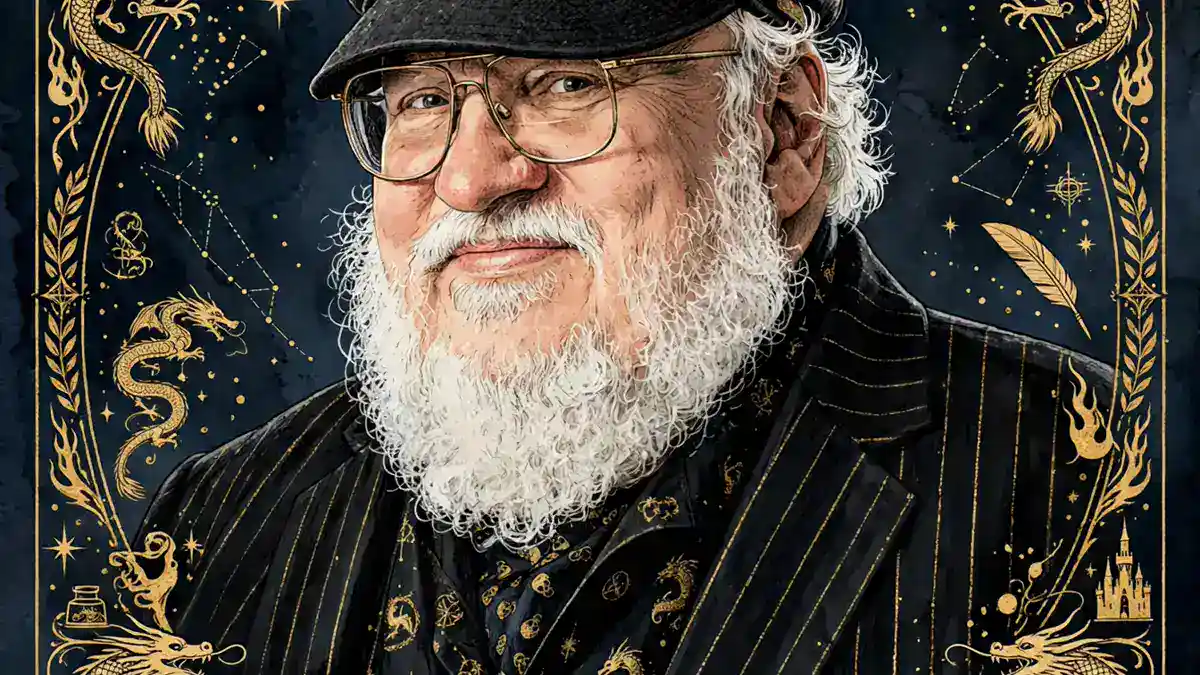
George R.R. Martin‘s net worth is estimated at $110 million to $130 million as of October 2026. The figure anchors at $120 million — the number Celebrity Net Worth and Parade both land on this year — and it rests on three pillars: a reported $15 million per season from HBO’s Game of Thrones, a mid-eight-figure overall deal with the network signed in 2021, and book royalties from more than 90 million copies of A Song of Ice and Fire sold worldwide. A Statista analysis found he had already collected $60.5 million in HBO royalties between May 2011 and June 2016 alone, before the show’s two biggest seasons ever aired. In 2026 the money keeps compounding: House of the Dragon aired its third season in the summer and was renewed for a fourth, while A Knight of the Seven Kingdoms — the Dunk and Egg spinoff — premiered in January, got renewed, and has already wrapped filming on season two. Meanwhile The Winds of Winter, the sixth novel in the saga, sits at roughly 1,100 manuscript pages with, by Martin’s own admission, no clear net growth since 2022.
George R.R. Martin: Quick Facts
| Estimated net worth | $120 million (range: $110M–$130M) |
|---|---|
| Profession | Novelist, screenwriter, television producer |
| Nationality | American |
| Born | September 20, 1948 (age 78) |
| Height | 5 ft 6 in (1.68 m) |
| Primary income sources | Book royalties, HBO producer fees and royalties, overall development deal, licensing and merchandise, consulting |
| Active years | 1970–present |
| Last reviewed | October 2026 |
- Quick Facts
- Early Life and Background
- Education
- Career Journey
- Rise to Fame
- Main Sources of Income
- Salary and Earnings
- Businesses and Investments
- Brand Deals and Sponsorships
- Houses, Cars and Other Assets
- Awards and Achievements
- Net Worth Growth Over the Years
- Social Media Presence
- Personal Life
- Sources & Reporting
- Frequently Asked Questions
- Final Thoughts
Early Life and Background
George Raymond Richard Martin was born on September 20, 1948, in Bayonne, New Jersey, a blue-collar industrial town wedged between New York Harbor and Newark Bay. His father, Raymond Collins Martin, worked as a longshoreman; his mother, Margaret Brady Martin, worked in a lingerie factory. The family — including his two younger sisters, Darleen and Janet — lived in a federal housing project near the Bayonne docks, and in a 2024 post on his blog Not A Blog, Martin wrote that “home was Bayonne, New Jersey… I spent my childhood there, most of it in the federal housing projects on First Street.” Raised Roman Catholic, he took the confirmation name Richard at thirteen — hence the double R.
Money was tight and entertainment was whatever the town provided. Martin’s first business was storytelling itself: as a boy he wrote monster stories and sold them to neighborhood children for pennies, dramatic readings included, as chronicled in the EBSCO research biography of his life. In high school he became a serious comic-book fan and collector, and his teenage fandom left a paper trail — a letter he wrote to the editor appeared in Fantastic Four #20 (November 1963). He also attended the first-ever Comi-Con in New York, and began writing fiction for amateur comic fanzines. There is a straight line from those pennies-a-story childhood sales to the nine-figure literary fortune that followed.
Education
Martin attended Mary Jane Donohoe School and Marist High School in Bayonne before leaving New Jersey for college in 1966 — “the first time I ever went beyond the borders of Jersey and NYC,” he wrote on his blog. He enrolled at Northwestern University in Evanston, Illinois, earning a B.S. in journalism, summa cum laude, in 1970 and an M.S. in journalism in 1971. As a conscientious objector during the Vietnam War, he performed alternative service with VISTA (Volunteers in Service to America), working as communications coordinator for the Cook County Legal Assistance Foundation in Chicago from 1972 to 1974. He spent the rest of the decade on a patchwork of jobs — directing chess tournaments for the Continental Chess Association from 1973 to 1976, teaching journalism at Clarke College in Dubuque, Iowa, from 1976 to 1978, and serving as writer-in-residence there from 1978 to 1979 — while selling fiction on the side. His first professional sale, the short story “The Hero,” went to Galaxy magazine in 1970, published in the February 1971 issue.
Career Journey
Martin’s fiction career built slowly through the 1970s and 80s. He won the 1975 Hugo Award for best novella for A Song for Lya, then swept 1980 with the Hugo and Nebula for the novelette “Sandkings” plus another Hugo for the short story “The Way of Cross and Dragon.” His early novels included Dying of the Light (1977) and the Mississippi-vampire novel Fevre Dream (1982), but The Armageddon Rag (1983) flopped commercially and nearly ended his career as a novelist. He pivoted to Hollywood: story editor on the CBS revival of The Twilight Zone, staff writer on Max Headroom, and from 1987 to 1990 writer, executive story consultant and producer on the cult hit Beauty and the Beast. The TV money kept him afloat, but the tight production budgets chafed him — he had written battle scenes he could never afford to film. In 1991, partly out of frustration with television’s constraints, he began a new novel with a sentence about a boy watching his father’s men execute a deserter. That novel was A Game of Thrones, published in August 1996.
The money during these decades was modest by any measure. In a detail LoveMoney resurfaced in its 2026 richest-authors gallery, Martin once described himself as nearly penniless in the mid-1970s, surviving on short-story proceeds before teaching to make ends meet. The sale of his first science-fiction novel, Dying of the Light, brought roughly three times his annual salary at the time — enough to let him write full-time from 1979, when he settled in Santa Fe.
Rise to Fame
A Game of Thrones sold well but not spectacularly at first; the series grew book by book into a phenomenon. Just days before the HBO series premiered in April 2011, The New Yorker reported that Martin had sold over 15 million books worldwide — already a fortune by any publishing standard. The television adaptation detonated those numbers: by the mid-2010s the series had passed 25 million copies, and it has since crossed 90 million copies sold worldwide, translated into dozens of languages. Every new season of the show — and later every spinoff — sent readers back to the books, a flywheel that kept Martin’s backlist on bestseller lists for a decade and a half.
HBO paid for the privilege. Martin served as co-executive producer on Game of Thrones for all eight seasons (2011–2019), wrote some of its most celebrated episodes — “Baelor,” “Blackwater,” “The Bear and the Maiden Fair,” “The Lion and the Rose” — and shared in the show’s four Outstanding Drama Series Emmy wins. A much-cited 2016 report from Celebrity Net Worth (carried by the Christian Post) pegged his HBO income at $15 million per season and his annual book royalties near $10 million a year, with a then-net worth of $65 million. Statista’s royalty tracking put his documented HBO earnings at $60.5 million between May 2011 and June 2016: $15 million in 2012, $12 million a year from 2013 to 2015, and $9.5 million in the first half of 2016 — before the two most lucrative seasons even aired.
The post-2019 years expanded the franchise further. Martin’s 2018 Targaryen history Fire & Blood became HBO’s House of the Dragon (2022–present), of which he is co-creator and executive producer. In January 2026 HBO premiered A Knight of the Seven Kingdoms, based on his Dunk and Egg novellas — a show renewed for a second season before the first finished airing. As of late 2026, Martin has confirmed that five or six further Westeros projects sit in development, including work on an Aegon the Conqueror project and animated series — a development slate that functions as a royalty annuity on top of his fixed deal.
Main Sources of Income
Martin’s fortune divides into four streams, and the split matters: the money is overwhelmingly literary and television, with businesses that look more like passion projects than profit centers.
Book royalties. The foundation. More than 90 million copies of the Song of Ice and Fire books have sold, and at typical hardcover and mass-market royalty rates that backlist generates millions annually with minimal effort. When Game of Thrones was airing, estimates put Martin’s book income near $10 million a year (Celebrity Net Worth, 2016 via Christian Post). Even in quiet publishing years, the five novels plus Fire & Blood, the Dunk and Egg collections, The World of Ice & Fire and The Lands of Ice and Fire keep selling across dozens of languages.
HBO producer fees and royalties. The accelerator. The reported $15 million-per-season producer compensation for Game of Thrones, multiplied across eight seasons, implies roughly $120 million in gross TV income — and note the math: several net-worth blogs claim the show paid him a total of $200 million, a figure that does not square with the per-season figure they quote or with his documented $65 million net worth in 2016. The more careful accounting (Statista’s documented $60.5 million through mid-2016, plus the two final blockbuster seasons) lands closer to the low nine figures in total HBO compensation. His 2021 five-year overall deal — described by The Hollywood Reporter as “mid-eight figures,” reported by GameSpot — added a second HBO revenue layer covering House of the Dragon and future spinoffs. Note the wrinkle: the overall deal was suspended on June 1, 2023, during the WGA and SAG-AFTRA strikes, as The Escapist reported from Martin’s own blog — a reminder that even eight-figure deals can pause.
Licensing, merchandise and games. Martin’s worlds generate royalties far beyond pages and screens: HBO merchandise programs, licensed board games, maps and calendars, and — unusually for a novelist — video games. FromSoftware’s Hidetaka Miyazaki, a self-described “huge fan” of Martin’s work, recruited him to write the backstory and mythology of 2022’s Elden Ring, one of the best-selling games of the decade. Martin has said he shipped his worldbuilding work to the studio and handed it off; the fee was never disclosed, but the consulting arrangement put his name on a game that sold more than 25 million copies. He had no involvement in the 2024 Shadow of the Erdtree expansion, Miyazaki confirmed to Famitsu via NME.
Editorial and producing work. Since 1986 Martin has created and edited the Wild Cards shared-world anthology series — more than 30 volumes — a steady editorial income stream with a Peacock television adaptation in development. He also earns speaking and appearance fees at conventions, though he is famously selective about his schedule.
Salary and Earnings
No single “salary” defines Martin’s income; his money arrives as advances, royalties, episodic producer fees and lump-sum deal payments. But the figures that matter are unusually well documented for an author:
The HBO per-season number. Parade, Celebrity Net Worth and multiple competitors report $15 million per season of Game of Thrones — an average of a little over $1 million per episode depending on the season’s length. That number has never been officially confirmed by HBO, so treat it as the best available press estimate, not a filing. Statista’s documented royalties ($60.5 million from May 2011 to June 2016) support the order of magnitude: the first six seasons alone delivered tens of millions before the show’s peak.
The book-income number. The 2016 Celebrity Net Worth reporting that the Christian Post carried put his annual book royalties near $10 million a year at the height of the show’s popularity. That figure has certainly eased as the show’s cultural heat cooled — but the spinoff flywheel (House of the Dragon viewers discovering the books, then A Knight of the Seven Kingdoms viewers doing the same) keeps the backlist selling at a level most novelists would call a career year.
The overall deal. The March 2021 five-year agreement was described by The Hollywood Reporter as worth “mid-eight figures” — language that points to roughly $40–60 million, though GameSpot’s writeup carefully notes only that it is “at least $10 million.” The gap between the two characterizations is itself the story: nobody outside HBO and Martin’s representatives knows the exact number, and the wide spread is why our estimate is a range. The deal covers development of new programming for HBO and HBO Max (now Max), folding in the Westeros spinoff slate.
Against that documented flow, one common claim deserves a debunk. Several low-quality net-worth pages assert Martin “earned $200 million from Game of Thrones” — a number that contradicts their own $15-million-per-season claim (eight seasons at that rate is $120 million, not $200 million) and sits oddly against his $65 million net worth in 2016 after six seasons. The honest accounting is that his lifetime HBO compensation is likely in the low nine figures, with the exact total undisclosed. On top of the headline fees, producer deals of this kind typically carry residuals from global streaming and syndication, so every rewatch cycle on Max quietly feeds the same income stream.
Businesses and Investments
Martin’s business portfolio is best understood as a wealthy author spending money on the things he loves — and loving the things he spends money on.
The Jean Cocteau Cinema. In 2013 Martin bought the historic Jean Cocteau Cinema at 418 Montezuma Avenue in Santa Fe’s Railyard District, a single-screen, 132-seat theater that had been dark since 2006, and renovated and reopened it on August 9, 2013, according to the cinema’s own history page. The purchase price was never disclosed. A 132-seat arthouse theater is not a wealth-building asset — it is a cultural one — but the building has become the anchor of a small Martin-owned hospitality cluster.
The Railyard cluster. The same 1910 adobe building that houses the cinema also holds Beastly Books, Martin’s bookstore and coffee shop devoted to fantasy, science fiction, horror and mystery, and Milk of the Poppy, a cocktail bar named for the fictional painkiller of his novels. New Mexico Magazine‘s 2025 profile of Martin’s Santa Fe footprint describes the strip as a deliberately built “community hub” — a medieval-apothecary-styled bar, a genre bookstore and an indie cinema under one roof. These are lifestyle businesses run with evident affection, not income streams that move a $120 million net worth.
Stage and production. Martin has kept a hand in stage production and continues to develop television through his HBO relationship, with at least five or six Westeros projects in various stages of development as of late 2025. These are best read as deal-driven income rather than equity businesses: his capital contribution is the intellectual property, and HBO supplies the production budgets.
There is no public record of a significant investment portfolio, venture holdings or brand equity stakes — which is consistent with an author whose wealth arrived as liquid royalties and fees rather than startup equity. His financial footprint looks like a successful professional’s: a primary residence in Santa Fe, working businesses he enjoys, and — presumably — the quiet portfolios of someone who has been earning seven figures a year for nearly two decades.
Brand Deals and Sponsorships
Martin is not a brand-deal personality, and that is worth stating plainly in an industry where “endorsements” often get invented to pad net-worth breakdowns. He does not front watch campaigns or cologne lines. His commercial relationships are extensions of his creative work: licensing programs tied to HBO’s Game of Thrones merchandise (apparel, collectibles, board games, calendars) that pay him as the underlying rights holder; the Elden Ring consulting engagement with FromSoftware and Bandai Namco; and long-running publishing licenses across dozens of languages and formats, from graphic-novel adaptations to the A Game of Thrones illustrated editions.
The one quasi-endorsement in his portfolio is the least glamorous: convention appearances and speaking fees, where promoters pay for the draw of his name. These are real income but modest next to the HBO money — five figures per appearance territory, based on industry norms for literary celebrities, and he accepts them sparingly.

Houses, Cars and Other Assets
Martin has lived in Santa Fe, New Mexico, since 1979 — nearly half a century in the same city — and his property footprint reflects a man who found his place early and stayed. He owns the Jean Cocteau Cinema building on Montezuma Avenue, purchased in 2013, and his primary residence is in Santa Fe, though he keeps its details private (unlike the cinema, it is not a public attraction, and no reliable outlet has published its address or value). Santa Fe luxury real estate has appreciated strongly over the decades he has lived there, which likely puts meaningful equity in his personal property.
He is not a car collector in any documented sense, and there are no credible reports of superyachts, private jets or trophy estates. The most on-brand luxury in his life is arguably the cinema itself — a working 1910 theater he bought because he was sad it had closed, then filled with the art-house programming and midnight movies he wanted Santa Fe to have. The milk-of-the-poppy bar and the Beastly Books shop complete the picture: his major capital spending has gone into cultural infrastructure, not depreciating status symbols.
Awards and Achievements
The hardware matters to the money story because it documents the decades of credibility that made the HBO deal possible. Martin has won multiple Hugo Awards — including the 1975 best-novella Hugo for A Song for Lya and the 1980 wins for “Sandkings” — plus Nebula Awards, a World Fantasy Award, a Bram Stoker Award and a Locus Award shelf that spans his whole career. Time named him to the Time 100 list of the world’s most influential people in 2011, the year Game of Thrones premiered.
As co-executive producer of Game of Thrones, he shared in the show’s four Outstanding Drama Series Emmy victories (2015, 2016, 2018 and 2019), and the series’ record 59 total Emmys made it the most-awarded drama in television history at the time. On the literary side, A Dance with Dragons (2011) debuted at No. 1 on bestseller lists worldwide, and the series’ 90-million-plus sales make A Song of Ice and Fire one of the best-selling book series ever written — the kind of sales figure that lets an author name his price in every negotiation that follows.
Net Worth Growth Over the Years
The honest version of this table has gaps — private individuals do not file annual wealth disclosures — but the documented points tell a clean story of a fortune that took off with HBO and kept climbing with the spinoffs.
| Year | Estimated net worth | What drove it |
|---|---|---|
| 2011 | $10M–$20M (press estimates) | Pre-HBO wealth: 15M+ books sold, TV writing residuals, early producer deal |
| 2016 | $65M | Game of Thrones seasons 1–6; $60.5M in documented HBO royalties 2011–2016 (Statista); ~$10M/yr book royalties |
| 2021 | ~$100M (tracker estimates) | Show’s end + backlist surge; mid-eight-figure five-year HBO overall deal signed March 2021 |
| 2024 | $120M | Elden Ring royalties; House of the Dragon season 2; sustained backlist sales |
| 2026 | $110M–$130M (anchored $120M) | House of the Dragon season 3 + season 4 renewal; A Knight of the Seven Kingdoms premiere and season 2 renewal |
The pattern is worth noting: the net worth roughly doubled between 2016 and 2024 — a span in which Martin published no new Song of Ice and Fire novel. The money is no longer tied to his typing speed. It is tied to the intellectual property.
Social Media Presence
Martin’s primary channel is his long-running blog, Not A Blog, where he posts production updates, convention plans, obituaries of friends, and — occasionally — Winds of Winter progress reports that fans parse like scripture. He is also active on X (formerly Twitter) under @GRRMspeaking, where his posts regularly draw hundreds of thousands of impressions, and maintains a presence on Instagram and Facebook. His following is large by literary standards — millions across platforms — though he posts irregularly and has said the attention is a distraction from writing. Unlike many celebrities, his social accounts have never been a meaningful income source; there is no record of paid partnerships or sponsored content.
Personal Life
Martin married Gale Burnick in 1975; they divorced in 1979 with no children. He has been with Parris McBride since the early 1980s — she has been described in profiles as his partner, manager of his fan correspondence in the early years, and a fixture at his side at premieres and conventions — and the couple married in January 2011, months before Game of Thrones premiered. They live in Santa Fe, where Parris is closely involved in the family’s cultural projects.
He is famously a creature of habit: he writes fiction on an ancient DOS machine running WordStar, a detail he has confirmed in interviews for years, and he has described himself as a “lapsed Catholic.” His personal sigil is a turtle — a reference to a childhood pet — and he is rarely photographed without his signature black fisherman’s cap, sometimes with a turtle pin. He turned 78 in September 2026.
Sources & Reporting
Celebrity Net Worth — the $120 million net worth estimate (2024–2026 reporting) and the 2016 reporting of $65 million net worth, $15 million per Game of Thrones season, and ~$10 million annual book royalties (via the Christian Post’s 2016 coverage).
Parade — 2026 net worth estimate of $120 million; the $15 million-per-season figure; $10 million annual book-sales income; the 90-million-copies-sold figure; background on his TV career and the Twilight Zone/Beauty and the Beast years.
The Hollywood Reporter — the March 2021 five-year overall HBO deal described as “mid-eight figures” (via GameSpot and The Playlist’s coverage); the January 2026 interview in which Martin described his working relationship with House of the Dragon showrunner Ryan Condal as “worse than rocky, it’s abysmal” (via Dark Horizons).
Statista — documented HBO royalty payments to Martin: $60.5 million from May 2011 to June 2016, including $15 million in 2012, $12 million per year 2013–2015, and $9.5 million in the first half of 2016 (via the Christian Post’s 2016 coverage).
GameSpot — coverage of the 2021 HBO overall deal (five years, at least $10 million; mid-eight-figure range) and its slate of up to five Song of Ice and Fire projects in development.
The Escapist — the suspension of Martin’s HBO overall deal on June 1, 2023, during the WGA and SAG-AFTRA strikes, drawn from Martin’s own blog post.
NME — Martin’s Elden Ring worldbuilding role (backstory and history, then handoff to FromSoftware) and Miyazaki’s confirmation that Martin was not involved in the Shadow of the Erdtree expansion.
Gizmodo (April 2026) — debunking of the fake leaked Winds of Winter 2026 release date; confirmation that House of the Dragon season 3 was scheduled for June 2026.
ScreenRant (October 2026) — House of the Dragon season 3 aired summer 2026 and was renewed for season 4; A Knight of the Seven Kingdoms premiered early 2026 and was renewed for season 2.
New Mexico Magazine (2025) — Martin’s Santa Fe footprint: the Jean Cocteau Cinema, Beastly Books and Milk of the Poppy in the 1910 Railyard building.
Jean Cocteau Cinema — the theater’s official history: Martin’s 2013 purchase and August 9, 2013 reopening.
EBSCO — biographical record: Bayonne birth, Northwestern journalism degrees (1970, 1971), VISTA service 1972–1974, Clarke College teaching years, Hugo/Nebula wins, Twilight Zone and Beauty and the Beast television work.
Not A Blog (georgerrmartin.com) — Martin’s own account of his Bayonne childhood, the Winds of Winter manuscript status, and his HBO development slate updates.
LoveMoney (2026) — richest-authors ranking placing Martin at $120 million; context on his pre-fame finances.
Reporting window: biographical facts span 1948–present; financial estimates reflect reporting from 2016 through October 2026. Net worth figures are estimates, not audited disclosures.
Frequently Asked Questions
What is George R.R. Martin’s net worth?
George R.R. Martin’s net worth is estimated at $110 million to $130 million as of October 2026, anchored at $120 million. Celebrity Net Worth, Parade, LoveMoney and CEO Today Magazine all converge on the $120 million figure in 2025–2026 reporting. The range reflects the fact that his private assets, residuals and deal terms are not publicly disclosed.
How much did George R.R. Martin make per episode of Game of Thrones?
Martin reportedly earned $15 million per season as a co-executive producer of Game of Thrones, which averages out to a little over $1 million per episode depending on the season’s length, as Parade’s 2026 profile calculates. HBO has never officially confirmed the number, so it remains the best available press estimate. Statista documented $60.5 million in HBO royalties to Martin between May 2011 and June 2016 alone — before the two biggest seasons aired.
How much money does George R.R. Martin make from his books?
At the height of Game of Thrones‘ popularity, estimates put his book royalties near $10 million a year (Celebrity Net Worth, 2016, via the Christian Post). More than 90 million copies of the A Song of Ice and Fire books have sold worldwide across dozens of languages, and the backlist — the five main novels plus Fire & Blood, the Dunk and Egg collections and companion volumes — keeps selling with every new HBO spinoff.
How many books has George R.R. Martin sold?
More than 90 million copies of the A Song of Ice and Fire books have been sold worldwide since A Game of Thrones was published in 1996, a figure cited by Parade and widely repeated in 2025–2026 reporting. Before the HBO series premiered in 2011, The New Yorker reported he had sold over 15 million books — meaning the television adaptation multiplied his readership roughly sixfold.
Will George R.R. Martin ever finish The Winds of Winter?
Unknown — and that is the honest answer. Martin has said the manuscript runs roughly 1,100 pages but has shown no clear net growth since 2022, and he has stated he will not begin the final volume, A Dream of Spring, until Winds is done. In April 2026 Gizmodo debunked a viral claim that he had turned in a 1,600-page manuscript for a holiday 2026 release; it was fake. He continues to say he is working on it between his many HBO projects.
Is George R.R. Martin married?
Yes. Martin married Parris McBride in January 2011, months before Game of Thrones premiered on HBO. They have been together since the early 1980s and live in Santa Fe, New Mexico, where she is closely involved in the family’s cultural projects including the Jean Cocteau Cinema. His first marriage, to Gale Burnick (1975–1979), ended in divorce.
Is George R.R. Martin a billionaire?
No. At an estimated $120 million, Martin is wealthy but roughly an order of magnitude short of billionaire status. The billionaire author in fantasy is J.K. Rowling, estimated at around $1.2 billion. Martin sits in the second tier of literary wealth alongside Stephen King ($400–500 million) and well ahead of most working novelists — but the dragon money, while enormous, is not billionaire money.
Who is richer: J.K. Rowling or George R.R. Martin?
J.K. Rowling, by a wide margin. CEO Today Magazine’s 2026 richest-authors ranking puts Rowling at around $1.2 billion — roughly ten times Martin’s estimated $120 million. Rowling’s wealth compounds through the Harry Potter theme parks, the Wizarding World licensing empire and the Fantastic Beasts films, while Martin’s fortune rests on a narrower base of books and HBO adaptations. Both, however, prove the same point: the real money in publishing is in owning the underlying world.
Final Thoughts
George R.R. Martin’s $120 million fortune is a case study in what intellectual property is worth when it finds its medium. He spent thirty years as a respected but modestly paid writer — short stories, novels that flopped, television staff jobs — and then a single world, Westeros, found HBO, and the arithmetic changed forever. The reported $15 million a season, the mid-eight-figure overall deal, the 90-million-copy backlist: none of it required him to publish a new novel after 2011. The money detached from the typing and attached itself to the IP.
That is also the risk in the story. His fortune now depends on a development slate — House of the Dragon, A Knight of the Seven Kingdoms, and five or six more projects — inside a network relationship that he himself described in 2026 as “worse than rocky.” The books made him rich; the shows keep him rich; and the unfinished sixth novel remains the one asset only he can deliver. Whether The Winds of Winter ever arrives will not change his net worth much. It will change everything else.
Published on 2026-10-24. Last reviewed October 2026. Found an error? See our corrections policy.