
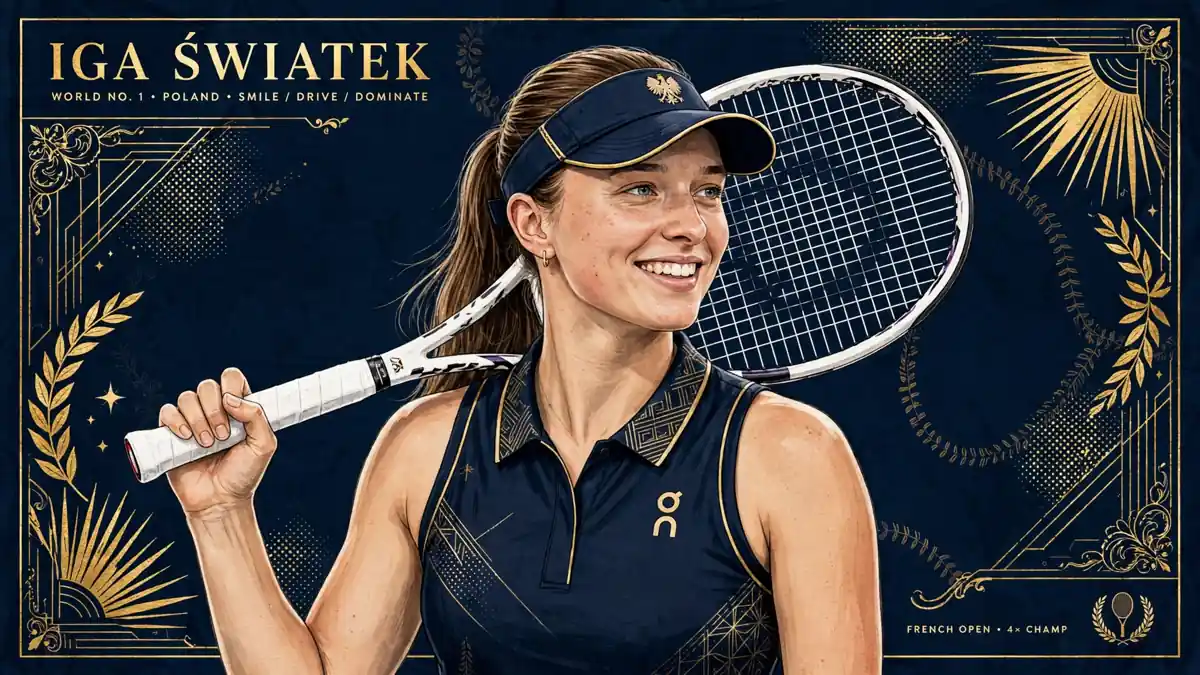
Iga Świątek‘s net worth is estimated at $25 million to $35 million as of November 2026. Celebrity Net Worth puts the figure at $30 million, the midpoint of that range, while the WTA’s official prize-money list credits her with more than $45 million in career earnings before tax. Forbes put her 2025 income at $25.1 million, split between $10.1 million on court and $15 million off court, after a season crowned by her first Wimbledon title.
Iga Świątek: Quick Facts
| Estimated net worth | $30 million (range: $25 million to $35 million) |
|---|---|
| Profession | Polish professional tennis player |
| Nationality | Polish |
| Born | 31 May 2001, Warsaw, Poland (age 25) |
| Height | 1.76 m (5 ft 9 in) |
| Primary income sources | Tournament prize money, endorsements and sponsorships, appearance fees |
| Active years | 2016–present |
| Last reviewed | November 2026 |
- Early Life and Background
- Education
- Career Journey
- Rise to Fame
- Main Sources of Income
- Salary and Earnings
- Businesses and Investments
- Brand Deals and Sponsorships
- Houses, Cars and Other Assets
- Awards and Achievements
- Net Worth Growth Over the Years
- Social Media Presence
- Personal Life
- Sources & Reporting
- Frequently Asked Questions
- Final Thoughts
Early Life and Background
Iga Natalia Świątek was born on 31 May 2001 in Warsaw, Poland, to Dorota Świątek, an orthodontist, and Tomasz Świątek, a rower who competed for Poland in the men’s quadruple sculls at the 1988 Seoul Olympics. Her older sister Agata, about three years her senior, became a dentist. Sport was a family expectation rather than a casual hobby: Tomasz wanted both daughters to take up an individual sport, reasoning that it would teach accountability in a way a team sport could not, and he first steered them toward water sports. Iga has said she was scared of water, so tennis won out, and Agata played seriously as a junior before choosing dentistry while Iga kept going.
The financial shape of her childhood matters to the net worth story because it was not a wealthy-prodigy story. Tomasz has spoken in Polish media about periods when the family feared the tennis dream might have to stop for money reasons, and the early years were built on junior tournaments, federation support and coaching time rather than private wealth. That background explains two traits that still define her commercial profile: a disciplined, low-flash public image that sponsors in Poland and abroad have been happy to attach themselves to, and a habit of giving prize money away that predates her biggest paydays. She did not arrive on tour with a famous surname or a ready-made brand. She arrived with a forehand, a work rate that coaches kept remarking on, and a father who understood elite sport from the inside.
As a junior she won the 2018 Wimbledon girls’ singles title and the 2018 French Open girls’ doubles title alongside Caty McNally of the United States. Those junior results mattered commercially because they put her on the radar of agents and sponsors before she had won a senior title, and they gave her a ranking pathway into senior events without years of grinding through the lowest tier. She turned professional in 2016 on the ITF circuit, and by 2019 she was contesting WTA main draws. Her 2019 prize money, reported by Surprise Sports at $633,807, shows how modest the starting point was: a full season on tour, no title, and earnings that would barely cover a top player’s annual team costs once travel, coaching and tax were deducted. The leap from that figure to nearly $10 million a season came in three years, and it came almost entirely from results, not from a single endorsement windfall.
Education
Świątek’s schooling ran alongside her tennis, and she has spoken about the tension between classroom timetables and tournament travel in interviews through her teenage years. She attended school in Warsaw while competing as a junior, and her family treated education as a parallel track rather than a fallback to be abandoned at the first sign of tennis success. That balance shaped her public voice: she reads widely, talks about psychology and mental health with unusual fluency for a touring athlete, and works with sports psychologist Daria Abramowicz, a relationship that has become one of the most discussed parts of her team setup.
The education section of a tennis fortune story is usually thin, and Świątek’s is no exception in the sense that no university degree or business qualification drives her income. Her education, in money terms, was the junior circuit itself: learning to travel, to handle press conferences in a second language, and to manage a schedule that crosses continents before she turned 20. Sponsors later paid for that polish. On, Rolex and her Polish partners did not sign a player who needed media training from scratch; they signed a 19-year-old Grand Slam champion who already sounded composed in English and Polish alike. The classroom detail that does carry a financial echo is her interest in psychology, which later became a genuine brand pillar through her mental-health charity work and her public advocacy, rather than a line on a CV.
Career Journey
Świątek’s senior breakthrough had almost no warm-up act. She won her first WTA title at Adelaide in 2021 and added Rome the same year, beating Karolína Plíšková in the Rome final, but the result that changed her earning power came earlier: the 2020 French Open, won at 19 without dropping a set, making her the first Polish player to win a Grand Slam singles title, the youngest women’s singles champion at Roland Garros since Monica Seles in 1992, and the youngest singles champion at the tournament since Rafael Nadal in 2005. A first major at 19 does something no marketing campaign can do: it moves a player from appearance-fee hopeful to appearance-fee headliner, and it puts her name on the shortlist every sponsor keeps for the next Olympic cycle.
Coaching changes mark the chapters of her career, and each one carried a cost and a payoff. Piotr Sierzputowski coached her through the 2020 French Open win. Tomasz Wiktorowski, who had previously worked with Agnieszka Radwańska, took over from the end of 2021 until October 2024 and presided over the dominant 2022 and 2023 seasons. Wim Fissette, the Belgian coach, was hired in October 2024, and together they won Wimbledon and Cincinnati in 2025 before parting ways after a March 2026 loss at the Miami Open. On 2 April 2026 she announced Francisco Roig, a long-time member of Rafael Nadal’s team, as her new coach. A coaching change at this level is not cheap: a top coach’s salary, plus a physio, a fitness trainer, a psychologist and travel for the whole team, is one of the largest annual costs in a tennis player’s accounts, and it is a cost that never appears in a prize-money total.
The difficult chapter came in late 2024, when a positive test for the banned substance trimetazidine led to a one-month suspension after the International Tennis Integrity Agency accepted that the violation was not intentional and carried no significant fault, with contamination from a regulated non-prescription medicine identified as the source. She missed tournaments during that period, and the episode put her sponsorships under a spotlight that most athletes never face. The commercial consequence was contained rather than catastrophic: her major partners stayed, and her 2025 season, crowned by Wimbledon, rebuilt the on-court case for every deal. The episode still belongs in a net worth account because it shows how fragile a tennis income can be. A player has no guaranteed salary. A suspension, an injury or a ranking slide cuts prize money immediately, while endorsement contracts, which are usually paid in instalments tied to ranking and appearances, can follow.
By 2025 she had added the one surface that had eluded her. Wimbledon 2025, won with a 6-0, 6-0 defeat of Amanda Anisimova in the final, gave her a sixth Grand Slam singles title and completed a set spanning clay, hard court and grass: four French Opens (2020, 2022, 2023, 2024), the 2022 US Open and Wimbledon 2025. She also won the 2023 WTA Finals, going unbeaten in Cancún and beating Jessica Pegula in the final, and she won bronze in singles at the Paris 2024 Olympic Games. Those results are the spine of her fortune because Grand Slam titles pay the largest single cheques in tennis and because they are the results sponsors write bonuses around.
Rise to Fame
Świątek became world No. 1 on 4 April 2022, after Ashleigh Barty’s sudden retirement opened the top spot, and she held it for 125 weeks in total, the third-longest stint in WTA history at the time of writing and seventh-longest across both tours’ histories on some counts. The ranking itself is a money machine: the No. 1 ranking guarantees top seeding, which protects a player from early meetings with other top players and therefore protects prize-money progression through draws, and it triggers appearance fees at non-mandatory events that lower-ranked players cannot command. Her 2022 season turned that advantage into a record: a 67-9 win-loss record, eight titles, and a 37-match winning streak from Doha in February to Wimbledon in July, the longest in women’s tennis since 1997 and the longest of the 21st century, taking in Doha, Indian Wells, Miami, Stuttgart, Rome and Roland Garros in succession.
The streak is the single best explanation for why her prize money jumped from under $1 million a season to nearly $10 million. Each title in that run paid a six- or seven-figure cheque, and the streak itself became a story that broadcasters and sponsors could sell. She won the Sunshine Double in 2022, Indian Wells and Miami back to back, becoming the youngest player to do so, and she finished the year as the WTA’s top prize-money earner by almost $5 million over Ons Jabeur, her nearest challenger at $4,976,594. Tennis.com’s year-end money list put her 2022 total at $9,875,525, ahead of every other woman on tour and, for much of the season, ahead of every man as well. She was, for a stretch of 2022, the highest-earning tennis player in the world, man or woman, on prize money alone.
Her fame in Poland added a second layer that foreign rivals could not match. She has topped Polish rankings of the most valuable female personal brands for five consecutive years, with one Polish brand-value study putting her brand value at $525 million in 2025 — a brand-value figure, not a net worth figure, and it should not be confused with money in her bank account, but it explains why Polish companies such as Oshee and PZU pay to be associated with her and why her domestic endorsement market is deeper than that of most players ranked around her. In Poland she is not a tennis player with sponsors; she is a national sporting figure whose face sells drinks, insurance and technology.
Main Sources of Income
Świątek’s income comes from three streams, and their order changed as her career matured. Prize money came first and, in 2022 and 2023, dominated. Endorsements then caught up and, by 2025, passed prize money: Forbes credited her with $15 million off court against $10.1 million on court for 2025, and Sportico put the split at $13 million off court against $10.1 million on court, a difference in method that explains the $2 million gap between their totals. Appearance fees form the third stream. They are the least documented part of a tennis income because tournaments do not publish them, but top players routinely receive guarantees for playing non-mandatory events, and a former world No. 1 with six majors commands them. Exhibition matches, such as the charity events she has headlined, sometimes pay a fee and sometimes pay nothing, with the money going to charity instead.
What she does not have, on the public record, is a business empire. There is no Świątek fashion label, no restaurant chain, no venture fund with her name on it, and no property portfolio disclosed in press reporting. That absence is itself a finding: unlike Serena Williams, whose venture fund and fashion lines sit alongside her tennis earnings, or players who moved early into business, Świątek’s fortune is, as far as public reporting shows, a tennis fortune — prize money banked, endorsement fees banked, and whatever investments she has made privately in Poland, which one profile describes only in general terms as centred in Poland. A net worth estimate for her therefore rests on fewer, cleaner pillars than for an athlete with a company to value, and it is also more sensitive to her next two seasons on court.
Her management sits with IMG, which she joined after winning her third Grand Slam title at the 2022 US Open, according to Surprise Sports. IMG’s role matters because the agency negotiates the endorsement deals, takes a commission typically in the range agents charge top tennis players, and shapes the portfolio toward long-term partners rather than one-season deals. The portfolio that emerged — On for clothing and shoes, Tecnifibre for rackets, Rolex for watches, plus Porsche, Visa, Infosys, Lego and a cluster of Polish brands — is built for duration. None of those deals has a published value, and this article does not invent one. The one figure that has leaked into reporting is the June 2026 Coach deal, described by EssentiallySports as a multi-year agreement reportedly worth seven figures annually, after her Lancôme partnership ended in January 2026.

Salary and Earnings
Tennis players have no salary. Every dollar Świątek earns on court is prize money, paid per tournament and per round, and the figures below are the WTA’s published totals, before tax, before agent commission and before team costs. That distinction is the key to the whole net worth debate: her career prize money passed $45 million in mid-2026, yet her net worth is estimated at $30 million, because a large share of that gross figure went to Polish and international tax, to IMG commission, to a travelling team, and to living costs across a decade on tour. Anyone who adds career prize money to career endorsement income and calls the sum a net worth is double-counting gross income as wealth.
Her season-by-season prize money tells the story in numbers. In 2019 she earned $633,807. In 2022 she earned $9,875,525, the highest single-season total for a woman on tour that year and, at the time, a record for a WTA season. In 2023 she earned $9,857,686, just $17,839 less, after winning the French Open, the WTA Finals, Beijing, Warsaw, Stuttgart and Doha and finishing the year as world No. 1. In 2024 she earned $8,550,693, a step down that reflected a disrupted second half of the season: her French Open win paid about $2.4 million, Madrid paid $963,225, Rome paid $699,690, Doha and Indian Wells together paid about $1.6 million, the WTA Finals appearance paid $1 million, and a US Open quarter-final paid $530,000, per Sportskeeda’s season breakdown. In 2025 she earned $10,112,532, a career high, with $9,912,532 of it in singles. Three seasons above $9.8 million in four years is a run only Serena Williams and Aryna Sabalenka have matched in WTA history, and it is the foundation under every net worth estimate.
The biggest single cheques deserve their own paragraph because they show where the money concentrates. Her 2022 US Open win paid $2.6 million, ahead of her 2022 French Open cheque of about $2.3 million, with $1.2 million each for Indian Wells and Miami that year. Her 2025 Wimbledon win paid £3 million under the tournament’s published prize schedule, worth roughly $4.01 million at the exchange rate used by Surprise Sports, making it her largest single payday. Her 2024 French Open win paid €2.4 million, about $2.4 million to $2.7 million depending on the conversion date used by the outlet reporting it — a reminder that prize money reported in euros, pounds and dollars will never line up to the cent across outlets. The WTA’s official career list, updated to 29 June 2026 and quoted by SureBets, put her career total at $45,638,749, third all-time behind Serena Williams at $94.8 million and Aryna Sabalenka at $49.9 million, ahead of Venus Williams at $43.1 million. Later 2026 reporting, including a profile putting the total at $47,269,084, reflects prize money earned after June, and the two figures are consistent rather than contradictory: the total moves every time she wins a match.
Annual earnings lists from Forbes and Sportico give the fullest picture because they add endorsements. Forbes, in its list of the world’s highest-paid female athletes for 2025, ranked Świątek third at $25.1 million, behind Coco Gauff at $33 million and Aryna Sabalenka at $30 million, with $10.1 million on court and $15 million off court. Sportico’s list, covering a slightly different window from July 2025 to July 2026, also ranked her third but at $23.1 million, with $10.1 million in prize money and $13 million in endorsements. The $2 million gap is a methods gap, not a factual dispute: Forbes and Sportico measure different 12-month windows and estimate endorsement values differently, since no sponsor publishes what it pays her. Both lists agree on the ranking, both agree on the prize-money component, and both agree that endorsements now out-earn prize money. Earlier, Forbes had put her early-2025 earnings at $23.8 million, and a Forbes tennis-earnings list dated August 2026 put her at $20.5 million for a different window — again, a window effect, not a collapse in income. A reader who sees $20.5 million, $23.1 million and $25.1 million in three outlets is seeing three windows, not three different athletes.
Her 2026 season, by contrast, has been thinner on court. Reporting through June 2026 put her 2026 prize money at about $2 million, with EssentiallySports citing $2.24 million at mid-year and the United Cup win with Poland as her largest single 2026 cheque to that point, while a September 2026 comparison put her 2026 prize money above $4.1 million against Sabalenka’s $8 million-plus through 14 September. She ended the Grand Slam season in 2026 without a singles title for the first time since 2021, according to EssentiallySports’ October 2026 reporting, and was on the verge of missing the WTA Finals cut for the first time in five years. That matters for net worth because a title-less season cuts both prize money and the performance bonuses written into endorsement deals, and because it is the reason the $25 million to $35 million range, rather than a single figure, is the honest answer in November 2026.
Businesses and Investments
On the public record, Świątek has no company of her own, no disclosed startup portfolio and no announced property business. One profile reports that her investments are centred in Poland, without naming an asset, a fund or a property, and this article repeats that only as a reported general claim, not as a verified holding. The absence of a business story is not a gap in research; it is a genuine feature of a 25-year-old athlete whose career is still in its peak earning phase. Serena Williams founded Serena Ventures during her playing career, and Naomi Osaka built a skincare and media portfolio, but Świątek has so far kept her commercial life inside endorsement contracts, which pay fees rather than equity.
That choice has a financial logic. An endorsement fee is certain money, paid whether or not a product sells, while equity in a startup can go to zero. For a player whose on-court income already exceeds $10 million in a good year, the marginal value of a risky business venture is lower than it is for an athlete whose playing income is small. It also means her net worth is easier to audit in outline: banked prize money, banked endorsement fees, minus tax and costs, plus whatever private investments she holds. It also means her wealth is less diversified than that of older athletes, and more exposed to her ranking. If she plays at a top-five level into her late twenties, the endorsement fees will keep renewing at or above current levels. If her ranking slides, the fees will follow, with a lag of one contract cycle.
One quasi-business deserves mention: her charity merchandising. In January 2023 she sold memorabilia from every Grand Slam of the 2022 season, plus limited “IGA & FRIENDS” and “1GA” T-shirts, through Allegro’s charity platform with UNICEF Poland, with proceeds supporting children from Ukraine. That was fundraising, not a business, and the money went to charity, but it showed a commercial instinct — limited-edition items tied to specific tournaments — that sponsors notice. Her 2022 “Iga & Friends” charity event for Ukraine raised over €500,000 for Ukrainian children, according to Polish brand reporting, and she later made what Elina Svitolina described as a very large donation to United24, the Ukrainian government fundraising platform, which funded children’s tennis camps. None of that adds to net worth, and some of it subtracts from it, but it adds to the brand value that sponsors pay for.
Brand Deals and Sponsorships
Świątek’s sponsorship timeline is a study in upgrading. She started on Nike, switched to Asics in 2020, and then, in March 2023, became the first female tennis player sponsored by On, the Swiss sportswear company co-founded by Roger Federer, which now supplies her footwear and apparel head to toe. The On deal is the centrepiece of her portfolio because it is a head-to-toe apparel deal with a brand that had built its tennis identity around Federer, and because it signalled that On saw women’s tennis as a growth market rather than an afterthought. Tecnifibre supplies her rackets, and she extended that deal through 2026. Rolex made her its first Polish ambassador, a distinction that matters in Poland, where Rolex’s ambassador roster is a status marker.
Around those three anchors sits a portfolio that spans luxury, technology, automotive, finance and Polish consumer brands. Porsche lists her as a Friend of the Brand in Poland — a real but narrower title than a global ambassador deal, and the distinction matters because some net worth roundups inflate it into a global Porsche contract. Visa, Infosys, Lego and Red Bull are all confirmed partners in multiple profiles. Lancôme signed her in 2024, taking her into beauty and lifestyle audiences beyond sport, and that partnership ended in January 2026, to be replaced in June 2026 by Coach, the American luxury brand, in a multi-year deal EssentiallySports reports as worth seven figures annually. Polish partners include Oshee, the sports drink brand whose logos appeared on her tournament kit in an enhanced partnership in 2025, and PZU Insurance. A Forbes profile dated August 2026 also lists Procter & Gamble among her sponsors, alongside Coach, Infosys, Lego, On, Porsche, Rolex and Visa, which suggests the portfolio kept expanding into 2026 even as her on-court results cooled.
Individual deal values have not been disclosed by any party, and this article does not estimate them one by one. Two claims found in weaker roundups should be treated with caution. One site credits her with a five-year Rolex deal at $2.5 million a year and an Asics deal at $3 million to $4 million a year; those figures appear in a single low-authority profile, conflict with her actual timeline — she left Asics for On in 2023 — and are not repeated by Forbes, Sportico or EssentiallySports, so they are not used here. The honest aggregate is the one Forbes and Sportico provide: about $13 million to $15 million a year in off-court income in 2025, across the whole portfolio. That aggregate, divided across eight or more partners, implies an average in the low seven figures per major deal, with On and Rolex presumably at the top end and Polish domestic deals lower — but that is inference, and it is labelled as such.
The Coach signing is the clearest sign of where her commercial value is heading. A luxury fashion house does not sign a tennis player for tennis performance alone; it signs her for reach into fashion and lifestyle audiences, for a clean public image, and for a social following that buys handbags as well as tennis shoes. The timing, after the Lancôme deal ended, shows a portfolio being actively managed rather than left to renew on autopilot, with IMG moving her from beauty into luxury fashion at the moment her Wimbledon win gave her the strongest lifestyle case of her career. If the Coach deal is indeed seven figures a year, it alone replaces a large share of what a title-less season costs her in prize money, which is exactly why endorsements now matter more to her net worth than any single tournament.

Houses, Cars and Other Assets
There is no verified public record of a Świątek house purchase, no reported property portfolio, and no car collection profiled in the press, and this article does not invent one. She is based in Poland, and profiles describe her investments as centred there, but no outlet has published a Warsaw apartment, a house purchase price or a mortgage record that could be checked, so none is claimed here. That restraint is deliberate: many net worth roundups fill this section with a luxury car or a mansion borrowed from another athlete’s profile, and the result is fiction presented as fact. For Świątek, the honest statement is that her visible assets are her prize-money and endorsement earnings, her team, and her brand, and that any property she owns has not been publicly documented.
The one automotive association that is real is Porsche, through her Friend of the Brand role in Poland. That title typically involves access to vehicles and appearances rather than ownership of a fleet, and no outlet reports her as owning a particular Porsche model, so no model is named here. The same discipline applies to watches: Rolex is her sponsor, and she wears Rolex, but a sponsored watch is not a purchased asset, and no collection has been valued in print. Readers looking for a garage tour or a house tour will not find a reliable one for Świątek, and that absence fits the rest of her profile: a player who gives prize money to children’s mental-health charities, who wears a ribbon for Ukraine on court, and whose public spending has never been the story. Her money story is accumulation through tennis, not display through property.
What can be said about assets is structural. A tennis player’s real assets, beyond cash and investments, are intangible: a ranking, a reputation, and a set of contracts with renewal dates. Świątek’s ranking asset was at its peak in 2022 to 2024, when 125 weeks at No. 1 gave her maximum bargaining power in every negotiation. Her contract asset is strongest in apparel and watches, where multi-year deals with On, Tecnifibre and Rolex give her income visibility beyond a single season. Her reputation asset took a hit in late 2024 with the doping suspension and recovered in 2025 with Wimbledon, which is why sponsors who stayed through 2024 were rewarded with a champion in 2025. Those three intangibles, not bricks or cars, are what a buyer of her brand is actually paying for.
Awards and Achievements
Świątek’s trophy record is the reason her net worth conversation starts at $25 million rather than $5 million. Six Grand Slam singles titles: the French Open in 2020, 2022, 2023 and 2024, the US Open in 2022, and Wimbledon in 2025. The 2023 WTA Finals title, won unbeaten. A bronze medal in singles at the Paris 2024 Olympic Games, Poland’s first Olympic tennis medal in singles. More than 25 WTA singles titles in total, a count that moves with each tournament and is therefore stated here as a floor rather than a fixed number. Twelve WTA 1000 titles on some counts, eleven on others, depending on whether the count is taken before or after a given tournament — another case where a range is more honest than a single number.
The ranking record stands beside the titles: world No. 1 for 125 weeks, first reached on 4 April 2022, the third-longest total in WTA history. She finished as year-end world No. 1 in 2022 and 2023, and she won the WTA’s top prize-money race in both years. She was the youngest player to complete the Sunshine Double in 2022, and her 37-match winning streak that year is the longest in women’s tennis since 1997. She has been named in Forbes’ and Sportico’s highest-paid female athlete lists for 2025, third on both, behind Coco Gauff and Aryna Sabalenka. She has topped Polish personal-brand rankings for five consecutive years. Each of those honours carries a cheque or a contract clause behind it: year-end No. 1 finishes trigger bonuses in some deals, Grand Slam titles trigger others, and a top-three place on a Forbes list is itself a negotiating document for the next renewal.
The Olympic bronze deserves emphasis because Olympic medals pay little directly — the medal itself carries no prize money from the Games — but they pay indirectly for years. A bronze in Paris, won in front of a home continent audience, strengthened her case with Polish sponsors and with global brands that value Olympic association, and it gave her a story that no Grand Slam title can replicate: representing Poland as well as herself. The same logic applies to her Billie Jean King Cup appearances for Poland and her United Cup win with Poland in 2026, which EssentiallySports cited as her largest single 2026 cheque to mid-year. National-team success does not pay like a major, but it deepens the domestic market that pays her endorsement fees.
Net Worth Growth Over the Years
The growth curve is steep, short and easy to misread. In 2019, on $633,807 of prize money and no major endorsement portfolio, her net worth was a small fraction of today’s figure — a working tennis player’s savings, not a fortune. The 2020 French Open win changed the slope, but the real inflection came in 2022, when $9,875,525 of prize money plus a first wave of major endorsements moved her into eight figures of cumulative gross income. A 2023 profile put her net worth at $13.6 million, a figure that looks low today but was consistent with two seasons of prize money minus tax and costs at that point. Forbes’ early-2025 estimate of $23.8 million in earnings, Celebrity Net Worth’s $30 million net worth figure in 2026, and the $25 million to $35 million range used here trace a curve that rises with each $10 million season and flattens in a title-less year.
| Year | Prize money (WTA / reported) | What drove it |
|---|---|---|
| 2019 | $633,807 | First full WTA season, no title |
| 2022 | $9,875,525 | Eight titles, French Open, US Open, 37-match streak, year-end No. 1 |
| 2023 | $9,857,686 | Six titles, French Open, WTA Finals, year-end No. 1 |
| 2024 | $8,550,693 | French Open, four WTA 1000 titles, Olympic bronze, disrupted second half |
| 2025 | $10,112,532 | Wimbledon, Cincinnati, Seoul, career-high season total |
| 2026 (to mid-year) | About $2 million to $2.24 million | United Cup win with Poland; no Grand Slam singles title to that point |
Peer comparison puts the range in context. Serena Williams, with $94.8 million in career prize money and a venture portfolio built over two decades, sits in a different wealth bracket entirely, with published net worth estimates far above Świątek’s. Aryna Sabalenka, who passed Świątek on the all-time prize-money list in late 2025 and reached $49.9 million by mid-2026, with Forbes putting her 2025 earnings at $30 million against Świątek’s $25.1 million, is the closest peer: a near-identical prize-money total, a larger endorsement haul in 2025, and a net worth range that overlaps Świątek’s at the top end. Coco Gauff, at $33 million in Forbes 2025 earnings with $25 million off court, shows what the next tier looks like: a younger player whose endorsement income already dwarfs her prize money. Świątek sits between the two models — a bigger prize-money accumulator than Gauff, a smaller endorser than Gauff, and a near-twin of Sabalenka on court with a slightly smaller off-court haul in 2025.
| Player | Career prize money (mid-2026 reporting) | 2025 total earnings (Forbes) |
|---|---|---|
| Serena Williams | $94.8 million | Not on the 2025 active list |
| Aryna Sabalenka | $49.9 million | $30 million |
| Iga Świątek | $45.6 million | $25.1 million |
| Coco Gauff | Below Świątek on prize money | $33 million |
Why the range, and why not a single number? Because three reputable approaches give three answers. Celebrity Net Worth says $30 million. Sports Digest says $25 million to $35 million. SureBets, testing the $30 million figure against the WTA prize-money list and the Forbes earnings list, also lands on $25 million to $35 million. Mabumbe says $25 million to $30 million. One profile claims over $50 million, apparently by adding gross career prize money to gross endorsement estimates without deducting tax, commission or team costs, and that figure is not adopted here because it fails the basic test that net worth must be less than cumulative gross income once costs are counted. The $25 million to $35 million range, anchored at $30 million, is the range that survives contact with the verifiable numbers.
Social Media Presence
Świątek’s social media presence is large but deliberately low-key, and that restraint is part of her commercial value. Polish brand reporting puts her following above two million across platforms, and she uses Instagram and X to post training clips, match reflections, book recommendations and mental-health messages, including a World Mental Health Day post on 10 October 2026 in which she called for better access to psychiatric care for children and young people in Poland. She does not run a lifestyle-influencer account: there are no daily product placements, no paid-post churn, and no reality-television presence. Sponsors therefore buy her social reach as part of a larger deal — a post in On kit, a Rolex appearance, a Porsche event — rather than as a standalone influencer income stream, and no reliable figure exists for what she earns from social posts alone, so none is claimed.
The social account that matters most to her money is the one she uses for charity. Her Instagram announcements drove the 2023 UNICEF Poland memorabilia sale, her “Iga & Friends” event promotion, and her mental-health donation announcements, including the $50,000 Indian Wells prize-money donation in 2021 to two Polish children’s mental-health foundations, the $58,000 Ostrava prize-money donation in 2022 to SOS Children’s Villages Poland, and the $70,000 donation in 2023 through UNICEF for mental health. Those posts convert sporting success into charitable money and, indirectly, into sponsor goodwill. A brand that signs Świątek is signing an athlete whose social feed will not embarrass it, and in a sport where a single ill-judged post can cost a deal, that reliability has a price.
Personal Life
Świątek keeps her private life private, and the public record reflects that choice. She is not married, she has no children, and no partner has been publicly confirmed in reliable reporting, so this article names none. Her parents divorced when she was a teenager, and her father Tomasz remains a visible figure at her matches, including the well-reported moment after her 2024 French Open win when he pulled her nose affectionately after a long hug, a family gesture that Polish television replayed for days. Her sister Agata, a dentist, has spoken about the family’s early sacrifices, and her mother Dorota, an orthodontist, has kept a lower public profile.
Her personal life, in money terms, is notable for what it does not contain: no divorce settlement, no public legal dispute over money, no luxury lifestyle coverage, and no reality-television income. The one personal theme that does intersect with money is mental health. She works with psychologist Daria Abramowicz, she has spoken openly about the pressure of holding the No. 1 ranking and about the strain of the 2024 doping case, and she donates prize money to children’s mental-health services in Poland. That advocacy is not a side project bolted onto a tennis career; it is the through-line of her public life, from the 2021 Indian Wells donation to the October 2026 World Mental Health Day message, and it is the reason brands in health, technology and luxury feel comfortable associating with her. Her personal brand is, in short, discipline, discretion and a cause, and that brand is worth more to sponsors than a flashier image would be.
Sources & Reporting
Forbes — 2025 highest-paid female athletes list: Świątek third at $25.1 million ($10.1 million on court, $15 million off court), behind Gauff ($33 million) and Sabalenka ($30 million); early-2025 earnings figure of $23.8 million; August 2026 tennis-earnings list. Reporting window: December 2025 to August 2026.
Sportico — 2025 highest-paid female athletes list: Świątek third at $23.1 million ($10.1 million prize money, $13 million endorsements), July 2025 to July 2026 window, via WTA reporting of the list. Reporting window: 2025–2026.
WTA — official career prize-money leaders list: $45,638,749 at 29 June 2026, third all-time; season prize-money totals and ranking history, including 125 weeks at No. 1. Reporting window: to June 2026, with later totals reflecting subsequent results.
Celebrity Net Worth — net worth estimate of $30 million, cited by EssentiallySports and Tennis365 in 2026 reporting. Reporting window: 2026.
EssentiallySports — 2026 net worth and career-earnings reporting: $30 million estimate, $45.88 million career prize money at mid-2026, $2.24 million in 2026 prize money to mid-year, Coach multi-year deal reported June 2026, Lancôme partnership ended January 2026, coaching change to Francisco Roig in April 2026. Reporting window: 2025–2026.
Tennis365 — 2025 season prize money of $10,112,532, career total of $43,640,490 at the end of 2025, Wimbledon 2025 cheque of £3 million, and the Celebrity Net Worth $30 million figure dated July 2025. Reporting window: 2025–2026.
SureBets — July 2026 editorial range of $25 million to $35 million, tested against the WTA prize-money list and the Forbes 2025 earnings list; sponsor list including On, Tecnifibre, Rolex, Porsche, Infosys, Lancôme, Oshee, Visa and Lego. Reporting window: July 2026.
Surprise Sports — career prize money above $45.3 million, 2025 prize money of $10,112,532, 2019 prize money of $633,807, endorsement portfolio including On, Tecnifibre, Rolex, Porsche, Visa, Infosys, Lego, Lancôme, Oral-B and Oshee, IMG management from after the 2022 US Open. Reporting window: 2026.
Tennis.com — year-end 2022 prize-money list: Świątek $9,875,525, top of the WTA list. Reporting window: December 2022.
Wikipedia — biographical record: born 31 May 2001 in Warsaw, parents Dorota and Tomasz, 125 weeks at No. 1, six Grand Slam singles titles, 2023 WTA Finals title, Paris 2024 Olympic bronze. Reporting window: to May 2026.
Frequently Asked Questions
What is Iga Świątek’s net worth in 2026?
Iga Świątek’s net worth is estimated at $25 million to $35 million in November 2026, anchored at $30 million by Celebrity Net Worth. The range reflects disagreement between outlets and the fact that her taxes, agent commission, team costs and private investments are not public.
How much prize money has Iga Świątek earned in her career?
The WTA’s official career prize-money list put her total at $45,638,749 on 29 June 2026, third all-time in women’s tennis behind Serena Williams and Aryna Sabalenka. Later 2026 reporting puts the total above $47 million, reflecting prize money earned after June. Prize money is gross income, before tax and costs.
How much did Iga Świątek earn in 2025?
Forbes estimated her 2025 earnings at $25.1 million, split between $10.1 million in prize money and $15 million in endorsements, ranking her third among the world’s highest-paid female athletes. Sportico put the same year at $23.1 million, with $13 million in endorsements, using a different 12-month window.
Who sponsors Iga Świątek?
Her confirmed sponsors include On for apparel and footwear, Tecnifibre for rackets, Rolex as her first Polish ambassador, Porsche as a Friend of the Brand in Poland, and Visa, Infosys, Lego, Red Bull, Oshee and PZU. Coach signed her to a multi-year deal in June 2026 after her Lancôme partnership ended in January 2026. Individual deal values have not been disclosed.
How many Grand Slam titles has Iga Świątek won?
Six: the French Open in 2020, 2022, 2023 and 2024, the US Open in 2022, and Wimbledon in 2025. She also won the 2023 WTA Finals and a bronze medal in singles at the Paris 2024 Olympic Games.
Why is her net worth lower than her career prize money?
Career prize money is gross income. Tax, agent commission to IMG, coaching and travel costs for a full team, and living expenses across a decade on tour all come out of it before anything is saved or invested. A $45 million-plus gross prize-money total is consistent with a $30 million net worth once those costs and endorsement income are accounted for.
Did Iga Świątek switch from Nike to On?
Yes. She wore Nike early in her career, switched to Asics in 2020, and then signed with On in March 2023, becoming the first female tennis player sponsored by the Swiss brand. On now supplies her footwear and apparel.
What happened with Iga Świątek’s doping case?
In late 2024 she tested positive for trimetazidine and served a one-month suspension after the International Tennis Integrity Agency accepted the violation was not intentional and carried no significant fault, with contamination from a regulated non-prescription medicine identified as the source. Her major sponsors stayed, and she won Wimbledon in 2025.
Final Thoughts
Iga Świątek’s fortune is a tennis fortune in the purest sense: $45 million-plus in gross prize money, banked season by season from a $633,807 season in 2019 to a $10.1 million season in 2025, plus an endorsement portfolio that now earns more in a year than her prize money does. The $25 million to $35 million range, anchored at $30 million, is the honest answer because it survives contact with the WTA’s verifiable totals and with both Forbes and Sportico, while the $50 million-plus claims found in weaker roundups do not survive the simple test of deducting tax and costs from gross income.
What happens next depends on the court more than on any boardroom. A return to Grand Slam finals would renew her biggest deals at higher rates and push the range upward; a second title-less season would compress it, as endorsement bonuses tied to ranking and results come under pressure. Either way, the structure is sound: multi-year deals with On, Tecnifibre and Rolex, a new luxury deal with Coach, and a domestic Polish market where she remains the most valuable female sporting brand. She built this fortune the hard way, one title at a time, and the numbers, properly read, show exactly how.
Published on 1 November 2026. Last reviewed November 2026. Found an error? See our corrections policy.