
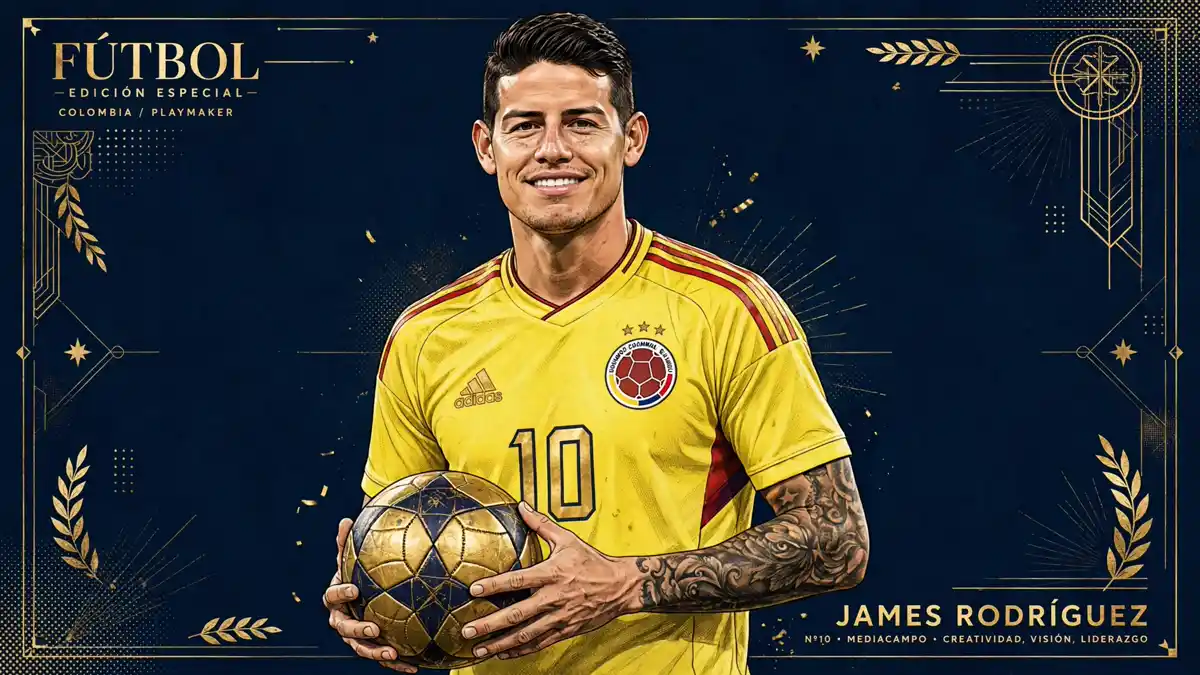
James Rodríguez‘s net worth is estimated at $80 million as of October 2026. The Colombian playmaker banked his fortune during a peak run at Real Madrid and Bayern Munich, rebuilt his reputation with a Player of the Tournament display at Copa América 2024, and then, at 35, came home: a free transfer to Atlético Nacional in September 2026, his 14th club, on a deal Colombian reporting puts at $2.5 million to $3 million a year.
James Rodríguez: Quick Facts
| Estimated net worth | $80 million (range: $75–$80 million) |
|---|---|
| Profession | Professional footballer, attacking midfielder |
| Nationality | Colombian |
| Born | 12 July 1991, Cúcuta, Colombia (age 35) |
| Height | 1.80 m (5 ft 11 in) |
| Primary income sources | Club salaries, national-team earnings, endorsements (Adidas, Pepsi, Huawei, Libertex), business ventures |
| Active years | 2006–present |
| Last reviewed | October 2026 |
- Early Life and Background
- Education
- Career Journey
- Rise to Fame
- Main Sources of Income
- Salary and Earnings
- Businesses and Investments
- Brand Deals and Sponsorships
- Houses, Cars and Other Assets
- Awards and Achievements
- Net Worth Growth Over the Years
- Social Media Presence
- Personal Life
- Sources & Reporting
- Frequently Asked Questions
- Final Thoughts
Early Life and Background
James David Rodríguez Rubio was born on 12 July 1991 in Cúcuta, a border city in the Norte de Santander department of Colombia, and raised in Ibagué, in the Tolima region, after his family moved there. His father, Wilson James Rodríguez Bedoya, had played football himself; his mother, María del Pilar Rubio, raised him with her new partner after his father left the family home when James was young. The hardship of that split is part of the standard telling of his childhood, and it sits beside a second fact: from his earliest years, football was the fixed point. Colombian press profiles describe a boy who stood at the edge of training sessions for the local second-division side Cooperamos Tolima at the age of two, copying the players’ movements.
His first real break came at the Pony Fútbol youth tournament in 2004. Playing for Academia Tolimense, Rodríguez finished as the tournament’s top scorer as his side won the trophy, and the performance earned him a move to Envigado, a club in Medellín with a reputation for developing young talent. He, his mother and her partner relocated to Medellín to support the move. Envigado gave him his senior debut while he was still a teenager — Colombian outlets differ on whether he was 14 or 15 at the time, a small discrepancy that follows from the two different debut dates cited in club histories, and this article does not pretend to settle it. What is not disputed is the speed of what followed: within two years he was in Argentina.
Banfield signed him in 2008. On 27 February 2009 he scored his first goal for the club, a long-range strike in a 3–1 win over Rosario Central, and at 17 he became the youngest foreign player to score in Argentina’s top flight. Later that year he played every game of Banfield’s Apertura 2009 title run — the club’s first league championship — scoring in wins over Newell’s Old Boys, Godoy Cruz and Vélez Sarsfield. He carried that form into the 2010 Copa Libertadores, scoring five times in eight appearances. European scouts were already watching; the fee that took him across the Atlantic shows how quickly his price was rising.
Education
Rodríguez has no university education on the public record, and no profile should invent one. His schooling was football: Envigado’s academy system, then Banfield’s first-team environment in Buenos Aires, where a teenager learned a professional dressing room in a foreign country. That counts as education in the only sense that matters for his earnings story, because each step — Envigado to Banfield to Porto — was a paid apprenticeship that raised his market value. By 19 he was a Portuguese league player; by 21 he had won a Europa League medal and been voted the best player in Portugal. The classroom version of his career is short: he left formal schooling behind early, and the game itself supplied the training, the languages (Spanish, Portuguese, and working English from his Premier League spell) and the commercial education that later produced his own brand deals.
One detail from his youth illustrates the private coaching behind the public talent. Bleacher Report’s 2014 profile records that, while coming through at Envigado, Rodríguez paid youth coach and former professional Omar Suárez 100,000 pesos a month — about £31 at the time — for extra one-to-one sessions. It is a small sum that says a lot about where the money went before there was any money: back into the craft.
Career Journey
Porto signed Rodríguez on 6 July 2010 for €5.1 million, taking 70 percent of his economic rights, on a four-year deal carrying a €30 million release clause. His first season in Portugal was quiet in league terms — 15 appearances — but it ended with a hat-trick in Porto’s 6–2 Taça de Portugal final win over Vitória Guimarães. Over the next two seasons he became a regular, scoring 23 goals across those campaigns, winning three Primeira Liga titles in total and the 2010–11 Europa League, and collecting the Portuguese Golden Ball for 2012 as the league’s best player. Porto also sold a slice of his economic rights along the way, 35 percent to Gol Football Luxembourg for €2.5 million in November 2010, a reminder that his value was already being traded like an asset before he turned 20.
Monaco paid €45 million for him on 25 May 2013, then the second-most expensive transfer in Portuguese football history behind Hulk’s move to Zenit. He signed a five-year contract and spent one season in France, scoring nine goals in 34 league games and helping a newly promoted Monaco side finish second in Ligue 1. The fee, large as it was, lasted barely a year as his career high. The 2014 World Cup changed everything, and Real Madrid paid a fee reported at around €75 million to €80 million — £63 million in British reporting — to take him to Spain in July 2014. He was, at that moment, one of the most expensive players in world football and the most expensive Colombian player of all time, a record he still holds.
His first season at the Bernabéu under Carlo Ancelotti was the best club season of his life: 17 goals and 18 assists in all competitions, per Colombia Reports’ summary of that campaign. Then came the slow slide that defines the middle of his career. Under Zinédine Zidane he fell down the pecking order, and a two-year loan to Bayern Munich (2017–2019) produced two Bundesliga titles but no permanent deal: Bayern declined its €42 million option to buy. Back in Madrid he made a single La Liga appearance between November 2019 and the end of the delayed 2019–20 season. Everton, managed by Ancelotti for a third time, signed him in September 2020 on a two-year deal with an option for a third; the fee was initially reported at £22 million, though later reporting said the clubs had signed a confidentiality agreement and the deal may have amounted to Everton covering part or all of his remaining Madrid wages. He scored six goals in 26 appearances in 2020–21, then played no part under new manager Rafael Benítez and left in September 2021.
What followed was a six-year tour of short contracts: Al-Rayyan in Qatar (September 2021, fee reported at €8 million), Olympiacos in Greece (September 2022, released by mutual consent in April 2023), São Paulo in Brazil (July 2023 to July 2024, after a season in which he struggled for minutes), Rayo Vallecano in Spain (August 2024, six La Liga appearances, one start), and León in Mexico (January 2025, where he finally found continuity — 34 appearances, five goals and nine assists in 2025, per All Football’s season summary). None of those stays lasted more than a season. Each move lowered his wage while keeping his name in circulation, and each one kept him available for the one stage where he never stopped performing: Colombia.
February 2026 brought the most unexpected stop of all. Minnesota United signed him on a short-term deal running through the summer World Cup, with a club option through December 2026, after his León contract expired in December 2025. He was not a Designated Player, which capped his MLS earnings, and he made eight appearances with two assists, three of them starts, before becoming a free agent in July. An apparent move to Italian Serie B side Avellino faded, and on 11 September 2026 Atlético Nacional announced his signing on a free transfer, a contract running to 30 June 2027 with an option for a further year. It is his 14th club, in his 12th country as a professional, and his first spell in Colombian domestic football since he left Envigado for Argentina in 2008 — 18 years earlier.
Rise to Fame
Rodríguez was a known prospect before 2014 and a global star after it. The tournament that did it was the World Cup in Brazil, where he scored six goals — more than any other player — and won the Golden Boot as Colombia reached the quarter-finals for the first time. The goal people still replay is the one against Uruguay in the last 16: chest control on the edge of the box, a turn, and a left-foot volley that dipped under the bar. It won the FIFA Puskás Award for goal of the year. The tournament also gave him the commercial platform that defined his peak earnings: within weeks he was a Real Madrid player, an Adidas headline act, and, per Forbes’ rankings, the eighth-highest-earning footballer in the world.
The second act of his fame arrived a decade later and surprised almost everyone. Left out of Colombia’s 2021 Copa América squad, his international career looked finished. Under head coach Néstor Lorenzo he returned to the centre of the side, and at Copa América 2024 in the United States he produced the best playmaking tournament of his life: one goal and six assists as Colombia reached the final, losing 1–0 to Argentina in Miami. His six assists broke the single-edition record since Opta-style records began in 2011, passing Lionel Messi’s five from 2021, and he was named Player of the Tournament — the second Colombian to win that honour after Carlos Valderrama in 1987. He created 20 chances in the tournament, six more than any other player, and four of his six assists came from set pieces. The revival mattered commercially as well as emotionally: it put him back in shop windows at 33, and Rayo Vallecano signed him weeks later on the strength of it.
His Colombia record as a whole underpins his marketability at home. He debuted for the senior team against Bolivia in October 2011, scored his first goal against Peru later that year, and has captained the side through three World Cup cycles, including the 2026 tournament, where he captained Colombia after his Minnesota spell. For sponsors, that longevity is the product: a player who has been the face of Colombian football for 15 years, across generations of teammates.
Main Sources of Income
Club wages supply the bulk of Rodríguez’s fortune — roughly three quarters of his peak-year earnings, per Verdict’s analysis of his 2014–2018 income split, with endorsements supplying the remaining quarter. That split held across his career: even in his best endorsement year, salary dwarfed sponsorship. The second stream is endorsements, led by Adidas and stretching across drinks, watches, telecoms and trading platforms. The third stream is his own ventures — a restaurant business, a wellness firm, a clothing line and a cryptocurrency token — which have produced headlines rather than verified profits, and this article treats them accordingly. A fourth, smaller stream is image rights and appearance work tied to his Colombia captaincy, including the social-media reach that made him Minnesota United’s most famous signing by a wide margin.
Transfer fees are not income for the player, but they explain why clubs kept paying him. His moves generated fees of €5.1 million (Porto), €45 million (Monaco), around €75–80 million (Real Madrid) and €8 million (Al-Rayyan), with the Bayern loan carrying a €13 million fee and a €42 million option. Agents and selling clubs took their cuts; Rodríguez’s share came through wages and signing bonuses, including a reported €5 million signing bonus in the Everton deal structure reported by Remezcla. The pattern is a familiar one for elite players: the fee headlines belong to the clubs, the wage bill belongs to the player, and the wage bill is where the $80 million was built.

Salary and Earnings
At Real Madrid, Rodríguez’s pay is unusually well documented because Football Leaks published his contract details. His first season (2014–15) paid around €7.0 million, rising to about €7.76 million a year from 2015–16, with the full six-year deal valued at €45.8 million gross. Verdict reported a headline contract figure of €8.2 million a year, a number that sits close to the leaked figures once bonuses are included. Forbes’ annual rankings give the cleanest year-by-year picture of his peak: in 2015–16 he earned $25.4 million in total, $21.4 million of it salary and bonuses and $4 million from endorsements, making him the eighth-highest-paid footballer in the world. In 2017–18, while on loan at Bayern, Forbes via Men’s Journal put his earnings at $22.1 million. Verdict’s four-year tally for 2014–2018 was $89 million, an average of about $22 million a year, with endorsement income peaking at $7 million in 2016 — roughly a third of his $21.9 million total that year.
The Bayern loan itself was a €6.5 million net annual wage, per the leaked documents published by Managing Madrid, with Bayern paying Real Madrid a €13 million loan fee in two €6.5 million instalments and holding a €42 million option to buy that it never exercised. SalarySport’s contract-by-contract database, which tracks his wages season by season, lists weekly wages of £184,000 in 2017, £190,000 in 2018 and £224,000 in 2019 across the Madrid and Bayern years, then £215,000 in 2020 — figures that line up with the leaked euro amounts once exchange rates and gross-versus-net reporting are taken into account. The database puts his total career wages at £66.664 million (about $89 million at recent rates), a gross wages figure, not a net-worth figure: tax, agent fees and spending sit between the two.
Everton is where the reporting splits. Spanish outlet Marca reported he halved his salary to €4.5 million a year to make the move; Colombian journalist Pipe Sierra put his wages closer to £120,000 a week; later English reporting pushed the figure to £200,000 a week, and ESPN, via coverage of his exit, cited a £10 million-a-year deal. Surprise Sports’ contract table puts his two-year Everton deal at £9.36 million total, or £4.68 million a year. This article does not pick a winner from that spread: the honest Everton figure is a range, roughly £4.7 million to £10 million a year depending on which report counts bonuses and image-rights payments, and the spread itself is the story of a transfer whose terms the clubs agreed to keep confidential.
Al-Rayyan restored him to top-bracket pay. Colombian outlet Semana, via English press coverage of the move, reported €12 million a year — about £215,000 a week — slightly above his Everton wage, with a transfer fee of €8 million. Olympiacos and São Paulo paid less: SalarySport’s series shows his weekly wage falling to £51,000 in 2023 and £36,000 in 2024, and Surprise Sports lists his São Paulo salary at $2,364,146 for 2023. At São Paulo he was the club’s second-highest earner behind former Tottenham forward Lucas Moura, per reporting at the time of the 2024 Copa América, and president Julio Casares admitted publicly that Rodríguez did not figure in the coach’s plans — a candid comment that preceded his July 2024 exit.
León reversed the slide. El Futbolero USA, citing Liga MX transfer site 360Score, reported an estimated $5 million annual salary, described as the highest in Mexican football history, or roughly $450,000 a month. That figure is single-sourced and should be read as reported, not confirmed, but it fits the pattern of León using him as a marquee signing. Minnesota United was the opposite: as a non-Designated Player he could not earn at star level, and reporting around the signing put the non-DP ceiling at about $1.74 million a year — a $743,750 maximum budget charge plus up to $1 million of Targeted Allocation Money — while SalarySport lists his Minnesota wage at £22,000 a week, or £1.144 million a year. Atlético Nacional’s deal, reported by El Futbolero Colombia via HCN Times, is $2.5 million to $3 million a year on a one-year contract to June 2027 with an option for a further year. That is a steep fall from his Madrid peak of roughly $25 million a year in total earnings, and it is also the clearest evidence that his late-career choices are driven by playing time and homecoming rather than money.
Putting the salary arc together gives the shape of the $80 million estimate. His peak years (2014–2020) delivered roughly $20–25 million a year in salary and bonuses. His middle years (2021–2024) delivered roughly $10–12 million a year in Qatar, then sharply less in Greece and Brazil. His late years (2025–2027) deliver roughly $2–5 million a year. Gross career wages near £66.7 million, per SalarySport, plus endorsement income that peaked at $7 million a year and ran at $4 million a year through his peak, support a net worth in the $75–80 million band after tax, agents’ cuts and a decade of high spending — and support it better than the stale $30 million figure that some older profiles still carry, which predates his most lucrative contracts.
Businesses and Investments
Rodríguez’s best-known business move is also his strangest: the JR10 Token. In May 2018, while at Bayern Munich, he announced a partnership with blockchain startup SelfSell to launch a cryptocurrency named for his initials and his number 10 shirt. The public sale was set to start on 12 July 2018 — his birthday — through SelfSell’s app, with 160 million tokens, 8 percent of the total issue, earmarked to be given to fans free of charge. SelfSell described it as the first cryptocurrency launched by an active footballer, and Finance Colombia covered the launch in detail. No verified figure for what Rodríguez personally earned from the token has ever been published, and the token never became a mainstream asset; its value to his fortune is best described as promotional rather than financial, and any profile that counts it as a major holding is guessing.
His more conventional ventures sit in Colombia. In September 2026, Archysport reported that Rodríguez, alongside Colombia teammates including David Ospina, Juan Guillermo Cuadrado, Yerry Mina and Santiago Arias, had directed capital into gastronomy, real estate, training academies and retail. Rodríguez’s named holdings in that report are the restaurant concept Arrogante and the nutrition and wellness firm Truly Genius. He also has a J10 underwear line produced with Colombian retailer Bronzini, a venture that dates back to his peak years and used his image on packaging and advertising. None of these businesses publish revenue figures, so this article credits them as diversification, not as quantified wealth — a distinction his own numbers demand, since his fortune was made on wages, not on company exits.
He has also put money into charitable work through Fundación Colombia Somos Todos (We Are All Colombia), the foundation tied to his name, which Sportzwiki lists among his off-field activities. Charity does not add to net worth, but it belongs in any honest account of where a footballer’s money goes, alongside the taxes and agent fees that separate gross wages from net worth.
Brand Deals and Sponsorships
Adidas is the spine of Rodríguez’s endorsement career. The German brand signed him early — he was approached by Adidas scout Claus Peter Meyer during his South American youth career — and after the 2014 World Cup it issued him custom gold boots to mark his Golden Boot win. Multiple profiles, including ClutchPoints and Sportzwiki, report a clause in his Adidas deal requiring him to wear the number 10 shirt wherever he plays, a clause that has complicated squad-number negotiations at several clubs and explains why the 10 has followed him from Monaco to Madrid to Colombia. Adidas remained his most lucrative sponsor through his peak, and Verdict’s analysis credits the brand with the bulk of his endorsement income.
Around Adidas sits a long roster: Pepsi and Gatorade, Huawei, Calvin Klein, Hugo Boss, trading platform Libertex, Colombian telecom Claro, Nestlé’s Milo chocolate drink, Pony Malta soft drink, Clear shampoo and Rexona deodorant. Sportcal, the sports market intelligence firm cited by Verdict, counted nine deals with six companies signed since 2014, with Adidas, Gatorade and Libertex among them. Forbes’ profile put his endorsement income at about $4 million a year during his peak; Verdict’s year-by-year reconstruction puts the peak higher, at $7 million in 2016. The gap between those two numbers is a reporting difference, not a contradiction: Forbes’ figure is a single-year snapshot, Verdict’s is a reconstruction across his peak seasons. Either way, endorsements were a quarter or less of his income — a much smaller share than for a Messi or a Ronaldo, whose off-field earnings rival their wages.
Two sponsorship facts separate him from most footballers. First, his Colombian domestic deals — Pony Malta, Milo, Claro — gave him endorsement income in a market where few global stars bother to sign local contracts, and they kept paying after his European star faded. Second, his social following made him a sponsor’s asset in itself: at his Minnesota signing in February 2026, Sports Illustrated reported his Instagram following at 51.7 million, more than all of Minnesota’s major professional sports teams combined. That audience is why a 35-year-old on a non-Designated Player deal still commands sponsor interest, and why Atlético Nacional’s announcement of his signing was treated as a commercial event in Colombia, not just a sporting one.

Houses, Cars and Other Assets
Rodríguez’s property base is Medellín. Property blogs describe a hillside home in the El Poblado district, the city’s upmarket neighbourhood near Parque Lleras, and one such site, HomeDecorToday, claims a 2018 purchase price of $8 million and a current value of $12 million on a house built in 2015. Those numbers come from a property-content site, not a land registry, so this article reports them as claimed, not confirmed — and the same caution applies to the wider lifestyle reporting around him. He has also been linked in press profiles to homes in Madrid from his Real years and in Miami, neither of which carries a verified sale price in public reporting. What can be said with confidence is that his long-term base is Colombia, and the Nacional move fits a player settling his life where it started.
His car collection is better documented, because footballers’ cars are photographed everywhere. VIPFortunes’ rundown lists a Mercedes-Benz A-Class, an Audi A3, an Audi RS7 (sticker price around $108,000 in its day) and a first-generation Audi R8 V10, and notes that his spells at Audi-sponsored clubs — Real Madrid and Bayern Munich both had Audi deals during his time — supplied him with Audis. He has described himself as a Mercedes admirer, and the R8 carries the best anecdote in his collection: a speeding story from his Madrid years in which he arrived late to training, drove fast to make up time, and only learned a police car had been following him when he reached the ground. Splashier claims — a private jet and a yacht — circulate on lifestyle sites without primary evidence, and this article does not repeat them as fact. When a net-worth profile lists a jet without a registration, a photo or a charter record, it is repeating a rumour, and readers deserve to know the difference.
Awards and Achievements
Rodríguez’s trophy cabinet is deep, even if the biggest club prizes eluded him. With Porto he won three Primeira Liga titles (2010–11, 2011–12, 2012–13), the 2010–11 Europa League and the 2011 Portuguese Cup, and he was voted the Portuguese Golden Ball winner for 2012. With Monaco he took a Ligue 1 runners-up medal in 2013–14. With Real Madrid he won two La Liga titles (2016–17, 2019–20), two Champions Leagues (2015–16, 2016–17), two Club World Cups and a Copa del Rey, though his role shrank in the later triumphs. With Bayern Munich he won two Bundesliga titles (2017–18, 2018–19) and a German Cup. With Banfield he won the 2009 Apertura, and with Envigado he won promotion from Primera B in 2007.
His individual honours are the more distinctive list: 2014 World Cup Golden Boot with six goals; 2014 FIFA Puskás Award for his volley against Uruguay; a place in the 2014 World Cup All-Star Team; Portuguese Golden Ball 2012; Primeira Liga Breakthrough Player of the Year for 2011–12; and Copa América 2024 Player of the Tournament with a record six assists. He was also named in the UEFA Champions League Squad of the Season for 2017–18. For a player whose club career is often framed as unfulfilled, that individual list is the counter-argument: at the two tournaments that define a footballer’s legacy, he was, twice, the best in his role.
Net Worth Growth Over the Years
The table below tracks the published estimates against his career, not a bank balance. Early figures are thin because his early wages were small; the jump after 2014 is the Real Madrid contract; the plateau after 2020 reflects high wages in Qatar offset by falling wages elsewhere; the current $80 million figure has held steady across outlets since 2021 even as his salary fell, because net worth, unlike salary, does not drop when a player takes a pay cut — it grows more slowly.
| Year | Career moment | Published estimate |
|---|---|---|
| 2010 | Porto signing, €5.1 million fee | Under $5 million |
| 2013 | Monaco move, €45 million fee | About $10 million |
| 2014 | World Cup Golden Boot, Real Madrid move | About $30 million (TheRichest era figure) |
| 2016 | Forbes peak: $25.4 million earned in a year | About $45–50 million |
| 2018 | Bayern loan, Forbes $22.1 million for 2017–18 | About $60 million |
| 2021 | Everton exit, Al-Rayyan €12 million-a-year deal | $80 million (Celebrity Net Worth) |
| 2024 | Copa América Player of the Tournament | $80 million |
| October 2026 | Atlético Nacional homecoming | $80 million (range $75–80 million) |
Two things stand out in that arc. First, the $30 million figure still carried by some older profiles is a snapshot from the mid-2010s, not a current estimate, and any article that leads with it is years out of date. Second, the $80 million figure has survived five years of salary decline, which tells its own story: the fortune was banked between 2014 and 2021, and everything since has been management of it rather than growth of it.
Social Media Presence
Rodríguez’s social reach is one of his most valuable commercial assets, and it is unusually well documented for a footballer. At his Minnesota United signing in February 2026, Sports Illustrated reported his Instagram following at 51.7 million on the @jamesrodriguez10 account — more than Minnesota’s Vikings, Twins, Timberwolves, Wild, United, Lynx and Frost combined, a comparison the club itself leaned on in its announcement coverage. He also ranked among the 100 most-followed Instagram accounts worldwide in October 2026 tracking, sitting alongside the sport’s biggest names. His Facebook following was reported at about 31 million during his peak years, and he has used Twitch — including a 2022 stream in which he first floated the idea of playing in MLS — to talk directly to fans.
That audience explains two late-career facts. It is why Minnesota United, a club with no history of signing global stars, treated his short-term deal as its most high-profile arrival ever, per All Football’s coverage of the signing. And it is why his Nacional homecoming announcement, a social-media video in which the club wrote “there’s no announcement here — just work done out of love for this team,” travelled far beyond Colombian football. For sponsors, a 51-million-strong audience attached to a player earning $2.5–3 million a year in Colombia is a bargain; for Rodríguez, it is the asset that keeps paying after the wages fall.
Personal Life
Rodríguez married Daniela Ospina, a professional volleyball player and the sister of Colombia goalkeeper David Ospina, when both were teenagers — he was 19 and she was 18, per Colombia Reports — and Celebrity Net Worth dates the marriage to 2011. Their daughter, Salomé, was born in 2013. The couple announced their divorce in 2017. His son, Samuel, was born in 2019. He has since been linked in press coverage to Venezuelan model Shannon de Lima. This article keeps personal detail to what is publicly reported and relevant to his career: the Ospina family connection matters because David Ospina was his Colombia teammate and brother-in-law, and the divorce in 2017 coincided with the hardest stretch of his Madrid years, a period in which his public life and his club life both contracted at once.
He has kept his private life quieter since, and the late-career moves read as family decisions as much as football ones. The Rayo Vallecano reporting in August 2024 noted he spent days in Madrid looking at accommodation for his family before signing; the Nacional move returns him to Medellín, where his mother and his earliest football roots are. At 35, with a World Cup captaincy behind him and a one-year homecoming deal in front of him, the personal arc matches the financial one: the peak is banked, the travelling is nearly done, and the base is home.
Sources & Reporting
Celebrity Net Worth — headline $80 million net-worth estimate; 2015 annual income reporting of $29 million; marriage to Daniela Ospina in 2011 and divorce in 2017; Bayern loan fee and option figures. Reporting window: profile maintained through 2024–2025, last crawled 2026.
Forbes — annual highest-paid footballers rankings: $25.4 million total earnings in 2015–16 ($21.4 million salary and bonuses, $4 million endorsements); $22.1 million for 2017–18, via Men’s Journal’s republication of the Forbes list; endorsement income of about $4 million a year. Reporting window: 2015–2018 lists.
Sportsnet — Copa América 2024 Player of the Tournament coverage: six assists, one goal, final defeat to Argentina. Reporting window: July 2024.
Associated Press — Copa América 2024 revival coverage via TSN: record six assists passing Messi’s five from 2021, 20 chances created, return under Néstor Lorenzo. Reporting window: July 2024.
Sports Illustrated — Minnesota United signing coverage: short-term deal through the World Cup with a club option, non-Designated Player status, Instagram following of 51.7 million at signing. Reporting window: February 2026.
Managing Madrid (Football Leaks documents, August 2017) — Bayern loan fee of €13 million, €6.5 million net annual wage, €42 million purchase option, prior Madrid wage of about €4 million net. Reporting window: 2017.
Verdict (2018) — four-year earnings reconstruction: $89 million across 2014–2018, endorsement peak of $7 million in 2016, Real Madrid contract figure of €8.2 million a year. Reporting window: 2018.
SalarySport — season-by-season wage database: weekly wages from £184,000 (2017) to £22,000 (Minnesota, 2026), career wages of £66,664,000, Minnesota yearly salary of £1,144,000. Reporting window: database current to 2026.
All Football / AFP — Everton signing (£22 million reported fee, September 2020); Rayo Vallecano signing and six La Liga appearances; León 2025 season (34 appearances, five goals, nine assists); Minnesota signing (eight appearances, two assists) and Atlético Nacional free transfer (contract to 30 June 2027, option year). Reporting window: 2020–2026.
HCN Times / El Futbolero Colombia (September 2026) — Atlético Nacional salary report of $2.5 million to $3 million a year, one-year deal through June 2027. Reporting window: September 2026.
El Futbolero USA / 360Score (January 2025) — León salary report of about $5 million a year, described as the highest in Liga MX history. Reporting window: January 2025.
Finance Colombia (2018) — JR10 Token launch with SelfSell, public sale from 12 July 2018, 160 million tokens (8 percent) for fans. Reporting window: 2018.
Archysport (September 2026) — business holdings: restaurant concept Arrogante and wellness firm Truly Genius, alongside Colombia teammates’ ventures. Reporting window: September 2026.
Colombia Reports, Bleacher Report (2014), Toffeeweb and Remezcla (2020) — early life, Envigado debut, Banfield title, Porto and Monaco fees, Everton contract structure and salary disputes. Reporting windows: 2014–2020.
Where outlets disagree — most sharply on his Everton wage (£4.7 million to £10 million a year) and on the exact Real Madrid fee (€75 million to €80 million) — this article publishes the range and names the outlets, rather than choosing a single number.
Frequently Asked Questions
What is James Rodríguez’s net worth in 2026?
James Rodríguez’s net worth is estimated at $80 million as of October 2026, the figure carried by Celebrity Net Worth and repeated by most current outlets. This article uses a $75–80 million range to reflect tax, agent fees and the absence of audited accounts, but the headline number is consistent across recent reporting. Older $30 million figures are stale mid-2010s snapshots.
What team does James Rodríguez play for now?
As of October 2026 he plays for Atlético Nacional in Colombia, who announced his signing on a free transfer on 11 September 2026. His contract runs to 30 June 2027 with an option for a further year. It is his 14th club and his first in Colombian domestic football since leaving Envigado in 2008.
How much does James Rodríguez earn at Atlético Nacional?
Colombian outlet El Futbolero Colombia, via HCN Times, reports an annual salary of $2.5 million to $3 million. That is a reported figure, not a club-confirmed one, and it is a steep fall from his Real Madrid peak, when Forbes put his total annual earnings at $25.4 million.
What was James Rodríguez’s salary at Real Madrid?
Football Leaks documents put his first-season wage at about €7.0 million, rising to about €7.76 million a year, with the six-year deal worth €45.8 million gross. With bonuses, Forbes put his 2015–16 total earnings at $25.4 million, including $4 million from endorsements.
How much did Real Madrid pay for James Rodríguez?
Real Madrid signed him from Monaco in July 2014 for a fee reported at around €75 million to €80 million (£63 million in British reporting), after his six-goal Golden Boot run at the 2014 World Cup. He was the most expensive Colombian player of all time, a record he still holds.
What did James Rodríguez win at Copa América 2024?
He was named Player of the Tournament after recording a record six assists and one goal as Colombia reached the final, losing 1–0 to Argentina. His six assists passed Lionel Messi’s single-edition record of five from 2021, and he created 20 chances, six more than any other player.
What brands does James Rodríguez endorse?
His long-standing lead sponsor is Adidas, which issued him custom gold boots after his 2014 Golden Boot win and reportedly requires him to wear the number 10 shirt. His other deals have included Pepsi, Gatorade, Huawei, Calvin Klein, Hugo Boss, Libertex, Claro, Nestlé Milo, Pony Malta, Clear and Rexona. Endorsement income peaked at about $7 million in 2016, per Verdict.
Is James Rodríguez married?
He was married to volleyball player Daniela Ospina, sister of Colombia goalkeeper David Ospina; Celebrity Net Worth dates the marriage to 2011 and the couple announced their divorce in 2017. They have a daughter, Salomé, born in 2013, and his son Samuel was born in 2019.
Final Thoughts
James Rodríguez’s $80 million fortune is a story of a peak banked early and managed carefully ever since. Between 2014 and 2021 he earned at the very top of world football — $25.4 million in his best Forbes year, a €75–80 million transfer, endorsement income that peaked at $7 million — and the wages from those years still account for most of what he is worth today.
What makes his story unusual is the second act. Most players who slide from Real Madrid to six clubs in six years fade from the record; Rodríguez used the Colombia shirt to write his way back, with a Copa América performance at 33 that broke a record held by Messi and earned him Player of the Tournament. That revival did not restore his wages — his reported $2.5–3 million a year at Atlético Nacional is roughly a tenth of his peak earnings — but it restored his standing, and it delivered the homecoming that closes the circle: back in Colombia, 18 years after he left, wearing the number 10 for the country’s most decorated club.
For readers weighing the headline figure, the honest summary is this: $80 million, built on verified peak earnings and gross career wages near £66.7 million, held steady across outlets for five years despite falling salaries. The fortune is real, the peak is past, and the homecoming is the final chapter of one of Colombian football’s defining careers.
Published on 31 October 2026. Last reviewed October 2026. Found an error? See our corrections policy.