
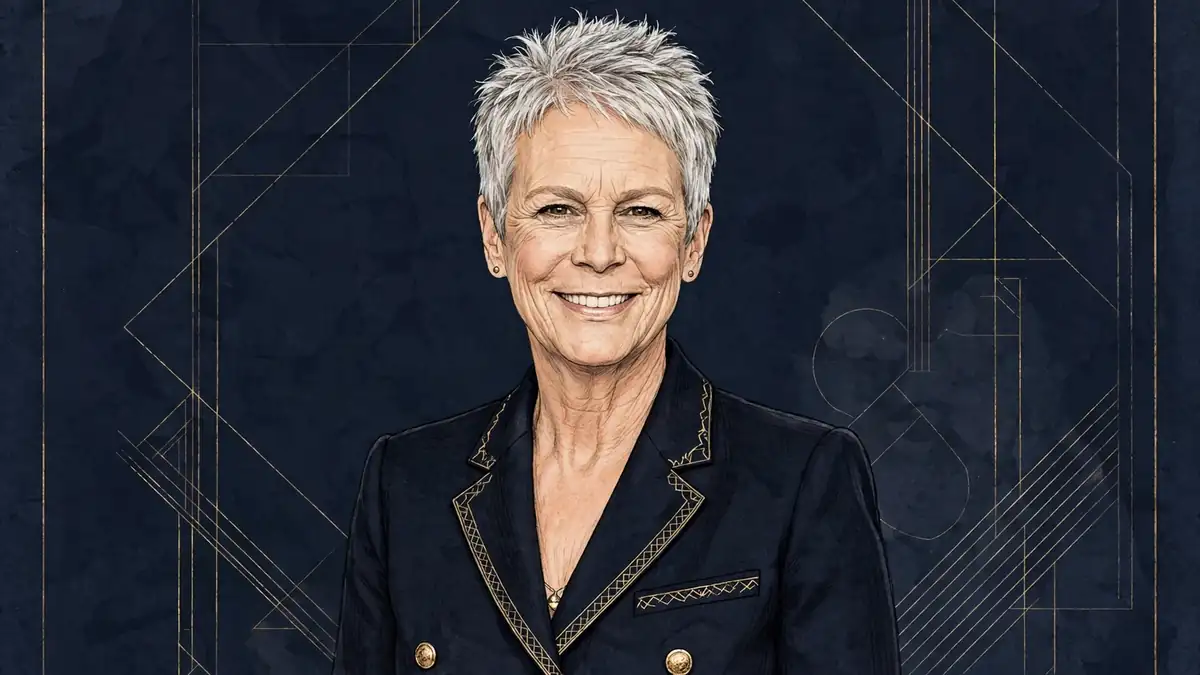
Jamie Lee Curtis‘s net worth is estimated at $60 million as of November 2026. That figure is a combined estimate with her husband, actor and director Christopher Guest, and it rests on one of the longest money stories in Hollywood: an $8,000 paycheck for the 1978 horror film Halloween, a six-year yogurt endorsement she took to stay home with her daughter, a stack of bestselling children’s books, and a late-career surge — an Oscar in 2023, an Emmy in 2024, Disney Legend status in 2024 — that pushed her fees to their highest level at age 67.
Jamie Lee Curtis: Quick Facts
| Estimated net worth | $60 million (range: $60 million; combined with husband Christopher Guest) |
|---|---|
| Profession | Actress, producer, children’s author |
| Nationality | American |
| Born | November 22, 1958 (age 67) |
| Height | 5 feet 7 inches (170 cm) |
| Primary income sources | Film salaries and backend profit participation, television, producing fees, children’s book royalties, brand endorsements |
| Active years | 1977–present |
| Last reviewed | November 2026 |
- Early Life and Background
- Education
- Career Journey
- Rise to Fame
- Main Sources of Income
- Salary and Earnings
- Businesses and Investments
- Brand Deals and Sponsorships
- Houses, Cars and Other Assets
- Awards and Achievements
- Net Worth Growth Over the Years
- Social Media Presence
- Personal Life
- Sources & Reporting
- Frequently Asked Questions
Early Life and Background
Jamie Lee Curtis was born on November 22, 1958, in Santa Monica, California, into Hollywood royalty — and into a household that was already coming apart. Her father was Tony Curtis, the Bronx-born matinee idol of Some Like It Hot and Spartacus. Her mother was Janet Leigh, the actress whose shower scene in Alfred Hitchcock’s Psycho (1960) became one of the most famous images in film history. Curtis was two years old when her parents’ marriage ended in divorce in 1962, and she grew up largely with her mother in Los Angeles, with a stepfather, stockbroker Robert Brandt, providing the steadier domestic frame. She has one full sister, actress Kelly Curtis, and half-siblings from her father’s later marriages, including Allegra Curtis.
Growing up around film sets gave Curtis an early, unsentimental view of the business. She has said in interviews over the years that she understood acting as a job before she understood it as an art — a practical attitude that shows up again and again in the financial decisions of her career, from the endorsement deal she took to stay home with a small child to the scale-plus-backend deal she accepted on the 2018 Halloween revival. She was not a child star. She did not work as a teenager, and she did not arrive in Hollywood with a famous surname and a red carpet waiting. The surname opened a door — director John Carpenter has acknowledged that being Janet Leigh’s daughter was part of why she was cast in Halloween — and then she had to prove, for the next 48 years, that she belonged in the room on her own terms.
The Santa Monica childhood also left her with a lifelong attachment to the city. Decades later, the Spanish Colonial Revival home she shares with Christopher Guest in Santa Monica is reported to be worth an estimated $10 million to $12 million, according to Parade — the single largest visible asset in the couple’s portfolio and a reminder that the fortune was built slowly, in one city, over a working lifetime, rather than in a single windfall.
Education
Curtis attended the Westlake School for Girls in Los Angeles, then finished high school at Choate Rosemary Hall, the Connecticut boarding school, graduating in 1976. She enrolled at the University of the Pacific in Stockton, California, to study social work — a choice that says something about the person she expected to become. She lasted one semester. Acting work came calling, she left school, and she has never gone back to finish the degree. The social-work instinct never quite left her, though: her children’s books, her charity work with Children’s Hospital Los Angeles, and her public advocacy all carry the same through-line as that first, abandoned major.
The short college career matters to the money story in one specific way. Curtis entered acting without the cushion of a long formal training pipeline and without a family fortune to fall back on — her father’s money was not hers, and her parents’ divorce had split the household early. Her first professional paychecks were small, her first film paid $8,000, and the career that followed was built job by job. That is the context for everything that came after: a performer who learned early that a career is a portfolio of gigs, and who kept adding income streams — books, endorsements, producing — instead of betting everything on the next acting fee.
Career Journey
Curtis took small television parts in 1977, then landed the role that changed her life: Laurie Strode, the babysitter stalked by Michael Myers in John Carpenter’s Halloween (1978). The film was shot in about 20 days on a budget of roughly $300,000, and Curtis was paid $8,000 for the whole shoot — $2,000 a week, by her own account to Rotten Tomatoes. She bought her own wardrobe for the film at JCPenney for about $200. The film grossed $47 million in the United States and around $70 million worldwide, making it the highest-grossing independent film of its era and turning a 19-year-old unknown into the defining horror star of her generation.
The label that followed her — “scream queen” — was both a career and a trap. The early 1980s brought a run of horror work: The Fog (1980), Prom Night (1980), Terror Train (1980), Roadgames (1981) and Halloween II (1981), for which her fee rose to $100,000. The pay jump from $8,000 to $100,000 in three years tells the story of the first phase of her fortune: horror made her bankable, and bankability, even in a genre Hollywood looked down on, translated into real money fast.
Curtis spent the rest of the 1980s breaking out of the box horror had put her in. Trading Places (1983), opposite Eddie Murphy and Dan Aykroyd, showed she could hold a comedy; A Fish Called Wanda (1988) won her a BAFTA for Best Supporting Actress and proved she could hold her own against John Cleese and Kevin Kline; Blue Steel (1990) and My Girl (1991) kept her in steady studio work. The commercial peak of this period came with True Lies (1994), James Cameron’s action comedy opposite Arnold Schwarzenegger, which grossed $378 million worldwide and won Curtis a Golden Globe for Best Actress in a Musical or Comedy — the first major award of her career, and the role that moved her from genre star to mainstream leading lady.
The 2000s brought a second reinvention. Freaky Friday (2003), the Disney body-swap comedy with Lindsay Lohan, grossed $160 million worldwide and earned Curtis a Golden Globe nomination; it remains one of the most profitable films of her career relative to its budget. She followed it with family comedies (Christmas with the Kranks, 2004), voice work (Beverly Hills Chihuahua, 2008) and a return to television with Ryan Murphy’s Scream Queens (2015–2016), which earned her another Golden Globe nomination. Through these years she was also writing: her children’s books, published steadily from 1993 onward, became a parallel career with its own royalties, its own audience, and its own shelf life — income that did not depend on a casting director’s phone call.
The third act, from 2018 onward, is the most lucrative of her life. She returned as Laurie Strode for Blumhouse’s Halloween trilogy — Halloween (2018), Halloween Kills (2021) and Halloween Ends (2022) — which grossed nearly $500 million worldwide combined. She played Linda in Rian Johnson’s Knives Out (2019), which grossed $312 million worldwide. Then came Everything Everywhere All at Once (2022), the A24 film that grossed $143 million worldwide and won her the Academy Award for Best Supporting Actress in March 2023, at 64. Since then she has played Donna Berzatto, the volatile mother at the centre of FX’s The Bear, winning an Emmy in 2024; appeared in Haunted Mansion (2023) and Borderlands (2024); and returned to Disney as both star and producer of Freakier Friday (2025), which grossed $153.2 million worldwide on a $42–45 million budget.
Rise to Fame
Curtis became famous overnight, at 19, in a film nobody expected to matter. Halloween opened in October 1978 with no stars, no budget and no marketing muscle; it became the tenth-highest-grossing film of the year in the United States and the most profitable independent film ever made at that point, returning more than 150 times its production budget. The role invented the “final girl” — the resourceful young woman who survives the killer when everyone else does not — and Curtis, with her plain-spoken toughness and refusal to play the victim as a scream, became the template for the archetype. Horror historians still trace the modern slasher heroine back to Laurie Strode.
Fame, in her case, arrived without money attached. The $8,000 fee is the most quoted number of her early career because it captures the gap between cultural impact and compensation: the film made tens of millions, and its star made less than a schoolteacher’s annual salary. Curtis has told the story herself, without bitterness, and it has become the founding anecdote of her financial narrative — the starting point against which every later payday is measured. By Halloween II she was earning $100,000. By Halloween H20 in 1998, $5 million. By the 2018 revival, she was negotiating gross participation on a film that grossed $255 million worldwide. The arc from $8,000 to a backend deal on a quarter-billion-dollar grosser is the whole career in miniature.
The second rise — the one that made her a prestige name rather than a genre name — came much later, and it is the more unusual story. Most actresses who peak in horror at 19 do not win an Oscar at 64. Curtis did it by refusing to leave: she kept working through the thin years, kept writing books, kept taking television, and when the right part arrived — Deirdre Beaubeirdre, the frumpy, put-upon IRS auditor of Everything Everywhere All at Once — she was still there to take it. The Oscar win, followed by the Emmy for The Bear a year later, turned a respected veteran into a late-career awards magnet, and that status is what lets a 67-year-old actress command top fees and producer credits in 2025 and 2026.
Main Sources of Income
Curtis’s income comes from five streams, and the mix is what makes the fortune durable. Acting fees are the largest single source, but they arrive in lumps — a film fee here, a television guest run there — and the other four streams smooth the gaps between them.
Acting salaries and backend participation are the core. Her franchise work pays the most: the Halloween films, the Disney comedies and the ensemble hits. The 2018 Halloween deal is the model for her modern pay — a modest upfront fee, reported by Parade as scale, plus a share of the gross that turned into an estimated $5 million to $10 million once the film passed $255 million worldwide. That structure rewards her when a film overperforms and costs the studio little when it does not, which is why Blumhouse was willing to offer it — and why it paid Curtis so well.
Producing fees are the second stream, and the one that has grown fastest since 2020. Curtis is a credited producer on Freakier Friday (2025) through her production company, and she has executive-produced television including the Prime Video series The Sticky (2024). Producer fees are smaller than star salaries but they come with a different kind of value: a producer credit is a seat at the table on casting, budget and backend, and it keeps paying if a project gets a sequel or a streaming deal.
Children’s book royalties are the quiet stream. Curtis has written more than a dozen children’s books since 1993, several of them New York Times bestsellers, illustrated by Laura Cornell. Books do not make an actress rich on their own, but they pay for decades — a backlist title sells a few thousand copies a year, every year, with no audition required — and they gave Curtis a public identity beyond acting that helped her land the Activia deal and the speaking and appearance work that followed.
Endorsements are the fourth stream, dominated by one deal: six years as the face of Dannon’s Activia yogurt, from roughly 2007 to 2013. The fee was never disclosed, but a six-year national campaign for a major food brand is a seven-figure engagement by any measure, and Curtis has been frank about why she took it — she wanted to stay home with her young daughter, and the commercials let her earn without leaving town. She said exactly that at Cannes Lions in June 2025, telling the audience she “sold yogurt that makes you s**t for six years and I won an Oscar” — a line that captures how little embarrassment she feels about commercial work.
Television and residuals are the fifth stream. Her recurring role as Donna Berzatto on The Bear — first in the celebrated season two episode “Fishes,” then across seasons three and four — pays a prestige-TV guest-star fee and, more importantly, keeps her visible to the awards voters and casting directors who decide the next film offer. Add residuals from a 48-year filmography that streams constantly — Halloween alone is re-licensed every October — and the back catalogue earns while she sleeps.
Salary and Earnings
No actress of Curtis’s generation has a better-documented pay ladder, because the Halloween franchise kept rehiring her for 44 years and the fee for each return leaked into the press. Parade’s 2026 salary breakdown, built from Curtis’s own statements and trade reporting, gives the clearest picture:
| Film | Year | Reported pay | Notes |
|---|---|---|---|
| Halloween | 1978 | $8,000 | Flat fee, $2,000 a week; she bought her own wardrobe at JCPenney for about $200 |
| Halloween II | 1981 | $100,000 | First six-figure cheque after the original’s box-office success |
| Halloween H20 | 1998 | $5,000,000 | Return to the role after 17 years away |
| Halloween: Resurrection | 2002 | $3,000,000 | Brief appearance; killed off in the opening scenes |
| Halloween | 2018 | $5,000,000–$10,000,000 (estimated) | Scale upfront plus gross participation; film grossed $255 million worldwide on a $10 million budget |
| Halloween Kills / Halloween Ends | 2021–2022 | Undisclosed, multi-million | Fees not publicly reported; trade estimates put each in the multi-million range |
The pattern is the story. The fee multiplied twelvefold between the first two films, then fiftyfold by 1998, then doubled again — with backend — in 2018. The 2018 deal is the one to study: Curtis took scale upfront, a few thousand dollars a week, on a $10 million-budget film, and let the gross participation do the work. When the film earned $255 million, that participation was worth an estimated $5 million to $10 million, according to Parade — more than she had ever been paid for a single Halloween, and a deal she could only have negotiated because she was the one person the franchise could not make the film without.
Outside the franchise, her fees are less public, which is normal for an actress whose biggest paydays came before the era of leaked salary reporting. Her Freaky Friday fee was never disclosed; her True Lies fee was never disclosed; her fee for Everything Everywhere All at Once was never disclosed, though trade and fan reporting suggests she took a fraction of her usual rate for the independent film — a pay cut that the Oscar win repaid many times over in the fees she could command afterward. What can be said with confidence is that her per-film asking price rose sharply after March 2023: an Oscar winner in her sixties with a hit Disney sequel and an Emmy-winning television role is a scarce commodity, and scarcity is what sets a fee. Her work as a producer on Freakier Friday — a film that grossed $153.2 million worldwide against a $42–45 million budget — adds a producer’s fee and a share of the film’s success to the acting pay.
One number that is often misread: the $60 million. It is not Curtis’s personal bank balance, and it is not a salary. It is a combined household estimate with Christopher Guest, whose own four-decade career — This Is Spinal Tap, Best in Show, A Mighty Wind — contributes its own share. No outlet has published a split of the two fortunes, and any article that claims to know Curtis’s solo net worth to the dollar is guessing. The honest statement is the one Celebrity Net Worth and Parade both make: together, the couple is worth an estimated $60 million.
Businesses and Investments
Curtis runs her career like a small business, and the company at the centre of it is Comet Pictures, her production banner. Through Comet Pictures she develops film and television projects, and the producer credit she holds on Freakier Friday is the most visible recent fruit of it: a producer on a Disney sequel is paid a fee, shares in the film’s success, and — just as importantly — gets a say in how the film is made. Her executive-producer work on the Prime Video series The Sticky (2024) shows the same model applied to television. Comet Pictures is not a studio and it does not publish accounts, so no revenue figure can be attached to it; its value to Curtis is control and continuity, not a line on a balance sheet.
The books are the second business, and the more measurable one. Curtis’s first children’s book, When I Was Little: A Four-Year-Old’s Memoir of Her Youth, appeared in 1993. She followed it with Tell Me Again About the Night I Was Born (1996), Today I Feel Silly, and Other Moods That Make My Day (1998) — a New York Times bestseller — I’m Gonna Like Me (2002) and more than half a dozen further titles, all illustrated by Laura Cornell. A bestselling picture book earns its author an advance plus royalties of roughly 10 percent of the cover price, and a backlist of a dozen titles sells steadily for decades; the books are a modest but permanent annuity, and they are the reason Curtis is a familiar name in households that have never seen a horror film.
On investments beyond her own work, Curtis is private — there are no public filings, no venture fund, no startup portfolio attached to her name, and no credible reporting of stock or crypto holdings. That absence is itself informative: unlike the tech-founder celebrities who make headlines for angel investing, Curtis’s wealth is a working actor’s wealth, built from fees, royalties and property. The one investment that is documented is real estate, covered below, and it is the classic Hollywood kind: buy a good house in a good neighbourhood, hold it for thirty years, and let the land do the compounding.
The career itself is the investment that paid off most. Curtis’s decision to keep working through the 2000s and 2010s — television, voice work, books, endorsements — when film leads dried up is what put her in position for the 2018 Halloween revival and the 2022 Oscar. Actresses who step away rarely get a third act. Curtis never stepped away, and the third act is now the most valuable part of the fortune.
Brand Deals and Sponsorships
The endorsement that defines Curtis’s commercial career is Activia. From about 2007 to 2013 she was the face of Dannon’s probiotic yogurt in the United States, appearing in a long-running series of television commercials that made “Jamie Lee Curtis” and “yogurt” inseparable in the public mind for a generation of viewers. The campaign ran for six years — an unusually long tenure for a celebrity endorser — and its fee was never disclosed. A six-year national deal for a Danone brand is a seven-figure engagement by industry standards, and it arrived at exactly the moment her film career was quietest, which is why it mattered so much financially: it paid a star’s wage for work that kept her in Los Angeles, on a schedule she controlled.
Curtis has been strikingly open about the deal’s real motive. Speaking at Amazon Port during the Cannes Lions festival in June 2025, she told the audience she took the Activia job because she was “trying to stay home with my kid” — her first child, Annie, was young at the time — and she dismissed any snobbery about it in a single sentence: “I sold yogurt that makes you s**t for six years and I won an Oscar.” The point she was making, and the one that matters to the money story, is that commercial work and prestige work stopped being separate tracks: the yogurt money funded the years when film offers were thin, and the Oscar then raised the price of everything that followed, including the next endorsement.
She has not chased a string of endorsement deals since Activia ended. There is no long list of fashion, beauty or watch contracts attached to her name, and that restraint is part of the brand: Curtis’s public image is built on candour — about ageing, about sobriety, about her family — and a hard sell would sit badly with it. Her more recent commercial-adjacent work is appearance and speaking fees, including festival and industry appearances such as Cannes Lions 2025, and her long-running advocacy work, which brings no fee at all. The Activia deal remains the single big endorsement of her career, and it is enough: six years of national television paid for a substantial part of the fortune’s middle years.
Houses, Cars and Other Assets
The most valuable asset Curtis owns that the public can see is the house. She and Christopher Guest live in a Spanish Colonial Revival home in Santa Monica, California, reported by Parade to be worth an estimated $10 million to $12 million. The couple have owned property in the city for decades, and the Santa Monica market has done the heavy lifting: a house bought for a fraction of its current value in the 1990s is now worth eight figures, and it accounts for roughly a fifth of the couple’s estimated $60 million fortune on its own. That is the quiet engine of many Hollywood fortunes — not a stock tip, but a good address held for thirty years.
The house made headlines for a different reason in January 2025, when the Palisades fire forced evacuations across Los Angeles and Curtis and her family had to leave the area. She evacuated safely, and she used her platform in the days that followed to direct attention and donations to the relief effort — consistent with the public role she has played for years through her charity initiative My Hand In Yours, which has helped raise nearly $2 million for Children’s Hospital Los Angeles, according to the Clio Entertainment Awards announcement that honoured her in October 2026.
On cars, Curtis is a study in restraint. There is no reported collection, no garage of supercars, no auction record attached to her name. She has been photographed over the years in ordinary, practical vehicles, and she has never made cars part of her public image. That is a choice worth noting in a niche where a celebrity’s garage is usually Exhibit A: Curtis’s spending, as far as the public record shows, goes to the house, to her family and to her charity, not to depreciating metal. The absence of a car story is, in its own way, a fact about the fortune — it was kept, not spent.
Other assets are harder to pin down and should not be invented. No art collection, jewellery haul or watch portfolio has been reported for Curtis, and her business holdings beyond Comet Pictures and her book backlist are not public. What can be said is that the visible fortune — a $10–12 million house, a filmography that pays residuals every October, a book backlist and a production company — is consistent with a $60 million combined estimate, and that the estimate’s largest single component after the house is the simplest one: 48 years of acting fees, saved and compounded.

Awards and Achievements
Curtis’s trophy shelf tells the story of a career that peaked twice. The first peak came in the 1980s and 1990s: a BAFTA for Best Supporting Actress for A Fish Called Wanda (1989 ceremony) and a Golden Globe for Best Actress in a Musical or Comedy for True Lies (1995). She was also nominated for Golden Globes for Trading Places (1984), Freaky Friday (2004) and Scream Queens (2016). A star on the Hollywood Walk of Fame followed in 1998.
The second peak, from 2022 onward, is the one that changed her earning power. For Everything Everywhere All at Once she won the Academy Award for Best Supporting Actress at the 95th Oscars on March 12, 2023 — her first Oscar, at 64, after 45 years in the business. She won the BAFTA for Best Supporting Actress and the Screen Actors Guild Award for the same role in the same season, completing a sweep of the three major supporting-actress prizes. A year later, in September 2024, she won the Primetime Emmy for Outstanding Guest Actress in a Comedy Series for her performance as Donna Berzatto in The Bear, and she was nominated again in 2025 for her season three work. She was named a Disney Legend at the D23 fan event in 2024, in recognition of a Disney filmography that runs from Freaky Friday to Haunted Mansion and Freakier Friday. And on November 19, 2026, she is set to receive the Honorary Clio Entertainment Award at the Dolby Theatre in Los Angeles, recognising a five-decade career and her influence on how horror is marketed.
The awards matter to the money story because they are the reason the third act pays what it does. An Oscar and an Emmy in consecutive years, at 64 and 65, turned Curtis from a respected veteran into a bankable prestige name — the kind of actress a studio puts on a poster and a streamer builds a season around. Her fees after March 2023, her producer credit on Freakier Friday, and her continued casting in prestige television all trace back to those two statues. She is also, by any measure, the most decorated horror star in history: no other performer has carried a slasher franchise for 44 years and then won an Oscar for something else entirely.
For comparison, here is how her fortune sits next to other actresses of her generation and circle, using NetWorthCraft’s own estimates:
| Actress | Estimated net worth | Main wealth engine |
|---|---|---|
| Jamie Lee Curtis | $60 million (combined with spouse) | Halloween franchise, Disney comedies, books, Activia |
| Emma Stone | $40–60 million | Film salaries and backend, Fruit Tree production company, Louis Vuitton deal |
| Lindsay Lohan | $2–5 million | Acting comeback, Freakier Friday, brand work |
| Reese Witherspoon | $400–440 million | Hello Sunshine sale, acting, producing |
The table makes the point plainly: Curtis sits in the middle of her peer group — far above the child stars who never rebuilt, far below the moguls who sold a company. Her fortune is a working actor’s fortune, and the comparison with Reese Witherspoon, another actress-producer who built a company, shows the scale of what a sale can add: Witherspoon’s Hello Sunshine exit is worth roughly seven times Curtis’s entire fortune. Curtis never sold a company. She kept the career.
Net Worth Growth Over the Years
Curtis’s fortune grew slowly for twenty years, then faster as the franchise cheques and the property market compounded. The figures below are NetWorthCraft modelled estimates for the years before reliable public estimates existed; the 2026 figure is the published consensus.
| Year | Estimated net worth | What moved it |
|---|---|---|
| 1978 | Under $100,000 | Halloween fee of $8,000; career just beginning |
| 1985 | ~$1 million | Trading Places and steady studio work after horror |
| 1995 | ~$10 million | True Lies Golden Globe win; peak studio fees; Santa Monica property |
| 2005 | ~$25 million | Freaky Friday success; Activia deal beginning; book royalties |
| 2015 | ~$40 million | Activia six-year run complete; Scream Queens; property appreciation |
| 2020 | ~$50 million | Halloween revival backend; Knives Out |
| 2023 | ~$55 million | Oscar win; fee uplift across film and television |
| 2026 | $60 million | Consensus estimate (Celebrity Net Worth, Parade); Freakier Friday producer credit |
Two things stand out. First, the fortune never jumped — it climbed, at roughly $1–2 million a year in the good decades, which is what a working actor’s wealth looks like when it is saved rather than spent. Second, the curve bends upward after 2018, when the backend deal on a $255 million grosser and the Oscar win did more for the fortune in five years than the previous fifteen had. The lesson is the one Curtis’s career keeps teaching: longevity is the investment, and the payoff arrives late.
Social Media Presence
Curtis’s main public platform is Instagram, where her account @jamieleecurtis counts followers in the millions and functions less like a celebrity feed than like a family newsletter crossed with an advocacy bulletin. She posts candid photographs of her husband and daughters, tributes to friends in the industry, and outspoken posts on the causes she supports — gun safety, children’s health, and the rights of transgender people, including her daughter Ruby. The tone is unfiltered and personal, and it is the same candour that defines her interviews: she has written about ageing without cosmetic surgery, about sobriety, and about the realities of a body in its late sixties, in language that no publicist would approve and that her audience clearly trusts.
Social media is a small direct earner for Curtis — she is not a creator-economy influencer and she does not run a sponsored-post business — but it is a real indirect one. A following in the millions is part of what a studio buys when it casts her: it is free marketing for a film’s opening weekend, and it is a direct line to the audience for a book launch or a charity appeal. Her My Hand In Yours fundraising for Children’s Hospital Los Angeles, which has helped raise nearly $2 million, runs largely through that channel. The account is also where she announced and celebrated the Oscar and Emmy wins in real time, turning awards into content that kept her name in front of casting directors between jobs.
Personal Life
Curtis has been married to Christopher Guest since December 18, 1984 — one of the longest marriages in Hollywood, now past its 41st anniversary. The story of how they met is part of the legend: Curtis saw Guest’s photograph in a magazine in 1984, told a friend she was going to marry the man in the picture, and then did. Guest, the actor, writer and director behind This Is Spinal Tap, Waiting for Guffman, Best in Show and A Mighty Wind, is a successful filmmaker in his own right, and his career is the other half of the $60 million combined estimate. The couple adopted two daughters: Annie, born in 1986, and Ruby, born in 1996. Ruby came out as transgender in 2021, and Curtis has spoken publicly and proudly about supporting her — including officiating Ruby’s wedding in 2022, in a ceremony she described with characteristic bluntness and joy.
Curtis has also spoken openly about addiction and recovery. She became dependent on prescription pain medication after cosmetic surgery in the late 1990s and has said she became sober in 1999; she has discussed the experience in interviews and in her writing, and she marks the sobriety as one of the turning points of her adult life. It is the kind of candour that runs through everything she does in public — the Activia quote at Cannes, the posts about ageing, the refusal to pretend the $8,000 fee was anything but what it was — and it is a large part of why audiences trust her. She lives in Santa Monica, works steadily, and, at 67, shows no sign of slowing down: Ella McCay, James L. Brooks’s political drama, opened in December 2025, a fifth season of The Bear is in the works, and she is attached to co-star alongside Nicole Kidman in Amazon’s Scarpetta adaptation of Patricia Cornwell’s novels.
Sources & Reporting
Celebrity Net Worth — the $60 million combined estimate with Christopher Guest, updated in a profile snapshot dated November 6, 2026; also the source for the $8,000 Halloween fee and the $100,000 Halloween II fee. Reporting window: profile current as of November 2026.
Parade — 2026 net worth reporting confirming $60 million; the film-by-film Halloween salary breakdown ($8,000; $100,000; $5 million for H20; $3 million for Resurrection; scale plus $5–10 million estimated backend for 2018); the Santa Monica home valued at an estimated $10–12 million; and the June 2025 Cannes Lions report on the Activia deal (“six years”, “trying to stay home with my kid”). Reporting window: March–June 2025 and 2026.
Rotten Tomatoes — Curtis’s own account of the 1978 shoot: $8,000 for the whole film, $2,000 a week, 17–20 days of shooting on a roughly $300,000 budget, and the film’s $47 million domestic gross. Reporting window: 2026 retrospective.
Wikipedia — Freakier Friday box office of $153.2 million worldwide on a $42–45 million budget, release date August 8, 2025, and Curtis’s producer credit; filmographies and release dates cross-checked against trade reporting. Reporting window: November 2026.
Variety — The Bear season three Emmy nomination for Curtis and reporting on the show’s fifth season; trade reporting on Freakier Friday‘s opening weekend. Reporting window: 2025.
Muse by Clio — the Honorary Clio Entertainment Award announcement (October 29, 2026): the November 19, 2026 ceremony at the Dolby Theatre, Curtis’s Oscar and Emmy wins, her bestselling children’s books, and My Hand In Yours raising nearly $2 million for Children’s Hospital Los Angeles. Reporting window: October–November 2026.
D23 — Disney Legend induction in 2024 and Curtis’s Disney roles including Freaky Friday, Freakier Friday and The Bear. Reporting window: 2024–2025.
Figures labelled as estimates are NetWorthCraft’s own modelling, built from the sources above; no audited financial statement for Curtis or Guest has been published. Where sources disagree — most often on the exact size of the 2018 backend — we publish the range and name the source.
Frequently Asked Questions
What is Jamie Lee Curtis’s net worth in 2026?
Jamie Lee Curtis’s net worth is estimated at $60 million in 2026, according to Celebrity Net Worth and Parade. The figure is a combined estimate with her husband, actor and director Christopher Guest, not a solo figure — no outlet has published a split of the two fortunes.
Is the $60 million combined with her husband’s money?
Yes. Celebrity Net Worth states explicitly that the $60 million is a combined net worth with Christopher Guest, whom Curtis married in 1984. Guest has his own four-decade career as the director of This Is Spinal Tap, Best in Show and A Mighty Wind, and his earnings are pooled into the same household estimate.
How much did Jamie Lee Curtis make for Halloween in 1978?
She was paid $8,000 for the whole film — $2,000 a week, by her own account. The film was shot in about 20 days on a budget of roughly $300,000 and grossed $47 million in the United States. She bought her own wardrobe for the role at JCPenney for about $200.
How much did she earn for Halloween in 2018?
She took scale upfront — a few thousand dollars a week — plus a share of the gross. Because the film earned $255 million worldwide on a $10 million budget, Parade estimates her total take at $5 million to $10 million, the largest single Halloween payday of her career.
Did Jamie Lee Curtis win an Oscar?
Yes. She won the Academy Award for Best Supporting Actress on March 12, 2023, for her role as IRS auditor Deirdre Beaubeirdre in Everything Everywhere All at Once. She also won the BAFTA and the Screen Actors Guild Award for the same performance, and she won an Emmy in 2024 for her guest role on The Bear.
How old is Jamie Lee Curtis?
Jamie Lee Curtis was born on November 22, 1958, in Santa Monica, California. She is 67 years old as of November 2026 and turns 68 on November 22, 2026. Her parents were actors Tony Curtis and Janet Leigh.
How tall is Jamie Lee Curtis?
Jamie Lee Curtis is 5 feet 7 inches tall (170 cm), according to biographical reporting. Her height has been a minor curiosity for fans because she often appears taller on screen next to her co-stars.
What is Jamie Lee Curtis doing in 2025 and 2026?
She starred in and produced Freakier Friday, the Disney sequel with Lindsay Lohan, which opened August 8, 2025 and grossed $153.2 million worldwide. She appeared in Ella McCay, which opened December 12, 2025, continues as Donna Berzatto on The Bear, and is set to receive the Honorary Clio Entertainment Award on November 19, 2026.
Final Thoughts
Jamie Lee Curtis’s $60 million is the least flashy fortune in the celebrity wealth niche, and that is exactly what makes it worth studying. There was no windfall, no company sale, no crypto bet and no inheritance. There was an $8,000 cheque in 1978, a $100,000 cheque in 1981, a $5 million cheque in 1998, a backend deal in 2018 that paid $5–10 million, six years of yogurt commercials that kept the family afloat while film work was thin, a shelf of children’s books that pays a little every year, a house in Santa Monica that tripled in value while she lived in it, and — at 64 and 65 — an Oscar and an Emmy that raised the price of everything she does next. The fortune is a 48-year savings plan with a famous name on it, and the plan worked because she never stopped working long enough for Hollywood to forget her. If there is a lesson in it, it is the unglamorous one: show up, diversify, keep the house, and let time do the compounding.
Published on November 10, 2026. Last reviewed November 2026. Found an error? See our corrections policy.