
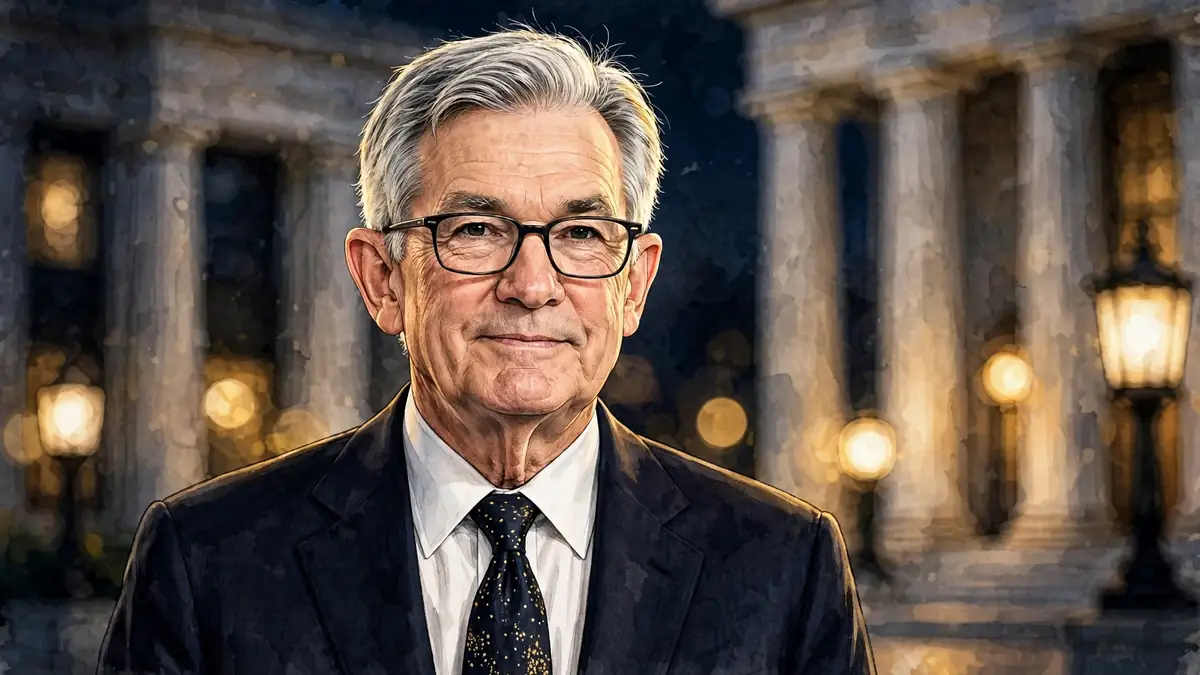
Jerome Powell‘s net worth is estimated at $20 million to $55 million as of November 2026. That range comes straight from his own federal financial disclosure, filed when he was nominated to chair the Federal Reserve, and every published estimate since has landed inside it: Celebrity Net Worth puts the figure at $50 million, CoinCodex at $55 million, and TheStreet at the same $20 million to $55 million spread. Powell built the fortune before he ever set foot in the Eccles Building as chair — eight years as a partner at the Carlyle Group, six years at the investment bank Dillon, Read & Co., and a spell as a Treasury undersecretary — then spent eight years running American monetary policy on a government salary that, at roughly $190,000 a year, barely moved the total. His chair term ended in May 2026, when Kevin Warsh succeeded him, and Powell stayed on as a Federal Reserve governor, a post he holds until January 2028.
Jerome Powell: Quick Facts
| Estimated net worth | $20 million to $55 million (range: $20 million to $55 million) |
|---|---|
| Profession | Central banker, lawyer, former investment banker and private equity executive |
| Nationality | American |
| Born | February 4, 1953 (age 73) |
| Height | Not publicly disclosed |
| Primary income sources | Private equity partnership at the Carlyle Group, investment banking, investment returns, Federal Reserve salary |
| Active years | 1979–present |
| Last reviewed | November 2026 |
- Early Life and Background
- Education
- Career Journey
- Rise to Fame
- Main Sources of Income
- Salary and Earnings
- Businesses and Investments
- Brand Deals and Sponsorships
- Houses, Cars and Other Assets
- Awards and Achievements
- Net Worth Growth Over the Years
- Social Media Presence
- Personal Life
- Sources & Reporting
- Frequently Asked Questions
Early Life and Background
Jerome Hayden Powell was born on February 4, 1953, in Washington, D.C., and grew up in Chevy Chase, Maryland, one of six children. His father, Jerome Powell Sr., was a lawyer in private practice and a World War II veteran. His mother, Patricia Hayden Powell, was a mathematician and statistician who worked part time for the Republican National Committee. His maternal grandfather, James J. Hayden, was dean of the Columbus School of Law at the Catholic University of America and a lecturer at Georgetown Law School. Law, numbers and public service were the family trades, and Powell picked up all three.
Chevy Chase in the 1960s was a quiet, tree-lined suburb a short drive from the Capitol, and Powell’s childhood there was, by every account, unremarkable in the best sense: school, sports, and a large family table. He has five siblings — Susan, Matthew, Tia, Libby and Monica — and the household ran on the routines of a working lawyer father and a mother who kept her hand in statistics and party politics. Nothing in his early years pointed to a fortune. The money came later, and it came from the private sector, not from the public jobs that made him famous.
Two details from his youth still show up in profiles because they cut against the polished central-banker image. After graduating from Princeton in 1975, Powell spent about four months as a warehouse assistant at an office-supply store in Bladensburg, Maryland, before starting his legal career. It was a short, ordinary job, and he has never dressed it up as anything else. The other is his senior thesis at Princeton, which examined the prospects for political change in South Africa under apartheid — an early sign of the interest in how economies and political systems shape each other that would run through his whole career.
Powell attended Georgetown Preparatory School, a Jesuit university-preparatory school in North Bethesda, Maryland, graduating in 1971. Georgetown Prep’s Jesuit tradition — rigorous, argumentative, service-minded — suited him. Classmates and teachers from that period describe a student who was serious without being showy, good at argument, and already drawn to the intersection of law and public affairs. He did not arrive at Princeton as a prodigy with a plan. He arrived as a bright, disciplined student from a large Catholic family in the Washington suburbs, and he left with a degree in politics and a law-school place at Georgetown.
The Washington upbringing matters to the money story in a specific way. Powell grew up inside the capital’s professional class, not its wealthy class. His father practised law; his mother worked in statistics. The family had standing and education, not capital. When Powell later made his money at Dillon, Read and the Carlyle Group, he was building from a professional salary base, not an inheritance. That is one reason his disclosed fortune, large as it is, stops at $55 million rather than running into the hundreds of millions that founders and fund managers with carried interest in much bigger funds sometimes reach. He was a partner in a buyout group, not the founder of the firm.
Education
Powell earned a Bachelor of Arts in politics from Princeton University in 1975. His senior thesis, on political change in South Africa, required him to weigh economic pressure, sanctions and internal politics against each other — the same kind of multi-variable judgement he would later apply to interest-rate decisions, where inflation, employment, financial stability and politics all pull in different directions. Princeton gave him the politics degree; it did not give him an economics degree. That gap has followed him through his career, and his critics have raised it, but it also shaped his style: Powell has always presented himself as a practical decision-maker who leans on staff economists, rather than as a theorist with a model to defend.
He went on to the Georgetown University Law Center, earning his Juris Doctor in 1979 and serving as editor-in-chief of the Georgetown Law Journal. Running a law journal is a grinding, detail-heavy job — checking citations, managing a staff of student editors, deciding what gets published — and it is the kind of credential that opens doors in Washington law firms and on the federal bench. After law school, Powell clerked for Judge Ellsworth Van Graafeiland of the United States Court of Appeals for the Second Circuit, a one-year post that put him inside the federal judiciary and sharpened the legal reasoning he would later use in Treasury and at the Fed, where the line between monetary policy and the law is thinner than most people realise.
Powell’s education explains a good deal about how he made his money. He was not an economist who drifted into finance, and he was not a trader. He was a lawyer who moved into investment banking, where legal training — reading deal documents, structuring transactions, judging risk in contracts — is directly billable. Dillon, Read hired him in 1984, five years after law school, precisely because he could do the legal and commercial work of a deal at the same time. The Carlyle Group hired him in 1997 for the same reason: a partner who could run an industrial buyout group needed to understand the businesses being bought, the debt being raised, and the contracts binding them together.
It is worth stating plainly what Powell’s education did not include: no PhD in economics, no MBA, no trading floor apprenticeship. Every Federal Reserve chair before him since the 1970s had been an economist by training, and his appointment in 2017 broke that pattern. The Senate confirmed him anyway, twice, by wide bipartisan margins. The education section of his biography is therefore not a footnote to the net worth story; it is the explanation for why his fortune looks the way it does. Lawyers who become buyout partners get paid for deals and for the funds they manage, and Powell’s pay at Carlyle reflected that, not a salary scale.
Career Journey
Powell’s working life divides cleanly into three acts: law and investment banking, public service at the Treasury, and private equity — followed by a long second act in public service at the Federal Reserve. The money was made in the first and third acts. The fame came in the last.
After his clerkship, Powell worked as a lawyer, including a spell at the firm Werbel & McMillen, before switching to finance in 1984. He joined Dillon, Read & Co., the old New York investment bank, and spent six years there, concentrating on financing, merchant banking and mergers and acquisitions. He rose to vice president, and by the time he left in 1990 he was a senior vice president. Dillon, Read was later acquired by UBS, but in the 1980s it was still an independent merchant bank with a reputation for discreet, relationship-driven deal work. Powell’s job was to put financings together for companies and to advise on acquisitions — work that paid well by the standards of the time and taught him the buyout business from the inside.
In 1990, Powell moved back to Washington. Nicholas F. Brady, the former Dillon, Read chairman, was Secretary of the Treasury under President George H. W. Bush, and Powell joined the department as Assistant Secretary of the Treasury for Domestic Finance. In April 1992 he was promoted to Under Secretary of the Treasury for Domestic Finance, a post he held until January 1993. The job covered policy on financial institutions, the Treasury debt market and related areas — the plumbing of American finance. It paid a government salary and added no fortune, but it gave him something more valuable for the next stage of his career: a Rolodex of regulators, bankers and Treasury officials, and a working knowledge of how Washington and Wall Street deal with each other.
After the Bush administration ended, Powell returned to the private sector. He was a managing director at Bankers Trust from 1993 to 1995, then went back to Dillon, Read as a managing director. In 1997 came the move that made his fortune: he joined the Carlyle Group as a partner and founded and led the Industrial Group within the Carlyle U.S. Buyout Fund. He stayed at Carlyle until 2005. The Carlyle Group was, by then, one of the largest private equity firms in the world, and a partner who ran a buyout group shared in the firm’s economics — management fees on the funds and a slice of the profits on successful deals. That is where the $20 million to $55 million range comes from. No single deal made Powell rich. Eight years of partnership economics did.
Powell left Carlyle in 2005 to found Severn Capital Partners, a boutique private equity firm, and in 2008 he became a managing partner at the Global Environment Fund, which invests in sustainable energy. From 2010 to 2012 he was a visiting scholar at the Bipartisan Policy Center, a Washington think tank, where he worked on federal debt and fiscal policy. That think-tank spell was the bridge back to public service. In 2012, President Barack Obama nominated him to the Federal Reserve Board of Governors, and the Senate confirmed him. He took his seat on the board in May 2012, a governor on a modest government salary, and he has been in public service ever since — first as a governor, then as chair, and now, after his chair term ended, as a governor again.
The career arc is unusual in one respect that matters for the net worth figure. Most Fed chairs arrive from academia or from government, with modest personal wealth. Powell arrived from private equity with a disclosed fortune in the tens of millions. When he joined the board in 2012, he was already, by the standards of public officials, a wealthy man. His wealth then essentially froze in place: a governor’s salary cannot add millions to a $20 million to $55 million portfolio, and the ethics rules that govern Fed officials restrict the trading and outside income that might have grown it faster. The fortune you see in the 2017 disclosure is, in substance, the fortune he carried out of Carlyle in 2005, plus investment returns on it over the following decade.
Rise to Fame
Powell was not famous before 2017. He was well known in Washington finance circles and respected as a Fed governor, but the wider public had no reason to know his name. That changed on November 2, 2017, when President Donald Trump nominated him to succeed Janet Yellen, who chaired the Fed before him, as the 16th Chair of the Federal Reserve. The Senate confirmed him by 84 votes to 13, and he took office on February 5, 2018. The choice surprised some observers: Trump had passed over Yellen, a Democrat-appointed economist, for Powell, a Republican-appointed lawyer and former private equity partner. The market reaction was calm, which was the point. Powell was seen as a continuity choice — a governor who already knew the institution and would not rock it.
His first years as chair were quiet by central-banking standards. He raised interest rates gradually in 2018, paused in 2019, and cut them three times that year as trade tensions and slowing global growth weighed on the economy. Then came the pandemic. In March 2020, Powell cut rates to near zero in two emergency moves and launched a vast programme of asset purchases and emergency lending facilities. The Fed’s balance sheet, which had been shrinking, ballooned toward $9 trillion. Powell’s press conferences became appointment viewing for investors, and his name became familiar to people who had never followed monetary policy. The pandemic response is the single event that made him a household name, and it is also the event that defined his reputation: fast, large, and willing to use every tool the Fed had.
The second defining episode was inflation. Prices surged in 2021 and 2022, and Powell, who had initially described the rise as transitory, changed course. Starting in March 2022, the Fed raised rates at the fastest pace in four decades, lifting its benchmark rate to a range of 5.25% to 5.50% by July 2023. Mortgage rates, credit-card rates and business borrowing costs all jumped. Powell became, for a time, the most criticised man in American economic life — blamed by borrowers for expensive credit and by savers’ advocates for having waited too long. He held the line, arguing that the Fed had to restore price stability even at the cost of slower growth. By late 2024, inflation had cooled enough for the Fed to begin cutting rates again, and the economy had avoided the recession many forecasters had predicted.
The third episode was political, and it arrived in his final year as chair. President Trump, who had nominated Powell in 2017, pressed him publicly and repeatedly to cut rates faster, and in January 2026 Powell disclosed that the Department of Justice had opened a criminal investigation tied to his Senate testimony about the Fed’s headquarters renovation, a project whose costs had risen to about $2.5 billion. Powell said publicly that the investigation was an attempt to pressure the Fed over interest rates. In March 2026, a federal judge quashed the Justice Department’s subpoenas, ruling they were a pretext to pressure Powell on rates or to push him out. The department dropped the investigation in April 2026 and referred the renovation matter to the Fed’s inspector general. The episode ended Powell’s chairmanship in a storm of argument about the Fed’s independence — and it is the freshest part of his story, one that older profiles written before 2026 do not cover at all.
President Trump announced in January 2026 that Kevin Warsh, a former Fed governor, would be his choice to succeed Powell. Warsh was formally nominated in March, advanced by the Senate Banking Committee in April, and confirmed by the Senate in May 2026. Powell’s four-year term as chair ended on May 15, 2026, and Warsh was sworn in as the 17th chair shortly afterwards. Powell stayed on the Board of Governors, where his term runs until January 31, 2028. The transition closed an eight-year chairmanship that ran from a calm 2018 through a pandemic, an inflation surge, the fastest tightening cycle in modern history, and a criminal investigation that a federal judge threw out. Few Fed chairs have faced that much in eight years.
Main Sources of Income
Powell’s income has come from four places, in very different proportions. The largest by far is private equity: his eight years as a partner at the Carlyle Group, from 1997 to 2005, where he founded and led the Industrial Group within the Carlyle U.S. Buyout Fund. A buyout partner’s pay is not a salary in the ordinary sense. It is a mix of a base draw, a share of the management fees the firm charges its funds, and carried interest — a percentage of the profits when the fund sells companies for more than it paid. The exact figures for Powell’s Carlyle years are not public, and the firm has never disclosed what individual partners earned. What is public is the result: the disclosure he filed on joining the Fed put his net worth in the tens of millions, and the Carlyle years are the only period of his career in which he could have accumulated sums of that size.
The second source is investment banking. Six years at Dillon, Read & Co., rising to vice president and then senior vice president, plus later spells as a managing director at Bankers Trust and back at Dillon, Read, paid the kind of compensation that senior Wall Street bankers earned in the late 1980s and 1990s: a solid base salary and a bonus tied to the deals he worked on. That pay built the base on which the Carlyle fortune sat. It also explains the shape of his wealth. Powell’s money is not the product of one huge payout, like a founder selling a company. It is the product of fifteen years of high professional pay, saved and invested, with the Carlyle years adding the largest single layer.
The third source is investment returns on the fortune itself. Powell’s disclosures list diversified holdings, reported in the broad bands the ethics forms require. The forms do not give a line-by-line portfolio, and we do not invent one. What the record does show is that the disclosed range stayed roughly stable between the 2017 filing, at about $19 million to $55 million, and the 2019 filing, at $17.7 million to $54.9 million. A portfolio in that range, invested in the broad market through the long bull market of the 2010s and the volatile 2020s, would have grown on its own — but Fed ethics rules restrict officials’ trading, and Powell’s holdings were largely in diversified funds rather than individual stocks, so the growth was steady rather than spectacular.
The fourth source, and the smallest, is his government salary. As a Fed governor from 2012, Powell earned a governor’s salary. As chair from 2018, he earned the chair’s salary, commonly cited at $190,000 a year. Over fourteen years in public service, that salary added roughly $2.5 million to $3 million in gross pay — real money, but a small fraction of a $20 million to $55 million fortune. The salary matters to the story because it shows how little of Powell’s wealth came from the job he is famous for. He was rich before he became Fed chair, and the chairmanship did not make him richer in any material sense.
There are two income sources Powell does not have, and the absence is worth noting because competitors sometimes imply otherwise. He has no book deal of the kind former Fed chairs sometimes sign, no paid speaking circuit of the kind Janet Yellen ran up $7.2 million in speaking fees on between jobs, and no corporate board seats paying directors’ fees — Fed ethics rules bar them while he serves. He also has no business of his own. Severn Capital Partners, the boutique firm he founded in 2005, was a small private equity vehicle, not a lasting operating company, and he left it behind when he returned to public service. His fortune is a closed book: made in the private sector, then held and managed under ethics rules while he served the public.
Salary and Earnings
Powell’s salary as Fed chair is one of the most misreported figures in his biography, and the confusion is worth untangling because it is a good example of how a simple number can be wrong in two different ways at once. The figure most outlets cite is $190,000 a year. TheStreet, CoinCodex and several other profiles all list it, and Powell himself has referred to a figure around $190,000 when asked what he earns. That number has been repeated so often that it has become the standard answer.
The official pay table tells a different story. The chair of the Federal Reserve is paid under the federal Executive Schedule, Level I. The published Level I salary was $250,600 in 2025 and $253,100 in 2026. Earlier in Powell’s tenure, the figures were lower: Celebrity Net Worth reports that the chair earned $203,500 in 2019 and $226,300 by 2023. So which number is right? Both, in a sense. The Level I schedule is the nominal rate for the post, while the $190,000 figure is the amount commonly cited as Powell’s actual pay — a gap that reflects federal pay freezes and the way the Fed’s own pay arrangements have operated in practice. We report both numbers and the reason they differ, because picking one without explaining the other would mislead a reader who checks the pay table.
What is not in doubt is the scale. Whether the chair’s pay was $190,000 or $253,100, it was a small fraction of Powell’s wealth. A year as chair added, at most, about a quarter of a million dollars in gross pay to a fortune measured in tens of millions — and that is before tax. Over his eight years as chair, his total gross salary was roughly $1.5 million to $2 million, depending on which figure you use for each year. Over his full fourteen years on the Fed board, the total was roughly $2.5 million to $3 million. That is a comfortable living. It is not a fortune-building income.
The comparison that puts the salary in perspective is with the private sector he left behind. A partner at a major buyout firm in the late 1990s and early 2000s could earn several million dollars in a good year, and Powell’s Carlyle years are the reason his disclosure showed tens of millions. The pay cut he took to join the Fed board in 2012 was therefore enormous — from millions a year to a governor’s salary of under $200,000. He took it anyway, and he stayed for fourteen years. That choice is the financial heart of the Powell story: a man who made his money, then gave up the chance to make much more of it in order to run the central bank.
There is one more earnings figure that sometimes appears in profiles and needs a correction. Some sites list Powell’s annual income at $2 million to $3 million. That figure has no basis in any disclosure on file. It appears to be an estimate of investment income on a $20 million to $55 million portfolio, not a salary or a reported earning. We do not use it. Powell’s only reported income in public service is his government salary, and his only documented wealth is the disclosure range. Anything beyond that is arithmetic on an estimate, not a fact.
Businesses and Investments
Powell’s business career is the Carlyle story, and the Carlyle story needs some numbers around it to make sense. When Powell joined the firm in 1997, the Carlyle Group was already a major private equity house, and it grew enormously during and after his tenure. By 2024, Carlyle managed $426 billion in assets, according to CoinCodex’s profile of Powell. That figure is the firm’s, not Powell’s, and it would be wrong to imply that he owned a share of it. But it sets the scale of the machine he worked inside. A partner who founded and led a buyout group inside a firm of that size was working with very large sums of other people’s money, and the fees and profits on those funds were correspondingly large.
The Industrial Group Powell founded inside the Carlyle U.S. Buyout Fund invested in industrial companies — manufacturers, distributors and service businesses that make and move physical things. That focus suited Powell. He was not a technology investor and not a dealmaker chasing fashionable sectors. He bought established industrial businesses, worked on their operations and finances, and sold them when the time was right. The buyout model is simple to describe and hard to execute: buy a company with a mix of equity and borrowed money, improve it, and sell it for more than the purchase price. The partner’s pay comes from the management fee on the fund and from carried interest on the gains. Powell did that work for eight years, and the disclosure range he later filed is the visible residue of it.
After Carlyle, Powell founded Severn Capital Partners in 2005, a boutique private equity firm. Boutique is the right word: Severn was a small vehicle, not a rival to Carlyle, and it did not produce a second fortune. In 2008 he became a managing partner at the Global Environment Fund, which invests in sustainable energy. That move is interesting for two reasons. It showed an early interest in energy and environmental investing, years before it became fashionable, and it kept him in the investment business while he moved toward the think-tank and public-service work that led back to the Fed. Neither Severn nor the Global Environment Fund made Powell rich. Both kept his hand in the business he knew best while his Carlyle fortune sat invested.
What did Powell invest in, personally? His federal disclosures, filed annually under the Ethics in Government Act, list his holdings in the broad bands the forms require — ranges such as $1 million to $5 million for a given asset, rather than exact values. That is why the total comes out as a range, and why no outlet can give a precise figure. The filings show diversified holdings, largely in funds rather than individual stocks, which is what the Fed’s ethics rules encourage: officials are expected to avoid holdings that could create conflicts with the monetary policy they set. Larry Fink, whose BlackRock manages trillions in index funds, runs a business that sells the kind of diversified funds Powell’s disclosures describe — a reminder that the index-fund world Powell invested in is the same one Fink built.
One more point about the investments: Powell’s fortune did not grow much during his Fed years, and the disclosures explain why. Between the 2017 filing at roughly $19 million to $55 million and the 2019 filing at $17.7 million to $54.9 million, the range barely moved. A portfolio invested in broad market funds through the late 2010s would normally have grown, but Powell’s filings suggest a conservative, diversified mix, and the ethics rules limited his ability to trade actively. The fortune is best understood as a sum made in the private sector and then held, not a sum that kept compounding aggressively while he chaired the Fed.
Brand Deals and Sponsorships
Powell has no brand deals and no sponsorships, and that sentence is not a gap in the research — it is the correct answer. Federal Reserve chairs do not sign endorsement contracts, appear in advertisements, or take paid promotional work. The ethics rules that govern Fed officials bar outside earned income of that kind, and Powell’s public image has never been commercial in any case. He is not a celebrity who monetises fame. He is a public official whose fame is a by-product of his job.
That absence is itself a useful contrast with the other profiles on this site. Actors, athletes and musicians build fortunes in part from endorsements, and their net worth pages quite properly list the deals. A central banker’s fortune works the other way round: the money is made first, in the private sector, and the public job that follows pays a salary and forbids the commercial activity that might add to it. Any profile of Powell that lists brand deals is inventing them. We list none, and we say so plainly, because a reader searching for Powell’s endorsements deserves a straight answer rather than a padded section.
The closest Powell comes to a commercial relationship is the book and speaking world that surrounds former Fed chairs — and he has not entered it. Janet Yellen earned more than $7.2 million in speaking fees in the two years between leaving the Fed and joining the Treasury, and former chairs routinely command large fees on the lecture circuit. Powell, still a serving governor, has not taken that path, and there is no record of a book deal. If he leaves the board in 2028, that may change. As of November 2026, it has not, and his income remains his government salary and the returns on his disclosed investments.

Houses, Cars and Other Assets
Powell and his wife, Elissa Leonard, live in Chevy Chase Village, Maryland, the same suburb where Powell grew up. The family home is a private residence, not a showcase property, and no reliable public record gives its purchase price or current value. We do not invent one. What can be said is that Chevy Chase Village is an affluent, quiet community of large homes on wooded streets, a short drive from the Fed’s Washington headquarters, and that Powell has lived there for decades. He did not buy a mansion on becoming chair, and he did not sell one on leaving the post. The house is a home, not an investment story.
There is no verified record of other properties in Powell’s name. No beach house, no ranch, no city apartment portfolio appears in any disclosure or reliable report. That is consistent with the shape of his fortune. A $20 million to $55 million portfolio held largely in diversified funds does not need a property empire to explain it, and Powell has never been described as a property investor. Competitors who list multiple homes for Powell are guessing. We list the one home that is documented — the Chevy Chase residence — and we say that no other property is publicly recorded.
The same honesty applies to cars. No reliable source reports what Powell drives, and there is no verified car collection. He is not known as a car collector, and no profile in a reputable outlet has ever listed his vehicles. A net worth article that invents a fleet of luxury cars for a man who takes the same route to the Eccles Building every morning would be fabricating a lifestyle. Powell’s public image is deliberately unflashy: dark suits, a briefcase, a press conference. The assets that matter to his net worth are financial — funds and investments reported in his disclosures — not cars or houses.
One asset that does appear in the record, in a different sense, is the Fed’s own balance sheet, and it is worth distinguishing from Powell’s personal wealth because the numbers are so large that readers sometimes confuse them. Under Powell, the Fed’s balance sheet grew to nearly $9 trillion during the pandemic, then shrank to about $6.7 trillion by late April 2026 as the Fed reduced its holdings. Those trillions belong to the Federal Reserve, not to its chair. The Fed also reported losses of its own — $114.3 billion in 2023 and $77.6 billion in 2024 — because it was paying more interest on the reserves banks hold at the Fed than it earned on the bonds it owned. Those losses are the central bank’s, not Powell’s, and they did not reduce his personal fortune by a dollar. The distinction matters, and it is one that several competitor profiles blur.
Awards and Achievements
Powell has not collected the kind of awards that fill a trophy cabinet, and that is normal for a central banker. His achievements are institutional, and they are measured in confirmations, crises managed and terms served rather than in prizes. The list below is the honest version of that record.
His first achievement was the chairmanship itself. Nominated by President Trump in November 2017, Powell was confirmed by the Senate 84–13 and took office on February 5, 2018, as the 16th Chair of the Federal Reserve. President Barack Obama, who had appointed Powell to the Fed board in 2012, had already trusted him with a governorship; Trump trusted him with the chair. President Joe Biden then re-nominated him in November 2021, and the Senate confirmed him for a second term in May 2022 by 80 votes to 19. Three presidents, from both parties, put their trust in the same man. That is a rarer achievement in modern Washington than any award.
His second achievement was the pandemic response. In March 2020, Powell cut rates to near zero, restarted large-scale asset purchases, and opened emergency lending facilities that kept credit flowing to businesses, states and cities. The Fed’s actions, taken in days, are widely credited with preventing a financial collapse on top of a public-health crisis. Economists argue about the details — whether the Fed stayed too loose for too long afterwards — but the speed and scale of the March 2020 response is not seriously disputed as an achievement. It was the largest peacetime intervention in the Fed’s history, and Powell directed it.
His third achievement was bringing inflation down without a recession. The tightening cycle that began in March 2022 was the fastest in four decades, and most forecasters expected it to end in a downturn. By late 2024, inflation had cooled from its peak, the labour market was still strong, and the Fed was cutting rates again. The soft landing — if that is what it proves to have been — is the outcome Powell aimed at from the start, and it is the achievement his defenders point to first. His critics reply that the Fed was late to start tightening, and that the inflation surge of 2021 and 2022 was partly the Fed’s own doing. Both parts of that argument belong in an honest profile, and both are true at the same time.
His fourth achievement is a negative one, and it may prove the most important: he kept the Federal Reserve independent under direct political pressure. In his final year as chair, Powell faced public demands from the president to cut rates faster, and then a criminal investigation that he disclosed in January 2026 and that a federal judge quashed in March of that year. Powell did not resign, did not change policy to suit the pressure, and did not hide the investigation. He disclosed it, defended the Fed’s independence in public, and finished his term. Central bank independence is an abstract idea until a chair has to defend it, and Powell defended it in the open, at personal cost, in 2026.
Finally, there is the simple fact of longevity. Powell served as a Fed governor from 2012, as chair from 2018 to May 2026, and as a governor again afterwards, with his board term running to January 31, 2028. Fourteen years at the top of the central bank, through a pandemic, an inflation surge and a political storm, is a tenure few of his predecessors matched. CoinCodex and other profiles also note that he was the richest Fed chair since the 1940s — a distinction that says as much about the economics profession’s pay as it does about Powell’s fortune, but a distinction all the same.
Net Worth Growth Over the Years
Powell’s net worth has no year-by-year public record, because his wealth was built in the private sector and disclosed only when he entered public service. The table below uses the figures that are actually on file, and marks the years where no disclosure exists rather than inventing one.
| Year | Estimated net worth | What changed |
|---|---|---|
| 1984–1990 | Not publicly reported | Dillon, Read & Co., rising to vice president; senior Wall Street pay, fortune building |
| 1992–1993 | Not publicly reported | Under Secretary of the Treasury for Domestic Finance; government salary |
| 1997–2005 | Not publicly reported | Partner at the Carlyle Group, founded the Industrial Group; the fortune-making years |
| 2005–2012 | Not publicly reported | Founded Severn Capital Partners; managing partner, Global Environment Fund; visiting scholar, Bipartisan Policy Center |
| 2017 | $19 million to $55 million | Personal financial disclosure filed on nomination as Fed chair; first public figure |
| 2019 | $17.7 million to $54.9 million | Later disclosure; range barely moved, showing a held, diversified portfolio |
| 2026 | $20 million to $55 million | Working estimate: Celebrity Net Worth $50 million; CoinCodex $55 million; TheStreet $20 million to $55 million |
The shape of that table is the point. Powell’s wealth was made between 1997 and 2005, disclosed in 2017, and has been essentially flat in the public record ever since. There is no rags-to-riches arc in his forties, no sudden windfall in his sixties, and no billionaire leap. There is a steady professional fortune, made in private equity, held through fourteen years of public service, and reported in the broad bands that federal ethics forms require. Readers who expect a dramatic growth curve will not find one here, and that is the honest answer.
Social Media Presence
Jerome Powell has no verified personal social media presence. He does not run a public account on X, Instagram, Facebook or LinkedIn, and no account in his name on any of those platforms is verified as his. That is normal for a Federal Reserve chair. The Fed communicates through official channels — press conferences, speeches, minutes and the Federal Reserve’s own accounts — and its chair does not post personal updates.
That absence has a practical consequence for readers: any social media account claiming to be Powell, or claiming to quote his private views, is not him. The Fed’s official communications are the only reliable source for what Powell has said, and they are published on the Federal Reserve’s own website. Profiles that list follower counts for Powell are inventing them. We list none.
The Fed’s own social media presence is a different matter. The Federal Reserve posts speeches, press conference videos and policy announcements on its official accounts, and Powell’s remarks are carried there. A reader who wants to follow Powell’s thinking should follow the Fed, not search for a personal account that does not exist.
Personal Life
Powell married Elissa Ann Leonard, a filmmaker and television producer, in September 1985. The wedding took place at the Bethlehem Chapel in Washington National Cathedral. They have three children — Samuel, Lucy and Susie — and live in Chevy Chase Village, Maryland, where Elissa has been involved in local community life. The family keeps a low profile, and Powell has always guarded their privacy. His children are adults now, and none of them is a public figure.
Elissa Leonard Powell is a producer and writer in her own right, and she has served in local elected office in Chevy Chase Village. The couple’s life together is, by Washington standards, strikingly ordinary: a long marriage, three children, a house in the suburb where Powell grew up, and a shared involvement in the local community. There is no second home in the public record, no society-page presence, and no lifestyle brand. Powell’s idea of a good evening, by his own account in interviews, is a quiet one.
Powell is known among colleagues for a calm, unshowy manner. He listens more than he talks, he asks staff economists to argue with him, and he has a reputation for changing his mind when the data changes — a quality that served him well in the pandemic, when the data changed weekly, and that his critics say served him badly in 2021, when he held to the view that inflation was transitory for too long. He plays golf, he reads widely, and he has spoken about the importance of the Fed’s independence as a personal conviction. That conviction was tested in 2026, and he held to it in public.
His parents’ influence runs through the personal story. His father was a lawyer, his mother a mathematician, and his grandfather a law school dean. Powell grew up in a house where argument was a way of life and numbers were a language. He has five siblings, and the family remains close. None of that made him rich. What it made him was the kind of person who could run a buyout group, a Treasury office and a central bank — and who, having made his money, was willing to spend fourteen years in public service on a salary that was a fraction of what he had earned before.
Sources & Reporting
Reporting window: January 2026 to November 2026, with historical filings from 2017 and 2019. Celebrity Net Worth lists Powell’s net worth at $50 million and reports his 2017 disclosure range of roughly $19 million to $55 million, his chair salary history ($203,500 in 2019, $226,300 in 2023, $253,100 Level I in 2026) and the May 2026 succession by Kevin Warsh. TheStreet reports the $20 million to $55 million disclosure range, the $190,000 commonly cited salary, and the Fed’s reported losses of $114.3 billion in 2023 and $77.6 billion in 2024. CoinCodex lists $55 million, notes earlier reports of as much as $112 million, reports the $190,000 salary, Carlyle’s $426 billion in assets under management as of 2024, and Powell’s chair term ending May 15, 2026. Wikipedia provides the biographical spine: born February 4, 1953, in Washington, D.C.; Princeton BA 1975; Georgetown JD 1979; Dillon, Read 1984–1990; Treasury undersecretary 1992–1993; Carlyle partner 1997–2005; Fed governor from 2012; chair February 5, 2018 to May 15, 2026; governor term to January 31, 2028. EBSCO confirms the education and career timeline, the Severn Capital Partners founding in 2005, the Global Environment Fund role from 2008, and the family details (married Elissa Leonard 1985, three children, Chevy Chase, Maryland). NPR, via its member stations, reported in January 2026 that Powell’s net worth is estimated between $20 million and $55 million and that his chair term ran through May 2026 with the option to stay on the board. The 2026 transition and investigation timeline is drawn from contemporaneous reporting on the Warsh nomination, the Senate Banking Committee vote of April 29, 2026, the March 2026 court ruling quashing the Justice Department subpoenas, and the department’s April 2026 decision to drop the investigation.
Frequently Asked Questions
What is Jerome Powell’s net worth in 2026?
Jerome Powell’s net worth is estimated at $20 million to $55 million as of November 2026. The range comes from his own federal financial disclosure, filed when he was nominated as Fed chair. Celebrity Net Worth puts the figure at $50 million and CoinCodex at $55 million, both at the top of the disclosed range.
How did Jerome Powell make his money?
Powell made his fortune in the private sector before joining the Federal Reserve. He spent six years at the investment bank Dillon, Read & Co., then eight years as a partner at the Carlyle Group from 1997 to 2005, where he founded and led the Industrial Group within the Carlyle U.S. Buyout Fund. His Fed salary, at roughly $190,000 a year, added only a small fraction to that fortune.
What is Jerome Powell’s salary as Fed chair?
The figure most often cited is $190,000 a year, and Powell himself has referred to a figure around that level. The official Executive Schedule Level I rate for the post was $250,600 in 2025 and $253,100 in 2026, with $203,500 reported for 2019 and $226,300 for 2023. The gap reflects federal pay freezes and the Fed’s own pay arrangements; either way, the salary is a small fraction of his wealth.
Is Jerome Powell a billionaire?
No. Powell’s disclosed net worth is $20 million to $55 million, far below $1 billion. He is, however, reported to be the richest person to chair the Federal Reserve since the 1940s, because most of his predecessors came from academia or government with modest personal wealth.
When did Jerome Powell’s term as Fed chair end?
Powell’s four-year term as chair ended on May 15, 2026. Kevin Warsh, nominated by President Trump in March 2026 and confirmed by the Senate in May 2026, succeeded him as the 17th chair. Powell remained on the Federal Reserve Board of Governors, where his term runs until January 31, 2028.
Who is Jerome Powell’s wife?
Powell has been married to Elissa Ann Leonard, a filmmaker and television producer, since September 1985. They have three children — Samuel, Lucy and Susie — and live in Chevy Chase Village, Maryland.
How old is Jerome Powell?
Jerome Powell was born on February 4, 1953, in Washington, D.C., which makes him 73 years old as of November 2026.
What was the 2026 Justice Department investigation into Jerome Powell about?
In January 2026, Powell disclosed that the Justice Department had opened a criminal investigation tied to his Senate testimony about the Federal Reserve’s headquarters renovation, a project whose costs had risen to about $2.5 billion. Powell said the investigation was an attempt to pressure the Fed over interest rates. In March 2026, a federal judge quashed the department’s subpoenas, ruling they were a pretext, and in April 2026 the department dropped the investigation and referred the renovation matter to the Fed’s inspector general.
Final Thoughts
Jerome Powell’s net worth, at $20 million to $55 million, is a private-sector fortune carried into public service, not a fortune made in it. Eight years at the Carlyle Group and six at Dillon, Read built it; fourteen years at the Federal Reserve, on a salary of roughly $190,000 a year, barely moved it. That is the fact that explains everything else about him: he was already rich when he took the Fed’s top job, and the job never made him richer.
His eight years as chair, from February 2018 to May 2026, ran through a pandemic, the fastest interest-rate increases in four decades, and a criminal investigation that a federal judge threw out. He leaves the chair with his fortune intact, his reputation argued over, and his independence defended in public. The next chapter is a governor’s seat until January 2028 — and, after that, whatever a man with $20 million to $55 million and eight years at the top of the world’s most powerful central bank chooses to do next.
Published on November 10, 2026. Last reviewed November 2026. Found an error? See our corrections policy.