
Jerry Hall‘s net worth is estimated at $50 million to $70 million as of November 2026. The Texas-born supermodel earned top modelling fees through the late 1970s, built a second career on stage and screen, and then saw her fortune reshaped twice by two of the most talked-about separations in modern celebrity history — a settlement from Mick Jagger reported at $15 million to $22 million, and a 2022 divorce from Rupert Murdoch that left her with an Oxfordshire estate, a house in the south of France and a cash payment reported anywhere from £50 million to £250 million. At 70, she is back on television in the BBC’s Celebrity Traitors and back in the pages of British Vogue.
Jerry Hall: Quick Facts
| Estimated net worth | $70 million (range: $50 million to $70 million) |
|---|---|
| Profession | Supermodel, actress, television personality |
| Nationality | American |
| Born | July 2, 1956 (age 70) |
| Height | 6 feet (1.83 m) |
| Primary income sources | Modelling fees, stage and film acting, television, book royalties, art sales, divorce settlements, property |
| Active years | 1973–present |
| Last reviewed | November 2026 |
- Early Life and Background
- Education
- Career Journey
- Rise to Fame
- Main Sources of Income
- Salary and Earnings
- Businesses and Investments
- Brand Deals and Sponsorships
- Houses, Cars and Other Assets
- Awards and Achievements
- Net Worth Growth Over the Years
- Social Media Presence
- Personal Life
- Sources & Reporting
- Frequently Asked Questions
Early Life and Background
Jerry Faye Hall was born on July 2, 1956, in Gonzales, Texas, a small town between San Antonio and Houston. She was one of five daughters born to Marjorie and John Hall, and she has a twin sister, Terry. The family later settled in Mesquite, a suburb of Dallas, where Hall spent most of her childhood. Her father was a Second World War veteran who worked as a driver for a chemical company. Hall has spoken openly about a violent and unstable home life, explaining that her father’s wartime experiences left him deeply troubled. She decided early that she wanted out of Texas, and she chased that exit with unusual focus for a teenager.
The break came from an unlikely place: a car accident. Hall received an insurance payment of $800 after being injured in a crash, and she spent the money on a one-way ticket to France. She was 16, had just finished high school early, and had a trunk of clothes bought from Frederick’s of Hollywood. The $800 stake — the kind of sum that would barely cover a week in Paris today — bought her a new life. She arrived in France in 1973 with no contacts in fashion and no safety net, and within days she was spotted on a beach in Saint-Tropez.
The discovery story has become fashion lore. Hall was sunbathing on the French Riviera in a metallic pink crocheted bikini when modelling agent Claude Haddad approached her. Haddad saw a six-foot teenager with waist-length blonde hair and a Texas drawl, and he moved fast. Within weeks Hall was working in Paris, sharing a flat with fellow model Grace Jones — then also modelling, before her singing career took off — and with Jessica Lange, another model finding her feet in the city. The three young women lived on the edges of Paris nightlife, and Hall performed risqué cabaret acts in clubs with Jones while her modelling work gathered pace. She soon moved in with fashion illustrator Antonio Lopez, whose circle opened doors across the Paris fashion world.
What set Hall apart from the start was scale. At six feet tall she towered over most models of the era, and her long blonde hair photographed like a signature. Photographers noticed immediately. Norman Parkinson shot her early, and Helmut Newton — whose stark, powerful imagery defined 1970s fashion photography — made her one of his regular subjects. David Bailey and Norman Parkinson both photographed her repeatedly. By the time she was 21, Hall had appeared on dozens of magazine covers, and the girl who had arrived in France on an $800 insurance cheque was one of the most photographed women on the planet.
Her Texas roots never left her. Hall kept the drawl, kept the bluntness, and kept a habit of describing her career in plain, unglamorous terms. That directness later became part of her stage persona, and it is one reason interviewers kept coming back to her across five decades. The childhood she escaped also shaped her spending instincts: Hall has always been described as careful with money rather than extravagant, a trait that matters when a fortune is built across fifty years rather than five.
Education
Hall attended North Mesquite High School in Mesquite, Texas, and graduated early at 16. She also spent time with the Kim Dawson Modeling Agency in Dallas, which gave her an early taste of professional modelling before she left for France. She did not go to university, and she has never pretended otherwise. Her education, in the practical sense, happened in Paris studios, on magazine sets and in the company of photographers, illustrators and designers who taught her the business from the inside.
That on-the-job schooling shows in the way Hall managed her career. She learned early which photographers and designers mattered, which contracts were worth signing, and how a model’s image could be turned into something that lasted beyond a single season. She also learned languages and manners fast enough to work across Paris, Milan, London and New York while still a teenager. The absence of a degree never held her back in an industry that paid for presence, not paper, and her later stage career — which demanded real craft — suggests she kept learning long after the classroom years ended.
Career Journey
Hall’s professional life falls into three clear acts: the modelling years that made her famous, the acting career that gave her a second income stream, and the long later phase in which television, books and selective fashion work kept her earning while her property and settlements did the heavy lifting. Few models of her generation managed all three. Most faded when the bookings slowed. Hall kept finding new rooms to walk into.
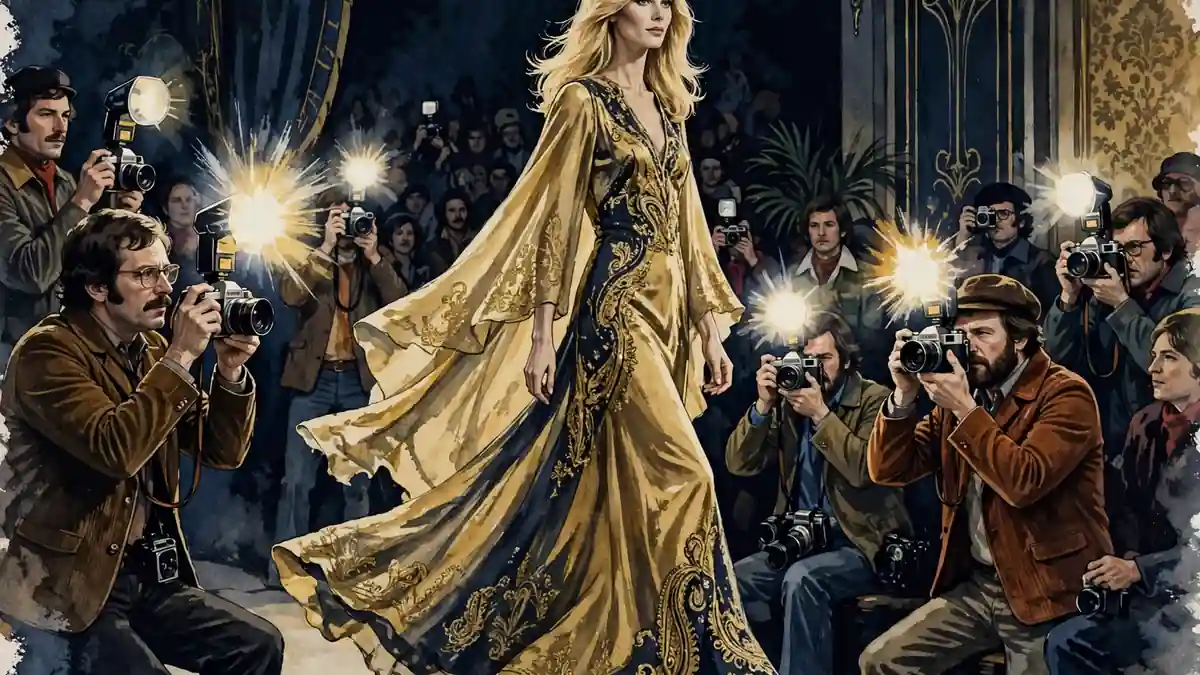
The modelling act began the day Haddad spotted her in Saint-Tropez and ran through the rest of the 1970s at full speed. She worked for Christian Dior, Yves Saint Laurent, Oscar de la Renta, Thierry Mugler and Versace, and she appeared on the covers of Vogue in its Italian, French and British editions as well as Cosmopolitan. By 1977 she had been on 40 magazine covers. The photographers who defined the decade — Newton, Bailey, Parkinson — all shot her, and artists including Andy Warhol, Lucian Freud, Ed Ruscha and Francesco Clemente painted or photographed her. Being a muse for that crowd brought more than flattery; it put her image into galleries and collections, and it kept her name in circulation long after the runway seasons ended.
The acting act started while she was still at the top of modelling. Her first film appearance came in the 1980 romantic drama Urban Cowboy, starring John Travolta and Debra Winger. Her best-known film role followed in 1989, when Tim Burton cast her as Alicia Hunt in Batman — the girlfriend of Jack Nicholson’s Jack Napier before his transformation into the Joker. The film grossed $411 million worldwide and remains one of the defining blockbusters of its era. Hall’s other film credits include Savage Hearts and Princess Caraboo, and she appeared on British television in Cluedo in 1993, The Detectives, Hotel Babylon and French and Saunders, as well as voicing the animated series Popetown.
Stage work, though, is where her acting career found its footing. In 1988 she played Cherie in Bus Stop in New Jersey — the role Marilyn Monroe made famous on film — and later reprised it in London’s West End. In 2000 she made her West End debut as Mrs. Robinson in a stage adaptation of The Graduate, a production that drew heavy press attention because Hall appeared nude on stage. She went on to perform in The Vagina Monologues, Picasso’s Women, and in 2005 she played Mother Lord in the West End production of Cole Porter’s High Society. In 2012 she appeared opposite David Soul in a Dublin production of A. R. Gurney’s Love Letters. Stage work pays far less than a film franchise, but it gave Hall something modelling never could: a craft she controlled, and a reason for the press to write about her work rather than her relationships.
Television kept her visible between stage runs. In 2005 VH1 built an entire reality series around her — Kept, in which a group of younger men competed for the chance to become her “kept man.” In 2012 she competed on the tenth season of Strictly Come Dancing, partnered with professional dancer Anton du Beke. And in 2026, shortly before her 70th birthday, she joined the second celebrity edition of the BBC’s The Traitors, filmed at Ardross Castle in Scotland — a booking that put her in front of a new generation of viewers and, according to BBC reporting, made her the richest contestant ever to appear on the show.
Through all of it, Hall never fully left fashion. She appeared in a Saint Laurent campaign in 2022 and modelled alongside members of her family for Burberry. In 2026 she returned to the pages of British Vogue for a fashion shoot and a long retrospective on her career, more than half a century after her first day on a French beach. That kind of longevity is rare in modelling, and it is worth money: a model who can still book Vogue at 70 is a model whose image never stopped being saleable.
In 2010 Hall published Jerry Hall: My Life in Pictures, a book pairing photographs from her career with stories from her life in modelling, entertainment and rock music. Her earlier autobiography, Tall Tales, was published in 1985. Books like these earn modestly compared with modelling fees or settlements, but they keep a public figure’s story in print and under her own control — and they pay royalties for years.
Rise to Fame
Hall’s rise was fast even by 1970s standards. She arrived in France in 1973, and by 1975 she was on the cover of Roxy Music’s fifth studio album, Siren, painted blue and posed as a mermaid. The image became one of the most famous album covers of the decade. It also changed her personal life: Roxy Music’s lead singer, Bryan Ferry, had requested her for the shoot after seeing her portfolio, and within months he gave her an engagement ring. The couple were engaged from 1975 to 1977, and she appeared in the promotional film for his 1976 solo hit “Let’s Stick Together.” Ferry later wrote the song “Kiss and Tell” about her, after her autobiography described the relationship.
By 1977 — less than four years after leaving Texas — Hall had been on 40 magazine covers and was earning modelling fees in excess of $1,000 per day. That daily rate, in 1977 money, would be worth roughly $5,000 a day in 2026 dollars. She was the face of Yves Saint Laurent’s Opium perfume, one of the most talked-about fragrance launches of the decade, and she was a fixture at Studio 54 and the 21 Club in New York. The Rolling Stones’ song “Miss You” was written by Mick Jagger for Hall. She met Jagger at a dinner party in Manhattan in 1976, while still engaged to Ferry, and left Ferry for him in 1977.
The Jagger relationship kept Hall in the headlines for the next 22 years, but it would be wrong to read her fame as borrowed. By the time she met Jagger she was already one of the highest-paid models in the world, with a cover count and a day rate to prove it. What the relationship did was extend her fame beyond fashion pages into front pages — and it tied her name to one of the biggest touring acts in history. When she later moved into acting, audiences already knew who she was. That recognition is the quiet asset behind every second act in entertainment: it turns a stage debut into news, and news into ticket sales.
Her contemporaries help put her standing in perspective. Cindy Crawford, the defining supermodel of the next generation, built a $400 million combined fortune with her husband Rande Gerber, anchored by her stake in the Meaningful Beauty skincare line. Hall’s career ran a decade earlier, in an era when models were paid by the day rather than given equity in beauty brands — a structural difference that explains much of the gap between their fortunes. Hall earned like a star of the 1970s; Crawford earned like a businesswoman of the 1990s. Both approaches worked, but only one of them compounds.
Main Sources of Income
Hall’s money comes from six streams, and their balance has shifted sharply across her life. Modelling paid the early bills and built the first million. Acting and stage work added steady income through the 1980s, 1990s and 2000s. Television — Kept, Strictly Come Dancing, The Traitors — paid appearance fees and kept her marketable. Books added royalties. Art sales, including pieces auctioned from her personal collection at Sotheby’s, turned taste into cash. And two settlements — from Jagger in 1999 and Murdoch in 2022 — delivered the largest single sums of her life, in cash and in property.
The honest shape of the fortune is this: Hall earned well as a model and actress, but the settlements are what moved her from comfortable to wealthy. That is not a criticism; it is the arithmetic of her life. A model earning $1,000 a day in 1977, even across a long career, does not reach $70 million on fees alone. The Jagger settlement, reported at $15 million to $22 million, and the Murdoch settlement — with cash estimates starting at £50 million — are the two events that define the top line. Everything else is the foundation that made those sums possible: the fame, the image, the staying power.
Property sits across the streams. Hall bought an 8.1-square-kilometre ranch in Lone Oak, Texas, with her early modelling fees — land bought young and held for decades. She later lived at Downe House on Richmond Hill in London, a property Jagger bought in the early 1990s. The Murdoch marriage added Holmwood House and a house in the south of France, both of which she kept. Real estate, in Hall’s case, has been both home and store of value: the houses she lived in were also the assets that held their worth while cash came and went.
There is also the income that never shows up in a headline figure: appearance fees, speaking engagements, magazine shoots in later life, and the Vogue retrospective of 2026. None of these is individually large. Together they explain why Hall, at 70, is still earning rather than simply spending down a settlement. A public figure who can still book Vogue and the BBC does not need to touch capital to live well.
Salary and Earnings
The best-documented number in Hall’s earning history is her peak modelling rate: more than $1,000 per day by 1977, when she was 21 and had already appeared on 40 magazine covers. In today’s money that is roughly $5,000 a day, and a busy model working 150 to 200 days a year at that rate would gross $150,000 to $200,000 a year in 1977 dollars — before agency commission, tax and expenses. Across the late 1970s, that pace put Hall among the highest-earning models in the world, in an era before supermodels commanded the seven-figure contracts of the 1990s.
The Opium contract with Yves Saint Laurent in 1977 was the prestige booking of her career, and its terms were never disclosed — fragrance houses of that era did not publish model fees, and Hall has never quoted a figure. The same silence surrounds most of her later commercial work, including the Saint Laurent campaign of 2022 and the Burberry family campaign. What can be said is that a former supermodel returning to a major house at 66 commands a premium fee rather than a standard one; the value to the brand is the name and the history, as much as the photograph.
Film and stage pay is easier to frame, even where exact figures are private. Hall’s film roles — Urban Cowboy in 1980, Batman in 1989 — were supporting parts, not star salaries. Batman grossed $411 million worldwide, but Hall played Alicia Hunt, a supporting role, and there is no public record of her fee. Her co-star Jack Nicholson famously took $6 million up front plus a share of the gross for playing the Joker, a deal that eventually earned him more than $40 million — a useful reminder of how far apart lead and supporting pay sits on a blockbuster. Hall’s stage work paid West End salaries: respectable, steady, and far below film money, but enough to keep her working through the 2000s on her own terms.
Television fees are similarly undisclosed. VH1’s Kept in 2005 was built entirely around Hall, which implies a meaningful fee, but no figure was published. Her Strictly Come Dancing appearance in 2012 would have paid the BBC’s standard contestant fee for the series. Her 2026 Celebrity Traitors appearance is the most recent payday, and the BBC does not publish contestant fees. What matters for the net worth picture is that none of these television jobs was a fortune-maker on its own; their value was visibility, and visibility is what keeps the fashion and appearance work coming.
Book royalties are the smallest stream. Tall Tales (1985) and Jerry Hall: My Life in Pictures (2010) both sold on the strength of her name, and both continue to earn small royalties. Neither book was a bestseller on the scale of a celebrity memoir today, and neither needs to be: their role in the fortune is to keep the story — and the image rights that go with it — active.
Putting the earning years together, Hall’s career income before settlements likely ran into the low tens of millions of dollars across five decades: strong modelling years in the 1970s, solid acting and stage work through the 1980s and 1990s, and selective, well-paid appearances from the 2000s onward. That is a successful career by any measure. It is the settlements, though, that explain the jump to $70 million — and they deserve their own careful accounting, because the numbers around them are the most argued-over figures in her story.
Businesses and Investments
Hall never built a product empire. She has no skincare line, no fashion label, no restaurant chain — and that absence is the single biggest difference between her fortune and those of the supermodels who came after her. Cindy Crawford turned fame into equity in Meaningful Beauty; Hall turned fame into fees, property and art. Both paths work, but equity compounds in a way fees do not, and the gap shows in the final numbers.
Her closest thing to a business is her art collection. Hall spent decades around artists — Warhol, Freud, Ruscha, Clemente all painted or photographed her — and she collected seriously. Pieces from her personal collection have been sold at auction through Sotheby’s, and British reporting credits art sales as one of the named sources of her fortune alongside modelling, acting and the settlements. The value of a private collection is almost impossible to pin down from outside: auction results are public when a piece sells, but the full inventory is private. What is clear is that Hall bought well, bought early, and held work by artists whose markets rose sharply over the decades she owned them.
Property has been her most consistent investment. The Lone Oak ranch in Texas — 8.1 square kilometres bought with early modelling fees — was land bought young in a state where land values have climbed for fifty years. She held it while her career moved to London and Paris, which is exactly the kind of patient holding that turns a purchase into a real asset. London property did similar work: the years at Downe House on Richmond Hill put her in one of the capital’s most expensive postcodes, even though that house was Jagger’s purchase rather than hers.
The Murdoch years added property on a different scale. Holmwood House, the 18th-century Georgian estate near Henley-on-Thames, was bought by the couple in 2019 for about £11 million; the house had been listed for £11.25 million through Savills the year before. A house in the south of France, bought around 2017, completed the pair. Both passed to Hall in the divorce. Property bought at that level, in those locations, tends to hold value even when cash is spent — and Hall’s decision to live at Holmwood after the divorce, rather than sell it, suggests she treats it as a home first and an asset second.
There is no public record of Hall holding shares, funds or business equity of any size, and no filing or rich-list entry credits her with a company stake. That silence is itself information: her fortune is visible in property, art and cash, not in a portfolio. For a reader weighing the $70 million figure, that matters. A fortune held in houses and art is real, but it is less liquid than a fortune held in shares — and its value moves with the property and art markets, not the stock market.
Brand Deals and Sponsorships
Hall’s brand work divides into two eras. The first ran through the 1970s, when she modelled for Dior, Yves Saint Laurent, Oscar de la Renta, Thierry Mugler and Versace, and fronted the Opium perfume launch for Saint Laurent in 1977. Opium was one of the most controversial fragrance launches of the decade — the name alone drew protests — and putting Hall’s face on it made her the visual shorthand for the scent. Fragrance contracts of that era were among the best-paid work in modelling, and the Opium deal is the single brand association most often cited in profiles of her career.
The second era is the comeback: a Saint Laurent campaign in 2022, when Hall was 66, and a Burberry campaign in which she modelled alongside members of her family. These are not the bookings of a model chasing work; they are the bookings of a house buying heritage. Saint Laurent and Burberry both wanted the woman who had defined their aesthetic fifty years earlier, and they paid for the history as much as the photograph. The 2026 British Vogue shoot and retrospective completed the arc: the magazine that had put her on its covers in the 1970s was now celebrating her at 70.
What Hall never did was lend her name to the kind of mass endorsement that fills a modern celebrity’s income statement — no high-street collection, no diet tea, no paid social posts. Her Instagram following, at around 60,000, is far too small for influencer income to matter, and she has never tried to build it into a business. That restraint fits the rest of her career: she sold her image to the highest tier of fashion, and left the rest alone.

Houses, Cars and Other Assets
Holmwood House is the anchor asset. The Grade II-listed Georgian country house sits in Binfield Heath, Oxfordshire, near Henley-on-Thames, with 11 bedrooms and extensive grounds. The house was put up for sale through Savills in November 2018 for £11.25 million, and Murdoch and Hall bought it in 2019 for about £11 million. In the divorce settlement Hall kept it, and she has lived there since. A house of that size in that location is worth roughly what was paid for it, and likely more after the post-2020 rise in country-house prices — though no recent valuation is public.
The second property is a house in the south of France, in the St Tropez area, bought around 2017. British reporting consistently lists it alongside Holmwood House as part of the settlement, and Hall was reported to have the keys to it after the divorce. A St Tropez property bought for a Murdoch is not a cottage; it is a serious asset, even if no purchase price has ever been published.
Before Murdoch, there was Downe House on Richmond Hill in London, where Hall lived with Jagger after he bought it in the early 1990s. That house stayed with Jagger after the split. And before London, there was the Lone Oak ranch in Texas, bought with her own early fees and held for decades. The pattern is consistent: Hall has always lived in substantial houses, and she has always ended up holding at least one of them.
The Bel Air property is the one she lost. During the Murdoch marriage the couple kept a home in Bel Air, Los Angeles, and after the split Hall was required to remove her possessions from it within 30 days, providing receipts for items she claimed as her own while security personnel watched the move. Vanity Fair reported the detail in its account of the breakup, and it is a reminder that a divorce settlement is more than a number: it is also a timetable, a set of conditions, and a move conducted under supervision.
Cars barely feature in Hall’s public story, and that is telling. There are no profiles of her collection, no auction records of a garage, no interviews about vehicles. She has been photographed in and around expensive cars for fifty years, as any celebrity is, but no source credits her with a collection worth naming. The same goes for jewellery and watches: she has worn remarkable pieces in photographs, but none is documented as an asset of stated value. In a fortune built on property, art and cash, vehicles are a footnote — and we will not invent one.
The art deserves a final word here, because it may be the most undervalued line in her balance sheet. Hall was painted by Lucian Freud, photographed by Warhol and Newton, and collected work by artists whose markets have risen many times over since she bought. Pieces from her collection have sold at Sotheby’s. A collection assembled across fifty years, with that kind of access and that kind of eye, is not a hobby. It is a portfolio that happens to hang on walls.
Awards and Achievements
Hall’s honours are not the kind that come with a trophy cabinet. Modelling in the 1970s had no awards circuit for its stars; the reward was the cover, the rate and the next booking. By those measures her record is hard to beat: 40 magazine covers by the age of 21, the face of a landmark perfume launch, and a working relationship with every major fashion photographer of her generation.
Her one formal record is a Guinness World Record. In 2004 she appeared in six West End productions in a single night — The Phantom of the Opera, Les Misérables, Anything Goes and three more — a stunt that required precise timing, the cooperation of six companies, and a performer willing to be treated as a novelty act for an evening. It worked: the record put her back in the papers for her stage work rather than her private life, and it remains the most-cited single achievement of her acting career.
The stage milestones matter more than the record. Playing Cherie in Bus Stop in 1988, Mrs. Robinson in The Graduate in 2000, and Mother Lord in High Society in 2005 gave Hall a theatrical CV that most models-turned-actresses never build. The Graduate run, in particular, drew press attention far beyond the theatre pages, because Hall appeared nude on stage — a decision that dominated coverage at the time and that she has always treated as a professional choice rather than a stunt.
The 2026 double — British Vogue at 70 and Celebrity Traitors in the same year — is the achievement that best captures her longevity. Vogue does not hand retrospective shoots to former models out of nostalgia alone; it does so because the subject still sells magazines. And the BBC does not cast a 70-year-old on its biggest reality show unless she still holds an audience. Hall’s career, measured across 53 years, is less a peak than a plateau: she reached the top early and then refused, for five decades, to leave it.
Net Worth Growth Over the Years
Hall’s fortune did not grow in a straight line. It grew in jumps — a modelling peak, a settlement, a marriage, a divorce — with long flat stretches in between. The table below is our reconstruction from the public record: early figures are informed estimates based on her documented day rate, and later figures follow the reported settlements. Where the record is thin, we say so.
| Year | Estimated net worth | What moved it |
|---|---|---|
| 1977 | About $1 million | Peak modelling years: 40 covers, fees above $1,000 a day, Opium contract; Texas ranch bought with early fees |
| 1985 | About $3 million | Continued modelling and early film work; Tall Tales published; art collecting under way |
| 1990 | About $5 million | Stage work building; Batman (1989); long-term partnership with Jagger, one of the world’s richest musicians |
| 1999 | $15 million–$22 million | Jagger settlement reported in that range after the Bali marriage was declared invalid; the single biggest jump of her life to that point |
| 2010 | About $20 million | Stage, television and book income; art collection appreciating; older estimates from this period cluster near $20 million |
| 2016 | About $25 million | Marriage to Murdoch; shared property purchases begin, including Holmwood House in 2019 |
| 2022 | $50 million–$70 million | Murdoch divorce: Holmwood House, the St Tropez house and a cash payment reported from £50 million upward |
| 2026 | $50 million–$70 million | Celebrity Net Worth updates to $70 million; British reporting agrees at £53 million; Vogue and Celebrity Traitors keep her earning |
Two things stand out. First, the 1999 and 2022 jumps are the whole story: without them, Hall’s fortune would look like a successful model’s retirement fund, not a $70 million estate. Second, the range has narrowed, not widened, since the divorce. Before 2022, published estimates sat anywhere from $15 million to $25 million. After the settlement, the freshest reporting — Celebrity Net Worth in October 2026 and British outlets the same month — converges on $70 million. The BBC’s £20 million figure, still circulating in November 2026 rich lists, looks like an older number that has not caught up with the settlement. We have weighted the fresh reporting over the stale one, and we show the range so readers can see the uncertainty rather than tripping over it.
For scale, here is how Hall’s fortune sits beside the people her story keeps returning to. Mick Jagger is estimated at $500 million to $600 million, built on six decades of Rolling Stones touring, publishing royalties and a $250 million property portfolio — roughly eight times Hall’s fortune, which is what a 22-year partnership with a rock fortune looks like from the other side. Cindy Crawford sits at $400 million combined with her husband, with a solo figure above $200 million anchored by her beauty-brand equity. Jack Nicholson, her Batman co-star, is estimated at $400 million, built on film salaries, backend deals and an art collection valued at up to $200 million. Hall’s $70 million is the smallest of the four — and the only one built without equity, backend points or a touring machine behind it.
Social Media Presence
Hall keeps a low profile online. Her official Instagram account, @jerryfayehall, has a little over 60,000 followers, and she uses it to post career milestones, family photographs and news rather than daily content. That is a small audience by modern celebrity standards — a working influencer with 60,000 followers would be a micro-influencer — and it tells its own story about where Hall’s fame comes from. She became famous before social media existed, and she has never needed it to stay famous.
She has no meaningful presence on other platforms as a creator. There is no Hall TikTok, no YouTube channel, no paid-post business. Fan accounts and press coverage do most of the work of keeping her visible online, and the 2026 Celebrity Traitors run did more for her search visibility in a month than her own posting has done in years. For net worth purposes, social media contributes almost nothing to her income — and that is fine. A fortune built on property, art and settlements does not need an engagement rate.
Personal Life
Hall’s personal life has been public for fifty years, and she has rarely tried to hide it. She was engaged to Bryan Ferry from 1975 to 1977, after meeting him on the Siren album shoot. She left Ferry for Mick Jagger, whom she had met at a Manhattan dinner party in 1976. Hall and Jagger were together for more than two decades, from 1977 to 1999, and had four children: Elizabeth, born in 1984; James, born in 1985; Georgia May, born in 1992; and Gabriel, born in 1997. Elizabeth and Georgia May both became successful models; James pursued acting. The family has remained close, and Hall and Jagger have appeared together at family events for decades since the split.
The couple took part in a Hindu wedding ceremony in Bali on November 21, 1990, and considered themselves married for years afterward. That ceremony became the central legal question of their breakup. After revelations that Brazilian model Luciana Gimenez was pregnant with Jagger’s child, Hall filed for divorce in early 1999. Jagger’s lawyers argued that the Bali ceremony had never created a legally valid marriage, and in August 1999 the High Court of England and Wales formally declared the marriage invalid under both English and Indonesian law. Hall accepted an annulment, and the financial terms were never disclosed. Later British reporting has commonly placed her settlement at about £10 million — roughly $15 million at the time — with other reports putting the range at $15 million to $22 million. Newspapers at the time had speculated she might seek as much as $50 million.
Hall began dating Rupert Murdoch in 2015. They announced their engagement in January 2016 and married in London in March 2016, when Murdoch was 85 and controlled a media empire built on News Corp and what became Fox Corporation. The marriage lasted six years. In 2022 Murdoch informed Hall by email that he was ending the marriage — a message that reportedly began “Jerry, sadly I’ve decided to call an end to our marriage” — while she was waiting to meet him at their Oxfordshire estate. She filed for divorce in Los Angeles in July 2022, citing irreconcilable differences, and the divorce was finalised within weeks.
The settlement’s full terms were never disclosed, and the couple had signed a prenuptial agreement that protected the bulk of Murdoch’s multibillion-dollar business fortune. Even so, what Hall received was substantial. She kept Holmwood House and the house in the south of France, and British reporting put the cash payment anywhere from £50 million to £250 million — a spread that says more about how little was disclosed than about the actual figure. One October 2026 report put the cash at £72 million with two mansions; an earlier tabloid claim of $303 million has never been corroborated and clashes with the prenup reporting, so we do not rely on it. Vanity Fair’s later account added two striking details: the settlement reportedly barred Hall from feeding story ideas to the writers of HBO’s Succession, whose fictional Roy family had often been compared to the Murdochs; and after she moved into Holmwood House she reportedly found surveillance cameras still transmitting footage to Fox headquarters, until Mick Jagger sent a security specialist to disconnect the system.
Hall has said she has had no contact with Murdoch since the divorce. She has described family life as one of her greatest priorities, and she has several grandchildren. She has also been open about rejecting cosmetic surgery and other conventional approaches to ageing in the fashion industry, and she has kept modelling, gardening, theatre and art at the centre of her life at Holmwood House. The through-line of her personal life is resilience: a difficult childhood, two very public breakups, and a career that kept going through all of it.
Sources & Reporting
Every figure in this article traces to a named source. Celebrity Net Worth supplies the anchored $70 million estimate, the $1,000-a-day modelling rate, the Jagger settlement range and the Holmwood House details, in a profile updated October 1, 2026. BBC reporting on the Celebrity Traitors rich list carries the older £20 million figure that our range treats as stale. The Guardian reported the filing and the finalisation of the Murdoch divorce in 2022, including the joint statement that the couple “remain good friends.” Vanity Fair reported the email breakup, the Succession clause and the Holmwood House surveillance cameras. OK! Magazine and BritBrief supplied the October 2026 reporting that converges on £53 million ($70 million), the £72 million cash claim and the Jagger settlement range of $15 million to $22 million. The Tab reported the Murdoch cash range of £50 million to £250 million. Forbes supplies the Murdoch family fortune context, estimated at about $22.7 billion in early 2026. Wikipedia’s Holmwood House entry, citing Savills and The Guardian, confirms the £11.25 million asking price and the 2019 purchase. Reporting window for this article: October–November 2026. Where sources conflict — above all on the Murdoch cash figure — this article publishes the range and names who says what, rather than picking a single number and hiding the disagreement.
Frequently Asked Questions
How much is Jerry Hall worth in 2026?
Jerry Hall’s net worth is estimated at $70 million as of November 2026, according to Celebrity Net Worth’s October 2026 update, with British reporting agreeing on £53 million. Our working range is $50 million to $70 million, because the cash portion of her 2022 divorce settlement from Rupert Murdoch was never publicly disclosed and published estimates of it run from £50 million to £250 million.
How did Jerry Hall make her money?
Through six streams: top modelling fees in the 1970s, when she earned more than $1,000 a day; stage and film acting, including Batman in 1989 and a long West End career; television work such as Kept, Strictly Come Dancing and Celebrity Traitors; book royalties; art sales through Sotheby’s; and two divorce settlements — a reported $15 million to $22 million from Mick Jagger in 1999 and a far larger settlement from Rupert Murdoch in 2022 that included two houses and a substantial cash payment.
How much did Jerry Hall get in the Rupert Murdoch divorce?
The full terms were never disclosed, and the couple had a prenuptial agreement. What is confirmed: she kept Holmwood House, the 11-bedroom Oxfordshire estate bought for about £11 million, and a house in the south of France. Published cash estimates vary widely, from £50 million to £250 million, with one October 2026 report putting the cash at £72 million. A tabloid claim of $303 million has never been corroborated and conflicts with the prenup reporting.
How much did Jerry Hall get from Mick Jagger?
The financial terms were confidential and never officially disclosed. Later British reporting commonly places her 1999 settlement at about £10 million, roughly $15 million at the time, with other reports putting the range at $15 million to $22 million. Newspapers at the time speculated she might seek as much as $50 million. The couple’s 1990 Bali wedding ceremony was declared invalid by the High Court in August 1999, so the settlement was reached as an annulment rather than a divorce.
How old is Jerry Hall?
Jerry Hall was born on July 2, 1956, in Gonzales, Texas, which makes her 70 years old in 2026. She celebrated the milestone with a British Vogue retrospective shoot and a run on the BBC’s Celebrity Traitors, more than half a century after she was discovered on a beach in Saint-Tropez at 16.
How tall is Jerry Hall?
Jerry Hall is 6 feet tall (1.83 m). Her height, together with her waist-length blonde hair, was her trademark as a model and a large part of why she stood out on runways and magazine covers in the 1970s.
Who are Jerry Hall’s children?
Jerry Hall has four children with Mick Jagger: Elizabeth, born in 1984; James, born in 1985; Georgia May, born in 1992; and Gabriel, born in 1997. Elizabeth and Georgia May both became successful models, and James pursued acting. Hall also has several grandchildren, and she has described family life as one of her greatest priorities.
Is Jerry Hall still modelling?
Yes, selectively. She appeared in a Saint Laurent campaign in 2022, modelled alongside family members for Burberry, and returned to British Vogue in 2026 for a fashion shoot and career retrospective shortly before her 70th birthday. She also joined the cast of the BBC’s Celebrity Traitors in 2026, her highest-profile television booking in years.
Final Thoughts
Jerry Hall’s $70 million fortune is really three fortunes layered on top of each other. The first was earned: $1,000-a-day modelling fees, 40 magazine covers by 21, and a stage career built on real craft. The second was negotiated: a settlement from Mick Jagger reported at $15 million to $22 million. The third was the largest and the least visible: a divorce from Rupert Murdoch that delivered two houses and a cash payment nobody outside the room has ever confirmed. The honest number sits in a range, $50 million to $70 million, because the biggest cheque in her life came with a confidentiality clause attached.
What is not in doubt is the staying power. Hall arrived in France in 1973 on an $800 insurance cheque, and at 70 she is still booking Vogue and the BBC. Models half her age would trade careers for that kind of run. The money followed the longevity, not the other way round — and that is the part of her story most worth remembering.
Published on November 15, 2026. Last reviewed November 2026. Found an error? See our corrections policy.