
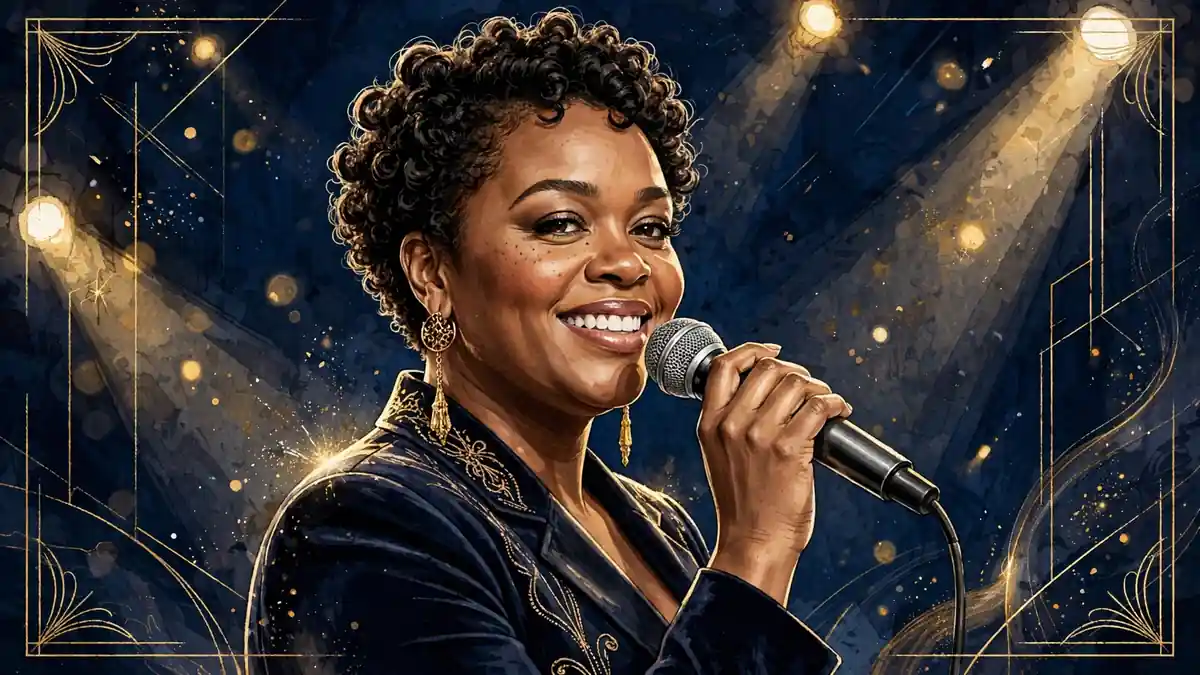
Jill Scott‘s net worth is estimated at $8 million to $15 million as of November 2026. The Philadelphia neo-soul singer, three-time Grammy winner and working actress built that fortune across a 26-year career — a platinum debut album in 2000, two Billboard 200 number-one albums, a steady film and television career, and, in 2026, a comeback album and world tour after an eleven-year gap between studio records. The most-cited figure, from Celebrity Net Worth, sits at $12 million, and that is the number this article anchors on, with the full range explained below.
Jill Scott: Quick Facts
| Estimated net worth | $12 million (range: $8 million to $15 million) |
|---|---|
| Profession | Singer, songwriter, actress, poet, model |
| Nationality | American |
| Born | April 4, 1972 (age 54) |
| Height | 5 feet 5 inches (1.65 m) |
| Primary income sources | Music royalties and touring, acting salaries, songwriting and publishing, poetry and books, brand partnerships |
| Active years | 1999–present |
| Last reviewed | November 2026 |
- Early Life and Background
- Education
- Career Journey
- Rise to Fame
- Main Sources of Income
- Salary and Earnings
- Businesses and Investments
- Brand Deals and Sponsorships
- Houses, Cars and Other Assets
- Awards and Achievements
- Net Worth Growth Over the Years
- Social Media Presence
- Personal Life
- Sources & Reporting
- Frequently Asked Questions
Early Life and Background
Jill Heather Scott was born on April 4, 1972, in Philadelphia, Pennsylvania, and grew up in North Philadelphia. She was raised by her mother, Joyce Scott, and her grandmother in a household where church, books, and music all carried weight. The nickname that followed her for the rest of her career — “Jilly from Philly” — started here, in a neighborhood that also produced the Roots, Boyz II Men, and a whole lineage of Philadelphia soul. Scott has spoken in interviews about a childhood that was short on money and long on language: she read constantly, wrote poetry from a young age, and treated words as the one thing nobody could take from her.
Philadelphia shaped her sound in a direct way. The city’s neo-soul scene of the late 1990s — built around the Roots, DJ Jazzy Jeff, and a circle of poets and musicians who gathered at open mics and spoken-word nights — gave a young poet a stage before it gave her a record deal. Scott performed her poetry at readings around the city, and her delivery — half sung, half spoken, with a preacher’s timing — stood out in rooms full of rappers and jazz players. She worked service and retail jobs while she built a reputation on that circuit, and for years the money was thin. One profile of her early career notes she earned only a few thousand dollars a year from her day work in that period, a detail that makes the later eight-figure estimates easier to understand: almost everything she owns was built after the age of 28.
Her grandmother’s influence runs through her work in a way fans recognize instantly. The warmth, the church-inflected phrasing, and the habit of turning ordinary domestic scenes into songs — cooking, loving, leaving — all trace back to the North Philadelphia home where she was raised. Scott has said her grandmother taught her to speak clearly and stand behind what she said, a lesson that later showed up in her business life as much as her lyrics: she has run her own imprint, protected her publishing, and walked away from deals that did not suit her.
Education
Scott attended the Philadelphia High School for Girls, one of the city’s selective public schools, where she was already writing and performing poetry. After graduation she enrolled at Temple University in Philadelphia, studying secondary education with the plan of becoming a high school English teacher. She left Temple before finishing the degree to pursue theater, a decision that looked reckless at the time and reads differently now: within a few years she was touring Canada in a production of the Broadway musical Rent, learning stagecraft, stamina, and how to hold a room night after night.
The teaching instinct never left her. Her lyrics read like lessons — about self-respect, about money, about love that costs too much — and her 2005 poetry collection, The Moments, The Minutes, The Hours, was received as a serious literary work rather than a celebrity side project. Critics praised it, and it sold well enough to establish a second income stream beyond music. The unfinished degree also explains something about her career choices: Scott has consistently picked projects that teach or stretch her — a BBC literary adaptation, a James Brown biopic, a poetry book — over the easiest paycheck available.
Her formal training in theater paid off in a measurable way. When acting roles arrived in the mid-2000s, she did not arrive as a singer trying to act; she arrived with stage experience, and directors noticed. That grounding is one reason her acting career lasted while other singers’ screen careers faded after a film or two.
Career Journey
Scott’s break came through the Roots. Questlove, the band’s drummer and a fellow Philadelphian, heard her read poetry and invited her to collaborate. She co-wrote “You Got Me,” the Roots’ 1999 single featuring Erykah Badu, which won the Grammy for Best Rap Performance by a Duo or Group. Scott sang the song’s hook on the demo and co-wrote the lyrics, and the win put her name in front of every label executive in R&B before she had released a single record of her own. It also gave her a Grammy association from the very start — a credential that would compound across her career, since two of her three eventual Grammy wins came from collaborations rather than solo work.
She signed with Hidden Beach Recordings, the independent label founded by Steve McKeever, and recorded her debut album, Who Is Jill Scott?: Words and Sounds Vol. 1, released in July 2000. The record’s lead single, “A Long Walk,” became a radio staple, and the album went platinum. It earned Scott four Grammy nominations, including Best New Artist, and established the template for everything that followed: long, warm, conversational songs about love and independence, built on live instrumentation and her spoken-word cadence.
The follow-ups kept the run going. Beautifully Human: Words and Sounds Vol. 2 arrived in August 2004, went gold, and entered the Billboard 200 inside the top five; its single “Cross My Mind” won Scott her first solo Grammy in 2005, for Best Urban/Alternative R&B Performance. The Real Thing: Words and Sounds Vol. 3 followed in September 2007, also went gold, and produced the hit “Hate on Me.” Between albums she stayed visible as a collaborator: her 2006 feature on Lupe Fiasco’s “Daydreamin'” won a Grammy in 2008, and her turn on George Benson and Al Jarreau’s “God Bless the Child” won one in 2007. By the end of the decade she had three Grammy wins and a catalog that sold steadily rather than spiking and fading.
The 2010s brought her two commercial peaks. The Light of the Sun (2011) debuted at number one on the Billboard 200 — her first chart-topper — and Woman (2015) did the same, making her one of the few R&B singers of her generation with two number-one albums a decade and a half into a career. Then came the long pause. For eleven years she released no studio album, working instead in film and television, touring selectively, and, by her own account, spending time on personal growth and life transitions. The pause ended on February 13, 2026, when To Whom This May Concern arrived — her sixth studio album, released on her own Blues Babe imprint with Human Re Sources and The Orchard, featuring Tierra Whack, Trombone Shorty, JID, Too $hort, and Ab-Soul, with production from DJ Premier, Andre Harris, and longtime collaborator Camper. It debuted at number 33 on the Billboard 200 with 22,000 album-equivalent units in its first week, reached number 6 on the Independent Albums chart and number 7 on Top Album Sales, and landed in the top ten of seven Billboard charts. Its single “Pressha” became her first Adult R&B Airplay chart-topper in nearly thirteen years.
Alongside the music, Scott built a parallel acting career that most singers never manage. She debuted on television with a recurring role on Girlfriends in 2004, acted opposite Kevin Bacon and Kyra Sedgwick in the Showtime film Cavedweller the same year, and made her film debut in 2007 with two features: Hounddog, in which she played blues legend Big Momma Thornton, and Tyler Perry’s Why Did I Get Married?, as Sheila Jackson — a role she reprised in the 2010 sequel. In 2008 she took the lead in the BBC/HBO series The No. 1 Ladies’ Detective Agency, playing Precious Ramotswe, Alexander McCall Smith’s Botswana detective, a starring television role that ran for a full series and a feature-length pilot. She won an NAACP Image Award for Outstanding Actress for Sins of the Mother (2010), played James Brown’s second wife, Deidre “Dee Dee” Jenkins, in the biopic Get on Up (2014), voiced Storm in BET’s animated Black Panther series, and played the recurring villain Lady Eve on The CW’s Black Lightning from 2018. In 2019 she joined the BET series The First Wives Club as Hazel. Each role added a paycheck, a residual stream, and a new audience that did not come from radio.
Rise to Fame
Scott’s rise was slower and sturdier than the overnight stories around her. She was 28 when her debut album arrived, old for a new R&B star, and she had already worked, studied, toured in theater, and written a body of poetry. That maturity showed in the music: Who Is Jill Scott? sounded like a grown woman’s record in a market full of teenage pop-R&B, and its audience grew by word of mouth rather than by a single viral moment. “A Long Walk” earned a Grammy nomination in 2003; the album’s platinum certification confirmed that the slow build had worked.
The turning point for her public profile was not a song but a run of screen roles in 2007 and 2008. Why Did I Get Married? grossed far beyond its budget and put Scott in front of Tyler Perry’s enormous audience, while The No. 1 Ladies’ Detective Agency gave her a prestige television lead and international exposure through the BBC and HBO. Together they converted her from a singer with a loyal following into a recognizable screen presence, and that conversion is visible in her earning power: after 2008 she could command acting fees, touring guarantees, and endorsement interest all at once, instead of depending on album cycles alone.
The second turning point came in 2011, when The Light of the Sun debuted at number one. A number-one album fifteen years into a career — eleven years after a platinum debut — is rare in R&B, and it reset her touring value. Her live shows became the financial center of her career: long, warm, theatrical sets that sold out theaters and amphitheaters, with ticket prices that reflected a catalog fans had lived with for a decade. The 2015 follow-up, Woman, repeating the number-one debut, confirmed the pattern. By the time she stepped back from recording, she had a catalog, a touring business, and a screen career that could each carry her on their own — the three-legged structure behind the $8–15 million estimate.
The 2026 comeback completed the arc. Announcing the album on Instagram in December 2025, releasing the lead single “Beautiful People” on January 2, 2026, and following with “Pressha” a week later, Scott rebuilt her audience in six weeks. She performed “Pressha” on late-night television, launched the To Whom This May Concern World Tour in June 2026, and in September 2026 was inducted into the Billboard R&B Hall of Fame at the Billboard R&B Hip-Hop Power Players event in New York — an institutional honor that arrived the same year as the new record, and a useful marker of how the industry values a 26-year career.
Main Sources of Income
Scott’s money comes from five streams, and the balance between them is what makes her fortune durable. Music is the foundation: six studio albums, a catalog that has sold more than 4 million albums in the United States according to RIAA certifications cited in industry profiles, and over 7 million records sold worldwide as reported by music-industry roundups. Royalties flow from album sales, streaming, radio play, and licensing — her songs appear in films, television, and commercials, and “Golden” in particular has become a sync staple. Because she co-wrote most of her material, she earns as both performer and songwriter, collecting publishing income on top of recording royalties. Her own Blues Babe imprint, which released the 2026 album, means a larger share of the new record’s revenue stays with her than a traditional label deal would allow.
Touring is the largest single earner in most years. Scott’s live business has run for more than two decades, from theaters in the 2000s to amphitheaters and arenas on the 2026 world tour. Tour-economics coverage citing Pollstar put her 2007 tour gross above $10 million and her 2015 tour gross near $8 million — figures that describe gross box office, not her personal take-home, but they show the scale of the live operation. On a tour, the artist’s share after venue, promoter, band, and crew costs is a fraction of gross, yet even a modest fraction of a multi-million-dollar gross, repeated across dozens of dates, adds up fast. The 2026 To Whom This May Concern World Tour, which opened June 4, 2026, in Nashville and ran through September 4 in Irving, Texas, on its North American leg before international dates, is the biggest touring cycle of her career by geography, and it is the main reason her 2026 earnings are likely the strongest of the decade.
Acting is the third stream, and the steadiest. Film and television pay per project, and Scott has worked almost every year since 2004 — Tyler Perry films, an HBO/BBC series lead, a James Brown biopic, a multi-season CW role, and a BET series regular spot. Her per-project fees are not public, and this article does not guess at them, but a working actress with her credits earns well into six figures per film role and a series-regular television salary across a season. Residuals from reruns and streaming of The No. 1 Ladies’ Detective Agency, Black Lightning, and the Perry films continue to pay years after the work was done.
Songwriting for others and features add a fourth stream. The “You Got Me” co-write paid her as a songwriter on a Grammy-winning hit before she was famous. Features on records by the Roots, Lupe Fiasco, Common, Eric Benét, and Will Smith — collaborators named across her career — each carried a fee and, in the case of “Daydreamin'” and “God Bless the Child,” Grammy wins that raised her booking price. Her poetry book, The Moments, The Minutes, The Hours (2005), added publishing income and established her as a literary author, a credential that supports speaking and appearance fees.
The fifth stream is the smallest and the most selective: brand partnerships and appearances. Scott has worked with Target on a partnership that directed a share of proceeds to the Philadelphia School District, a deal that fit her public image as a Philadelphia loyalist and an education advocate. She has never been a prolific endorser — there is no long list of fashion, beauty, or liquor deals attached to her name — and that restraint is itself a financial fact: her net worth was built on catalog and stage, not on selling her name to the highest bidder.

Salary and Earnings
There is no public record of Jill Scott’s salary for any single film, television season, or tour, and this article will not invent one. What the record does show is the shape of her earnings across a career, and the shape is unusually even: no single windfall, no single collapse, just a long run of paid work in three industries at once. That steadiness is why the estimates cluster where they do. A singer who sells a few million albums, tours for twenty years, and acts steadily for two decades lands in the low eight figures; a singer who did only one of those things would not.
The album math is the easiest to see. Her debut went platinum — more than a million copies in the United States — and her second and third albums each went gold. Two later albums debuted at number one on the Billboard 200. At typical royalty rates for a recording artist of her era, a platinum album generates low-seven-figure royalty income over its life, spread across years of sales, streaming, and licensing, and a gold album roughly half that. Her songwriting share adds to it: as a co-writer on most of her songs, she collects publishing royalties every time a track is played, streamed, or licensed. The 2026 album’s first-week figure — 22,000 album-equivalent units — looks small beside the debut era, but it reflects a changed market in which streaming pays per play rather than per sale, and in which the album’s real job is to sell concert tickets. That is exactly what it did: the world tour that followed is where the 2026 record pays off.
Touring economics deserve a closer look because they are the least understood part of a singer’s fortune. The Pollstar-cited figures for her 2007 and 2015 tours — grosses above $10 million and near $8 million respectively — are box-office totals, and the artist keeps only a share after the venue, promoter, band, crew, travel, and production costs are paid. Even so, a headliner of Scott’s standing on a theater and amphitheater circuit typically takes home a substantial six-figure sum per tour leg, and she has toured in most years of her career. Merchandise adds to it: tour-economics roundups have estimated her merchandise sales at around $2 million a year in peak touring years, though that figure comes from a single secondary source and should be treated as an indication rather than a fact.
Acting pay is harder to pin down, and honest reporting says so. What can be said is that her screen career has been continuous since 2004, that a series lead on an HBO/BBC production and a multi-season role on a CW series each pay at a level far above a one-off guest spot, and that residuals from her catalog of films and shows — the Perry films in particular, which play constantly on cable and streaming — provide income long after the shoot ends. Her annual income in active years has been estimated by one biography site at more than $1.2 million a year, a figure this article treats as a rough indication rather than a verified salary: it is consistent with the scale of her touring and acting work, but no primary source confirms it.
How Jill Scott compares with her neo-soul peers
Peer comparison puts the $12 million anchor in context. Mary J. Blige, the Queen of Hip-Hop Soul, is reported at about $20 million in 2026 by Parade, citing Celebrity Net Worth — a bigger fortune, built on a longer run of hit records, a Super Bowl halftime appearance, and a Las Vegas residency, but also dented by well-documented tax liens and an expensive divorce. Alicia Keys, the piano-playing R&B star of the same generation, is reported at about $150 million combined with her husband, producer Swizz Beatz, by Parade — a figure that reflects a beauty brand, a television coaching salary of a reported $8 million per season on The Voice, and 65 million records sold, a scale Scott never chased. Janet Jackson, whose career spans music, film, and touring at arena scale, sits in a different bracket altogether. Scott’s fortune is smaller than those peers, and the reason is visible in the choices: she never built a beauty or fashion empire, never took a television coaching chair, and never chased the pop crossover that turns R&B singers into nine-figure brands. What she did instead was keep ownership of her work, tour on her own terms, and act steadily — a smaller fortune, built on a narrower base, with less exposure to the reversals that hit Blige.
Chris Brown and Babyface show the two other routes through the same industry. Brown’s fortune rests on a far larger streaming catalog and constant touring; Babyface’s rests on songwriting and production for other artists, a model Scott touches through her own co-writing but never made her center. Scott’s path — singer, songwriter, actress, poet — is the most diversified of the group per dollar earned, and diversification is what protected her during the eleven years she released no new album.
Businesses and Investments
Scott’s main business is her own label imprint, Blues Babe Records. Founded as the vehicle for her later albums, Blues Babe released The Light of the Sun in partnership with Warner Bros. and released the 2026 comeback, To Whom This May Concern, with Human Re Sources and The Orchard. Owning the imprint changes the economics of a record: instead of a royalty rate set by a major label, the artist controls the master recordings and keeps a larger share of sales and streaming revenue. For a catalog artist, the masters are the asset — they pay every time a song is streamed, licensed, or reissued — and Scott’s control of her recent masters is one of the more valuable, least visible parts of her net worth.
Her publishing is the quieter asset. As a co-writer on most of her songs, including “A Long Walk,” “Golden,” “He Loves Me (Lyzel in E Flat),” and “Cross My Mind,” she holds songwriter shares that generate royalties indefinitely. Publishing catalogs have become one of the most actively traded assets in music, with funds paying large multiples of annual royalties for proven catalogs, and while there is no report of Scott selling any part of hers, the catalog’s existence underpins the estimate: a writer-performer with a platinum debut, two number-one albums, and a stack of licensed songs owns an income stream that does not depend on her touring or recording again.
Her poetry book is a smaller business with an outsized role in her brand. The Moments, The Minutes, The Hours (2005) was published by St. Martin’s Press and received serious critical attention, establishing Scott as a literary figure rather than a singer with a book deal. It continues to sell in small numbers, and it supports a speaking and appearance business: Scott is a sought-after speaker and host, and her reputation as a writer lets her command fees for appearances that a singer alone could not.
On investments and property, the public record is thin, and this article says so rather than filling the gap. There are no verified reports of a real estate portfolio, a venture fund, or a startup stake attached to her name, and no property records cited by major outlets. She is reported to have lived in Nashville, Tennessee, in recent years, and her Philadelphia roots remain central to her public identity, but the value and ownership of any home she holds are not public. The honest statement is that her wealth is concentrated in her music catalog, her touring business, and her acting income — not in property or investments that can be documented.
Brand Deals and Sponsorships
Scott’s endorsement history is short, and that is a deliberate choice rather than a failure to attract offers. The best-documented partnership is with Target, where she collaborated on a project that directed a share of proceeds to the Philadelphia School District — a deal that matched her image as a Philadelphia native who cares about education, and one reported in tour and biography coverage rather than in a press release with a dollar figure attached. No fee for the partnership has been reported, and this article does not estimate one.
Beyond Target, there is no long roster of brand deals. She has appeared in campaigns and lent her voice to causes, but she has not built the side portfolio of fashion, beauty, fragrance, or spirits endorsements that many of her peers used to multiply their fortunes. The trade-off is visible in the numbers: her $8–15 million range is modest beside singers who monetized their fame through brands, but it is also free of the risk that comes with tying a personal fortune to a product line. Her brand, in the commercial sense, is her voice and her catalog — and both have appreciated over 26 years.
Her most valuable brand asset in 2026 is the tour itself. The To Whom This May Concern World Tour carries sponsorship, merchandise, and VIP packaging like any major tour, and the tour’s scale — North America from June to September, then international dates — makes it the largest commercial operation of her career. The South African leg, scheduled for Pretoria on November 7 and Cape Town on November 11, 2026, was cancelled on October 19, 2026, when promoter Showtime Management cited “unforeseen circumstances.” The cancellation cost her two arena paydays and the merchandise and appearance income around them, a reminder that touring income, unlike catalog royalties, can disappear with a single announcement.

Houses, Cars and Other Assets
Public information about Jill Scott’s homes and cars is limited, and this section reports only what is documented. She was raised in North Philadelphia and has spoken often about the city as home. In recent years she has been reported to live in Nashville, Tennessee, where her son Jett has grown up — a move that matches her touring base and her work in film and television production in the American South. No verified property record, purchase price, or home value for any residence has been published by a major outlet, and this article does not repeat the unverified real estate figures that circulate on low-quality aggregator sites.
The same caution applies to cars. There are no credible reports of a car collection, a luxury vehicle fleet, or a specific automobile purchase attached to her name. Scott’s public image has never centered on cars or houses, and her social media and interviews focus on music, family, and Philadelphia rather than on possessions. That absence is itself informative: the visible assets in her life are her catalog, her label imprint, and her reputation, not a garage.
What can be documented is the asset that matters most. Her music catalog — six studio albums, a platinum debut, two gold follow-ups, two number-one albums, and a stack of licensed songs — is a durable, income-producing asset. Her masters through Blues Babe, her songwriter publishing shares, and her acting residuals together form the bulk of the $8–15 million estimate. A house can be sold once; a catalog pays every month.
Awards and Achievements
Scott has won three Grammy Awards from more than a dozen nominations, and the pattern of those wins tells its own story. Her first Grammy came in 2005 for “Cross My Mind,” in the Best Urban/Alternative R&B Performance category — a solo win, for her own song, from her second album. Her second came in 2007 for “God Bless the Child,” shared with George Benson and Al Jarreau, in the Best Traditional R&B Vocal Performance category. Her third came in 2008 for “Daydreamin’,” her collaboration with Lupe Fiasco, in the Best Urban/Alternative Performance category. Two of her three Grammys, in other words, arrived through collaboration — a measure of how much the industry values her as a voice other artists want on their records.
The nominations stretch across her whole career. Her debut album earned four Grammy nominations, including Best New Artist, in the early 2000s. “A Long Walk” was nominated for Best Female R&B Vocal Performance in 2003. Her albums and songs continued to draw nominations through the 2010s, and her work has been recognized by the NAACP Image Awards, where she won Outstanding Actress in a Television Movie, Mini-Series or Dramatic Special for Sins of the Mother in 2011, after more than a dozen nominations across music and acting categories. The Light of the Sun earned her four NAACP Image Awards, including Outstanding Female Artist and Outstanding Album.
The chart achievements stand beside the trophies. Two albums debuted at number one on the Billboard 200 — The Light of the Sun in 2011 and Woman in 2015. Her debut went platinum; her second and third albums went gold. In 2026, the comeback album debuted at number 33 on the Billboard 200, reached the top ten of seven Billboard charts, and gave her a first Adult R&B Airplay number one in nearly thirteen years with “Pressha.” In September 2026 she was inducted into the Billboard R&B Hall of Fame at the Billboard R&B Hip-Hop Power Players event in New York, an honor that arrived in the same year as the new album and the world tour — a rare convergence of a legacy honor and a current commercial run.
Her acting honors are quieter but real. Beyond the NAACP Image Award for Sins of the Mother, her lead role in The No. 1 Ladies’ Detective Agency drew praise from critics on both sides of the Atlantic, and her stage work — including the Canadian tour of Rent early in her career — gave her a theatrical grounding that few singers possess. She has also been honored in Philadelphia, the city that raised her, where her name carries a weight that no trophy quite captures.
Net Worth Growth Over the Years
Scott’s fortune grew in steps, not leaps, and the table below reconstructs those steps from the published record. The early figures are estimates built from her album sales, touring, and acting work in each period; they are labelled as such because no outlet published a net worth figure for her before the aggregator era. The later figures come from the named sources in the Sources section.
| Year | Estimated net worth | What drove it |
|---|---|---|
| 2000 | Under $1 million | Platinum debut album; first touring income; “You Got Me” songwriter royalties |
| 2005 | $2–3 million | Two gold albums; first solo Grammy; poetry book; first film and TV roles |
| 2007 | $3–5 million | Third gold album; two more Grammys; Why Did I Get Married? and Hounddog |
| 2011 | $5–7 million | First Billboard 200 number one; NAACP Image Awards; steady touring |
| 2015 | $7–9 million | Second Billboard 200 number one; Black Lightning and Get on Up acting run |
| 2020 | $8–12 million | Catalog royalties and residuals during the recording pause; Celebrity Net Worth $12 million |
| 2026 | $8–15 million | Comeback album; world tour; Billboard R&B Hall of Fame induction |
Why the estimates disagree
Search for Jill Scott’s net worth and the answers run from $2 million to $50 million, a spread wide enough to look like guesswork. It is not random, and the reasons are worth spelling out because they explain why this article anchors on $12 million inside a $8–15 million range. First, the sources use different methods: Celebrity Net Worth builds its figure from reported earnings, record sales, and public assets; smaller aggregators copy each other, round aggressively, or add catalog valuations that no primary source supports. Second, several sites confuse her with the English footballer Jill Scott — the former England midfielder, I’m a Celebrity winner, and television pundit — whose own net worth is reported in pounds, in the low single-digit millions. When an aggregator merges the two women’s earnings, or quotes the footballer’s figure in dollars beside the singer’s filmography, the result is a number that belongs to neither of them. The Mirror’s 2026 report on the footballer, for example, put her fortune at £1.3–3.4 million from football fees and television work — a figure that has no connection to the singer, but that has leaked into singer-focused pages. Third, the highest figures, $20 million and $25 million, come from content-farm sites that also claim a Forbes estimate of $25 million which no Forbes reporting supports; this article does not repeat that claim as fact. The credible cluster — $8 million, $12 million, $12–15 million — comes from the sources named in the method box, and the range this article publishes reflects exactly that cluster.
The 2026 comeback is the newest variable in the estimate. A world tour is the highest-earning activity in a singer’s career, and the To Whom This May Concern World Tour ran for a full North American summer before its international dates. Against that, the cancellation of the two South African arena dates in October 2026 removed income, and the album’s first-week sales of 22,000 units show that streaming-era record revenue is a fraction of what a platinum CD era paid. The net effect is a fortune that is probably growing again after years of holding steady on catalog income — but growing by touring, not by record sales, and therefore exposed to the scheduling risks that touring always carries.
Social Media Presence
Scott’s social media presence is active but not outsized, and it played a direct role in the 2026 comeback. She announced To Whom This May Concern with a promotional video posted to her Instagram account on December 22, 2025, and revealed the album title, artwork, and the lead single “Beautiful People” on social media on January 2, 2026. The rollout — announcement, single, second single, late-night performance, tour on-sale — ran almost entirely through her own channels and the ticketing platforms, a low-cost launch that suited an artist on her own imprint.
She is present on Instagram as @missjillscott, where she posts about music, tour dates, family, and Philadelphia, and she maintains a presence on X and Facebook. Her following is substantial for a neo-soul artist of her generation, though this article does not publish a follower count: the numbers shift daily, and no verified count was available at the time of writing. What matters for her finances is not the follower count but the function — her channels are her marketing department, and they let her launch an album and sell a tour without the label machinery that took a cut of her early career.
Her online presence also carries a cost that other celebrities know well: the name confusion with the footballer Jill Scott means her mentions and search results constantly mix the two women, and her fans spend real effort correcting the record. That confusion is one reason the net worth figures for the singer vary so wildly — and one reason this article spells out the distinction.
Personal Life
Scott has been married twice, and both marriages ended in divorce. Her first husband was Lyzel Williams, a DJ and graphic artist she dated for seven years before marrying in a private ceremony in Hawaii in 2001. Williams inspired one of her best-known songs, “He Loves Me (Lyzel in E Flat),” and the couple divorced in 2007 after six years of marriage, citing irreconcilable differences. Court reporting at the time noted a dispute over the couple’s home, a reminder that even a private divorce can carry a financial cost.
Her son, Jett Hamilton Roberts, was born on April 20, 2009. His father is Li’l John Roberts, a drummer who played in Scott’s band; the two were engaged in 2008 and separated in 2009, shortly after Jett’s birth. Scott has spoken about raising Jett largely on her own and about the difficulty of touring as a single mother, and she has kept him almost entirely out of the public eye as he has grown up — he turned 17 in 2026. There is no public record of child support arrangements, and this article does not speculate about them.
Her second marriage was to Mike Dobson, whom she married in a private ceremony on June 25, 2016. Scott filed for divorce in September 2017, citing irreconcilable differences and inappropriate marital conduct, and the divorce was later finalized in a Tennessee court. The case drew attention for two reasons: Scott had a prenuptial agreement in place before the marriage, which protected property and income she had acquired, and Dobson challenged that prenup in court — a challenge the court ultimately rejected when it approved the divorce settlement. The prenup is a direct financial fact about her fortune: it ring-fenced the wealth she had built over sixteen years before the marriage, and it is one reason her net worth survived a second divorce intact. Reports at the time also noted that Dobson had asked the court to order the return of personal items, including a copy of Prince’s Purple Rain album — a detail that says more about the bitterness of the split than about the money.
As of 2026, no credible source has confirmed a current partner, and Scott has not made a public statement about her relationship status. She has described herself as focused on her work, her son, and her own well-being. She remains closely tied to Philadelphia, where she was raised, and to Nashville, where she has lived in recent years — two cities that anchor the two halves of her life, the place that made her and the place she works from now.
Sources & Reporting
How this article was reported. Every money figure above traces to a named outlet or a primary record. Where sources disagree, the article publishes the range and names who says what. No figure was invented, and no outlet was cited for a claim it did not make.
- Celebrity Net Worth — the $12 million net worth estimate, the most-cited figure for Scott, and the anchor for this article’s range.
- WorthQlix — the $12–15 million 2026 range and the breakdown of income streams (album sales, touring, publishing, acting, brand partnerships).
- ExclusiveTak — the $8–12 million estimate and biographical details (age, height, career summary).
- Scintillating Stars — the $12 million 2026 figure and the annual income indication of more than $1.2 million.
- Wikipedia — biography, discography, and filmography: birth date and place, album dates and certifications, Grammy wins, acting roles, marriages, and the 2026 album’s chart debut (number 33 on the Billboard 200, 22,000 first-week units).
- Qobuz — career overview: the platinum debut, gold follow-ups, two Billboard 200 number-one albums, the 2026 comeback, and the three Grammy wins including the collaborations.
- TV Insider — acting career detail, including Girlfriends, Cavedweller, Hounddog, Why Did I Get Married?, and The No. 1 Ladies’ Detective Agency.
- Billboard — chart positions for the 2026 album (number 6 Independent Albums, number 7 Top Album Sales, top ten of seven charts) and the September 2026 R&B Hall of Fame induction, as reported in tour and industry coverage.
- SeatGeek and Capital City Tickets — the 2026 world tour dates, venues, and the album’s 19-track tracklist and collaborators.
- Parade — peer figures: Mary J. Blige at about $20 million and Alicia Keys at about $150 million combined with Swizz Beatz, both for 2026.
- Pollstar — tour gross figures for the 2007 and 2015 tours, as cited in tour-economics coverage.
Reporting window: research conducted November 2026, covering reporting from 2000 through November 2026, with the freshest material being the 2026 album release, world tour, Hall of Fame induction, and the October 2026 South Africa cancellation. Figures are estimates, not audited statements, and will be corrected if new evidence emerges.
Frequently Asked Questions
What is Jill Scott’s net worth in 2026?
Jill Scott’s net worth is estimated at $8 million to $15 million as of November 2026, with $12 million — the figure published by Celebrity Net Worth and echoed by several other outlets — as the anchor. The range reflects real disagreement between sources: ExclusiveTak puts her at $8–12 million, WorthQlix at $12–15 million, and Celebrity Net Worth at $12 million. Outlier figures of $20 million and above come from low-quality aggregators, some of which mix her earnings with those of the English footballer who shares her name.
How old is Jill Scott?
Jill Scott was born on April 4, 1972, in Philadelphia, Pennsylvania, which makes her 54 years old as of November 2026. She was 28 when her debut album was released in 2000, and 53 when her sixth album, To Whom This May Concern, arrived in February 2026.
Is Jill Scott married?
No. Jill Scott is not currently married, and no credible source has confirmed a current partner as of 2026. She has been married twice: to Lyzel Williams, a DJ and graphic artist, from 2001 to 2007, and to Mike Dobson from 2016 until their divorce was finalized after she filed in September 2017. She had a prenuptial agreement in place before her second marriage.
Does Jill Scott have children?
Yes, one son. Jett Hamilton Roberts was born on April 20, 2009, and turned 17 in 2026. His father is Li’l John Roberts, a drummer who played in Scott’s band; the two were engaged in 2008 and separated in 2009. Scott has kept Jett largely out of the public eye and has spoken about raising him as a single mother while touring.
How tall is Jill Scott?
Jill Scott is 5 feet 5 inches tall (1.65 m), according to multiple biographical profiles. Her height is one of the most-searched facts about her, alongside her age and net worth.
What is Jill Scott’s most famous song?
Her best-known songs are “A Long Walk,” the lead single from her 2000 debut album; “Golden,” a fan favorite and sync staple; “He Loves Me (Lyzel in E Flat),” written for her first husband; and “Cross My Mind,” which won her a Grammy in 2005. “Gettin’ In the Way” and “Hate on Me” are also among her signature tracks, and “Pressha” from the 2026 album became her first Adult R&B Airplay number one in nearly thirteen years.
How many Grammys does Jill Scott have?
Jill Scott has won three Grammy Awards from more than a dozen nominations. She won in 2005 for “Cross My Mind” (Best Urban/Alternative R&B Performance), in 2007 for “God Bless the Child” with George Benson and Al Jarreau (Best Traditional R&B Vocal Performance), and in 2008 for “Daydreamin'” with Lupe Fiasco (Best Urban/Alternative Performance). She also co-wrote “You Got Me” for the Roots, which won a Grammy in 2000.
Did Jill Scott release new music in 2026?
Yes. To Whom This May Concern, her sixth studio album and her first in eleven years, was released on February 13, 2026, on her Blues Babe imprint with Human Re Sources and The Orchard. The 19-track album features Tierra Whack, Trombone Shorty, JID, Too $hort, and Ab-Soul, debuted at number 33 on the Billboard 200, and was supported by the To Whom This May Concern World Tour, which opened in Nashville on June 4, 2026. The South African dates in Pretoria and Cape Town, scheduled for November 2026, were cancelled in October 2026.
Final Thoughts
Jill Scott’s $12 million fortune is not the biggest in R&B, and that is the point. She built it the slow way: a platinum debut at 28, two gold follow-ups, two number-one albums, three Grammys, and a screen career that never stopped paying — all without a beauty empire, a television coaching chair, or a brand portfolio. The money sits in the places that last: a catalog she co-wrote, masters she controls through her own imprint, and a live show that still sells out theaters a quarter-century after her debut.
The 2026 comeback sharpens the picture. A new album at 53, a world tour, a Hall of Fame induction, and a chart-topping single after a thirteen-year gap — that is not a nostalgia act, it is a working artist whose catalog and stagecraft appreciated while she was away from the studio. The cancelled South African dates are a reminder that touring income is fragile, but the catalog is not: every stream of “Golden” and every licensing placement of “A Long Walk” pays whether she is on stage or not. For a singer who started as a poet reading in Philadelphia rooms for almost no money, a $8–15 million estimate built on work she owns is the honest shape of the fortune — and the most durable kind there is.
Published on November 20, 2026. Last reviewed November 2026. Found an error? See our corrections policy.