
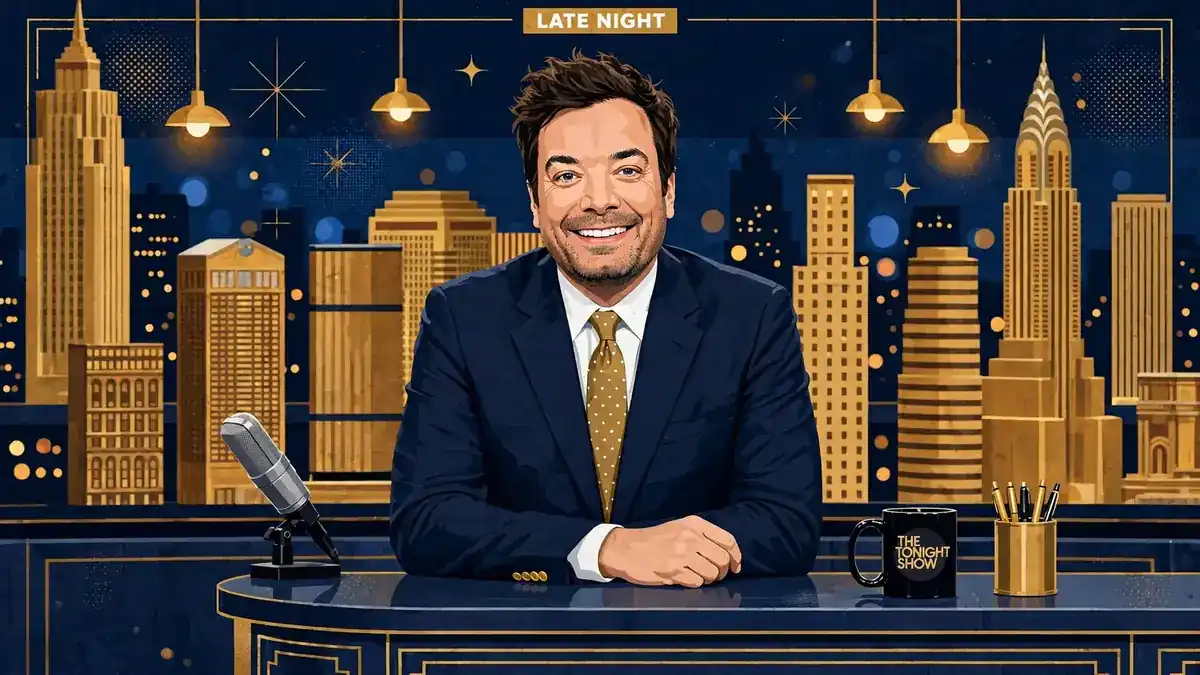
Jimmy Fallon‘s net worth is estimated at $70 million to $90 million as of November 2026. The anchor is the figure most outlets still publish: $70 million, the estimate carried by Celebrity Net Worth and repeated by Parade. The top of the range comes from a newer, fully modeled revision — NetWorthRadar’s October 2026 estimate of $90 million, built by adding two more seasons of his reported $16 million-a-year Tonight Show salary to the old $70 million base. NBC has never confirmed his pay, so no single number is airtight. What is solid: a hosting contract that runs through 2028, a production company behind two NBC primetime shows, a shelf of bestselling children’s books, and a Hamptons farmhouse bought for $5.7 million in 2011 and now valued near $10 million. The fortune is a television fortune, earned one 11:35 p.m. monologue at a time — and it keeps growing while the contract runs.
Jimmy Fallon: Quick Facts
| Estimated net worth | $70 million to $90 million (range: $70 million–$90 million) |
|---|---|
| Profession | Television host, comedian, actor, author, producer |
| Nationality | American |
| Born | September 19, 1974 (age 52) |
| Height | 6 feet (1.83 m) |
| Primary income sources | The Tonight Show salary, Electric Hot Dog producing fees, book royalties, State Farm endorsements |
| Active years | 1998–present |
| Last reviewed | November 2026 |
- Early Life and Background
- Education
- Career Journey
- Rise to Fame
- Main Sources of Income
- Salary and Earnings
- Businesses and Investments
- Brand Deals and Sponsorships
- Houses, Cars and Other Assets
- Awards and Achievements
- Net Worth Growth Over the Years
- Social Media Presence
- Personal Life
- Sources & Reporting
- Frequently Asked Questions
Early Life and Background
James Thomas Fallon was born on September 19, 1974, in Brooklyn, New York, and raised in Saugerties, a small town in the Hudson Valley about two hours north of the city. His father, James W. Fallon, and his mother, Gloria, raised Jimmy and his older sister, Gloria, in a household where comedy was the family language. As a boy, Fallon performed impressions for his relatives — his party trick was doing voices from the cast of Saturday Night Live, the same show he would join as a cast member before he turned 24. He sang in the school choir, played guitar, and treated the family living room as a stage, recording himself doing bits on a tape recorder.
Saugerties shaped the act in a specific way. Fallon grew up far from the New York comedy clubs, so his first audience was his family and his school, and his first material was mimicry: he learned to copy singers, actors, and television hosts because that was the entertainment available to him. The impressions later became the spine of his Saturday Night Live audition and the reason Lorne Michaels hired him. The small-town upbringing also explains the tone of the adult career — Fallon’s comedy has always been warm and fan-like rather than cutting, the style of a kid who loved show business from the outside and never stopped acting like a fan who got let in.
By his late teens, Fallon had set his sights on stand-up. He performed at open mics and school talent shows, and after leaving college he headed for Los Angeles, where the stand-up circuit of the mid-1990s was still the main road into television. He worked the clubs — The Improv and the Laugh Factory among them — building a set built on impressions and musical parody. The road was short: within about two years of arriving in Los Angeles, he was auditioning for Saturday Night Live in New York.
Education
Fallon attended Saugerties High School, graduating in 1992, then enrolled at the College of Saint Rose in Albany, New York, where he majored in communications. Saint Rose was a deliberate choice for a kid who wanted to work in media: a small Catholic college with a broadcasting program, close enough to home that the leap did not feel reckless. He studied there for four years and built the same reputation he had in high school — the funny guy who could do the voices.
He left Saint Rose in 1996, one semester short of his degree, to chase stand-up comedy in Los Angeles. The decision looks reckless on paper and obvious in hindsight: the Saturday Night Live job came two years later, and a degree would have meant nothing to Lorne Michaels. Fallon has told the story himself as a lesson in timing — he left because the clubs were where the work was, and the classroom could wait. The classroom did wait: in May 2009, the College of Saint Rose awarded him his bachelor’s degree in communication, thirteen years after he walked out. He returned to campus to accept it, closing a loop that most dropouts never get to close.
The education detail matters to the money story in one narrow way: Fallon has no business degree, no finance background, and no formal training in the deal-making that now fills his calendar. His fortune was built on a single skill — being funny on camera in a format advertisers pay for — and on a production company run with partners who handle the business side. The degree is a footnote; the timing of the departure is the story.
Career Journey
Fallon’s professional career began in Los Angeles stand-up in 1996 and 1997, where his impression-heavy set got him noticed fast. His break came in 1998, when he auditioned for Saturday Night Live in New York. He was 23. The audition is part of late-night lore now: Fallon did his Adam Sandler, his Jerry Seinfeld, his Chris Rock, and his Robin Williams, and Michaels hired him on the strength of the voices. He joined the cast for the 1998–99 season and stayed six seasons, through 2004.
On SNL, Fallon became the show’s musical-comedy engine. He co-anchored Weekend Update with Tina Fey from 2000 to 2004, a pairing that defined the segment for a generation of viewers, and his celebrity impressions — Sandler, Seinfeld, Mick Jagger, Barry Gibb in the recurring “Barry Gibb Talk Show” sketch with Justin Timberlake — were the ones the show built sketches around. He also wrote and performed original songs, a skill that later became the backbone of his late-night act. The SNL years paid modestly by the standards of what came later — cast salaries in that era ran in the low six figures — and the real payoff was the platform: six years on the most famous comedy stage in America, in front of the producers and executives who would hire him next.
Film came while he was still on SNL and in the years right after. He took a small role in Woody Allen’s Anything Else (2003), then headlined the action-comedy Taxi (2004) opposite Queen Latifah, which grossed roughly $69 million worldwide, per Box Office Mojo. His best-known film role followed a year later: Fever Pitch (2005), the Farrelly brothers’ Boston Red Sox romance, in which he starred opposite Drew Barrymore — the same Drew Barrymore whose production company his future wife co-founded. Fever Pitch took in about $50 million worldwide, per Box Office Mojo, a respectable result that did not turn Fallon into a movie star. He added a supporting turn in Factory Girl (2006) and voice work in animation, then stopped chasing film leads. The calculation was plain: movies paid once, television paid every week.
The television career that followed has three chapters. In March 2009, Fallon took over Late Night from Conan O’Brien, who moved to The Tonight Show. The hire was a gamble — Fallon had never hosted a talk show, and the early reviews were skeptical — and he answered it by rebuilding the format for the internet era: games, musical impressions, celebrity lip-syncs, and segments designed to be clipped and shared. It worked. By 2013, NBC trusted him enough to hand him the franchise itself.
On February 17, 2014, Fallon became the sixth permanent host of The Tonight Show, succeeding Jay Leno and moving the show back to New York, to Studio 6B at 30 Rockefeller Plaza, after more than four decades in California. He has held the chair for more than twelve years. NBC renewed his deal in May 2021 through 2026, then extended it again in June 2024, keeping him as host through 2028. TVLine and Variety both reported the 2024 renewal; neither disclosed what NBC paid for it.
Rise to Fame
Fallon’s rise has two distinct peaks, and the second is the one that made him rich. The first peak was SNL: six seasons, a Weekend Update chair, and a national profile. The second peak was the invention of a new kind of late-night show. When Fallon took Late Night in 2009, the format was dying in slow motion — monologue, desk bit, two guests, musical act, good night. Fallon kept the skeleton and changed the muscles: the show became a nightly variety hour built around games (“Thank You Notes,” “Lip Sync Battle,” “Wheel of Musical Impressions”), musical numbers with guests, and a host who treated celebrities like friends rather than interview subjects.
The formula’s real genius was that it was built for YouTube before YouTube mattered to network television. A three-minute clip of Fallon and a guest doing a lip sync could travel further in a day than the broadcast itself, and NBC’s digital team learned to cut the show into shareable pieces. The numbers now tell the story: the show’s YouTube channel passed 34 million subscribers by November 2026, and NBC says the program has more than 127 million followers and subscribers across platforms. In November 2026, TheWrap reported the show had posted a 34% year-over-year increase in the advertiser-coveted 18-to-49 demographic — the kind of number that keeps a host employed.
The Tonight Show move in 2014 completed the transformation. Fallon inherited the most famous desk in television and filled it with the same game-show energy, and the ratings followed: the show led late night in the 18-to-49 demographic for years after the move, and its digital clips regularly drew audiences larger than the broadcast. The fame that followed was different from SNL fame — it was daily, mainstream, and monetizable in a way sketch comedy never is. A late-night host is on television five nights a week, 172 episodes a season, and every one of those nights is a reminder to advertisers, publishers, and studios that the host exists. That repetition is the asset behind the salary.
There was also a quieter ingredient: Fallon is liked. His interviews rarely make enemies, his games make guests look good, and his audience is the broadest in late night — families as well as comedy nerds. Advertisers pay a premium for that breadth. State Farm has kept him in its commercials for years for exactly this reason: Fallon reads as trustworthy on camera, and trust is the product an insurer is selling.
Main Sources of Income
Fallon’s money comes from four lanes, and the first one is so much larger than the others that the rest are best understood as bonuses on top of a television salary. The table below ranks them by their contribution to his wealth.
| Income source | How it pays | Share of the fortune |
|---|---|---|
| The Tonight Show hosting salary | Reported $16 million to $18 million a year from NBC, under contract through 2028 | The largest share by far — more than a decade of top-tier late-night pay |
| Electric Hot Dog producing fees | Executive producer fees and backend participation on Password, That’s My Jam, and On Brand with Jimmy Fallon | Growing — a second income stream inside the same NBC relationship |
| Book royalties | Children’s picture books, several of them New York Times No. 1 bestsellers, with one title alone selling more than 2 million copies by Fallon’s own account | Steady and real, but small next to the television money |
| Endorsements | Long-running State Farm campaign, plus paid appearances | Modest — Fallon does far fewer brand deals than most celebrities at his level |
| Acting and voice work | Film roles in the 2000s, voice roles in animation, guest appearances | Small — mostly a legacy stream now |
One honest correction belongs here, because most net-worth pages get it wrong: the Tonight Show’s enormous YouTube audience does not pay Fallon directly. The channel’s advertising revenue belongs to NBCUniversal, which owns the show. Fallon’s benefit from those 34 million subscribers is indirect — the digital numbers are his bargaining power in every contract negotiation, and they are the reason NBC extended him through 2028. The audience is the asset; the salary is how he cashes it in.
Salary and Earnings
The salary question is the one every reader asks first, and it is the one with the messiest answer. Celebrity Net Worth puts Fallon’s annual Tonight Show salary at $16 million. Parade, citing Variety, puts it at $18 million a year, and says the figure rose from $16 million after his 2017 renegotiation. Forbes, in its 2025 ranking of the highest-paid television hosts, estimated his pre-tax television earnings at $16 million for the year. NBC has never confirmed any of these numbers, and the network does not disclose host pay. The honest figure is the range: $16 million to $18 million a year.
The range still makes him the highest-paid host in late night. FandomWire’s 2025 comparison of the three big late-night hosts put Fallon at $16 million a year, ahead of his rivals, and LateNighter — the trade publication that tracks the genre — also uses the $16 million figure. At 172 episodes per season, the number Parade cites for 2024, the math works out to roughly $93,000 per episode at the $16 million figure, or about $105,000 per episode at $18 million. That per-episode number is the one that surprises people: Fallon earns in one night what the median American household earns in a year and a half.
The career total is where the arithmetic gets interesting — and where honest reporting has to slow down. Fallon has hosted The Tonight Show since February 2014, more than twelve seasons. His pay was lower in the early years and rose with each renewal. At the current reported rate, a dozen seasons works out to roughly $190 million in gross pay before tax, agents, and managers take their share, but that is arithmetic on a reported figure, not a reported total. The real number is lower in the early years and higher now. What the arithmetic does prove is the shape of the fortune: this is a salary fortune, built season by season, and it is the reason the $70 million net-worth estimate holds up. A host who grosses something on the order of $15 million-plus a year for a dozen years, pays tax, buys property, and lives well can plausibly hold $70 million to $90 million in net assets.
There is also the Late Night chapter. Fallon’s pay for Late Night with Jimmy Fallon (2009–2014) was far below his Tonight Show money — entertainment outlets reported it at a fraction of the later figure — and his SNL salary in the late 1990s and early 2000s was smaller still, in the low six figures. The pay curve of his career is a staircase: modest money at SNL, real money at Late Night, franchise money at The Tonight Show. The June 2024 extension through 2028 means the staircase has at least two more steps.
One more earnings line deserves a mention because it separates Fallon’s case from the usual celebrity math. Forbes’ $16 million figure is labeled pre-tax television earnings — money earned, not money kept. After federal and New York taxes, agent commissions (typically 10%), and management fees, a $16 million salary leaves roughly half in hand. That is why the modeled $90 million estimate from NetWorthRadar, which builds its number by adding only what Fallon most likely kept from two further seasons — about $20 million after costs, on its own math — is the most careful of the recent revisions. The $70 million anchor and the $90 million top are not rivals; they are the same fortune seen through different assumptions about tax, spending, and time.
Businesses and Investments
Fallon’s business life runs through one company: Electric Hot Dog, the production company he founded and runs with producing partners. The name is a joke — it comes from a bit on the show — and the company is serious. Electric Hot Dog produces the NBC primetime game shows that have become Fallon’s second act inside the network: Password, the revival of the classic word game, which Fallon hosts and executive-produces, and That’s My Jam, the music-game show built from his most popular Tonight Show segments. In September 2025, NBC added a third: On Brand with Jimmy Fallon, a new show that premiered on September 30, 2025, with Fallon as host and executive producer.
The producing fees are the point. A host is paid to show up; an executive producer is paid to own a piece of the show. Fallon’s producing income comes on top of his hosting salary, and it comes with backend participation — a share of the money the shows earn from licensing, syndication, and international formats. NBC does not disclose what those fees are worth, and no outlet has published a reliable figure. What can be said with confidence is that three primetime shows under one production banner, all inside the same network that already pays Fallon $16 million to $18 million a year to host, is the structure of a man who has turned a job into a business. The company also gives him weight at the table: when his hosting contract comes up for renewal, NBC is negotiating with the producer of three of its shows — a very different conversation than negotiating with a host alone.
Books are the second business, and the numbers here are unusually solid for celebrity publishing. Fallon has published a string of children’s picture books, and the first two — Your Baby’s First Word Will Be Dada (2015) and Everything Is Mama (2017) — both reached No. 1 on the New York Times bestseller list. Fallon told North Country Public Radio in 2019 that Dada alone had sold more than 2 million copies. Publishers Weekly’s sales data backs up the scale: the trade publication recorded 792,510 copies of one title across five reported years. No public royalty rate exists, so nobody can say what Fallon personally kept from those sales — children’s picture books typically pay the author a royalty in the single-digit to low-double-digit percent of the cover price — and this profile does not guess. What the sales do prove is that the books are a real business, not a vanity project: millions of copies, two No. 1 bestsellers, and a backlist that keeps selling to new parents every year. His later titles — This Is Baby (2019), Nana Loves You More (2021), and Con Pollo (2022), written with Jennifer Lopez — extended the shelf, and a 2020 collaboration with pacifier company WubbaNub turned his book characters into a licensed product.
His earlier books show the same instinct in a different key. I Hate This Place: The Pessimist’s Guide to Life (1999), written with his sister Gloria, came out the year after he joined SNL; Thank You Notes (2011), a spin-off from his Late Night segment, became a New York Times bestseller. Fallon has been monetizing his own jokes in print for his entire career.
Investments are the thinnest part of the record, and honesty requires saying so. Fallon has not spoken publicly about a stock portfolio, a venture fund, or startup stakes, and no filing ties him to one. The one investment the public record does show is the one that went wrong: the Bored Ape Yacht Club NFT. On a November 2021 episode of The Tonight Show, Fallon announced on air that he had bought his first Bored Ape NFT through the crypto platform MoonPay, calling it “like the PayPal of crypto.” The ape was reported to have cost about $216,000. In December 2022, Fallon was named as a defendant — along with Electric Hot Dog and Universal Television — in a federal class action, Real v. Yuga Labs, alleging that celebrities promoted the NFTs without disclosing that they were paid to do so. The complaint said the on-air segment was a paid promotion dressed up as a spontaneous moment. Yuga Labs has denied the claims, calling them without merit. A court order in September 2025 addressed the case, and the litigation has continued to move through the courts. Fallon has not commented publicly on the suit, and this profile does not treat an allegation as a finding. The episode matters to the money story for a narrower reason: it is the only public record of Fallon putting his own capital into a speculative asset, and it is a reminder that the fortune’s foundation — a network salary — is far sturdier than the side bets.
Brand Deals and Sponsorships
Fallon does fewer brand deals than almost any celebrity at his level of fame, and the one he does is the one that has lasted. He has appeared in State Farm commercials for years, playing the same genial, slightly goofy neighbor the insurer wants its customers to picture when they think about who answers the phone. The campaign works because Fallon’s public image is the product: warm, trustworthy, and funny without an edge. State Farm does not disclose what it pays its celebrity spokespeople, and this profile does not guess, but a multi-year national campaign for one of America’s largest insurers is a seven-figure relationship by any reasonable reading of the market.
Beyond State Farm, Fallon’s endorsement record is thin by design. He has done paid appearances and voice work, and his books have generated licensed products, but he has not built the portfolio of fashion, watch, car, and liquor deals that fills most celebrity net-worth pages. The reason is structural: a late-night host who mocks products on air every night cannot credibly sell them by day, and a host whose show is itself a nightly advertisement for NBC has less need of outside money. The State Farm deal is the exception that proves the rule — one brand, one image, many years.
The Bored Ape episode sits in this section as a caution, not a deal. The class action alleges that Fallon’s on-air NFT segment was a paid promotion for MoonPay and Yuga Labs, arranged through talent manager Guy Oseary, and that neither Fallon nor the companies disclosed the payment. If the allegation is true, it was an endorsement deal that was never labeled as one. If it is false, it was a host talking about a purchase he genuinely made. Either way, it is the only endorsement controversy of Fallon’s career, and it has not produced a second one: since 2022, his commercial work has stayed with State Farm.
Houses, Cars and Other Assets
Property is the one part of Fallon’s wealth that can be checked against public records, and the records are unusually detailed. He owns two homes that the press has tracked for years, and he sold a third in a transaction that produced one of the more interesting deed-level footnotes in celebrity real estate.
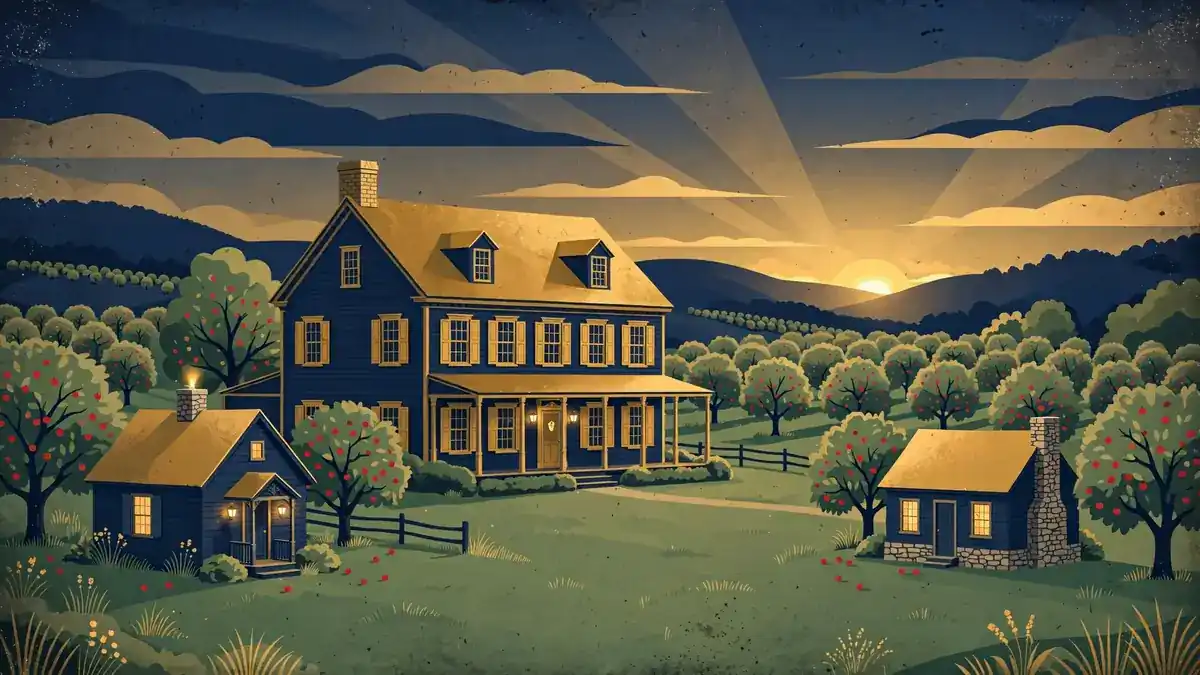
The Hamptons home is the keeper. In 2011, Fallon and his wife, Nancy Juvonen, bought a 19th-century farmhouse in Sagaponack, New York, for $5.7 million. The property sits on 2.2 acres and includes a main house of about 3,500 square feet with six bedrooms and five and a half bathrooms, two guest cottages, two barns, and an apple orchard. Collider, which profiled the estate in 2025, puts its current value at about $10 million — a gain of roughly $4.3 million on paper over fifteen years, before the cost of the renovations the couple has made. The house is famously playful inside: an indoor slide, retro arcade games, and rooms designed around the family’s sense of humor. It is the Fallons’ primary residence and the place where their two daughters grew up.
The New York City apartment is the one they sold. Fallon bought his first home in 2002: a one-bedroom apartment in Manhattan’s Gramercy Park for $850,000. Over the next decade, he bought four more units in the same building and, with Juvonen’s help, combined all five into a roughly 4,950-square-foot triplex. The family listed it at $15 million and sold it in 2022 to model and actress Cara Delevingne for a reported $10.8 million, according to Collider — a sale price well below the asking price, and a reminder that even celebrity sellers take a haircut. The deed record adds a wrinkle most reports miss: two same-day deeds for the sale totaled $11.75 million, about $950,000 above the price repeated in most coverage, a gap that shows why a single headline number is never the whole story of a property deal.
Cars are the blank spot. Fallon has no public record of an exotic car collection, no garage features in the automotive press, and no known fleet of supercars. He has been photographed in ordinary vehicles and has joked on air about his driving, but the car collection that fills so many celebrity net-worth pages simply does not exist here in any verifiable form. This profile does not invent one. What can be said is that the absence is consistent with the rest of the record: Fallon’s visible spending goes to property and family, not to depreciating machines.
Put the property together and the picture is conservative for a man of his income. One $10 million home, one $10.8 million sale, and no known car collection: the real estate supports the $70 million to $90 million range without straining it, and it leaves plenty of room for the cash, investments, and residuals that do not show up in any public record.
Awards and Achievements
Fallon’s trophy shelf is smaller than his fame, and the reason is the genre: late-night hosts are rarely showered with awards, because the work is daily and the industry’s prizes are built for weekly shows. What he has won, he won for the two skills that define him — music and comedy.
The headline award is a Grammy. His 2012 comedy album Blow Your Pants Off won the Grammy Award for Best Comedy Album in 2013, a prize that recognized the musical parodies and original songs that had been his signature since SNL. He had been nominated before, for his first album The Bathroom Wall (2002), and the win put him in the small group of comedians who hold both a Grammy and a Primetime Emmy.
The Emmy came for guest-hosting the show that made him. Fallon won the Primetime Emmy Award for Outstanding Guest Actor in a Comedy Series for hosting Saturday Night Live in 2012, and he has collected further Emmy nominations across his career, including for his Tonight Show work. The SNL 40th Anniversary Special, in which he performed, won the Emmy for Outstanding Variety Special in 2015. His books have their own honors: Your Baby’s First Word Will Be Dada and Everything Is Mama both topped the New York Times bestseller list, and Thank You Notes did the same.
The digital awards are the ones that matter most to his employer. The Shorty Awards have repeatedly named The Tonight Show the most-followed, most-viewed, and most-engaging talk show on Instagram and TikTok, and NBC’s own releases call it the No. 1 late-night program on digital. Those are not trophies for a shelf; they are the metrics behind the contract extension through 2028.
Net Worth Growth Over the Years
Year-by-year net-worth figures for Fallon are not published by any serious outlet, and this profile does not invent them. What the public record does support is a timeline of the financial milestones that built the fortune — each one tied to a reported figure, not a guess.
| Year | Milestone | Reported money figure |
|---|---|---|
| 1998 | Joins the cast of Saturday Night Live | Cast pay in the low six figures — the platform, not the paycheck |
| 2002 | Buys first home, a Gramercy Park one-bedroom | $850,000 purchase price |
| 2004 | Leaves SNL; stars in Taxi and Fever Pitch | Roughly $69 million and $50 million in worldwide box office, per Box Office Mojo |
| 2009 | Takes over Late Night; college awards his degree | Late-night pay far below his later Tonight Show money |
| 2011 | Buys the Sagaponack farmhouse; publishes Thank You Notes | $5.7 million purchase; New York Times bestseller |
| 2014 | Becomes host of The Tonight Show | Salary rises into eight figures a year |
| 2015 | Your Baby’s First Word Will Be Dada hits No. 1 | More than 2 million copies sold, per Fallon |
| 2017 | Salary renegotiation reported | Pay reported rising from $16 million toward $18 million a year |
| 2022 | Sells Gramercy Park triplex; hosts and executive-produces Password | $10.8 million reported sale price; producing fees begin |
| 2024 | NBC extends his contract through 2028 | Deal value undisclosed; the $70 million estimate is already circulating |
| 2026 | On Brand with Jimmy Fallon premieres; NetWorthRadar models $90 million | Estimate range now $70 million to $90 million |
The shape of the table is the shape of the career: a long flat stretch in the 2000s, a steep climb after 2014, and a plateau in the 2020s as the salary, the producing fees, and the property appreciation compound. The 2024 contract extension through 2028 is the most important row, because it means the climb has not ended. Two more seasons at the reported rate add roughly $32 million to $36 million in gross earnings before tax — the raw material for the next revision of the estimate.
For scale, the late-night peer group puts Fallon’s number in context. Conan O’Brien, who held the Late Night chair before Fallon and built the Team Coco production company, is estimated at $200 million by our sister site GuideNetWorth — a figure swollen by the reported $150 million sale of Team Coco to SiriusXM in 2022. Trevor Noah, who left The Daily Show for global touring and Netflix specials, is put at roughly $180 million by entertainment outlets. Fallon’s $70 million to $90 million is smaller than both, and the reason is the same in each case: O’Brien and Noah sold companies or toured the world, while Fallon stayed in one chair, on one network, collecting one of the largest salaries in television. Different strategies, different fortunes — and Fallon’s is the steadiest of the three.
Social Media Presence
Fallon’s social media presence is really the show’s presence, and the show’s numbers are the largest in late night. The Tonight Show YouTube channel, @fallontonight, had 34.2 million subscribers and 20.25 billion total views as of November 8, 2026, according to vidIQ’s public YouTube statistics — up from 32.4 million subscribers in April 2025, per Wikipedia’s channel data. NBC says the program has more than 127 million followers and subscribers across all platforms, and the Shorty Awards cite more than 17.2 million Instagram followers and more than 22.5 million TikTok followers for the show, calling it the most-followed, most-viewed, and most-engaging talk show on both platforms.
Fallon’s personal accounts are large but smaller than the show’s. Entertainment trackers put his personal Instagram following above 27 million as of September 2025, and his X account was reported at about 50 million followers in 2023, a figure that has not been refreshed in public reporting since. The gap between the personal and the show accounts is itself the story: Fallon’s audience follows the desk as much as the man, and the desk belongs to NBC. That is why the digital numbers show up in this article as bargaining power rather than income — they are the reason the network keeps paying, not a paycheck in themselves.
The content strategy behind the numbers has not changed since 2009: short, shareable, musical, and kind. Lip-sync battles, classroom instruments, thank-you notes, and games with guests are built to travel, and they do — individual clips routinely draw tens of millions of views, far more than the broadcast audience on any given night. In November 2026, TheWrap reported that the show’s 18-to-49 audience was up 34% year over year, a sign that the digital-first formula is still finding new viewers twelve years into the Tonight Show run.
Personal Life
Fallon married film producer Nancy Juvonen on December 22, 2007. Juvonen is a significant figure in her own right: she co-founded Flower Films with Drew Barrymore — the same Barrymore who starred opposite Fallon in Fever Pitch two years before the wedding — and has produced films including Charlie’s Angels and 50 First Dates. The couple’s professional lives have overlapped ever since, with Juvonen’s producing career running alongside Fallon’s hosting career, and their combined household is one of the more durable partnerships in entertainment.
They have two daughters: Winnie Rose, born in July 2013, and Frances Cole, born in December 2014. Both were born via surrogate, a fact Fallon and Juvonen have discussed publicly — Fallon has spoken about the couple’s five-year struggle with fertility before the girls were born, and about how the experience shaped his children’s books. Your Baby’s First Word Will Be Dada was written for Winnie; Everything Is Mama followed for Frances. The books are, in that sense, the most personal part of the fortune: products of the family, sold to other families.
Born September 19, 1974, Fallon turned 52 in September 2026. For the full picture of Jimmy Fallon’s age and birthday, including how old he was at each career milestone, our sister site GuideNetWorth has the complete breakdown. Fallon stands 6 feet tall, and Jimmy Fallon’s height in full detail, with comparisons to his fellow late-night hosts, is covered by CelebAmerica. The family lives primarily at the Sagaponack farmhouse, and Fallon has spoken often about the ordinary shape of his life outside the studio: school runs, guitar practice with his daughters, and a home full of arcade games.
He keeps his private life private by late-night standards. There are no tabloid feuds, no public breakups, no reality-show appearances — just a marriage that has lasted nearly two decades and a family that shows up in his work as material rather than as content. That stability is part of the brand State Farm buys and part of the reason NBC trusts him with the franchise.
Sources & Reporting
Celebrity Net Worth — the $70 million net-worth estimate and the $16 million annual salary figure, plus its history of late-night host salaries and contracts.
Parade — the $70 million 2026 estimate and the $18 million salary figure attributed to Variety, plus the 172-episodes-per-season count for 2024.
Forbes — the 2025 highest-paid television hosts ranking, estimating $16 million in pre-tax television earnings for Fallon.
NetWorthRadar — the October 2026 modeled estimate of $90 million, with a likely range of $74.5 million to $108 million and a disclosed method.
Variety — reporting on the June 2024 contract extension through 2028 and the $18 million salary figure.
TVLine — reporting on the June 2024 contract extension through 2028.
LateNighter — the $16 million per-season salary estimate and late-night ratings coverage.
Publishers Weekly — children’s book sales data, including 792,510 copies of one Fallon title across five reported years.
North Country Public Radio — Fallon’s 2019 interview stating Your Baby’s First Word Will Be Dada sold more than 2 million copies, and the No. 1 New York Times bestseller history of his first two children’s books.
vidIQ — public YouTube statistics for the Tonight Show channel: 34.2 million subscribers and 20.25 billion views as of November 8, 2026.
TheWrap — the November 2026 report of a 34% year-over-year increase in the show’s 18-to-49 audience.
Collider — the Sagaponack farmhouse profile (2011 purchase at $5.7 million, current value near $10 million) and the Gramercy Park triplex sale to Cara Delevingne for $10.8 million in 2022.
CourtListener — the federal court record for Real v. Yuga Labs, the class action naming Fallon, Electric Hot Dog, and Universal Television.
Kelley Drye — analysis of the Bored Ape NFT lawsuit, including the November 2021 Tonight Show segment and the allegations in the complaint.
NBC — show releases on the Tonight Show’s 127 million-plus followers and subscribers and its status as the longest-running talk show on television. Reporting window: October–November 2026, with historical career facts verified against coverage from 1998–2026.
Frequently Asked Questions
What is Jimmy Fallon’s net worth in 2026?
Jimmy Fallon’s net worth is estimated at $70 million to $90 million as of November 2026. Celebrity Net Worth and Parade both publish the $70 million figure, which is the most-cited estimate. NetWorthRadar modeled a higher $90 million in October 2026 by adding two more seasons of his reported salary to the old base. NBC has never confirmed his pay, so the range — not a single number — is the honest answer.
How much does Jimmy Fallon make a year?
Fallon reportedly earns $16 million to $18 million a year hosting The Tonight Show. Celebrity Net Worth and LateNighter use the $16 million figure, while Parade, citing Variety, puts it at $18 million. Forbes estimated his pre-tax television earnings at $16 million in 2025. The network has never confirmed the number.
How much does Jimmy Fallon make per episode?
At 172 episodes per season — the count Parade cites for 2024 — a $16 million salary works out to roughly $93,000 per episode, and an $18 million salary to about $105,000 per episode. That is the hosting fee alone; his executive producer fees for Password and That’s My Jam are separate and undisclosed.
How long is Jimmy Fallon’s Tonight Show contract?
NBC extended Fallon’s contract in June 2024 to keep him hosting The Tonight Show through 2028. TVLine and Variety both reported the renewal, but neither disclosed what the network paid. He took over the show on February 17, 2014, so the extension carries him past fourteen years in the chair.
Who is Jimmy Fallon’s wife?
Jimmy Fallon’s wife is film producer Nancy Juvonen, whom he married on December 22, 2007. Juvonen co-founded Flower Films with Drew Barrymore and has produced films including Charlie’s Angels and 50 First Dates. The couple have two daughters, Winnie Rose (born 2013) and Frances Cole (born 2014), both born via surrogate.
How old is Jimmy Fallon?
Jimmy Fallon is 52 years old as of November 2026. He was born on September 19, 1974, in Brooklyn, New York. He joined Saturday Night Live at 23, took over Late Night at 34, and became host of The Tonight Show at 39.
How tall is Jimmy Fallon?
Jimmy Fallon is 6 feet tall (1.83 m). He is taller than most of his fellow late-night hosts, though he is rarely the tallest person on his own show — many of his celebrity guests, including his frequent musical collaborators, stand taller than he does.
What books has Jimmy Fallon written?
Fallon has written a string of books, most of them children’s picture books. The best known are Your Baby’s First Word Will Be Dada (2015) and Everything Is Mama (2017), both No. 1 New York Times bestsellers — Fallon says Dada alone sold more than 2 million copies. His other titles include Thank You Notes (2011), This Is Baby (2019), Nana Loves You More (2021), and Con Pollo (2022), written with Jennifer Lopez.
Final Thoughts
Jimmy Fallon’s fortune is the simplest kind to explain and the hardest kind to copy: one job, held for a very long time, at the top of its market. The $70 million anchor comes from Celebrity Net Worth, the $90 million top from a modeled revision that counts two more seasons of a reported $16 million salary, and the truth sits somewhere between them — because NBC has never confirmed the pay, and no outsider can audit the assets. What nobody disputes is the engine: a contract through 2028, a production company with three primetime shows, a backlist of bestselling books, and a Hamptons farmhouse that has nearly doubled in value since 2011.
The comparison with his peers sharpens the picture. Conan O’Brien is worth more because he sold a company; Trevor Noah is worth more because he toured the world. Fallon stayed in one chair and collected one of the largest salaries in television, season after season, and the steadiness of that choice is its own argument. The Bored Ape lawsuit is a reminder that the side bets can go wrong, and the State Farm campaign is a reminder that the main bet — being the most likable man on television at 11:35 p.m. — keeps paying. As long as the contract runs, the estimate will keep creeping upward, and the next revision will probably look a lot like this one: a little higher, still a range, and still anchored in a salary the network will not confirm.
Published on November 9, 2026. Last reviewed November 2026. Found an error? See our corrections policy.