
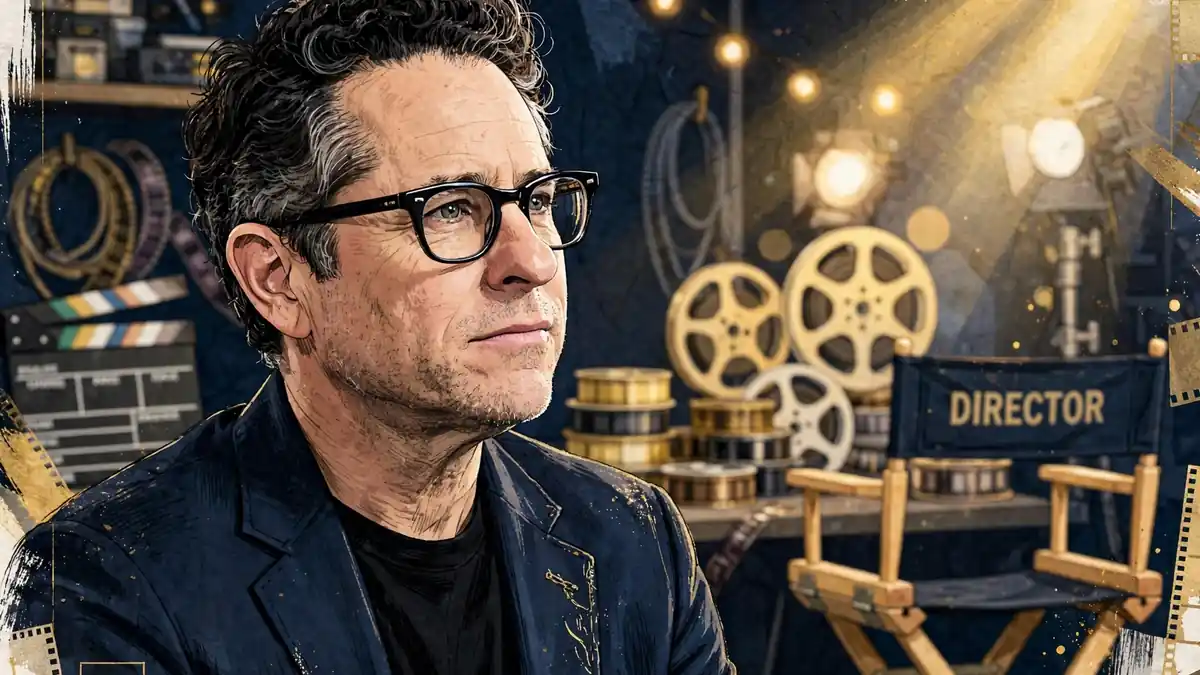
J.J. Abrams‘s net worth is estimated at $250 million to $300 million as of November 2026. The filmmaker behind two Star Wars films that grossed more than $3 billion between them built the fortune the slow way: three decades of writing, directing and producing, a production company he owns with his wife, and a 2019 studio deal worth $250 million — an offer he took after turning down more than $500 million from Apple. In April 2026 he began shrinking that empire, closing Bad Robot’s Los Angeles office and moving the company to New York to get back behind the camera.
J.J. Abrams: Quick Facts
| Estimated net worth | $300 million (range: $250 million to $300 million) |
|---|---|
| Profession | Film and television director, producer, screenwriter |
| Nationality | American |
| Born | June 27, 1966 (age 60) |
| Height | 5 feet 7 inches (1.70 m) |
| Primary income sources | Directing fees, producing fees and backend participation, Bad Robot Productions, studio overall deals, real estate |
| Active years | 1982–present |
| Last reviewed | November 2026 |
- Early Life and Background
- Education
- Career Journey
- Rise to Fame
- Main Sources of Income
- Salary and Earnings
- Businesses and Investments
- Brand Deals and Sponsorships
- Houses, Cars and Other Assets
- Awards and Achievements
- Net Worth Growth Over the Years
- Social Media Presence
- Personal Life
- Sources & Reporting
- Frequently Asked Questions
Early Life and Background
Jeffrey Jacob Abrams was born on June 27, 1966, in New York City, and grew up in Los Angeles in a household where television was the family trade. His father, Gerald W. Abrams, was a television producer. His mother, Carol Ann Abrams, was a Peabody Award-winning television executive producer, author and law academic who died in 2012. His sister, Tracy Rosen, went into screenwriting. Abrams has said the house ran on story meetings and production talk, and he spent much of his childhood making amateur films with friends, obsessed with movies, special effects and the mechanics of how a scene gets built.
That early start was literal. At 16, Abrams received his first professional film credit, composing the music for the low-budget 1982 horror film Nightbeast. It was a small job on a film almost nobody saw, and it still tells you something useful about how his career would work: he entered the business through a side door, doing whatever job was open, and kept collecting skills — writing, composing, producing — until the jobs got bigger. The composer credit also explains a thread that runs through his later television work. He wrote the theme music for Felicity himself, and music has stayed a hands-on part of his productions rather than something handed off and forgotten.
He attended Palisades High School in Los Angeles, in the same Pacific Palisades neighbourhood where he would later buy and sell some of his most valuable property. The through-line from that childhood to the fortune is unusually straight. Abrams did not arrive in Hollywood from outside it. He grew up inside the production system, learned its economics young, and by his early thirties was negotiating the kind of backend participation — a share of a project’s revenues after costs — that turns a good salary into lasting wealth.
Education
Abrams enrolled at Sarah Lawrence College in New York, where he studied film and graduated with a bachelor’s degree in 1988. The college years produced his first real payday and his first studio relationship. While still a student, he collaborated with fellow student Jill Mazursky on a screenplay that Touchstone Pictures bought. The script became the 1990 comedy Taking Care of Business, starring James Belushi and Charles Grodin, and it gave Abrams his first major professional screenwriting credit before he had even settled into a career.
Sarah Lawrence mattered in a second way. It put Abrams in New York, away from the Los Angeles production world he had grown up in, and the screenwriting discipline he picked up there — structure, character, dialogue — became the base for everything that followed. His television shows would later be famous for mystery-box plotting and long story arcs, and his films for set pieces built around character decisions. Both habits trace back to a writer’s education rather than a director’s one. Abrams came to directing late, at 40, after fifteen years of writing and producing. The writing is what got him hired; the directing is what made him rich.
Career Journey
Abrams spent the 1990s as a working screenwriter, and the credits stack up fast. After Taking Care of Business he wrote the 1991 drama Regarding Henry, starring Harrison Ford, and the 1992 romantic fantasy Forever Young, starring Mel Gibson. He co-wrote the 1997 comedy Gone Fishin’ with Joe Pesci and Danny Glover. Then came the script that changed his earning power: Michael Bay’s disaster blockbuster Armageddon in 1998, starring Bruce Willis and Ben Affleck. The film grossed more than $550 million worldwide and finished as the highest-grossing movie of its year. A writer with a $550 million hit on his résumé does not stay a hired gun for long, and Abrams did not. He co-wrote the 2001 thriller Joy Ride, starring Paul Walker and Steve Zahn, and by then he was already moving into television production, where his biggest early money would be made.
Television gave Abrams something film writing never had: ownership. A screenwriter sells a script and moves on. A television creator keeps a piece of the show — producing fees, a share of syndication and DVD revenue, and, in the streaming era, library value that keeps paying. His first television breakthrough came in 1998, when he co-created Felicity with Matt Reeves. The WB drama, starring Keri Russell as a college student in New York, ran for four seasons. Abrams served as executive producer and writer, and composed the show’s theme music himself.
In 2001 he created the ABC spy drama Alias, starring Jennifer Garner as CIA agent Sydney Bristow. The series mixed espionage with science fiction and family melodrama, ran for five seasons, and earned Abrams his first Emmy nomination for writing in 2002. His next creation, Lost, premiered on ABC in September 2004. Developed with Damon Lindelof and Jeffrey Lieber, the mystery drama followed plane-crash survivors stranded on a strange island, became an international phenomenon, ran for six seasons, and redrew the rules for serialized network television. In 2005 Abrams won two Primetime Emmy Awards for it: Outstanding Directing for a Drama Series and Outstanding Drama Series as an executive producer. The Television Academy lists 10 Emmy nominations and 2 wins across his career. He went on to co-create the science-fiction series Fringe, which premiered in 2008 and ran for five seasons, built around parallel universes and long-running mysteries.
Directing came last and paid best. Abrams made his feature directing debut with Mission: Impossible III in 2006, starring Tom Cruise, which grossed roughly $398 million worldwide. He produced the found-footage monster film Cloverfield in 2008, directed by Matt Reeves on a modest budget; it grossed about $172 million worldwide and grew into a franchise with 10 Cloverfield Lane and The Cloverfield Paradox. His 2009 Star Trek reboot, with Chris Pine as James T. Kirk and Zachary Quinto as Spock, revived a dormant franchise and grossed more than $385 million worldwide. Super 8 followed in 2011, an original science-fiction adventure made with Steven Spielberg that grossed more than $260 million worldwide. Star Trek Into Darkness in 2013 grossed about $467 million. He stayed involved as a producer on Star Trek Beyond in 2016 and on several Mission: Impossible sequels, including Ghost Protocol, Rogue Nation, Fallout and Dead Reckoning.
Then came Star Wars. Disney and Lucasfilm announced Abrams as director and producer of Star Wars: The Force Awakens in January 2013. He directed, co-wrote and produced the film, which opened in December 2015 and grossed more than $2.06 billion worldwide, including more than $936 million in the United States and Canada — a domestic record at the time. He executive-produced The Last Jedi in 2017, then returned to direct and co-write Star Wars: The Rise of Skywalker in 2019 after Colin Trevorrow left the project. That film earned about $1.07 billion worldwide. His two Star Wars films alone generated more than $3.1 billion in theatrical revenue, and his films as a director have grossed more than $4 billion worldwide in total, placing him among the ten highest-grossing directors of all time before adjusting for inflation, according to Wikipedia’s box-office ranking.
Rise to Fame
Abrams became famous twice, and the two fame curves explain the two halves of his fortune. The first came with Lost. In 2004 and 2005 the show was the most talked-about drama on American television, a weekly puzzle that turned its creators into celebrities and its production company into a brand. The Emmys in 2005 — directing and best drama — made Abrams a name beyond the industry. The second came with The Force Awakens in 2015. Directing the return of Star Wars put him in charge of the biggest film of the decade, and the $2.06 billion gross made him one of only a handful of directors ever to helm a $2 billion movie. The first fame made him powerful in television. The second made him bankable in film at a scale almost nobody else could match.
The money followed the same two-step pattern. Television gave him backend participation and a production company with a library. Film gave him eight-figure directing fees and franchise-level producing income. The 2006 contracts, signed between Mission: Impossible III and the Star Trek reboot, show the moment the two halves joined. The Los Angeles Times reported in July 2006 that Abrams had negotiated simultaneous agreements with Warner Bros. Television and Paramount Pictures worth as much as $68 million combined. The television deal guaranteed him at least $4 million a year for six years, plus about $2 million a year in overhead for Bad Robot, and at least 35 percent of the backend revenue from his television projects — syndication, DVD sales and digital distribution. The Paramount deal guaranteed about $2 million a year for five years, another $2 million a year in production overhead, a $500,000 annual discretionary fund, and a reported $5 million fee for his first directing project, plus profit participation. Other sources put his annual personal compensation closer to $6 million. That 35 percent backend figure is the number that matters most. On a hit show, backend is where a producer’s fortune is actually made, and Lost was a hit show.
One detail worth flagging, because most profiles get it wrong: the founding date of Bad Robot. Trade reporting in Variety and The Hollywood Reporter dates the company to 1999, when Abrams set it up with producer Bryan Burk. Several net-worth profiles, including Celebrity Net Worth, date it to 2001. The 1999 date is the one the trades use, and it fits the record — Bad Robot was already the home of Felicity and Alias by the early 2000s. The confusion is a small thing, and it is a useful warning about how much of the Abrams numbers online are copied from one profile to the next without checking.
Main Sources of Income
Abrams earns from five streams, and the balance between them has shifted over his career. Early on, screenwriting fees and television producing fees did the work. In the 2010s, directing fees and franchise backend took over. Today, the studio deals and the Bad Robot library matter most, because they pay whether or not he is on a set.
Directing fees. A director of Abrams’ standing commands a multi-million-dollar fee per film, plus a share of the gross. Contemporary press reports placed his fee for directing The Force Awakens at roughly $5 million, with an additional 2 percent participation in the film’s gross revenue. Disney never publicly confirmed those terms, so treat the participation figure as reported rather than settled. Even the base fee alone puts a single Abrams film in the top tier of directing pay, and the participation is where the real money sits when a film grosses $2 billion.
Producing fees and backend. Through Bad Robot, Abrams takes producing fees on every project the company makes, plus profit participation. The 2006 television deal’s 35 percent backend share shows how rich that stream can be on a long-running hit. Lost ran six seasons and sold into syndication and home video around the world. Westworld, which premiered on HBO in 2016 with Abrams as executive producer alongside creators Jonathan Nolan and Lisa Joy, added another premium-cable hit to the library. Bad Robot’s television slate also includes Person of Interest, Revolution, Castle Rock and Lovecraft Country.
Studio overall deals. The largest single cheques in Abrams’ career came not from individual films but from the overall agreements that paid Bad Robot to develop projects for one studio. The 2019 WarnerMedia deal, worth about $250 million over five years, is the headline example, and the 2006 Warner Bros. Television and Paramount deals, worth up to $68 million combined, are the earlier one. These deals pay a company, not a person, and much of the money funds staff, offices and development. The personal wealth comes from the salary, fees and profit share Abrams draws as owner, and from the value of the company itself.
Writing and composing. Abrams still earns writing fees and residuals from scripts and television episodes, plus music royalties from themes he composed, including the Felicity theme. These are smaller streams than directing or producing, and they rarely appear in net-worth estimates. They matter because they show how many revenue lines one career can carry: a single episode of Lost could pay him as writer, director, executive producer and composer at once.
Real estate. Property has been a genuine second business for Abrams and his wife. Their Pacific Palisades purchases and sales, covered in detail below, produced a reported gain of about $5.93 million before renovation costs, taxes and selling expenses on a single house — the Riviera estate bought for $14.47 million in 2014 and sold for about $20.4 million in 2022. That is not a side hobby. It is a meaningful slice of the fortune, and it is one of the few parts of his wealth with a public paper trail.

Salary and Earnings
No studio has ever published Abrams’ salary, so the honest way to describe his earnings is project by project, with the source named each time. The figures below are the reported ones, and the gaps are labelled as gaps.
The earliest hard number comes from the Los Angeles Times in 2006: the Warner Bros. Television deal guaranteed at least $4 million a year for six years, and the Paramount film deal about $2 million a year for five years. Add the overhead and discretionary funds, and the two deals together were worth as much as $68 million, with his personal compensation reported at $4 million to $6 million a year depending on the source. That was 2006 money, before Star Trek, before Star Wars, and before the streaming wars rewrote what studios would pay a hitmaker.
The Star Wars paydays are the most asked-about numbers in his career, and the least confirmed. Press reports put his Force Awakens directing fee at about $5 million plus 2 percent of the gross. If that participation applied to the full $2.06 billion theatrical gross, the arithmetic would be enormous — and that is exactly why the number needs care. Gross participation in Hollywood is calculated on defined receipts after distribution fees and costs, never on the raw box-office total, and Disney has never confirmed the terms. The safe statement is the reported one: a fee in the region of $5 million, plus a gross participation that press reports put at 2 percent. What is certain is that the two Star Wars films grossed more than $3.1 billion between them, and that the director of the highest-grossing domestic film in history at the time did not walk away with a flat fee alone.
The 2019 WarnerMedia deal is the biggest earnings event of his career, and it is also the most misunderstood. Early reports suggested it could be worth as much as $500 million. Later industry reporting, including Celebrity Net Worth’s reconstruction, established the guaranteed value at about $250 million over five years. The deal covered film, television, video games and digital entertainment across Warner Bros. Pictures, Warner Bros. Television and HBO. The $250 million was guaranteed compensation plus production commitments. Extra money was available if Abrams launched a major new theatrical franchise — industry reports suggested the total could have passed $1 billion in that case. He never hit those milestones, so the extra money never arrived. In August 2024, Puck reported that Warner Bros. had spent about $250 million on the five-year deal without getting the commercially successful programming it expected. That figure is what the studio spent, not what Abrams personally kept, and the distinction matters: much of it funded Bad Robot’s staff, offices and development slate.
The bidding war behind the deal is one of the best-documented stories in modern Hollywood. Apple, Netflix, Amazon and NBCUniversal all competed for Bad Robot. According to The Hollywood Reporter, Apple offered more than $500 million for a multi-year agreement that would have required Bad Robot to produce exclusively for Apple TV+. Abrams and McGrath turned it down. They wanted the freedom to work with multiple distributors, they valued Warner Bros.’ theatrical distribution business, and they wanted access to its library of intellectual property. The deal also let them keep valuable profit participation in their earlier work and keep selling some projects to outside buyers. Turning down $500 million to take $250 million looks strange until you see what they kept: freedom, a theatrical pipeline, and their back catalogue. It is the single most revealing financial decision of Abrams’ career, and it explains why his net worth sits at $300 million rather than far higher. He chose control over cash, twice — first by refusing Apple’s exclusivity, then by refusing to sell his backend rights.
For scale, the same era produced even bigger talent deals. Celebrity Net Worth notes Ryan Murphy’s five-year, $300 million Netflix contract and Greg Berlanti’s $400 million WarnerMedia agreement. Abrams’ $250 million sits below both, and the comparison is instructive: Murphy and Berlanti were prolific television factories with shows already on the air. Abrams was being paid for what he might make next, and the studio’s bet did not pay off the way it hoped.
Businesses and Investments
Bad Robot Productions is the business, and Abrams owns it with his wife, Katie McGrath, who serves as co-CEO. The company began as a television production house and grew into a film, television, documentary and animation operation. Its hits include Lost, Fringe, Person of Interest, Westworld and Castle Rock on television, and Cloverfield, Super 8, the Star Trek reboots and the Star Wars sequels in film. More recent output includes the 2024 Apple TV+ legal drama Presumed Innocent, starring Jake Gyllenhaal, which became a streaming success and was renewed for a second season; the animated series Batman: Caped Crusader, which premiered on Amazon Prime Video in 2024; documentaries including The Blue Angels and Elizabeth Taylor: The Lost Tapes; and the 2025 crime drama Duster, starring Josh Holloway, which was cancelled after one season.
The company’s recent history is a case study in how fast the streaming-era economics changed. The 2019 deal assumed Bad Robot would launch a new franchise and a slate of HBO event series. Several of the biggest swings never reached production. Demimonde, a big-budget science-fiction series for HBO that would have been Abrams’ first solo creation since Alias, was cancelled in 2022 after Warner Bros. Discovery executives balked at a production budget industry reports put above $200 million. An adaptation of Stephen King’s The Shining called Overlook and a group of television programmes based on DC Comics’ Justice League Dark characters were announced and never made. The DC projects were shelved once DC Studios was created under James Gunn and Peter Safran. Bad Robot never created the major new film franchise that would have triggered the big performance bonuses in the WarnerMedia deal, and Celebrity Net Worth’s assessment is blunt: the deal is generally considered one of the worst of the peak-TV streaming era, and it led to layoffs at Bad Robot.
December 2024 brought a smaller, humbler arrangement: a two-year, non-exclusive first-look deal with Warner Bros. covering film and television. Then April 2026 brought the restructuring. Variety reported on April 8, 2026 that Bad Robot was downsizing across the board, shuttering its Los Angeles office on April 2 and moving operations to New York, where Abrams now lives. The move had been months in the making. The company had sold its Santa Monica creative office space for $31 million in the fall of 2025, and it had been shedding staff for years. Hannah Minghella, Bad Robot’s head of film, had left for Netflix in 2024. One insider told Variety the downsizing was “a dramatic scaling back” and “the end of an era”. Another source, quoted in the same reporting, put it more personally: Abrams no longer wanted to play mogul. “J.J. is a tinkerer,” the source said. “He wants to go back to making stuff.”
That is the context for his return to directing. The Great Beyond, an original science-fiction adventure starring Glen Powell, Jenna Ortega, Emma Mackey and Samuel L. Jackson, is his first feature as director since The Rise of Skywalker in 2019 and his first original screenplay directed for the screen since Super 8. Abrams wrote and directed it, filming in the United Kingdom and Rhode Island. At a Warner Bros. presentation during CinemaCon in April 2026, he said he wanted to return to original stories rather than keep working only with established franchises. The film was first set for November 13, 2026, and was later moved to an October 2027 theatrical release. Bad Robot also released the science-fiction thriller The End of Oak Street, directed by David Robert Mitchell and starring Anne Hathaway and Ewan McGregor, in August 2026; it grossed about $121.6 million worldwide against a reported $85 million production budget. The company is attached to produce the 2028 Dr. Seuss adaptation Oh, the Places You’ll Go!, from directors Jon M. Chu and Jill Culton. For a full picture of how another blockbuster director built a comparable fortune, see Christopher Nolan’s net worth — Nolan, like Abrams, turned franchise-scale directing into a production-company business.
Outside Bad Robot, Abrams’ investments are private and rarely reported. He has no public venture portfolio, no known startup stakes, and no crypto or public-market holdings on the record. That absence is normal for a filmmaker of his generation: the wealth sits in the company, the backend, and the property, not in a portfolio of startup bets. The Katie McGrath & J.J. Abrams Family Foundation is the couple’s philanthropic vehicle, and it is the closest thing to a public record of how they deploy money outside the business.
Brand Deals and Sponsorships
Abrams has no endorsement career, and that is a deliberate choice rather than a gap in the record. He does not front advertising campaigns, sell a product line, or lend his name to brands. The closest thing to a commercial partnership in his career is the studio deal itself: Warner Bros., Disney and Paramount paying for his creative output is the sponsorship, in the sense that a studio’s money funds his work and takes a share of the return.
One partnership deserves a mention because it shaped his public image. His creative relationship with Steven Spielberg, his mentor, ran from Super 8 — a film Spielberg produced that wears its Amblin influences openly — through years of mutual support. Spielberg, like Abrams, moved to New York in 2026, according to the same Variety reporting on the Bad Robot move. The two men are not business partners, and there is no joint venture to value. The connection matters because it explains how Abrams learned the producer’s side of the business: from the most successful filmmaker-producer of the previous generation. Ron Howard’s net worth offers a useful parallel — another director who moved from acting into directing and then into running a production company.
Houses, Cars and Other Assets
Real estate is the most documentable part of Abrams’ wealth, because property records are public. The pattern is consistent: buy in Pacific Palisades, renovate thoroughly, hold, and sell for a gain. The numbers below come from property records and trade reporting, and they are the strongest evidence in this article that the $300 million estimate rests on real assets rather than paper valuations.
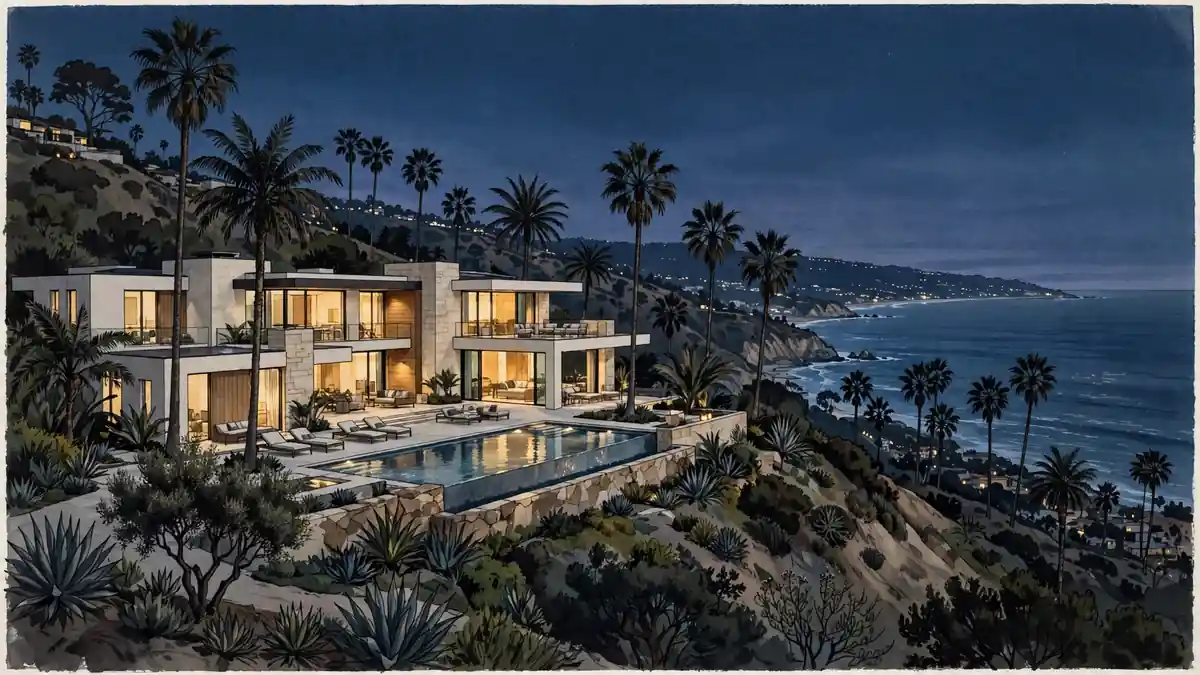
The headline property is the Riviera estate in Pacific Palisades. In February 2014, Abrams and McGrath bought an approximately 8,000-square-foot Connecticut-style mansion in the gated Riviera community for $14.47 million, according to property records cited by The Real Deal and the Los Angeles Times. Built in 1995, the house sat on more than half an acre, with five bedrooms, seven bathrooms, a swimming pool, a spa, outdoor entertaining areas, and views of the Pacific Ocean and Los Angeles. After extensive renovations, the couple listed it for about $22 million in April 2021 and sold it in 2022 for about $20.4 million — a gain of $5.93 million over the purchase price before renovation costs, taxes and selling expenses. The renovation bill was substantial, so the net profit was smaller than the headline gain, and no public record states the final figure.
The second purchase came in April 2017, when Abrams paid $6.275 million for another Pacific Palisades residence near the Rustic Canyon Recreation Center, in an off-market deal reported by the Los Angeles Times. The property held a roughly 4,200-square-foot house built in 1923, with five bedrooms and seven bathrooms on more than half an acre of grounds with mature landscaping and a swimming pool. The couple undertook substantial renovations there too, and in April 2026 Variety reported that they had recently completed an extensive remodelling of the Rustic Canyon home. That timing is worth noting: the renovation finished just as Bad Robot was leaving Los Angeles, which suggests the house, not the office, is where the family’s California base now sits.
A third, smaller Pacific Palisades home followed in 2018, bought for about $2.6 million. The three-bedroom, two-bathroom house was built in 1928 and held about 1,700 square feet. Abrams listed it in September 2024 for $3.495 million, nearly $900,000 above the purchase price. Whether it sold, and at what price, has not been publicly confirmed.
Cars are a blank in the public record. No reliable reporting lists Abrams’ vehicles, and this article will not invent a garage. He is not known as a car collector, and his public image has always been built around the work rather than the lifestyle. The same restraint applies to yachts, jets and watches: nothing on the public record, so nothing claimed here. The wealth is visible in the houses and the company, and that is where the evidence stops.
Awards and Achievements
Abrams’ trophy record is strong in television and thin in film, which fits a career built on creating shows rather than chasing Oscars. The Television Academy lists 10 Emmy nominations and 2 wins. Both wins came in 2005 for Lost: Outstanding Directing for a Drama Series and Outstanding Drama Series as an executive producer. Later nominations as executive producer covered Westworld in 2017 and 2018 and Lovecraft Country in 2021, plus earlier nominations for Lost in 2008, 2009 and 2010 and for writing Alias in 2002. Lost also won the Golden Globe for Best Television Series — Drama in 2006. In 2013 he received the Founders Award at the International Emmy Awards for his impact on global television.
Film awards have been nominations rather than wins at the highest level. Star Wars: The Force Awakens earned Academy Award nominations in technical categories but no Best Picture or Best Director nomination for Abrams, and he has never been nominated for an Oscar as a director. Awards databases credit him with 12 Saturn Award wins from 26 nominations, including Best Director for Super 8 and for The Rise of Skywalker, and Best Writing for The Force Awakens. Those genre awards track his standing inside science fiction and fantasy, where his reputation is highest.
The achievement that matters financially is not a trophy but a ranking: his films as a director have grossed more than $4 billion worldwide, making him one of the ten highest-grossing directors of all time before adjusting for inflation. The Force Awakens was, at release, the seventh-highest-grossing film in history and the highest-grossing film ever in the United States and Canada. Numbers like that are what let a director demand gross participation, and gross participation is what turns a career into a fortune.
Net Worth Growth Over the Years
A year-by-year net worth table for Abrams would be guesswork, because no audited figures exist and the aggregators that publish them copy each other. What does exist is a dated trail of reported deals and sales, and that trail is more honest than a fabricated curve. The table below lists the milestones with their reported figures and sources, so readers can see how the fortune was built rather than take a smooth line on trust.
| Year | Milestone | Reported figure |
|---|---|---|
| 1990 | First screenplay sale, Taking Care of Business | Undisclosed; first studio credit |
| 1998 | Armageddon becomes the year’s top-grossing film | More than $550 million worldwide |
| 2004–2005 | Lost premieres; two Emmy wins | Backend participation begins |
| 2006 | Warner Bros. TV + Paramount deals | Up to $68 million combined (Los Angeles Times) |
| 2014 | Riviera estate purchased, Pacific Palisades | $14.47 million (property records) |
| 2015 | Star Wars: The Force Awakens released | More than $2.06 billion worldwide |
| 2019 | WarnerMedia five-year deal signed; Apple offer declined | $250 million guaranteed; Apple offered $500 million+ (Hollywood Reporter) |
| 2019 | Star Wars: The Rise of Skywalker released | About $1.07 billion worldwide |
| 2022 | Riviera estate sold | About $20.4 million (gain of $5.93 million before costs) |
| 2024 | New Warner Bros. first-look deal (two years, non-exclusive) | Undisclosed; described as much smaller |
| 2025 | Bad Robot sells Santa Monica headquarters | $31 million (Variety / Hollywood Reporter) |
| 2026 | Bad Robot downsizes; LA office closes; HQ moves to New York | Downsizing reported by Variety, April 2026 |
| 2026 | Net worth estimate | $250 million to $300 million |
Two things stand out in that trail. First, the fortune was built in three jumps — the 2006 contracts, the Star Wars years, and the 2019 WarnerMedia deal — with long flat stretches between them. Second, the most recent news points down, not up: a smaller studio deal, a sold headquarters, a downsized company. The $300 million figure is a stock of wealth accumulated over thirty years, not a reflection of his 2026 income. If The Great Beyond succeeds when it reaches theatres in October 2027, the next jump could come from original filmmaking rather than franchise work, which is exactly the bet Abrams says he is making.
A note on the low-end estimates floating around online: a few thin aggregator pages put Abrams at $60 million to $90 million, and one puts him at $75 million. Those figures cannot be reconciled with the documented record. The 2006 contracts alone were worth up to $68 million, the WarnerMedia deal guaranteed $250 million to his company, and his property sales are a matter of public record. Celebrity Net Worth’s $300 million, updated in November 2026, and the $250 million to $300 million range used by other 2026 profiles, are the figures that fit the evidence. The low numbers look like stale copies of decade-old estimates that were never updated after the Star Wars paydays.
Social Media Presence
Abrams keeps one of the lowest public profiles of any filmmaker at his level of wealth, and his social media footprint shows it. He does not run an active verified personal Instagram or X account, and he does not use social platforms to promote his work, share his opinions, or show his life. Announcements about his projects come through Bad Robot’s official accounts and through studio channels, not from a personal feed. That silence is consistent with everything else about how he handles fame: the work is public, the person is not.
The contrast with his daughter is sharp, and it is worth a sentence because readers ask about it. Gracie Abrams, his daughter with Katie McGrath, is a successful singer-songwriter with a large social following, albums including Good Riddance and The Secret of Us, and a tour with Taylor Swift. Her father built his career before social media existed as a career tool, and he has never adopted it. For a net-worth estimate, the practical effect is simple: there is no influencer income, no sponsored-post revenue, and no social following to value. The fortune comes from films, television and property, and the absence of a social brand is itself a statement about where he chose to put his time.
Personal Life
Abrams married public relations executive and producer Katie McGrath on September 29, 1996, after meeting her at a dinner party in 1994. The marriage is also a business partnership: McGrath serves as co-CEO of Bad Robot and has helped oversee its expansion across film, television and other media. She was part of the team that negotiated the WarnerMedia deal and the Apple rejection, and she has been central to the company’s strategy for more than two decades. Few Hollywood couples share a company the way the Abramses do, and it means the $300 million estimate is, in practical terms, a household figure built by two people rather than one.
The couple have three children: Henry Abrams, born in 1998; Gracie Abrams, born in 1999, who became a pop singer-songwriter; and August Abrams, born on January 11, 2006. The family has long lived in Pacific Palisades, Los Angeles, where their property purchases are concentrated, and Abrams is now reported to be based in New York as Bad Robot moves east. He is Jewish and his wife is Catholic, a detail noted in biographical profiles and rarely discussed by the couple themselves.
Philanthropy is a visible part of the family’s public life. Abrams and McGrath have served together as chairpersons of the Children’s Defense Fund, and in June 2020 the family pledged $10 million to organisations supporting racial justice causes. They run their giving through the Katie McGrath & J.J. Abrams Family Foundation. The $10 million pledge is one of the largest single charitable commitments on the public record for the family, and it sits alongside years of political fundraising and support for education, civil rights and healthcare causes. Simon Pegg’s net worth is a useful companion read — Pegg played Scotty in Abrams’ Star Trek films and co-wrote Star Trek Beyond, so the two careers are tied together on screen as well as at the box office.
Sources & Reporting
Celebrity Net Worth — the $300 million net worth figure, updated November 4, 2026; the WarnerMedia deal reconstruction ($250 million guaranteed, Apple offer above $500 million, Puck’s $250 million spent figure); the 2006 contract breakdown; the Star Wars fee reports; the 2026 Bad Robot restructuring; the property purchase and sale prices. Reporting window: profile published 2020, updated November 2026.
Variety — the April 8, 2026 report on Bad Robot’s downsizing, the Los Angeles office closure, the move to New York, and the $31 million sale of the Santa Monica headquarters; the December 2024 replacement first-look deal.
The Hollywood Reporter — contemporaneous reporting on Apple’s offer of more than $500 million for Bad Robot in 2019; the April 2026 downsizing coverage, including the $31 million headquarters sale and the “tinkerer” account of Abrams’ return to hands-on filmmaking.
Los Angeles Times — the July 2006 report on the simultaneous Warner Bros. Television and Paramount agreements (up to $68 million combined, $4 million a year television guarantee, 35 percent backend, $5 million first directing fee); the 2017 off-market Pacific Palisades purchase of $6.275 million.
The Real Deal — property records for the Riviera estate purchase ($14.47 million, 2014) and the Latimer Road purchase ($6.27 million, 2017).
Wikipedia — biographical facts (born June 27, 1966, New York City; Sarah Lawrence College, B.A. 1988; filmography and box-office totals); the ranking of Abrams among the ten highest-grossing directors of all time; the Star Wars grosses.
Television Academy — the official Emmy record: 10 nominations and 2 wins for J.J. Abrams, both wins in 2005 for Lost.
The City Celeb — the 2026 biography corroborating the $250 million to $300 million range, the Pacific Palisades property prices, the September 29, 1996 wedding date, the children’s birth years, the height of 5 feet 7 inches, and the October 2027 date for The Great Beyond.
Figures in this article are estimates built from public reporting, not audited financial statements. Where sources disagree — most visibly on the founding year of Bad Robot (1999 in trade reporting, 2001 in some profiles) and on the low-end net worth figures published by thin aggregators — the article says so and explains why it chose the figure it did. Corrections are welcome under our corrections policy.
Frequently Asked Questions
What is J.J. Abrams’ net worth in 2026?
J.J. Abrams’ net worth is estimated at $250 million to $300 million as of November 2026. Celebrity Net Worth, updated November 4, 2026, puts him at $300 million, and a second 2026 profile lands on the same $250 million to $300 million range. The fortune comes from directing and producing fees, backend participation, the Bad Robot production company he owns with his wife, and Pacific Palisades property.
How much did J.J. Abrams make from Star Wars: The Force Awakens?
Contemporary press reports placed his directing fee at about $5 million, plus a 2 percent participation in the film’s gross revenue. Disney never publicly confirmed those terms, and gross participation is calculated on defined receipts after costs, not on the raw $2.06 billion box-office total. His two Star Wars films together grossed more than $3.1 billion worldwide.
Why did J.J. Abrams turn down Apple’s $500 million offer?
According to The Hollywood Reporter, Apple offered more than $500 million for a multi-year deal that would have required Bad Robot to produce exclusively for Apple TV+. Abrams and his wife Katie McGrath took WarnerMedia’s smaller $250 million deal instead because it let them work with multiple distributors, keep access to Warner Bros.’ theatrical business and library, and keep their profit participation in earlier work.
What happened to Bad Robot in 2026?
Bad Robot downsized across the board in April 2026, shuttered its Los Angeles office on April 2, and moved operations to New York, where Abrams now lives. Variety reported the move on April 8, 2026. The company had sold its Santa Monica headquarters for $31 million in the fall of 2025 and signed a smaller two-year, non-exclusive first-look deal with Warner Bros. in December 2024. Abrams said he wanted to return to hands-on directing.
Who is J.J. Abrams’ wife?
J.J. Abrams has been married to Katie McGrath, a public relations executive and producer, since September 29, 1996. McGrath is co-CEO of Bad Robot Productions and helped negotiate the company’s studio deals. The couple met at a dinner party in 1994.
How many children does J.J. Abrams have?
Abrams and Katie McGrath have three children: Henry Abrams, born in 1998; Gracie Abrams, born in 1999, who became a successful singer-songwriter; and August Abrams, born on January 11, 2006.
How tall is J.J. Abrams?
J.J. Abrams is 5 feet 7 inches tall (1.70 m). He was born on June 27, 1966, in New York City, which makes him 60 years old as of November 2026.
What is J.J. Abrams’ next movie?
His next film as director is The Great Beyond, an original science-fiction adventure starring Glen Powell, Jenna Ortega, Emma Mackey and Samuel L. Jackson. Abrams wrote and directed it, filming in the United Kingdom and Rhode Island. It was first set for November 13, 2026, and was later moved to an October 2027 theatrical release.
Final Thoughts
J.J. Abrams’ $250 million to $300 million fortune is a thirty-year accumulation, not a single windfall. It was built in three jumps: the 2006 studio contracts that paid him millions a year plus 35 percent of his television backend, the Star Wars years that put him in charge of the biggest films of the decade, and the 2019 WarnerMedia deal that guaranteed his company $250 million. The most revealing decision in that story is the one that cost him money: turning down more than $500 million from Apple to keep his freedom, his theatrical pipeline and his back catalogue.
The 2026 news changes the shape of the story without changing the total. Bad Robot is smaller, the Los Angeles office is closed, the headquarters is sold, and the man who once ran one of Hollywood’s biggest production companies is trying to become a working director again. The Great Beyond, due in October 2027, is the test of that bet. If it works, the next chapter of his fortune will come from original stories rather than franchises — the kind of work he started with, back when he was a 16-year-old writing music for a horror film nobody saw.
Published on 2026-11-21. Last reviewed November 2026. Found an error? See our corrections policy.