
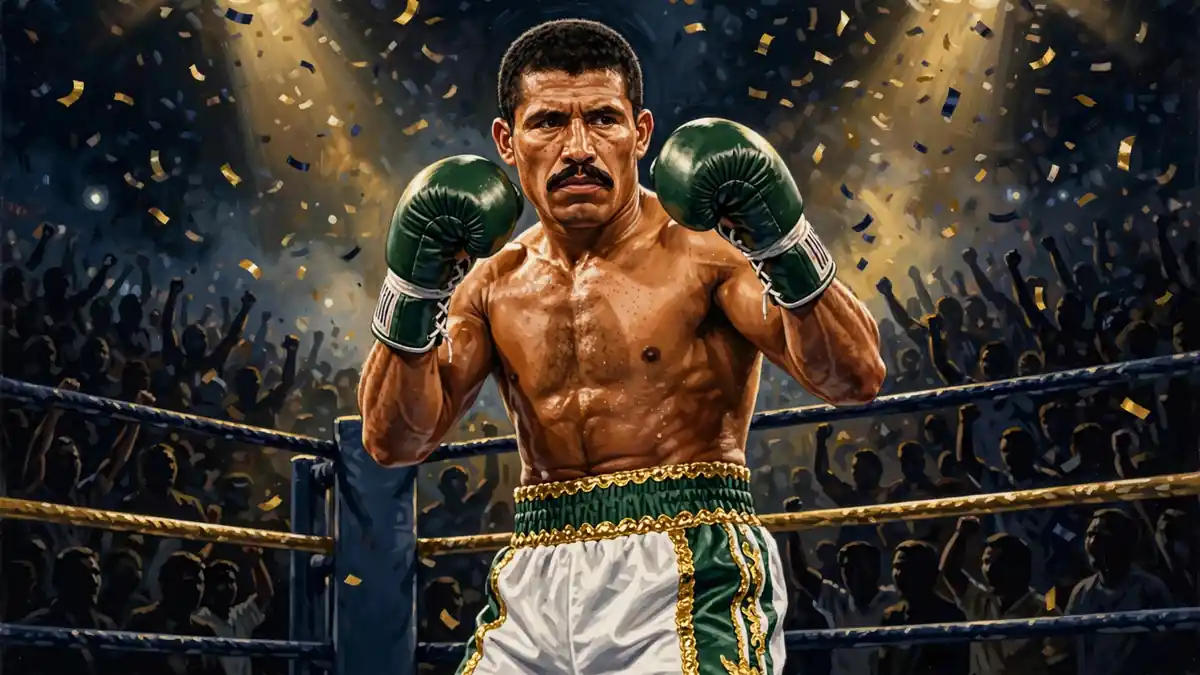
Julio Cesar Chavez‘s net worth is estimated at $10 million as of October 2026, with some outlets placing the range as low as $4 million. The number surprises people because Chávez collected one of the largest purses of the pre-Pay-Per-View era — more than $9 million for facing Oscar De La Hoya in 1996 — and a conservative tally of his twelve biggest reported fight purses alone lands near $40 million. Where did the money go, and what is he earning now? He has said himself that excess and addiction took a heavy bite out of his fortune, and today he earns as one of Mexican television’s most prominent boxing analysts while running two rehab clinics in his home state of Sinaloa.
Julio Cesar Chavez: Quick Facts
| Estimated net worth | $10 million (range: $4 million – $10 million) |
|---|---|
| Profession | Former professional boxer; boxing analyst and businessman |
| Nationality | Mexican |
| Born | July 12, 1962 (age 64) |
| Height | 5 ft 7 in (1.70 m) |
| Primary income sources | Fight purses (1980–2005), TV analyst contracts, Baja del Sol rehab clinics, Chávez Factory promotions, boxing gyms |
| Active years | 1980–2005 (25 years, 115 professional bouts) |
| Last reviewed | October 2026 |
- Quick Facts
- Early Life and Background
- Education
- Career Journey
- Rise to Fame
- Main Sources of Income
- Salary and Earnings
- Businesses and Investments
- Brand Deals and Sponsorships
- Houses, Cars and Other Assets
- Awards and Achievements
- Net Worth Growth Over the Years
- Social Media Presence
- Personal Life
- Sources & Reporting
- Frequently Asked Questions
- Final Thoughts
Early Life and Background
Julio César Chávez González was born on July 12, 1962, in Ciudad Obregón, Sonora, Mexico, and raised in Culiacán, Sinaloa — where, as widely documented, his family lived in an abandoned railroad car while his father worked for the railroad. Poverty was the backdrop of his childhood, and it shaped the relentless, forward-pressing style that would define him in the ring.
He came to boxing as a teenager, turning professional at 17 after a short amateur career of just 13 bouts, per the International Boxing Hall of Fame. The famous detail, which Chávez himself has repeated in interviews, is the promise he made to his mother Isabel before he started: if he ever lost a fight, he would retire. He kept that vow for fourteen years and ninety fights — his first professional defeat did not come until 1994. The promise tells you something about how he saw the sport from the start: winning wasn’t the goal, it was the condition of participation.
Culiacán sits in Sinaloa, and that geography matters to his money story later. When he built his post-boxing life, he didn’t move to Las Vegas or Los Angeles like many retired champions; he built it where he grew up, converting his own former Culiacán mansion into a rehabilitation clinic — the building where, by his own account in the 2026 ViX/N+ Docs series “Chávez vs. Chávez,” his substance abuse years had played out. The place that made him became the place he invests in.
Education
Chávez did not pursue formal higher education; his schooling was the gym. He left the classroom path early to fight for a living, and his “education” in the business of boxing came from 115 professional bouts over 25 years, the negotiation tables of promoters, and the hard lessons of managing sudden wealth. There is no hidden college record to surface — a number of thin competitor pages invent nothing here either, and inventing would be worse than admitting the gap. What matters for his finances is that he learned the sport’s economics from the inside: what a purse split looks like, what a management percentage costs, and how fast a fortune can evaporate without discipline.
Career Journey
Chávez turned pro in 1980 and spent his early years on Mexico’s club circuit, fighting in Culiacán and Tijuana and building the kind of record — win after win, mostly by knockout — that forced American promoters to pay attention. His first world title came in 1984, when, unbeaten at 43-0, he stopped Mario Martínez in eight rounds to take the WBC super featherweight championship. Nine successful defenses followed.
The lightweight division was next: he stopped Edwin Rosario in eleven rounds in 1987 for the WBA title, then added the WBC version by beating José Luis Ramírez in 1988. In 1989 he moved up again, taking the WBC light welterweight crown from Roger Mayweather with a tenth-round stoppage to become a three-division world champion. The purses were still modest by later standards — the Mayweather fight reportedly paid him around $100,000 — but the trajectory was unmistakable. He fought constantly: at one point eleven times in a single year early in his career, a volume modern boxers would consider unthinkable.
The journey had a shadow too. By his own later admission, the same years that made him a national hero planted the habits — drinking, drugs, reckless spending — that would later drain his fortune. The career journey and the money story are inseparable: he earned like a champion of his era and, for a long stretch, spent like one.
Rise to Fame
Two nights made Chávez immortal. The first was March 17, 1990, at the Hilton in Las Vegas — “Thunder Meets Lightning.” Chávez, 68-0, faced 24-year-old IBF champion Meldrick Taylor, 24-0-1, in a unification fight. For eleven rounds Taylor’s speed owned the fight; he led 108-101 and 107-102 on two cards. Then Chávez broke him down. In the final seconds of the twelfth round, referee Richard Steele stopped it with Taylor on wobbly legs — a controversial TKO that unified the titles and cemented Chávez as the sport’s pound-for-pound best. His purse that night: a reported $1.2 million.
The second was February 20, 1993, at the Estadio Azteca in Mexico City. 132,274 fans packed the stadium to watch Chávez dismantle Greg Haugen — who had mocked Chávez’s competition as “Tijuana taxi drivers” before the fight — in five rounds. The International Boxing Hall of Fame records it as one of the largest paid crowds in boxing history. Later that year came the controversial majority draw with Pernell Whitaker in San Antonio, a fight most ringside observers thought Chávez lost, which kept his unbeaten run alive.
By 1993 Chávez stood 89-0-1. The Ring magazine had him as the world’s best pound-for-pound fighter from 1990 to 1993. He was, as Boxing News later put it, Mexico’s champion and the sport’s measuring stick. That status is the asset everything else in this article monetizes — the clinics trade on his redemption story, the TV networks trade on his authority, and the product lines trade on the name.
Main Sources of Income
Chávez’s money arrived in waves, and understanding the waves is the whole net-worth story. The first wave was ring earnings: purses from 1980 to 2005, peaking with the $9 million-plus payday against Oscar De La Hoya in 1996. The second wave was decline and rebuilding — years of addiction and excess he has discussed openly, which is why a fighter who earned tens of millions carries a $10 million net worth. The third wave, still running in 2026, is a diversified retirement income built on the one asset he never lost: his name.
Today his income sources are: television analyst contracts — he is a lead ringside voice on TV Azteca’s Box Azteca broadcasts alongside fellow legends Erik Morales, Marco Antonio Barrera and Juan Manuel Márquez, and a regular analyst on ESPN Deportes’ weekly “A Los Golpes” show; two Baja del Sol rehabilitation clinics in Tijuana and Culiacán; Chávez Factory, his own promotional company launched to develop young fighters; JC Chávez Boxing Studio gyms; licensed product lines including a signature tequila and “JC Chávez Vitamins” supplements, as reported by Al Bawaba in September 2026; and broadcast/image-rights income from projects like the Disney+/ViX reality series “Los Chávez” and the 2026 ViX/N+ Docs docuseries “Chávez vs. Chávez.”
The honest way to describe his finances: he is not a billionaire-in-waiting like some modern champions, and he is not broke like so many retired fighters. He earns a steady, respectable living from the brand he built over 115 fights — and, at 64, he is more financially relevant than he was at 54.

Salary and Earnings
Boxers don’t have salaries; they have purses, negotiated fight by fight. Chávez’s purse history — compiled from boxing-press reporting, notably a purse-by-purse breakdown published by EssentiallySports — reads like a chart of his rising market value through the 1980s and 1990s:
| Fight (year) | Reported purse |
|---|---|
| Roger Mayweather I (1985) | $100,000 |
| Edwin Rosario (1987) | $425,000 |
| Roger Mayweather II (1989) | $750,000 |
| Meldrick Taylor I (1990) | $1.2 million |
| Héctor Camacho (1992) | $3 million |
| Greg Haugen (1993) | $3 million |
| Pernell Whitaker (1993) | $5 million |
| Frankie Randall I (1994) | $5 million |
| Frankie Randall II (1994) | $5 million |
| Meldrick Taylor II (1994) | $5 million |
| Oscar De La Hoya I (1996) | $9 million guaranteed (reported up to ~$15 million with PPV share) |
| Miguel Ángel González (1998) | $3 million |
The De La Hoya payday deserves a closer look because it was historic. At Caesars Palace in June 1996, Chávez — 33 years old, entering his 99th fight — took home a career-high guarantee north of $9 million against the 23-year-old “Golden Boy,” making him, as Bleacher Report documented, the highest-paid Mexican boxer in history at the time. Boxing News 24’s contemporary reporting pegged the figure at $9.1 million; EssentiallySports’ later breakdown adds roughly another $6 million from a 35% pay-per-view share, which would put the night’s total near $15 million. The two accounts differ in how they treat the PPV upside, so treat $9 million-plus guaranteed as the solid floor.
Add the twelve listed fights and you land near $40 million in disclosed purses alone — and Chávez fought 115 times. His true career ring earnings almost certainly cleared $50 million. Why isn’t the net worth higher? Four drains: taxes (top U.S. and Mexican rates on peak-era income), management and promoter cuts (the era’s standard percentages went to the people who got him the big fights), camp and training costs over 25 years, and — the one he has owned publicly — years of addiction and unchecked spending during and after his prime. A 1990s $9 million purse, after all four drains, is not remotely a $9 million net-worth contribution. That’s the arithmetic behind the $10 million figure.
One comparison puts his era in perspective: Chávez’s entire career earnings are roughly what a single Canelo Álvarez superfight commands today. He fought before the modern pay-per-view explosion turned elite boxing into nine-figure paydays, and his purses — record-breaking in 1996 — look modest against the Mayweather-Pacquiao era that followed.
The 1996 De La Hoya fight, promoted by Don King — Chávez’s long-time promoter and a presence at his career’s biggest nights — was also his financial ceiling. He lost in four rounds, and his market value never regained its 1996 height. The 1998 rematch paid substantially less, and his last major reported payday, the $3 million draw with Miguel Ángel González in January 1998, marked the end of the seven-figure era. His final bouts through 2005, including losses to Kostya Tszyu and two to Willy Wise, were club-level economics compared to the Azteca and Caesars Palace nights. This is why the net-worth math looks the way it does: the fortune was essentially made by 1996, spent down over the following decade, and rebuilt from scratch in retirement.
A family footnote on earnings: his son Julio César Chávez Jr. earned his own headline money — a reported $3 million for the 2012 Sergio Martínez fight, $3 million against Canelo Álvarez in 2017, and $3 million against Daniel Jacobs in 2019, per Boxing Scene and BolaVip reporting. The father’s peak single night still dwarfed the son’s, but the son fought in a far richer era, which is why the two generations’ lifetime earnings are closer than the legend would suggest.
Businesses and Investments
Chávez’s post-retirement business life is unusual among retired fighters: it’s real, diversified, and mission-driven. The centerpiece is the Baja del Sol rehabilitation clinic network. The first clinic opened in Tijuana; the second, in Culiacán around 2014, sits in his converted former mansion — the same house, by his own account, where his darkest addiction years played out. The opening ceremony drew Don King, Oscar De La Hoya, WBC president Mauricio Sulaimán, and Culiacán’s mayor, per BoxingScene’s reporting. NPR reported in 2015 that the Tijuana facility alone housed around 40 patients, and Chávez told reporters he wanted to open at least two more. These are operating businesses — treatment centers with staff, patients, and fees — and they also feed his speaking and media income, because the redemption story is his most valuable current asset.
In 2013 he launched Julio César Chávez Factory, his own promotional company, aimed at developing young Mexican fighters from amateur to professional; its first card ran that August. EssentiallySports also credits him with a sportswear line, and Al Bawaba’s September 2026 financial profile reports a JC Chávez Boxing Studio gym chain serving hundreds of members, plus a signature tequila and a “JC Chávez Vitamins” supplement line. Those last two come from a single recent source, so treat them as reported-but-unconfirmed rather than established fact — they don’t appear in the older profiles.
What about classic “portfolio” investments — stocks, bonds, a real-estate empire? There is no public record of a Chávez investment portfolio, and competitors that list generic “real estate portfolio” holdings are padding. The one concrete property claim in recent reporting — Al Bawaba’s assertion of a $1.5 million Tijuana home and a California mansion worth over $10 million — is single-sourced and unconfirmed elsewhere. What is verifiable: the clinic properties in Sinaloa, and a lifetime of income now anchored in Mexican businesses rather than Wall Street instruments.
Brand Deals and Sponsorships
During his fighting prime, Chávez was the face Mexican brands wanted. His endorsement work centered on the Mexican market — television commercials and appearances trading on his status as the nation’s most beloved athlete — though the specific deals were rarely documented with the dollar figures that accompany modern contracts. That scarcity is itself a data point: the 1980s–90s endorsement market for Mexican boxers simply didn’t produce the nine-figure shoe deals of later eras, and Chávez’s commercial income always played second fiddle to his purses.
His most valuable modern “endorsement” is arguably his own employment: TV Azteca’s Box Azteca lead analyst chair and the ESPN Deportes regular role give him a steady salary for being Julio César Chávez — authority you can’t buy. In 2016 he fronted an ESPN “This is SportsCenter” commercial alongside LA Galaxy’s Giovani dos Santos, a sign of his crossover marketability. Beyond that: motivational speaking built around his addiction-and-recovery story (a paid circuit many retired athletes mine), image-rights income from “Los Chávez” on Disney+ and ViX, and the 2026 “Chávez vs. Chávez” docuseries from ViX and N+ Docs. The pattern is consistent — every modern revenue line monetizes the same thing: the legend, the comeback, and the face.
Houses, Cars and Other Assets
The honest summary of Chávez’s asset sheet: much of what he owns serves his businesses rather than his lifestyle. His most significant known property asset is the Culiacán estate converted into the second Baja del Sol clinic — a mansion that went from symbol of excess to working treatment center. He has long been based in Sinaloa (Culiacán and Tijuana), and recent reporting associates him with a luxury Tijuana residence, though the widely cited “$10 million California mansion” claim traces to a single 2026 profile and isn’t corroborated elsewhere.
Cars? Unlike modern boxers who document every supercar on Instagram, Chávez’s vehicle collection is not a matter of public record, and this article won’t invent one. His @jcchavez115 posts show family life, gym visits, and broadcast work — not a showroom. The pattern of his retirement spending reads less like a collector’s and more like an operator’s: property that houses clinics, businesses that employ people, and a lifestyle anchored in Culiacán rather than Montecito.
Awards and Achievements
The résumé, in the form the Hall of Fame states it: six world-title reigns in three weight divisions (WBC super featherweight, WBA and WBC lightweight, WBC light welterweight twice, IBF light welterweight); 27 successful title defenses, tied for the all-time record; a 90-fight unbeaten streak from 1980 to 1994; Fighter of the Year honors from the Boxing Writers Association of America (1987) and The Ring (1990); The Ring’s pound-for-pound No. 1 from 1990 to 1993; No. 24 on ESPN’s “50 Greatest Boxers of All Time”; and induction into the International Boxing Hall of Fame as part of the class of 2011, alongside Mike Tyson and Kostya Tszyu. He holds records for the most total successful defenses of world titles, most title-fight victories (31) and most title fights.
Outside the ring, the honors continued. A 20-foot bronze statue of Chávez went up in Culiacán’s main square, and Mexican president Enrique Peña Nieto named him an “anti-addiction ambassador” at a national conference on Mexico’s drug problem. For net-worth purposes, these aren’t trophies on a shelf — they’re the credibility that powers his analyst contracts, his clinics, and every product line carrying his name.
Net Worth Growth Over the Years
Nobody published audited Chávez balance sheets in 1995, so the table below is built the way this site builds all its estimates: reported purses, reported figures, and clearly labeled inference. The arc is unmistakable — a fortune made in the ring, a trough of losses he has acknowledged himself, and a rebuilt, diversified income in retirement.
| Period | Estimate / reported figure | What drove it |
|---|---|---|
| 1984–1990 | Rising: six-figure to $1M+ purses | First world titles; Taylor I payday $1.2M |
| 1991–1996 (peak) | Career earnings crossing ~$40M | $3–5M purses routine; De La Hoya I $9M+ in 1996 |
| 1997–2005 | Declining; purses shrink with status | Losses to De La Hoya, Tszyu; final bouts; excess spending |
| 2006–2011 | Rebuilding from a low base | Addiction years; TV analyst work begins; sobriety from 2011 |
| 2012–2020 | Stabilizing | ESPN Deportes and TV Azteca contracts; clinics open; Chávez Factory |
| 2021–2025 | ~$10M (Celebrity Net Worth) | Steady media/clinic/gym income; “Los Chávez” image rights |
| 2026 | $4M–$10M (anchored at $10M) | Docuseries income; gym chain growth; family legal costs possible drag |
Two notes on reading this table. First, the 2026 $10 million anchor is Celebrity Net Worth’s standing figure, and the $4 million floor comes from Al Bawaba’s September 2026 profile — the spread reflects how little of his wealth sits in disclosed assets versus private businesses. Second, 2025–26 carried a new, unquantified financial pressure: his son Julio César Chávez Jr.’s legal saga (arrest, deportation, Mexican legal proceedings) has required lawyers on both sides of the border, and while there’s no reporting on who paid what, family legal crises of this scale are rarely free.
Social Media Presence
Chávez runs one of the most-followed accounts of any retired boxer. His Instagram handle @jcchavez115 carries roughly 966,000 followers (per Heepsy’s 2026 profile), managed professionally — his bio lists business inquiries through The Squared Circle LLC. On X (Twitter), the same @jcchavez115 handle draws around 400,000 followers. The feed is classic elder-statesman content: training clips, family moments, broadcast booth photos, tributes to Mexican boxing history, and his trademark rallying cry, #HayTiro.
Does social media move his net worth? Indirectly, yes. A million-follower audience is what makes the “Los Chávez” reality series, the docuseries, and the sponsored posts viable — it’s the distribution channel for everything he sells. He doesn’t post supercar content; he posts credibility, and credibility is the actual product.
Personal Life
Chávez’s family is boxing royalty. His sons Julio César Chávez Jr. — a former WBC middleweight champion — and Omar Chávez both followed him into professional boxing, and his daughter Nicole has stayed out of the ring’s spotlight. The family remains based in Sinaloa, the state whose capital city raised him and which he has spent his retirement trying to give back to.
The personal story that matters most to his finances is the one he tells himself. Chávez has been sober since 2011, after years of alcohol and drug addiction that he says consumed a large part of his ring fortune. In a 2016 Boxing News interview he described his clinics as his way of giving others the “second chance” life gave him. And in 2025–26, the family faced its hardest public chapter: in July 2025, days after Chávez Jr. lost to Jake Paul in Anaheim, U.S. immigration authorities arrested the younger Chávez in Studio City — accused of overstaying his visa and making false statements on his residency application, with alleged ties to organized crime under investigation in Mexico dating to 2019. He was deported to Mexico in August 2025, detained in Hermosillo, and released pending trial by a Mexican judge on August 24, 2025.
Chávez Sr. responded with a family statement defending his son and insisting on his innocence — “we fully trust in his innocence,” the family said — and WBC president Mauricio Sulaimán publicly urged a fair process. The episode kept the Chávez name in headlines through 2025 and into 2026, an uncomfortable kind of publicity that nonetheless confirms one thing: three decades after his last great fight, the family name still moves markets, media, and money.
Sources & Reporting
International Boxing Hall of Fame — career record (107-6-2, 88 KOs, 115 bouts), title history, the 132,274-fan Haugen fight, 89-0-1 start, 2011 induction. The authoritative source for every career figure in this article.
Celebrity Net Worth — the standing $10 million net-worth estimate that anchors this article; also the $4 million figure for Chávez Jr. used for family context.
Al Bawaba (English) — September 2026 financial profile reporting the $4–10 million range, the JC Chávez Boxing Studio gym chain, signature tequila and “JC Chávez Vitamins” lines, “Los Chávez” broadcast income, and the Tijuana home / California mansion property claims (single-source, flagged as unconfirmed in the article).
EssentiallySports — the twelve-fight purse ladder (Mayweather $100K through De La Hoya $9M + PPV share), Chávez Factory promotions, sportswear line, and the August 2025 account of Chávez Jr.’s deportation, detention, release, and return to training.
BoxingScene — the 2014 opening of Chávez’s second Baja del Sol clinic in Culiacán (attendees: Don King, Oscar De La Hoya, Mauricio Sulaimán), and the 2013 launch of Julio César Chávez Factory.
NPR — 2015 feature on the Tijuana clinic (~40 patients), the planned clinic expansion, the Peña Nieto “anti-addiction ambassador” designation, and his ESPN en Español / TV Azteca analyst roles.
Boxing News — 2016 interview: the vow to his mother Isabel, 14 years and 90 fights before his first loss, sober since 2011, the two Baja del Sol clinics (“where it used to be my own house”), and the Azteca drama series.
Bleacher Report — the $9 million-plus career-high payday against Oscar De La Hoya in 1996, cited as the record for a Mexican boxer.
Boxing News 24 — the $9.1 million De La Hoya purse figure via the Manila Bulletin (2012).
The Ring — June 2025 feature confirming Chávez as one of Mexican television’s most prominent boxing broadcasters; also the 1990–93 pound-for-pound No. 1 designation.
15rounds.com — ESPN’s No. 24 all-time ranking, BoxRec’s No. 17 pound-for-pound ranking, the 132,274 Azteca attendance, and the Ring/lineal title history.
World Boxing News — the Chávez family statement on Chávez Jr.’s 2025 arrest and deportation proceedings, with Mexican President Claudia Sheinbaum’s confirmation.
MMA Mania — Chávez Sr.’s July 2025 FightHype interview defending his son (“my boy might be a lot of things, but he’s no criminal”).
OutKick — August 2025 deportation at the Nogales crossing and the timeline of the 2019 investigation / 2023 warrant.
ESPN Press Room — the November 2012 debut of “A Los Golpes” on ESPN Deportes with Chávez as regular analyst alongside David Faitelson and Bernardo Osuna.
Heepsy — @jcchavez115 Instagram follower count (~966,000), engagement data, and business-inquiry management.
CelebsMoney — biographical cross-check: born July 12, 1962; 5’7″; Mexican nationality; six world titles across three divisions.
Reporting windows: career figures from Hall of Fame and contemporary fight reporting (1984–2005); purse data from boxing-press retrospectives; business and net-worth figures from 2015–2026 profiles, with the most recent (Al Bawaba, September 2026) and family legal reporting (July–August 2025) carrying the freshness.
Frequently Asked Questions
What is Julio Cesar Chavez’s net worth in 2026?
Julio Cesar Chavez’s net worth is estimated at $10 million as of October 2026, with some outlets placing the range as low as $4 million. Celebrity Net Worth’s standing $10 million figure is the most cited; a September 2026 financial profile put the range at $4–10 million. The figure reflects a fighter who earned an estimated $50 million-plus in the ring but lost large portions to taxes, management cuts, and years of addiction and excess spending he has discussed openly.
What was Julio Cesar Chavez’s highest purse?
His career-high payday came against Oscar De La Hoya in June 1996 at Caesars Palace: a reported $9 million-plus guaranteed, the largest purse for a Mexican boxer at the time. Some later breakdowns add roughly $6 million from a 35% pay-per-view share, which would put the night’s total near $15 million — the accounts differ on the PPV upside, so $9 million-plus guaranteed is the solid floor. His other million-dollar nights included $5 million each against Pernell Whitaker, Frankie Randall (twice), and Meldrick Taylor (rematch), and $3 million each against Héctor Camacho, Greg Haugen, and Miguel Ángel González.
How did Julio Cesar Chavez lose his money?
By his own account, excess and addiction were the main drains — he has said openly that personal struggles and wild living took a heavy bite out of his fortune, and he has been sober since 2011. The structural drains mattered too: his peak purses came in the 1990s before the modern pay-per-view explosion, and every purse shrank through taxes, promoter and management percentages, and 25 years of training-camp costs. He rebuilt from the low point through TV analyst contracts, two rehab clinics, a promotions company, gyms, and licensed products.
Is Julio Cesar Chavez still alive in 2026?
Yes. Julio Cesar Chavez is alive and active at 64 — born July 12, 1962. He works as a lead boxing analyst on TV Azteca’s Box Azteca broadcasts and ESPN Deportes, runs two Baja del Sol rehab clinics in Mexico, and appeared in the 2026 ViX/N+ Docs docuseries “Chávez vs. Chávez.”
What is Julio Cesar Chavez doing now?
He is one of Mexican television’s most prominent boxing broadcasters — a lead ringside analyst for TV Azteca’s Box Azteca (alongside fellow legends Erik Morales, Marco Antonio Barrera and Juan Manuel Márquez) and a regular on ESPN Deportes’ “A Los Golpes.” Outside broadcasting he operates two Baja del Sol addiction-recovery clinics in Tijuana and Culiacán, runs the Julio César Chávez Factory promotional company and a JC Chávez Boxing Studio gym chain, licenses his name to product lines, and earns image rights from the Disney+/ViX reality series “Los Chávez.”
How many world titles did Julio Cesar Chavez win?
Chávez won six world-title reigns in three weight divisions: the WBC super featherweight title (1984), the WBA lightweight title (1987), the WBC lightweight title (1988), the WBC light welterweight title (1989), the IBF light welterweight title (1990, from Meldrick Taylor), and the WBC light welterweight title again (1994, reclaiming it from Frankie Randall). He recorded 27 successful title defenses, tied for the all-time record.
What happened to Julio Cesar Chavez Jr. in 2025?
Days after losing to Jake Paul in Anaheim on June 28, 2025, Chávez Jr. was arrested by U.S. immigration authorities in Studio City, California (July 2–3, 2025) — accused of overstaying his visa and making false statements on his residency application, with alleged organized-crime ties under investigation in Mexico since 2019. He was deported to Mexico in August 2025, detained in Hermosillo on arms-trafficking charges, and released pending trial by a Mexican judge on August 24, 2025. Chávez Sr. issued a family statement defending his son and insisting on his innocence.
What was Julio Cesar Chavez’s boxing record?
Julio Cesar Chavez retired in 2005 with a professional record of 107 wins, 6 losses and 2 draws (88 knockouts) across 115 bouts, per the International Boxing Hall of Fame. He went unbeaten in his first 90 fights (1980–1994) — a 13-year undefeated streak — before his first loss to Frankie Randall in January 1994. He was inducted into the Hall of Fame as part of the class of 2011.
Final Thoughts
Julio Cesar Chavez’s $10 million net worth is the number that survives the most scrutiny — the top of a $4–10 million range, anchored by Celebrity Net Worth and stress-tested against a documented $40 million-plus in disclosed purses. The gap between what he earned and what he kept is the real story: a pre-pay-per-view-era fortune taxed, split with the people who built his career, and then genuinely damaged by the excess he has owned in public. Few retired fighters tell that story as plainly as he does.
What separates him from the cautionary tales is the third act. At 64, Chávez earns a steady living from authority rather than punches: the broadcast booth, the clinics that turned his darkest years into his business model, the gyms, and the name that still sells in Mexico. His fortune is smaller than his legend — but unlike many legends, he still owns the legend, and it still pays.
Published on October 13, 2026. Last reviewed October 2026. Found an error? See our corrections policy.