
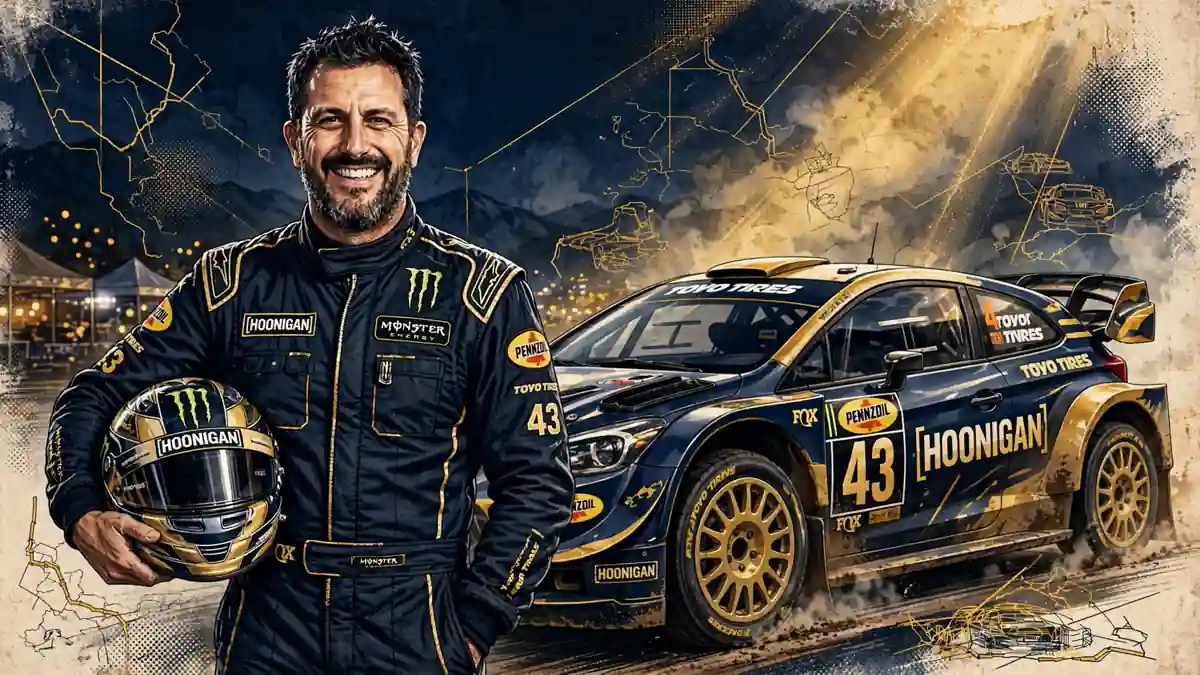
Ken Block‘s net worth is estimated at $100 million to $200 million as of November 2026. The rally driver and businessman built the fortune twice over: first as co-founder of DC Shoes, sold to Quiksilver in 2004, and then as the face of Hoonigan and the Gymkhana video series, which turned precision driving into a media business with more than 500 million views. He died on January 2, 2023, aged 55, so the figure below is an estimate of the estate he left behind, not a live fortune still being traded or audited.
Ken Block: Quick Facts
| Estimated net worth | $100 million to $200 million at his death in January 2023 (range: $100 million to $200 million) |
|---|---|
| Profession | Professional rally driver, rallycross driver and entrepreneur |
| Nationality | American |
| Born | November 21, 1967, Long Beach, California (died January 2, 2023, aged 55) |
| Height | Not publicly confirmed |
| Primary income sources | DC Shoes sale, Hoonigan Industries, rally and rallycross prize money and contracts, sponsorships, Gymkhana media and licensing |
| Active years | 1994–2023 (business from 1994; professional rally from 2005) |
| Last reviewed | November 2026 |
- Quick Facts
- Early Life and Background
- Education
- Career Journey
- Rise to Fame
- Main Sources of Income
- Salary and Earnings
- Businesses and Investments
- Brand Deals and Sponsorships
- Houses, Cars and Other Assets
- Awards and Achievements
- Net Worth Growth Over the Years
- Social Media Presence
- Personal Life
- Sources & Reporting
- Frequently Asked Questions
- Final Thoughts
Early Life and Background
Kenneth Paul Block was born on November 21, 1967, in Long Beach, California, and grew up inside Southern California’s skateboard and snowboard culture. That scene shaped both halves of his working life: the shoe company came first, the racing career second, and the two stayed connected for three decades. Skateboarding gave him his first business partners, his first customers and his first instinct for marketing through video and athlete sponsorship.
Block’s family backed his first venture directly. Reporting by Grunge puts the seed money at a $10,000 loan from his parents, matched by his co-founder Damon Way. It is a small number against what followed, and it matters because it fixes the story in place: DC Shoes was not launched with venture capital or a corporate parent. Two young men from the skate scene, a five-figure family loan, and a gap they could see in the footwear market.
What Block saw was simple. Skateboarders in the early 1990s were wearing basketball shoes and trainers never designed for a board. A shoe built for skating — padded, grippy, durable, styled for the culture rather than borrowed from another sport — had no established leader. DC Shoes filled that gap, and its early growth was fast enough to be measured in months rather than years.
Education
Block attended a community college in the San Diego area, where he met Damon Way. The friendship became the business partnership behind DC Shoes. No university degree or formal business training sits on his public record, and none is needed to explain the trajectory: the company was built on product feel and scene credibility, not credentials.
The college connection also explains the company’s early distribution. Way’s brother Danny was a professional skateboarder, which gave the fledgling brand instant access to the riders other shoe companies were paying to endorse. Block learned the sponsorship model from the inside — pay the athlete, put the product in the video, let the culture do the selling — and he later ran the same playbook at Hoonigan with cars instead of boards.
Career Journey
Block’s career divides cleanly into three acts. Act one, 1994 to 2004, was DC Shoes. Act two, 2005 to 2021, was professional rallying, first with Subaru and then in an 11-year exclusive partnership with Ford. Act three, 2010 to 2023, overlapped the second: Hoonigan Industries and the Gymkhana series, the media business that made him famous far beyond rallying’s usual audience.
DC Shoes grew from that $10,000 start to almost $7 million in annual sales by the end of 1995, according to retrospective reporting. By 2002 the brand was selling in 52 countries with about $250 million in retail sales. The scale is worth pausing on, because it explains why the 2004 sale price — the single largest cash event of Block’s life — was so large, and why later net worth estimates stayed in nine figures even after he walked away from the shoe business.
In March 2004, Block and Way sold DC Shoes to Quiksilver. The widely repeated sale price is $87 million. The New York Times, as cited in later retrospectives, reported a richer structure: up to $113 million in cash plus 1.6 million restricted shares of stock. Both numbers describe the same deal, and the gap between them is the first warning against treating any single headline figure as Block’s personal payout. The price covered the whole company, shared among founders, partners and other stakeholders, and Block’s individual share was never made public.
Block did not retire on the sale. In 2004, the same year DC changed hands, he married his wife Lucy and attended rally school with Team O’Neil. He entered professional rallying in 2005 with Vermont SportsCar, driving a Subaru, and was named Rally America Rookie of the Year that season. He was 37 years old — a late start by motorsport standards, funded by a shoe fortune rather than a junior racing ladder.
The Subaru years produced his domestic record. Block won 16 Rally America events and stood on the podium 28 times, finishing runner-up in the championship in 2006, 2008 and 2013. His five consecutive victories at the Rally in the 100 Acre Wood, completed on February 27, 2010, broke a record held by American rally great John Buffum. He also collected two X Games medals during this period, a crossover result that showed his appeal extended past rallying’s core fans.
2010 brought the Ford switch. Block left Subaru, joined Ford, and campaigned a Ford Focus RS WRC in the World Rally Championship for the Monster World Rally Team, alongside long-time co-driver Alex Gelsomino. He became the first American driver to run a full WRC programme of that kind, scoring his first world championship points with ninth place at Rally Spain in 2010. Across his WRC career he contested 24 rallies, scored 18 points and recorded a best finish of seventh at Rally Mexico in 2013.
Rallycross added a second racing income stream. In the Global RallyCross Championship Block won six races, reached 12 podiums and finished second in the championship in 2014. In the FIA World Rallycross Championship he made 26 starts, took two podiums and finished a best ninth overall in 2017. None of these series paid anything like Formula 1 money — rally drivers earn a fraction of circuit racers — which is precisely why Block’s wealth cannot be explained by racing alone. The cars were the content; the business around them was the money.
Rise to Fame
Block’s fame did not come from a championship. He never won a WRC rally, never won a world title, and never led a major series. His fame came from a video format he effectively invented for the internet age: Gymkhana.
The first Gymkhana video, a practice session filmed in 2008, showed Block sliding a Subaru around an airfield with a precision that looked choreographed. Gymkhana 2 followed in 2009, and Gymkhana 3 in 2010 moved the series abroad for the first time, to the banked circuit at Montlhéry in France, in a 600-horsepower Ford Fiesta rallycross car. That third film drew more than seven million views in its first week — a huge number for 2010, when YouTube was still a young platform.
Gymkhana 5, filmed on the streets of San Francisco in 2012 with Travis Pastrana appearing on a dirt bike, drew 5.1 million views in its first 24 hours and was the most-viewed video of that week. By the time Block announced the end of his Ford partnership in January 2021, he put the series total at more than 500 million views. The Gymkhana Files, a behind-the-scenes television series built around Gymkhana 10, earned an Emmy nomination, taking the format from YouTube clips into long-form television.
The fame mechanism mattered commercially. A rally win reaches rally fans. A Gymkhana video reaches everyone with a phone. Sponsors were not buying stage times; they were buying a share of that audience, and Block owned the audience because he owned the brand that made the films. That ownership — driver, team boss, brand owner and star in one person — is the structural reason his fortune looks different from other rally drivers’.
Mainstream media followed the videos, not the results pages. He appeared on the BBC’s Top Gear, took presenter James May to his stunt training at Inyokern Airport in California, and saw his cars licensed into video games, including Codemasters’ DiRT series and Microsoft’s Forza Horizon and Forza Motorsport titles. Each appearance widened the audience for the next Gymkhana film, and each film raised the price of the next sponsorship deal.
Main Sources of Income
Block’s income came from five distinct streams, and ranking them correctly is the key to understanding the $100 million to $200 million estimate:
1. The DC Shoes sale (2004). The largest single event. The company sold for a reported $87 million, or up to $113 million in cash plus stock on the New York Times version of the deal. Block’s personal share is undisclosed, but even a minority founder’s stake in a sale of that size, plus any retained stock, would have put him in eight figures before he ever turned a rally wheel.
2. Hoonigan Industries. Founded in 2010 as an apparel and lifestyle brand for car enthusiasts, Hoonigan sold clothing, accessories and parts, and later merged with aftermarket giant Wheel Pros in 2021. Block was co-owner and “Head Hoonigan In Charge” until his death. Hoonigan’s own value was once estimated around $20 million in secondary roundups — a modest number next to DC, but the brand also carried the Gymkhana rights and the sponsorship inventory that funded the race team.
3. Sponsorships. Monster Energy, Ford, Subaru, Audi, Castrol and Toyo Tires all backed Block at various points. The Ford deal ran 11 years and covered rally programmes, rallycross, eight Gymkhana films and spin-offs including Climbkhana and Terrakhana. Manufacturer deals of this kind typically cover cars, logistics and team costs as well as a driver fee, so the headline value of a deal overstates the cash that reaches the driver — but over a decade, the fees alone were substantial.
4. Media and licensing. Gymkhana advertising revenue, the Gymkhana Files television deal, video game licensing and branded content all paid Block as a creator and rights holder, not just as a driver. This stream is routinely underestimated by net worth roundups that count only race winnings.
5. Racing income. Prize money, start money and team salaries from Rally America, the WRC, Global RallyCross and World Rallycross. Real money, but the smallest of the five streams — rallying, unlike Formula 1, does not pay its stars tens of millions a season.
Salary and Earnings
No contract figure for Block’s driver salary has ever been published, and any article quoting a precise annual salary for him is guessing. What can be documented is the shape of his earnings across time, and it is lumpy rather than smooth — the pattern of a founder, not a salaried athlete.
The 2004 DC sale was the windfall. Everything after it was operating income: sponsorship fees, Hoonigan profits, media revenue and race earnings, reinvested heavily into a race team that burned cash at a serious rate. A WRC programme, a rallycross team and a fleet of one-off Gymkhana cars cost millions a season to run, and manufacturer backing covered much of it — but the team was Block’s, so the gap between sponsorship income and team spending came out of his pocket when deals fell short.
One useful check on the scale of his media earnings is what YouTube-only estimators get wrong. Net Worth Spot, which models income from a single channel’s views, puts a “Ken Block” figure near $141,500, with an upper guess under $200,000. That number measures one channel’s advertising, not a man’s fortune. It ignores DC Shoes, Hoonigan, sponsorships, licensing and property entirely, and it is a textbook example of why single-source net worth figures mislead. Block’s real wealth was in equity and brand value, not ad cheques.
Secondary roundups have at various points described Block as earning “several million dollars a year” from his combined ventures in his peak years. That phrasing is vague because the underlying records are private, but it is consistent with the visible spending: a race team, a car collection, multiple properties and a content operation employing a full crew. The honest statement is that his annual income varied sharply with sponsorship cycles and Hoonigan trading, and no single-year figure is verifiable.
After his death, the estate’s income did not stop overnight. Hoonigan continued trading, Gymkhana films kept earning, and licensing continued. The family’s Block House Racing operation, run from Park City, Utah, has since carried the brand forward, including his daughter Lia’s racing career. Estate income is private, so no post-2023 figure can be stated as fact — but the brand’s survival is a matter of public record.
Businesses and Investments
DC Shoes (1994–2004). Co-founded with Damon Way. Sold to Quiksilver in 2004. The deal that made Block’s fortune, and the reason his wealth predates his fame as a driver by a decade. Block stayed involved with the brand after the sale, and DC went on trading as a major action-sports label under Quiksilver, later Authentic Brands Group ownership. Block’s ongoing stake, if any, after 2004 is not publicly documented, so no post-sale DC income is counted here.
Hoonigan Industries (2010–present). Co-founded by Block as the apparel and media company behind Hoonigan Racing Division. The team name changed from Monster World Rally Team to Hoonigan Racing Division in 2013, aligning the race team with the consumer brand. In 2021 Hoonigan merged with Wheel Pros, a large aftermarket wheel company, in a deal that expanded the group’s footprint across the automotive aftermarket. The merger put Hoonigan inside a much larger corporate structure, which complicates any attempt to value Block’s personal holding from outside.
The post-death complication. In 2024, the wider Hoonigan/Wheel Pros group filed for Chapter 11 bankruptcy protection, with secondary reporting putting its accumulated debt near $1.2 billion. That filing belongs to the company, not to Block’s estate, and Chapter 11 is a restructuring rather than a liquidation — but it does cloud the value of any Hoonigan equity the estate still held, and it is a reason to treat the top end of the net worth range with caution in 2026. A brand can be culturally alive and financially distressed at the same time, and Hoonigan after 2024 is exactly that.
Gymkhana Grid. Block co-founded Gymkhana Grid in 2010, a competition format that turned the video stunt discipline into live events held around the world. He won an all-wheel-drive event at the format’s early editions, beating Jake Archer in a final duel in 2014. The event business was small next to DC or Hoonigan, but it showed the same instinct: own the format, don’t just perform in it.
Other investments. No stock portfolio, startup portfolio or property portfolio for Block is a matter of public record. Profiles that list “investments” among his income sources are repeating a generic category, not a documented holding. The verifiable investments are the two companies, the race team, the car fleet and the real estate below.
Brand Deals and Sponsorships
Block’s sponsor roster reads like a history of his career, because each manufacturer deal defined an era. Subaru backed his entry into rallying in 2006, alongside team-mate Travis Pastrana, under the Subaru Rally Team USA banner. Ford took over in 2010 and stayed for 11 years — the longest and richest partnership, covering WRC, rallycross and the Gymkhana films. When that deal ended in January 2021, Block announced the split himself in a social media video, joking that after 11 years they had “decided to see other people.”
He returned to Subaru in April 2021 and announced a partnership with Audi in September 2021. The Audi deal produced his final major film project, Elecktrikhana, in which he drove the all-electric Audi S1 Hoonitron around Las Vegas in 2022 — a deliberate callback to his 1980s Audi Quattro enthusiasm, updated for the electric era. Castrol and Toyo Tires backed him across multiple eras, and Monster Energy’s branding ran through the Hoonigan years.
The commercial logic of these deals deserves a note that most net worth roundups skip. A manufacturer rally deal is not a salary. It is a bundle: cars, parts, logistics, team staff, media production and a driver fee. When DirtFish reported the Ford split, it credited the partnership with 19 wins, 17 podiums, two X Games medals and more than 500 million Gymkhana views — the sponsor’s return was measured in audience, not trophies. Block understood that better than almost any driver of his generation, which is why he kept ownership of the content his sponsors paid to appear in.
Smaller deals filled the gaps: wheel and parts brands including Rotiform and Wheel Pros, whose merger with Hoonigan later tied the sponsor relationship directly to the company’s ownership. Signature wheels and parts collaborations gave Hoonigan a product line beyond T-shirts, and gave Block a royalty-style income from hardware, not just media.
Houses, Cars and Other Assets
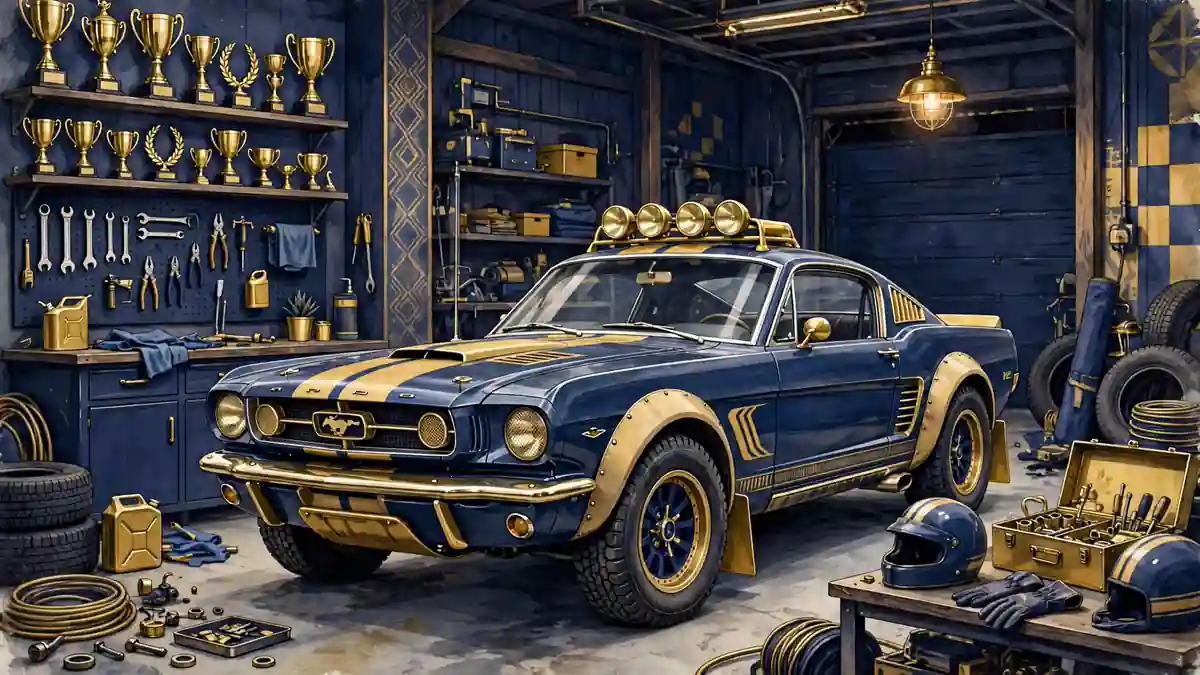
Property. Block’s best-documented home was the family ranch near Woodland, Utah, in Wasatch County, where he died. The ranch, with its snowmobiling terrain, was the family’s base for winter sports and the site of the accident on January 2, 2023. The family racing operation, Block House Racing, is based in Park City, Utah, where a 2025 garage tour showed the car collection, trophies and race gear kept together as a working headquarters rather than a museum.
Secondary profiles also list a Rancho Santa Fe, California home and a Hawaii beach house, and report that Block sold the 22-acre DC Mountain Lab property in December 2015. No public property record confirming the California or Hawaii holdings has been cited in those profiles, so they are noted here as reported, not verified. That gap is itself informative: for a man worth nine figures, Block’s property footprint is unusually lightly documented, because his visible wealth sat in companies and cars rather than a publicised real estate portfolio.
The car collection. Block’s fleet is the most famous part of his asset base, and the hardest to value. The headline cars were all one-off builds, which means there is no market price for them:
The 1965 Ford Mustang “Hoonicorn” RTR, a wide-bodied, all-wheel-drive Mustang built for Gymkhana 7, with a twin-turbo V8 reported at 1,400 horsepower. The 1977 Ford F-150 “Hoonitruck”, a similarly extreme pickup built for Gymkhana 10. The 1994 Ford Escort RS Cosworth “Cossie V2”, a Group A-style Escort that became a fan favourite. The Audi S1 E-Tron Quattro “Hoonitron”, the electric showpiece of Elecktrikhana. The Ford Fiesta ST RX43 rallycross car, the Can-Am Maverick X3 off-roader, and a rotating cast of Subarus, Fords and Audis from his racing career.
Valuing this fleet with auction comparables would mislead. A one-off Gymkhana car is worth what its fame makes it worth, and that fame is tied to Block himself. The collection stayed with the family after his death and remains at the Park City headquarters, where his daughter Lia has driven the Hoonicorn — a sign the family treats the cars as heritage assets, not sale stock.
Other assets. Race team equipment, the Hoonigan brand and Gymkhana rights, video game licensing, and the Gymkhana Grid event format. No private jet, yacht or supercar collection of the kind that fills other celebrity net worth profiles is documented for Block. His spending went into the team and the films, which is why his balance sheet looked more like a small business owner’s than a celebrity’s.
Awards and Achievements
Block’s trophy record is strong domestically and modest internationally, and the honest version of it is more interesting than the inflated version found in some roundups. He never won a world championship, and claims that he won “16 national titles” confuse his 16 Rally America race wins with championship titles. The verified record:
Rally America Rookie of the Year, 2005. Sixteen Rally America race victories and 28 podiums, with championship runner-up finishes in 2006, 2008 and 2013. Five consecutive Rally in the 100 Acre Wood victories, a record. Six Global RallyCross wins and a championship runner-up finish in 2014. Two World Rallycross podiums and a best championship finish of ninth in 2017. Eighteen World Rally Championship points from 24 rallies, best finish seventh at Rally Mexico in 2013. Two X Games medals. An Emmy nomination for The Gymkhana Files. And, outside competition, a place in the record books as the driver who took rally-style driving to a mass online audience — an achievement no trophy measures.
That last point is where Block’s legacy genuinely outruns his results. Before Gymkhana, rally drivers were famous inside motorsport. After Gymkhana, one rally driver was famous everywhere. The audience he built is the reason his daughter’s career, his brand and his films all still draw attention in 2026.
Net Worth Growth Over the Years
| Year | Milestone | Estimated position |
|---|---|---|
| 1994 | Co-founds DC Shoes on a $10,000 family loan | Startup; negligible personal wealth |
| 1995 | DC approaches $7 million in annual sales | Paper wealth growing; no liquidity event yet |
| 2002 | DC selling in 52 countries, about $250 million retail sales | Major private-company stake |
| 2004 | DC sold to Quiksilver (reported $87 million; up to $113 million plus stock per the New York Times version) | First liquidity event; eight figures personally, exact share undisclosed |
| 2005–2009 | Subaru rally career; Rally America wins; Gymkhana begins | Fortune invested in racing and content |
| 2010–2021 | Ford partnership; Hoonigan founded; Gymkhana passes 500 million views | Peak earning years; secondary roundups put him near $200 million by 2012 |
| June 2022 | Front Office Sports reports about $230 million | Top-end published figure before his death |
| January 2023 | Dies aged 55 in a snowmobile accident | Estate estimated $100 million to $200 million by most outlets; Celebrity Net Worth $100 million |
| 2024 | Hoonigan/Wheel Pros group enters Chapter 11 restructuring | Brand equity clouded; estate value not publicly restated |
| November 2026 | Estate and Block House Racing continue under family control | $100 million to $200 million remains the defensible public range |
Two patterns stand out. First, the fortune was made in 2004 and then defended, spent and rebuilt for 19 years — it was not a steadily rising salary curve. Second, the range widened as the sources got weaker: the further from the DC sale and the closer to the present, the more the estimates rely on repetition rather than reporting. That is why this article anchors on a range and names the outlier, instead of picking a single number and pretending it is audited.
Social Media Presence
Block’s social media presence was the business, not an accessory to it. His Hoonigan channels on YouTube carried the Gymkhana films and the team’s behind-the-scenes output, and by 2021 the Gymkhana series alone had passed 500 million views. Secondary tracking in late 2025 put the Hoonigan-linked channel at roughly 2.14 million subscribers and about 229 million total views across some 230 videos — a reminder that the films lived across several channels and re-uploads, so no single subscriber count captures the audience.
On Instagram and X he announced career moves himself, including the Ford split in January 2021, which he broke in a self-shot video rather than a press release. That direct-to-fan habit was part of the commercial model: sponsors paid for access to an audience Block addressed personally, and the audience trusted the recommendation because it came from the driver, not a marketing department.
Since his death, the accounts have continued under family and team control, promoting Block House Racing, Lia Block’s career and the family’s garage projects. The audience did not disperse when the driver died, which is the strongest evidence that the brand had become bigger than one man — and the strongest reason the estate’s media assets retain value in 2026.
Personal Life
Block married Lucy Block in July 2004. They had three children — daughters Lia and Kira, and son Mika — and all three have raced. The family was not a backdrop to his career; it was part of the operation. Lucy raced alongside him, made her all-wheel-drive racing debut in 2022, and in 2024 contested the Baja 1000 with Lia and former Baja champions Rodrigo Ampudia and Terry Madden, sealing a class victory, according to CarBuzz.
Lia Block has become the family’s most visible racing heir. She raced in Extreme E in 2023 and moved into single-seater racing through the F1 Academy programme, while also fronting Block House Racing projects from the Park City headquarters, including driving her father’s Hoonicorn. Kira and Mika have also competed, keeping the Block name on entry lists after Ken’s death.
Block died on January 2, 2023, at his ranch near Woodland, Utah. The Wasatch County Sheriff’s Office confirmed he was riding a snowmobile around 2 p.m. when he tried to climb a steep slope, the machine upended and landed on him, and he was pronounced dead at the scene. He was 55. Hoonigan announced the death first on social media, calling him “a visionary, a pioneer and an icon. And most importantly, a father and husband.” The motorsport world responded with tributes from drivers, manufacturers and fans across every discipline he had touched — skate, snow, rally and rallycross alike.
Sources & Reporting
Celebrity Net Worth — the $100 million estimate at Block’s death, the anchor for the low end of the range.
Front Office Sports — the June 2022 report of about $230 million, plus the DC sale price of $88 million and the career record; treated here as the top-end outlier.
NPR — death reporting from January 3, 2023, including the sheriff’s account of the snowmobile accident, the 1994 DC founding and the $87 million sale.
DirtFish — the January 2021 Ford split, the 19 wins, 17 podiums, two X Games medals and 500 million Gymkhana views, plus the WRC career detail.
Grunge — the $10,000 parental loan, the DC founding with Damon Way, and the 2004 sale context.
The New York Times — as cited in later retrospectives, the richer DC deal structure of up to $113 million in cash plus 1.6 million restricted shares.
CarBuzz — family detail, the Woodland ranch, the Baja 1000 class win for Lucy and Lia in 2024, and the Hoonigan car list.
Wikipedia — career statistics summary (24 WRC rallies, 18 points, 16 Rally America wins, 28 podiums, Global RallyCross and World Rallycross records) cross-checked against DirtFish and NPR reporting.
Reporting window: death coverage January 2023; career retrospectives 2023–2025; Hoonigan bankruptcy reporting 2024; channel and family updates through late 2025; range reviewed November 2026. Where outlets disagreed — most sharply on $100 million versus $200 million-plus — this article publishes the range and names both sides rather than choosing a single figure.
Frequently Asked Questions
What was Ken Block’s net worth when he died?
Ken Block’s net worth at his death in January 2023 is estimated at $100 million to $200 million. Celebrity Net Worth put it at $100 million, while Front Office Sports reported about $230 million in June 2022. No audited figure exists, so the range is the honest answer.
How did Ken Block make his money?
Mostly from business, not racing. He co-founded DC Shoes in 1994 and sold it to Quiksilver in 2004 for a reported $87 million (up to $113 million plus stock on the New York Times version of the deal). He then built Hoonigan Industries, earned manufacturer sponsorships from Subaru, Ford and Audi, and turned the Gymkhana video series into a media property with more than 500 million views.
How did Ken Block die?
Ken Block died on January 2, 2023, aged 55, in a snowmobile accident near his ranch in Woodland, Utah. The Wasatch County Sheriff’s Office said he was riding around 2 p.m. when he tried to climb a steep slope, the snowmobile upended and landed on him, and he was pronounced dead at the scene.
What was DC Shoes sold for?
DC Shoes was sold to Quiksilver in March 2004 for a widely reported $87 million. The New York Times reported a structure worth up to $113 million in cash plus 1.6 million restricted shares. The price covered the whole company, and Block’s personal share was never disclosed.
Who is Ken Block’s wife?
Ken Block’s wife is Lucy Block, whom he married in July 2004. She is a racing driver herself, made her all-wheel-drive racing debut in 2022, and won her class at the Baja 1000 in 2024 alongside daughter Lia.
What is the Hoonicorn?
The Hoonicorn is Block’s 1965 Ford Mustang RTR, a wide-bodied, all-wheel-drive Mustang built for Gymkhana 7 with a twin-turbo V8 reported at 1,400 horsepower. It became the most famous car in the Gymkhana series and remains with the family at Block House Racing in Park City, Utah.
How many views did the Gymkhana videos get?
Block himself put the Gymkhana total at more than 500 million views when he announced the end of his Ford partnership in January 2021. Gymkhana 5 alone drew 5.1 million views in its first 24 hours in 2012.
What happened to Hoonigan after Ken Block’s death?
Hoonigan continued trading under co-founder Brian Scotto’s leadership after Block’s death, and the family launched Block House Racing to carry on his projects. In 2024 the wider Hoonigan/Wheel Pros group entered Chapter 11 bankruptcy restructuring, with secondary reporting putting its debt near $1.2 billion — a company matter that clouds, but does not erase, the brand’s value.
Final Thoughts
Ken Block’s fortune is best understood as two fortunes joined together. The first was a shoe company built on a $10,000 family loan and sold for a sum that, on either version of the deal, ran into nine figures. The second was a media and motorsport business built on the back of that sale, in which Block owned the team, the brand and the audience all at once. Neither half alone explains the $100 million to $200 million range; together, they do.
The range itself is part of the story. Nobody audited Block’s wealth while he was alive, his share of the DC sale was never disclosed, and the company at the centre of his second fortune went through a bankruptcy restructuring after his death. An article that picked a single number and printed it without qualification would be tidier — and less honest. The defensible position, in November 2026, is the range, the named sources behind it, and the caveat that the top end looks shakier now than it did in June 2022.
What is not in doubt is the legacy. Block took a driving discipline most people had never heard of and made it appointment viewing for hundreds of millions of people, and he did it as an owner, not an employee. His daughter now races under the same number 43, in the same family operation, in front of the audience he built. Fortunes get spent, restructured and argued over. That audience is still there.
Published on November 4, 2026. Last reviewed November 2026. Found an error? See our corrections policy.