
Kendrick Lamar‘s net worth is estimated at $140–$220 million as of October 2026. Celebrity Net Worth — the most-cited tracker — publishes the figure at $200 million following its September 2026 update, and the range reflects a genuine split in how trackers read the same public record: a rapper who earned a reported $109 million in 2025 alone, the biggest single-year payday in hip-hop history, yet keeps his business holdings, master ownership, and investment portfolio almost entirely private. What the paper trail proves outright: a $390.7 million tour that reset the record books, a diss track that earned $280,000 in its first week and five Grammys within a year, a 2018 Pulitzer Prize no rapper had ever won, and a property portfolio with roughly $77 million in purchase prices across two coasts. He is the most decorated rapper alive — 27 Grammys — and the only one whose fortune was built without a liquor brand, a fashion empire, or a tech exit.
Kendrick Lamar: Quick Facts
| Estimated net worth | ~$200 million (range: $140–$220 million) |
|---|---|
| Profession | Rapper, songwriter, record producer |
| Nationality | American |
| Born | June 17, 1987 (age 39) |
| Height | 5 ft 5 in (165 cm) |
| Primary income sources | Music royalties, touring, publishing, pgLang, brand partnerships |
| Active years | 2003–present |
| Last reviewed | October 2026 |
- Early Life and Background
- Education
- Career Journey
- Rise to Fame
- Main Sources of Income
- Salary and Earnings
- Businesses and Investments
- Brand Deals and Sponsorships
- Houses, Cars and Other Assets
- Awards and Achievements
- Net Worth Growth Over the Years
- The Grand National Tour Money Machine
- The Drake Feud and the Not Like Us Payday
- The Hip-Hop Money Scoreboard
- The Catalog and Publishing Engine
- The Super Bowl Effect
- Social Media Presence
- Personal Life
- Sources & Reporting
- Frequently Asked Questions
Early Life and Background
Kendrick Lamar Duckworth was born on June 17, 1987, in Compton, California — the city that would become both his subject matter and his brand. His parents had moved to Compton from Chicago’s South Side; his father, Kenny Duckworth, worked at KFC and his mother, Paula Oliver, at McDonald’s, per biographical reporting. The family lived in Section 8 housing. Compton in the late eighties and early nineties was, by every account, a hard place to grow up: gang violence, the crack epidemic’s long tail, and a police presence that felt like an occupation. Lamar has described watching drug deals from his apartment window as a child.
The origin story the industry repeats — and Lamar himself has confirmed in interviews — is that he was eight years old when he watched Tupac Shakur and Dr. Dre film the “California Love” music video in Compton in 1995. He has called it the moment he decided to become a rapper. It is the kind of story that sounds too neat to be true, except that the geography checks out: Dre is Compton’s most famous musical export, Tupac shot the video there, and Lamar was the right age in the right neighborhood. Whether or not that afternoon determined his career, it determined his mythology — the Compton kid anointed by the city’s ghosts.
What matters for the money story is what Compton gave him that money can’t buy: credibility as an asset. In hip-hop, authenticity is a pricing mechanism. A rapper who is believed commands higher touring guarantees, better brand deals, and deeper catalog loyalty than one who isn’t. Lamar’s Compton biography — public housing, the Tupac video, the streets he still references — is the foundation of a premium brand that has never needed to manufacture an image. Every dollar on this page traces, in some way, to the fact that the audience believes him.
Education
Lamar attended Centennial High School in Compton, where he was by all accounts a strong student — he has described himself as a quiet kid who got good grades and avoided the trouble around him. He graduated and briefly attended community college, though music had already taken priority by then. There is no university degree on the record, and unlike the business-school rappers who followed (Jay-Z’s Marcy lecture circuit, Kanye’s dropout mythology), Lamar has never framed education as part of his brand.
The schooling that mattered was the mixtape circuit. At sixteen, under the name K-Dot, he released his first mixtape, Youngest Head Nigga in Charge (Hub City Threat: Minor of the Year), in 2003. The tape circulated through Compton and caught the attention of Top Dawg Entertainment, the independent Carson, California label run by Anthony “Top Dawg” Tiffith. TDE signed him. He was sixteen years old, still in high school, with no album, no radio record, and no money — just a local reputation and a work ethic that everyone who met him remarked on.
Career Journey
The TDE years were an apprenticeship in the old sense: years of unpaid or low-paid work building toward a breakthrough. After the K-Dot mixtape, Lamar released Training Day (2005) and C4 (2009), building a regional following. In 2010 came Overly Dedicated, his first project under his own name, which cracked the Billboard R&B/Hip-Hop Albums chart and — critically — caught the attention of Dr. Dre. Dre, who had built Aftermath Entertainment into a hit factory with Eminem and 50 Cent, saw the Compton lineage and brought Lamar into the fold. The deal structure, reported at the time: Lamar signed to Aftermath in a joint venture with Interscope, while remaining with TDE. It was a recording contract, not an ownership stake — a distinction that matters enormously for the net worth math, as InvestorMint’s 2026 analysis emphasizes.
Section.80 arrived in July 2011 as his debut studio album (independent, via TDE), selling a modest 5,000 copies in its first week but establishing the critical template: dense lyricism, social commentary, Compton as moral universe. Then came the major-label debut, good kid, m.A.A.d city, in October 2012. The album debuted at number two on the Billboard 200 with 242,000 copies sold in its first week, per Billboard’s chart reporting. It was eventually certified triple platinum. The singles — “Swimming Pools (Drank),” “Bitch, Don’t Kill My Vibe,” “Poetic Justice” — made him a radio artist without diluting the critical acclaim. The album appeared on nearly every critic’s year-end list. He was 25, and the industry had its next great rapper.
To Pimp a Butterfly (March 2015) was the artistic leap that separated him from every peer. A sprawling jazz-funk-rap opus about Black identity, depression, and fame, it debuted at number one with 324,000 equivalent album units. It won the Grammy for Best Rap Album and was nominated for Album of the Year. Critics called it a masterpiece; it remains his most critically decorated album. Commercially, it was a success but not a blockbuster — the kind of album that builds a legacy premium rather than a quarterly number.
DAMN. (April 2017) was both. It debuted at number one with 603,000 equivalent album units in its first week, per Billboard — nearly double the Butterfly opening — and spawned “HUMBLE.,” his first number-one single as a lead artist. The album won the Grammy for Best Rap Album. Then, in April 2018, came the announcement that rewrote his biography: DAMN. had won the Pulitzer Prize for Music. He was the first non-classical, non-jazz artist to win it in the prize’s 75-year history. The Pulitzer board called it “a virtuosic song collection unified by its vernacular authenticity and rhythmic dynamism.” No rapper had ever been admitted to that room. The prestige premium on everything after — touring guarantees, brand fees, cultural cachet — repriced upward permanently.
Mr. Morale & the Big Steppers (May 2022) arrived after a five-year gap, the longest of his career. It debuted at number one with 295,000 equivalent album units, per Billboard, with all 18 tracks hitting the Hot 100 simultaneously. The album was rawer, more personal — therapy, fatherhood, transgression — and it divided critics less than it confirmed his restlessness. The supporting Big Steppers Tour (2022–2023) grossed $110.9 million across 73 shows, per Marca’s reporting, making it the highest-grossing rap tour in history at the time. A record that would last barely two years.
GNX (November 2024) was the surprise. Dropped without warning, the sixth studio album was a lean, West Coast-rooted record that debuted at number one and — crucially — arrived in the slipstream of the Drake feud, converting cultural momentum into commercial velocity. It won the Grammy for Best Rap Album in 2026, per Parade’s September 2026 update. The album’s existence is itself a business story: released under pgLang in partnership with Interscope, it represented Lamar operating as an independent creative entrepreneur rather than a label-signed artist — the structural shift InvestorMint identifies as the most significant in his wealth strategy since 2022.
Rise to Fame
Lamar’s fame arrived in the traditional three-act structure, except each act was bigger than the last and none of them required him to change. Act one was good kid, m.A.A.d city (2012): the major-label debut that made him the critical consensus pick for rap’s future. Act two was To Pimp a Butterfly (2015) and DAMN. (2017): the artistic peak and the commercial peak arriving back-to-back, crowned by the Pulitzer. Act three was the Drake feud (2024) and its aftermath: the moment a rapper’s rapper became a pop-cultural event, with “Not Like Us” as the most commercially successful diss track in history.
What never arrived was the empire-building phase that converted his peers’ fame into ten-figure fortunes. Jay-Z built Roc Nation, D’Ussé, and a portfolio that made him hip-hop’s first billionaire ($2.5 billion, per Prestige’s 2026 reporting). Dr. Dre sold Beats to Apple for $3 billion. Diddy built Cîroc into a nine-figure annual earner. Lamar built pgLang — a creative company, not a consumer brand. The $140–$220 million range on this page is what happens when the greatest rapper of his generation chooses art over empire: a fortune built on music, touring, and selective partnerships, with a lower ceiling than the moguls but a foundation no one can call diluted.
Main Sources of Income
| Income source | What it is | Scale (reported) |
|---|---|---|
| Touring | Grand National Tour, Big Steppers Tour, festival headlines | $390.7M gross (2025); $110.9M (2022–23) |
| Music royalties | Streaming, sales, catalog (6 studio albums) | $109M 2025 earnings (Forbes-linked) |
| Publishing | UMPG exclusive admin deal (2020); songwriter royalties | Terms confidential |
| pgLang / Project 3 | Creative company + B2B agency; brand work, film | Revenue undisclosed |
| Brand partnerships | Nike, American Express, Calvin Klein, Chanel | Selective; fees undisclosed |
| Features | Guest verses (fee per verse) | ~$250K/verse (Billboard, 2015) |
The mix tells the story the mogul narrative misses. Touring is the engine — the two record-breaking tours account for over $500 million in gross box office across three years. Music royalties are the compounding asset: six albums, billions of streams, a catalog that spikes with every cultural moment. Publishing is the quiet annuity, enhanced by the 2020 UMPG deal. pgLang is the optionality — a creative company that could become a real business, or remain a vehicle for his own projects. Brand work is the smallest line by design: Lamar has said no to more deals than most rappers ever see.
Salary and Earnings
| Period | Source | Reported earnings |
|---|---|---|
| 2013 | Industry estimates | ~$9M |
| 2014 | Industry estimates | ~$9M |
| 2015 | Industry estimates | ~$12M |
| 2016–17 | Forbes | $30M (June 2016–June 2017) |
| 2017–18 | Forbes Hip-Hop Cash Kings | $58M (#3, career best at the time) |
| 2018–19 | Forbes | $38.5M (#8 hip-hop) |
| 2020 | Industry estimates | ~$5M (pandemic year) |
| 2021–22 | Industry estimates | ~$10M/year |
| 2022–23 | Tour reporting (Marca) | ~$20M (Big Steppers Tour net est.) |
| 2024 | Industry estimates | ~$40M (feud year, GNX) |
| 2025 | Forbes-linked reporting | $109M (biggest hip-hop year ever) |
The Forbes spine is the verified core: $30 million for June 2016–June 2017 (Parade’s reporting), $58 million for the 2018 Cash Kings list where he ranked #3 behind Jay-Z ($76.5M) and Diddy ($64M), and $38.5 million for 2019. The 2018 figure is the one to linger on — it was his career best at the time, driven by the DAMN. Tour and the Pulitzer halo, and it put him ahead of Drake ($47M) on that year’s list. The tables turned later, but in 2018 Kendrick Lamar was the third-highest-paid rapper in the world.
The 2025 figure — $109 million — deserves its own paragraph because it is the number that repriced everything. Reported across multiple outlets citing Forbes-linked data, it represents the Grand National Tour’s artist share plus the streaming surge from “Not Like Us” and GNX. It is, by every account, the highest single-year earnings total for any hip-hop artist in history. For context: it exceeds his entire 2013–2017 earnings combined. One year, one tour, one feud — and a nine-figure payday that accounts for a meaningful share of the net worth on this page.
On the features market, one hard number exists: Billboard reported in 2015 that Lamar charged around $250,000 per verse. A decade later, with a Pulitzer and the biggest rap tour in history behind him, that fee has surely risen — but no outlet has published a current figure, and this article won’t invent one. The 2015 number stands as the last verified data point on what a Kendrick Lamar verse costs.
Businesses and Investments
In 2020, Lamar and his longtime creative partner Dave Free founded pgLang, a multidisciplinary media company handling his music, film, and brand work. The name is a stylization; the concept is a creative house that operates outside the traditional label system. It is, as InvestorMint’s 2026 analysis puts it, the most structurally significant shift in Lamar’s wealth strategy since 2022: the transition from label-signed recording artist to independent creative entrepreneur.
What pgLang actually does, per Fast Company’s 2025 reporting: music releases, visual storytelling, brand strategy, and artist development. It signed artists including Baby Keem (Lamar’s cousin, a Grammy winner in his own right) and Tanna Leone. It produced the pgLang-led Calvin Klein campaign in 2021. It won six Cannes Lions in 2023 for its creative work. And it is the vehicle for his most ambitious project: Whitney Springs, a live-action musical comedy with South Park creators Trey Parker and Matt Stone, set up at Paramount.
The Whitney Springs saga deserves detail because it is the clearest window into pgLang as a business. Announced in 2022, the film was dated for July 2025, pushed to March 2026, then pulled from Paramount’s schedule entirely in November 2025. On September 10, 2026, Parker and Stone issued a public apology to The Ankler, taking “full responsibility for the schedule delay” and thanking “our partners at pgLang and Paramount” for their patience. Principal photography reportedly wrapped in October 2024, and Lamar has recorded original songs for it — but as of October 2026, it has no release date. A film in limbo is not an asset; it is a cost center with option value.
In 2025, pgLang launched Project 3 Agency, a global creative agency offering brand design, strategy, and content creation to external clients. To build it, pgLang acquired Frosty, an international creative studio with a 30-person global team founded by Greg Stogdon and J.D. Ostrow, per Fast Company’s reporting. This is the meaningful structural shift: Project 3 moves pgLang from a personal management company into a fee-generating B2B services business. Publicly confirmed brand collaborations connected to pgLang include Chanel and Calvin Klein. Speculation about a creative role tied to the FIFA World Cup 2026 circulated in 2026 but was never officially confirmed.
What pgLang is not, per InvestorMint: a label equity play. Lamar does not own Aftermath Entertainment — his Dr. Dre association was a recording contract, not an ownership stake. Master ownership on his pre-2022 releases remains publicly undisclosed. The company is a creative services business with a film in development, not a catalog acquisition vehicle. Its contribution to the net worth is real but unquantifiable from outside — which is why the range on this page stays wide.
Beyond pgLang, the investment record is thin by design. A 2025-dated Medium analysis claims tech startup and wellness investments, but names no companies and cites no filings — we report the claim as a claim. The rumored private art collection (works by Black artists, per the same analysis) is similarly unsourced. What is verifiable is the real estate portfolio, covered in detail below, and the discipline of it: buy, hold, never sell at a loss, never over-leverage.
Brand Deals and Sponsorships
Lamar has never been a billboard-for-hire, and the selectivity is itself a wealth strategy. The recurring names across a decade of reporting: Nike, Reebok, American Express, Calvin Klein, and Beats by Dre. The Nike relationship is the deepest: the Cortez Kenny sneaker collaborations honored his West Coast roots across multiple drops, and each release sold through. The Reebok partnership (2014–2017 era) centered on the “I Am” campaign preaching unity. American Express turned his concerts into immersive fan experiences under its “Unstaged” and membership programs.
The pgLang era added fashion-house prestige: a 2021 Calvin Klein campaign led by pgLang’s creative team, and Chanel eyewear in 2025, per NetflixJunkie’s brand roundup. Gatorade, Converse, and the Light Phone (a minimalist device brand) round out the portfolio. Every deal shares a trait: cultural alignment over cash volume. Lamar does not do fast food, does not do liquor, does not do crypto. The fees are undisclosed — no outlet has published a single brand-deal figure — but the strategy is legible: fewer deals, higher fees, zero brand dilution.
The contrast with the mogul tier is instructive. Diddy’s Cîroc deal was reportedly worth nine figures over its lifetime. Jay-Z’s D’Ussé sale valued the brand at $750 million. Travis Scott’s McDonald’s and Nike deals are estimated in the tens of millions annually. Lamar’s brand income is almost certainly the smallest line on his P&L relative to his fame — a choice, not a failure. He has optimized for prestige and control, and the Pulitzer on the shelf means he never needed the check.

Houses, Cars and Other Assets
Unlike rappers who treat property as content, Lamar buys and holds. His portfolio spans both coasts, each purchase marking a career chapter — and the documented purchase prices total roughly $77 million, making real estate likely his largest single asset class after his music catalog.
| Property | Bought | Reported price | Notes |
|---|---|---|---|
| Eastvale, CA (starter home) | 2013 | $523,500 | 4 bed/3 bath; sold 2021 ~$800K |
| Calabasas, CA | 2017 | $2.65M | Gated community; 5,400 sq ft; family base |
| Manhattan Beach, CA | 2019 | $9.7M | Off-market; 5,350 sq ft; 4 bed/7 bath |
| Bel Air, CA | Dec 2022 | $15.85M | 1951 Edward Fickett estate; ~8,000 sq ft |
| Brooklyn penthouse, NY | 2023 | $8.6M | Pierhouse, Brooklyn Bridge Park; 3,140 sq ft duplex (NYT) |
| Brentwood, CA | May 2024 | $40M | 16,200 sq ft farmhouse-style estate |
The arc is the story: a $523,500 starter home in Eastvale (bought for his parents, per HipHopDX via NME) to a $40 million Brentwood compound in eleven years. The Manhattan Beach purchase (2019, $9.7 million off-market, per Architectural Digest via Realtor.com) coincided with the birth of his first child — a family home, not a trophy. The Bel Air estate (December 2022, $15.85 million) is a 1951 Edward Fickett mid-century, expanded to 8,000 square feet with a gym, screening room, and two-story guesthouse on a three-quarter-acre lot in the East Gate section. The Brooklyn penthouse (2023, $8.6 million, per the New York Times) is a 3,140-square-foot duplex at Pierhouse in Brooklyn Bridge Park — an East Coast base for work. The Brentwood estate (May 2024, $40 million; some outlets report $42 million for two parcels) is a 16,200-square-foot modern farmhouse where he is now primarily based, per The Celeb Trends’ 2026 reporting.
Several of these markets have appreciated since purchase — Bel Air, Brentwood, and the Brooklyn waterfront most of all — so the portfolio’s current value likely exceeds the $77 million in purchase prices. He holds the properties through trusts and LLCs and is reported to buy primarily in cash, avoiding leverage. No forced sales, no distressed listings, no flipping: the discipline of a man who treats houses like catalog — buy quality, hold forever.
The car collection is modest by rap standards, which is itself a data point. Reported vehicles: a Mercedes G-Wagon, Range Rover, Bentley Continental GT, and Tesla Model S, per a 2025 Medium analysis. No Bugattis, no Maybach fleet, no viral garage tours. On the jewelry side, the famous data point is the $3 million diamond-encrusted crown he wore during the Mr. Morale era — a Tiffany & Co. piece by Elsa Peretti’s successor designers, heavy in every sense. It is the only public luxury flex in a career otherwise defined by restraint.
Awards and Achievements
| Award | Count / Year | Notes |
|---|---|---|
| Grammy Awards | 27 wins, 66 nominations | Most recent tally (Parade, Sept 2026) |
| Pulitzer Prize for Music | 2018 (DAMN.) | First non-classical/jazz winner ever |
| Billboard Music Awards | Multiple | Including Top Rap Album |
| MTV Video Music Awards | Multiple | Including Video of the Year (“HUMBLE.”) |
| BRIT Awards | International Male Solo Artist | 2018 |
The Grammy count — 27 wins from 66 nominations as of September 2026, per Parade — makes him the most decorated rapper in Grammy history. The 2025 Grammys were the coronation: five wins for “Not Like Us” alone, including Record of the Year and Song of the Year, the first time a diss track had ever taken the top honors. GNX added Best Rap Album in 2026. But the Pulitzer remains the achievement that separates him from every peer: in 2018, the Pulitzer board awarded the music prize to DAMN., calling it “a virtuosic song collection unified by its vernacular authenticity.” No rapper before or since has been admitted to that room. It is the kind of credential that doesn’t directly pay — and then pays on everything, forever, in pricing power.
Net Worth Growth Over the Years
| Year | Estimate | What changed |
|---|---|---|
| 2012 | ~$5M | good kid, m.A.A.d city; Aftermath/Interscope deal |
| 2015 | ~$20M | To Pimp a Butterfly; touring scale-up |
| 2017 | ~$40M | DAMN. 603K first week; Forbes $30M year |
| 2018 | ~$75M | Pulitzer; Forbes $58M (#3 Cash Kings) |
| 2020 | ~$75M | pgLang founded; pandemic pause |
| 2022 | ~$100M | Mr. Morale; Big Steppers Tour $110.9M |
| 2024 | ~$140M | Drake feud; “Not Like Us”; GNX surprise drop |
| 2025 | ~$180M | $109M earnings year; Grand National Tour |
| 2026 | $140–$220M | Our range; CNW $200M (Parade Sept 2026) |
The curve has two distinct slopes. From 2012 to 2020, it is the steady climb of a critical darling converting acclaim into money: $5 million to $75 million in eight years, with the Pulitzer year (2018) as the steepest single step. From 2022 to 2025, it is the commercial detonation: $100 million to roughly $200 million in three years, driven by two record-breaking tours and the most commercially successful feud in rap history. The 2025 step alone — an estimated $109 million in earnings — added more in twelve months than the entire 2012–2017 climb. That is what a cultural event does to a balance sheet.
The Grand National Tour Money Machine
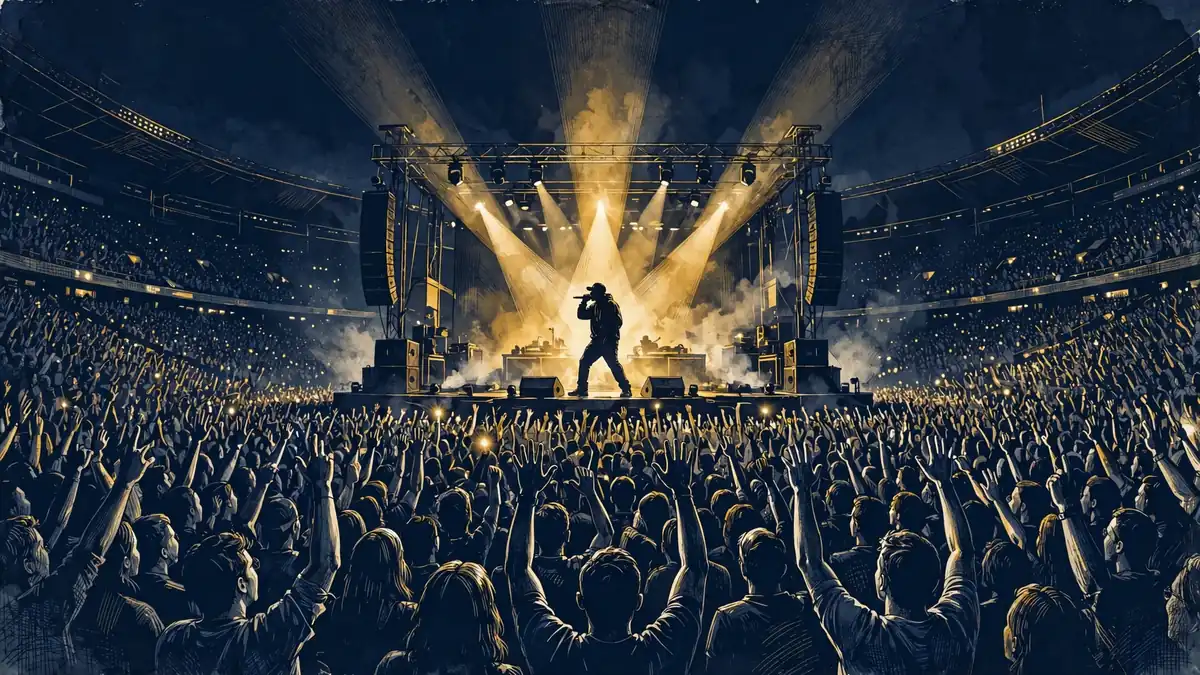
The numbers, reported by Touring Data via Chart Data and XXL in September 2025: $390.7 million gross across 47 shows, with 2.037 million tickets sold. Every dollar of it came in the 2025 calendar year. It is the highest-grossing tour by a rapper in history, and the highest-grossing co-headlining tour of all time — edging Jay-Z and Beyoncé’s 2018 On The Run II by about $3 million.
The structure matters as much as the total. SZA co-headlined the North American and European legs; Lamar continued solo through Australia and Latin America from September to December 2025. The tour kicked off April 19, 2025, at Minneapolis’ U.S. Bank Stadium — $9 million-plus from 47,000 tickets on opening night, making Lamar the first rapper to gross over $9 million from a single concert. Houston’s NRG Stadium followed at $9.4 million, breaking Eminem’s $9 million Melbourne record from 2019. The Seattle stop pulled $14.8 million from 60,000-plus tickets, the highest-grossing hip-hop concert ever at the time. His September 23, 2025 show at Mexico City’s Estadio GNP Seguros drew 58,426 — his most-attended show ever — for $5.879 million, performed without SZA.
Here is what the gross does not tell you, and what this article will not pretend to know: the public gross is collected before promoter and venue shares, stadium rent, staging, transport, crew, insurance, ticketing, marketing, and taxes — and the co-headliner split with SZA is private. Without a settlement statement, nobody outside the tour’s accountants can calculate Lamar’s personal profit. What we can do honestly is illustrative math, and we label it as such: on a representative $8.3 million-per-show average gross, industry-standard splits typically leave the artist side with roughly 60–70% before the artist’s own costs; split two ways with a co-headliner, then subtract a three-hour stadium production with a massive ensemble cast, plus taxes and management. A reasonable illustrative range for Lamar’s per-show take-home lands in the low seven figures. Real money — and a fraction of the headline. This is illustrative, not reported.
The records tell the pricing-power story the net can’t. First rapper to $9 million in a single night. Highest-grossing hip-hop concert ever in Seattle. Most-attended show of his career in Mexico City. These are not just superlatives; they are data points for the next negotiation. Every promoter who books Kendrick Lamar after 2025 knows what the last tour did. The guarantee goes up. The backend gets richer. The $390.7 million gross is a historical fact; its real value is as a comp for every deal after it.
For perspective on the trajectory: the Big Steppers Tour (2022–2023) grossed $110.9 million across 73 shows, per Marca — the rap-tour record at the time. The Grand National Tour grossed 3.5 times that in 26 fewer shows. Stadiums instead of arenas, a co-headliner doubling the draw, and the feud’s cultural heat turned a record into a relic in two years.
The Drake Feud and the Not Like Us Payday
The 2024 feud with Drake was the most commercially consequential rap beef in history, and its economics deserve a section because no competitor covers them with this specificity. The exchange produced multiple diss tracks from both sides, but one song became the event: “Not Like Us.” Released in May 2024, it broke the record for the most-streamed song in a single week in the U.S. this decade: 96 million streams in its first seven days, per Parade’s reporting, bumping Cardi B’s “WAP” and Taylor Swift’s “Fortnight” from the top spots. It reportedly earned $280,000 in that first week alone.
The $280,000 is the tree; the forest is what followed. “Not Like Us” won five Grammy Awards in February 2025, including Record of the Year and Song of the Year — the first diss track ever to take the top honors. Lamar performed it at the Super Bowl halftime show days later, in front of 133.5 million viewers, with the camera cutting to Serena Williams crip-walking during the bridge. The song’s momentum powered the surprise GNX drop, the Grand National Tour’s pricing power, and a catalog-wide streaming surge. Parade’s analysis is direct: the bigger payoff came downstream, in the album, the halftime show, and the $390.7 million tour.
The feud’s financial asymmetry is the honest part. Drake’s net worth sits at roughly $400 million (Celebrity Net Worth, 2026) — double Lamar’s — built on catalog ownership, the 2022 UMG equity arrangement, and brand partnerships including Stake.com that survived the beef intact. Lamar won the cultural battle decisively and converted it into the biggest single-year payday in hip-hop history ($109 million in 2025). But as Film Daily’s 2026 analysis notes, the structural gap never closed: Drake’s diversified holdings and ownership stakes compound faster than single-year spikes from diss tracks. Lamar out-earned Drake by a reported $31 million in 2025 (per LitNightzNews) yet still trails by $200 million in total net worth. The beef was a battle; the balance sheet is a war.
The Hip-Hop Money Scoreboard
| Artist | Est. net worth (2026) | How made |
|---|---|---|
| Jay-Z | $2.5B | Roc Nation; D’Ussé; Uber; catalog |
| Dr. Dre | ~$500M+ | Beats sale ($3B to Apple); Aftermath |
| Drake | $400M | UMG equity; catalog; Stake.com; touring |
| Kendrick Lamar | $140–$220M | Touring; royalties; pgLang; real estate |
| J. Cole | ~$60M | Dreamville; touring; catalog |
| Travis Scott | ~$80M | Cactus Jack; Nike; McDonald’s; touring |
The table is the article’s thesis in miniature. Everyone above Lamar on the money list built a consumer empire: Jay-Z’s liquor and portfolio, Dre’s headphones, Drake’s equity-plus-sponsorship machine. Everyone below him is either earlier in the arc (Cole) or built on brand heat rather than catalog depth (Travis Scott). Lamar sits alone in the middle: the only artist whose fortune is overwhelmingly music-derived — touring, royalties, publishing — with no liquor brand, no fashion empire, no tech exit. It is a lower ceiling and a cleaner foundation. The $140–$220 million range reflects music money, honestly counted, with no empire premium attached.
The Drake row deserves a second look because it is the comparison every reader makes. Same generation, same 2024 feud, wildly different structures. Drake’s 2022 UMG arrangement included an ownership stake in his masters plus future releases — equity that compounds. Lamar operates under standard label contracts (with the pgLang/Independent overlay for new work) and an exclusive publishing admin deal, not an ownership play. Industry analysts cited by Film Daily note that equity stakes compound faster than royalty splits. The $200 million gap between them is not a talent gap; it is a deal-structure gap, nearly two decades in the making.
The Catalog and Publishing Engine
Six studio albums, billions of streams, and a catalog that behaves differently from every peer’s. The key structural fact: in 2020, Lamar signed an exclusive publishing administration deal with Universal Music Publishing Group. Terms are confidential — UMPG does not disclose admin splits — but the deal covers his songwriter royalties going forward and represents the professionalization of his publishing income. As a songwriter on nearly everything he releases, Lamar earns both the artist royalty and the writer’s share, a double dip that most performers don’t get.
The catalog’s economics are event-driven in a way that rewards his release strategy. Lamar releases rarely — five years between DAMN. and Mr. Morale, then the surprise GNX — and each release triggers a catalog-wide streaming surge as new listeners work backward. The Drake feud was the extreme case: “Not Like Us” didn’t just stream itself, it lifted every album. The Super Bowl did the same. This is the quality-over-quantity dividend: fewer releases, each one a cultural event, each event repricing the entire back catalog. It is the opposite of the mixtape-era volume play, and it works because the music sustains the attention.
What remains undisclosed — and what keeps the range wide — is master ownership on the pre-2022 releases. InvestorMint’s 2026 analysis is explicit: master ownership on pre-Mr. Morale recordings is publicly undisclosed, and Lamar does not own Aftermath (the Dre association was a recording contract, not equity). If he owns his TDE-era masters, the catalog is worth significantly more than if Interscope/Aftermath hold them. Until a filing or interview clarifies it, the honest position is the range: $140 million if the masters are largely label-held, $220 million if he controls more of the catalog than the public record shows.
The Super Bowl Effect
On February 9, 2025, Kendrick Lamar headlined the Apple Music Super Bowl LIX Halftime Show at the Caesars Superdome in New Orleans. The official viewership, announced by NBC: 133.5 million viewers — the most-watched halftime show in history, edging Michael Jackson’s 133.4 million from 1993. (Bad Bunny’s 2026 show drew 128.2 million, per NBC’s February 2026 announcement, leaving Lamar’s record intact.) The setlist spanned the catalog — “squabble up,” “HUMBLE.,” “DNA.,” “euphoria,” “luther” with SZA, “All the Stars” with SZA, “Not Like Us,” “tv off” — with guest appearances from Samuel L. Jackson, Serena Williams (crip-walking during “Not Like Us”), and producer Mustard. It was his second Super Bowl appearance; in 2022 he’d performed in the all-star hip-hop lineup with Dr. Dre, Snoop Dogg, Eminem, and Mary J. Blige.
The halftime show doesn’t pay — the NFL covers production costs but performers traditionally play for exposure, not a fee — so its value is entirely indirect. And the indirect value was enormous: a 133.5-million-viewer commercial for the Grand National Tour, which kicked off ten weeks later; a catalog streaming spike across every platform; and the cultural cementing of “Not Like Us” as the song of the year, days after its five Grammy wins. The tour’s record-breaking pricing power is inseparable from the halftime show’s audience. A $390.7 million tour doesn’t happen without the 133.5 million people who watched him command the biggest stage in American television two months before tickets went on sale.
Social Media Presence
Lamar’s social media presence is famously minimal — and the minimalism is strategic. His Instagram following sits in the tens of millions, but posts are rare, often limited to album announcements, tour dates, and pgLang projects. There is no daily content, no lifestyle flexing, no sponsored posts. His X/Twitter is similarly sparse. The approach is the opposite of the influencer-rapper playbook: scarcity as brand management.
The economics of the absence are worth noting. A rapper with Lamar’s following could command mid-six-figures per sponsored post; he posts none. The foregone income is a choice — the same choice that keeps his brand deals selective and his public image controlled. In an era when every artist is a content creator, Lamar’s refusal to create content is itself a differentiator. The mystique has a price, and he pays it in unposted ads.
Personal Life
Lamar has been with his fiancée, Whitney Alford, since high school. They got engaged in 2015 and have two children together. Alford, a licensed esthetician, has remained almost entirely out of the public eye — she appeared with their children in the “Not Like Us” music video in 2024, a rare public moment that merged family with art. The relationship’s longevity and privacy stand in sharp contrast to the public romantic lives of most rap stars; there are no tabloid cycles, no public breakups, no drama to monetize or manage.
The family is the through-line of the later albums: Mr. Morale & the Big Steppers is in large part about fatherhood, therapy, and breaking cycles. The Brentwood estate (2024, $40 million) and Manhattan Beach home (2019, $9.7 million) are family bases, not bachelor pads. For a man whose art is obsessed with legacy — what gets passed down, what gets broken — the private life is the thesis lived: stability as rebellion, family as the real empire.
Sources & Reporting
Celebrity Net Worth (via Parade, Sept 2026) — $200M estimate; 27 Grammys/66 nominations; “Not Like Us” $280K first week, 96M streams; Forbes $30M (2016–17), $58M (2018). InvestorMint (June 2026) — $140–$220M range analysis; $109M 2025 earnings; pgLang/Project 3 structure; no Aftermath ownership; UMPG deal; path to $250–$300M. Touring Data via Chart Data / XXL (Sept 2025) — Grand National Tour $390.7M, 47 shows, 2.037M tickets; Seattle $14.8M; Minneapolis $9M+ opener. Forbes Hip-Hop Cash Kings (2018, 2019) — $58M (#3, 2018), $38.5M (#8, 2019); methodology (pretax, June–June). NBC (Feb 2026) — Super Bowl LIX 133.5M viewers (record); Bad Bunny LX 128.2M. Billboard — album first-week figures (DAMN. 603K, Mr. Morale 295K, good kid 242K); $250K/verse (2015). Architectural Digest via Realtor.com — Manhattan Beach $9.7M (2019); Bel Air $15.85M (Dec 2022, Fickett 1951). New York Times — Brooklyn penthouse $8.6M (2023, Pierhouse). Fast Company (2025) — Project 3 Agency launch; Frosty acquisition (30 staff); Dave Free interview. The Ankler (Sept 2026) — Parker/Stone apology; Whitney Springs delay. Marca — Big Steppers Tour $110.9M (73 shows). Film Daily (2026) — Drake $400M vs Kendrick $200M; UMG equity vs standard contracts. Prestige (2026) — Jay-Z $2.5B context; GNX Grammy. HipHopDX via NME — Eastvale $523.5K (2013). The Celeb Trends (2026) — Brentwood $40–42M (2024); property portfolio ~$79M. Reporting window 1987–October 2026.
Frequently Asked Questions
What is Kendrick Lamar’s net worth in 2026?
Estimated at $140–$220 million. Celebrity Net Worth — the most-cited tracker — publishes $200 million via Parade’s September 2026 update. The range reflects uncertainty about master ownership on his pre-2022 releases and the private finances of pgLang. His 2025 earnings of $109 million, the biggest single-year payday in hip-hop history, support the upper half of the range.
How much did Kendrick Lamar make from the Grand National Tour?
The tour grossed $390.7 million across 47 shows — the highest-grossing rap tour ever. His personal take-home is undisclosed: it was a co-headline with SZA, and the gross is split with promoters, venues, crew, and production before artists are paid. Illustrative math (not reported figures) puts his per-show net in the low seven figures.
How much did Kendrick Lamar make from “Not Like Us”?
Parade reports the song earned roughly $280,000 in its record-breaking first week (96 million US streams). The bigger payoff came downstream: five Grammy Awards including Record and Song of the Year, a Super Bowl halftime performance, and the momentum that powered the GNX album and the $390.7 million Grand National Tour.
Who is richer, Drake or Kendrick Lamar?
Drake, by roughly double. Celebrity Net Worth lists Drake at $400 million versus Kendrick’s $200 million in 2026. The gap comes from deal structure: Drake’s 2022 UMG arrangement included an ownership stake in his masters plus sponsorship income, while Kendrick operates under standard label contracts with a publishing admin deal.
Does Kendrick Lamar own his masters?
Master ownership on his pre-2022 releases is publicly undisclosed. What is confirmed: an exclusive publishing administration deal with Universal Music Publishing Group (2020, terms confidential), and that he does not own Aftermath Entertainment — his Dr. Dre association was a recording contract, not an equity stake. Newer releases come through pgLang, his own company.
What is pgLang?
pgLang is the multidisciplinary creative company Kendrick Lamar co-founded with Dave Free in 2020. It handles his music, film, and brand work, signed artists including Baby Keem, won six Cannes Lions in 2023, and launched the Project 3 creative agency in 2025. It is also behind the delayed Whitney Springs film with South Park creators Trey Parker and Matt Stone.
How many Grammys does Kendrick Lamar have?
27 Grammy wins from 66 nominations, per Parade’s September 2026 tally — the most of any rapper in history. Five of those came in 2025 for “Not Like Us,” including Record of the Year and Song of the Year. He also won the 2018 Pulitzer Prize for Music for DAMN., the first non-classical/jazz artist ever to do so.
How much is Kendrick Lamar’s house worth?
His property portfolio’s purchase prices total roughly $77 million: a $40 million Brentwood estate (2024, his primary home), $15.85 million Bel Air estate (2022), $9.7 million Manhattan Beach home (2019), $8.6 million Brooklyn penthouse (2023), $2.65 million Calabasas home (2017), plus a starter home bought for $523,500 in 2013 and sold around 2021. Several markets have appreciated since purchase.
Final Thoughts
Kendrick Lamar’s $140–$220 million is the fortune of the greatest rapper alive who refused to become a mogul. The $109 million year — the biggest in hip-hop history — came from music: a $390.7 million tour, a diss track that became a cultural event, a catalog that spikes with every moment. No liquor brand, no fashion empire, no tech exit. Just six albums, 27 Grammys, a Pulitzer, and the most disciplined brand in rap.
The range stays honest because the private holdings stay private: master ownership undisclosed, pgLang’s books closed, the Whitney Springs film in limbo. What is certain is the trajectory — from $5 million in 2012 to $200 million in 2026, with the steepest climb in the last three years. Drake has double the net worth and half the Grammys. Jay-Z has ten times the fortune and a liquor empire. Lamar has the Pulitzer, the record tour, and a catalog that will pay his grandchildren. That was the trade, and he made it on purpose.
Published on October 7, 2026. Last reviewed October 2026. Found an error? See our corrections policy.