
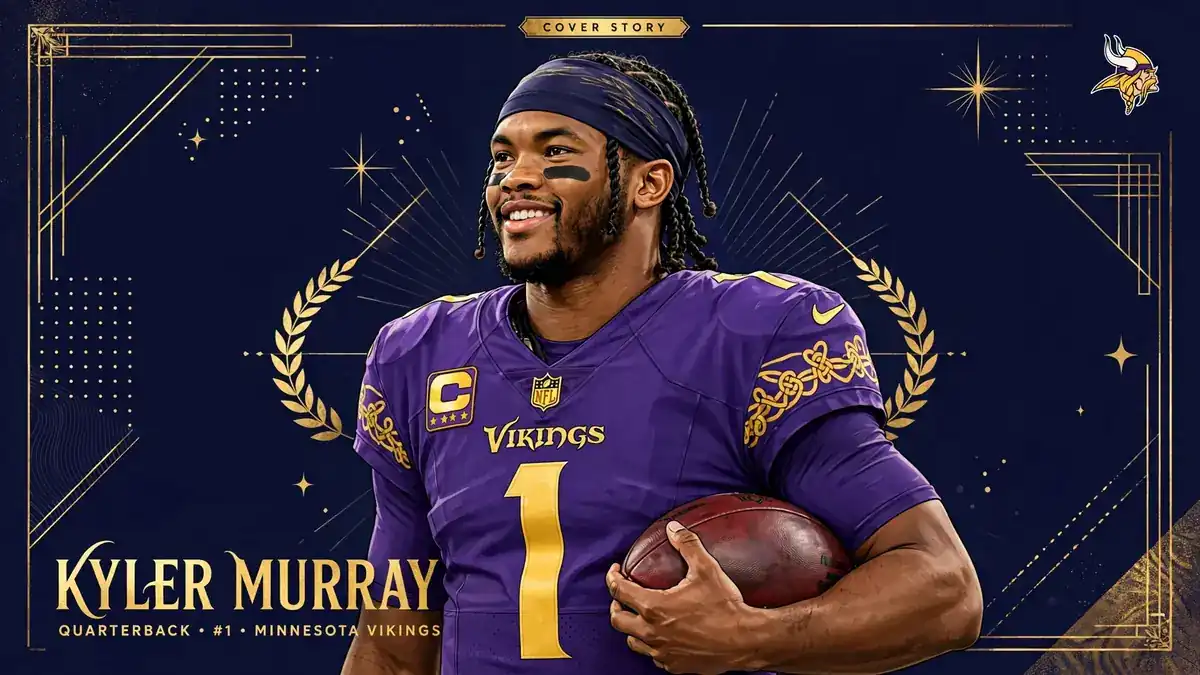
Kyler Murray‘s net worth is estimated at $40 million to $50 million as of November 2026. The figure sits at the center of one of the strangest money stories in the modern NFL: a quarterback who signed a $230.5 million extension in 2022, watched his team cut him in March 2026, and still banks roughly $36.8 million this season — $35.5 million of it from the franchise that let him go, plus a $1.3 million veteran-minimum deal with the Minnesota Vikings. Behind that headline sits $206.8 million in career cash earnings, a Heisman Trophy, a first-overall draft pick, a $4.66 million baseball signing bonus he walked away from, and a second act in Minnesota that began with six starts and ended, for now, with a hamstring strain. This article breaks down every dollar — contract by contract, deal by deal — with sources named for each figure.
Kyler Murray: Quick Facts
| Estimated net worth | $40–50 million (range: $40 million to $50 million) |
|---|---|
| Profession | NFL quarterback, Minnesota Vikings |
| Nationality | American |
| Born | August 7, 1997 (age 29) |
| Height | 5 ft 10 in (1.78 m) |
| Primary income sources | NFL contracts, endorsement deals, appearance fees |
| Active years | 2019–present |
| Last reviewed | November 2026 |
- Early Life and Background
- Education
- Career Journey
- Rise to Fame
- Main Sources of Income
- Salary and Earnings
- Businesses and Investments
- Brand Deals and Sponsorships
- Houses, Cars and Other Assets
- How Murray Compares With Other Quarterbacks
- Awards and Achievements
- Net Worth Growth Over the Years
- Social Media Presence
- Personal Life
- Sources & Reporting
- Frequently Asked Questions
- Final Thoughts
Early Life and Background
Kyler Cole Murray was born on August 7, 1997, in Bedford, Texas, and grew up inside football. His father, Kevin Murray, quarterbacked Texas A&M from 1983 to 1986 and later coached his son, so the game was less a hobby than the family trade. His mother, Missy Murray, kept the household steady while her son’s schedule filled with two sports at once — football in the fall, baseball in the spring — and that dual path would later put an eight-figure decision in front of him before his 22nd birthday.
At Allen High School, north of Dallas, Murray became the most decorated schoolboy quarterback Texas had produced in a generation. He won three consecutive state championships and never lost a game as Allen’s starter, finishing 43–0, a record that still gets cited whenever scouts argue about whether winning at every level is a skill or a coincidence. Recruiting services rated him a five-star prospect and the top dual-threat quarterback in the 2015 class, and he committed to Texas A&M, his father’s school, over offers from nearly every major program in the country. The decision looked straightforward at the time. Within a year it would unravel, and the detour that followed — a transfer, a redshirt year, a season holding a clipboard behind a Heisman winner — is what turned a famous high school name into a first-overall NFL pick.
What the high school years explain about the money is simple: Murray arrived in college football already carrying a reputation, and reputation is what made two professional leagues bid against each other for him three years later. The Oakland Athletics drafted him ninth overall in the 2018 MLB draft while he was still Oklahoma’s starting quarterback, and the bidding war that followed — baseball money on one side, football money on the other — set the floor for everything he has earned since.
Education
Murray enrolled at Texas A&M in 2015 and played as a true freshman, appearing in eight games as the backup to Kyle Allen and throwing for 686 yards. The season ended in friction: Allen transferred, Murray announced his own transfer in December 2015, and the most celebrated recruit in program history left College Station after a single year. He landed at Oklahoma, where NCAA transfer rules forced him to sit out the 2016 season entirely — a year of practice reps and scout-team work with no Saturdays attached.
In 2017 he backed up Baker Mayfield, the quarterback who would win the Heisman Trophy that December and go first overall in the 2018 NFL draft. Murray threw for 359 yards in limited duty, and the apprenticeship mattered more than the stat line: he spent a full season inside Lincoln Riley’s offense, learning the system he would inherit, while Mayfield’s farewell tour showed him exactly what the job paid in attention and draft stock. When Mayfield left, the job was Murray’s, and the 2018 season he produced is one of the best single years any college quarterback has ever had.
The numbers still hold up against any season in the sport’s history: 4,361 passing yards, 42 passing touchdowns, 1,001 rushing yards, 12 rushing touchdowns, and 54 total touchdowns, with just seven interceptions. Oklahoma won the Big 12, reached the College Football Playoff, and lost a 45–34 semifinal to Alabama. Murray won the Heisman Trophy over Alabama’s Tua Tagovailoa, added the Davey O’Brien Award as the nation’s best quarterback, and was named the Associated Press College Football Player of the Year. He had played exactly one season as a college starter — and it was enough to make him the most argued-over prospect in the 2019 NFL draft, a 5-foot-10 quarterback with a baseball contract already in his pocket and a Heisman on his shelf.
Career Journey
Murray’s professional story starts in baseball. The Oakland Athletics selected him ninth overall in the June 2018 MLB draft and signed him to a contract carrying a $4.66 million signing bonus, with a clause — never before granted by a major league club, according to Sports Illustrated — allowing him to play one more season of college football before reporting to spring training in 2019. The plan was clean on paper: one Heisman-caliber season at Oklahoma, then a baseball career. Then the season he had was better than anyone expected, and the plan collapsed under its own success.
That winter, Oakland tried to buy his football future outright. According to Sports Illustrated’s Robert Klemko, the Athletics offered Murray a reworked deal worth $14 million in guaranteed money on top of his signing bonus, plus a spot on the 40-man roster — a package designed to match what a top-10 NFL draft pick would earn. Murray turned it down. On February 11, 2019, days before he was due at spring training, he announced on social media that he was “firmly and fully committing” to football. The price of the choice was immediate: he repaid $1.29 million of the $1.5 million signing bonus he had already received and forfeited the remaining $3.16 million, per ESPN’s Jeff Passan. Oakland kept his baseball rights on its restricted list, but the $4.66 million was gone, and the $14 million was never collected.
The football payoff arrived fast. Murray measured 5 feet 10 and 1/8 inches and 207 pounds at the NFL Scouting Combine in February 2019, ending months of speculation that he might measure shorter, and the Arizona Cardinals selected him first overall on April 25, 2019. He signed a fully guaranteed four-year rookie deal worth about $35 million on May 9, 2019, including a signing bonus worth roughly $23.5 million, per ESPN. The rookie contract alone was worth more than everything baseball had offered combined — the gamble had paid, and it had paid in the first week.
His rookie season justified the pick. Murray threw for 3,722 yards with 20 touchdowns and 12 interceptions, added 544 rushing yards and four rushing touchdowns, and was named NFL Offensive Rookie of the Year. The Cardinals went 5–10–1, but the direction of the franchise had changed, and Murray’s dual-threat skill set — a passer who could turn a broken play into a 30-yard run — gave Arizona an identity it had lacked for years.
The next two seasons were the peak of his Arizona tenure. In 2020 he threw for 3,971 yards and 26 touchdowns, ran for 819 yards and 11 touchdowns, and made his first Pro Bowl. In 2021 he threw for 3,787 yards and 24 touchdowns, the Cardinals opened the season 7–0, finished 11–6, and reached the playoffs for the first time since 2015, losing to the eventual Super Bowl champion Rams in the wild-card round. Murray made his second straight Pro Bowl. At that point, at 24 years old, he looked like a franchise quarterback for the next decade — and the Cardinals paid him like one.
The extension came on July 21, 2022: five years, $230.5 million, with $160 million guaranteed and a $46.1 million average annual value that ranked third among NFL quarterbacks at signing, behind only Patrick Mahomes and Josh Allen, according to Sporting News. The deal also carried the most talked-about clause in recent NFL history — a requirement that Murray complete four hours of independent film study per week, with guarantees at risk if he did not. The backlash was instant and league-wide, and the Cardinals removed the clause within days. The episode left a mark on Murray’s public image that outlasted the contract language itself, and it colors how his Arizona years are remembered: a quarterback paid like a star, questioned like a project.
Then came the injuries. On December 12, 2022, Murray tore his ACL against the New England Patriots, ending his season after 11 games in which he had thrown for 2,368 yards and 14 touchdowns. The recovery cost him the first nine games of 2023; he returned on November 12 against Atlanta and played eight games, throwing for 1,799 yards with 10 touchdowns and five interceptions. He came back healthy in 2024 and played all 17 games, throwing for 3,851 yards with 21 touchdowns and 11 interceptions at a career-best 68.8 percent completion rate, plus 572 rushing yards and five rushing touchdowns. The Cardinals finished 8–9, and the season felt like a holding pattern: good numbers, no playoffs, and a roster that was clearly being rebuilt around someone else’s timeline.
The end arrived in 2025. Murray played five games, throwing for 962 yards with six touchdowns and three interceptions, before suffering a foot injury in a Week 5 loss to the Tennessee Titans. He went on injured reserve on November 5, 2025, Jacoby Brissett took over as starter, and the Cardinals shut Murray down for the rest of the season on December 5. The reporting out of Arizona through the winter was consistent: the franchise had decided to move on, and the only question was how much it would cost. ESPN’s Adam Schefter reported the Cardinals had informed Murray he would be released on the first day of the new league year if no trade partner emerged. No trade emerged.
On March 11, 2026, the Cardinals released him, absorbing a $54.7 million dead-cap hit, per Over The Cap. The next day, March 12, Murray signed a one-year, $1.3 million veteran-minimum deal with the Minnesota Vikings, per multiple outlets — a contract that, on paper, made him one of the lowest-paid starting quarterbacks in the league. The paper lied. Arizona still owed him $36.8 million in guaranteed money for 2026 regardless of where he played, and the $1.3 million Vikings salary is offset against that obligation, meaning his total 2026 cash is roughly $36.8 million. His Vikings deal also includes a no-tag clause, according to Spotrac, so Minnesota cannot use the franchise or transition tag on him after the season — he will hit free agency again in 2027 with his choice of destination.
Through Week 8 of the 2026 season, Murray had started six games for Minnesota, completing 100 of 154 passes for 1,022 yards with five touchdowns and three interceptions, and adding 167 rushing yards. On November 1, against Detroit, he suffered a Grade 2 hamstring strain, per NFL Network’s Tom Pelissero, and was ruled out for the Week 9 Monday night game against Buffalo. Head coach Kevin O’Connell said injured reserve was not under consideration and described Murray as week-to-week, with Carson Wentz — who had started two games earlier in the season after Murray suffered a concussion — in line to start. The Vikings were 6–1 at the time, and the question hanging over Murray’s second act was the same one that had followed him in Arizona: whether his body would let him finish what his talent started.
Rise to Fame
Murray’s rise ran on a compressed schedule that few athletes ever match: three state titles in high school, a Heisman Trophy in his only season as a college starter, a first-overall draft pick four months later, and Offensive Rookie of the Year before his 23rd birthday. Each step raised the price of the next one. The high school winning streak made him a five-star recruit. The Heisman made him a two-sport bidding war. The rookie season made him a $230.5 million quarterback.
The 2021 season was the high-water mark of his fame. The Cardinals’ 7–0 start was the best in franchise history, Murray was an early MVP candidate, and his highlights — a 47-yard touchdown run against Dallas in 2020, a Hail Mary to DeAndre Hopkins to beat Buffalo that same season — were the plays that travel furthest on social media and do the most for a player’s market value. Two Pro Bowls in his first three seasons put him in the same conversation as the league’s young stars, and the extension in 2022 was the formal version of that conversation: Arizona had decided he was the future.
What makes Murray’s fame unusual is how much of it arrived before he had won anything that mattered in January. He reached the playoffs once in seven Arizona seasons and lost his only playoff game. His reputation was built on talent and potential rather than postseason results, and that gap is the central tension of his career — and of his net worth. The $230.5 million contract was a bet on what he could become. The 2026 release was the bill for what he had not.
Main Sources of Income
NFL contracts account for nearly all of Murray’s wealth, and the arithmetic is unusually clean because his earnings are a matter of public record. Over The Cap puts his career cash earnings at $205,491,784 from the Cardinals across seven seasons, plus $1.3 million from the Vikings in 2026, for a career total of roughly $206.8 million. That figure counts salary, signing bonuses, roster bonuses, and incentives actually paid — not the headline value of contracts, which is always larger than the cash a player collects. The gap between the $230.5 million extension and the cash he actually banked from it is the story of the deal: Arizona’s guarantees covered about $160 million of it, and the rest was money he would only have seen by staying healthy and staying on the roster through 2028.
Endorsements are the second income stream, and a much smaller one. Murray’s confirmed deals include Nike, which signed him around his rookie season and supplies his footwear and apparel, Panini America for trading cards, and FaZe Clan, the gaming organization he joined in 2021. No outlet has published a verified annual endorsement total for Murray, and the deals are confirmed while the dollars are not — a pattern that holds for most NFL players outside the top handful of pitchmen. The reasonable reading, based on the size and number of the deals, is that endorsements contribute a small fraction of his yearly income next to his playing salary, and they never approached the scale of his contract money.
Appearance fees, paid social media work, and his gaming and streaming presence round out the picture. Murray streams video games on Twitch and has built a genuine audience there, which is both a hobby and a small revenue line, and his FaZe Clan membership sits at the intersection of the two — a gaming deal that pays him to do something he would be doing anyway. None of these streams is large enough to move his net worth by itself. The honest summary of Murray’s income is a one-line version: he is a football player who got paid like a star quarterback, and everything else is a footnote.

Salary and Earnings
The contract that defines Murray’s finances is the extension he signed on July 21, 2022: five years, $230.5 million, $160 million guaranteed, a $46.1 million average annual value. Sporting News, working from Spotrac’s breakdown, reported the guarantee figure as $159.7 million — the small difference comes from how the final year of guarantees was structured — and noted that $105 million was guaranteed at signing, per PlayersBio. At the moment the ink dried, only Patrick Mahomes and Josh Allen carried a higher average annual value among quarterbacks. The deal also gave Arizona an escape hatch after the 2027 season, when the remaining guarantees thinned out; the Cardinals never got there, because the injuries and the 2025 collapse brought the divorce forward by two years.
Under the extension’s original schedule, Murray was set to earn a $22.835 million base salary in 2026 with a $53.26 million salary-cap hit, followed by $19.5 million in base salary and a $43.535 million cap hit in 2027, and $34 million in base salary with a $46.35 million cap hit in 2028. Those numbers are the ones Arizona walked away from in March 2026, and they explain why the release cost so much: $29.835 million of his 2026 money had already become fully guaranteed on the fifth day of the 2025 league year, per ESPN, and the total guaranteed obligation for 2026 came to $36.8 million, per Spotrac and Bleacher Report. Cutting him before June 1 meant eating $54.7 million in dead cap, per Over The Cap, against roughly $1.5 million in cap savings — a brutal trade, and one the Cardinals made anyway, which says more about how the relationship had deteriorated than any press release could.
His rookie deal is the other anchor of his earnings. The four-year, fully guaranteed contract worth about $35 million, with a signing bonus of roughly $23.5 million, paid him more in its first year than most players earn in a career, and it set up the extension: by the time Arizona had to decide on his fifth-year option and then the extension, Murray had already banked more than $70 million in cash from football. The table below shows the contract milestones that built the fortune.
| Contract | Value | Key detail |
|---|---|---|
| Rookie deal, Cardinals (2019) | ~$35 million over 4 years | Fully guaranteed; ~$23.5 million signing bonus |
| Extension, Cardinals (2022) | $230.5 million over 5 years | $160 million guaranteed; $46.1 million average annual value |
| Vikings deal (2026) | $1.3 million over 1 year | Veteran minimum; includes a no-tag clause |
| Cardinals guarantee still owed (2026) | $36.8 million | Paid regardless of roster status; Vikings salary offsets it |
| Career cash earnings | ~$206.8 million | Over The Cap: $205.5 million from Arizona, $1.3 million from Minnesota |
The arithmetic of 2026 deserves a closer look, because it is the detail most coverage gets wrong. Headlines called Murray a $1.3 million quarterback this season, and his Vikings pay stub does say $1.3 million. But the Cardinals’ $36.8 million guarantee is money he collects no matter what, and the Vikings salary is deducted from Arizona’s obligation under the NFL’s offset rules — the same structure Russell Wilson used in Pittsburgh in 2024 after Denver released him. Murray’s real 2026 cash is therefore about $36.8 million in total: roughly $35.5 million from Arizona plus $1.3 million from Minnesota. He is simultaneously the lowest-salaried starter in the league and one of its highest-paid players in real dollars, and that paradox is the cleanest summary of his financial position in 2026.
What comes next is where the money gets interesting again. The no-tag clause in his Vikings deal means Minnesota cannot franchise him in 2027, so he will reach free agency with a full choice of teams. A healthy season as a starter — or even a strong run of games in relief — would put him in line for a multi-year deal in the $20 million to $30 million per year range that second-tier starting quarterbacks command, while another injury-marred year would push him toward backup money. His net worth in 2027 will turn on which of those two outcomes arrives.
Businesses and Investments
Here is where Murray’s profile differs from the quarterbacks he is usually compared with. Patrick Mahomes owns pieces of the Kansas City Royals, Sporting Kansas City, and the Kansas City Current, plus a stake in a Formula 1 team. Lamar Jackson negotiated his own $260 million extension and has spoken openly about his business ambitions. Murray, by contrast, has no verified public record of a business portfolio — no announced startup equity, no franchise stake, no real estate fund, no public filing tying him to a company. That absence is itself a data point, and it is worth stating plainly rather than filling the gap with speculation.
What he does have is a gaming footprint. In 2021 Murray joined FaZe Clan, the esports and entertainment organization, as a member — a deal that put a starting NFL quarterback inside one of the biggest gaming brands in the world and made him one of the first active NFL players to sign with an esports organization. The arrangement fits his actual life: Murray is a serious gamer, streams on Twitch, and has talked about gaming as his main pastime away from football. Whether the FaZe deal carries equity or is a straight endorsement contract has never been disclosed, and FaZe Clan’s own corporate history — a SPAC listing, a steep fall in value, a private buyout — makes any equity guess unreliable. We count it as an endorsement, not an investment, until a filing says otherwise.
His other investments, if any, are private. No property record, corporate filing, or verified report ties Murray to a business venture of any size, and his public statements about money have been sparse. The contrast with his peers is instructive: the quarterbacks who built the biggest fortunes after football — the Mahomes model, the Tom Brady model — treated their playing years as the funding round for a second career. Murray, at 29, still has time to follow that path, and the 2027 free agency will be the moment to watch: a new contract in a new city is also a chance to build the off-field portfolio he has not built yet. For now, his wealth is almost entirely a football story, and that concentration is both his strength and his risk. A player’s body is a depreciating asset, and Murray’s injury history — an ACL in 2022, a foot injury in 2025, a hamstring strain in 2026 — is the reason a diversified portfolio matters. The money he has already banked is safe. The money he has not yet earned depends on staying on the field.
Brand Deals and Sponsorships
Murray’s endorsement portfolio is selective rather than sprawling, and it tracks his two identities: the football star and the gamer. Nike is the anchor — the company signed him around his rookie season, and he has worn Nike cleats and apparel throughout his NFL career, including in the brand’s quarterback campaigns. Panini America, the trading card company, holds his card and collectibles rights, a standard deal for a first-overall pick whose rookie cards carry real value on the secondary market. FaZe Clan, as above, covers the gaming side.
What he has not done is also notable. Murray has never fronted a national fast-food campaign, a car commercial, or a bank advertisement of the kind that pays quarterbacks eight figures over a career. Some of that is positional: Arizona is a smaller media market than Dallas or New York, and the Cardinals’ limited prime-time exposure during his tenure kept his national profile below his talent level. Some of it is temperamental: Murray is famously private, rarely gives long interviews, and has never cultivated the media presence that turns a good quarterback into a commercial star. The result is an endorsement income that, while comfortable, is a rounding error next to his contract money — and a reminder that in the NFL, the biggest endorsement deal is usually the contract itself.
One episode from his endorsement-adjacent life deserves a mention because it briefly became a national story. In February 2022, during the contract extension talks, Murray scrubbed his Instagram account of Cardinals references and unfollowed the team, a move his agent later framed as a negotiating tactic and the internet read as a trade demand. The deal got done five months later, but the episode showed how quickly a social media account can become a bargaining chip in a nine-figure negotiation — and how closely fans and front offices now watch a player’s feed for signals about his future.

Houses, Cars and Other Assets
Public records offer little on Murray’s property and possessions, and this section says so rather than inventing a garage list. No verified public record documents a headline home purchase by Murray — no $10 million mansion reveal, no celebrity real estate column with a sale price attached. During his Arizona years he was based in the Phoenix area, as most Cardinals players are, and local reporting has placed him in the Scottsdale area, but no purchase price or address has been confirmed in a public record we could verify, and we do not publish unconfirmed property claims.
The same restraint applies to cars. Murray has posted vehicles on social media over the years, as most young athletes do, but no verified inventory of a collection exists, and the internet’s car lists for celebrities are mostly guesswork stitched together from Instagram screenshots. What can be said with confidence is that his tangible assets — whatever home and vehicles he owns — are a small slice of a $40 million to $50 million net worth built overwhelmingly from contract cash, and that his spending habits have never produced the kind of public financial trouble that follows some athletes. The absence of a flashy lifestyle record is, for a net worth estimate, good news: it means the money he earned is more likely to still be there.
That discipline, if it holds, matters more than any single purchase. NFL careers are short — the average is about three years — and the players who keep their money are usually the ones whose spending never scaled with their signing bonus. Murray has earned roughly $206.8 million in cash from football. Even after taxes, agent fees, and living costs, a player who banked that much and avoided the usual traps should be worth far more than the $40 million to $50 million range we publish. The fact that he is not worth $100 million is the other side of the estimate: taxes on $206.8 million of income take roughly half, agent fees take up to 3 percent, and seven years of life as a young star in the NFL cost real money. Our range is the number that survives that arithmetic, and it is consistent with what Celebrity Net Worth and the other outlets report.
Awards and Achievements
Murray’s trophy case is front-loaded: almost everything in it dates from before his 23rd birthday, and the NFL honors stopped coming after 2021. That pattern is the cleanest summary of his career arc, and the list below tells it without commentary.
- Heisman Trophy winner, 2018 — in his only season as Oklahoma’s starting quarterback
- Davey O’Brien Award, 2018 — the nation’s best college quarterback
- Associated Press College Football Player of the Year, 2018
- Big 12 Offensive Player of the Year, 2018, and first-team All-American
- NFL Offensive Rookie of the Year, 2019
- Two-time Pro Bowl selection, 2020 and 2021
- PFWA All-Rookie Team, 2019
- First overall pick, 2019 NFL Draft, Arizona Cardinals
- Ninth overall pick, 2018 MLB Draft, Oakland Athletics — the only athlete in modern history drafted in the first round of both leagues’ drafts in consecutive years
The last item on that list is the one historians will remember longest. Deion Sanders and Bo Jackson played both sports, but neither was a first-round pick in both drafts. Murray is the only player who was, and the $4.66 million baseball bonus he gave up to chase football is the price tag on a decision that defined his life. Everything since — the Heisman, the $230.5 million, the release, the Vikings — follows from a choice he made at 21, in the space of a few weeks, between two sports that both wanted him.
For the record, his NFL career totals through Week 8 of the 2026 season stand at 21,482 passing yards, 126 passing touchdowns, 63 interceptions, a 67.0 percent completion rate, 3,360 rushing yards, and 32 rushing touchdowns across 93 games, per FantasyData. The rushing numbers deserve emphasis: only a handful of quarterbacks in league history have run for 3,000 yards and 30 touchdowns, and Murray reached both marks before turning 30. His legs were always the separator — the trait that made a 5-foot-10 quarterback worth a first-overall pick — and they remain the reason a team will pay him again in 2027 if his hamstring heals.
Net Worth Growth Over the Years
Murray’s wealth followed the standard arc of a first-overall pick: a steep climb on the rookie deal, a jump when the extension landed, then a plateau as taxes and spending caught up with earnings. The table below is our estimate for each year, built from his contract cash flow and the published valuations of the outlets named in the sources section. The 2026 figure is a range because the outlets disagree; the earlier years are point estimates, and they should be read as approximations, not audited figures.
| Year | Estimated net worth | What moved it |
|---|---|---|
| 2019 | $4 million | Rookie deal signed; ~$23.5 million signing bonus lands |
| 2020 | $8 million | First Pro Bowl; second year of rookie salary |
| 2021 | $13 million | Second Pro Bowl; 7–0 start; playoff run |
| 2022 | $24 million | $230.5 million extension; $105 million guaranteed at signing |
| 2023 | $29 million | Return from ACL injury; extension cash flow continues |
| 2024 | $36 million | Full 17-game season; career-best completion rate |
| 2025 | $40 million | Foot injury ends season after five games; Celebrity Net Worth pegs $40 million |
| 2026 | $40–50 million | Cardinals release; $36.8 million guarantee plus $1.3 million Vikings deal |
Two things stand out in that table. The first is how little the net worth moved between 2025 and 2026 despite a $36.8 million cash year: the guarantee money replaces salary he would have earned anyway, and by 2026 his spending and tax baseline had caught up with his income. The second is the gap between career cash ($206.8 million) and net worth ($40 million to $50 million). Roughly half the cash went to federal and state taxes, agent fees took their percentage, and the rest went to living costs, family support, and the ordinary spending of a young star. None of that is unusual — it is the normal shape of an NFL fortune — but it is why the $230.5 million contract never translated into a nine-figure net worth, and why the next contract matters so much. At 29, Murray has one more big deal in him if his body cooperates. That deal, not the one Arizona just paid off, will decide whether his net worth doubles or stalls.
Social Media Presence
Murray’s social media presence is large, guarded, and occasionally newsworthy for what disappears from it. His Instagram account, @k1, carries a following in the low millions and mixes game photos, training clips, and gaming content, with long stretches of silence between posts. His X account, @K1, follows the same pattern. He also streams video games on Twitch, where his audience is smaller but far more engaged — the gaming community knows him as a genuine player, not a celebrity dabbling in a hobby, and his FaZe Clan membership grew directly out of that credibility.
The most famous episode in his social media history came in February 2022, when he removed Cardinals content from his Instagram during extension negotiations. The move was read across the league as a trade demand, his agent issued a statement calling for the Cardinals to commit to him long-term, and the extension followed five months later. It was a reminder that for a modern athlete, the feed is a negotiating table, and Murray — quiet in interviews, sparing with posts — used his sparingly and effectively. Since the move to Minnesota, his accounts have stayed focused on football and gaming, with no public commentary on the Arizona divorce beyond the work itself.
Personal Life
Murray keeps his private life out of public view to a degree that is rare for a quarterback of his profile. He is not publicly married, and no long-term partner has been confirmed in reliable reporting — the gossip sites that list a girlfriend for every athlete have cycled through names without a single one being confirmed by Murray or anyone close to him, and we do not repeat unconfirmed relationship claims. His family is the part of his personal life that is documented: his father, Kevin, played quarterback at Texas A&M and coached Kyler through high school, and the two remain close; his mother, Missy, has been a steady presence at his games since his Allen High School days.
Football and gaming fill most of the public record of how he spends his time. He has spoken about video games as his main outlet away from the facility, and his Twitch streams are the most unguarded version of him that exists in public — a contrast with his careful, clipped media sessions. He has not built a public charitable foundation of the kind some quarterbacks run, and his community work has been low-key rather than branded. At 29, with a new team, a new city, and a contract year ahead of him, the personal story is subordinate to the professional one: everything about Kyler Murray in 2026 comes back to whether he can stay healthy long enough to earn the next deal.
How Murray Compares With Other Quarterbacks
Stacked against the quarterbacks drafted around him and paid alongside him, Murray’s $40 million to $50 million net worth sits in the middle of the pack — ahead of some, far behind the very top. The table below uses Celebrity Net Worth’s published estimates for the comparison, so the numbers are one outlet’s view, not a blend, and they should be read as relative rather than exact.
| Quarterback | Estimated net worth | Why the gap |
|---|---|---|
| Patrick Mahomes | ~$90 million | Record $450 million contract, Super Bowl wins, equity stakes in four pro teams |
| Josh Allen | ~$70 million | $258 million Bills extension, MVP award, national endorsement profile |
| Joe Burrow | ~$50 million | $275 million Bengals extension, Super Bowl appearance |
| Kyler Murray | $40–50 million | $230.5 million extension, one playoff appearance, no postseason win |
| Lamar Jackson | ~$40 million | $260 million Ravens deal, two MVP awards, but a later start on the biggest money |
The pattern is plain: the quarterbacks who won in January are worth roughly twice what Murray is, even when their contracts are similar in size. Mahomes’ $450 million deal and his business portfolio put him in a different category, and Allen’s MVP season did for his market value what no regular-season stat line could do for Murray’s. The comparison is also the clearest argument for why the Vikings chapter matters financially: a deep playoff run in Minnesota would do more for Murray’s next contract — and for the endorsement deals that follow winning — than any single regular-season performance in Arizona ever did.
Sources & Reporting
Sporting News — the $40 million Celebrity Net Worth valuation and the full breakdown of the 2022 extension, including the $159.7 million guarantee figure and the year-by-year base salaries and cap hits from Spotrac.
ESPN — the 2019 rookie signing report ($35 million fully guaranteed, $23.5 million signing bonus), the 2026 reporting that the Cardinals had informed Murray of his release, and the $29.835 million guarantee trigger on the fifth day of the 2025 league year.
Spotrac — contract structure for the 2022 extension, the $36.8 million guaranteed for 2026, the $1.3 million Vikings deal, and the no-tag clause in the Minnesota contract.
Over The Cap — career cash earnings of $205,491,784 from Arizona, the $54.7 million dead-cap cost of the March 2026 release, and the $1.3 million 2026 Vikings cash figure.
Bleacher Report — the March 2026 reporting on the expected veteran-minimum deal, the $36.8 million Cardinals guarantee, and the offset mechanics that govern his 2026 pay.
Sports Illustrated — the 2018 reporting on the Athletics’ $14 million offer to keep Murray in baseball and the $4.66 million signing bonus terms.
Celebrity Net Worth — the $40 million net worth valuation cited by Sporting News and the peer-comparison figures in this article.
Surprise Sports — the $40 million to $55 million 2026 estimate range, updated October 2026.
Pro Football Archives — career and season-by-season statistics, including the 2025 and career totals used here.
FantasyData — 2026 Minnesota statistics through Week 8 and career totals (21,482 passing yards, 126 touchdowns, 3,360 rushing yards).
Reporting window: September 2025 to November 8, 2026. Contract figures come from Spotrac and Over The Cap records; net worth figures are estimates from the outlets named above, not audited financial statements. Where sources disagreed — the guarantee total, the top of the net worth range — we published the range and named who said what.
Frequently Asked Questions
What is Kyler Murray’s net worth in 2026?
Kyler Murray’s net worth is estimated at $40 million to $50 million as of November 2026. Celebrity Net Worth puts the figure at $40 million, while Surprise Sports gives a range of $40 million to $55 million and most other outlets land between $40 million and $50 million. His wealth comes almost entirely from NFL contracts: roughly $206.8 million in career cash earnings, led by the five-year, $230.5 million extension he signed with Arizona in 2022.
How much does Kyler Murray make in 2026?
About $36.8 million in total cash. His Minnesota Vikings contract pays a $1.3 million veteran-minimum salary, but the Arizona Cardinals still owe him $36.8 million in guaranteed money from his old deal, and the Vikings salary is offset against that obligation — so he collects roughly $35.5 million from Arizona plus $1.3 million from Minnesota. He is, at the same time, the lowest-salaried starter in the league and one of its highest-paid players in real dollars.
What team does Kyler Murray play for in 2026?
The Minnesota Vikings. Murray signed a one-year, $1.3 million deal with Minnesota on March 12, 2026, one day after the Arizona Cardinals released him. Through Week 8 he had started six games for the Vikings, throwing for 1,022 yards with five touchdowns and three interceptions, before a Grade 2 hamstring strain sidelined him for the Week 9 game against Buffalo.
Why did the Cardinals release Kyler Murray?
A mix of injuries, results, and cap math. Murray played only five games in 2025 before a foot injury ended his season, the Cardinals finished out of the playoffs, and his 2026 cap hit under the old deal would have been $53.26 million. Arizona decided the roster rebuild mattered more than the quarterback, even though cutting him cost $54.7 million in dead cap and left the team paying him $36.8 million to play elsewhere.
What was Kyler Murray’s contract with the Cardinals?
A five-year, $230.5 million extension signed in July 2022, with $160 million guaranteed and a $46.1 million average annual value that ranked third among NFL quarterbacks at the time. The deal famously included a clause requiring four hours of independent film study per week, which the Cardinals removed within days after a public backlash. His rookie deal, signed in 2019, was four years and about $35 million, fully guaranteed.
Did Kyler Murray play baseball?
He was drafted, but he never played professionally. The Oakland Athletics selected Murray ninth overall in the 2018 MLB draft and signed him to a $4.66 million signing bonus, allowing him to play one more season of football at Oklahoma. After winning the Heisman Trophy, he chose football, turned down a $14 million offer from Oakland to stay in baseball, repaid $1.29 million of his bonus, and forfeited the remaining $3.16 million.
How tall is Kyler Murray?
Kyler Murray is 5 feet 10 inches tall (1.78 m) and weighs 207 pounds, as measured at the 2019 NFL Scouting Combine. His height was the most debated question of his draft class — he is one of the shortest quarterbacks ever taken first overall — and his success as a dual-threat passer is often cited as proof that the league’s old height rules no longer apply the way they once did.
Is Kyler Murray married?
No — Murray is not publicly married, and no long-term partner has been confirmed in reliable reporting. He keeps his private life out of public view, and unconfirmed relationship claims on gossip sites have never been verified by Murray or anyone close to him. His father, Kevin Murray, a former Texas A&M quarterback, remains the family figure most often seen at his games.
Final Thoughts
Kyler Murray’s net worth — $40 million to $50 million — is the balance sheet of a career that has already contained two different lives. The first was the rise: a 43–0 high school quarterback, a Heisman winner, a first-overall pick, a $230.5 million extension before his 25th birthday. The second is the reckoning: an ACL tear, a foot injury, a release, and a $1.3 million prove-it deal in Minnesota that pays him like a backup while his old team wires him $36.8 million. Few players have ever been paid so much to leave, and fewer still have had a second chance as clean as the one Minnesota gave him.
What happens next is a football question with a financial answer. If Murray stays healthy and plays well for a 6–1 Vikings team, the no-tag clause in his contract hands him a free-agent market in 2027 where starting quarterbacks still command $20 million-plus per year — and his net worth could double within two seasons. If the hamstring lingers and the injuries keep coming, he will be negotiating for backup money, and the $40 million to $50 million range will be close to where his fortune settles. Either way, the $206.8 million he has already banked means the worst-case outcome is still a comfortable life. The best case is a career that, at 29, is only half written — and a net worth that finally catches up with the talent that earned the first $230.5 million.
Published on November 8, 2026. Last reviewed November 2026. Found an error? See our corrections policy.