
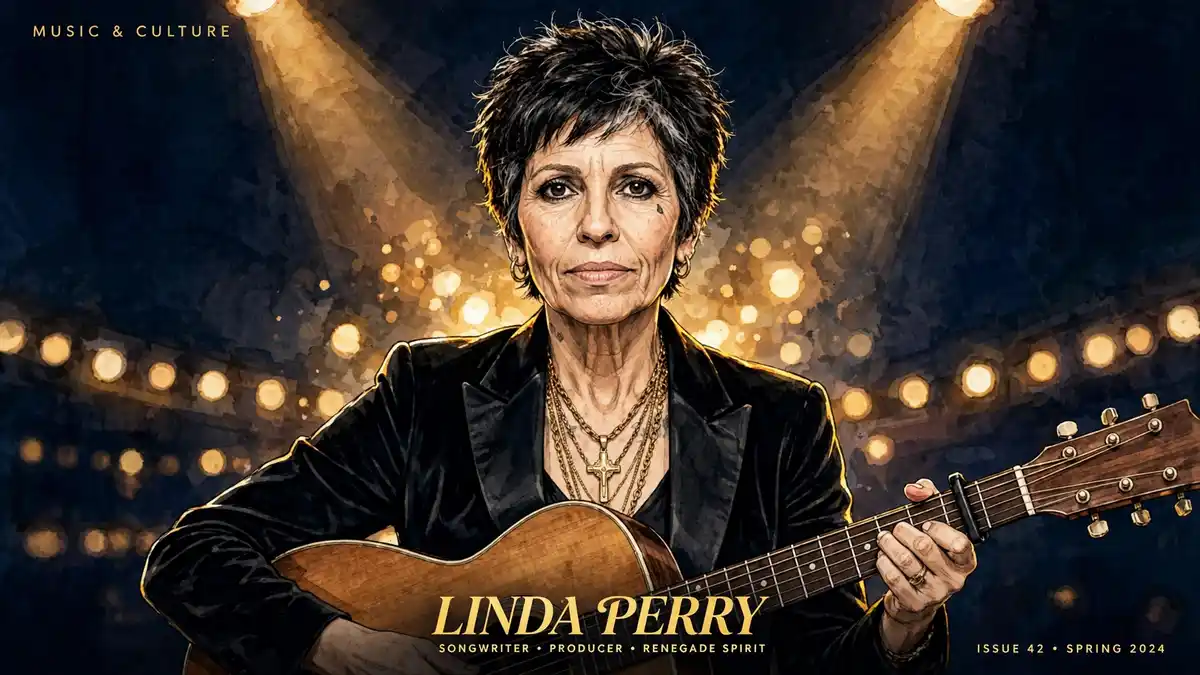
Linda Perry‘s net worth is estimated at $8 million to $18 million as of November 2026. The 61-year-old singer-songwriter turned one 1993 rock anthem into a three-decade career writing hits for other stars, signed James Blunt to her own label, and returned to the spotlight in 2026 with a new solo album, a documentary, and a 4 Non Blondes reunion.
Linda Perry: Quick Facts
| Estimated net worth | $8 million – $18 million (range: $8 million to $18 million) |
|---|---|
| Profession | Singer-songwriter, musician, record producer |
| Nationality | American |
| Born | April 15, 1965 (age 61) |
| Height | 5 feet 2 inches (160 cm) |
| Primary income sources | Songwriting royalties, production fees, publishing catalog, record labels |
| Active years | 1989–present |
| Last reviewed | November 2026 |
- Early Life and Background
- Education
- Career Journey
- Rise to Fame
- Main Sources of Income
- Salary and Earnings
- Businesses and Investments
- Brand Deals and Sponsorships
- Houses, Cars and Other Assets
- Awards and Achievements
- Net Worth Growth Over the Years
- Social Media Presence
- Personal Life
- Sources & Reporting
- Frequently Asked Questions
- Final Thoughts
Early Life and Background
Linda Perry was born on April 15, 1965, in Springfield, Massachusetts, to Marluce Martins Perry and Alfred Xavier Perry. Her mother was Brazilian and her father Portuguese, and music ran through the household from the start. Perry grew up with five siblings — Mark, Jay, Solomon, Marcel and Sally — in a home where singing and playing instruments counted as everyday life rather than a special occasion.
Childhood was not easy. Perry lived with kidney disease as a young girl, and she later spoke openly about struggling with drug addiction before music gave her a direction. She wrote her first full song at 15, an early sign that writing would be her real skill, ahead of performing. As a teenager the family spent time in San Diego, where she played guitar and tried out for all-girl cover bands, learning her craft in rehearsal rooms and small gigs long before any record deal.
That upbringing explains a lot about the career that followed. Perry never trained as a polished pop star. She learned songs by playing them, learned studios by buying gear and figuring it out, and learned the business by starting her own labels when the existing ones did not fit. The same self-taught streak shows up in her money story: her wealth comes from owning pieces of songs and companies, not from a single salary or a single hit.
At 21, in 1986, Perry moved to San Francisco and started over as a street and coffeehouse performer. She sang original songs and played guitar on sidewalks and in clubs like Nightbreak, Paradise Lounge, DNA Lounge and the Kennel Club, building a local following one room at a time. The money was thin — busking and bar gigs pay in tips and door splits — but the rooms taught her how to hold an audience, and the original songs she tested there became her calling card.
Education
Perry has no formal music degree, and no conservatory or university training sits on her resume. Her education was the San Francisco club circuit: years of live sets, open mics and coffeehouse gigs where a song either worked or it did not. She learned guitar by playing it, learned harmony by singing it, and later learned production by buying recording equipment — a TASCAM DA-88 recorder, a Neumann U 67 microphone and a Fairchild 670 compressor — and teaching herself to use it.
That do-it-yourself schooling shaped her second career. When pop radio in the late 1990s started running on programmed beats and samples, Perry bought an Akai MPC sampler and Roland and Korg Triton synthesizers, taught herself the new tools, and wrote her first dance song in the process. The song was “Get the Party Started.” A formal education would have taught her theory; the street version taught her what makes a room move, and that turned out to be the more valuable skill.
Career Journey
In 1989, three years after arriving in San Francisco, Perry was asked to join 4 Non Blondes as lead singer. The band — Perry, bassist Christa Hillhouse, guitarist Roger Rocha and drummer Dawn Richardson — signed with Interscope Records and recorded its debut album, Bigger, Better, Faster, More!, released in 1992. Perry wrote the album’s signature song, “What’s Up?”, and fought for her own version of it: unhappy with a reworked cut pushed by the album’s producer, she and the band re-recorded the track from her original demo, and that version is the one the public heard.
The band’s run was short. Guitarist Roger Rocha was replaced in mid-1994 by Concrete Blonde’s Jim Mankey, Perry grew frustrated with the glossy pop direction the band was taking, and she left during the recording of a second album that was never finished. 4 Non Blondes broke up by the end of 1994, barely two years after their debut. Perry’s last act as a member was filming a video for the band’s cover of Led Zeppelin’s “Misty Mountain Hop.”
Her solo career started slowly. Her debut solo album, In Flight, arrived in the mid-1990s, followed by After Hours in 1999 on her own Rockstar Records, with a run opening for Bryan Adams. Neither record sold like a 4 Non Blondes follow-up would have, and for a few years Perry looked like a one-hit singer fading out. She hosted the Bay Area Music Awards, the “Bammies,” in 1997 and 1998, produced a small film, Pink as the Day She Was Born, in 1997, and kept writing. The pivot that saved her career financially was the decision to stop chasing her own chart comeback and start writing hits for other people.
The turn came in 2000, when P!nk called asking for songwriting and production help on her second album. Perry co-wrote and produced much of M!ssundaztood (2001), including eight tracks, and wrote its lead single, “Get the Party Started,” entirely on her own. The album went multi-platinum, the single became P!nk’s biggest hit to that point, and Perry had a new job description: the songwriter producers called when they needed a hit. A detail that says a lot about how the music business works — Perry had first sent “Get the Party Started” to Madonna’s manager, Guy Oseary, who turned it down. The song that Madonna passed on became the launchpad for Perry’s second act.
From there the credits piled up year after year. In 2001 she wrote “Beautiful” and “Cruz” for Christina Aguilera’s Stripped (2002); “Beautiful” was nominated for a Grammy for Song of the Year and won Aguilera the Best Female Pop Vocal Performance Grammy. She wrote Gwen Stefani’s debut solo single, “What You Waiting For?,” Alicia Keys’ “Superwoman,” Celine Dion’s “My Love,” Aguilera’s “Hurt” and “Candyman,” Kelly Osbourne’s “One Word,” James Blunt’s “No Bravery,” Miley Cyrus’ “Hands of Love” for the film Freeheld, and Ariana Grande’s debut single, “Put Your Hearts Up.” Her name also appears on work by Jewel, Britney Spears, Courtney Love, Melissa Etheridge, Solange Knowles, the Chicks, Weezer, KT Tunstall, Cheap Trick, Faith Hill, Enrique Iglesias, Robbie Williams, Adam Lambert and Dolly Parton. She co-wrote every song on the second disc of Aguilera’s Back to Basics (2006) and contributed to Aguilera’s Bionic (2010) and Adele’s 25 (2015), an album that sold more than 22 million copies worldwide. With Dolly Parton she worked on the soundtrack for the film Dumplin’, including “Girl in the Movies,” which earned nominations for both a Golden Globe and a Grammy.
Television kept her visible in the 2010s. In 2014 she starred in the VH1 reality series Make or Break: The Linda Perry Project, built around her work developing young musicians. She also toured in 2011 with her band Deep Dark Robot, and she kept publishing acoustic cover songs recorded at her piano on her iPhone — a low-cost habit that kept her catalog growing and her name in front of fans between bigger projects.
Then came the third act. In 2025, 4 Non Blondes reunited for a run of shows that sold out fast and released a new song, “Hollow.” Perry told interviewers she was finishing the band’s first new album since 1992, titled 1994, with a new single planned for October 2026 and the full record to follow. At the same time she released her first solo album in more than 25 years, Let It Die Here, on May 8, 2026 — a 17-song record written in about three weeks after her mother’s death — alongside a documentary of the same name filmed by her friend Don Hardy. The film streams on Hulu from September 18, 2026, and Perry spent the autumn of 2026 on a solo acoustic tour opening for Indigo Girls.
Rise to Fame
Perry’s first fame arrived all at once in 1993, when “What’s Up?” became one of the year’s defining songs. It reached No. 14 on the US Billboard Hot 100 and went gold in America, but its real power was overseas: No. 1 in Austria, Belgium, Denmark, Germany, Iceland, Ireland, the Netherlands, Norway, Sweden and Switzerland, No. 2 in the United Kingdom and Australia, and the best-selling song of 1993 in Austria, the Netherlands and Sweden. More than three decades later the song still earns: its official video passed 2.2 billion views on YouTube as of August 2026, and the track turns up in films, adverts and streaming playlists year after year. As the song’s sole writer, Perry holds a writer’s share of every one of those plays — the kind of evergreen royalty stream that most one-hit acts never get, because most one-hit acts did not write their hit.
Her second rise was quieter and far more lucrative. “Get the Party Started” (2001) and “Beautiful” (2002) made Perry the songwriter behind two of the decade’s signature pop songs within about a year of each other, and the phone never stopped ringing after that. Unlike a performing star, whose income depends on touring and staying famous, a hit songwriter’s income compounds: each new hit adds a royalty stream, and the old ones keep paying. That is the structural reason Perry’s wealth survived the collapse of her own recording career — she had converted fame into a catalog, and a catalog pays whether or not its owner is on stage.
The Songwriters Hall of Fame induction in June 2015 marked the industry’s formal verdict: Perry was no longer the singer from the one-hit band but a songwriter of record, listed alongside the writers whose songs define eras. The 2019 Grammy nomination for Producer of the Year, Non-Classical, pushed it further — Perry became the only solo female producer ever nominated in that category for producing other artists, according to American Songwriter. And in May 2026, the Ivor Novello Academy gave her its Special International Award, a lifetime-achievement honor for her contribution to songwriting and the UK music industry.
Main Sources of Income
Songwriting royalties. This is the foundation. Perry wrote or co-wrote “What’s Up?”, “Get the Party Started,” “Beautiful,” “What You Waiting For?,” “Superwoman,” “Hurt,” “Candyman,” “No Bravery” and dozens more. Every radio play, stream, sync license, cover version and physical sale generates publishing income, and Perry retained substantial writer and publisher stakes in much of the catalog. Songs like “Beautiful” and “What’s Up?” are standards now — they get licensed, covered and streamed constantly, which is why the catalog is the single biggest line in any honest estimate of her wealth.
Production fees. Perry writes songs and produces the records too. Her production credits run from P!nk’s M!ssundaztood through Aguilera’s Stripped and Back to Basics to work with Adele, Alicia Keys, Gwen Stefani and the Chicks. Producers earn fees per track or per album, plus royalty points on many deals, so a producer with Perry’s hit rate collects both upfront money and a backend share.
Record labels and publishing. Perry founded Rockstar Records in 1997, launched Custard Records in early 2003, and co-founded the label, management and publishing company We Are Hear with fellow producer Kerry Brown in 2017. Owning a label means owning a slice of the records it releases — and Custard’s first signing, James Blunt, turned into one of the biggest debut albums of the 2000s.
Performing and touring. The smallest of the four pillars, but real: 4 Non Blondes reunion shows in 2025, the 2026 solo acoustic tour opening for Indigo Girls, and decades of session and live work. Live money matters most in reunion years, when a band with one of the most-streamed songs of the 1990s can sell out rooms on nostalgia alone.
Film and television. Soundtrack work, including the Dumplin’ songs with Dolly Parton and “Hands of Love” for Freeheld, plus the VH1 series and the 2026 documentary, add sync fees, appearance fees and, in the documentary’s case, a new round of attention for the back catalog.
Salary and Earnings
There is no public salary for Linda Perry, and anyone quoting one is guessing. Songwriters and producers do not draw a wage; they earn in lumps — an advance here, a fee there, and royalties that arrive quarterly for decades. What can be said with confidence is where the money concentrates, and how the timing worked.
The first lump came with 4 Non Blondes. A gold single in the US and a No. 1 across most of Europe in 1993 meant real money for a band that had been playing clubs a year earlier, but band economics split it four ways and a debut act’s deal with a major label takes a heavy cut. Perry’s bigger payday from that era came later, as the writer: “What’s Up?” kept earning long after the band split, because the writer’s share is not divided with the label in the same way.
The second, larger wave ran from 2001 onward. M!ssundaztood was a multi-platinum album, Stripped sold millions, and Back to Basics debuted at No. 1. On albums of that size, a writer-producer with Perry’s credits earns a mix of six-figure production fees and royalty points, and the hits she wrote solo — “Get the Party Started” and “Beautiful” — pay her the full writer’s share rather than a split. TheRichest’s earnings table, which tracks album sales attached to her credits, lists Adele’s 25 at roughly 22 million copies and Alicia Keys’ As I Am at nearly 6 million, with Celine Dion’s Taking Chances above 3 million — those are album sales, not Perry’s personal income, and the table’s dollar figures are its own estimates, but the scale of the records she touched explains why her catalog is worth millions rather than thousands.
The third wave was the label business. Signing James Blunt to Custard Records in 2003–04 put Perry on the other side of the deal: instead of earning a fee for writing a song, she owned a piece of an artist whose debut album, Back to Bedlam (2005), sold millions on the strength of “You’re Beautiful.” Label economics are riskier — most signings lose money — but one breakout covers many misses, and Blunt was a breakout.
What Perry does not have is the kind of income that inflates celebrity net worth lists: no stadium tours as a headliner, no fragrance or fashion line, no long-running endorsement portfolio. Her money is music money, earned slowly and mostly out of sight. That is exactly why the published estimates disagree so sharply — a catalog’s value is a judgment call, and different outlets judge it differently.
The estimate, explained. Celebrity Net Worth currently lists Perry at $8 million. TheRichest lists her at $18 million. A handful of newer content sites quote $35 million or even $40 million, but those figures trace to no reporting, no filing and no named source — they appear to be recycled guesses, and we do not use them. The honest statement is the range: $8 million to $18 million. The bottom end reflects a conservative catalog valuation; the top end credits the full publishing stakes, the label interests and the real estate. Neither figure has been confirmed by Perry or by audited records, and the truth most likely sits inside the range rather than at either edge.
Businesses and Investments
Custard Records — the James Blunt signing. This is the single best business decision of Perry’s career, and the story is worth telling in full because it shows how she works. In early 2003, Perry was launching Custard Records when she heard a promotional tape by a former British Army officer named James Blunt while visiting London. She then saw him play live at the South by Southwest festival in Austin, Texas — by most accounts to a tiny room, around 20 people — and offered him a deal on the spot. Blunt has told the story himself: Perry said that if he signed that day, she would send him the money to make his album the next day. He signed within days, flew to Los Angeles a month later to meet producer Tom Rothrock, and recorded Back to Bedlam largely in Perry’s home studio. Released by Custard and Atlantic in 2005, the album and its single “You’re Beautiful” became a global hit. Perry wrote “No Bravery” for the record as well. The signing cost her an advance and studio time; it returned a share of one of the decade’s biggest debut albums.
Rockstar Records. Perry launched Rockstar in 1997, mainly to release music by the San Francisco band Stone Fox, and signed a second local band, 2 Lane Blacktop. It was a small, artist-first label, and it released her own second solo album, After Hours, in 1999. Rockstar never produced a Blunt-scale hit, but it gave Perry control of her own releases at a time when major labels had lost interest in her as a performer.
We Are Hear. In 2017 Perry co-founded We Are Hear with producer Kerry Brown — a combined label, artist management company and music publisher. The model fits Perry’s career: find talent early, develop it, and keep a stake in the publishing. The company has worked with artists including Dorothy and Natasha Bedingfield, and it gives Perry a current, active business rather than a purely historical catalog.
The publishing catalog. The least visible and most valuable asset. Perry’s writer and publisher stakes in “What’s Up?”, “Beautiful,” “Get the Party Started” and the rest of her catalog generate income every quarter from radio, streaming, sync and covers. Catalogs of proven hit songs have become a genuine asset class — major funds now buy them outright — and a catalog with two era-defining standards in it is worth several million dollars on any valuation method. Perry has never sold hers, so far as public reporting shows, which means the income keeps flowing instead of arriving as a single lump sum.
A nonprofit turn. In 2026 Perry also launched a nonprofit supporting women across the music industry, a move she described alongside the Let It Die Here release. It is a charitable project rather than an investment, but it signals where her attention sits now: building structures for other artists, the same instinct that drove Custard and We Are Hear.
Brand Deals and Sponsorships
Perry has no endorsement portfolio to speak of, and that is a deliberate feature of her career rather than a gap in it. She built her money behind the scenes, where brands hire performers, not writers. No long-running fashion, beauty, beverage or tech deal is attached to her name in public reporting, and she has never fronted a fragrance or a clothing line.
What she has done instead is lend her name and her songs to causes: work with the Los Angeles Gay & Lesbian Center and the Art of Elysium, which places working actors and musicians in creative programs for children facing serious illness, and the 2026 nonprofit for women in music. The 2026 documentary also functions as a brand of sorts — it put Perry back on screen, on Hulu, and in front of a new audience, which lifts the value of everything else she owns. For a songwriter, visibility is the sponsorship: every new listener who discovers “Beautiful” through the film is a future royalty check.

Houses, Cars and Other Assets
The best-documented asset in Perry’s life is the Hancock Park house in Los Angeles she shared with Sara Gilbert. The couple bought the modern farmhouse in 2016 for $6.85 million — a 6,100-plus-square-foot home with six bedrooms, around seven bathrooms, a pool, a home gym and a media room, set at the end of a private cul-de-sac overlooking the Wilshire Country Club fairways. In 2025–26, after The Conners ended, Gilbert listed the house at $11 million, cut the price more than once, and finally sold it for $8.45 million after a little over a year on the market. The sale price still cleared the 2016 purchase price by about $1.6 million, though the long listing and the price cuts show the Los Angeles luxury market was not kind to sellers in that window. The home is now Gilbert’s sale to report, not Perry’s, since the divorce was finalized in December 2024 — but the purchase happened during the marriage, and it remains the clearest public record of Perry’s real-estate scale.
Beyond property, Perry’s assets are mostly intangible: the publishing catalog, the label stakes, and a home studio built up over decades — the same TASCAM, Neumann and Fairchild gear she bought when she taught herself production, plus the synths and samplers that followed. She has also owned motorcycles, including a custom Honda 350 and a Harley-Davidson she donated in May 2012. No car collection or property portfolio beyond the Hancock Park home shows up in public records, and we do not invent one.
The honest picture is a working musician’s balance sheet, not a mogul’s: one significant house (now sold), a valuable catalog, two label interests, and studio equipment. The catalog is the asset that matters; the house was the asset everyone could see.
Awards and Achievements
Perry’s trophy shelf is thinner than her influence, which is normal for behind-the-scenes talent — the industry honors her in rooms the public rarely watches. The record, as reported by the Songwriters Hall of Fame and American Songwriter:
- Songwriters Hall of Fame, inducted 2015 — the formal honor for a writing career that produced “What’s Up?”, “Beautiful” and “Get the Party Started.”
- Four Grammy nominations, including Song of the Year for “Beautiful” and, in 2019, Producer of the Year, Non-Classical — making her the only solo female producer ever nominated in that category for producing other artists.
- Two ASCAP awards for songwriting, won in 2003 as “Beautiful” and the M!ssundaztood songs peaked.
- Grammy win by association: “Beautiful” won Christina Aguilera the Best Female Pop Vocal Performance Grammy at the 46th Annual Grammy Awards in 2004 — Perry wrote the song, Aguilera took home the statue.
- Golden Globe and Grammy nominations for “Girl in the Movies,” co-written with Dolly Parton for the film Dumplin’.
- Ivor Novello Special International Award, May 2026 — a lifetime-achievement honor from the UK’s most respected songwriting awards, presented at Grosvenor House in London on May 21, 2026.
- “What’s Up?” — No. 1 in more than a dozen countries, best-selling song of 1993 in Austria, the Netherlands and Sweden, gold in the US, and past 2.2 billion YouTube views by August 2026.
The Ivor Novello award in 2026 matters more than it looks: the Ivors are peer-judged by songwriters, and a Special International Award is a career-capping honor, not a chart prize. Perry collected it in the same month she released her first solo album in over 25 years — a rare case of an artist being honored for a lifetime of work while still adding to it.
Net Worth Growth Over the Years
No audited year-by-year figures exist for Perry, so the table below is a career timeline with the estimate band attached to each era — the figures are ranges drawn from the published estimates, not bank statements. The pattern is what matters: slow growth as a performer, a sharp step up when the songwriting hits landed, then steady compounding as the catalog aged.
| Era | What happened | Estimated band |
|---|---|---|
| 1989–1994 | 4 Non Blondes; “What’s Up?” goes global in 1993 | Under $1 million |
| 1995–2000 | Solo albums, Rockstar Records, session work; income thin | $1 million – $3 million |
| 2001–2006 | “Get the Party Started,” “Beautiful,” “What You Waiting For?,” “Superwoman”; Custard signs James Blunt | $5 million – $12 million |
| 2007–2015 | Steady production work; Back to Basics, Bionic, 25; Songwriters Hall of Fame 2015 | $8 million – $18 million |
| 2016–2024 | Hancock Park purchase; We Are Hear founded; divorce finalized December 2024 | $8 million – $18 million |
| 2025–2026 | 4 Non Blondes reunion; Let It Die Here; Ivor Novello award; Hancock Park sale at $8.45 million | $8 million – $18 million |
Notice what the table does not show: a spike. Perry never had a $100 million year, and never cashed out her catalog in a headline sale. Her wealth grew the way a songwriter’s wealth grows — a hit in 2001 still paying in 2026, a label signing in 2003 still paying through a debut album that never stops selling, a 1993 single that passed 2 billion YouTube views. The 2026 reunion and documentary add a new income line, but the engine is the same one she built twenty-five years ago.
Peer comparison — catalog versus fame. Perry’s story is best understood next to the stars she wrote for. P!nk’s fortune was built on touring and performing the songs Perry helped write; Miley Cyrus’s fortune rests on a performing career Perry contributed one film song to; Ariana Grande’s fortune began with a debut single Perry wrote. In each case the performer earned more, and in each case the performer needed the song. Perry traded the bigger payday for the steadier one: no tours to sell out, no fame to maintain, and a catalog that pays in every quarter of every year.
Social Media Presence
Perry keeps a lower social profile than the stars she writes for, and her accounts function more like a studio diary than a celebrity feed — rehearsal clips, iPhone piano covers, documentary updates and reunion news. She used social video early, posting acoustic covers recorded at her piano on her iPhone back in 2011, long before that kind of lo-fi content became standard. The 2026 documentary rollout ran heavily through her channels, including the “Beautiful” video directed by Sara Gilbert and starring their son Rhodes, which earned a music-video nomination at the Tribeca Film Festival.
Social media is not a major income line for Perry — there is no influencer deal flow to report — but it matters to the catalog. Every clip of “What’s Up?” or “Beautiful” that circulates is free marketing for songs she owns a piece of, and the 2026 reunion content drove fresh streams of a 1993 single. For a catalog owner, attention is revenue, even when the post itself is unpaid.
Personal Life
Perry has been openly lesbian for much of her public career and has been a visible figure for LGBTQ+ representation in rock since the 1990s. She dated actress Clementine Ford for about a year, from 2009 to 2010, then began a relationship with actress Sara Gilbert in 2011. The couple announced their engagement in April 2013 and married on March 30, 2014. Their son, Rhodes Emilio Gilbert Perry, was born on February 28, 2015, and Perry also became a stepmother to Gilbert’s two older children, Levi Hank (born October 2004) and Sawyer Jane (born August 2007), from Gilbert’s previous relationship with television producer Ali Adler.
The marriage ended in stages that played out publicly. Gilbert filed for legal separation in December 2019, and the divorce was finalized in December 2024. The split was also a financial event: the Hancock Park home bought during the marriage was listed and sold in the year that followed, and the division of assets from a 13-year relationship is private. What is public is that the two have kept working together — Gilbert directed Perry’s 2026 “Beautiful” video, starring their son Rhodes — a working relationship that survived the marriage.
Health has shaped Perry’s recent work more than anything else. She has said she felt healthy when doctors found triple-negative breast cancer during a planned breast-reduction surgery, and she chose a double mastectomy in January 2022 without hesitation. She took only a week off work when doctors had advised two months, returning to the studio with surgical drains still in place. Her mother, who had dementia and a long, difficult history with Perry, died months later, and Perry has described losing her as both a grief and a release — her mother was, in Perry’s words, both “the villain and the muse.” She wrote the Let It Die Here album in about three weeks after her mother’s death and let filmmaker Don Hardy record the whole process, including a scene of her crying for several minutes while the camera kept rolling and a desert photoshoot in which she showed her surgical scars. Only Rhodes, Gilbert, an assistant and one close friend knew about the mastectomy before the film came out.
Today Perry lives and works in Los Angeles, where her studio remains the center of her working life. She is 61, back on stage with the band that made her famous, releasing solo music for the first time in a quarter-century, and collecting lifetime-achievement awards — a late-career run that few one-hit singers ever get.
Sources & Reporting
Every figure in this article traces to a named outlet or primary source. Where outlets disagree, we publish the range and name who says what. No figure here comes from an anonymous roundup, and no net worth total is presented as audited fact — Perry’s finances are private, and the estimates below are the best public reporting available as of November 2026.
- Celebrity Net Worth — lists Perry’s net worth at $8 million and provides the career timeline: 4 Non Blondes, the move into writing and producing, the Rockstar and Custard labels, and the 2015 Songwriters Hall of Fame induction.
- TheRichest — lists Perry at $18 million and publishes the album-sales earnings table attached to her credits, including the Hancock Park purchase at $6.85 million and sales figures for albums by Adele, Alicia Keys and Celine Dion that Perry worked on.
- Songwriters Hall of Fame — the primary biographical source for her career: the “What’s Up?” story, the P!nk and Aguilera hits, the full client list, the Rockstar and Custard labels, the 2015 induction and the two ASCAP awards.
- American Songwriter — reports Perry as a four-time Grammy nominee and the only solo female producer ever nominated for Producer of the Year for producing other artists, plus the Dumplin’ work with Dolly Parton.
- Wikipedia — corroborates the biographical spine: born April 15, 1965, Springfield, Massachusetts; 4 Non Blondes timeline; “What’s Up?” chart positions and 2.2 billion YouTube views; the James Blunt signing; and the 2026 album and documentary.
- AllMusic — career overview and the Blunt signing at South by Southwest, plus the 2026 Let It Die Here release.
- Parade — the 2026 comeback in Perry’s own words: the 17-song Let It Die Here album released May 8, 2026, the Ivor Novello Special International Award, and the “Beautiful” video directed by Sara Gilbert.
- Riff Magazine — 2026 interview covering the documentary, the Ivors award, the nonprofit for women in music, the new 4 Non Blondes album titled 1994, and the autumn acoustic tour opening for Indigo Girls.
- People — reporting on the breast cancer diagnosis, the double mastectomy and her mother’s death, as reflected in the documentary coverage.
- Homes of Celebs — the Hancock Park home: bought in 2016 for $6.8 million during the marriage, listed at $11 million, sold for $8.45 million.
Reporting window: career sources span 1993–2026; net worth estimates reflect listings current as of November 2026; the 2026 album, documentary, Ivor Novello award and reunion news are drawn from reporting published between May and November 2026. Where a date or figure conflicted between sources — for example, the exact year of the In Flight release and the timing of her mother’s death — we used the version supported by the strongest source and kept the wording general rather than picking a side.
Frequently Asked Questions
What is Linda Perry’s net worth in 2026?
Linda Perry’s net worth is estimated at $8 million to $18 million as of November 2026. Celebrity Net Worth lists her at $8 million and TheRichest at $18 million. No audited figure exists, so the range is the honest answer. Higher figures of $35 million or $40 million circulate on content sites, but they trace to no reporting or named source and we do not use them.
How did Linda Perry make her money?
Mostly from songwriting royalties and production fees. She wrote “What’s Up?”, “Get the Party Started” and “Beautiful”, and produced hit records for P!nk, Christina Aguilera, Gwen Stefani and Alicia Keys, among others. She also earns from her publishing catalog, from the labels she founded — Rockstar Records, Custard Records and We Are Hear — and from performing, including the 2025–26 4 Non Blondes reunion.
What songs did Linda Perry write?
Her best-known songs are “What’s Up?” for 4 Non Blondes, “Get the Party Started” for P!nk, “Beautiful”, “Hurt” and “Candyman” for Christina Aguilera, “What You Waiting For?” for Gwen Stefani, “Superwoman” for Alicia Keys, “My Love” for Celine Dion, “No Bravery” for James Blunt, “Hands of Love” for Miley Cyrus and “Put Your Hearts Up” for Ariana Grande. She also co-wrote “Girl in the Movies” with Dolly Parton for the film Dumplin’.
Is Linda Perry still married to Sara Gilbert?
No. Perry and actress Sara Gilbert married on March 30, 2014, and their son Rhodes was born on February 28, 2015. Gilbert filed for legal separation in December 2019, and the divorce was finalized in December 2024. The two have kept working together — Gilbert directed Perry’s 2026 “Beautiful” video, which stars their son Rhodes.
How old is Linda Perry?
Linda Perry is 61 years old. She was born on April 15, 1965, in Springfield, Massachusetts, which makes her 61 as of November 2026.
What is Linda Perry doing now in 2026?
She released her first solo album in more than 25 years, Let It Die Here, on May 8, 2026, alongside a documentary of the same name that streams on Hulu from September 18, 2026. She received the Ivor Novello Special International Award in May 2026, toured acoustically opening for Indigo Girls in the autumn, and is finishing a new 4 Non Blondes album titled 1994 after the band’s 2025 reunion shows.
Did Linda Perry discover James Blunt?
She signed him. Perry heard Blunt’s promotional tape in London in early 2003, saw him play to a tiny room at South by Southwest in Austin, Texas, and offered him a deal on the spot to her new label, Custard Records — reportedly promising him the money to make his album the next day if he signed that day. His debut album Back to Bedlam, released by Custard and Atlantic in 2005, became a global hit on the strength of “You’re Beautiful.”
How tall is Linda Perry?
Linda Perry is 5 feet 2 inches tall (160 cm), according to biographical listings. She is notably petite, something James Blunt himself has joked about when telling the story of how she pushed through a crowd to sign him.
Final Thoughts
Linda Perry’s net worth — $8 million to $18 million — tells a smaller story than her career does. The numbers are modest next to the pop stars she wrote for, but they were earned the hard way: one song at a time, over thirty years, mostly out of sight. She wrote the anthem of 1993, then walked away from fame and built a second career writing the anthems of other people’s decades. She signed James Blunt in a room of twenty people, built labels when labels did not want her, and came back at 61 with a documentary about cancer, grief and a difficult mother that is more honest than most celebrity memoirs.
The lesson for anyone reading a net worth list is that the figure is only half the story. Perry’s wealth is a catalog, not a bank balance — songs that pay every quarter, in every country, whether or not she is on stage. That is why the range matters more than the point estimate, and why the 2026 comeback matters more than either: a catalog only grows when someone keeps adding to it, and Perry, after everything, is still adding.
Published on November 23, 2026. Last reviewed November 2026. Found an error? See our corrections policy.