
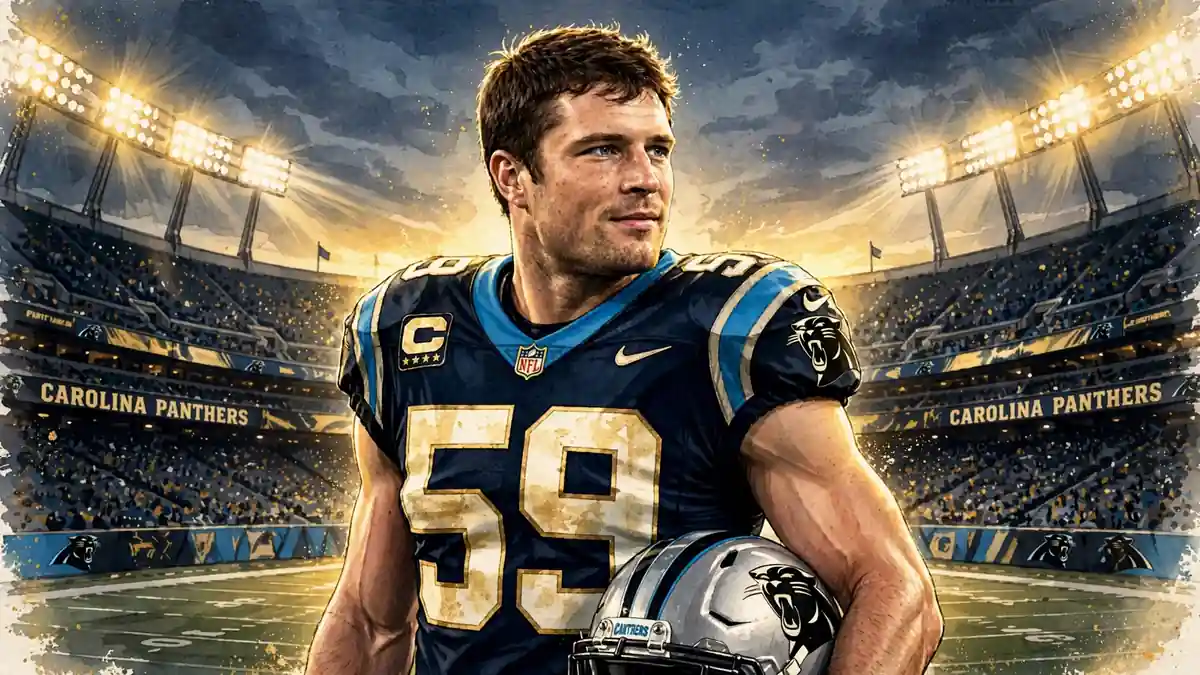
Luke Kuechly‘s net worth is estimated at $25 million to $30 million as of November 2026. The former Carolina Panthers linebacker banked more than $63 million in NFL salary and bonuses across just eight seasons, signed the richest middle-linebacker contract of his era in 2015, walked away from the game at 28 with roughly $22 million in scheduled pay still on the table, and then — in the space of five weeks in 2026 — was enshrined in the Pro Football Hall of Fame and debuted as Netflix’s lead NFL game analyst.
Luke Kuechly: Quick Facts
| Estimated net worth | $25 million (range: $25 million to $30 million) |
|---|---|
| Profession | Retired NFL linebacker; sports broadcaster |
| Nationality | American |
| Born | April 20, 1991 (age 35) |
| Height | 6 ft 3 in (1.91 m) |
| Primary income sources | NFL salary and bonuses, endorsements, broadcasting |
| Active years | 2012–2019 (NFL); 2020–present (scouting and broadcasting) |
| Last reviewed | November 2026 |
- Early Life and Background
- Education
- Career Journey
- Rise to Fame
- Main Sources of Income
- Salary and Earnings
- Businesses and Investments
- Brand Deals and Sponsorships
- Houses, Cars and Other Assets
- Awards and Achievements
- Net Worth Growth Over the Years
- Social Media Presence
- Personal Life
- Sources & Reporting
- Frequently Asked Questions
Early Life and Background
Luke August Kuechly was born on April 20, 1991, in Cincinnati, Ohio, to Tom and Eileen Kuechly. He grew up with two brothers, John and Henry, in a household that put school and sport on equal footing. The family ran an automotive parts business, J&N Auto Electric, and Luke spent his high-school summers working there — a detail that matters, because the work ethic his teammates later praised was formed a long way from a football field, in a parts shop in Cincinnati.
At St. Xavier High School, a private Catholic school with one of Ohio’s strongest football programs, Kuechly played linebacker under head coach Steve Specht. He helped the Bombers win the Ohio Division I state championship in 2007 with a perfect 15–0 record, recording 147 tackles as a junior and 130 more as a senior, with All-Greater Catholic League honors. He also played lacrosse, which sharpened the lateral movement and field vision that later let him cover ground sideline to sideline in the NFL.
The habit that defined his whole career started early. As a teenager, Kuechly was already studying game film before school, breaking down opponents’ formations and tendencies while his classmates were still waking up. Coaches at every level of his career would later describe the same trait: a linebacker who seemed to know where the ball was going before the snap. That preparation — not raw size, at 6 ft 3 in and 238 pounds he was big but not freakish by NFL standards — became his edge, and it is the reason his name still comes up in 2026 whenever analysts discuss the smartest defenders of the modern game.
By the time he left Cincinnati, Kuechly had something rarer than a highlight reel: a reputation among coaches as the most prepared player they had ever worked with. Boston College noticed, and the scholarship that followed put him on the fastest track in college football.
Education
Kuechly enrolled at Boston College in 2009 and produced three seasons of tackling numbers that still read like a misprint. As a freshman he recorded 158 tackles — second in the entire country — and was named ACC Defensive Rookie of the Year, a Freshman All-American, and a first-team All-ACC selection. Most freshmen spend a year learning a college defense. Kuechly spent his leading the nation in stops.
His sophomore season was better. In 2010 he led the country with 183 tackles, including 110 solo stops, and earned first-team All-America recognition — all while playing for a Boston College program that was not competing for national championships. The tackles kept coming because opponents kept running plays straight at him, and he kept beating them to the spot.
The 2011 season turned a great college career into a historic one. Kuechly led the nation again with 191 tackles, averaging nearly 16 per game, and swept the major defensive awards: the Butkus Award as the country’s top linebacker, the Bronko Nagurski Trophy as the nation’s best defensive player, the Rotary Lombardi Award, and the Lott IMPACT Trophy. He was also named ACC Defensive Player of the Year. He finished his three-year college career with 532 tackles, a Boston College and Atlantic Coast Conference record, and his average of 14 tackles per game set an NCAA record. He was a first-team All-ACC selection in all three seasons.
Rather than return for his senior year, Kuechly declared for the 2012 NFL Draft. His college achievements were formally recognized in 2023, when he was inducted into the College Football Hall of Fame — a rare honor for a player who left school after three seasons, and a preview of the second Hall of Fame induction that would follow in 2026.
Career Journey
The Carolina Panthers selected Kuechly with the ninth overall pick in the 2012 NFL Draft, pairing him with a team that had taken quarterback Cam Newton first overall the year before and was building toward contention under head coach Ron Rivera. Kuechly started all 16 games as a rookie and recorded 164 tackles by the league’s official count — leading the NFL — while Carolina’s own statisticians credited him with 205, a gap that reflects different methods of recording defensive stops. Either way, he was the first Panthers rookie in franchise history to lead the league in tackles, and he was named Associated Press NFL Defensive Rookie of the Year.
He followed it with a 2013 season that remains the centerpiece of his résumé. Kuechly recorded 156 tackles, four interceptions, and two sacks while Carolina went 12–4 and won the NFC South. In December 2013, against the New Orleans Saints, he made 24 tackles under the league’s official system and intercepted Drew Brees in a divisional game that swung the race. At season’s end he was named NFL Defensive Player of the Year — back-to-back with his Rookie of the Year award, a combination only a handful of players in league history have managed. He added his first Pro Bowl selection and first-team All-Pro honors.
In 2014 Kuechly recorded 153 tackles, earned another first-team All-Pro selection, won the professional Butkus Award as the league’s outstanding linebacker, and helped Carolina reach the playoffs despite a losing regular-season record. Through this period he formed one of the league’s most respected linebacker partnerships with veteran Thomas Davis, whose physicality paired with Kuechly’s diagnosis speed to make Carolina’s linebacker corps the unit opponents planned around.
The 2015 season was the peak of his team success. Led by Newton, who won NFL Most Valuable Player, the Panthers went 15–1, a franchise record. Kuechly anchored a defense ranked among the league’s best even after missing three regular-season games with a concussion. In the playoffs he delivered the two most famous plays of his career: an interception of Russell Wilson returned 14 yards for a touchdown in the divisional round against Seattle, and an interception of Carson Palmer returned 22 yards for a score in a 49–15 NFC Championship win over Arizona. Carolina reached Super Bowl 50, where the Denver Broncos — led by Peyton Manning and a defense featuring Von Miller — won 24–10. Kuechly earned another first-team All-Pro selection and his third straight Pro Bowl, but no championship ring.
The final four seasons showed the same production with a rising physical cost. In November 2016 he suffered a concussion against the New Orleans Saints, was visibly emotional as he was carted off, and missed the rest of the season, playing only 10 games. He returned in 2017 to play 15 games, recording 125 tackles, three interceptions, and 1.5 sacks, winning the NFL’s Art Rooney Sportsmanship Award and another first-team All-Pro selection plus his third professional Butkus Award. In 2018 he played all 16 games with 130 tackles and two sacks. His final season, 2019, saw him start all 16 games with 144 tackles, two interceptions, and 12 tackles for loss — still one of the most productive linebackers in football.
On January 14, 2020, Kuechly announced his retirement in an emotional video released by the Panthers. He was 28, still ranked among the league’s best at his position, and walking away from millions. He had suffered at least three known concussions, and he said plainly that he could no longer play the game with the physical intensity he demanded of himself. The decision stunned the league precisely because it was so uncharacteristic: players at his level almost never leave that young, that healthy-looking, and that well-paid.
His career totals tell the story of the eight seasons: 118 games, 1,092 tackles, 18 interceptions, 12.5 sacks, seven forced fumbles, and 25 turnovers forced. He led the NFL in tackles twice and finished with three seasons of more than 10 tackles for loss. Seven Pro Bowl selections in eight seasons. Five first-team All-Pro honors. And a retirement that, six years later, looks less like a career cut short than a career finished on his own terms.
Rise to Fame
Kuechly’s rise was unusually fast and unusually quiet. He did not arrive with a signature celebration or a social-media persona. He arrived by leading the NFL in tackles as a rookie and then, a year later, winning Defensive Player of the Year. National attention followed the production: by 2013, opposing coordinators were building game plans around a middle linebacker, which is something offensive coaches almost never do.
The December 2013 game against New Orleans was the moment the wider public caught up. Twenty-four tackles and an interception of Drew Brees in a game that decided the division — it was the kind of performance that turns a good player into a household name among football fans, and it came in his second season. The 2015 playoff run finished the job: two pick-sixes in two playoff games, on the way to a Super Bowl, made him the defensive face of the best Panthers team ever assembled.
What set him apart, and what still drives searches for his name in 2026, was the way he played. Teammates and coaches described a defender who called out the opposing play before the snap, adjusted his teammates’ positions, and then made the tackle himself. That film-study habit from St. Xavier never left him; it scaled up from high-school mornings to NFL Sundays, and it is the skill that translated directly into his second career in broadcasting.
The Hall of Fame completed the arc. Kuechly was elected to the Pro Football Hall of Fame in February 2026, in his second year of eligibility, and formally enshrined on August 8, 2026, in Canton, Ohio, as part of a five-man class alongside quarterback Drew Brees, wide receiver Larry Fitzgerald, running back Roger Craig, and kicker Adam Vinatieri. At 35, he became the second-youngest player ever inducted, behind only Gale Sayers, who was enshrined in 1977 at 34. He was introduced by his father, Tom, and became the third Panthers legend inducted in five years, joining Sam Mills and Julius Peppers — and the first Hall of Famer to have played his entire career with the Panthers.
Main Sources of Income
Kuechly’s wealth comes from three distinct phases, and the split between them explains why his net worth sits where it does. The first phase — his playing career — supplied almost all of it. The second — endorsements — added a smaller but real stream while he played. The third — scouting and broadcasting — keeps money coming in now, but at a different scale than an NFL contract. Understanding the proportions matters, because most of the inflated net-worth figures floating around online come from treating the third phase as if it paid like the first.
NFL salary and bonuses dominate the picture. Over The Cap puts his career salary and bonus total at $63,436,779; Spotrac, which counts cash slightly differently, puts it at $63,862,986. Either way, more than $63 million passed through his hands from the Panthers alone — the only NFL team he ever played for. His 2015 extension, with a $19 million signing bonus and $27 million guaranteed at signing, delivered the bulk of that money in a single year: he collected $20 million in cash in 2015 alone.
Endorsements were selective rather than sprawling. His partners included Nike, Pepsi, and Charlotte-based home-security company CPI Security, which put him in television advertisements. In 2016 he took an equity stake in sports-nutrition startup Eat the Bear instead of a straight fee — a deal structure that said something about how he thought about money. The financial terms of the individual endorsement agreements were never publicly disclosed, and neither was the value of the Eat the Bear stake, so no honest estimate can put a precise number on this stream. It was meaningful supplementary income, not a second fortune.
Broadcasting and scouting form the current phase. After retiring he spent two seasons as a Panthers pro scout, then moved into the Panthers Radio Network as a game analyst in 2022, worked college games for CBS Sports Network in 2024, appeared on ESPN’s alternative Monday Night Football broadcasts, and co-hosts the “JJ and Luke” podcast with Panthers long snapper JJ Jansen. In July 2026 Netflix named him its lead NFL game analyst, with his debut on September 10, 2026, calling the San Francisco 49ers against the Los Angeles Rams from Melbourne, Australia, alongside play-by-play announcer Noah Eagle. The Netflix deal covers four NFL game assignments and, according to reporting at the time, runs through 2029. Analyst pay is not public, and it is nowhere near NFL star money — but it keeps a Hall of Famer’s earning years going well past 28, which is the point.
There is no public record of a large business portfolio, a restaurant chain, a clothing line, or a venture fund in Kuechly’s name. That absence is itself informative: unlike players who chased deals after retirement, Kuechly’s post-playing income comes from the game itself — scouting it, then talking about it. The fortune is a football fortune, built in eight seasons and preserved, not multiplied, afterward.
Salary and Earnings
The contract story has two chapters, and the numbers are unusually well documented because both deals were reported in full when signed. Chapter one was the rookie deal. After Carolina took him ninth overall in the 2012 draft, Kuechly signed a four-year contract worth $12.58 million on May 10, 2012. It was fully guaranteed and included a signing bonus of approximately $7.59 million — substantial financial security before he had played a single professional snap. In April 2015 the Panthers exercised the fifth-year option on that deal, extending it through 2016.
Chapter two was the extension that made him rich. On September 10, 2015, Kuechly signed a five-year, $61.8 million extension — reported at the time as $62 million — that made him the highest-paid middle linebacker in NFL history by average annual value. The agreement included a $19 million signing bonus, $27 million guaranteed at signing, $34.36 million in total guarantees, and an average annual salary of $12,360,313. A $6 million roster bonus followed in March 2016. For a player at a position the league has historically underpaid relative to quarterbacks and pass rushers, it was a landmark deal.
The year-by-year cash tells the story of how the money actually arrived. His largest single-year payment came in 2015, when he collected $20 million in salary and bonuses — the signing-bonus year. The seasons after that paid $7 million in 2016, $7.36 million in 2017, $8.1 million in 2018, and $10.5 million in 2019. His 2019 total of $10,500,059 was built from a $950,059 base salary plus a $9.55 million bonus, a structure that shows how much of a veteran linebacker’s pay arrives as bonus money rather than weekly salary.
| Season | Cash earnings (approx.) | What drove it |
|---|---|---|
| 2012 | Rookie deal begins | Four-year, $12.58M contract; $7.59M signing bonus |
| 2013 | Base salary + bonuses | Defensive Player of the Year season |
| 2014 | Base salary + bonuses | First-team All-Pro; pro Butkus Award |
| 2015 | $20 million | Extension signed; $19M signing bonus year |
| 2016 | $7 million | $6M roster bonus in March; 10 games (concussion) |
| 2017 | $7.36 million | 15 games; Art Rooney Sportsmanship Award |
| 2018 | $8.1 million | 16 games; 130 tackles |
| 2019 | $10.5 million | Final season; $9.55M bonus + $950,059 base |
| Career total | $63.4M (Over The Cap) / $63.86M (Spotrac) | All from the Carolina Panthers |
The two career totals deserve a word, because the $426,000 gap between them confuses readers. Over The Cap’s $63,436,779 counts salary and bonuses; Spotrac’s $63,862,986 counts total cash including roster bonuses and guarantees under a slightly different method. Neither is wrong. They measure the same eight seasons with different rulers, and the honest way to report it is to print both and name who says what — which is what this article does.
Retirement had a direct, measurable cost. The extension was structured to run through the 2021 season, with scheduled salaries of roughly $10.8 million in 2020 and $11.2 million in 2021 that Kuechly never collected because he retired. That is about $22 million in scheduled pay he walked away from at 28. Carolina continued carrying $11.84 million in unamortized signing-bonus charges against its salary cap across 2020 and 2021 — but those charges were accounting for money already paid to him, not new money he received after retiring. Readers who see the $11.84 million figure and assume he kept getting paid are misreading the cap sheet.
A word on the numbers you should not believe. Some low-quality net-worth blogs claim Kuechly earned more than $100 million in his career, or cite a “$72 million extension covering 2019–2022” with “$40 million guaranteed.” Both claims are false. His extension was signed in 2015, was worth $61.8 million over five years, and he never played under a 2019–2022 deal — he retired in January 2020. The $100 million-plus career-earnings figure appears to come from sites that added his scheduled 2020–21 salaries to his actual earnings and then rounded up. The documented record, from Over The Cap and Spotrac, is just over $63 million. That is the figure this estimate is built on.
For scale, consider what $63 million in eight seasons means against the quarterbacks of his era. Patrick Mahomes signed a deal worth roughly half a billion dollars; Aaron Rodgers has earned several hundred million across his career. Kuechly, the best defensive player of his generation at his position, earned about a tenth of that — which is why the linebacker pay gap, and his 2015 extension as the moment it briefly narrowed, is part of his financial story, not a footnote to it.
Businesses and Investments
If you are looking for a Kuechly business empire, you will not find one — and the honest reporting is to say that plainly rather than invent one. There is no public record of Kuechly founding a company, launching a brand, or taking a high-profile venture-capital role after retirement. His one documented business move is the 2016 Eat the Bear deal, where he took an equity stake in a sports-nutrition startup instead of a conventional endorsement fee. The company sold protein supplements, and Kuechly promoted its products through advertising and appearances while keeping his Nike relationship. The value of that equity position has never been publicly established, and the company has not produced the kind of public exit that would let anyone put a number on it.
That restraint fits everything else known about him. Kuechly has never been a player who chased the spotlight off the field. His investments, to the extent they are visible at all, appear to be the quiet kind: his Charlotte home, and whatever portfolio a man who earned $63 million by 28 and then kept working in football has built privately. No filing, interview, or credible report has disclosed a portfolio, a property empire, or a business holding beyond the house and the Eat the Bear stake. This article does not guess at their value.
The contrast with his peers is instructive. Many retired stars convert fame into franchises, media companies, or product lines. Kuechly converted his into a second career inside football itself — scouting, then broadcasting. The Netflix analyst chair is, in financial terms, his biggest post-retirement asset: a national platform, a contract reported to run through 2029, and a role that grows more valuable as his Hall of Fame profile rises. It pays like television, not like football, but it is durable in a way a restaurant chain is not.
One more gap in the record is worth naming. Several net-worth sites claim Kuechly owns “multiple properties” in Cincinnati, South Carolina, and Los Angeles, or a portfolio of real estate. No deed record, listing, or credible report we could trace supports that claim. The only property tied to him in reporting with any specificity is the Charlotte home discussed below. The multi-property claim appears to be copied from site to site without a source, and this article does not repeat it as fact.
Brand Deals and Sponsorships
Kuechly’s endorsement portfolio was small on purpose. Where other stars of his stature signed a dozen deals, he signed a few — and the ones he signed fit the image Carolina was selling: disciplined, local, and serious about preparation.
Nike was the anchor. As one of the league’s most visible defensive stars, Kuechly wore Nike throughout his career, and the relationship continued into his broadcasting years. Pepsi was the national consumer brand on the list, the kind of deal that signals a player has crossed from sports pages into mainstream advertising. CPI Security, the Charlotte-based home-security company, was the regional deal — Kuechly appeared in its television advertisements, and for a player who spent his whole career in one city, a hometown sponsor made sense in a way a generic national deal would not.
The Eat the Bear agreement in 2016 was the most interesting of the group because of its structure. Instead of a fee, Kuechly took ownership in the business. That is a bet, not a paycheck: if the company grows, the stake is worth more than any single advertising payment would have been; if it does not, the endorsement earned him little. It reflected his interest in fitness and nutrition, and it showed a player thinking about equity rather than endorsements as rent. The financial terms were never disclosed, so the deal’s contribution to his net worth cannot be quantified — only its existence can be reported.
What the endorsement record does not show is equally telling. There was no car deal, no watch deal, no fast-food campaign, no video-game cover built around him. Kuechly’s public profile was always the football, and the brands that signed him bought the football — the preparation, the reliability, the Charlotte connection — not a personality. That kept his endorsement income modest by superstar standards, and it is one reason his net worth tracks his salary so closely: the money came overwhelmingly from the Panthers, and the endorsements were a supplement, not a second career.

Houses, Cars and Other Assets
The one property that reporting ties to Kuechly with any confidence is his home in SouthPark, a well-established neighborhood in Charlotte, North Carolina. He bought the house around 2014, during the early years of his extension money, and property-profile sites put the purchase price somewhere in the range of $1.7 million to $2.39 million, with current value estimates clustering around $2.3 million to $2.4 million. The spread exists because different listing and estimate sites disagree, and because Mecklenburg County deed records — the only source that would settle the purchase price — are not the source any of these sites cite. Treat the figure as a reported range, not a confirmed sale price.
What the house says about Kuechly is consistent with everything else about him. SouthPark is comfortable and established, not flashy; it is the neighborhood of a man who put down roots in the city where he played, rather than a player collecting trophy homes in three states. He has lived in the Charlotte area since the Panthers drafted him, coached middle-school football there after retirement, and built his broadcasting career out of the same city. The house is a home, not a portfolio.
On cars, the honest answer is that there is no verified public record of a Kuechly car collection. Some net-worth blogs list Mercedes, Range Rover, and Chevrolet models as his vehicles, but none of those claims traces to an interview, a photograph, or a registration record we could verify. Kuechly has never been photographed with an exotic car, never discussed a collection, and never used vehicles as part of his public image. This article does not repeat the unverified list. What can be said is that a man who earned $63 million and lives quietly in Charlotte is not known for automotive excess — and the absence of evidence here is itself the story.
The same caution applies to the rest of his asset picture. No watch collection, no art collection, no boat, and no private jet appears in any credible reporting. His most valuable assets, by any reasonable accounting, are the $63 million in career earnings — minus taxes, agent fees, and living costs — plus the Charlotte home and whatever private investments he has made since. That is why the net-worth estimate in this article is a range anchored to documented earnings rather than a precise number built from a guessed asset list.
Awards and Achievements
Kuechly’s trophy case is the reason his eight-year career is discussed alongside careers twice as long. The list below covers the honors that matter, with the years they were won — and it is worth reading as a whole, because the density of it is the point. Seven Pro Bowls in eight seasons. Five first-team All-Pro selections. Two Hall of Fame inductions, college and professional.
| Honor | Year(s) |
|---|---|
| Pro Football Hall of Fame inductee | 2026 (second-youngest ever) |
| College Football Hall of Fame inductee | 2023 |
| NFL Defensive Player of the Year | 2013 |
| NFL Defensive Rookie of the Year | 2012 |
| Pro Bowl selection | 2013, 2014, 2015, 2016, 2017, 2018, 2019 |
| First-team All-Pro | 2013, 2014, 2015, 2016, 2017 |
| Professional Butkus Award (top NFL linebacker) | 2014, 2015, 2017 |
| Art Rooney Sportsmanship Award | 2017 |
| Butkus Award (college) | 2011 |
| Bronko Nagurski Trophy | 2011 |
| Rotary Lombardi Award | 2011 |
| Lott IMPACT Trophy | 2011 |
| ACC Defensive Player of the Year | 2011 |
| ACC Defensive Rookie of the Year | 2009 |
| NFL tackles leader | 2012, 2014 |
Two details in that list deserve emphasis. First, the back-to-back Rookie of the Year and Defensive Player of the Year awards in 2012 and 2013 put him in rare company — few players in league history have won the two in consecutive seasons. Second, the Hall of Fame math: elected in his second year of eligibility, enshrined at 35, second-youngest ever. Hall of Fame voters usually make players wait. They did not make Kuechly wait, because eight seasons of that production left little to debate.
His college numbers belong in the same conversation. The 532 tackles are a Boston College and ACC record. The 14 tackles per game average is an NCAA record. The 2011 awards sweep — Butkus, Nagurski, Lombardi, Lott — is the kind of season that ends up in record books rather than highlight reels. And the 2023 College Football Hall of Fame induction, three years before Canton, shows that both halls reached the same conclusion independently.
Net Worth Growth Over the Years
Kuechly’s wealth curve has an unusual shape: a steep climb, a sudden stop, and then a long flat stretch that only recently tilted upward again. Most athletes’ net worth grows gradually over a 12- or 15-year career. Kuechly compressed the climb into four years — the rookie deal, then the extension — and then stopped earning NFL money entirely at 28. The table below is an estimate, built from his contract timeline and the published estimates that existed at each point. The early years are anchored to documented earnings; the later years are estimates, and they are labeled as such.
| Year | Estimated net worth | What changed |
|---|---|---|
| 2012 | $5 million–$8 million | Rookie deal signed; $7.59M signing bonus lands |
| 2015 | $15 million–$20 million | Extension signed; $20M cash year; highest-paid middle linebacker |
| 2019 | $22 million–$28 million | Final playing season; career earnings pass $63M |
| 2020 | $22 million–$28 million | Retirement; $22M in scheduled pay forfeited; scouting role begins |
| 2023 | $24 million–$29 million | College Football Hall of Fame; Panthers Radio Network role |
| 2026 | $25 million–$30 million | Pro Football Hall of Fame; Netflix lead analyst debut |
The flat years are the interesting part. Between 2020 and 2023, Kuechly earned a scout’s salary and then a regional broadcaster’s salary — real money, but a fraction of NFL pay. His net worth during that period moved mostly through investment returns and spending, not new income. The 2026 jump is not a salary jump either; it is a profile jump. Hall of Fame enshrinement and a Netflix chair raise the value of everything attached to his name — speaking, appearances, future broadcasting contracts — even if the Netflix analyst fee itself is not public.
How does he compare with the linebackers he is measured against? The table below uses Celebrity Net Worth’s published estimates for all three men, so the comparison is apples to apples, with career earnings from the same salary databases. The point is not who is richest. It is how much career length matters: Ray Lewis played 17 seasons and earned around $95 million in salary; Kuechly played eight and earned $63 million. Per season, Kuechly earned more — roughly $7.9 million a year against Lewis’s roughly $5.6 million — because he played in a richer salary-cap era and signed his big deal at the peak of his powers. Brian Urlacher, the other modern Hall of Fame middle linebacker, played 13 seasons for the Chicago Bears and is estimated at $16 million by Celebrity Net Worth, on roughly $80 million in career earnings.
| Player | Est. net worth (Celebrity Net Worth) | Career NFL earnings | Seasons |
|---|---|---|---|
| Luke Kuechly | $25 million | $63.4 million | 8 |
| Ray Lewis | $30 million | ~$95 million | 17 |
| Brian Urlacher | $16 million | ~$80 million | 13 |
The honest caveat is that net-worth estimates for retired players are softer than salary figures, and different sites put Lewis anywhere from $30 million to $65 million and Urlacher anywhere from $16 million to $21.5 million. The salary column is the solid ground. The net-worth column is the estimate — and on the salary column, Kuechly’s eight seasons stand up against careers twice as long, which is the real measure of how well-paid his short career was.
Social Media Presence
Kuechly keeps one of the lowest public profiles of any modern Hall of Famer. He has no verified public social-media presence that he promotes or uses as a platform — no Instagram feed of endorsements, no X account for commentary, no TikTok. In an era when retired athletes routinely convert followers into income, Kuechly has simply declined to play that game.
That absence shapes his post-retirement earning model. Without a large social following to monetize, his income depends on institutional roles — the Panthers Radio Network, CBS Sports Network, ESPN appearances, and now Netflix — rather than on sponsored posts or direct-to-fan products. It also shapes his public image: when Kuechly trends, it is because of something he did on a field or in a broadcast booth, not something he posted.
Fans looking for current updates will find him through the channels that employ him: Panthers Radio Network broadcasts, the “JJ and Luke” podcast he co-hosts with JJ Jansen, and Netflix’s NFL coverage, where he debuted on September 10, 2026. The Pro Football Hall of Fame’s official player page also carries his enshrinement details and career record. What fans will not find is a personal feed — and after a career built on preparation rather than publicity, that is consistent with the man.
Personal Life
Kuechly’s personal life is private by design, and the reporting reflects that. His longtime partner is Shannon Reilly, who has been linked to him publicly since his playing days and was referenced in his retirement speech in 2020. Some websites describe Reilly as his wife; others describe her as his girlfriend. No marriage date, wedding report, or public record we could verify confirms a marriage, and the couple has not publicly clarified the question. This article describes Reilly as his longtime partner and does not state a marital status that the public record does not support. Readers should treat any site that prints a confident wedding date with skepticism — the detail varies wildly between low-quality sites, and none of them cites a source.
His family remains close. His father, Tom, introduced him at his Hall of Fame enshrinement in Canton, a moment that capped a relationship visible since his St. Xavier days, when his parents supported the film-study habit and the summers working at the family auto-parts business. His brothers, John and Henry, were part of the same Cincinnati upbringing that emphasized school, work, and sport in that order.
Since retiring, Kuechly has stayed in the Charlotte area, where he has helped coach middle-school football players — a quiet extension of the teaching instinct that made him a great linebacker. He is 35, a Hall of Famer, a national broadcaster, and — by the standards of his profession — still at the beginning of his second career. The eight seasons on the field made the money. The decades after them will decide what the final number looks like.
Sources & Reporting
Celebrity Net Worth — the $25 million net-worth estimate; career salary and bonus total of $63,436,779 attributed to Over The Cap; rookie contract and 2015 extension terms; Hall of Fame enshrinement details and the Netflix analyst role; career totals of 1,092 tackles, 18 interceptions, and 12.5 sacks.
Pro Football Network — Spotrac’s career-earnings figure of $63,862,986; the 2015 extension breakdown including the $19 million signing bonus and $6 million roster bonus; the 2012 rookie contract terms.
Spotrac — career earnings total of $63,862,986, cited via Pro Football Network’s reporting.
Over The Cap — career salary and bonus total of $63,436,779, cited via Celebrity Net Worth’s reporting.
NBC Sports — Hall of Fame enshrinement on August 8, 2026; Kuechly as the second-youngest inductee ever at 35, behind Gale Sayers at 34; third Panthers legend inducted in five years after Sam Mills and Julius Peppers.
Associated Press — Hall of Fame Class of 2026 coverage, including the five-man class of Brees, Fitzgerald, Kuechly, Craig, and Vinatieri, and Kuechly’s introduction by his father, Tom.
Sports Media Watch — the Netflix lead-analyst appointment, reported by Andrew Marchand of The Athletic; Kuechly’s Panthers Radio Network work since 2022 and CBS Sports Network college games in 2024.
EssentiallySports — endorsement portfolio including Nike, Pepsi, and CPI Security; the Eat the Bear equity deal; the $25 million estimate as reported by Celebrity Net Worth.
Home Improvement Geek — the SouthPark, Charlotte home, with purchase estimates of $1.7 million to $2.39 million and a current value around $2.3 million to $2.4 million, flagged in this article as a reported range because the underlying sources conflict.
Reporting window: November 2026. Contract figures trace to the original 2012 and 2015 reporting and the salary databases that track them. The wider spread of online net-worth estimates — $15 million at the low end, $40 million at the high end — comes from low-authority estimate sites that publish no sourcing for their figures; this article anchors on Celebrity Net Worth’s $25 million and reports the $25 million to $30 million range rather than repeating the outliers as if they were equally sourced.
Frequently Asked Questions
What is Luke Kuechly’s net worth in 2026?
Luke Kuechly’s net worth is estimated at $25 million to $30 million as of November 2026. Celebrity Net Worth, the most-cited source for his figure, puts it at $25 million. Wider online estimates run from $15 million to $40 million, but those come from low-authority sites that publish no sourcing, so this article anchors on the $25 million figure and reports the $25 million to $30 million range.
How much did Luke Kuechly earn in his NFL career?
Over The Cap puts his career salary and bonuses at $63,436,779, while Spotrac puts his total career cash earnings at $63,862,986. The small gap comes from different counting methods. All of it came from the Carolina Panthers, the only NFL team he played for across eight seasons from 2012 to 2019.
Why did Luke Kuechly retire at 28?
Kuechly announced his retirement on January 14, 2020, saying he could no longer play with the physical intensity he demanded of himself. He had suffered at least three known concussions, including one in November 2016 that ended his season, and the physical toll of eight seasons at middle linebacker had accumulated. He walked away from roughly $22 million in scheduled 2020–21 salaries.
What is Luke Kuechly doing now?
Since July 2026 he has been Netflix’s lead NFL game analyst, debuting on September 10, 2026, calling the San Francisco 49ers against the Los Angeles Rams from Melbourne, Australia, alongside Noah Eagle. He also continues on the Carolina Panthers Radio Network, co-hosts the “JJ and Luke” podcast with JJ Jansen, and was enshrined in the Pro Football Hall of Fame on August 8, 2026.
When was Luke Kuechly inducted into the Hall of Fame?
He was elected in February 2026, in his second year of eligibility, and formally enshrined on August 8, 2026, in Canton, Ohio, as part of the Class of 2026 alongside Drew Brees, Larry Fitzgerald, Roger Craig, and Adam Vinatieri. At 35, he became the second-youngest player ever inducted, behind only Gale Sayers, who was enshrined at 34 in 1977.
Is Luke Kuechly married?
His longtime partner is Shannon Reilly, who has been publicly linked to him since his playing days. Some websites call her his wife and others call her his girlfriend, but no marriage date or public record confirms a wedding, and the couple has not publicly clarified it. This article describes her as his longtime partner.
What was Luke Kuechly’s biggest contract?
On September 10, 2015, he signed a five-year, $61.8 million extension with the Carolina Panthers — reported at the time as $62 million — that made him the highest-paid middle linebacker in NFL history by average annual value. It included a $19 million signing bonus, $27 million guaranteed at signing, $34.36 million in total guarantees, and an average annual salary of $12,360,313.
How many tackles did Luke Kuechly have in his career?
Kuechly recorded 1,092 tackles in 118 NFL games, along with 18 interceptions, 12.5 sacks, and seven forced fumbles — 25 turnovers forced in total. He led the NFL in tackles twice, in 2012 and 2014, and recorded 532 tackles in three seasons at Boston College, an NCAA record average of 14 per game.
Final Thoughts
Luke Kuechly’s financial story is the story of a short career played at the highest possible level. Eight seasons, one team, more than $63 million in salary and bonuses, and a net worth estimated at $25 million to $30 million in November 2026. He earned the richest middle-linebacker contract of his era, then gave back roughly $22 million in scheduled pay by retiring at 28 — a decision that looked radical in 2020 and looks principled now, with his health intact, a Hall of Fame bust in Canton, and a Netflix analyst chair as his second career.
The number to remember is not the $25 million. It is the $63 million, and the eight seasons it took to earn it. Kuechly made more per season than Hall of Fame linebackers who played twice as long, because he signed his big deal at his peak and never gave the league a down year to discount. The endorsements were modest, the business ventures were few, and the house in Charlotte is comfortable rather than extravagant. What he built was a football fortune, and what he is building now — in a broadcast booth, six years after leaving the field — is the second act that most players his age never get.
Published on November 16, 2026. Last reviewed November 2026. Found an error? See our corrections policy.