
Max Scherzer‘s net worth is estimated at $150 million to $180 million as of November 2026. The three-time Cy Young Award winner banked more than $363 million in cash from baseball contracts through the 2026 season, set the sport’s annual-salary record with the New York Mets, and still has $30 million in deferred money coming from a team he last pitched for in 2021.
Max Scherzer: Quick Facts
| Estimated net worth | $165 million (range: $150 million to $180 million) |
|---|---|
| Profession | Major League Baseball pitcher |
| Nationality | American |
| Born | July 27, 1984 (age 42) |
| Height | 6 ft 3 in (191 cm), 208 lb |
| Primary income sources | MLB salaries and contracts, deferred payments, endorsements, real estate |
| Active years | 2008–present |
| Last reviewed | November 2026 |
- Early Life and Background
- Education
- Career Journey
- Rise to Fame
- Main Sources of Income
- Salary and Earnings
- Businesses and Investments
- Brand Deals and Sponsorships
- Houses, Cars and Other Assets
- Awards and Achievements
- Net Worth Growth Over the Years
- Social Media Presence
- Personal Life
- Sources & Reporting
- Frequently Asked Questions
Early Life and Background
Maxwell Martin Scherzer was born on July 27, 1984, in Chesterfield, Missouri, a suburb of St. Louis, to Brad and Jan Scherzer. He grew up a St. Louis Cardinals fan in a household where baseball was the default conversation, and the game shaped his childhood in a literal way: the boy who became one of the hardest throwers of his generation spent his early years in the shadow of Busch Stadium, watching the Cardinals teams of the 1980s and 1990s from the stands.
Two physical traits marked Scherzer from the start and later became part of his public image. He has heterochromia iridum — his right eye is light blue and his left eye is dark brown — a detail photographers and broadcasters have pointed out for his whole career. He also developed an unusual pitching motion, finishing his delivery with his head pointed toward the ground and his right foot kicked high in the air, a quirk that pitching coaches tried to smooth out and eventually learned to leave alone because the results kept coming.
At Parkway Central High School in Chesterfield, Scherzer played baseball and basketball and began to show the arm that would carry him to the big leagues. He was not a polished blue-chip prospect in the way some first-round picks are; his rise depended on velocity that kept climbing and a competitive streak that coaches kept describing with the same word — relentless. That streak earned him the nickname “Mad Max” later in his career, after umpires, managers and teammates all learned the same lesson: Scherzer hated coming out of games, argued when managers tried to remove him, and treated every start like a personal argument with the opposing lineup.
His younger brother Alex died in 2012, a loss Scherzer has spoken about rarely and in private terms. The family has kept that part of its story out of the spotlight, and Scherzer has never used it as public material. What is visible is the discipline that followed him out of Chesterfield: a pitcher who treated conditioning, preparation and routine as seriously as the pitching itself, and who stayed durable deep into his 40s while most of his draft class had been retired for years.
Education
Scherzer attended the University of Missouri, where he pitched for the Tigers from 2004 to 2006. He arrived in Columbia as a raw arm with big velocity and left as one of the best college pitchers in the country, earning Big 12 Pitcher of the Year honours in 2005. His college years also shaped his personal life in a lasting way: he met Erica May, a pitcher on the Missouri softball team, on campus. The two dated for more than eight years before marrying in November 2013.
Missouri gave Scherzer something else that mattered for his earnings later — bargaining power. After two strong college seasons he was a known commodity, and the Arizona Diamondbacks selected him 11th overall in the 2006 MLB draft. He signed a four-year, $4.3 million contract with Arizona, reportedly putting pen to paper just before the club’s May 30 deadline. That deal, modest by the standards of what followed, was the first entry in a contract ledger that would eventually pass $390 million in guaranteed money.
He never finished a degree — the draft pulled him into professional baseball after his junior year — and he has never presented himself as a businessman with a classroom background. His education, in the sense that matters to his net worth, was the Missouri pitching lab and three years of facing Big 12 lineups, where he learned to pair a mid-90s fastball with a slider and changeup that would become his signature weapons.
Career Journey
Scherzer made his major-league debut for the Arizona Diamondbacks on April 29, 2008, and spent two seasons in the desert before the trade that changed his career. In December 2009, Arizona shipped him to Detroit in a three-team deal, and the Tigers became the place where a thrower turned into a pitcher. Across five seasons in Detroit he made the American League All-Star team twice, helped the Tigers win four straight American League Central titles from 2011 to 2014, and reached the 2012 World Series, where he started Game 4 against the San Francisco Giants.
Detroit also paired him with the pitcher whose career earnings would eventually sit just ahead of his own. His former Tigers rotation mate Justin Verlander and Scherzer anchored the same staff for five seasons, two future Hall of Fame cases sharing a clubhouse and pushing each other’s standards. Scherzer’s breakout came in 2013, when he went 21–3 with a 2.90 ERA, started the All-Star Game, became the season’s only 20-game winner and won his first Cy Young Award. He finished his Detroit tenure with a 15–5 record in 2014 and entered free agency as the best starting pitcher on the market, coming off a final arbitration season that paid him $15.525 million.
Free agency delivered the contract that built his fortune. In January 2015, Scherzer signed a seven-year, $210 million deal with the Washington Nationals — the largest pitching contract of its time — with a twist that still pays him today: $105 million of the total was deferred, paid out as $15 million every July 1 from 2022 through 2028. In Washington he won two more Cy Young Awards, in 2016 and 2017, made the National League All-Star team five times, and pitched two no-hitters in a single season in 2015, on June 20 against Pittsburgh and October 3 against the New York Mets.
The Nationals years produced the defining stretch of his career. On May 11, 2016, he tied the major-league record with 20 strikeouts in a nine-inning game. In 2018 he became only the sixth pitcher since 1900 to strike out 300 batters in a season. In June 2019 he broke his nose and took a black eye when a ball hit him during batting practice — then pitched seven scoreless innings with 10 strikeouts the next day. And in the 2019 World Series against Houston, he won Game 1, was scratched from Game 5 with neck spasms so severe he could barely dress himself, and still started Game 7, pitching five innings and allowing two runs as Washington won its first championship.
Washington traded him to the Los Angeles Dodgers in July 2021, where he finished third in National League Cy Young voting and, on September 12, 2021, became the 19th pitcher in history to record 3,000 career strikeouts. Free agency followed again, and the New York Mets gave him a three-year, $130 million contract that averaged $43.33 million a year — a record annual salary for any player at the time. Injuries limited his Mets tenure, and New York traded him to the Texas Rangers in 2023, covering much of the money still owed on the deal. With Texas he won his second World Series, in 2023, joining a group of only four pitchers in history — with Sandy Koufax, Tim Lincecum and Verlander — to win multiple World Series, multiple Cy Young Awards, throw multiple no-hitters and earn multiple All-Star selections.
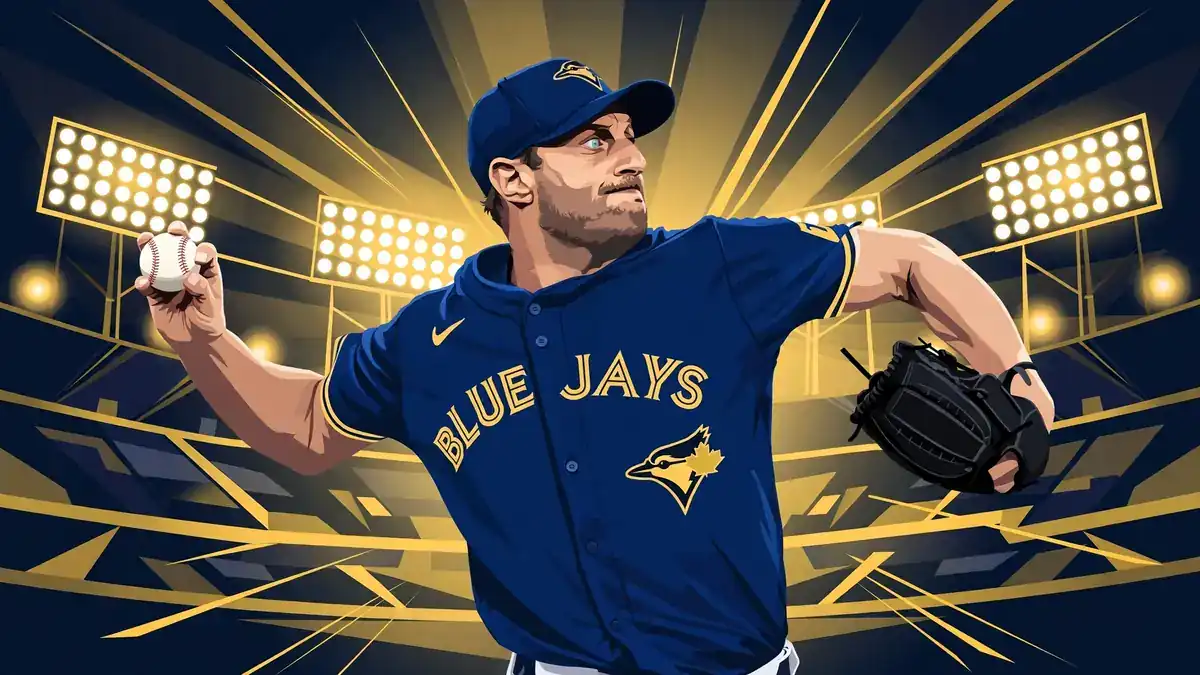
After an injury-hit 2024 with the Rangers, in which he went 2–4 with a 3.95 ERA in nine starts following offseason back surgery, Scherzer signed a one-year, $15.5 million contract with the Toronto Blue Jays in February 2025. He went 5–5 with a 5.19 ERA in 17 starts, then made three postseason starts, beating Seattle in Game 4 of the American League Championship Series and pitching 4⅓ innings of one-run ball in Game 7 of the World Series against the Dodgers, leaving to a standing ovation in Toronto as the Blue Jays lost 5–4 in 11 innings. Toronto brought him back in February 2026 — two weeks into spring training — on a one-year, $3 million contract with up to $10 million in performance bonuses. On June 10, 2026, starting against Philadelphia, he struck out Kyle Schwarber, the first batter he faced, for his 3,500th career strikeout, becoming only the 11th pitcher ever to reach the mark. He finished the 2026 season with 18 starts, a 4–9 record and a 5.74 ERA, and at 42 he is the oldest active player in Major League Baseball, undecided about retirement as the season ended.
Rise to Fame
Scherzer’s rise was not a single moment but a sequence of seasons in which each one raised his price. The 2013 Cy Young season in Detroit made him a star. The $210 million Nationals contract in 2015 made him rich. The two no-hitters in 2015 and the 20-strikeout game in 2016 made him a household name among baseball fans, and the 2019 World Series — the broken nose, the neck spasms, the Game 7 start — turned him into a folk hero in Washington, where the “Mad Max” persona became a civic treasure.
The numbers explain why the fame stuck. Scherzer recorded more wins (161) and more strikeouts (2,452) than any pitcher in the 2010s. He led his league in wins four times (2013, 2014, 2016, 2018) and in strikeouts three straight years (2016–2018). He became the third-fastest pitcher ever to 2,000 career strikeouts in 2017 and the fourth to strike out 250 or more in four consecutive seasons. Through the end of the 2026 season his career line reads 225 wins against 126 losses, a 3.29 ERA and 3,557 strikeouts across seven clubs — Arizona, Detroit, Washington, Los Angeles, New York, Texas and Toronto.
What set him apart commercially was the timing of his peaks. He hit free agency at 30, coming off a Cy Young, and signed the Nationals deal at the exact moment teams were paying record money for aces. He hit free agency again at 37, after a dominant half-season with the Dodgers, and the Mets paid him the highest average annual salary baseball had ever seen. Two free agencies, two record-setting paydays — that is the core of the Scherzer fortune, and it is why his net worth kept climbing even as his fastball aged.
Main Sources of Income
Baseball salary is the overwhelming source of Scherzer’s wealth, and it is not close. Spotrac’s ledger puts his cash received from MLB contracts at $363.1 million through the 2026 season, with $30 million more in deferred Nationals money still scheduled for 2027 and 2028 — $393.1 million in total guaranteed compensation. No other income stream in his life is within an order of magnitude of that figure, and any honest account of his net worth starts and mostly ends with the contracts.
The second stream is the deferred money itself, which deserves its own line because of how unusual it is. The Nationals deal pays Scherzer $15 million every July 1 through 2028, seven years after he last pitched for Washington. In 2026 alone he collected $15 million from the Nationals on top of his $3 million Blue Jays base salary — meaning his old team paid him five times what his current team did. That structure, negotiated by his agent Scott Boras, turned one contract into a 14-year income stream and is the single smartest financial feature of his career.
Endorsements form a third, much smaller stream. Scherzer’s deals with Nike and Fanatics bring in an estimated $150,000 to $1 million a year, according to Wealthy Gorilla’s endorsement breakdown — real money, but a rounding error next to a $43.3 million salary year. Forbes listed his total annual income at $53 million in 2024, ranking him the third-highest-paid player in the league that year, a figure driven almost entirely by the Mets contract and the deferred Nationals payments landing in the same 12 months.
Investment income is the fourth stream, led by a reported $2 million investment in Coral Vita, a coral-restoration company, through a seed venture-capital round in 2021. Real estate is the fifth: his Florida and Virginia properties have produced large gains on paper and, in the case of the McLean house, a reported sale at roughly triple his purchase price. Pitchers now sit near the top of baseball’s pay scale, alongside position-player stars such as Aaron Judge, whose own nine-year Yankees deal reset the market for hitters — and Scherzer’s career shows how a pitcher can match them, one record contract at a time.

Salary and Earnings
Scherzer’s salary history reads like a staircase with two very tall steps. He entered the league on a four-year, $4.3 million deal with Arizona in 2006, earned his way through arbitration in Detroit — his final arbitration season, 2014, paid $15.525 million — and then signed the two contracts that define his wealth. The table below lists the deals that matter, with the figures as reported by Spotrac, Celebrity Net Worth and the contemporary press.
| Period | Team / Deal | Value |
|---|---|---|
| 2006–2009 | Arizona Diamondbacks — rookie deal after being drafted 11th overall | $4.3 million over 4 years |
| 2010–2014 | Detroit Tigers — arbitration years, incl. 2013 Cy Young season | Final arbitration year (2014): $15.5 million |
| 2015–2021 | Washington Nationals — 7-year contract, $105 million deferred | $210 million |
| 2021 | Los Angeles Dodgers — acquired at the trade deadline | Prorated share of 2021 salary |
| 2022–2024 | New York Mets — 3-year contract, $43.33 million average annual value | $130 million |
| 2023–2024 | Texas Rangers — acquired at the 2023 trade deadline; Mets covered much of the remaining salary | Balance of Mets deal |
| 2025 | Toronto Blue Jays — 1-year contract | $15.5 million |
| 2026 | Toronto Blue Jays — 1-year contract plus incentives | $3 million base, up to $10 million in bonuses |
The Mets contract deserves a closer look because it explains Scherzer’s peak earning years. At $43.33 million a year it set the record for average annual salary in baseball history when he signed it in late 2021. Because the Nationals’ deferred payments arrived at the same time — $15 million every July 1 — Scherzer earned nearly $60 million a year in cash during the first years of the Mets deal, combining the two streams. Wealthy Gorilla’s salary table makes the same point from a different angle, putting his total career salary and bonuses at $314.6 million before the remaining deferred money, for $375 million by 2028; Spotrac’s fuller ledger, which counts the 2025 and 2026 Blue Jays deals, puts cash received at $363.1 million through 2026 and total guaranteed compensation at $393.1 million once the last two deferred payments land.
The 2026 deal shows how the market values a 41-year-old ace with a long injury list. Toronto paid a $3 million base with $10 million in performance bonuses — $1 million each for reaching 65, 75, 85, 95, 105, 115, 125, 135, 145 and 155 innings pitched, per Spotrac’s contract notes. He also kept a full no-trade clause. It was a fraction of his peak pay, but with the $15 million Nationals payment arriving in the same season, his 2026 cash income from baseball was still $18 million before bonuses — more than most starting pitchers in the league earned.
For scale, here is where Scherzer sits on the all-time career-earnings leaderboard through the end of the 2026 season, per Spotrac’s ledger as ranked by Celebrity Net Worth:
| Rank | Player | Career earnings |
|---|---|---|
| 1 | Alex Rodriguez | $485.2 million |
| 2 | Justin Verlander | $411.3 million |
| 3 | Miguel Cabrera | $393.2 million |
| 4 | Max Scherzer | $363.1 million |
| 5 | Albert Pujols | $341.8 million |
| 6 | Zack Greinke | $341.0 million |
| 7 | Mike Trout | $338.6 million |
| 8 | Clayton Kershaw | $314.7 million |
He is the fourth-highest-earning player in baseball history and, behind Verlander, the second-highest-earning pitcher ever. The leaderboard also frames his net worth: Verlander, who earned roughly $48 million more on the field, carries a Celebrity Net Worth estimate of $200 million, against Scherzer’s $150–$180 million — a gap that tracks the earnings gap closely. Shohei Ohtani’s $70 million average annual value Dodgers deal has since blown past Scherzer’s $43.3 million record, but Ohtani’s contract defers most of its money; Scherzer’s record was built on cash paid in full, year by year, which is why his bank balance caught up to his contract totals faster.
Businesses and Investments
Scherzer has never built a public business empire, and that restraint is part of his financial story. Unlike athletes who launch clothing lines, restaurants or media companies, he kept his off-field portfolio quiet and narrow: a venture investment here, real estate there, and the rest presumably in the kind of diversified holdings a player with $363 million in career cash can afford to keep private. No filings, interviews or profiles describe him running a company, and we do not invent one.
The one investment that is on the record is Coral Vita, a company that grows coral on land to restore damaged reefs. Sportskeeda reported that Scherzer invested $2 million in the company through a seed venture-capital round in 2021. The amount is small next to his baseball income — roughly what he earned in a single week at his Mets salary — but it fits a pattern: a Florida-based athlete with a waterfront home putting money into ocean restoration. Coral Vita has since raised further rounds and expanded its reef-farming operations, though no public figure values Scherzer’s stake today, and we do not guess at one.
His other documented investing activity is real estate, covered in detail below, where the numbers are public because property records are public. The McLean purchase, renovation and sale, and the two Jupiter waterfront transactions, show a consistent approach: buy in prime locations, improve or rebuild, and sell when the market or the family’s plans change. The Jupiter estate sale in 2026 — an unfinished house sold for $23 million with a construction contract that brought the total deal to $35 million — is the largest single property transaction of his life and the clearest evidence that his real-estate judgment has been as sound as his contract judgment.
What he has not done is also worth stating plainly. There is no verified record of Scherzer taking equity in a startup portfolio, backing a fund, or buying into a sports franchise. Lower-tier net-worth sites credit him with “minority stakes in sports-related startups” and “private equity funds focusing on tech and entertainment” without naming a single company or fund; we found no primary reporting to support those claims, so they do not appear in his totals. His wealth is a baseball fortune with a real-estate kicker, and presenting it any other way would overstate the record.
Brand Deals and Sponsorships
Scherzer’s endorsement portfolio is thin by superstar standards, and the reason is simple: he built his brand on performance, not personality. He has long-term deals with Nike, for shoes and apparel, and with Fanatics, the sports merchandising company — the two partners Wealthy Gorilla names in its endorsement breakdown, which estimates his annual endorsement income at $150,000 to $1 million. For a pitcher who earned $43.3 million in a single season, endorsements were never more than a footnote, and Scherzer never chased the camera the way some of his peers did.
That modesty shows up in his public profile. He rarely posts on social media — his Instagram account has sat largely unused since 2019 and his X account since January 2023, according to Sportskeeda’s profile — which limits the sponsored-content income that drives many athletes’ off-field earnings. He has done the standard appearances and team-related promotional work, and his “Mad Max” persona has featured in Nationals and Mets marketing, but there is no record of a national advertising campaign built around him, no signature shoe, and no beverage or car deal of the kind that pays eight figures to the sport’s biggest names.
The comparison that matters is Forbes’ 2024 list, which put Scherzer’s total annual income at $53 million and ranked him the third-highest-paid player in baseball that year. That figure was almost entirely salary and deferred money, not endorsements — the opposite of the split you see for a player like Ohtani, whose endorsement income rivals his salary. Scherzer’s money came from throwing baseballs past hitters, and his sponsors paid for the association with that, not for a media personality.

Houses, Cars and Other Assets
Scherzer’s property record is unusually well documented, because each move involved a headline price and a public record. The story starts in McLean, Virginia, the Washington suburb where the family lived during his Nationals years. In August 2015, months after signing the $210 million Nationals deal, Scherzer and his wife Erica closed on a 4,800-square-foot house on Crest Lane for $5.2 million, a secluded three-acre spread overlooking the Potomac with four bedrooms, five baths and a heated indoor pool, according to Washingtonian. He planned a multimillion-dollar renovation, opening the Potomac-facing side with glass, and by the time the family listed the house in 2020 it had grown to 8,264 square feet with five bedrooms. The asking price was $15 million — nearly triple the purchase price — and Washingtonian reported it went under contract with a buyer for an undisclosed sum; PlayersBio later reported the sale closed in December 2021 for $15 million. Even at the asking price, the gain on the McLean house alone is close to $10 million before renovation costs.
The family moved its base to Jupiter, Florida, buying a waterfront mansion there for $9.8 million in 2020, according to property records cited by The Real Deal. That house, across the street from their later project, is their primary residence. In 2023 they bought the lot across the street — 217 Commodore Drive, a 0.7-acre waterfront parcel in the gated Admirals Cove community — for $14.9 million, and began building a custom home of nearly 10,000 square feet with interiors by celebrity designer Krista Watterworth. The project became Scherzer’s most ambitious property move, and then a change of plan: after touring Discovery Land Company’s planned Atlantic Fields community in Hobe Sound, which promises more open space and family-friendly features across more than 1,500 acres, the Scherzers decided against Admirals Cove. They listed the unfinished Jupiter mansion for $36 million in February 2026, and in April 2026 The Real Deal reported the sale: $23 million for the property itself, with the construction contract included bringing the total deal to $35 million, to buyers Thomas and Kimberly Abrams of Northville, Michigan. The house will not be completed until 2027.
On cars, Scherzer keeps a low profile. No verified reporting describes a collection, a supercar purchase or a sponsored vehicle deal, and the car roundups on fan sites name no specific models with sourcing. A pitcher who earned $43.3 million in a single season could own any garage he wanted; the absence of reporting suggests he either keeps his vehicles private or simply does not treat cars as a public hobby. We do not fill that gap with guesses.
His other assets are the ones any reader can verify: the $30 million in deferred Nationals payments still to arrive in 2027 and 2028, which is a contractual asset as concrete as a house; the Coral Vita stake; and the Florida real estate. Taken together, the property record supports the top end of his net-worth range rather than the bottom — the McLean sale and the Jupiter transactions show realised gains in the tens of millions, on top of the salary fortune.
Awards and Achievements
Scherzer’s trophy case is the foundation of his Hall of Fame case and, indirectly, of every contract he signed. The headline honours:
- 3× Cy Young Award — 2013 (American League, Detroit), 2016 and 2017 (National League, Washington). Only 11 pitchers in history have won three Cy Youngs, and only four have won more than three.
- 2× World Series champion — 2019 with the Washington Nationals and 2023 with the Texas Rangers.
- 8× All-Star — 2013–2019 and 2021, seven straight selections from 2013 to 2019.
- 2× All-MLB First Team — 2019 and 2021.
- 4× wins leader — 2013, 2014, 2016 and 2018; 3× NL strikeout leader — 2016, 2017 and 2018.
- Two no-hitters in 2015 — June 20 against Pittsburgh and October 3 against the New York Mets, a feat that put him in rare company.
- 20 strikeouts in a nine-inning game — May 11, 2016, tying the major-league record.
- 300 strikeouts in 2018 — only the sixth pitcher since 1900 to reach the mark in a season.
- 3,000th career strikeout — September 12, 2021, with the Dodgers, the 19th pitcher ever; 3,500th — June 10, 2026, with Toronto, the 11th pitcher ever.
- Most wins (161) and strikeouts (2,452) of any pitcher in the 2010s.
He was also the sixth pitcher to win Cy Young Awards in both leagues, and his 2013 season — 21–3, a 2.90 ERA, the All-Star start and the only 20-win season in baseball that year — remains one of the great single seasons by a pitcher of his generation. Through 2026 he sits ninth all time in career strikeouts with 3,557, within reach of the top eight if he pitches again in 2027. Every one of those lines strengthened his negotiating position at the two free agencies that made him rich.
Net Worth Growth Over the Years
Scherzer’s wealth grew in steps that track his contracts, not in a smooth line. The rookie deal paid $4.3 million. The Detroit arbitration years built a base. The Nationals contract in 2015 changed the scale entirely, the Mets contract in 2022 doubled his annual pay, and the deferred money has kept paying him long after both deals ended. Published estimates of his net worth tell the same story in the open record:
| Year | Published estimate | Source / context |
|---|---|---|
| 2021 | ~$120 million | Celebrity Net Worth figure reported at the time, after the Dodgers stint |
| 2023 | ~$120 million | PlayersBio, after the Mets deal and Rangers trade |
| 2025 | $150 million | EssentiallySports, after the first Blue Jays contract |
| 2026 | $150–$180 million | Wealthy Gorilla $150M; Celebrity Net Worth $180M |
The jump between the 2023 and 2025 estimates is easy to explain without inventing anything: the Mets contract paid its final $43.3 million year in 2023, the deferred Nationals payments kept arriving at $15 million a year, and the 2025 Blue Jays deal added $15.5 million more. The range widened in 2026 because the outlets updated on different schedules — Celebrity Net Worth refreshed its page to $180 million and a career-earnings total above $390 million in guaranteed money, while Wealthy Gorilla held at $150 million on a lower career-earnings count. Our range, $150–$180 million, honours both, and the $165 million midpoint is the figure a reader should carry away.
Two stale figures still circulate and deserve a correction. Several low-tier sites still list $70 million, a number that predates the Mets contract and ignores more than $130 million in salary Scherzer has earned since; it is out of date and should be disregarded. And a handful of auto-generated pages credit the $210 million Nationals contract to the Mets or describe a “2025 Mets deal” that never existed — Scherzer’s 2025 deal was with Toronto, and the Mets deal ran from 2022 to 2024. Readers who see those errors are looking at pages that were never checked against the contract record.
Social Media Presence
Scherzer is present on social media but barely uses it, which is itself a statement about where his attention goes. His Instagram account, @maxscherzer31, has around 200,000 followers, according to Sportskeeda’s player profile, but he has not posted there since 2019. His X account, @Max_Scherzer, has roughly 332,000 followers, per the same profile, with no posts since January 2023. A Facebook page under his name carries around 78,000 followers. Booking-agency data from MN2S puts his combined Instagram and Facebook audience at about 260,000.
That quiet footprint is unusual for an athlete of his stature and it costs him real endorsement money — sponsored posts are a standard income line for players with far smaller followings. It also fits the “Mad Max” persona: a pitcher who communicates through performance, argues with managers about staying in games, and treats the offseason as training time. His wife Erica is more active online, and family photos that do surface publicly tend to come through her account, @emaysway, rather than his.
For fans, the practical point is that Scherzer’s accounts are not a reliable source of news about him. Contract news breaks through the clubs and the press — NBC Sports reported the February 2026 re-signing, Field Level Media reported the 2025 deal — and his own feeds stay silent for months at a time. Anyone following @maxscherzer31 for retirement news in the winter of 2026–27 will be waiting a long time.
Personal Life
Scherzer married Erica May in November 2013 after more than eight years together. They met at the University of Missouri, where both were pitchers — he for the baseball team, she for the softball team — and their shared background as college athletes has been a constant in profiles of the family. They have four children: daughters Brooklyn, born November 29, 2017; Kacey, born July 4, 2019; and Nikki, born January 30, 2023; and a son, Derek, born May 2, 2021. Scherzer pitched a complete game on the afternoon Derek was born before leaving for the hospital.
The family keeps four rescue dogs and two cats, a detail that has appeared in profiles since 2017 and says something about the household’s priorities. They lived in McLean, Virginia, through the Nationals years, moved their base to Jupiter, Florida, in 2020, and are now weighing a move to the Atlantic Fields community in Hobe Sound after deciding against the Admirals Cove estate they were building. Erica has been a visible presence at his games for a decade, from the 2019 World Series run in Washington to the 2025 postseason in Toronto, and she has spoken publicly about the family’s life around baseball’s schedule — the moves, the rehabs, the long seasons.
Off the field, Scherzer is known among teammates for an intensity that does not switch off. Toronto manager John Schneider joked during the 2025 playoffs about a dugout exchange when he tried to take Scherzer out of a game — “I thought he was going to kill me. It was great,” Schneider said, in a quote Britannica preserved in its profile. That story, told with affection by a manager, captures the trait that defined his career: a pitcher who wanted the ball, always, and who built a $150–$180 million fortune on the simple fact that, for almost two decades, giving it to him was usually the right call.
Sources & Reporting
Figures in this article were checked against the outlets below between September and November 2026, covering reporting through the end of the 2026 MLB season. Where outlets disagreed, the article publishes the range and names the outlet behind each figure.
- Celebrity Net Worth — the $180 million net-worth estimate; the career-earnings leaderboard through the end of 2026; contract history including the $210 million Nationals deal, the $130 million Mets deal and the 2025–2026 Blue Jays contracts.
- Spotrac — the contract ledger: $363.1 million in cash received through 2026, $393.1 million in total guaranteed compensation including $30 million in deferred money for 2027–2028; 2026 contract terms ($3 million base, up to $10 million in innings bonuses, full no-trade clause).
- Wealthy Gorilla — the $150 million net-worth estimate; career salary table; endorsement income range ($150,000–$1 million a year from Nike and Fanatics); Forbes’ 2024 annual-income figure of $53 million.
- EssentiallySports — the $150 million estimate for 2025; career earnings above $350 million at the time of the first Blue Jays deal.
- NBC Sports — the February 2026 re-signing with Toronto (one year, $3 million, up to $10 million in bonuses); 2025 season line (5–5, 5.19 ERA) and postseason starts.
- Field Level Media — the January 2025 report of the one-year, $15.5 million Blue Jays contract; 2024 Rangers season (2–4, 3.95 ERA) and career totals at the time.
- Wikipedia — career statistics through 2026 (225–126, 3.29 ERA, 3,557 strikeouts); team history; family details; the 3,500th strikeout on June 10, 2026.
- Britannica — career narrative, the 2019 World Series neck injury and Game 7 start, the broken-nose game, and the John Schneider dugout exchange.
- Baseball-Reference — career summary, Cy Young and All-Star record, 3,000-strikeout milestone.
- The Real Deal — the April 2026 sale of the unfinished Jupiter estate ($23 million, $35 million with the construction contract); the $14.9 million 2023 purchase; the $9.8 million 2020 home.
- Washingtonian — the $5.2 million McLean purchase in 2015 and the $15 million listing in 2020.
- PlayersBio — the reported $15 million McLean sale in December 2021; Jupiter home details; the ~$120 million net-worth figure for 2023.
- Sportskeeda — the reported $2 million Coral Vita investment in 2021; social-media handles and follower counts; family details.
How we estimated: the $150–$180 million range is anchored to the two freshest published estimates (Celebrity Net Worth $180 million, Wealthy Gorilla $150 million), tested against Spotrac’s contract ledger and the public property record. Older or auto-generated figures — including a $70 million estimate that predates the Mets contract — were excluded as stale. All contract figures are guaranteed money as reported; net worth is an estimate, not an audited figure, and will move with new contracts, property sales and investment results.
Frequently Asked Questions
What is Max Scherzer’s net worth in 2026?
Max Scherzer’s net worth is estimated at $150 million to $180 million as of November 2026. Celebrity Net Worth puts the figure at $180 million, while Wealthy Gorilla puts it at $150 million; we publish the range because both outlets are current and credible, and the $165 million midpoint is a fair single figure to use.
How much does Max Scherzer make a year?
In 2026, Scherzer’s Toronto Blue Jays contract paid a $3 million base salary with up to $10 million in innings-based bonuses, and his old team, the Washington Nationals, paid him another $15 million in deferred money — so his baseball cash income for the year was $18 million before bonuses. At his peak, the Mets contract paid $43.33 million a year plus the same $15 million deferred payment, close to $60 million a year in cash.
What was Max Scherzer’s biggest contract?
His largest contract by total value was the seven-year, $210 million deal he signed with the Washington Nationals in January 2015, half of which ($105 million) was deferred. His highest-paying contract per year was the three-year, $130 million deal with the New York Mets, which averaged $43.33 million a season — a record annual salary in baseball when he signed it.
How much has Max Scherzer earned in his career?
Spotrac’s ledger puts his cash received from MLB contracts at $363.1 million through the 2026 season. Another $30 million in deferred Nationals money is still to arrive in 2027 and 2028, bringing his total guaranteed career compensation to $393.1 million. That makes him the fourth-highest-earning player in baseball history and the second-highest-earning pitcher ever, behind Justin Verlander.
Who is Max Scherzer’s wife?
Max Scherzer is married to Erica May-Scherzer. They met at the University of Missouri, where both were pitchers — he for the baseball team, she for the softball team — dated for more than eight years, and married in November 2013. They have four children: daughters Brooklyn, Kacey and Nikki, and a son, Derek.
How many Cy Young Awards has Max Scherzer won?
Three. He won the American League Cy Young Award with the Detroit Tigers in 2013, going 21–3, and the National League Cy Young Award with the Washington Nationals in 2016 and 2017. Only 11 pitchers in baseball history have won three Cy Young Awards.
How many World Series has Max Scherzer won?
Two. He won his first with the Washington Nationals in 2019, starting Game 7 against Houston days after neck spasms forced him out of Game 5, and his second with the Texas Rangers in 2023. He is one of only four pitchers ever to win multiple World Series, multiple Cy Young Awards, throw multiple no-hitters and earn multiple All-Star selections.
Is Max Scherzer still playing in 2026?
Yes. He re-signed with the Toronto Blue Jays in February 2026 on a one-year, $3 million contract with up to $10 million in performance bonuses, made 18 starts, and recorded his 3,500th career strikeout on June 10, 2026, against Philadelphia. He finished the season at 42 as the oldest active player in the majors and was undecided about retirement — and a free agent — when the season ended.
Final Thoughts
Max Scherzer’s fortune is a study in timing and stubbornness. He hit free agency twice at the exact moments the market was paying record money for aces, and he signed both times with an agent who built deferrals into the first deal so the money would keep arriving for 14 years. The $150–$180 million estimate reflects $363 million in cash already banked, $30 million still to come from Washington, and a property record that turned a $5.2 million Virginia house into a reported $15 million sale and a $14.9 million Florida lot into a $35 million deal.
The baseball case is settled even if the retirement decision is not. Three Cy Young Awards, two World Series titles, two no-hitters, 3,557 strikeouts and the fourth-highest career earnings in the sport’s history put him on a clear path to Cooperstown, and his 2026 season — a $3 million deal, a 3,500th strikeout, a Game 7 start in the World Series at 41 the year before — showed a pitcher still competing on his own terms at 42. If he pitches again in 2027, the deferred cheques keep coming either way. If he retires, Washington still owes him $15 million a year through 2028. That is the rare athlete fortune that no longer depends on the athlete.
Published on November 23, 2026. Last reviewed November 2026. Found an error? See our corrections policy.