
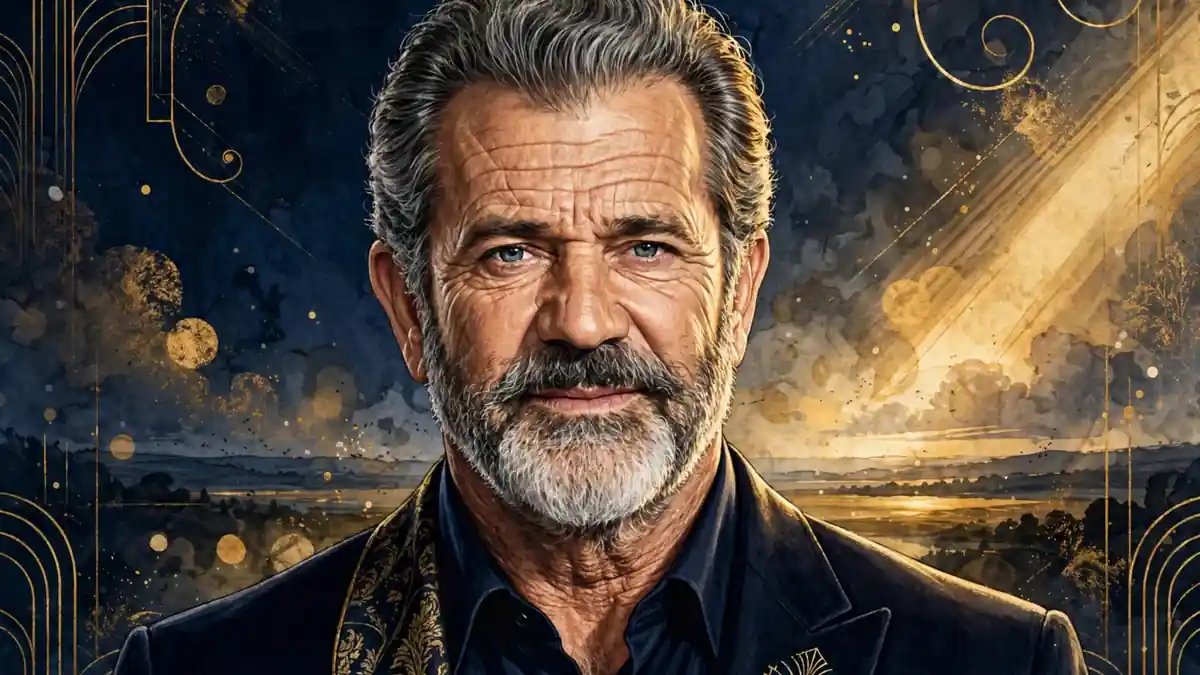
Mel Gibson‘s net worth is estimated at $425 million to $450 million as of November 2026. The figure sits far below the fortune he held before his 2011 divorce, and almost all of it traces back to one decision: putting $45 million of his own money into a film no studio would finance, then keeping half the profits. That film, The Passion of the Christ, returned an estimated $400 million to $475 million to Gibson personally, according to Celebrity Net Worth — still described by the outlet as the largest single payday in Hollywood history. His acting fees, led by $25 million paydays for Signs and Lethal Weapon 4, built the base. A divorce settlement reported at $400 million to $425 million cut the peak fortune roughly in half. And in 2025 and 2026, Gibson returned to directing with Flight Risk and finished shooting the long-promised two-part sequel The Resurrection of the Christ, a project that could move the number again.
Mel Gibson: Quick Facts
| Estimated net worth | $425 million to $450 million (range: $425–450 million) |
|---|---|
| Profession | Actor, director, producer, screenwriter |
| Nationality | Australian-American |
| Born | 3 January 1956 (age 70) |
| Height | 5 ft 9¾ in (177 cm) |
| Primary income sources | Acting salaries, directing and producing profits, Icon Productions, film library and residuals |
| Active years | 1977–present |
| Last reviewed | November 2026 |
- Quick Facts
- Early Life and Background
- Education
- Career Journey
- Rise to Fame
- Main Sources of Income
- Salary and Earnings
- Businesses and Investments
- Brand Deals and Sponsorships
- Houses, Cars and Other Assets
- Awards and Achievements
- Net Worth Growth Over the Years
- Social Media Presence
- Personal Life
- Sources & Reporting
- Frequently Asked Questions
Early Life and Background
Mel Columcille Gerard Gibson was born on 3 January 1956 in Peekskill, New York, the sixth of eleven children. His father, Hutton Gibson, was a railroad brakeman who won a substantial sum on the quiz show Jeopardy!, and his mother, Anne Reilly, was born in Ireland. The family moved to Australia in 1968, when Gibson was twelve, after Hutton Gibson worried his sons would be drafted for the Vietnam War and after the family received a payout from a workplace injury claim. The move shaped everything that followed: Gibson grew up in Sydney, trained as an actor there, and still carries dual Australian and American citizenship.
The household was large, Catholic and strict. Gibson has spoken in interviews about a childhood spent in a crowded house where money was watched closely — a detail that matters when weighing the later $45 million Passion gamble, because the man who risked it did not grow up with a safety net. He was not a child star and did not come from industry money. His first screen work came in his early twenties, after drama school, and his first paycheques were small enough that the $9,000 to $15,000 he earned for Mad Max in 1979, reported by Parade, was a meaningful sum at the time.
Australia gave him two things Hollywood could not: a classical stage training and a film industry small enough that a young actor could land leading roles fast. By 1981 he had headlined Gallipoli, one of the defining Australian films of its era, and by 1982 he had starred opposite Sigourney Weaver in The Year of Living Dangerously. Those films paid far less than his later Hollywood work, but they built the reputation that let him cross over. The early-life pattern — modest beginnings, a move across the world at twelve, a big family — runs through the money story too: Gibson has repeatedly bet on himself rather than on a studio, and the biggest bet paid off on a scale few actors have ever matched.
Education
Gibson attended St Leo’s Catholic College in Wahroonga, Sydney, and later the National Institute of Dramatic Art (NIDA), Australia’s leading drama school, graduating in 1977. NIDA classmates included Judy Davis, with whom he appeared on stage, and the training was classical: Shakespeare, voice work, stagecraft. His stage debut came with the Sydney Theatre Company, and his first film role, in Summer City (1977), arrived while he was still a student.
The education matters to the fortune in a specific way. NIDA gave Gibson the stage discipline that later let him direct actors in Aramaic, Latin and Yucatec Maya — languages he did not speak — and to hold a set through the long shoots of Braveheart and Apocalypto. It also gave him a network: his producing partner Bruce Davey was a fellow Australian film figure, and the two founded Icon Productions in 1989. Formal schooling ended at NIDA. Everything after that — the directing, the financing, the deal-making — Gibson learned on sets and in negotiations, which helps explain both the $475 million Passion return and the $425 million divorce bill that followed a marriage with no prenuptial agreement.
Career Journey
Gibson’s career falls into four clear chapters, and each one changed the money picture. The first, from 1977 to 1986, was the Australian breakout and the Hollywood arrival: Mad Max (1979), Mad Max 2 (1981), Gallipoli (1981), The Year of Living Dangerously (1982), The Bounty (1984) and the first Lethal Weapon (1987). Fees in this period were modest by later standards — the Mad Max pay was reported at $9,000 to $15,000 — but the films made him a global star before he turned thirty.
The second chapter, 1987 to 2000, was the peak acting years. Four Lethal Weapon films turned Gibson into one of the highest-paid actors alive, with his fee climbing from an undisclosed sum on the first two films to $10 million for Lethal Weapon 3 (1992) and $25 million for Lethal Weapon 4 (1998), per Celebrity Net Worth. Around the same run he starred in Hamlet (1990), directed The Man Without a Face (1993), then directed, produced and starred in Braveheart (1995), which won five Academy Awards including Best Picture and Best Director for Gibson. The year 2000 alone put him in three films that each grossed over $100 million — The Patriot, Chicken Run (voice) and What Women Want — a run few actors have matched.
The third chapter, 2001 to 2016, was the director-producer era and the fall. Signs (2002) paid him $25 million and grossed $408 million worldwide, becoming the highest-grossing film of his acting career. Then came The Passion of the Christ (2004), the self-financed gamble that made him hundreds of millions, followed by Apocalypto (2006). In July 2006 Gibson was arrested for drink-driving in Malibu, and the recorded remarks from that arrest, followed by the leaked recordings from his split with Oksana Grigorieva in 2010, froze his acting career for years. He worked little between 2010 and 2016, and his public standing collapsed even as his bank balance stayed high.
The fourth chapter, 2016 to the present, is the comeback. Hacksaw Ridge (2016) earned six Academy Award nominations, won two, and put Gibson back in the Best Director race for the first time since Braveheart. Since then he has acted steadily in smaller films — Daddy’s Home 2 (2017), Dragged Across Concrete (2018), Boss Level (2020), Fatman (2020) — and returned to directing with Flight Risk, released in January 2025 and starring Mark Wahlberg. In 2025 he also filmed The Resurrection of the Christ, the two-part sequel to The Passion of the Christ, in Italy, with Lionsgate handling worldwide distribution. In January 2025, President Donald Trump named Gibson, Sylvester Stallone and Jon Voight as special envoys to Hollywood, a public signal of his return to favour in parts of the industry.
Rise to Fame
The rise had two engines: Mad Max and Lethal Weapon. George Miller’s Mad Max cost about $400,000 Australian dollars to make and became a global hit, turning an unknown drama-school graduate into an action star. The sequel, Mad Max 2 (1981), played even bigger, and by the time Mad Max Beyond Thunderdome arrived in 1985 Gibson was a proven international draw. What set him apart from other action stars of the period was range: in the same years he was making post-apocalyptic action films, he was also playing a young journalist in The Year of Living Dangerously and a First World War runner in Gallipoli.
Lethal Weapon (1987) locked in the fame and the money. As Martin Riggs, opposite Danny Glover, Gibson anchored a franchise that ran for four films and grossed over $950 million worldwide across the series. The role made him bankable enough that studios would pay $20 million-plus per film through the late 1990s, and it gave him the standing to demand producing control. That standing led directly to Icon Productions and, eventually, to Braveheart. Few actors convert a franchise payday into directing power; Gibson did it twice, first with Braveheart and then, far more profitably, with The Passion of the Christ.
The fame also carried a cost that shows up in the net worth maths. At his peak, before the divorce, Gibson’s fortune was reported at roughly $850 million — a figure Celebrity Net Worth and other outlets tie to the Passion windfall plus two decades of top-tier salaries. The 2006 arrest and the 2010 recordings did not take money directly, but they stopped the $25 million paydays. Between 2006 and 2016 he directed no films and headlined none. The comeback restored his directing career, not his acting fee level: his recent acting roles are supporting parts in mid-budget films, and his current earning power sits behind the camera, where the Resurrection sequel is the largest open question in his finances.
Main Sources of Income
Gibson’s wealth comes from four streams, and their sizes are wildly uneven. Acting salaries built the foundation: Celebrity Net Worth’s salary table totals his reported film fees at roughly $168 million across his career, led by the $25 million paydays for Signs and Lethal Weapon 4 and the $10 million fee for Lethal Weapon 3. Those are gross fees before tax, agents and managers, so the take-home figure is lower — but the scale is real, and it ran for two decades.
The second stream, directing and producing profits, dwarfs the first. The Passion of the Christ alone returned an estimated $400 million to $475 million to Gibson, per Celebrity Net Worth’s detailed breakdown. Braveheart grossed $213 million worldwide on a $72 million budget and won Best Picture, which paid Gibson as actor, director and producer. Hacksaw Ridge grossed $180.6 million on a $40 million budget, and Apocalypto grossed $120.7 million on a $40 million budget. As the owner of Icon Productions, Gibson kept a producer’s share of these films rather than a flat directing fee.
The third stream is the Icon Productions library and distribution business. Icon, founded with Bruce Davey in August 1989, owns or controls a library reported at more than 250 titles, and its Australian arm, Dendy Icon Group, still owns Icon Film Distribution, Dendy Cinemas and Icon Film Finance as of 2025. That is a working business, not a vanity label: it distributes films in Australia, runs cinemas, and finances productions. Its value is hard to pin down from public records, which is one reason the published net worth figures carry a $25 million spread.
The fourth stream is residuals, streaming and home video. The Passion of the Christ earned about $75 million from DVD sales alone at the format’s peak, per Celebrity Net Worth, with Gibson keeping the bulk of it because he financed the film himself. The film’s return to streaming charts in April 2026, reported by Screen Rant ahead of the sequel, shows the title still earns. The Lethal Weapon and Mad Max franchises continue to generate residuals and licensing income, and Gibson’s older films still sell on streaming and physical media. None of these streams is large on its own in 2026, but together they keep the fortune from shrinking while he works on the sequel.
Salary and Earnings
The salary record shows a steep climb, a long plateau at the top, and then a sharp drop after 2006. The earliest figure is the smallest: $9,000 to $15,000 for Mad Max (1979), reported by Parade. Gibson has said he was paid about $500 a week on that shoot in some accounts, which sits inside the same range once the shoot length is counted. Either way, the first Mad Max film paid him less than a mid-level office worker’s annual salary — and made him famous worldwide.
The climb ran through the 1980s and 1990s. His fee for Lethal Weapon 3 (1992) was $10 million, his first eight-figure payday, per Celebrity Net Worth and Wealthy Gorilla. For Lethal Weapon 4 (1998) the reported fee is $25 million in Celebrity Net Worth’s table, though some outlets, including WhatCulture, report $30 million — the higher figure may include backend or signing payments, so we report the $25–30 million range. For Signs (2002) he took $25 million to play Reverend Graham Hess, a fee Parade confirms. His salary for Braveheart was never made public; because he directed, produced and starred, his return came through backend points on a film that grossed $213 million, which likely put his total Braveheart payday in eight figures.
The table below uses Celebrity Net Worth’s published salary figures, the most complete public list. Fees for films where no figure was reported are left out rather than guessed.
| Film | Year | Reported salary |
|---|---|---|
| Mad Max | 1979 | $9,000 – $15,000 |
| Lethal Weapon 3 | 1992 | $10,000,000 |
| Lethal Weapon 4 | 1998 | $25,000,000 (some reports say $30,000,000) |
| The Patriot | 2000 | $25,000,000 |
| What Women Want | 2000 | $25,000,000 |
| Signs | 2002 | $25,000,000 |
| We Were Soldiers | 2002 | $25,000,000 |
| The Passion of the Christ (as financier/director) | 2004 | $400,000,000 – $475,000,000 total profit |
Two points about these numbers deserve emphasis. First, the $168 million career acting-salary total published by Celebrity Net Worth and Wealthy Gorilla counts only reported upfront fees; it excludes backend points, residuals and the Passion profits, which is why the acting total looks small next to the $425 million net worth. Second, Gibson’s peak earning years ended abruptly. After 2006 he did not command a $20 million fee again. His recent acting work pays a fraction of the old rate, which is why the 2026 fortune depends on the Passion money, the Icon library and property — assets built before the fall — rather than on current paycheques.
Businesses and Investments
Icon Productions is the centre of Gibson’s business life. He and Bruce Davey founded it in August 1989 to finance Hamlet (1990), after Gibson struggled to raise money for the film through studios. The company grew into an Australian-American production and distribution group with offices in Santa Monica, Sydney and London, and at its peak it owned a library of more than 250 film titles. Its Australian parent, Dendy Icon Group, still held by Gibson and Davey, owns Icon Productions, Icon Film Distribution, Dendy Cinemas and Icon Film Finance as of 2025, according to Wikipedia’s Icon Productions entry.
The Passion deal shows how Icon worked at its best. When no major studio would finance a subtitled Aramaic-language film about the Crucifixion, Gibson put up $30 million of production money through Icon, then added $15 million for marketing — $45 million in total, roughly $80 million in today’s dollars after inflation, per Celebrity Net Worth. He struck a distribution deal with Newmarket Films that split profits 50–50. The film grossed $610 million worldwide, with $370 million of that in the United States, and Celebrity Net Worth breaks the personal return down as about $150 million from the box-office split, $75 million from DVD sales and $50–100 million from merchandise, for a total of $400–475 million. Forbes, writing in 2004, projected a lower figure of about $300 million at that stage — the gap reflects DVD and merchandise income that arrived later. Either way, it remains the biggest self-financed win in modern Hollywood.
Gibson has also invested heavily in property, covered in the assets section below, and in a private island, Mago Island in Fiji, bought in 2004–05 for a reported $15 million (some reports put the price near $19 million) and kept largely undeveloped. He has never been a public endorser of startups or a venture investor in the way some actors are, and there is no public record of him holding a major equity stake outside film and property. That concentration is a risk: his fortune is tied to two assets — the Passion-era film library and land — rather than a spread of businesses. It also explains why the published net worth has barely moved since 2011: the assets are stable, illiquid and hard to revalue, and there has been no second Passion-scale event.
The Resurrection sequel is the one live investment question. Reports in 2025 and 2026 put its budget near $100 million, with Lionsgate distributing worldwide and production based at Cinecittà Studios in Rome. Gibson has worked on the script for years with his brother Donal Gibson and Braveheart screenwriter Randall Wallace, and he has described it on the Joe Rogan Experience podcast as an ambitious, wide-ranging story running from the fall of the angels to the death of the last apostle. Filming ran from October 2025 to April 2026 across Italy and wrapped after 134 days, according to Lionsgate, with Finnish actor Jaakko Ohtonen playing Jesus in place of Jim Caviezel. Part One is scheduled for release on 6 May 2027 and Part Two on 25 May 2028. If the two-part film repeats even a fraction of the original’s return, it would be the largest single event in Gibson’s finances since 2004. If it underperforms, the production cost sits against the same fortune.
Brand Deals and Sponsorships
Gibson has never built his wealth on brand deals, and that is itself a data point. Unlike actors of his generation who signed long endorsement contracts — George Clooney, a fellow actor-director who turned a tequila brand into a billion-dollar exit, is the sharpest contrast — Gibson’s public record shows almost no endorsement income. His earning model was always fees plus ownership: act for a salary, then direct and produce for a share of the profits.
The one commercial relationship that mattered was with the studios themselves. Warner Bros. paid his Lethal Weapon fees, Paramount and Fox distributed Braveheart, and Lionsgate has become his key partner in the comeback era, distributing Hacksaw Ridge in the US, Flight Risk and now The Resurrection of the Christ. These are distribution and financing deals, not sponsorships, and they pay through box-office splits and fees rather than endorsement cheques. There is no public record of Gibson fronting a watch, car, fragrance or fashion campaign, and his controversies after 2006 would have made such deals hard to sign in any case. For readers comparing him with peers, the honest summary is that endorsements contribute close to nothing to the $425–450 million figure — the money came from the work itself.
Houses, Cars and Other Assets
Gibson’s property record is long, expensive and, in the last two years, partly burned down. The best-documented home is the Malibu estate on Carbon Mesa Road: a 6,578-square-foot Old World-style house on 5.5 acres, bought in 2008 for $11.5 million from actors David Duchovny and Téa Leoni. Gibson listed it for $17.5 million in 2017, cut the price to $16.5 million and then $14.5 million, and eventually took it off the market. In January 2025, while Gibson was away in Austin, Texas, the Palisades fire destroyed the house. He spoke about the loss on NewsNation, noting his partner Rosalind Ross and their family had evacuated safely. Reports from mid-2025 show him rebuilding on the same plot rather than selling the land.
The other Malibu property, Lavender Hill Farm in the guard-gated Serra Retreat, was the family home for nearly twenty years with his former wife Robyn. The hacienda-style estate sat on about three acres with six bedrooms, a tennis court, organic orchards and two guest houses. It was listed for $14.5 million in 2010 after the split and sold in 2012 for about $9.3 million to The Bachelor creator Mike Fleiss.
Outside California, the holdings are large and slow to sell. The Costa Rica estate, Hacienda Barrigona on the Nicoya Peninsula, covers about 403 acres with three hilltop villas, the largest with seven bedrooms and eight bathrooms. Gibson found the land while scouting locations for Apocalypto. It was listed at $35 million, then cut to $29.75 million in 2017, and has been on and off the market for years. Mago Island, a 5,200-acre private island in Fiji bought in 2004–05 for a reported $15 million, remains largely undeveloped. He also owned the 45,000-acre Beartooth Ranch in Montana, sold in 2005, and the 75-acre Old Mill Farm estate in Greenwich, Connecticut, bought in 1994 for about $9 million and sold in 2010 for $24 million. He sold smaller Los Angeles properties — a Sherman Oaks house for $2.1 million in 2017 and an Agoura Hills cottage for about $683,000.
Cars barely register in the record. Gibson is not known as a collector, and no outlet has published a verified list of his vehicles. That absence is worth stating plainly rather than filling with guesses: the asset story here is land and film rights, not garages. Taken together, the property portfolio explains part of why the net worth figure has stayed flat — several of the largest assets are listed for years without selling, and the Malibu fire turned one $11.5 million purchase into a rebuilding project.
Awards and Achievements
Gibson’s awards record is short and top-heavy: two Academy Awards from three nominations, one Golden Globe win from four nominations, and two BAFTA nominations without a win. The peak was Braveheart at the 68th Academy Awards in 1996: ten nominations, five wins, including Best Picture and Best Director for Gibson. He became only the sixth actor-turned-director to win the Best Director Oscar. He also won the Golden Globe for Best Director for the same film.
The comeback award was Hacksaw Ridge: six Academy Award nominations, including Best Picture and a second Best Director nomination for Gibson, with wins for Best Sound Mixing and Best Film Editing. The film also won nine Australian Academy Awards, including Best Film and Best Direction. Apocalypto earned a BAFTA nomination for Best Film Not in the English Language, and The Passion of the Christ earned three Academy Award nominations, including Best Cinematography, without a win.
The box-office record sits alongside the trophies. As a director, his films grossed $213 million (Braveheart), $610 million (The Passion of the Christ), $120.7 million (Apocalypto) and $180.6 million (Hacksaw Ridge) worldwide, per Box Office Mojo figures cited by the Australian Tribune and Wikipedia. As an actor, his highest-grossing film is Signs at $408 million, followed by What Women Want at $374 million and The Passion of the Christ as a director. The achievement that matters most to the money story is not a trophy: it is that The Passion of the Christ was for years the highest-grossing R-rated film in US box-office history and remains the most profitable self-financed film ever made.
Net Worth Growth Over the Years
The growth table below mixes reported figures with our editorial estimates. The anchor points are solid: the $400–475 million Passion profit (Celebrity Net Worth), the roughly $850 million pre-divorce peak (Celebrity Net Worth, Nicki Swift), and the $400–425 million divorce settlement (Daily Mail, Celebrity Net Worth, Parade). The in-between years are estimates built from reported salaries and film grosses, and are labelled as such.
| Year | Estimated net worth | What moved it |
|---|---|---|
| 1985 | $5 million (estimate) | Mad Max trilogy and Australian film fees |
| 1990 | $30 million (estimate) | Lethal Weapon franchise, Hamlet, Icon Productions founded |
| 1995 | $100 million (estimate) | Braveheart wins Best Picture and Best Director |
| 2000 | $200 million (estimate) | Three $100M+ films in one year; $25M fee level reached |
| 2004 | $600 million (estimate) | The Passion of the Christ returns $400–475M personally |
| 2010 | $850 million (reported peak) | Pre-divorce peak, per Celebrity Net Worth |
| 2011 | $425 million (reported) | Divorce from Robyn Moore finalised; $400–425M settlement |
| 2016 | $425 million (reported) | Hacksaw Ridge comeback; fortune flat during the fallow years |
| 2021 | $425 million (reported) | Steady acting work; property sales and Icon income |
| 2026 | $425–450 million (reported range) | Flight Risk directing return; Resurrection sequel filmed, Part One due May 2027 |
The shape of the table is unusual for a star of Gibson’s stature: a steep rise, a cliff in 2011, then fifteen years of flat water. Compare that with Kevin Costner, another actor-director of the same generation whose fortune kept moving through Yellowstone, or with Sean Penn, whose smaller fortune reflects a career built on prestige films rather than franchises. Gibson’s line went flat because the two engines that built it — $25 million acting fees and self-financed directing profits — both stopped at once, in 2006 and 2011 respectively, and only the second has restarted. The Resurrection sequel is the first project since 2004 with the scale to bend the line upward again.
Against his action-star peers the figure still stands up. Chuck Norris, whose fortune Celebrity Net Worth reports at about $70 million, shows how far Gibson’s directing profits carried him past a pure acting career. The peer table below uses Celebrity Net Worth figures where stated, and our own site’s published estimate for Costner.
| Actor | Reported net worth (2026) | Main wealth engine |
|---|---|---|
| Mel Gibson | $425–450 million | Passion profits + acting fees |
| George Clooney | About $500 million | Acting fees + Casamigos tequila sale |
| Kevin Costner | About $250 million | Acting fees + Yellowstone + directing |
| Sean Penn | About $70 million | Acting fees, prestige films |
| Chuck Norris | About $70 million | Acting fees + television residuals |
Social Media Presence
Gibson keeps almost no public social media footprint, which is rare for a star of his standing and worth stating clearly. He has no verified personal Instagram or TikTok account, and he does not run a public Facebook page. Statements from him in recent years have arrived through interviews, podcasts — most notably the Joe Rogan Experience appearance in which he discussed the Resurrection sequel — and press appearances, rather than through his own accounts. In 2025, posts tied to him circulated on X, including a statement after the murder of activist Charlie Kirk, but fans should treat unverified accounts with care: several accounts use his name and image without any link to him.
The absence of a social media operation also means there is no influencer income to count. Gibson earns nothing from sponsored posts, and his public image is managed, if at all, through film promotion and interviews. For a net worth profile, that is a useful check: the $425–450 million figure contains no social media valuation, no follower-count multiple, and no brand-deal pipeline. It is film money, property and a production company.
Personal Life
Gibson married Robyn Moore, a dental nurse, in 1980, shortly before Mad Max made him famous. They had seven children together — Hannah, Edward, Christian, William, Louis, Milo and Thomas — and were married for 26 years before separating in 2006. The divorce was finalised in December 2011. There was no prenuptial agreement, which is why the settlement was so large: Moore received a reported $400 million to $425 million, about half the marital estate, in what was then one of the most expensive celebrity divorce settlements on record. Gibson has nine children in total: his daughter Lucia, born in 2009 to Oksana Grigorieva, and his son Lars Gerard, born in 2017 to his long-term partner Rosalind Ross, a former equestrian vaulter turned screenwriter. Gibson and Ross ended their nine-year relationship in 2025, confirming the split in a joint statement to People on 30 December 2025 and saying they had quietly parted about a year earlier, with co-parenting their son Lars remaining the priority.
The personal history is inseparable from the money story in two ways. First, the divorce is the single largest outflow in Gibson’s financial life — larger than any film budget he ever financed, including the $45 million he put into The Passion of the Christ. Second, the controversies that damaged his career — the 2006 drink-driving arrest in Malibu and the recorded remarks that followed, and the leaked 2010 recordings from the Grigorieva split, after which he pleaded no contest to a misdemeanour battery charge in 2011 — cost him the $25 million fee level for a decade. Sean Penn, a contemporary who also mixed acting with directing and political outspokenness, offers a useful contrast: Penn’s career never stopped, while Gibson’s did, and the gap shows in both men’s fortunes. Gibson has apologised publicly for the 2006 remarks, sought treatment, and rebuilt his directing career through Hacksaw Ridge and the Lionsgate partnership. He remains a practising traditionalist Catholic, a faith that shaped The Passion of the Christ and the Resurrection sequel, and he divides his time between Los Angeles and the rebuilding Malibu property.
Sources & Reporting
Celebrity Net Worth — the $425 million net worth figure and its November 2026 snapshot; the detailed Passion profit breakdown ($45 million invested, 50% split with Newmarket Films, $150 million box-office share, $75 million DVD, $50–100 million merchandise, $400–475 million total); the salary table totalling about $168 million in reported acting fees; the $850 million pre-divorce peak; and the description of the Passion return as the largest single payday in Hollywood history.
Parade — the $425 million figure attributed to Celebrity Net Worth; the $25 million Signs salary; the $9,000–15,000 Mad Max fee; and the $400 million-plus divorce settlement framing.
Forbes — the 2004 projection that Gibson would personally earn about $300 million from The Passion of the Christ, an early figure that later DVD and merchandise income pushed higher.
Wikipedia — Icon Productions founded August 1989 with Bruce Davey; Braveheart’s ten Oscar nominations and five wins; Hacksaw Ridge’s $180.6 million gross and six Oscar nominations; Apocalypto’s $120.7 million gross; and the filmography and awards record.
Mansion Global — the Costa Rica estate relisted at $29.75 million, the 403-acre Nicoya Peninsula holding, and the 2017 sales of the Sherman Oaks and Agoura Hills properties.
Movieguide — Lionsgate joining Icon Productions for The Resurrection of the Christ, the $610 million worldwide gross and $370 million US gross for The Passion of the Christ, and filming in Italy at Cinecittà Studios.
Screen Rant — the April 2026 streaming return of The Passion of the Christ and the two-part release plan for the sequel, Part One on 6 May 2027 and Part Two on 25 May 2028.
Nicki Swift — the $425 million figure, the $400 million divorce settlement reported by the Daily Mail, and the $850 million pre-divorce fortune.
Reporting window: figures checked against live reporting between January and November 2026. Where outlets disagree — $425 million versus $450 million for the net worth, $25 million versus $30 million for the Lethal Weapon 4 fee, $15 million versus $19 million for the Mago Island purchase — this article publishes the range and names the disagreement rather than picking one number.
Frequently Asked Questions
What is Mel Gibson’s net worth in 2026?
Mel Gibson’s net worth is estimated at $425 million to $450 million as of November 2026. Celebrity Net Worth puts him at $425 million in its November 2026 snapshot, while other 2026 trackers publish $450 million. Before his 2011 divorce, his fortune was reported at roughly $850 million.
How much did Mel Gibson make from The Passion of the Christ?
Gibson earned an estimated $400 million to $475 million from the film, according to Celebrity Net Worth. He invested $30 million of his own money in production and $15 million in marketing — $45 million in total — and kept 50% of the profits under a distribution deal with Newmarket Films. The film grossed $610 million worldwide. Forbes projected about $300 million for him in 2004, before DVD and merchandise income arrived.
How much did Mel Gibson get in his divorce settlement?
His former wife Robyn Moore received a reported $400 million to $425 million when their divorce was finalised in December 2011. There was no prenuptial agreement, so the settlement covered about half the marital estate. It was one of the most expensive celebrity divorce settlements on record at the time.
How much did Mel Gibson make for Mad Max?
Gibson earned a reported $9,000 to $15,000 for the original Mad Max in 1979, according to Parade. It was one of his first film roles, fresh out of drama school, and the fee was small even by 1979 standards — but the film made him a global star.
How much was Mel Gibson paid for Lethal Weapon 4?
His reported fee for Lethal Weapon 4 (1998) was $25 million, per Celebrity Net Worth, though some outlets report $30 million. The higher figure may include backend or signing payments. His fee for Lethal Weapon 3 (1992) was $10 million, his first eight-figure payday.
Is Mel Gibson still directing in 2026?
Yes. He directed Flight Risk, released in January 2025 and starring Mark Wahlberg, his first directing job in nearly a decade. He is now directing The Resurrection of the Christ, the two-part sequel to The Passion of the Christ, with Lionsgate distributing worldwide and filming in Italy wrapped in April 2026 after 134 days. Part One is scheduled for release on 6 May 2027, with Part Two following on 25 May 2028.
Where does Mel Gibson live now?
Gibson lives in the Los Angeles area. His Malibu home on Carbon Mesa Road, bought in 2008 for $11.5 million, was destroyed in the January 2025 Palisades fire while he was in Austin, Texas, and reports from mid-2025 show him rebuilding on the same 5.5-acre plot.
How many children does Mel Gibson have?
Gibson has nine children: seven with his former wife Robyn Moore, a daughter Lucia born in 2009 to Oksana Grigorieva, and a son Lars Gerard born in 2017 to his long-term partner Rosalind Ross.
Final Thoughts
Mel Gibson’s $425–450 million fortune is a story of one bet, one bill and one comeback. The bet was $45 million of his own money on a film no studio would touch, and it returned up to $475 million — the largest single payday Hollywood has seen. The bill was a divorce settlement of $400–425 million with no prenup to limit it, which cut the peak fortune in half in a single stroke. The comeback, through Hacksaw Ridge, Flight Risk and now the two-part Resurrection sequel, restored his standing behind the camera without restoring the $25 million acting fees of the 1990s.
That shape is what makes the number interesting. Most stars of Gibson’s generation built their wealth steadily, film by film. Gibson built his in two surges — the Lethal Weapon years and the Passion windfall — then watched half of it leave in 2011 and spent fifteen years flat. If the Resurrection sequel lands anything like the original, the flat line finally bends upward. If it does not, the fortune stays where it has sat since the divorce: large, illiquid, and built on a gamble that paid off once.
Published on 10 November 2026. Last reviewed November 2026. Found an error? See our corrections policy.