
Michael Jordan‘s net worth is estimated at $4.3 billion to $4.7 billion as of November 2026. Forbes put him at $4.3 billion on its 2026 annual billionaires list, published in March 2026, and its real-time tracker later showed $4.7 billion in October 2026 — a spread that reflects how fast private holdings move, not a disagreement about the shape of the fortune. The money was built almost entirely after he stopped playing basketball: a Nike royalty stream Forbes estimates at nearly $300 million a year, the 2023 sale of his majority stake in the Charlotte Hornets at a valuation near $3 billion, and a portfolio of equity stakes and licensing deals that keep paying him decades after his last NBA game. Jordan earned roughly $90 million in salary across 15 NBA seasons. He now earns several times that amount every year without stepping on a court, which is why he sits alone at the top of every richest-athlete ranking ever compiled.
Michael Jordan: Quick Facts
| Estimated net worth | $4.3 billion – $4.7 billion (range: $4.3 billion to $4.7 billion) |
|---|---|
| Profession | Former professional basketball player, businessman, team owner |
| Nationality | American |
| Born | February 17, 1963 (age 63) |
| Height | 6 ft 6 in (1.98 m) |
| Primary income sources | Nike Jordan Brand royalties, Charlotte Hornets sale proceeds, endorsements, 23XI Racing, Cincoro Tequila, DraftKings equity, investments |
| Active years | 1984–2003 (NBA playing career); business career ongoing |
| Last reviewed | November 2026 |
- Quick Facts
- Early Life and Background
- Education
- Career Journey
- Rise to Fame
- Main Sources of Income
- Salary and Earnings
- Businesses and Investments
- Brand Deals and Sponsorships
- Houses, Cars and Other Assets
- Awards and Achievements
- Net Worth Growth Over the Years
- Social Media Presence
- Personal Life
- Sources & Reporting
- Frequently Asked Questions
- Final Thoughts
- Related Profiles
Early Life and Background
Michael Jeffrey Jordan was born on February 17, 1963, in Brooklyn, New York, the fourth of five children of James and Deloris Jordan. The family moved to Wilmington, North Carolina, while he was still a toddler, and Wilmington is the town he calls home. His father worked at a General Electric plant and his mother worked in banking; both parents drilled into their children that work came before talent, a line Jordan has repeated in interviews for forty years. The house on Gordon Road had a basketball hoop in the backyard, and the games there against his older brother Larry were famously physical. Larry, a year and a half older, beat him regularly, and Jordan has said for decades that those backyard losses shaped his competitiveness more than any coach ever did.
The most retold story of his youth is also the most misunderstood. As a sophomore at Emsley A. Laney High School in Wilmington, Jordan tried out for the varsity basketball team and was cut. He was 5 feet 11 inches tall at the time, and the coach kept a 6-foot-7 senior named Leroy Smith instead. Jordan cried on the way home, then spent the next year growing four inches and working on his game with a focus that teammates from that era still talk about. He made varsity as a junior, averaged more than 20 points a game as a senior, and was named a McDonald’s All-American in 1981. The cut did not make him — the work after it did — but the story survives because it fits the pattern of everything that followed: a slight, real or imagined, answered with practice.
Baseball ran alongside basketball in those years. Jordan played Little League, hit well, and kept a pitcher’s arm that would matter later, when he walked away from basketball at the height of his fame to try professional baseball. His father had always wanted to see him play baseball, and that wish, along with his father’s murder in the summer of 1993, sits at the center of the strangest chapter of his career. The Wilmington years also gave him the accent, the drawl, and the small-town grounding that reporters kept noticing when the fame arrived: for all the money that followed, Jordan’s public manner stayed rooted in the North Carolina town where he grew up.
Education
Jordan attended the University of North Carolina at Chapel Hill from 1981 to 1984, playing for head coach Dean Smith. Smith ran a system that spread the ball around, which meant the most talented freshman in the country took fewer shots than he would have anywhere else — and Jordan has credited that discipline with teaching him to play within a team. The payoff came fast. In the 1982 NCAA championship game against Georgetown, with 17 seconds left and North Carolina down by one, Smith called a play for Jordan. The freshman from Wilmington took the jumper from the left wing and made it. North Carolina won 63–62, and the shot became the first entry in a career defined by late-game makes.
He stayed two more seasons at Chapel Hill, winning the Naismith College Player of the Year and Wooden awards in 1984, and left after his junior year for the NBA draft. The degree came later: Jordan returned to Chapel Hill and completed his bachelor’s degree in cultural geography in 1986, while already an NBA star. The detail matters because it cuts against the image of a player who skipped school and never looked back. He looked back, finished the work, and has kept ties to the university ever since — the Jordan Brand’s first college partnership was with North Carolina, and the Tar Heels still wear the Jumpman logo.
Career Journey
The Chicago Bulls selected Jordan third overall in the 1984 NBA draft, after Hakeem Olajuwon went first to Houston and Sam Bowie went second to Portland — a pick Portland has spent four decades explaining. Jordan averaged 28.2 points a game as a rookie and won Rookie of the Year. In his second season he broke his foot, missed 64 games, and returned in time to score 63 points against the Boston Celtics in the 1986 playoffs, a performance Larry Bird described as “God disguised as Michael Jordan.” The Bulls lost that series, and the next several years followed the same pattern: Jordan scored at a historic rate while the team around him was not good enough to win a title.
The turnaround arrived with the pieces the Bulls added around him — Scottie Pippen, drafted in 1987 and developed into one of the great two-way players in league history, and head coach Phil Jackson, who installed the triangle offense in 1989. The Bulls broke through against the Detroit Pistons in 1991 and won the first of three straight championships, beating the Lakers, the Trail Blazers, and the Suns. Jordan won the Finals MVP award in all three series, and the 1991–93 Bulls became the first team since the 1960s Celtics to win three titles in a row.
Then came the first retirement. In October 1993, months after his father James was murdered during a highway robbery, Jordan announced he was leaving basketball. He signed a minor-league baseball contract with the Chicago White Sox organization in February 1994 and played the season with the Double-A Birmingham Barons, batting .202 with three home runs and 51 runs batted in. The numbers were modest, but the fact that a 31-year-old with no professional baseball background held his own at Double-A impressed scouts. He returned to basketball in March 1995 with a two-word fax to the media — “I’m back” — and the Bulls went 72–10 in the 1995–96 season, still the standard for regular-season dominance until Golden State won 73 games twenty years later. Chicago won three more championships, in 1996, 1997, and 1998, the last sealed by Jordan’s steal and jumper over Bryon Russell in Game 6 against Utah — the shot that ended the dynasty and, for a second time, his Bulls career.
The third act was quieter. Jordan came out of retirement again in 2001, this time as a part-owner and player for the Washington Wizards, and played two seasons before retiring for good in April 2003 at the age of 40. His final game was in Philadelphia, where the crowd chanted his name and the 76ers called a timeout so he could take a curtain call. The playing career ended with six championships, five regular-season MVP awards, and a scoring average of 30.1 points per game — the highest in NBA history. What nobody at the time could have guessed was that the money was only getting started.
Rise to Fame
Jordan’s fame was built on two things at once: the basketball, which made him the best player alive by the late 1980s, and the Nike deal, which made him a commercial force unlike anything sports had seen. In the summer of 1984, before he had played an NBA game, Jordan’s agent David Falk took meetings with the shoe companies. Adidas was Jordan’s preference — he had worn the brand at North Carolina — but Adidas was in disarray after the death of its founder, and its offer was unremarkable. Converse, the dominant basketball shoe of the era, offered a standard deal. Nike, then a running-shoe company trying to break into basketball, offered something nobody else would: a five-year contract worth $2.5 million, a base of $500,000 a year, and a royalty on every pair of Air Jordans sold.
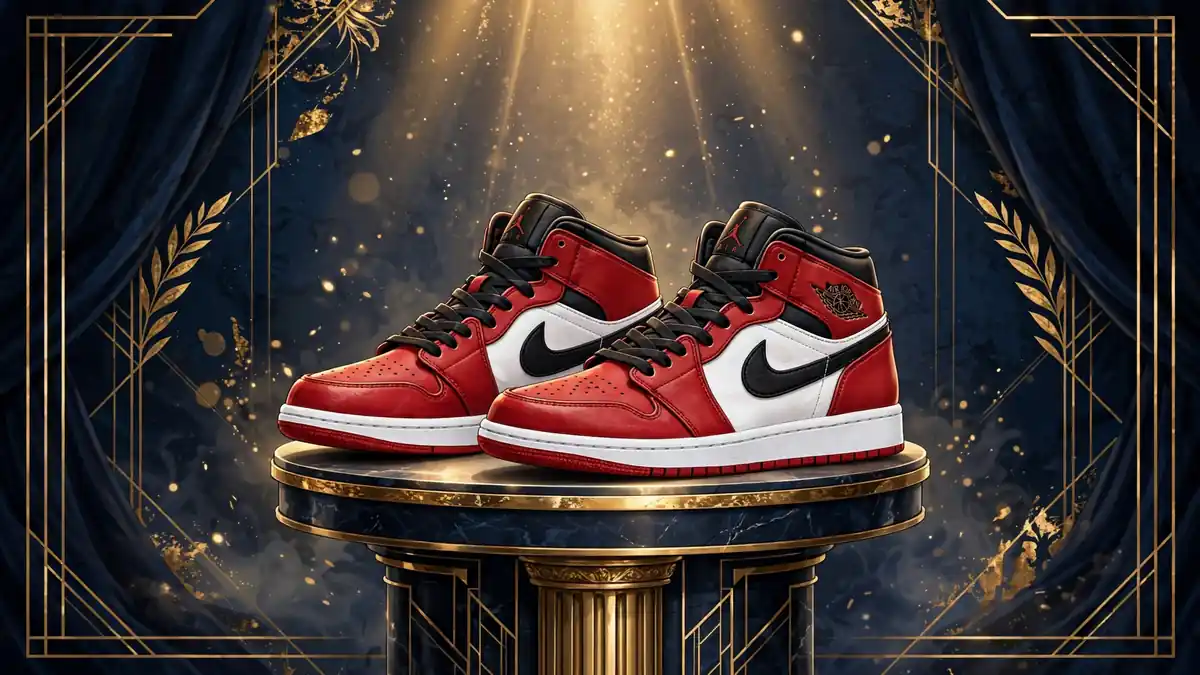
The royalty clause is the single most valuable sentence ever signed by an athlete. Nike projected $3 million in Air Jordan sales over the first three years. The shoe did $126 million in its first year alone, according to figures Falk later disclosed in interviews. The league fined Jordan $5,000 a game for wearing the black-and-red Air Jordan 1, which violated the NBA’s uniform policy, and Nike paid the fines and turned the punishment into an advertising campaign — “banned” became the selling point. By 1985, Jordan was the most famous athlete in America, and the shoe had crossed from sports equipment into fashion.
The 1992 Dream Team pushed the fame past sports entirely. Jordan, Magic Johnson, and Larry Bird led the first American Olympic team of NBA professionals to gold in Barcelona, and the tournament was watched around the world. Four years later came Space Jam, the 1996 film that paired Jordan with Bugs Bunny and the Looney Tunes cast. The movie grossed roughly $250 million worldwide, and Jordan was reportedly paid about $20 million for the role, per Parade’s reporting. It was not a great film by any serious measure, and it did not need to be: it put Jordan in front of children who had never seen him play, and it sold an enormous amount of merchandise. The Last Dance, ESPN’s ten-part documentary series released in 2020, did the same work for a new generation, drawing huge audiences during the pandemic sports shutdown and reminding everyone why the 1990s Bulls still sell shoes twenty years later.
Main Sources of Income
The shape of Jordan’s fortune is simple to describe and hard to believe. Almost none of it came from playing basketball. Sportico’s ranking of the highest-paid athletes of all time, cited by TheStreet, puts Jordan’s total career earnings at $2.77 billion in nominal dollars — $3.54 billion adjusted for inflation — and only about six percent of that total came from his NBA playing contracts, according to Fox Sports’ reading of the same list. The rest came from endorsements, licensing, and the sale of assets he bought with the endorsement money. Here is how the pieces fit together.
Nike is the engine. Jordan Brand, the Nike subsidiary built around his name, generated $6.6 billion in revenue in Nike’s fiscal 2023, about $7 billion in fiscal 2024, and $7.03 billion in fiscal 2026, according to Nike’s 10-K filings as reported by financial outlets. Jordan’s personal take from that revenue is not disclosed by Nike, but Forbes estimates it at nearly $300 million a year, and Front Office Sports reports the royalty at roughly 5 percent of Jordan Brand sales — a figure that produced a reported $256 million payment in 2022 alone, per Parade’s reporting of the Front Office Sports figure. Older estimates in the $150 million to $260 million range still circulate; the higher Forbes figure reflects the brand’s growth and the compounding of the royalty over four decades. Either way, the Nike check is the largest annual income stream of any retired athlete on earth, and it arrives whether Jordan does anything or not.
The second pillar is the Hornets sale. Jordan bought a majority stake in the Charlotte Bobcats — later renamed the Hornets — in 2010 and sold it in August 2023 to a group led by Gabe Plotkin and Rick Schnall at a valuation of about $3 billion, with the sale confirmed by the Associated Press. He kept a minority stake in the franchise, so the team still pays him in the form of rising equity value. The purchase price is one of the few numbers in this story where the sources genuinely disagree: most outlets, including Forbes, report about $275 million, while some report about $175 million. The difference likely comes from how much of the team’s debt Jordan assumed in the deal, and this article uses the $275 million figure as the headline number while noting the lower report. On either figure, the return was more than ten times his money.
The third pillar is everything else: equity stakes, licensing, and investments managed through his family office, Jump Management. Jordan co-founded the Cincoro Tequila brand in 2019 with fellow NBA owners Jeanie Buss, Wes Edens, and Wyc Grousbeck, along with Emilia Fazzalari. He became a special advisor to DraftKings in 2020 and took an equity stake in the company. He co-founded the NASCAR team 23XI Racing with driver Denny Hamlin in 2020. He invested in the esports holding company aXiomatic in 2018 as part of a reported $26 million round. Licensing income flows from video games — Jordan has appeared on the cover of NBA 2K multiple times — trading cards, memorabilia, and the endless reuse of his image and the number 23. None of these is individually as large as Nike, but together they form the kind of diversified portfolio that keeps a fortune growing after the headline deals are done.
Salary and Earnings
Jordan’s NBA salary history is a lesson in how much the league’s economics changed during his career. He earned $555,000 in his rookie season of 1984–85, a figure that looks like a rounding error against modern contracts. His pay rose steadily through the 1980s and early 1990s — $2 million in 1988–89, $4 million in 1992–93 — and then, in the final two seasons of the Bulls dynasty, it exploded. The Bulls paid him $30.14 million in 1996–97 and $33.14 million in 1997–98, the two largest single-season salaries in NBA history at the time, because the salary cap rules of that era let Chicago exceed the cap to keep its own free agent and owner Jerry Reinsdorf decided a dynasty was worth the price.
Those two seasons alone paid Jordan $63.28 million — more than double the roughly $28.5 million he earned in his first twelve seasons combined. It is one of the strangest pay curves in sports history: a player who was the best in the world for a decade, paid like a star but not a superstar, and then paid like a small country’s budget for two years at the end.
The career total depends on who is counting. Forbes puts his total NBA salary at about $90 million. Basketball-Reference, which lists every season’s contract, puts the figure at $94,022,500 across 15 seasons, including his two seasons with the Washington Wizards. The gap is a rounding and classification difference, not a dispute: Forbes rounds, and Basketball-Reference counts every dollar. This article uses the range of $90 million to $94 million. Either number makes the same point — his entire playing career paid him less than four months of his current Nike royalties, at the Forbes estimate of nearly $300 million a year.
The earnings picture after retirement is where the numbers get large. Sportico’s all-time list puts his career earnings at $2.77 billion nominal. Forbes has said Jordan has earned more than $1 billion from endorsements alone, a figure Parade repeated in its 2026 reporting. His reported $20 million payday for Space Jam in 1996 was, at the time, one of the largest acting fees ever paid to an athlete. The Last Dance reportedly earned him about $10 million, according to industry reporting cited by net-worth outlets — a figure this article treats as reported rather than confirmed, since neither Jordan nor ESPN disclosed the payment. What is confirmed is the direction of travel: every year since 2014, Jordan has earned far more from his name than he ever earned from his game.
Businesses and Investments
Jordan’s business career began while he was still playing, and it followed a pattern that later athletes — including LeBron James, whose own fortune passed $1 billion through a similar mix of equity and media — would copy. The first move was ownership. In 2006 Jordan bought a minority stake in the Charlotte Bobcats and became the team’s managing member of basketball operations. In 2010 he bought the majority stake and became the first former player to hold a controlling interest in an NBA franchise. The thirteen years of his ownership were not a sporting success — the Bobcats and Hornets made the playoffs twice and won a single playoff game in that span — but they were a financial triumph. The value of NBA franchises rose across the league through the 2010s as media rights deals ballooned, and Jordan sold at the top of that market. The Associated Press confirmed the August 2023 closing of the majority-stake sale to Plotkin and Schnall at a valuation of about $3 billion, and Forbes noted that the deal made Jordan the first professional athlete to make its list of the 400 richest Americans.
The second move was brand-building outside basketball. Cincoro Tequila, launched in 2019, was a deliberate play at the premium spirits market, and its co-founders were chosen with care: four NBA team owners and a spirits executive, a group with distribution contacts and capital. The brand has since expanded across the United States and into international markets, and while it does not disclose Jordan’s personal return, the tequila category has been one of the most reliable wealth-builders in celebrity business — the model that made George Clooney’s Casamigos sale famous is the one Cincoro follows.
The third move was motorsport. 23XI Racing, co-founded with Denny Hamlin in 2020, fields cars in the NASCAR Cup Series and has won races with drivers Bubba Wallace and Tyler Reddick. The team is a long-horizon investment — NASCAR teams are not the cash machines that NBA franchises are — but it put Jordan’s name and capital into a sport with a loyal audience and a growing media rights deal, and it gave him a competitive outlet after basketball. His DraftKings role, announced in September 2020, combined an advisory position with an equity stake in the sports-betting company at the moment legalized sports gambling was spreading across American states.
Behind all of this sits Jump Management, the family office Jordan uses to manage his investments, and a portfolio that has included stakes in the esports group aXiomatic and a string of restaurant ventures — the Michael Jordan’s Steak House locations in Chicago, New York, and Connecticut among them. The restaurant business is small against the Nike money, but it is characteristic: Jordan has always preferred businesses he can attach his name to and walk into, rather than passive positions he never sees. The one venture that did not work as planned was the Hornets’ on-court record, and even that ended in a tenfold return.
Brand Deals and Sponsorships
The Nike deal is the story, but it was never the only deal. Gatorade signed Jordan in 1991 and built the “Be Like Mike” campaign, one of the most famous advertising slogans in American history, around him. The campaign ran for years, the jingle is still quoted, and Gatorade has kept Jordan on its roster for more than three decades — a relationship that survived his retirements, his baseball detour, and his move into team ownership. Hanes has used him as a spokesman since the late 1980s, and the underwear ads became a running joke in his own circle: Jordan once said the Hanes deal paid for his golf habit, a line that says something about both the size of the check and the size of the habit.
McDonald’s, Coca-Cola, Wheaties, Upper Deck, and 2K Sports all paid for Jordan’s image at various points, and the Upper Deck relationship matters more than it looks: Jordan was one of the first athletes to take an equity-style interest in a trading card company rather than a flat fee, and the value of his rookie cards — a 1986 Fleer Jordan rookie in top condition has sold for more than $700,000 at auction — keeps his name in the collectibles market every year. The 2K relationship is the modern version of the same idea: Jordan has appeared on special editions of the NBA 2K game, and the licensing fees flow to him as the game sells millions of copies a year.
The honest total for all of this is hard to pin down, and the outlets that try are careful about it. Forbes has said Jordan has earned more than $1 billion from endorsements across his career. Sportico’s $2.77 billion career earnings figure, cited by TheStreet, folds endorsements together with salary and licensing. What both figures agree on is the order of magnitude: the endorsement money is measured in billions, not hundreds of millions, and it dwarfs the salary money by a factor of roughly thirty. The reason is the Nike structure. A flat endorsement fee pays once. A royalty pays every time a shoe sells, for forty years, in every country where Nike does business. No other athlete deal in history has that shape, and nobody has replicated it — not even LeBron James, whose lifetime Nike deal is reportedly worth more than $1 billion in total but is structured as a guaranteed contract rather than a pure royalty.

Houses, Cars and Other Assets
Jordan’s most famous property story is a sale, not a purchase. His Highland Park, Illinois, mansion — a 56,000-square-foot estate on about seven acres, built on land he bought in 1991 and completed in 1994 — was listed in 2012 for $29 million. It sat on the market for nearly thirteen years. The price was cut to $14.855 million in 2015, a figure the listing agent later said was chosen because the digits add up to 23, and it stayed there for about nine years. The estate finally sold on December 10, 2024, for $9.5 million, according to The Real Deal, with the buyer identified by ABC7 Chicago and Realtor.com as Nebraska real estate investor John Cooper. The house has nine bedrooms, nineteen bathrooms, a full indoor basketball court, a tennis court, a cigar room, a putting green, and a gate bearing the number 23. Cooper has since tried to turn it into a museum and a luxury rental, listing it for as much as $230,000 a month before cutting the ask to $89,000 a month, per Realtor.com’s reporting. Jordan lost roughly $20 million against the original asking price on paper — and the sale barely registers against a fortune measured in billions, which is itself a measure of how large the fortune is.
His main home now is in Florida. Jordan’s mansion at The Bears Club in Jupiter, a roughly 28,000-square-foot estate on three acres with its own full-size basketball gym, is his primary residence, and in April 2024 he bought a second home inside the same gated golf community, according to The Real Deal. He also owns a lake house on Lake Norman near Cornelius, North Carolina, close to the Charlotte area where he owned the Hornets. The Florida move is a familiar one for wealthy athletes — no state income tax, year-round golf — and Jordan has leaned into it, building his own private golf club, The Grove XXIII in Hobe Sound, Florida, which opened in 2019 and is named for his number.
The car collection has been covered by automotive magazines for decades, and the reported inventory includes a Ferrari 599 GTB Fiorano, a Porsche 911 Turbo S, and a Chevrolet Corvette ZR1, among others. He also owns a private jet, a Gulfstream with the tail number N236MJ — the 23 and his initials — and an 82-foot Viking sportfishing yacht named Catch 23, which he has fished in tournaments off the North Carolina coast. None of these is a major asset against a $4.3 billion fortune. The jet, the yacht, and the cars are the visible spending; the invisible assets — the Hornets minority stake, the Nike royalty stream, the equity portfolio — are where the money actually sits.
Awards and Achievements
The playing record needs no exaggeration, and this article will not attempt any. Jordan won six NBA championships with the Chicago Bulls, in 1991, 1992, 1993, 1996, 1997, and 1998, and was named Finals MVP in all six series — the only player in history to win the award six times. He won the regular-season Most Valuable Player award five times, in 1988, 1991, 1992, 1996, and 1998. He was selected to fourteen All-Star teams, won ten scoring titles, made the All-NBA First Team ten times, and was named to the All-Defensive First Team nine times. He was the Defensive Player of the Year in 1988, the Rookie of the Year in 1985, and the scoring champion in ten of his fifteen seasons.
The international record is just as clean. Jordan won Olympic gold medals with the United States in 1984 in Los Angeles, as a college player, and in 1992 in Barcelona with the Dream Team. He was inducted into the Naismith Memorial Basketball Hall of Fame in 2009, and President Barack Obama awarded him the Presidential Medal of Freedom in 2016, the highest civilian honor in the United States. His career scoring average of 30.1 points per game remains the highest in NBA history, ahead of Wilt Chamberlain’s 30.07 — a gap of three-hundredths of a point that has survived every scorer since.
The business honors are a separate list, and they matter more to a net-worth article. Jordan became the first athlete to reach billionaire status, according to Forbes, in 2014. He became the first professional athlete to make the Forbes 400 list of the richest Americans in 2023. He is the richest former athlete in history by a wide margin, and the only athlete whose fortune places him among the thousand richest people on the planet. The peer comparison below shows how wide the margin is.
Net Worth Growth Over the Years
The growth curve of Jordan’s fortune looks nothing like a normal athlete’s. Most players earn the most while they play and watch the money fade after retirement. Jordan’s money did the opposite: it was modest while he played and compounded after he stopped. The table below uses Forbes estimates throughout, because Forbes has tracked him the longest and its figures are the ones other outlets cite.
| Year | Estimated net worth | What drove it |
|---|---|---|
| 1984 | Under $1 million | Rookie contract of $555,000; Nike deal signed |
| 1998 | About $100 million | Peak NBA salary years; endorsements compounding |
| 2014 | $1 billion | First athlete billionaire (Forbes); Hornets value rising |
| 2020 | About $2.1 billion | Jordan Brand growth; The Last Dance; DraftKings stake |
| 2023 | About $3 billion | Hornets majority-stake sale; first athlete on the Forbes 400 |
| 2025 | $3.8 billion | Nike royalties; investment appreciation (Forbes) |
| 2026 | $4.3 billion – $4.7 billion | Forbes annual list $4.3B; real-time tracker $4.7B (Oct 2026) |
The jump from 2025 to 2026 — $500 million on the annual list, $900 million on the real-time tracker — came from investment appreciation and the continued royalty stream rather than any single transaction. That is the pattern of the whole curve: the fortune grows in large steps when an asset is sold, and in steady increments the rest of the time. The 2014 to 2023 period added roughly $2 billion, driven by the rising value of the Hornets and the compounding Nike royalties. The 2023 sale crystallized a large part of that gain into cash and liquid investments.
For context, here is how Jordan’s fortune compares with the other athlete billionaires Forbes tracks. The figures are Forbes estimates from 2025–26 reporting, and they move with markets, so treat them as a snapshot rather than a fixed ranking.
| Athlete | Estimated net worth | Main wealth source |
|---|---|---|
| Michael Jordan | $4.3 billion – $4.7 billion | Nike royalties; Hornets sale |
| LeBron James | About $1.4 billion | NBA salary; SpringHill; Fenway Sports Group stake |
| Tiger Woods | About $1.3 billion | Golf earnings; TGR business ventures |
| Magic Johnson | About $1.2 billion | Business empire; team ownership stakes |
| Floyd Mayweather | About $450 million | Boxing purses; promotions |
| Serena Williams | About $350 million | Tennis earnings; Serena Ventures |
Jordan’s fortune is roughly three times the size of the next athlete on the list. That gap is the story of this article in one table: nobody else in sports history has combined a royalty deal of this size with a franchise sale of this size, and the combination is unlikely to be repeated. LeBron James is the closest active comparison, and even his fortune — built across two decades of maximum NBA salaries and a media company — sits at about a third of Jordan’s.
Social Media Presence
Michael Jordan has no public personal social media accounts, and he never has. In an era when athletes build brands one post at a time, the richest athlete in history has built his without posting at all. The absence is deliberate: Jordan has said in interviews that he values his privacy, and the Jordan Brand does the public-facing work for him. The brand’s Instagram account, @jumpman23, counts its followers in the tens of millions, and its posts — new shoe releases, athlete endorsements, archive footage — routinely draw engagement that most active athletes would envy.
The trade-off is that Jordan’s online presence is managed by others, and the conversation about him happens in the media rather than on his own channels. ESPN, the NBA, and Jordan Brand drive the cycles: a new Air Jordan release, an anniversary of The Last Dance, a Hornets sale update. The model works because the product sells itself. The Air Jordan line does not need its namesake to post about it; the shoes are the post. For a net-worth article, the point is practical: Jordan’s social media footprint is the Jordan Brand’s footprint, and the brand’s revenue — $7.03 billion in Nike’s fiscal 2026 — is the number that matters, not a follower count.
Personal Life
Jordan married Juanita Vanoy in 1989. They had three children together — Jeffrey, Marcus, and Jasmine — and divorced in 2006. He married Yvette Prieto, a Cuban-American model, in 2013 in Palm Beach, Florida, and the couple had twin daughters, Victoria and Ysabel, in February 2014. The family lives primarily in Jupiter, Florida, and Jordan is a regular at his own golf club, The Grove XXIII, where the membership is small and the privacy is strict.
His philanthropy is large and, by his own design, low-key. In 2020, Jordan and Jordan Brand committed $100 million over ten years to organizations working on racial equality, social justice, and access to education. In 2023 he gave $10 million to Make-A-Wish, the largest individual donation in the organization’s history, on the occasion of his 60th birthday — Jordan has granted wishes with the organization since 1989. He has given more than $10 million to Novant Health to open health clinics in underserved neighborhoods of Charlotte, and he donated $2 million to relief efforts after Hurricane Florence hit North Carolina in 2018. The giving totals more than $130 million across the commitments named here, and it is one of the reasons the Jordan Brand’s community programs carry his name rather than a corporate slogan.
The gambling stories that followed Jordan through the 1990s deserve a straight answer, because readers still ask about them. Jordan has acknowledged that he gambled on golf and cards, and that the amounts were large by any normal standard. There has never been a credible report that gambling affected his play or his finances, and the NBA’s investigation in the early 1990s found no evidence of betting on basketball. The subject matters to a net-worth article only in that it does not matter: the fortune was built by the royalty and the franchise sale, and no credible reporting ties any part of it to gambling, in either direction.
Sources & Reporting
Forbes — the anchor source for the net-worth estimate: the 2026 annual billionaires list ($4.3 billion, valued March 1, 2026, rank 984) and the real-time billionaire tracker ($4.7 billion, October 18, 2026; $3.8 billion in 2025). Forbes also supplied the royalty estimate (nearly $300 million a year), the career salary figure (about $90 million), the first-athlete-billionaire milestone (2014), and the first-athlete-on-the-Forbes-400 milestone (2023). Reporting window: 2014–October 2026.
Nike — Form 10-K filings for Jordan Brand revenue: $6.6 billion in fiscal 2023, about $7 billion in fiscal 2024, $7.03 billion in fiscal 2026, as reported by financial outlets citing the filings. Nike’s fiscal year ends May 31. Reporting window: fiscal 2023–2026.
Associated Press — confirmation of the August 2023 closing of the Charlotte Hornets majority-stake sale to Gabe Plotkin and Rick Schnall at a valuation of about $3 billion, and Jordan’s retention of a minority stake. Reporting window: August 2023.
Basketball-Reference — the career salary record: $94,022,500 across 15 NBA seasons, including the $30.14 million season in 1996–97 and the $33.14 million season in 1997–98, plus career statistics (30.1 points per game, six championships, five MVP awards). Reporting window: 1984–2003 playing career.
Sportico — the all-time highest-paid athletes ranking, cited by TheStreet: $2.77 billion in career earnings nominal, $3.54 billion adjusted for inflation, with about six percent from playing contracts. Reporting window: 2023.
Parade — 2026 reporting on the Forbes estimates ($4.7 billion real-time figure), the Space Jam salary (about $20 million), the Hornets purchase and sale figures, the Front Office Sports royalty reporting ($256 million in 2022), and the Highland Park mansion sale timeline. Reporting window: January–October 2026.
The Real Deal — the Highland Park mansion sale (December 10, 2024, $9.5 million) and the second Bears Club home purchase in Jupiter, Florida (April 2024). Reporting window: 2024.
Realtor.com — the Highland Park sale details, the buyer (John Cooper), and the post-sale rental listings ($230,000 a month, later cut to $89,000). Reporting window: December 2024–December 2025.
Front Office Sports — the Jordan Brand royalty structure (about 5 percent of Jordan Brand sales) and the reported 2022 royalty payment, as cited by Parade. Reporting window: 2022–2026.
NBA.com — career history, championship record, and the Hornets sale coverage. Reporting window: 1984–2023.
Figures in this article were checked in November 2026. Where sources disagreed — the Hornets purchase price ($275 million versus $175 million), the career salary total ($90 million versus $94 million), the annual royalty ($150–$260 million versus nearly $300 million) — the article reports the range and names the sources on each side. Jordan’s personal finances are not publicly disclosed, and every figure here is an estimate built from public reporting.
Frequently Asked Questions
What is Michael Jordan’s net worth in 2026?
Michael Jordan’s net worth is estimated at $4.3 billion to $4.7 billion in 2026. Forbes put him at $4.3 billion on its annual billionaires list, valued March 1, 2026, and its real-time tracker later showed $4.7 billion in October 2026. The range reflects movement in his private holdings, not a dispute about the fortune’s size. He is the richest athlete in history by a wide margin.
Is Michael Jordan a billionaire?
Yes. Jordan became the first athlete to reach billionaire status in 2014, according to Forbes, when the rising value of the Charlotte Hornets pushed his fortune past $1 billion. In 2023 he became the first professional athlete to make the Forbes 400 list of the richest Americans, after selling his majority stake in the Hornets.
How much does Michael Jordan make from Nike per year?
Forbes estimates Jordan earns nearly $300 million a year from Nike in Jordan Brand royalties. Front Office Sports reports the royalty at about 5 percent of Jordan Brand sales, which produced a reported $256 million payment in 2022. Nike does not disclose what it pays him, so every annual figure is an estimate. Jordan Brand itself generated $7.03 billion in revenue in Nike’s fiscal 2026.
How much money did Michael Jordan make in the NBA?
Jordan earned $90 million to $94 million in NBA salary across 15 seasons — about $90 million per Forbes, and $94,022,500 per Basketball-Reference’s season-by-season record. His two biggest seasons were $30.14 million in 1996-97 and $33.14 million in 1997-98, the largest single-season salaries in NBA history at the time. His entire playing career paid him less than four months of his current Nike royalties.
How much did Michael Jordan sell the Charlotte Hornets for?
Jordan sold his majority stake in the Charlotte Hornets in August 2023 to a group led by Gabe Plotkin and Rick Schnall at a valuation of about $3 billion, with the sale confirmed by the Associated Press. He kept a minority stake in the team. He had bought the majority stake in 2010 for a reported $275 million, though some outlets report $175 million — the difference likely reflects debt assumed in the purchase.
Who is richer, Michael Jordan or LeBron James?
Michael Jordan is far richer. Forbes estimates Jordan’s net worth at $4.3 billion to $4.7 billion in 2026, while LeBron James’s fortune is estimated at about $1.4 billion. James is the richest active athlete in the world and the first active NBA player to become a billionaire, but his fortune is roughly a third of Jordan’s, because Jordan’s Nike royalty and Hornets sale have no equivalent in James’s portfolio.
How much did Michael Jordan make from Space Jam?
Jordan was reportedly paid about $20 million for Space Jam (1996), according to Parade’s reporting. The film grossed roughly $250 million worldwide at the box office and sold an enormous amount of merchandise, introducing Jordan to a generation of children who had never seen him play. The Last Dance, ESPN’s 2020 documentary series about the 1990s Bulls, reportedly earned him about $10 million.
Does Michael Jordan still own the Charlotte Hornets?
No, not as majority owner. Jordan sold his majority stake in August 2023 but kept a minority stake in the franchise, so he still benefits when the team’s value rises. He had owned the team for thirteen years, buying the majority stake in 2010, and the sale at a valuation of about $3 billion returned more than ten times his original investment.
Final Thoughts
Michael Jordan’s net worth in 2026 is estimated at $4.3 billion to $4.7 billion, and the number that explains it is not a salary or a single deal. It is a royalty clause signed in 1984, when a 21-year-old rookie took $500,000 a year plus a percentage of every shoe sold, and a franchise bought in 2010 for a reported $275 million and sold thirteen years later at a valuation near $3 billion. The playing career that made him famous paid him $90 million to $94 million in total. The business career that followed pays him nearly $300 million a year from Nike alone, by Forbes’ estimate, and it will keep paying as long as people buy Air Jordans — which is to say, for as long as anyone can see.
The gap between Jordan and every other athlete is the point. LeBron James, the richest active player in the world, is worth about a third of what Jordan is worth. The reason is not that Jordan was three times the player — it is that he signed the one contract in sports history that pays forever, and then he bought the one asset in sports that multiplies. Athletes who came after him studied both moves. None of them has matched either one. The fortune is an estimate, and it will move with markets and shoe sales, but the ranking will not: Michael Jordan is the richest athlete who ever lived, and the distance between him and second place is the largest in the history of sports wealth.
Published on November 10, 2026. Last reviewed November 2026. Found an error? See our corrections policy.