
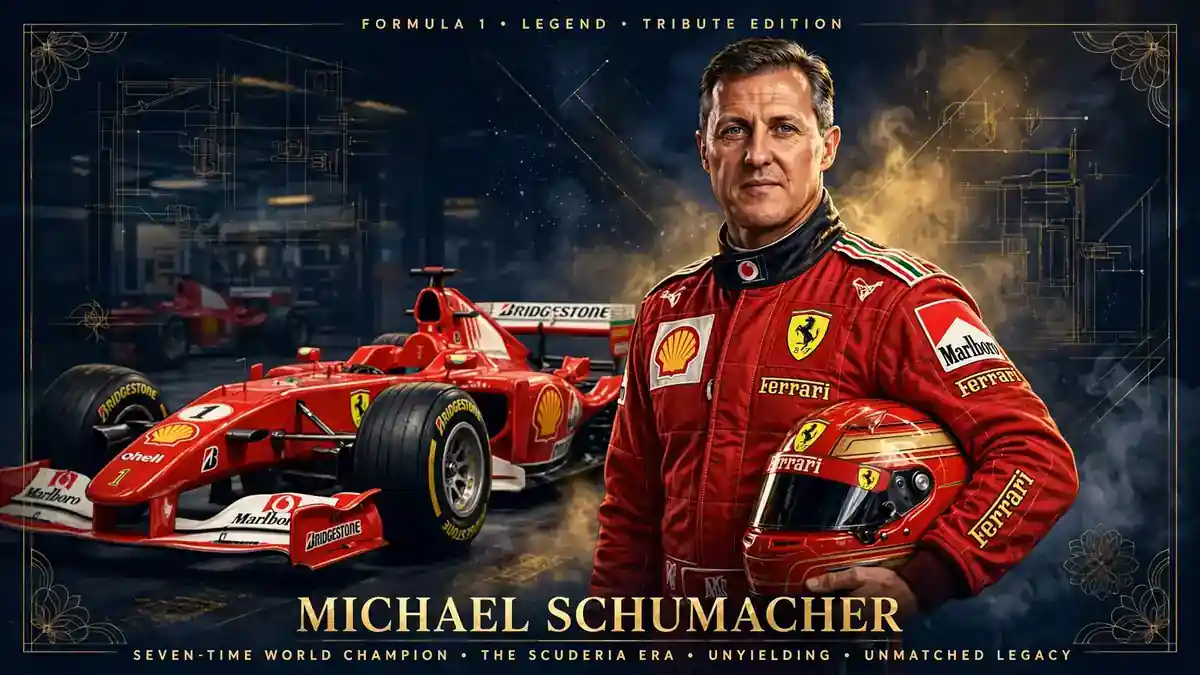
Michael Schumacher‘s net worth is estimated at $600–800 million as of November 2026. The seven-time Formula 1 world champion earned roughly $1 billion across his racing career, according to Forbes, and no driver who made his money on the track has matched him since. His fortune rests on three pillars: Ferrari contracts that rewrote what a racing driver could earn, endorsement deals that paid him millions simply to wear a sponsor’s cap, and a collection of cars, watches and property that keeps setting auction records — eight of his watches sold for nearly $4.4 million at Christie’s in May 2024, and two more pieces from his collection go under the hammer in Geneva on 9 November 2026, the day this article was last reviewed.
Michael Schumacher: Quick Facts
| Estimated net worth | $600 million (range: $600–800 million) |
|---|---|
| Profession | Former Formula 1 racing driver |
| Nationality | German |
| Born | 3 January 1969 (age 57) |
| Height | 1.74 m (5 ft 9 in) |
| Primary income sources | Ferrari and Mercedes race contracts, endorsements (Shell, Deutsche Vermögensberatung), car and watch collections, property |
| Active years | 1991–2006, 2010–2012 |
| Last reviewed | November 2026 |
- Quick Facts
- Early Life and Background
- Education
- Career Journey
- Rise to Fame
- Main Sources of Income
- Salary and Earnings
- Businesses and Investments
- Brand Deals and Sponsorships
- Houses, Cars and Other Assets
- Awards and Achievements
- Net Worth Growth Over the Years
- Social Media Presence
- Personal Life
- Sources & Reporting
- Frequently Asked Questions
- Final Thoughts
- Related Profiles
Early Life and Background
Michael Schumacher was born on 3 January 1969 in Hürth, a small town outside Cologne in what was then West Germany. His father, Rolf, was a bricklayer who ran the local karting track at Kerpen, and his mother, Elisabeth, worked in the track canteen. The family had little money by the standards of the sport their son would come to dominate, and that detail matters: karting is a rich family’s pursuit, and the Schumachers were not rich. Young Michael drove karts other families had discarded, patched together with used parts, and learned his craft on a track his father maintained by hand.
The kart track at Kerpen became his classroom. By the time he was a teenager he was winning German and European junior karting titles, and the people who watched him then remember the same traits that later defined his Formula 1 career: lap after lap of identical, metronomic pace, and a willingness to work longer than anyone else on the circuit. He won the German Junior Kart Championship in 1984 and the European Kart Championship in 1987, results that put him on the radar of Mercedes-Benz, which was rebuilding its junior driver programme at the end of the 1980s.
Mercedes signed him to its junior team in 1990 alongside Karl Wendlinger and Heinz-Harald Frentzen, and the three were put through sports cars and junior formulae as a group. Schumacher won the German Formula 3 championship in 1990 and finished fifth at Le Mans the same year in a Mercedes Sauber. The programme paid him a salary — modest by the standards of what came later — and taught him how a manufacturer team operates. It also gave him his break: when Bertrand Gachot went to prison in August 1991 and his Jordan seat fell vacant for the Belgian Grand Prix at Spa, Mercedes helped place its junior driver in the car.
He qualified seventh at Spa on a circuit he had never raced, in a car he had never driven, and retired with a broken clutch after half a lap. It was enough. Flavio Briatore signed him for Benetton before the next race, and Schumacher never drove for a backmarker team again. The Spa weekend is the hinge of the whole fortune: one qualifying lap turned a salaried junior into a Grand Prix driver, and the contracts that followed escalated from thousands to tens of millions within five years.
Education
Schumacher left school after his basic education in Hürth and trained as a car mechanic, an apprenticeship he completed before his racing career took over. The trade gave him something most drivers never had: a working understanding of the machine. Engineers at Benetton and Ferrari repeatedly said he could describe a handling problem in mechanical terms — a differential setting, a brake balance shift — rather than in the vague language drivers usually reach for. That fluency made him a development driver as much as a racing driver, and it is one reason Ferrari paid him like one.
His real education happened on the Kerpen kart track and in the Mercedes junior programme, where he learned fitness discipline, media handling and sponsor work alongside the driving. He spoke German, English and Italian by the time he joined Ferrari, and the Italian mattered: it let him work directly with the Maranello factory staff without translators, and it endeared him to the tifosi in a way no Ferrari driver before him had managed.
Career Journey
Schumacher’s Formula 1 career divides into four acts, and each one paid differently. At Benetton (1991–1995) he was a prodigy on a rising salary, winning his first Grand Prix at Spa in 1992 and back-to-back world titles in 1994 and 1995. The 1994 championship came in the season Ayrton Senna died at Imola, and it ended in controversy at Adelaide, where Schumacher’s damaged Benetton collided with Damon Hill’s Williams and handed him the title by a single point. The 1995 title was cleaner: nine wins, a dominant season, and a driver market that suddenly had every top team bidding for him.
Ferrari (1996–2006) is where the money became historic. Ferrari had not won a drivers’ championship since Jody Scheckter in 1979 when Schumacher arrived, and the team paid accordingly: a two-year deal reported at $60 million in total, which Crash.net still cites as the contract that reset the driver market. He rebuilt the team around himself, bringing technical director Ross Brawn and designer Rory Byrne with him from Benetton, and the titles followed — five in a row from 2000 to 2004, on top of the two at Benetton. His 2004 season remains one of the most dominant in the sport’s history: 13 wins from 18 races.
He retired at the end of 2006 with seven titles and 91 wins, records that stood for a decade and a half. Lewis Hamilton has since passed the win total, but nobody has matched the seven championships — Hamilton shares the record at seven — and nobody has matched the earnings. Schumacher then spent three seasons away before a comeback with Mercedes (2010–2012), where he earned a reported $10–12 million a year in base salary and helped develop the team that would go on to dominate the hybrid era after he left. He scored one podium in the comeback, at Valencia in 2012, and retired for good at the end of that season with 308 Grand Prix entries, 91 wins, 68 pole positions, 155 podiums and 77 fastest laps.
The fourth act is the one nobody wanted. On 29 December 2013, a year after his final retirement, Schumacher suffered a severe traumatic brain injury while skiing off-piste in Méribel in the French Alps with his son Mick. He hit his head on a rock with enough force to crack his helmet, spent months in a medically induced coma, and has not made a verified public appearance since. His family cares for him at home, and his earning career ended that day on the mountain.
Rise to Fame
Fame arrived fast and stayed. The Spa qualifying lap in 1991 made him a story; the first win at the same circuit a year later made him a star; the two Benetton titles made him Germany’s biggest sporting figure. In 1994 and 1995 he was the face of a sport grieving Senna and searching for its next champion, and German television audiences for Formula 1 exploded around him. RTL, which broadcast the races in Germany, built its Sunday programming around his results, and German sponsors queued to attach themselves to him.
The Ferrari move in 1996 turned national fame into global fame. Ferrari is the most followed team in motorsport, and Schumacher became its most successful driver, winning in the red car in front of crowds that treated him as one of their own. Forbes named him the world’s highest-paid athlete in 1999 and 2000, and in 2005 Euro Business magazine called him the world’s first billionaire athlete — a label that needs care, because it referred to his cumulative career earnings crossing $1 billion, not to a net worth of $1 billion. The distinction is the single most misunderstood number in his financial story, and it is why published net worth figures sit at $600–800 million while his career earnings passed $1 billion years ago.
His fame also survived his retirement in a way few athletes manage. The Netflix documentary Schumacher (2021) drew a global audience and included his wife Corinna’s first public words about his condition — “Michael is here. Different, but he’s here” — and a second documentary, Schumacher ’94: The Birth of a Legend, followed in 2026. Both kept his name in the news without a single new race result, and both fed the market for his memorabilia: the watch and car auctions of 2024 and 2026 are, in part, a measure of how durable that fame remains.
Main Sources of Income
Schumacher’s fortune came from four streams, and the balance between them shifted over his career. Race contracts were the foundation: roughly two decades of team salaries, rising from a junior’s wage at Jordan and Benetton to the richest driver deal in the sport at Ferrari. Endorsements were the second stream, and at his peak they were worth nearly as much as the driving itself. A third stream, often missed in net worth roundups, was his personal property in cars and watches — assets that appreciated while he owned them and have since sold at auction for millions. The fourth stream, investment income from a property portfolio built during his peak earning years, is the least documented and the hardest to value, because the family has kept its finances private since 2013.
The split at his peak, around 2003–2004, tells the story. Forbes put his total income in 2004 at $80 million, second among all athletes behind Tiger Woods. Of that, his Ferrari base salary was about $40 million, per Crash.net’s reporting of his contract, and the rest came from bonuses and personal sponsors. Celebrity Net Worth puts his peak annual income at $80–100 million including endorsements, a range that matches the Forbes figure once bonuses are counted. In other words, Schumacher was earning from sponsors almost as much as Ferrari paid him to drive — a ratio no Formula 1 driver had achieved before him, and one that set the template for the Hamilton and Verstappen deals that followed.
After retirement, the streams changed. Race salary stopped in 2012. Endorsement income shrank as he stepped away from public life, though long-standing deals and licensing kept some money coming in. What replaced them, gradually, was asset value: the cars and watches he had collected became saleable at auction, and the property he had bought in Switzerland and Spain held its value. The 2024 Christie’s watch sale and the 2022 sale of his championship-winning Ferrari F2003-GA — reported at about $14.87 million — are the visible part of that shift from income to assets.
One more stream deserves a mention because it confuses a lot of readers: prize money. Formula 1 teams, not drivers, collect the sport’s prize money, and drivers are paid by salary and bonus instead. Schumacher’s bonuses for wins and titles were contractual, negotiated in private, and reported only in round numbers. Any article that credits him with a specific prize-money total is guessing; the honest figure is the contract and endorsement reporting that follows.
Salary and Earnings
Formula 1 teams do not publish driver contracts, so every salary figure below comes from reporting at the time, and the honest way to read them is as a range rather than a payslip. The direction of travel is clear in every source: Schumacher’s pay roughly doubled with each new Ferrari contract, and his total income — salary plus bonuses plus sponsors — peaked at $80–100 million a year.
| Period | Team | Reported pay |
|---|---|---|
| 1991–1992 | Jordan / Benetton | Junior salary; low single-digit millions as his first full season began |
| 1994–1995 | Benetton | Multi-million salary as a two-time world champion; exact figures not publicly reported |
| 1996 | Ferrari | Two-year deal worth a reported $60 million in total; about $25 million salary and $35 million total income with sponsors in his first year, per Grandprix.com |
| 1999 | Ferrari | Salary reported at about £30 million by the end of the decade |
| 2001 | Ferrari | Two-year extension reported at about $115 million |
| 2003–2004 | Ferrari | New contract reported at £80 million in total; base salary of about $40 million (£29 million) in 2004, per Crash.net; total income of $80 million in 2004, per Forbes |
| 2010–2012 | Mercedes | Base salary of about $10–12 million a year, per contemporary reporting; Crash.net and Sports Illustrated put the full package, including endorsements, at about £30 million a year |
| Career total | All teams | About $1 billion in salary, bonuses and endorsements, per Forbes (2016) |
The Forbes career-earnings figure is the anchor for everything else. In 2016 the magazine estimated Schumacher’s career earnings at about $1 billion, making him the fifth-highest-earning athlete in history at that point, behind Michael Jordan, Tiger Woods, Arnold Palmer and Jack Nicklaus. That ranking is the context for the net worth range: a man who earned $1 billion gross, paid tax in Germany and Switzerland, lived at the top of the sport’s spending scale, and has faced more than a decade of private medical costs since 2013, keeping $600–800 million is a credible outcome. The $600 million figure from Celebrity Net Worth sits at the conservative end — it assumes heavier costs and lower asset values — while the $790–800 million figures from GQ Sports, cited by RacingNews365 in December 2025, and Alux’s October 2026 ranking sit at the optimistic end, valuing his property, cars and watches generously.
Inflation adds another layer that most net worth pages skip. Crash.net’s contract analysis, reported by Yardbarker, noted that Schumacher’s 2004 base salary of £29 million was worth about £53 million in today’s money — roughly the same, in real terms, as Lewis Hamilton’s reported Ferrari salary of just under $74 million (£55 million) in 2026. Schumacher was not underpaid by modern standards; he was paid modern money two decades early, before Formula 1’s revenues had grown to their current size.
There is also a number that gets repeated without a source and should be treated carefully: the claim that he earned $50 million a year as a flat salary. That figure appears on several net worth sites without attribution, and it does not match the contract reporting above. His Ferrari base salary was about $40 million at its peak, and the $80–100 million figures are total income, not salary. We use the sourced numbers, not the round ones.
Businesses and Investments
Schumacher never built a business empire in the way some athletes do — there is no Schumacher restaurant chain or fashion label — and that restraint is part of why his wealth is concentrated in a few visible buckets rather than spread across dozens of ventures. What he did build was a portfolio of property and collectibles, plus a licensing operation around his name that continued after he stopped racing.
Property was his largest investment. The family home is in Gland, on the shore of Lake Geneva in Switzerland, where the family has lived since the late 1990s and where Schumacher receives his care today. The family also owns a villa in Mallorca, Spain — in Port d’Andratx, bought in 2017 according to Spanish press reporting — which is where they spend part of the year. Swiss lakeside property and Balearic villas are both asset classes that have appreciated steadily across the period he owned them, and together they account for a meaningful share of the upper end of the net worth range. The family has never confirmed purchase prices, so we do not put a figure on either home.
His car collection is better documented, because parts of it keep appearing at auction. The headline sale was his Ferrari F2003-GA, the car in which he won his sixth world title: it sold at auction in Geneva in November 2022 for a reported CHF 14.87 million, about $14.9 million, one of the highest prices ever paid for a Formula 1 car. He also owned a Ferrari FXX, the track-only development car he helped develop, valued in reporting at about $2.1 million, and a Ferrari Enzo. These were not garage ornaments; the FXX programme in particular was a working relationship with the factory, and his feedback shaped the car.
The watch collection is the most transparent of his investments, because Christie’s published the results. In May 2024 the family consigned eight watches from his private collection to Christie’s Geneva sale, timed to the 30th anniversary of his first world championship. They sold for just under CHF 4 million — about $4.4 million. The top lot was a platinum F.P. Journe Vagabondage 1, a Christmas present from Jean Todt in 2004 with a dial marking his seven titles, which sold for CHF 1,497,000 ($1.65 million). A bespoke Audemars Piguet Royal Oak chronograph, also a Todt gift, made CHF 415,800, well above its estimate, and a boxed set of five F.P. Journe Ruthenium watches went to a single buyer for more than CHF 1.7 million. Two more watches with Schumacher provenance — a Ruthenium Tourbillon and a Chronomètre à Résonance that sold in 2024 for CHF 642,000 and CHF 390,600 — returned to Christie’s Geneva sale on 9 November 2026, the day this article was reviewed, with estimates in the CHF 300,000–1,500,000 range per piece.
Licensing rounds out the picture. The Schumacher name and the number 7 remain licensed for merchandise, and the family runs the Keep Fighting Foundation, the non-profit set up in his name after the accident, which is a charitable vehicle rather than an income stream. He also held advisory and ambassador roles after retirement, including work with Mercedes during and after his comeback, though the family has never disclosed fees for those roles and we do not estimate them.
Brand Deals and Sponsorships
Sponsorship was where Schumacher’s earnings separated from every driver before him. At his peak, personal sponsors paid him tens of millions a year on top of his team salary, and two deals in particular became famous for their simplicity. Shell paid him a reported $10 million a year simply to wear a Shell-branded cap at public appearances, according to Celebrity Net Worth and RacingNews365. Deutsche Vermögensberatung, the German financial advisory firm known as DVAG, paid a reported $8 million a year for the cap he wore during his Mercedes comeback. Two hats, $18 million a year, before he turned a wheel.
The wider sponsor list reads like a roll call of German and global brands of the era: Marlboro, which backed Ferrari through its tobacco era; Omega, the watchmaker; Navyboot, the Swiss shoe brand; Rosbacher, the mineral water; and the German telecom and consumer brands that bought into his image in his home market. He was also the face of Ferrari’s own commercial operation, and his image sold the team’s merchandise in a way no driver since has quite repeated.
What made the deals valuable was not just the money but the structure. Schumacher’s management, led for most of his career by Willi Weber, negotiated personal endorsements separately from the team’s sponsors, so the money flowed to him rather than through the team. That is the model every top driver uses now, and Schumacher was the first to operate it at full scale. It is also why his total income could reach $80–100 million while his team salary was $40 million: the sponsors were paying the man, not the seat.
After 2013 the endorsement stream dried up, as it had to — he could no longer appear, shoot commercials or attend events. The deals that remain are licensing and legacy arrangements managed by the family, not active endorsements. That is the quiet cost of the accident on the financial side: a man whose personal brand was worth tens of millions a year in endorsements lost that income overnight, and the net worth range published today reflects a fortune that has been largely static, managed rather than grown, for more than a decade.
Houses, Cars and Other Assets
The asset side of Schumacher’s fortune is the part readers can actually see, because so much of it has passed through public auction rooms. The homes are the exception: the family guards their privacy fiercely, and the two known residences — the Lake Geneva house in Gland, Switzerland, and the Mallorca villa in Port d’Andratx — are known from press reporting rather than any family statement. Both are in markets that have risen sharply since he bought them, and both are adapted for his care, with medical facilities installed at home. Reports have also linked the family to property in Dubai, including a villa on “The World” islands development, though that claim rests on thinner sourcing and we treat it as reported rather than confirmed.
The cars are the centrepiece. Beyond the F2003-GA that sold for about $14.9 million and the FXX valued at about $2.1 million, his collection at its peak included a string of Ferraris — road cars as well as race cars — and a private jet for travel between races and homes. A private jet is a cost as much as an asset, and the family is reported to have sold aircraft in the years since the accident, but no sale has been confirmed in public records we could verify, so we do not list a jet among current assets.
The watches, as the Christie’s results show, were a genuine store of value. Eight pieces, just under CHF 4 million in one sale, with individual pieces setting records for their makers. The Vagabondage 1 at CHF 1,497,000 is the headline, but the quieter result is the Ruthenium set: five watches, one buyer, more than CHF 1.7 million. Collectors pay for provenance, and Schumacher’s name on a watch — especially one given to him by Jean Todt, the man who built his Ferrari team — carries a premium that the 2026 return of two more pieces to Christie’s will test again.
There is a cost side to the asset picture that honest reporting has to include. Round-the-clock private care for a severe brain injury is expensive in any country, and the family has been paying it for more than twelve years. No figure has ever been confirmed by the family, and press estimates vary so widely that we will not repeat a number here. What is confirmed is the shape of it: a team of carers, medical equipment at home, and a house adapted around his needs. That cost is the main reason we weight the $600 million end of the range more heavily than the $800 million end, and it is also why the family’s decision to sell watches and a championship car reads as careful estate management rather than a fire sale.
Awards and Achievements
The record book is the foundation of the fortune, so it is worth setting out in full. Schumacher won seven Formula 1 World Drivers’ Championships — 1994 and 1995 with Benetton, then 2000, 2001, 2002, 2003 and 2004 with Ferrari. He won 91 Grands Prix, a record that stood until Lewis Hamilton passed it in 2020. He took 68 pole positions, stood on the podium 155 times, set 77 fastest laps, and started 306 of his 308 Grand Prix entries. He won five consecutive titles, a run no other driver has matched, and his 13 wins in 2004 stood as the single-season record until Max Verstappen won 19 races in 2023.
The honours off track were just as consistent. He was named the Laureus World Sportsman of the Year in 2002 and again in 2004, and Germany named him its Sportsman of the Year. He received the Goldene Kamera and the Bambi, Germany’s major media awards, and in 2006 the Italian president awarded him the title of Commander of the Order of Merit of the Italian Republic for his service to Ferrari and to Italy. In 2020 he was voted into the FIA Hall of Fame as one of the sport’s defining figures.
Two records deserve a closer look because they explain the money. The first is the 2002 season, when he finished on the podium in all 17 races — a record of consistency that sponsors paid for, because a Schumacher podium was the most reliable advertising slot in the sport. The second is the 2004 season: 13 wins from 18 races, a win rate of 72 percent, the year Forbes recorded his $80 million income. Dominance at that level is a commercial asset in itself; it is what let him charge $10 million for a cap.
Net Worth Growth Over the Years
Schumacher’s wealth grew in steps that tracked his contracts, not in a smooth line. The table below is built from the reported contract figures above and is labelled as estimates — nobody outside the family has seen a balance sheet — but the shape of it is consistent across every source we checked.
| Year | Milestone | Estimated net worth |
|---|---|---|
| 1991 | Formula 1 debut at Spa with Jordan | Under $1 million |
| 1995 | Second world title with Benetton | $10–20 million |
| 1996 | Joins Ferrari on a reported $60 million two-year deal | $40–60 million |
| 2000 | Third title; Ferrari’s first drivers’ championship in 21 years | $150–200 million |
| 2004 | Seventh title; peak income of about $80 million in a single year | $350–450 million |
| 2006 | First retirement after 91 wins | $450–550 million |
| 2012 | Final retirement after the Mercedes comeback | $550–650 million |
| 2016 | Forbes records about $1 billion in lifetime career earnings | $600–700 million |
| 2024 | Christie’s watch sale raises nearly $4.4 million | $600–800 million |
| 2026 | Estimates split: $600 million (Celebrity Net Worth) to $800 million (Alux, GQ Sports) | $600–800 million |
Two things stand out in that table. First, the fortune was essentially built by 2006; the comeback added income but not transformation. Second, it has been flat since 2013, which is exactly what you would expect for a fortune whose owner stopped earning and started paying for intensive care. The range has widened rather than moved: the low end reflects costs, the high end reflects asset values.
How does he compare with the other rich drivers? Alux’s October 2026 ranking of the richest racing drivers puts Schumacher first among drivers who made their money on the track, at $800 million on its upper estimate, ahead of Lewis Hamilton at about $550 million. The gap is a measure of era as much as talent: Schumacher earned his peak money when he was the sport’s only global superstar, while Hamilton shares the modern spotlight with Verstappen and a much larger driver market. Among retired champions, Sebastian Vettel — whose fortune our sister site covered at about $140 million — sits well below both, a reminder that Schumacher’s Ferrari contracts were an outlier even among world champions. The only people in racing richer than Schumacher are team owners and executives: Toto Wolff, who owns a third of the Mercedes team, at about $2.7 billion, and Bernie Ecclestone, the sport’s former commercial chief, at about $2.5 billion, per the same Alux ranking. Neither made their money driving.
Social Media Presence
Schumacher has no active personal social media presence and has not posted anything himself since the accident in December 2013. Official accounts in his name — on Instagram and Facebook — are maintained by his family and his management, and they post only on anniversaries and milestones: birthday tributes, championship anniversaries, and messages from the Keep Fighting Foundation. The tone is careful and the cadence is sparse, which is consistent with the family’s approach to everything since 2013.
That absence is itself a financial fact. An active Schumacher account would be one of the most valuable in motorsport, and its silence is a measure of what the accident cost in commercial terms. His children are the family’s public faces now: Mick Schumacher, who raced in Formula 1 with Haas in 2021 and 2022 and moved to IndyCar for 2026, and Gina-Maria, who won the World Reining Championship in Switzerland in December 2025. Both post publicly, and both are regularly asked about their father — and both decline to discuss his condition, as the family has always done.
Personal Life
Schumacher married Corinna Betsch in August 1995, and she has been the central figure in his life since the accident — his wife, his carer, and the guardian of his privacy. The couple have two children: Gina-Maria, born in 1997, a competitive western rider who won the World Reining Championship in December 2025, and Mick, born in 1999, who followed his father into Formula 1 with Haas and now races in IndyCar. Gina-Maria married in 2024, in a ceremony the family kept private.
The family lives between Gland in Switzerland and Mallorca in Spain, and their life since 2013 has been organised around his care. Corinna’s words in the 2021 Netflix documentary remain the family’s fullest public statement: “Michael is here. Different, but he’s here, and that gives us strength. We live together at home. We do therapy. We do everything we can to make Michael better and to make sure he’s comfortable.” She added the line that has become the family’s policy: “Private is private, as he always said.”
What is known about his condition comes from a thin stream of reporting, and it has to be handled with care. He has not been seen in public since December 2013. In September 2026 the Daily Mail reported, citing unnamed sources, that he is no longer bedridden, can sit upright in a wheelchair, and is wheeled around the family’s properties by carers, with partial awareness of his surroundings and very limited communication. The family has not confirmed any of it. A separate report in the same period said he communicates mainly through his eyes. Legal papers from 2025 described him as partially dependent and requiring assistance. We report these claims with their sourcing attached and the family’s silence noted, because the alternative — repeating them as fact — would be unfair to a man who cannot speak for himself.
Two episodes show how fiercely the family protects that privacy. In early 2025 three people were convicted of trying to blackmail the family for nearly £13 million, using more than 900 photographs and nearly 600 video clips taken from inside the family home. And in 2024, false rumours of his death circulated again, as they have every year since the accident — rumours the family has repeatedly had to swat down without giving the intruders the details they want. The privacy is not a quirk; it is a response to a decade of intrusion, and it is why so much of his financial picture after 2013 is estimated rather than documented.
Sources & Reporting
Celebrity Net Worth — the $600 million net worth figure, the $80–100 million peak annual income range, the $10 million-a-year Shell cap deal, and the $1 billion-plus career earnings total. Reporting window: profile updated in 2026.
Forbes — the 2004 income figure of $80 million, second among all athletes that year; the 2016 estimate of about $1 billion in career earnings, fifth-highest of any athlete; and the 1999 and 2000 highest-paid athlete rankings.
Alux — the October 2026 richest racing drivers ranking, putting Schumacher at $800 million, ahead of Lewis Hamilton at $550 million, and the $600–800 million range for his current wealth.
RacingNews365 — the $780 million estimate and the GQ Sports December 2025 figure of about $790 million; the team-by-team salary table (Ferrari $30–38 million a year, Mercedes $10–12 million) and the DVAG cap figure of $8 million a year.
Crash.net — the 1996 Ferrari deal at $60 million for two years, the 2003–2004 contract at £80 million in total, the 2004 base salary of $40 million (£29 million), and the Mercedes comeback package of about £30 million a year including endorsements.
Christie’s — the May 2024 Geneva watch sale (eight watches, just under CHF 4 million; F.P. Journe Vagabondage 1 at CHF 1,497,000; Audemars Piguet Royal Oak at CHF 415,800; Ruthenium set above CHF 1.7 million) and the 9 November 2026 sale featuring two more Schumacher-provenance F.P. Journe pieces.
GiveMeSport — the September 2026 report of the Daily Mail’s account of his condition, including the claim that he is no longer bedridden and can sit in a wheelchair. Unverified by the family; reported here as a claim, not a fact.
Grandprix247 — the 2026 overview of his post-accident privacy, the family’s care arrangements in Switzerland and Mallorca, and the status of the September 2026 reports.
Netflix — the 2021 documentary Schumacher, source of Corinna Schumacher’s on-record statements about his condition and the family’s life at home.
Grandprix.com — the January 1996 report that he expected to earn about $35 million in his first Ferrari year from team and sponsors combined.
Yardbarker — the comparison of Schumacher’s 2004 Ferrari salary with Lewis Hamilton’s 2026 deal, including the inflation adjustment of £29 million to about £53 million in today’s money.
The Cinemaholic — the Ferrari contract history, including the 1996 two-year deal and the 2001 extension reported at about $115 million, and the Mercedes base salary of about $10 million a year.
Reporting window for this article: sources published or updated between 2016 and November 2026, with auction and health reporting checked on 9 November 2026. Figures that rest on a single source are labelled as reported by that source. Where sources disagree on the net worth itself, we publish the range and name who says what.
Frequently Asked Questions
What is Michael Schumacher’s net worth in 2026?
Michael Schumacher’s net worth is estimated at $600–800 million as of November 2026. Celebrity Net Worth and most motorsport outlets put the figure at $600 million, while Alux and GQ Sports, cited by RacingNews365, put it at $790–800 million. The range reflects a real disagreement: the lower figure weights the cost of more than a decade of private medical care since his 2013 accident, while the higher figure values his property, cars and watches more generously.
How much did Michael Schumacher earn in his Formula 1 career?
Forbes estimated his career earnings at about $1 billion in 2016, covering salary, bonuses and endorsements across his Benetton, Ferrari and Mercedes years. That made him the fifth-highest-earning athlete in history at the time, behind Michael Jordan, Tiger Woods, Arnold Palmer and Jack Nicklaus. Career earnings are not the same as net worth: tax, spending and twelve years of medical care sit between the two figures.
What was Michael Schumacher’s salary at Ferrari?
His Ferrari salary rose from about $25 million a year when he joined in 1996 to a base salary of about $40 million (£29 million) by 2004, according to Crash.net’s contract reporting. His total income in 2004, including bonuses and sponsors, was $80 million, per Forbes — and at his peak his combined income from Ferrari and personal sponsors reached $80–100 million a year.
Is Michael Schumacher still alive?
Yes. Michael Schumacher is alive and receiving intensive private care at his family’s homes in Switzerland and Mallorca. He has not made a verified public appearance since his skiing accident on 29 December 2013, and his family keeps his condition private. Rumours of his death have circulated for years and are false.
What happened to Michael Schumacher?
On 29 December 2013, while skiing off-piste in Méribel in the French Alps with his son Mick, Schumacher hit his head on a rock with enough force to crack his helmet. He suffered a severe traumatic brain injury, was placed in a medically induced coma, and underwent two operations. He left hospital in 2014 and has been cared for at home ever since, with almost no confirmed information about his condition released by his family.
Who is the richest Formula 1 driver of all time?
Michael Schumacher is the richest driver who made his money on the track, with an estimated net worth of $600–800 million in 2026. Alux’s October 2026 ranking puts him ahead of Lewis Hamilton at about $550 million. The only people in racing worth more are team owners and executives, such as Toto Wolff at about $2.7 billion and Bernie Ecclestone at about $2.5 billion.
How much does Michael Schumacher’s medical care cost?
The family has never confirmed a figure, and press estimates vary too widely to repeat responsibly. What is confirmed is the shape of it: round-the-clock private care, a team of carers, medical equipment at home, and houses adapted for his needs, paid for continuously since December 2013. That ongoing cost is the main reason conservative estimates put his net worth at $600 million rather than $800 million.
What cars and watches does Michael Schumacher own?
His collection has included a Ferrari FXX, valued in reporting at about $2.1 million, a Ferrari Enzo, and a string of Ferraris. His championship-winning Ferrari F2003-GA sold at auction in Geneva in November 2022 for a reported CHF 14.87 million (about $14.9 million). Eight watches from his collection sold at Christie’s Geneva in May 2024 for just under CHF 4 million (about $4.4 million), led by a F.P. Journe Vagabondage 1 at CHF 1,497,000, and two more of his F.P. Journe watches returned to auction on 9 November 2026.
Final Thoughts
Michael Schumacher’s fortune is the largest ever built by a racing driver, and it was built the old-fashioned way: by being so good, for so long, that the market had to rewrite its prices around him. Seven world titles and 91 wins made him the sport’s first $80-million-a-year athlete, the first driver whose sponsors paid him nearly as much as his team did, and the first athlete — in career earnings — to pass $1 billion. The $600–800 million net worth range published today is the after-image of that career: a fortune built by 2006, held steady through a comeback, and then frozen in place by a skiing accident that ended his earning life in a single afternoon.
The honest version of this story has two halves. The first is the money: the Ferrari contracts, the $10 million cap deals, the $14.9 million race car and the $1.65 million watch. The second is the cost: twelve years of private care, a family that has said almost nothing in public since 2013, and a fortune that is now managed rather than grown. Both halves belong in the estimate, which is why we publish a range and weight the lower end. Schumacher earned more than any driver before him, and he kept most of it. That is the record that will stand alongside the seven titles.
Published on 9 November 2026. Last reviewed November 2026. Found an error? See our corrections policy.