
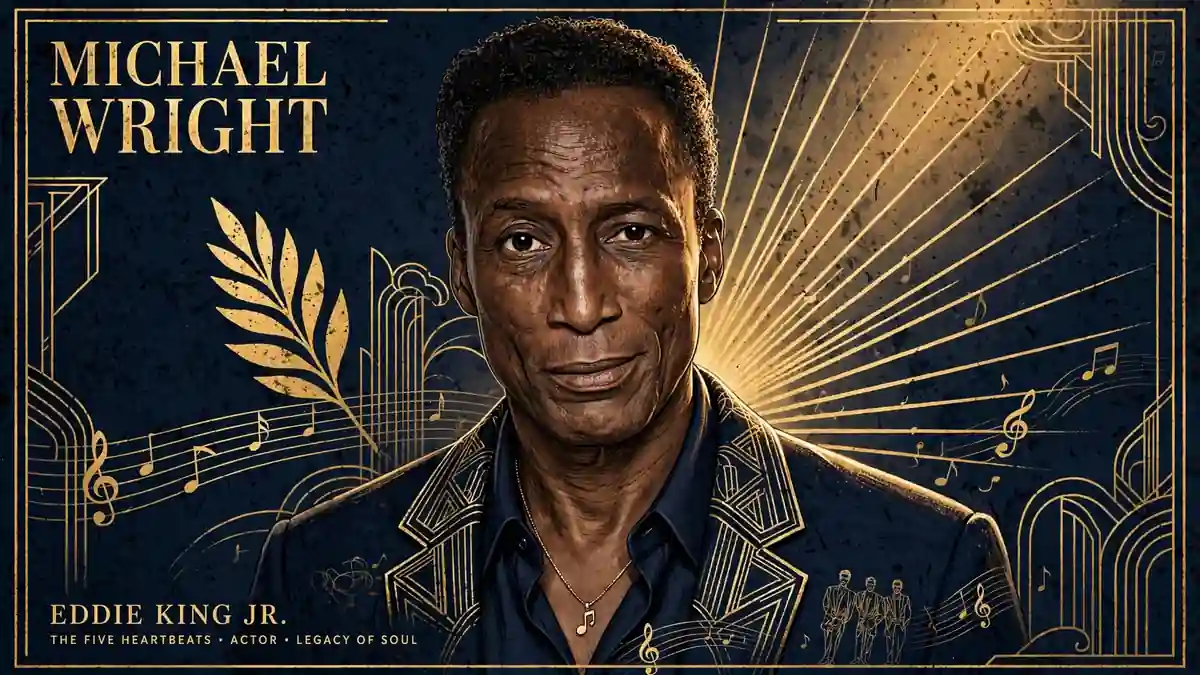
Michael Wright‘s net worth was estimated at $500,000 to $1 million at the time of his death in August 2026. Celebrity Net Worth puts the figure at $500,000; other profiles place it as high as $1 million — a modest fortune for a man who spent nearly five decades on stage and screen, shared a Volpi Cup win at Venice, and gave Black cinema one of its most quoted performances as Eddie King Jr. in The Five Heartbeats. He died August 19, 2026, in Los Angeles at 70, and the reporting around his passing is the freshest evidence we have of where his finances stood: a working character actor’s estate, not a leading man’s.
Michael Wright: Quick Facts
| Estimated net worth | $500,000–$1 million (at death, August 2026) |
|---|---|
| Profession | Actor (film, television, stage); producer, writer |
| Nationality | American |
| Born | April 30, 1956 – August 19, 2026 (aged 70) |
| Height | 6 ft 1½ in (~1.87 m), per IMDb |
| Primary income sources | Screen acting, television roles, residuals, voice work, producing |
| Active years | 1978–2026 |
| Last reviewed | October 2026 |
- Early Life and Background
- Education
- Career Journey
- Rise to Fame
- Main Sources of Income
- Salary and Earnings
- The Character-Actor Economy
- Businesses and Investments
- Brand Deals and Sponsorships
- Houses, Cars and Other Assets
- Awards and Achievements
- Net Worth Growth Over the Years
- Social Media Presence
- Personal Life
- Sources & Reporting
- Frequently Asked Questions
- Final Thoughts
Early Life and Background
Michael Wright was born April 30, 1956, in New York City and raised there, a detail every obituary in August 2026 agreed on (Variety, Deadline, Extra). His mother, Alberta Wright, owned Jezebel, a Southern restaurant in Manhattan’s theater district — which meant the boy grew up within earshot of the entertainment business rather than outside it. That proximity paid off in an unusually literal way: years later, it was at his mother’s restaurant that Wright met a young Robert Townsend, the meeting that eventually led to the role that defined his career.
Nothing in the public record names his father, and Wright himself never turned his family history into press material. What we know about his childhood comes mostly from the obituary wave — born and raised in New York, theater-district adjacent from the start, drawn to acting young. By 1978, still in his early twenties, he had entered the professional stage, per his Wikipedia biography.
Education
Wright graduated from the New Lincoln School in New York City, a fact confirmed across his biographies and obituaries. His acting training came through a work-study arrangement at the Lee Strasberg Theatre and Film Institute — and the detail is worth pausing on, because it says something about the economics of his beginnings. As Celebrity Net Worth reports, Wright performed odd jobs around the school, including answering phones and mopping floors, in exchange for acting classes. The arrangement gave him Method training without tuition money he didn’t have, and it shaped the physical, high-intensity acting style that later became his trademark: he learned the craft while literally doing the janitorial work around it.
Career Journey
Wright’s screen career began at 23 with the 1979 cult film The Wanderers, where he played Clinton, the leader of the Del Bombers street gang. It was a small film, but it put him in front of cameras — and within four years he was working with Robert Altman. In 1983’s Streamers, Altman’s adaptation of David Rabe’s Vietnam-era play, Wright played Carlyle, the volatile young soldier whose arrival detonates the film’s racial and sexual tensions. The performance put him on the map with critics: the entire Streamers cast collectively won the Volpi Cup for Best Actor at the 40th Venice International Film Festival, per Wikipedia — a rare shared award rather than a solo prize, which is an important correction to the way some profiles phrase it.
The same year brought the role that made him familiar to television audiences: Elias Taylor, the resistance fighter in NBC’s 1983 science-fiction miniseries V. Wright returned for the 1984 sequel V: The Final Battle and then carried the character through V: The Series in 1984–85. Back-to-back genre television work in the mid-1980s meant something concrete for his finances: his first stretch of steady, contracted TV paychecks. Around the same period he guested as “The Savage” in the 1987 Miami Vice episode “Duty and Honor,” and played Victor Duncan in The Principal (1987) opposite Jim Belushi and Louis Gossett Jr.
The late 1980s and early 1990s kept him working in supporting film roles, but the economics of a character actor’s life were already visible: respected, employed, never the name on the poster. That changed — at least culturally — in 1991.
Rise to Fame
Robert Townsend, the comedian Wright had met years earlier at his mother Alberta’s restaurant Jezebel (Extra), cast him as Eddie King Jr. in The Five Heartbeats (1991) — the gifted, self-destructive lead singer of a fictional 1960s R&B group, loosely modeled on the lives of artists like The Temptations, The Dells, and Frankie Lymon. Wright’s Eddie is the film’s live wire: magnetic on stage, unraveling off it, eventually fired from the group he helped make famous.
The film itself was not a box-office triumph. Produced and distributed by 20th Century Fox on a reported $9–10 million budget, it grossed $8,750,400 domestically, per Wikipedia — and yet it became one of the defining cult classics of Black cinema through VHS rentals, with many calling it Townsend’s masterpiece. Wright’s performance was singled out from the start: Entertainment Weekly critic Owen Gleiberman called it “a stunning performance,” noting how Wright made Eddie “sleek, with undercurrents of hostility and danger” (via Entertainment Weekly reporting cited in his obituaries).
The film’s afterlife is the more interesting financial story. Playing in just 862 theaters on release and met with mixed reviews, The Five Heartbeats found its audience on VHS and through bootleg copies, building a fan base that kept growing for decades (Wikipedia). DVD releases followed in 2002 and 2006 for the film’s 15th anniversary. The soundtrack — with songs like “Nights Like This” and “A Heart Is a House for Love” — fed the same revival. None of that revival money flowed to Wright beyond his original fee and residuals, but it cemented the cultural capital that still drives searches for his name and net worth today.
Three years later came his other signature film role: Raynathan “Ray” Skuggs in Sugar Hill (1994), playing the younger brother of Wesley Snipes’ Roemello in Barry Michael Cooper’s Harlem crime drama. Los Angeles Times critic Kenneth Turan singled out Wright’s work in his review, per obituary coverage. The film cemented his screen persona — volatile, vulnerable, dangerous, sympathetic, sometimes all at once — and Sugar Hill remains the second title most associated with his name.
From there, Wright settled into the pattern of a durable working actor: Aaron in the Chris Tucker action-comedy Money Talks (1997), roles in Piñero and Point Blank (with Mickey Rourke), a part in Sydney Pollack’s The Interpreter (2005) alongside Nicole Kidman and Sean Penn, guest spots on New York Undercover, and then his longest television engagement — Omar White on HBO’s prison drama Oz, appearing in 22 episodes from 2001 to 2003 as a drug-addicted killer undone by his unhinged cellmate (Extra). Late-career television included Lazarus Prime on The CW’s Black Lightning (2019) and a spot on the sitcom Rel (2018). His final screen credit was the 2025 film Dope King.
Main Sources of Income
Wright’s money came from exactly the places a five-decade character actor’s would — no businesses, no endorsement empire, no producing windfalls. The breakdown, as the public record supports it:
- Film acting. More than 50 film and television credits across his career. Supporting and co-starring roles in studio films (The Five Heartbeats, Sugar Hill, The Principal, Money Talks, The Interpreter) were his highest-profile paydays, though no individual salary figure for any role has ever been published.
- Television. The steadiest income stream. The V franchise (1983–85) gave him his first sustained TV work; the 22-episode Oz run (2001–2003) was his longest single engagement and, by the math of recurring television pay, likely his most lucrative contract; Black Lightning (2019) closed out his TV career.
- Residuals. Decades of reruns, syndication, and streaming of V, Oz, Miami Vice, and his films generated residual payments under SAG-AFTRA contracts — modest per check for a supporting player, but compounding over a long career.
- Voice work. He voiced a role in the 2003 video game Batman: Dark Tomorrow, per Net Worth Post — a smaller but real income line typical of working actors in that era.
- Producing and writing. IMDb credits him as producer on the shorts Passages from Miles (2011) and Lies (2016) and the series Stitch (2014), and as screenwriter on Lies. These were small independent projects — creative diversification, not wealth builders.

Salary and Earnings
Here is the honest part: no verified salary figure for any individual Michael Wright role exists in public reporting. No studio leaked his Five Heartbeats paycheck; no filing discloses his Oz per-episode rate. Any site printing an exact number is guessing. What the record does support is the shape of his earning life.
Wright was a supporting and ensemble player for nearly all of his 48 working years. In the 1980s and 1990s, that meant network and studio day-player and guest-star rates under SAG contracts — solid professional wages, not star money — with the occasional step up to co-starring billing (Sugar Hill opposite Snipes). His most sustained income almost certainly came from Oz: 22 episodes across three seasons (2001–2003) on an HBO prestige drama represented the longest continuous contract of his career, and recurring cable-drama pay in that era was the closest thing to a salary anchor a character actor could get.
The broader context matters more than any single check. As EURweb noted in its August 2026 piece on his $500,000 estimate, character actors can work for decades without ever receiving the salaries or residual income commanded by leading performers — and Wright’s career is close to a textbook case. He was never the name above the title; he was the performance people remembered anyway. That distinction is precisely why his estate figure looks the way it does.
The Character-Actor Economy: Why Five Decades Meant Half a Million
The number that surprises people about Michael Wright — half a million dollars after 48 working years — stops being surprising once you map the economics of the lane he worked in. Six structural facts explain it.
First, billing is destiny. Wright spent his career as a supporting or ensemble player. In film, that means a negotiated flat fee, not a percentage of the gross — and there is no record of Wright ever holding profit participation on anything he appeared in. His two most famous films illustrate the point brutally: The Five Heartbeats cost a reported $9–10 million and grossed $8,750,400 domestically (Wikipedia), meaning the film itself lost money theatrically and there was no backend to share; Streamers grossed just $378,452 on a $2 million budget. Even the cult afterlife of The Five Heartbeats — VHS rentals, bootlegs, DVD reissues in 2002 and 2006 — enriched the rights holders, not the supporting cast, whose compensation had been fixed decades earlier.
Second, television paid him as a guest, not a star. Wright’s TV résumé is long — the V franchise, Miami Vice, New York Undercover, Black Lightning — but almost entirely guest spots and recurring arcs rather than series-regular contracts. Series-regular money, with its per-episode guarantees across full seasons and renegotiation leverage, is where television wealth is built. Wright’s closest approach was Oz: 22 episodes across 2001–2003 as Omar White, his longest engagement — but as a recurring player on an ensemble cable drama, not a lead with a multi-season deal.
Third, residuals decay. Under SAG-AFTRA contracts, reruns and reuse generate residual payments, but the formulas pay less with each cycle and were designed for the broadcast era. A supporting actor’s residuals from 1980s network television and 1990s films are real income — and they compounded over Wright’s long career — but they are a pension, not a fortune.
Fourth, there was no second business. Many actors convert fame into parallel income: production companies with studio deals, endorsement contracts, product lines, real estate portfolios. Wright’s diversification stayed inside the craft — producing and writing small independent shorts in the 2010s (IMDb) — creative work, not wealth-building.
Fifth, timing. Wright’s peak earning years (roughly 1983–2005) predated the streaming-era salary explosion. The sums that supporting actors command on prestige television today simply did not exist when he was doing his most prominent work.
Sixth, longevity has costs. Forty-eight years in the business means 48 years of agent commissions, manager fees, and the ordinary expenses of a working life in Los Angeles. Net worth is what remains after all of that — and for a character actor paid in fees rather than equity, “what remains” is typically modest. Wright’s $500,000-to-$1-million estate is not an anomaly; it is the honest arithmetic of his profession.
Businesses and Investments
No business ventures, investment portfolios, or entrepreneurial sidelines appear anywhere in Wright’s public record. Unlike contemporaries who launched production companies, clothing lines, or restaurant chains, Wright’s late-career diversification stayed inside the craft: the producing and screenwriting credits on small independent shorts between 2011 and 2016 (IMDb). Nothing in obituaries, profiles, or interviews suggests stock holdings, startups, or brand ownership. His wealth — such as it was — came from acting work and its residuals, full stop.
Brand Deals and Sponsorships
None on record. Wright never fronted a national ad campaign, held a spokesperson contract, or licensed his likeness in any documented deal. For a character actor whose fame was concentrated in cult and ensemble work rather than mainstream stardom, that absence is typical, not surprising.

Houses, Cars and Other Assets
No verified property records, vehicle registrations, or asset filings for Michael Wright are publicly available. He died in Los Angeles, where he had lived and worked for years, but no reporting names a home purchase, its value, or its location — and we will not speculate. The modest size of his estimated estate is itself the clearest signal: whatever assets he held at his death fit comfortably inside a sub-million-dollar total.
Awards and Achievements
Wright’s trophy case was never crowded, but it contains one genuinely distinguished honor. At the 40th Venice International Film Festival in 1983, the entire ensemble cast of Streamers — Wright included, alongside Matthew Modine, David Alan Grier, Mitchell Lichtenstein, George Dzundza, and Guy Boyd — collectively received the Volpi Cup for Best Actor, per Wikipedia. It remains one of the rare occasions the Volpi Cup went to a full cast rather than an individual.
Beyond formal awards, his achievements were cultural: The Five Heartbeats grew from a box-office disappointment into a touchstone of Black cinema, with Wright’s Eddie King Jr. among its most imitated and quoted creations; his 22-episode Oz run put him at the center of one of HBO’s foundational prestige dramas; and his five-decade span — professional stage in 1978 to a 2025 film credit — is a longevity few actors manage.
Net Worth Growth Over the Years
No year-by-year audited figures for Wright’s finances exist, and we won’t invent them. What follows is a career-financial timeline built from verified milestones — the shape of how a character actor’s wealth accumulates (and plateaus).
| Period | Career milestone | Financial significance |
|---|---|---|
| 1978–1982 | Professional stage; film debut in The Wanderers (1979) | Early-career wages; stage and small-film pay |
| 1983 | Streamers (Volpi Cup win); V miniseries as Elias Taylor | First national exposure; first sustained TV paychecks |
| 1984–1985 | V: The Final Battle; V: The Series | Steady series income, mid-1980s network rates |
| 1987 | Miami Vice guest spot; The Principal | Guest-star and supporting-film rates |
| 1991 | The Five Heartbeats as Eddie King Jr. | Career-defining role; film grossed $8.75M on a $9–10M budget |
| 1994 | Sugar Hill opposite Wesley Snipes | Co-starring billing — likely his peak film payday |
| 1997–2005 | Money Talks, Piñero, The Interpreter, New York Undercover | Working-actor years; residuals begin compounding |
| 2001–2003 | Oz — 22 episodes as Omar White | Longest contract; most sustained income of his career |
| 2011–2016 | Producer/writer on independent shorts | Creative diversification; small-scale projects |
| 2019 | Lazarus Prime on Black Lightning | Late-career TV income |
| 2025 | Dope King — final screen credit | Working until the final year of his life |
| August 2026 | Death at 70; estate estimated $500,000–$1 million | Range reflects CNW’s $500K figure vs. higher biography estimates |
Social Media Presence
Wright kept a low public profile and no verified personal social media accounts are documented in any profile or obituary. The most-viewed social media post connected to him was not his own: his wife Susan’s Instagram announcement of his death on August 21, 2026, which became the source every major outlet quoted (Variety, Deadline, Extra). Tributes from co-stars — including his Five Heartbeats castmate Leon Robinson — circulated widely in the days after. His cultural footprint lives less in follower counts than in the film’s endlessly quoted scenes.
Personal Life
Wright was married twice. His first marriage was to Mitzie Lau, from November 1994 to January 2000, ending in divorce (IMDb). He later married Susan Wright, who announced his death and survives him. He is survived by Susan, five children, and a grandchild, per family statements reported by Extra and EURweb.
He died August 19, 2026, in Los Angeles at 70, after heart failure complicated by Marchiafava-Bignami disease — a rare neurological condition involving degeneration of the corpus callosum, the band of nerve fibers connecting the brain’s hemispheres — according to a family statement provided to TMZ. His wife’s Instagram tribute read, in part: “Michael, your work will live forever, but your love will live even longer in the hearts of those who knew you best.”
Sources & Reporting
- Celebrity Net Worth — the $500,000 net-worth estimate at death; early-life details (mother Alberta’s Jezebel restaurant, Lee Strasberg work-study).
- TMZ — cause and circumstances of death (August 19, 2026, Los Angeles; heart failure with Marchiafava-Bignami complications), via family statement; reported across August 2026 obituaries.
- Variety — obituary (August 2026): career overview, more than 50 film and TV credits, wife Susan’s Instagram announcement.
- Deadline — obituary (August 2026): death at 70, career summary.
- Extra — obituary (August 2026): met Robert Townsend at his mother’s restaurant; 22-episode Oz run; wife’s full tribute statement; survived by wife, five children, one grandchild.
- EURweb — August 2026 analysis of the $500,000 estimate and the character-actor pay gap it illustrates.
- Entertainment Weekly — Owen Gleiberman’s contemporary “stunning performance” assessment of Wright in The Five Heartbeats, cited in 2026 obituaries.
- Los Angeles Times — Kenneth Turan’s praise for Wright’s work in Sugar Hill (1994), cited in 2026 obituaries.
- IMDb — full filmography including producing/writing credits (2011–2016), height (6 ft 1½ in), Mitzie Lau marriage dates.
- Wikipedia — biographical dates, Volpi Cup collective win at the 40th Venice Film Festival, The Five Heartbeats budget ($9–10M) and box office ($8,750,400), Streamers budget and gross.
- Net Worth Post — $500,000 estimate; Batman: Dark Tomorrow voice-work credit.
- SAG-AFTRA — referenced for the residual-payment structure underlying long-career acting income (general contract context, not Wright-specific figures).
Reporting window: career coverage 1979–2025; net-worth and obituary reporting concentrated August–September 2026. No audited estate figures are public; where sources disagree we publish the range.
Frequently Asked Questions
What was Michael Wright’s net worth?
Michael Wright’s net worth was estimated at $500,000 to $1 million at the time of his death in August 2026. Celebrity Net Worth puts the figure at $500,000, and outlets including EURweb repeated that number; at least one biography profile suggests it could have reached $1 million. No audited estate figures are public, so the honest answer is the range.
How did Michael Wright die?
Wright died August 19, 2026, in Los Angeles at age 70. According to a family statement provided to TMZ, he suffered heart failure complicated by Marchiafava-Bignami disease, a rare neurological condition involving degeneration of the corpus callosum, the nerve-fiber band connecting the brain’s two hemispheres. His wife Susan announced his death on Instagram on August 21, 2026.
Who was Michael Wright’s wife?
At the time of his death, Michael Wright was married to Susan Wright, who announced his passing on Instagram and has been widely quoted in obituary coverage. He was previously married to Mitzie Lau from November 1994 to January 2000; that marriage ended in divorce.
What was Michael Wright’s most famous role?
Eddie King Jr. in The Five Heartbeats (1991) — the gifted, troubled lead singer of the fictional R&B group. Entertainment Weekly critic Owen Gleiberman called it “a stunning performance” at the time, and the film’s growth into a cult classic of Black cinema made Eddie the role Wright is remembered for above all others.
Did Michael Wright win any awards?
Yes. At the 40th Venice International Film Festival in 1983, the entire ensemble cast of Robert Altman’s Streamers — Wright included — collectively received the Volpi Cup for Best Actor, one of the rare occasions the award went to a full cast rather than an individual performer.
Is Michael Wright still alive?
No. Some older profiles written before August 2026 still describe him in the present tense, which is why the question circulates. Michael Wright died August 19, 2026, in Los Angeles at age 70; his death was announced by his wife Susan and covered by Variety, Deadline, Extra, and other major outlets.
How many children did Michael Wright have?
Five children, plus one grandchild, according to family statements reported after his death in August 2026. His wife Susan survives him.
What was Michael Wright’s last movie?
His final screen credit was the 2025 film Dope King. His last major television role was Lazarus Prime on The CW’s Black Lightning in 2019. He worked across 48 years, from the professional stage in 1978 to that 2025 credit.
Final Thoughts
Michael Wright’s $500,000-to-$1-million estate tells a story the entertainment business prefers not to dwell on: a half-century of respected, even beloved work does not automatically produce wealth. He shared a Volpi Cup at Venice, anchored a film that became sacred text in Black households, and held his own opposite Wesley Snipes and inside HBO’s most punishing drama — and still died with a fortune smaller than a single episode fee for a streaming-era star.
That is not a tragedy so much as an accounting. Wright chose — or was chosen by — the character actor’s path: the volatile best friend, the dangerous inmate, the singer coming apart. Those parts pay in longevity and in the peculiar immortality of being quoted at cookouts, not in backend points. His own wife’s epitaph got it right: the work lives forever; the love longer. The bank balance was never the point of Michael Wright, which is exactly why it deserves to be reported honestly.
Published on 2026-10-16. Last reviewed October 2026. Found an error? See our corrections policy.