
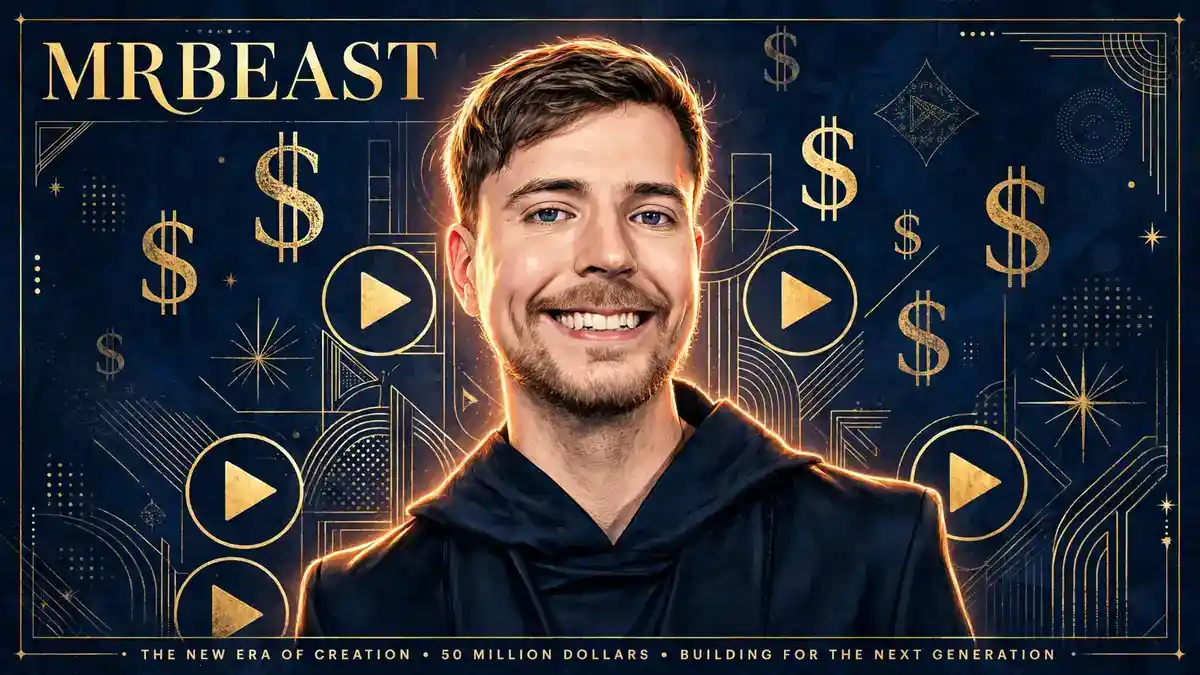
MrBeast‘s net worth is estimated at $1 billion to $2.6 billion as of November 2026, with the consensus figure at about $2.6 billion. Jimmy Donaldson, the 28-year-old from Greenville, North Carolina, built the most-subscribed YouTube channel on the planet, turned a chocolate bar into a retail business doing hundreds of millions in sales, and signed a nine-figure deal with Amazon — then told The Wall Street Journal in January 2026 that he had less than $1 million in personal funds and had borrowed money from his mother to pay for his wedding. That contradiction is the whole story: Donaldson is a billionaire on paper and cash-poor in real life, because nearly everything he owns is equity in Beast Industries, a private company valued at roughly $5.2 billion in its last funding round.
MrBeast: Quick Facts
| Estimated net worth | About $2.6 billion (range: $1 billion–$2.6 billion) |
|---|---|
| Profession | YouTuber, entrepreneur, media producer, philanthropist |
| Nationality | American |
| Born | May 7, 1998 (age 28) |
| Height | 6 ft 5 in (1.96 m), as commonly reported |
| Primary income sources | YouTube advertising, Feastables, Beast Games (Amazon), brand sponsorships, investments |
| Active years | 2012–present |
| Last reviewed | November 2026 |
- Early Life and Background
- Education
- Career Journey
- Rise to Fame
- Main Sources of Income
- Salary and Earnings
- Businesses and Investments
- Brand Deals and Sponsorships
- Houses, Cars and Other Assets
- Awards and Achievements
- Net Worth Growth Over the Years
- Social Media Presence
- Personal Life
- Sources & Reporting
- Frequently Asked Questions
Early Life and Background
James Stephen Donaldson was born on May 7, 1998, in Wichita, Kansas, and grew up in Greenville, North Carolina, where his mother, Sue Donaldson, raised him and his siblings. Britannica records him as the second of three children. Greenville was not a media capital. It was a small college town, and Donaldson’s childhood there — long hours on a computer in his bedroom, a mother working to keep the household steady — shaped the work ethic that later defined his channel. He has talked openly about a difficult home life and about his mother working long hours; the family moved around during his childhood before settling in Greenville.
The detail that matters for the money story is how early the obsession started. Donaldson uploaded his first YouTube video in February 2012, at 13, under the name MrBeast6000. For years almost nobody watched. He has said he spent his teenage years studying YouTube the way other kids studied for exams — tracking what made videos spread, testing thumbnails and titles, calling other small creators every day to trade notes on the algorithm. That daily study group of teenage YouTubers became his first real asset: a network of collaborators who grew up alongside him, several of whom — Chris Tyson, Chandler Hallow, Karl Jacobs — later became fixtures on his channel.
Greenville stayed home base. Even after the money arrived, Donaldson built his studio and warehouse operation in North Carolina rather than moving to Los Angeles, and he has said he keeps an apartment inside his warehouse. The choice kept costs lower than a Los Angeles production base and kept him close to the crew he started with — a practical decision that also became part of the brand, the small-town kid who out-produced Hollywood from a warehouse.
His father, Charles Donaldson, was largely absent from his public story for years, and Donaldson rarely discusses him. The relationship re-entered the news in September 2026, when reporting noted that Jimmy and his father would release a book, “The Most Dangerous Games,” alongside author James Patterson. The book announcement was one of the quieter 2026 headlines around him, and it sits in sharp contrast to the rest of the year’s noise — a wedding, a fintech acquisition, a $300 million Forbes year.
Education
Donaldson graduated from Greenville Christian Academy in 2016. He enrolled at Pitt Community College in Greenville, then dropped out — a decision he has framed as a bet, not a rejection of school. He gave himself a runway: he would try YouTube full time, and if it failed he would go back. His mother, by his own account, was unhappy with the choice at first and at one point asked him to move out, which pushed him to make the channel pay faster.
The dropout story is often told as a cliché, and it is worth stating plainly what made it different here. Donaldson did not drop out with a viral hit in hand. He dropped out with a tiny channel and a plan to study the platform for years. The education that mattered was the one he gave himself between 2012 and 2017: thousands of videos watched and dissected, hundreds of uploads that flopped, and a notebook of patterns about retention, pacing, and titles. By the time the channel broke through, he had spent longer learning YouTube than most people spend at university.
That self-taught streak shows up in the business too. Beast Industries employs hundreds of people and is run by a chief executive, Jeff Housenbold, a veteran media operator — a hire that suggests Donaldson knows where his own expertise ends. The company, not the creator, now handles the parts of the empire that look like a normal business: retail distribution, streaming deals, finance. Donaldson still drives the creative side, and the videos still carry his fingerprints.
Career Journey
Donaldson’s channel spent its first five years in obscurity. The early uploads were Let’s Play videos, commentary on other YouTubers, and a series estimating the wealth of creators — an early sign of the instinct that would later make him rich. The format that first moved the needle was endurance: in January 2017 he posted himself counting to 100,000, a stunt that took about 40 hours and became his first video to break out. He followed it by counting to 200,000 and reading the entire dictionary aloud. The videos were absurd, cheap to make, and perfectly built for a platform that rewards watch time. They also taught him the lesson that would run his whole career: a bigger, harder stunt earns a bigger audience, and a bigger audience earns the money to fund the next stunt.
The giveaway era started in 2018. Brand deals that once paid a few thousand dollars began to arrive, and instead of keeping the money, Donaldson gave it away on camera — handing $10,000 to a homeless man, tipping waitresses thousands of dollars, buying out a grocery store. The videos worked because the generosity was real and the scale kept climbing. Each video funded the next one, and the audience grew because every upload promised something larger than the last. By late 2018 and 2019, the channel had passed 10 million subscribers, then 20 million, and the stunts moved from cash handouts to full productions: buying a private island, recreating a game show set, giving away a house.
Two moves in 2019 showed the scale of what was coming. First, the PewDiePie versus T-Series subscriber race: Donaldson bought billboards and ran a campaign urging viewers to subscribe to PewDiePie, a stunt that put him in front of a global audience and cemented his reputation as YouTube’s most generous showman. Second, Team Trees, a fundraiser he launched with fellow creator Mark Rober to plant 20 million trees. The campaign passed its $20 million goal and ultimately raised more than $23 million, with donations from Elon Musk, Jack Dorsey, and YouTube itself. It proved Donaldson could move serious money for a cause — and that his audience would follow him off YouTube.
The pandemic years were the great acceleration. With the world stuck at home, Donaldson’s videos — filmed with big casts, big prizes, and no social distancing problems because his crew lived and worked together — became appointment viewing. In 2020 he launched MrBeast Burger, a delivery-only restaurant brand built with Virtual Dining Concepts, and opened Beast Philanthropy, a food pantry in Greenville that has given away millions of meals. In November 2021 he posted his recreation of Netflix’s “Squid Game,” with 456 players competing for a $456,000 prize. It became one of the most-viewed YouTube videos ever made, and it showed the world that a creator could out-produce a television network on a single video budget. For the full arc of that rise, from the first uploads to the 500-million-subscriber empire, see MrBeast’s full biography and career timeline on our sister site CelebAmerica.
By 2022 the channel was a company. Feastables launched in January of that year, Beast Industries was formalized as the holding company for the channels, the food brands, and the production business, and Donaldson began hiring executives from traditional media. The creator who once filmed alone in his bedroom now ran an operation that TIME reported in April 2026 employed around 750 people. The career journey is the rarest kind in the creator economy: a teenager’s hobby that became, step by step, a vertically integrated media and consumer-goods business with a $5 billion valuation.
Rise to Fame
Fame arrived in layers rather than in a single moment. The counting videos made him known to YouTube obsessives in 2017. The giveaways made him known to the wider internet in 2018 and 2019. The “Squid Game” recreation made him known to people who had never watched a YouTuber in their lives in 2021. Each layer widened the audience, and each widening made the next video cheaper to promote — by 2023, a new MrBeast upload was a news event covered by the same outlets that cover film releases.
The subscriber milestones tell the story in numbers. Donaldson passed 100 million subscribers in 2022, becoming only the second individual creator to do so. In June 2024 his main channel passed T-Series, the Indian music label, to become the most-subscribed channel on YouTube — the first time an individual creator had held the top spot outright. In June 2026 the main channel passed 500 million subscribers, a number no channel had ever reached. By late 2026, counts from creator-tracking outlets put the main channel above 515 million subscribers, and Forbes credited him with about 873 million followers across all platforms on its 2026 Top Creators list.
What made the rise stick, where other viral creators faded, was the reinvestment loop. Donaldson has said in interviews that he reinvests nearly everything the business earns — at times more than 100 percent of revenue — into the next production. A video that earns money funds a bigger video, which earns more money, which funds a bigger one still. The loop is why his production budgets grew from a few thousand dollars in 2017 to $3 million to $5 million per flagship video by 2025, and why competitors who tried to copy the format could not keep up: they were competing against a machine that treated profit as fuel rather than as a payout.
The other half of the fame story is dubbing. Donaldson invested early in translated versions of his channel — Spanish, Portuguese, Hindi, and more — with local voice actors re-recording his videos. The dubbed channels turned a North Carolina creator into a global one, and they are a large part of why his subscriber count kept climbing after the English-speaking market was saturated. Few competitors matched the investment, and the gap became a lasting advantage.
Main Sources of Income
MrBeast’s income comes from five streams that feed each other, and the mix is what separates him from creators who live on advertising alone. YouTube advertising is the smallest piece in percentage terms but the engine of everything else: it pays for the audience. Feastables is the profit center. Beast Games is the prestige play that buys mainstream reach. Sponsorships fund individual productions. Investments and acquisitions, led by the Step deal in 2026, are the newest stream — and the one that says the most about where the money is heading.
The table below breaks down the streams with the best available figures. Where a number is an industry estimate rather than a reported figure, it is labeled as such. Beast Industries does not publish audited financials, so every figure in this section traces to a named outlet or to Donaldson’s own statements.
| Income stream | What we know | Source |
|---|---|---|
| YouTube advertising | An estimated $70–$100 million a year across all channels; a flagship video earns roughly $500,000–$1.44 million in AdSense alone | Industry analysis; Forbes |
| Feastables | About $250 million in sales and more than $20 million in profit in 2024; over $215 million in revenue in 2024 by another count | DesignRush; Shortform |
| Beast Games / streaming | Amazon paid about $100 million for the first season; the show became Prime Video’s most-viewed unscripted series | DesignRush |
| Brand sponsorships | Reported deals of $15 million with T-Mobile (four videos) and $12.5 million with Amazon (five videos); $2.5–$3 million per integration | DesignRush; industry analysis |
| Investments & acquisitions | Step fintech acquired February 2026; 7 million-plus users; the company had raised over $500 million from venture investors | Reporting on the Step deal |
The key point is the direction of the money. YouTube pays for attention, Feastables turns attention into retail sales, and the streaming deal turns attention into mainstream credibility that makes the next retail launch easier. Each stream makes the others more valuable, and that is why the company is worth roughly $5 billion while the videos themselves, on advertising alone, would barely cover their own production costs.

Salary and Earnings
Forbes has ranked MrBeast the highest-earning creator in the world for five straight years, and the numbers it publishes are the most reliable earnings figures available — they are estimates built from interviews, company disclosures, and industry data, not guesses. The progression tells its own story about how the business changed.
| Forbes Top Creators year | Estimated earnings | Rank |
|---|---|---|
| 2023 | $82 million | No. 1 |
| 2024 | $85 million | No. 1 |
| 2025 | $85 million | No. 1 |
| 2026 | $300 million | No. 1 |
The jump from $85 million to $300 million between the 2025 and 2026 lists is the single most important earnings fact of the year. Forbes published the 2026 list in June 2026, and the increase reflects the Step acquisition, the maturing Feastables business, and the Beast Games deal landing in full. It also reflects a change in what Forbes counts: earlier years measured mostly creator earnings from content and deals, while the 2026 figure captures a business that now looks more like a consumer-goods company with a media arm than a YouTube channel with sponsors.
Per-video economics sharpen the picture. A flagship video on the main channel earns an estimated $500,000 to $1.44 million in YouTube AdSense alone, according to industry analysis — and costs $3 million to $5 million to produce. The gap is closed by sponsorships: Donaldson commands an estimated $2.5 million to $3 million per brand integration, and a single video can generate $4 million to $6 million in total revenue once sponsorships are included. The margins are thin by design. He has said the videos are a loss leader, and the financials back him up: Beast Industries reported $473 million in revenue in 2024 and still did not turn a profit, and its media business — YouTube plus Beast Games — reported roughly $250 million in sales while losing almost $80 million, according to reporting on the company’s finances.
That is the paradox at the center of the salary story. The highest-earning creator in the world runs a business that loses money on its most famous product. The losses are deliberate: the videos buy attention, the attention sells chocolate and streaming subscriptions, and the chocolate and streaming are where the profit lives. It works only as long as the audience keeps growing, which is why every dollar goes back into production.
Businesses and Investments
Beast Industries is the holding company that owns the channels, Feastables, MrBeast Burger, Lunchly, Viewstats, and — since February 2026 — the fintech app Step. It is the entity behind the $2.6 billion net worth figure, and understanding it is the only way to understand the number. Donaldson disclosed in a 2024 deposition that he owned a little over half of the company. In September 2025 the company raised money at a valuation of about $5.2 billion in a round led by UAE-based Alpha Wave Global. A stake of roughly 51 percent in a $5.2 billion company is worth about $2.65 billion on paper — which is where the $2.6 billion estimate comes from. Change either input and the answer moves: value the company at $2 billion and the stake is worth about $1 billion, which is why some outlets publish a $1 billion figure and why we carry the range.
Feastables is the most valuable piece after the channels themselves. Launched in January 2022 with Jim Murray, a former president of protein-bar company RXBAR, the chocolate brand debuted online and through Walmart, which remained its only store partner until 2023. Within two years it had expanded into more than 30,000 retail doors across North America. Feastables generated about $250 million in sales and more than $20 million in profit in 2024, according to DesignRush, and some analyses credit it with roughly half of Beast Industries’ total value. The brand spends almost nothing on paid advertising — every MrBeast video is a commercial watched by tens of millions of people — which is why its margins beat traditional chocolate companies that spend 15 to 25 percent of revenue on marketing.
MrBeast Burger, launched in December 2020 with Virtual Dining Concepts, was the first proof that the audience could be turned into a food business. The delivery-only brand generated a reported $100 million in sales in its first year. It later became a legal headache: Donaldson sued Virtual Dining Concepts in 2023 over quality complaints, and the partner countersued. The dispute is a reminder that licensing your name to a business you do not control carries real risk, and it is one reason the later food ventures — Feastables, then Lunchly — were built in-house.
Lunchly, launched in September 2024 with Logan Paul and KSI, packaged a lunch kit aimed squarely at the school-lunch market. Viewstats, his analytics tool for creators, is a smaller bet with a strategic purpose: it gives Donaldson data on what works, and it gives other creators a reason to stay inside his ecosystem. The Step acquisition in February 2026 was the biggest swing yet — a fintech firm with more than seven million mostly young users that had itself raised over $500 million from venture investors. Buying a bank for teenagers fits the empire’s logic: the same audience that watches the videos and buys the chocolate now has a reason to open an account with the same brand.
The honest caveat, from the company’s own chief executive, is that this empire has not yet made money as a whole. Jeff Housenbold told TIME in April 2026 that Beast Industries had lost about $500 million over five years but expected to become profitable in 2026. That was a forecast, not a result, and the 2024 numbers — $473 million in revenue, no profit — show how far there was to go. The $5 billion valuation is a bet by investors that the profit arrives, not proof that it has.
Brand Deals and Sponsorships
Donaldson treats sponsorships differently from most creators. A brand does not buy a 30-second mention in his videos; it buys a role inside a stunt, and the price reflects that. Reported deals include a $15 million agreement with T-Mobile for four video promotions and $12.5 million from Amazon for five main-channel ads, according to DesignRush. At $2.5 million to $3 million per integration, a single sponsored video can cost a brand more than a prime-time television slot — and brands keep paying because a MrBeast video routinely draws more than 100 million views.
The sponsorship model has a discipline to it. Donaldson has turned down deals that did not fit the video, and he has said the money from sponsors goes straight into production budgets rather than into his pocket. That is why the sponsorships matter less as income than as fuel: they are what lets a video cost $4 million to make. The brand gets its product inside the most-watched content on the internet; Donaldson gets a bigger video; the audience gets a bigger spectacle. Everyone in the triangle benefits except the traditional advertising industry, which is being bypassed entirely.
There is a risk in the model that rarely gets discussed. When a creator’s production budget depends on sponsors, a controversy can freeze the pipeline overnight. Donaldson has faced that pressure — most sharply in 2024, when allegations about workplace culture and a former collaborator’s conduct drew sustained press coverage, and when his Amazon show faced reports of difficult production conditions. The sponsors stayed, and the audience stayed, but the episodes showed how much of the business rests on a single person’s reputation. A brand deal is only as safe as the name attached to it, and in this empire the name is everything.

Houses, Cars and Other Assets
For a man worth $2.6 billion on paper, Donaldson’s visible assets are strikingly modest — and that is the point. He has said he keeps an apartment inside his warehouse in Greenville, North Carolina, and he does not own a portfolio of mansions or a fleet of supercars that the public knows about. There are no property records of a Beverly Hills estate, no yacht, no private jet in his name. The wealth is in the company, and the company is in the warehouse.
What he does own, beyond the equity, is the production infrastructure itself: the Greenville studio complex, the sets, the equipment, and the food and logistics operation that feeds a cast of hundreds. Those are business assets, not lifestyle assets, and they are worth far more to him than a house would be. A set that can be rebuilt for the next video is an asset that earns; a mansion is an asset that costs.
The cars that appear in his videos are usually prizes, not purchases — a Lamborghini given to a subscriber, a jet given away in a challenge. He has given away cars, houses, and an island on camera, and the giveaways are the point: the spectacle of giving something away is worth more to the channel than owning it. Anyone looking for the usual celebrity asset list — the cars, the watches, the houses — will not find it here, and that absence is one of the most honest signals in the whole fortune. A man who borrows cash from his mother for his wedding is not hiding a garage full of Ferraris.
The one asset that does not fit the modest picture is the company itself, and it is worth stating its scale once more: roughly 750 employees, a valuation above $5 billion, and a retail brand in tens of thousands of stores. That is the asset. Everything else is a rounding error.
Awards and Achievements
Donaldson has won the Streamy Award for Creator of the Year four times — in 2020, 2021, 2022, and 2023 — a run no other creator has matched. The Streamys are the creator economy’s own awards, voted by the industry, and four consecutive wins amount to a peer verdict: for four years running, the people who make online video agreed that nobody was doing it better.
The mainstream awards followed. He has won Kids’ Choice Awards, been named to Forbes’ 30 Under 30, and appeared on TIME’s lists of influential people. Beast Games earned him a different kind of recognition: the show became the most-watched unscripted series in Amazon Prime Video’s history, a milestone that put a YouTuber’s name on a record previously held by television productions with ten times the budget.
The achievements that matter most to the net worth story are not trophies but firsts. First individual creator to pass T-Series as the most-subscribed channel on YouTube. First channel to pass 500 million subscribers. First creator to turn a YouTube audience into a $5 billion company. First creator to earn an estimated $300 million in a single year, according to Forbes. The trophies are decoration; the firsts are the business.
Philanthropy belongs in this section too, because it is where Donaldson’s public standing was built. Team Trees raised more than $23 million to plant trees. Team Seas, launched in 2021 with Mark Rober, aimed to remove 30 million pounds of trash from the ocean and raised more than $30 million. Beast Philanthropy, his Greenville food pantry, has distributed millions of meals. In 2023 he posted “I Built 100 Wells In Africa,” funding wells across the continent — a video that drew praise and also criticism from aid workers who said the wells needed long-term maintenance plans. The debate itself was a sign of the scale: a YouTuber’s charity project was being judged by the standards of international development, because it was operating at that size.
Net Worth Growth Over the Years
There is no reliable year-by-year net worth record for Donaldson before 2024, because there was no company valuation to anchor one. Early estimates were guesses based on YouTube earnings, and they moved wildly — some outlets put him at $25 million in 2021, others at $100 million. The honest growth story starts when the numbers became checkable, and it runs like this.
| Year | What the record shows | What moved the number |
|---|---|---|
| 2017 | First viral video; channel still small | Counting to 100,000 proved the stunt format worked |
| 2019 | Passes 20 million subscribers; Team Trees raises $23M+ | Giveaway format scales; philanthropy builds trust |
| 2020 | MrBeast Burger launches; reported $100M first-year sales | Audience converts into a food business for the first time |
| 2022 | Feastables launches; passes 100 million subscribers | Chocolate becomes the profit engine |
| 2024 | Crosses the billionaire threshold in June, at 26 | Beast Industries valuation climbs; Amazon deal signed |
| 2025 | Funding round values Beast Industries at about $5.2B | Alpha Wave Global leads; stake worth about $2.65B on paper |
| 2026 | Consensus estimate about $2.6B; Forbes earnings $300M | Step acquisition; Beast Games season 3; wedding year |
The shape of the curve is the lesson. For a decade the fortune grew slowly, in line with the channel. Then, in two years — 2024 and 2025 — the company valuation did the work, and the net worth figure roughly tripled. That is the difference between earning money and owning equity: earnings grow in a line, valuations grow in jumps. It is also why the number can fall as fast as it rose. If Beast Industries’ next funding round values the company lower, Donaldson’s paper fortune drops with it, and no amount of YouTube revenue will cushion the fall.
For scale, the gap between Donaldson and the rest of the creator economy is now enormous. PewDiePie, the creator Donaldson once campaigned for, is estimated at around $40 million — a fortune by any normal measure, and roughly one-sixtieth of Donaldson’s paper wealth. The comparison shows what changed: PewDiePie built a channel; Donaldson built a company. Dwayne Johnson, who built his own business empire from a wrestling and film career, is the rare celebrity whose wealth sits in the same conversation — and even there, the paths could not be more different.
Social Media Presence
Donaldson’s social media footprint is the largest of any individual creator alive. The main MrBeast channel passed 500 million subscribers in June 2026, and Forbes credited him with about 873 million followers across all platforms on its 2026 Top Creators list. The network around the main channel is what makes the number work: MrBeast Gaming, MrBeast 2, MrBeast Reacts, Beast Philanthropy, and the dubbed channels in Spanish, Portuguese, Hindi, and other languages, each with tens of millions of subscribers of their own.
The dubbed channels deserve emphasis because they explain the growth after 2023. The English-speaking market for YouTube is finite, and Donaldson hit its ceiling years ago. The dubbed channels opened Latin America, India, and Southeast Asia, where hundreds of millions of new viewers had never seen his videos. A single stunt, filmed once in North Carolina, now earns views in a dozen languages — and advertising revenue in a dozen markets. No other creator invested in dubbing at that scale, and the lead has never closed.
Outside YouTube, his Instagram and TikTok accounts each count followers in the tens of millions, and his posts there routinely make news on their own — the wedding photos in July 2026 were posted to Instagram first, and the announcement traveled around the world within hours. His X account is where the business news breaks: the Step acquisition, the Forbes ranking, the occasional public statement about the company’s finances. The social presence is not a side project. It is the distribution system for everything else, and it is why a chocolate launch or a streaming premiere can reach more people in a day than a television network reaches in a week.
Personal Life
Donaldson married Thea Booysen in July 2026, in a week-long celebration on Necker Island, the private island in the British Virgin Islands owned by Richard Branson. The couple announced the marriage on July 21, 2026, posting wedding photos on Instagram with the caption “I found MrsBeast.” About 70 close family members and friends attended. Booysen is a South African content creator, author, and streamer who co-owns the esports organisation Nixuh; the two met in South Africa in 2022, began dating about a month later, and got engaged on Christmas Day 2024, with the engagement announced on New Year’s Day 2025.
The wedding itself produced one of the year’s most revealing money stories. Donaldson told The Wall Street Journal in January 2026 — months before the wedding — that he had borrowed money from his mother to cover wedding costs, and that he kept less than $1 million in personal funds. The man whose company was worth $5 billion could not pay for his own wedding out of his bank account. It was not a complaint; it was a statement of how the business works. Every dollar is reinvested, and the founder’s personal liquidity is the last priority. For the quick version of the age question that readers ask alongside the wedding news, see how old MrBeast is in 2026 on our sister site GuideNetWorth.
Before Booysen, Donaldson dated YouTuber Maddy Spidell from 2019 to 2022. He is famously private about his family beyond what he chooses to share, and he has no children. His daily life, by his own account, is unglamorous: long hours in the Greenville studio, video calls with the team, and an apartment inside the warehouse. The contrast with the fortune is the point. The money is not in his life; it is in his company.
Sources & Reporting
Forbes — Top Creators rankings 2023–2026: the $82 million, $85 million, $85 million, and $300 million annual earnings estimates, the No. 1 ranking each year, and the roughly 873 million total follower count for 2026.
Celebrity Net Worth — the consensus net worth estimate of about $2.6 billion in 2026, built from the Beast Industries valuation and Donaldson’s majority stake.
Fortune — reporting on the $2.6 billion consensus figure and the $5.2 billion Beast Industries valuation.
TIME — April 2026 reporting: Beast Industries employed around 750 people, carried a valuation above $5 billion, and chief executive Jeff Housenbold’s statement that the company had lost about $500 million over five years but expected to become profitable in 2026.
The Wall Street Journal — January 2026 interview: Donaldson’s statement that he had less than $1 million in personal funds, had borrowed money from his mother for wedding costs, and that viewers likely had more in their checking accounts than he did.
DesignRush — financial reporting: Feastables at about $250 million in sales and more than $20 million in profit in 2024; Beast Industries’ 2024 revenue of $473 million; the media business at roughly $250 million in sales with an almost $80 million loss; the Amazon deal at about $100 million; and the reported T-Mobile ($15 million) and Amazon ($12.5 million) sponsorship deals.
Britannica — biographical record: born May 7, 1998, in Wichita, Kansas; raised in Greenville, North Carolina; second of three children; married Thea Booysen in July 2026 on Necker Island; 2026 net worth estimate of $2.6 billion.
Wikipedia — corroborating dates: engagement announced January 1, 2025, after a Christmas Day 2024 proposal; marriage confirmed July 21, 2026; graduation from Greenville Christian Academy in 2016; Pitt Community College attendance and dropout.
Reporting window: figures reflect public reporting through November 2026. Beast Industries is privately held and does not publish audited financials; where sources disagree, this article publishes the range and names who says what.
Frequently Asked Questions
What is MrBeast’s net worth in 2026?
MrBeast’s net worth is estimated at about $2.6 billion in 2026, according to Celebrity Net Worth and Fortune. The honest range is $1 billion to $2.6 billion, because the figure depends on how you value Beast Industries, his private company. Almost all of it is equity, not cash.
How does MrBeast make his money?
Five streams: YouTube advertising (an estimated $70–$100 million a year across his channels), Feastables (about $250 million in sales in 2024), Beast Games on Amazon Prime Video (about $100 million for the first season), brand sponsorships ($2.5–$3 million per integration), and investments, including the Step fintech app acquired in February 2026.
Is MrBeast really a billionaire?
On paper, yes. He owns a little over half of Beast Industries, which was valued at about $5.2 billion in a September 2025 funding round — a stake worth roughly $2.65 billion. In cash, no: he told The Wall Street Journal in January 2026 that he had less than $1 million in personal funds and had borrowed money from his mother for his wedding. Until the company is sold or listed, the billions are not spendable.
How much does MrBeast earn per year?
Forbes estimated his earnings at $300 million for its 2026 Top Creators list, ranking him No. 1 for the fifth straight year. That is up from $85 million in both 2024 and 2025 and $82 million in 2023. The jump reflects the Step acquisition, the maturing Feastables business, and the Beast Games deal.
How much does MrBeast spend per video?
Flagship videos on his main channel cost $3 million to $5 million each to produce, covering sets, crews, safety staff, and prize money. A single video earns roughly $500,000 to $1.44 million in YouTube AdSense alone, so sponsorships — at $2.5 million to $3 million per integration — are what make the budgets work.
What is MrBeast’s real name and how old is he?
His real name is James Stephen Donaldson, and he was born on May 7, 1998, in Wichita, Kansas, which makes him 28 years old in 2026. He grew up in Greenville, North Carolina, and started uploading to YouTube at 13 under the name MrBeast6000.
Is MrBeast married?
Yes. He married South African content creator Thea Booysen in July 2026 on Necker Island, Richard Branson’s private island in the British Virgin Islands. They met in South Africa in 2022, got engaged on Christmas Day 2024, and held an intimate ceremony with about 70 guests.
How many subscribers does MrBeast have?
His main YouTube channel passed 500 million subscribers in June 2026, the first channel ever to do so, and stood above 515 million by late 2026. Forbes credited him with about 873 million followers across all platforms. He is the most-subscribed individual creator on YouTube, having passed T-Series in June 2024.
Final Thoughts
MrBeast’s net worth is estimated at about $2.6 billion, and the number is both true and misleading. It is true because the arithmetic checks out: a majority stake in a company valued at $5.2 billion is worth about $2.65 billion on paper, and three of the most careful outlets in business journalism — Forbes, Fortune, and Celebrity Net Worth — agree on the figure. It is misleading because it looks like money and behaves like something else. Donaldson cannot spend it, borrow against it easily, or use it to pay for his own wedding. It is a claim on a future sale that may or may not happen, and its value depends entirely on investors continuing to believe that a chocolate brand, a game show, and a fintech app add up to a $5 billion company.
That is what makes this fortune different from every other one in the creator economy. Most creators earn money; Donaldson built an asset. The videos are the marketing department of a consumer-goods company, and the company is the reason the net worth figure has a “b” in front of it. Whether the bet pays off depends on one thing: whether Beast Industries turns profitable, as its chief executive forecast for 2026. If it does, the $2.6 billion starts to look conservative. If it does not, the next funding round will say so, and the number will fall as fast as it rose. For now, the fairest summary is the one Donaldson gave himself: the richest creator on the internet, and a man who borrows cash from his mother.
Published on November 11, 2026. Last reviewed November 2026. Found an error? See our corrections policy.