
Parker Schnabel‘s net worth is estimated at $8–10 million as of October 2026, anchored by the widely cited $10 million figure published by Celebrity Net Worth. That number rests on three pillars: a $15 million land purchase in the Yukon, a career gold haul of more than 81,000 ounces, and one of the longest-running paychecks on the Discovery Channel. But nobody outside his company knows the true figure — his mining business files no public accounts, and his Discovery salary has never been disclosed. This article separates the documented facts from the mythology, including his record-breaking 10,596-ounce season in 2025, the mining economics that make a $42 million haul worth far less than it sounds, and why his fortune keeps growing while gold trades at record highs in 2026.
Parker Schnabel: Quick Facts
| Estimated net worth | $8–10 million (range: $8 million – $10 million; most commonly cited: $10 million) |
|---|---|
| Profession | Gold miner, reality television star, mining business owner |
| Nationality | American |
| Born | July 22, 1994 (age 32) |
| Height | Approximately 5 ft 9 in (175 cm) — sources vary between 5 ft 9 in and 5 ft 10 in |
| Primary income sources | Placer gold mining (Little Flake Mining), Discovery Channel salary and producer credits, mining land holdings |
| Active years | 2010–present |
| Last reviewed | October 2026 |
- Early Life and Background
- Education
- Career Journey
- Rise to Fame
- Main Sources of Income
- Salary and Earnings
- Businesses and Investments
- Brand Deals and Sponsorships
- Houses, Cars and Other Assets
- Awards and Achievements
- Net Worth Growth Over the Years
- Social Media Presence
- Personal Life
- Sources & Reporting
- Frequently Asked Questions
Early Life and Background
Parker Russell Schnabel was born on July 22, 1994, in Haines, Alaska, a small town tucked between the mountains and the Inside Passage. His father, Roger Schnabel, ran a construction business, and his mother, Nancy, raised Parker and his sister Payson in a household where heavy equipment was part of daily life. The family construction background mattered more than it looks on paper: Parker grew up around the machines and the cost calculations that decide whether a day of work is profitable.
The decisive figure in his life was his grandfather, John Schnabel, who owned the Big Nugget Mine near Porcupine Creek, outside Haines. Parker started going to the mine with his grandfather at around age five, learning the names and jobs of excavators, loaders, and wash plants the way other kids learn sports teams. John became Parker’s mentor and, eventually, one of the most loved personalities on Gold Rush. Rather than shielding his grandson from the financial reality of mining, he let Parker make decisions and live with the mistakes — a training method that explains the composure Parker shows on television at an age when most people are still figuring out rent.
By his mid-teens Parker was running real responsibility at Big Nugget as his grandfather stepped back from the daily grind. The mine was small by Klondike standards, and its gold was limited, but it was a working classroom. He learned the full cycle of placer mining — stripping overburden, feeding the wash plant, running cleanups, fixing whatever broke — years before most miners touch a real operation. That early immersion is the foundation of everything that followed: no other star of Gold Rush arrived with ten years of practice already banked.
Education
Parker attended Haines High School, where he played varsity basketball and did well enough academically that college was a genuine option.
Then he made the decision that defined his finances. Instead of spending his college fund on tuition, he took the money his family had set aside for his education and used it to stake an independent mining operation in the Yukon’s Klondike region at age 18. The college fund became seed capital for the first season of a mining career that would out-earn any degree. It was a gamble with no safety net: if the ground had been barren, there would have been no diploma and no savings. The ground was not barren.
Career Journey
Parker first appeared on television in 2010, when Discovery’s Gold Rush (then titled Gold Rush: Alaska) premiered on December 3, 2010. The early seasons followed the chaotic crew of Todd Hoffman and his partners, with Parker and his grandfather as the experienced local counterpoint. He was a teenager helping at the family mine — and already visibly more disciplined about ground selection and equipment than miners twice his age.
In season two, his grandfather stepped back and Parker took over the Big Nugget Mine. He was around 16 or 17 years old. That season’s total was 34 ounces — a number that looks tiny against what came later but proved he could run an operation, not just work in one.
The move that changed everything came at 18. Parker left the family mine for the Klondike around Dawson City in Canada’s Yukon Territory and leased mining ground associated with veteran miner Tony Beets. His first full Yukon season produced 1,029 ounces of gold worth about $1.4 million — the biggest single-season total the show had seen, and a haul that paid back the college-fund gamble in one stroke. Per the show’s published season records, the totals climbed almost vertically from there: 2,538 ounces in season 5, 3,372 in season 6, 4,311 in season 7, 6,280 in season 8, and 7,427 in season 9.
As the operation scaled, so did the team. One of his most important early hires was Rick Ness, who joined Parker’s crew with almost no mining experience and stayed for six years, rising to foreman before leaving to run his own operation as another principal star of Gold Rush. Parker also built relationships with seasoned specialists, including Freddy Dodge, whose expertise with wash plants and gold recovery made him a fixture of the franchise. Parker’s flagship wash plants — Big Red and Sluicifer — became characters in their own right, and keeping them running through the short Yukon season became the central drama of his storylines.
By age 24, Parker had already mined more than $13 million worth of gold. The 2018 season set a new personal record at $8.4 million in gold. In November 2022, the show documented him crossing 50,000 career ounces before his 30th birthday — more than $100 million in gross production at historical prices. The seasons between tell a less glossy story: after the explosive early climb, his totals sat in the 7,000s and low 8,000s for six straight years, and season 15 dipped to 6,837 ounces, a season the show framed as a costly disappointment. Rick Ness’s departure after six years — first as a greenhorn hire, then as foreman, then as a rival mine boss — stripped the operation of an experienced leader and became one of the franchise’s defining transitions. The break with the ground he had leased from Tony Beets, driven by the expiration of Indian River water licenses around season 10, forced Parker to rebuild on his own claims rather than someone else’s. The key discipline through all of it: almost every dollar went back into the operation. Bigger ground, more machines, more crew, more overburden stripped — each record season financed the attempt to beat it the next year. Season 16 was that attempt finally landing.
Rise to Fame
Parker stood out on Gold Rush for the simplest reason: he was a teenager outperforming grown men. Viewers watched him hire and fire adults, buy six-figure equipment, and absorb brutal losses without flinching. From 2012 to 2016 he also appeared on Gold Rush: The Dirt, the franchise’s aftershow, where his deadpan assessments of other miners’ mistakes became fan favorites.
His standing on the show kept growing with the operation. By the mid-2010s he was no longer the teenager learning the trade — he was the standard other crews measured themselves against, and Discovery treated him accordingly.
In 2017 Discovery built a second show around him: Gold Rush: Parker’s Trail. The first season retraced part of the historic route of the Klondike prospectors, including the punishing Chilkoot Trail. Later seasons went international — Guyana, Papua New Guinea, Australia, New Zealand, and eventually Brazil — with Parker studying mining methods and ground around the world. Australian prospector Tyler Mahoney became a recurring member of the expedition team. The international seasons changed the character of his fame: he was no longer just the kid who out-mined adults in the Yukon, but a mining operator studying how the trade works on four continents. By the time the Dominion Creek acquisition closed, Discovery was billing Schnabel as the biggest landowner in the Yukon — a claim about acreage, but also a measure of how far the teenager from Big Nugget had come. And the franchise kept its best drama close to home: the rivalry with Tony Beets, once a mentor whose ground Parker leased, became the central competitive engine of Gold Rush as both operations pushed past 10,000 ounces in season 16.
Main Sources of Income
Parker Schnabel’s money comes from three streams, and understanding their order matters. The gold is the engine; television is the stabilizer; the land is the compounding asset.
1. Placer gold mining. His company, Little Flake Mining, recovers gold from placer deposits in the Klondike. The 2025 mining season (season 16 of Gold Rush) produced 10,596.45 ounces, valued by the show at roughly $42 million — his best season ever. But that figure is gross metal value. Fuel, wages, equipment, repairs, royalties, and claim costs all come out before anything reaches Parker personally. The gross-to-net gap is the single most misunderstood fact in every net-worth profile of a miner, and it applies here: a 10,000-ounce season is revenue, not a paycheck.
It helps to know where the money actually goes in a placer operation. First comes stripping: excavators and haul trucks spend weeks moving barren overburden and frozen muck before a single ounce is recovered. Then the pay gravel is dug and fed to the wash plant, where water separates the heavy gold from the gravel. Cleanup — running the concentrate down to raw gold, usually weekly — is the only point in the whole cycle that produces revenue. Finally, reclamation restores the ground, a cost that arrives after the gold has stopped coming. Because the Yukon season is only a few months long, a full year of fixed costs has to be recovered in one short mining window — which is why a bad cut or a frozen spring, like the permafrost that wrecked season 15’s opening weeks, can erase millions in planned profit.
2. Television salary and producer credits. Discovery has never disclosed his fee, and Parker’s company files no public accounts, so the number is estimated. Widely cited industry estimates put him around $25,000 per episode, with some outlets suggesting up to $50,000 for the biggest stars. With 20-plus episodes per season of Gold Rush, plus Parker’s Trail and his producer credits, television likely delivers well over $500,000 a year — real money, but a fraction of the operation’s gold value. The TV income does something the gold cannot: it arrives whether the ground is rich or not.
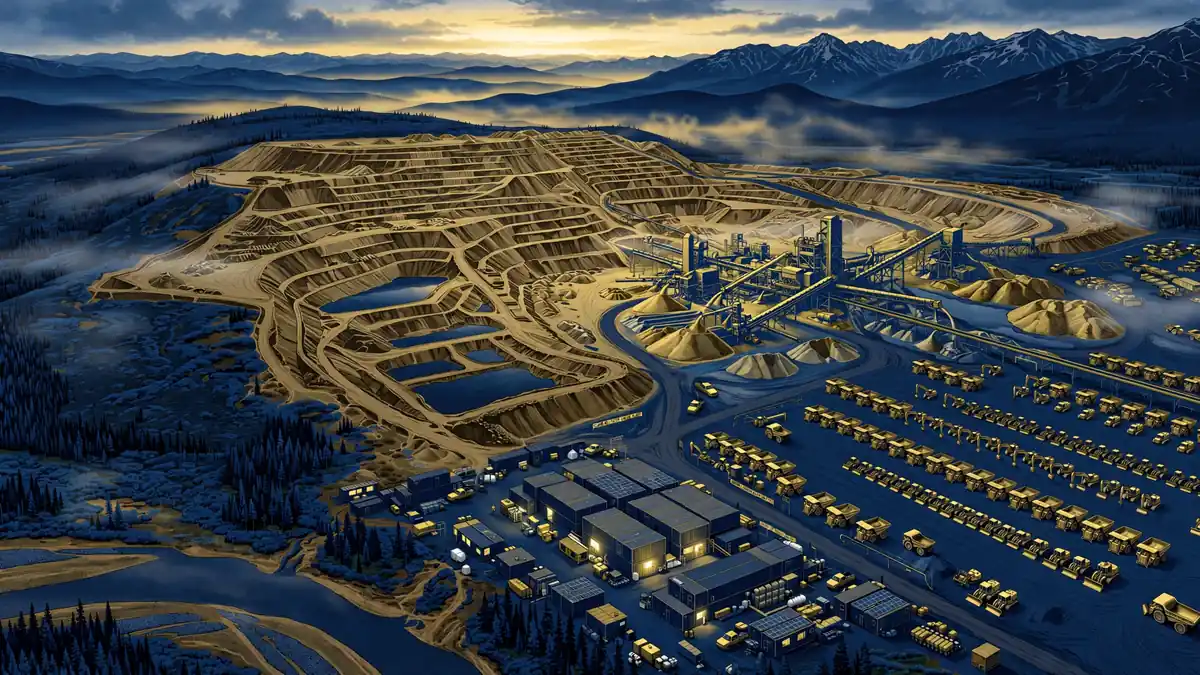
3. Land and business assets. The 7,500-acre Dominion Creek property, acquired for $15 million in 2023, is believed to hold up to 80,000 ounces of recoverable gold — worth $160 million at the $2,000-per-ounce prices of the time, and far more at 2026’s record-high gold prices. That is unrealized value: the gold is still in the ground, 40 feet under overburden that costs a fortune to move. Add a fleet of excavators, loaders, rock trucks, and four wash plants — some worth hundreds of thousands of dollars apiece — and most of his wealth is machinery and mineral rights, not cash.
Salary and Earnings
The most repeated figure in Parker Schnabel coverage is the per-episode salary: $25,000. Entertainment outlets including Finty and EatHealthy365 report it as the industry’s best estimate, while a few outlets stretch the range to $25,000–$50,000 for the show’s biggest stars. The honest framing, though: Discovery has never confirmed any cast salary, and Parker has never stated one. Treat every per-episode number as informed guesswork, not fact.
Crew payroll is the other big cost line, and it is mostly undisclosed. The operation’s crew pay has been reported at around $34 an hour, and a season’s wage bill across a crew of dozens is one of the largest expenses after fuel and equipment repairs. Parker has been unusually open about the cost side of the ledger — which is exactly the point: the gold is revenue, the paychecks and diesel are costs, and his personal share is whatever survives the season.
Season 16 revealed the operation’s cost structure at its most extreme. Running nearly 60 machines and four wash plants across Dominion Creek, Parker’s daily expenses were reported at more than $100,000. Celebrity Net Worth, citing a People interview, reports Parker saying the operation was spending around $100,000 per day in base operating costs, rising to $200,000–$250,000 per day when land acquisition and capital costs were included. A record 10,596-ounce season and a $100,000-a-day burn rate can coexist — that is placer mining economics.
Businesses and Investments
Every serious Parker Schnabel investment has been a mining decision. His company, Little Flake Mining, is a private placer-mining business operating in the Yukon and Alaska. No accounts are public, but its footprint is: by season 16 it ran multiple cuts, four wash plants, and a fleet of roughly 60 machines at Dominion Creek alone.
The defining deal is the $15 million acquisition of the Dominion Creek claim in 2023 — 7,500 acres of Yukon ground believed to contain as much as 80,000 ounces of recoverable gold. At the prices prevailing around the purchase, the theoretical gross metal value was $160 million; with gold at record highs in 2026, that math looks dramatically better. But the gold sits up to 40 feet deep, and reaching it means stripping enormous volumes of overburden before a single ounce is recovered. Parker has acknowledged, as reported by Celebrity Net Worth, that it would take years to know whether the purchase would pay off, and that the deal stretched him financially. He also explained the logic: the operation had grown so large that downsizing was nearly as unattractive as shutting down. The purchase made him a substantial landowner rather than a tenant — and it ended his long history of leasing ground associated with Tony Beets, shifting their relationship from mentor-and-lessee to direct competitors.
A second, less-covered deal shows how sophisticated the business had become. In January 2023, publicly traded Metallic Minerals Corporation announced a production royalty agreement giving Little Flake exclusive rights to mine 5.5 miles of alluvial gold claims at Australia Creek in the Klondike. Little Flake took the exclusive extraction rights, with Metallic Minerals receiving a production royalty. Parker was no longer leasing small slices of ground from established miners — his company was negotiating directly with mining businesses, running drilling programs, and managing complex royalty deals.
The break with Tony Beets deserves its own note. For over a decade Parker had operated partly on ground tied to Beets, paying royalties — the classic “royalty trap” that hands the landowner a percentage of every ounce pulled from the ground. The Dominion Creek purchase ended that arrangement, turning a mentor-and-tenant relationship into peer-level industrial competition. The season both men crossed 10,000 ounces was the payoff of that shift: Beets finished at 11,231 ounces, Parker at 10,596.45.
The Dominion bet is still being tested. After the property’s first full seasons, Parker continued buying strategic ground around the core Dominion asset rather than scattering to new regions. And season 17 opened with his most aggressive target yet: a reported $65 million production season aimed squarely at finally beating Beets. Whether Dominion justifies its $15 million price tag will be answered in the dirt over the next several seasons, not in the acquisition announcement. That is the honest shape of a miner’s fortune: every estimate is a snapshot of a bet still in motion.
Season 15 showed the downside of that bet in full. Early in the season Parker had pulled only 135 ounces in four weeks against a 10,000-ounce goal, and persistent permafrost at Dominion Creek shredded equipment — a bulldozer cracked its blade trying to rip frozen ground, and a 480 excavator’s bucket cutting edge was destroyed by concrete-like conditions. Faced with escalating costs, Parker suspended sluicing for at least three weeks mid-season to stop the bleeding. The operation recovered to 6,837.4 ounces, but the season was a reminder that even a record-breaking miner can be beaten by the ground itself.
Brand Deals and Sponsorships
Unlike most reality stars with his audience, Parker Schnabel has no public record of major brand deals or endorsement contracts. There are no confirmed shoe lines, supplement sponsorships, or paid ambassador roles — the machinery in his operation wears the livery of its manufacturers, and that is product placement in the normal course of filming, not a disclosed endorsement portfolio.
His one genuine “brand” is the television one: Gold Rush: Parker’s Trail exists because Discovery judged his name worth a standalone franchise, and producer credits across the franchise give him a different kind of power at the negotiating table than a sponsorship check. If you are comparing him to celebrities whose net worth leans on endorsement income, note the asymmetry — Parker’s wealth is built on assets that move dirt, not on deals that sell products. It also explains why his operation survived where flashier reality careers faded: the cameras can leave, but the gold in the Dominion Creek ground does not care about ratings.

Houses, Cars and Other Assets
Parker Schnabel’s spending is the least glamorous fact about a television millionaire. He has said himself, in 2024, that his only house was at a mine site. One widely quoted line sums up his philosophy: after a lucrative season, he said, “I don’t own a boat or any fancy cars or a fancy house. I have a big expensive sandbox instead.”
That said, his living situation has grown up. During the Yukon season he lives in a crew-focused house on the Dominion Creek claim, close to the work. In the off-season he is based in his hometown of Haines, Alaska. Older property stories are widely repeated but thinly sourced — including a Haines house once linked to a listing under $300,000, and newer claims of a $2.5 million Alaskan estate. The estate figure has no reliable public valuation behind it; treat it as speculation. And the $15 million number sometimes attached to his “house” is the Dominion Creek mining acquisition — 7,500 acres of industrial ground, not a mansion, as housing analysts have pointed out. He has said he owns no boat, no fancy cars, no fancy house. The wealth sits in the fleet, the wash plants, and the ground.
Awards and Achievements
The most substantive recognition of Parker’s career came outside television. In 2022, the Yukon government awarded him the Robert E. Leckie Award for Excellence in Environmental Stewardship, citing reclamation work at his Little Flake placer mine and previously disturbed mining areas. For a placer miner — in an industry with a fraught environmental record — a government stewardship award is a serious credential, and it reflects the years of reclamation work his operation has filmed but rarely headlined.
The on-camera milestones are their own record. He took over a family mine as a teenager and posted 34 ounces; at 18 he posted 1,029 ounces in his first independent Yukon season; he passed 50,000 career ounces before turning 30; and in season 16 he set a personal record of 10,596.45 ounces — crossing 10,000 ounces for the first time. In the process he became one of the largest private placer operators in the Klondike, and the subject of a standalone Discovery franchise. Those are not awards in the trophy sense, but in mining they are the scoreboard that matters.
Net Worth Growth Over the Years
Parker’s documented gold totals tell the business story better than any net-worth table can. Per the show’s published season records, his season totals went from 34 ounces (season 2) to 10,596.45 (season 16), with a cumulative 81,153.85 ounces across fifteen published seasons. The net-worth figures below are estimates from public reporting, and the honesty caveat from the intro applies throughout.
| Season | Ounces of gold | Season | Ounces of gold |
|---|---|---|---|
| Season 2 | 34 | Season 10 | 7,223 |
| Season 3 | 192 | Season 11 | 7,504.9 |
| Season 4 | 1,029 | Season 12 | 8,309.75 |
| Season 5 | 2,538 | Season 13 | 8,118 |
| Season 6 | 3,372 | Season 14 | 7,381.1 |
| Season 7 | 4,311 | Season 15 | 6,837.4 |
| Season 8 | 6,280 | Season 16 | 10,596.45 |
| Season 9 | 7,427.25 | Career total | 81,153.85 |
Read the shape: a near-vertical climb from 34 ounces to over 6,000 in six seasons, a long plateau in the 7,000s and low 8,000s, a dip to 6,837 in season 15, then the breakout to 10,596.45. That is a business scaling, maturing, hitting a ceiling — and breaking through it. The estimated net-worth arc runs alongside: roughly $1 million around 2014 (first 1,000-ounce Klondike seasons), around $5 million by 2018 (the $8.4 million record season), around $8 million by 2022 (the 50,000-ounce milestone, per 2025-era sources), and $8–10 million in 2026, with Celebrity Net Worth anchoring the top of the range.
Social Media Presence
Parker Schnabel keeps a leaner public profile than most reality stars at his level. His Instagram account, @goldrushparker, carries a large following, and the feed stays close to the work: mining machinery, season updates, behind-the-scenes footage, and occasional dispatches from his Parker Trail expeditions. He rarely posts personal content.
His television reach is the real audience asset: Gold Rush remains one of Discovery’s flagship series, and sixteen seasons have made him one of the network’s most recognizable faces. Discovery’s own coverage of the franchise keeps his name in the news cycle each autumn when the new season premieres. That said, there is no evidence of significant sponsored-post income, and he has never positioned the accounts as a revenue channel. The social presence is a byproduct of the mining story, not a business of its own.
Personal Life
Parker Schnabel is not married, and he has kept his romantic life largely private since his one public relationship ended. He previously dated Ashley Youle, an Australian veterinary nurse who joined him in the Klondike and appeared on Gold Rush in seasons seven and eight, driving trucks and working around the operation. They separated in 2018. Parker publicly took most of the blame, saying the mine had taken priority over the relationship.
Since then he has been candid about why the mining life makes relationships hard: the seasons are long, the ground is remote, and the work does not pause for anything. Media reports have linked him to Gold Rush assistant producer Sheena Cowell, but neither has confirmed anything publicly, and his social media stays silent on the subject. The pattern is consistent with the man who said his only house was at a mine site — the operation is the relationship.
Sources & Reporting
Celebrity Net Worth — anchors the $10 million estimate; contributed the Little Flake Mining history, the Dominion Creek purchase details, the Australia Creek royalty deal, the 2018 $8.4 million record season, the 50,000-ounce career milestone before age 30, the season 16 record of 10,596.45 ounces valued at $42 million, and the reported $65 million production target for season 17. Profile current as of 2026.
The UK Post — computed the 81,153.85-ounce career total from the show’s fifteen published per-season totals; provided the full season-by-season table used here and the core argument that a season’s gold is operation revenue, not personal income. Updated October 20, 2026 — the freshest published analysis.
TV Insider — season 16 finale reporting: Tony Beets at 11,231 ounces (about $45 million) against Parker’s 10,596.45 ounces (about $42 million); also covered the Dominion Creek $15 million acquisition and its 80,000-ounce, $160 million potential in the season 14 sneak peek.
Discovery — broadcast home of Gold Rush (premiered December 3, 2010); the source of the published season gold totals behind the career table.
Looper — Big Nugget Mine family history, John Schnabel’s ownership, and the college-fund seed capital story, sourced to Discovery GO.
Legacy.com — John Schnabel obituary: died March 18, 2016, at 96; bought the Big Nugget claim in 1984; handed the mine to Parker in the show’s second season.
Yukon government — news release 22-391 announcing the 2022 Robert E. Leckie Awards: the Excellence in Environmental Stewardship award to Parker Schnabel for reclamation work at the Little Flake placer mine and legacy mining areas.
Metallic Minerals Corporation — January 24, 2023 press release on the production royalty agreement: exclusive rights for Little Flake Mining to extract gold from 5.5 miles of alluvial claims at Australia Creek in the Klondike, with the company receiving a production royalty.
Home Improvement Geek — housing analysis separating the $15 million Dominion Creek land acquisition from mansion claims, and Parker’s own 2024 statement that his only house was at a mine site. 2026.
EatHealthy365 — the $25,000-per-episode salary estimate and the net-worth growth timeline from the early Klondike seasons. 2026.
Finty — the $10 million estimate, the $25,000-per-episode figure, and the “big expensive sandbox” quote on his spending philosophy.
Monsters & Critics — season 15 episode coverage: the slow start at Dominion Creek (135 ounces in four weeks), permafrost damage to equipment, and the decision to suspend sluicing for three weeks.
Celebzliving — age and biography details (born July 22, 1994, Haines, Alaska) and the Ashley Youle relationship and 2018 split. 2026.
Famous People Today — season-by-season gold totals and the cast rich-list comparison (Tony Beets at $15 million-plus, the show’s highest). Updated April 2026.
Techie Gamers — the $25,000-per-episode estimate and the reported $34-an-hour crew pay figure.
Frequently Asked Questions
What is Parker Schnabel’s net worth?
Parker Schnabel’s net worth is estimated at $8–10 million as of 2026, with $10 million the most commonly cited figure (Celebrity Net Worth). No audited number exists: his mining company is private and files no public accounts, and his Discovery salary has never been disclosed. Treat the range as the honest answer — older 2025 sources said $8 million, current 2026 sources converge on $10 million.
How old is Parker Schnabel?
Parker Schnabel was born on July 22, 1994, in Haines, Alaska, which makes him 32 years old as of October 2026. He took over his family’s Big Nugget Mine as a teenager and was mining independently in the Yukon by 18.
How much gold has Parker Schnabel mined?
Across the fifteen Gold Rush seasons with published totals, Parker’s crews recovered 81,153.85 troy ounces of gold — from 34 ounces in his first full season to a record 10,596.45 ounces in season 16. That is the operation’s output, not his personal earnings; wages, fuel, equipment, repairs, and royalties all come out first.
How much does Parker Schnabel make per episode of Gold Rush?
Discovery has never disclosed cast salaries, so every figure is an estimate. Industry reports most often cite around $25,000 per episode, with some outlets suggesting up to $50,000 for the show’s biggest stars. With 20-plus episodes a season, plus Parker’s Trail and producer credits, his television income likely exceeds $500,000 a year.
Is Parker Schnabel married?
No. Parker Schnabel is not married and has said he is not publicly dating anyone. His best-known relationship was with Australian veterinary nurse Ashley Youle, who appeared on Gold Rush in seasons seven and eight; they split in 2018, and he has said he could never prioritize the relationship over the mine.
Where does Parker Schnabel live?
During the mining season he lives at his Dominion Creek claim in the Yukon Territory, Canada, in a crew-focused house on the 7,500-acre property. In the off-season he is based in his hometown of Haines, Alaska. He said in 2024 that his only house was at a mine site — the $15 million figure sometimes attached to his name is the Dominion Creek mining land, not a mansion.
What company does Parker Schnabel own?
His principal business is Little Flake Mining, a private placer-gold company operating in the Klondike. In 2023 he also committed $15 million to acquire the Dominion Creek claim and signed a production royalty agreement with Metallic Minerals for exclusive rights to mine 5.5 miles of alluvial claims at Australia Creek, announced in January 2023.
Who is richer, Parker Schnabel or Tony Beets?
Tony Beets is estimated at $15 million or more, ahead of Parker’s estimated $8–10 million — a gap the 2025 mining season reflected on screen: Beets finished season 16 with 11,231 ounces worth about $45 million, beating Parker’s record 10,596.45 ounces (about $42 million) by more than 600 ounces.
Final Thoughts
Parker Schnabel took over a family mine as a teenager, mined 34 ounces in his first full season, and sixteen seasons later put through a record 10,596 ounces in a single year. The career total — 81,153.85 troy ounces of documented gold — is a genuine industrial achievement and all verifiable.
What it is not is a net worth. The gold belongs to an operation burning roughly $100,000 a day, paying a seasonal crew, feeding 60 machines, and still servicing the $15 million Dominion Creek bet. Nobody outside Little Flake Mining knows what is left at the end, which is why the honest answer is a range: $8–10 million, anchored at $10 million by the best-researched source in the field. With gold at record highs and a $65 million season target on the board for season 17, the next chapter of that estimate will be written in the Klondike dirt — not in a spreadsheet.
Published on October 22, 2026. Last reviewed October 2026. Found an error? See our corrections policy.