
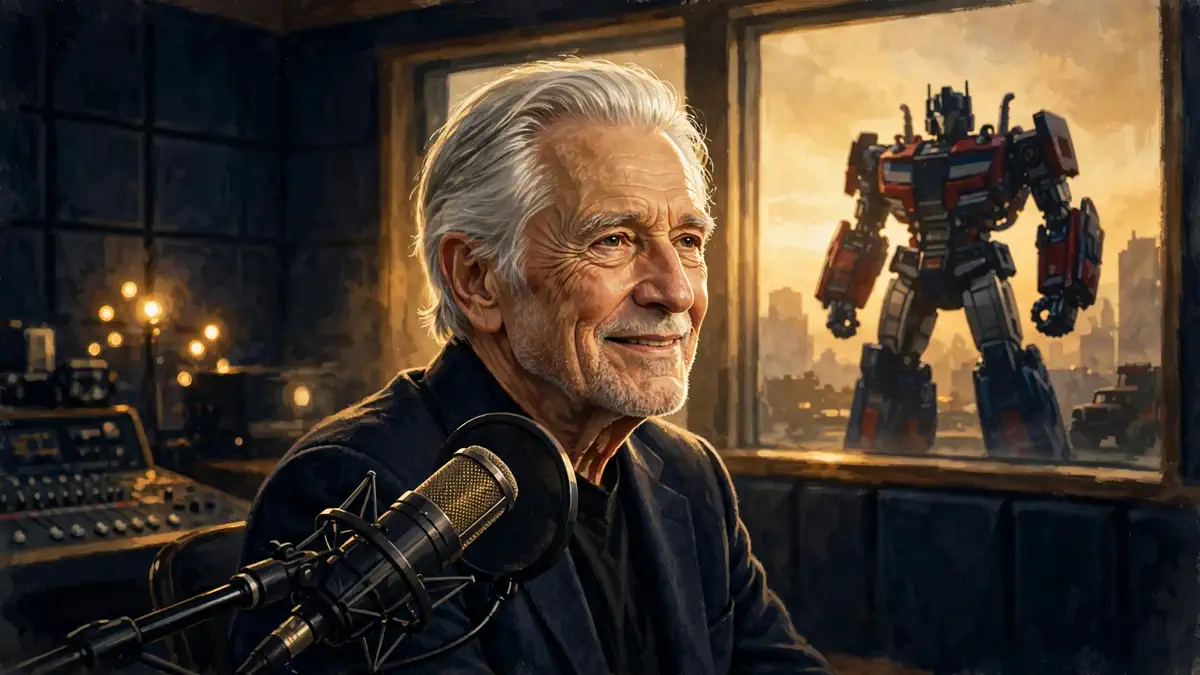
Peter Cullen‘s net worth is estimated at $6 million to $8 million as of October 2026. The man who gave Optimus Prime his voice — “one shall stand, one shall fall” — died on August 26, 2026 at 85, leaving behind a fortune built across 60 years: from $123-a-show animation sessions in the 1970s to the voice at the center of a film franchise that has grossed more than $5.28 billion worldwide.
Peter Cullen: Quick Facts
| Estimated net worth | $8 million (range: $6M–$8M) |
|---|---|
| Profession | Voice actor, performer |
| Nationality | Canadian |
| Born | July 28, 1941 (died August 26, 2026, aged 85) |
| Height | 5′ 8″ (1.73 m) |
| Primary income sources | Voice acting (Transformers franchise, Disney’s Winnie the Pooh), residuals, conventions, sound design |
| Active years | 1962–2026 |
| Last reviewed | October 2026 |
- Quick Facts
- Early Life and Background
- Education
- Career Journey
- Rise to Fame
- The Prime Revival and the Final Working Years
- Main Sources of Income
- Salary and Earnings
- Businesses and Investments
- Brand Deals and Sponsorships
- Houses, Cars and Other Assets
- Awards and Achievements
- Net Worth Growth Over the Years
- The Voice Actor Money Scoreboard
- Death and Legacy
- Social Media Presence
- Personal Life
- Sources & Reporting
- Frequently Asked Questions
Early Life and Background
Peter Claver Cullen was born on July 28, 1941, in Montreal, Quebec, to Henry and Muriel Cullen, American-born parents raising their family in French Canada. He grew up in a house full of siblings — older brother Larry, brother Sonny, and sister Michaela — in an Irish-rooted family where, by his own telling, storytelling was part of the furniture.
His childhood in Montreal in the 1940s and 50s was ordinary in the way that later made his extraordinary career possible. He listened to radio dramas, mimicked voices he heard around the house, and developed the ear that would eventually define two of the most famous voices in pop culture. The brother who shaped him most was Larry Cullen, who would go on to serve as a captain in the United States Marine Corps, including service in Vietnam. Peter would later say he built the voice of Optimus Prime from Larry — not the drill-instructor bark of a soldier in film, but the quiet authority of a leader who never needed to raise his voice.
That choice — strength delivered softly — became his signature. Decades later, his family’s farewell request to fans would echo it: be strong enough to be gentle.
Education
Cullen attended Regiopolis-Notre Dame Catholic High School in Kingston, Ontario, before earning a place in the very first graduating class of the National Theatre School of Canada in Montreal in 1963. The school’s first class was a small, high-pressure cohort; Cullen studied acting there under Bernard Diamant, a respected teacher who helped form the first generation of Canada’s professional theatre talent.
The classical training matters to the money story. Cullen never learned to be a cartoon voice in a booth; he learned to act. The restraint he brought to Optimus Prime — measured, paternal, never screaming — is stagecraft applied to animation. It is also why he worked steadily for six decades: directors could hand him any role, from a melancholic donkey to a killer robot, and he treated each with the same discipline.
Career Journey
Cullen’s professional life began in Canadian radio in the 1960s, where he worked on the comedy show Funny You Should Say That. His first voice acting job, by his own account, was as an announcer on The Smothers Brothers Comedy Hour in 1967. From there he became a utility player on American variety television: The Sonny & Cher Comedy Hour (series regular, 1971–1974), The Hudson Brothers Razzle Dazzle Show, and dozens of comedy-variety credits through the 1970s.
It was the classic journeyman path of a voice actor: be good at everything, get called for everything. By the late 1970s he had done on-camera work (King Kong, 1976 — he supplied the roars for the big ape), sound design, announcing, and cartoon voices. In 1982 he voiced KARR — the sinister counterpart to KITT — on Knight Rider, a role he would reprise in 2009. He even voiced Nintendo’s Mario in the Donkey Kong segments of Saturday Supercade (1983–84), and created the alien creature’s clicking sounds for 1987’s Predator — a sound-effects performance that required no words at all.
The 1980s animation boom made him indispensable. His credits read like a tour of the decade’s toy-box television: Voltron (Coran and King Alfor), G.I. Joe, DuckTales, Chip ‘n Dale: Rescue Rangers (Monterey Jack), The Smurfs, Alvin and the Chipmunks, Ghostbusters, Scooby-Doo — plus commercials, promos (he was the voice announcer on New Line Cinema’s trailers for Police Story 4), and Disney work. Two of those roles would anchor his finances for the rest of his life.
Rise to Fame
In 1984, Hasbro and Marvel launched The Transformers, a syndicated animated series built to sell transforming robot toys. Cullen auditioned for Optimus Prime, the heroic leader of the Autobots, by channeling his brother Larry. Producer Don Murphy would later recall that the audition nailed what the character needed: a commander who protected, not one who shouted. Cullen voiced both Optimus Prime and the weapons specialist Ironhide (a performance he modeled on actor Chill Wills) across the original series’ 98 episodes.
The defining shock of the era came in 1986’s The Transformers: The Movie, when Hasbro killed Optimus Prime twenty minutes in to make room for new toys. The fan backlash was ferocious — children wrote letters, and the character was resurrected. Few performers in entertainment history have ever been literally brought back to life by audience demand; Cullen was one of them.
Then came the second act no voice actor gets to plan. When director Michael Bay rebooted the property for DreamWorks in 2007, producers pushed to bring Cullen back. Don Murphy’s account is direct: they wanted him because he was iconic, the connection to the classic series. Cullen described returning to the booth as slipping into an old pair of very comfortable shoes. The 2007 film grossed $709.7 million worldwide, and Cullen reprised the role through Revenge of the Fallen ($836.3 million), Dark of the Moon ($1.12 billion), Age of Extinction ($1.10 billion), The Last Knight ($605.4 million), Bumblebee ($468.0 million), and Rise of the Beasts ($441.7 million). His final performance as the character came in 2024, on an episode of The Masked Singer.
Parallel to all of this ran his other legacy role. Beginning with The New Adventures of Winnie the Pooh in 1988, Cullen voiced Eeyore, the gloriously miserable donkey of the Hundred Acre Wood, across dozens of television episodes, feature films, specials, and video games over nearly four decades. The same man voiced the most reassuring character in children’s television and the most despondent — a feat of range that still feels slightly unfair.
The Prime Revival and the Final Working Years
The 2007 reboot did not just return Cullen to Optimus Prime — it made the character a second full-time career. When Michael Bay’s Transformers opened to $709.7 million, the industry learned what fans already knew: the voice was inseparable from the franchise. Producer Don Murphy said the team pushed for Cullen precisely because he was the living connection to the 1984 series. Bay himself later said the first time he heard Cullen record Optimus in the booth, the voice gave him chills.
The money years that followed are the ones the box-office tables remember: Revenge of the Fallen ($836.3 million, 2009), Dark of the Moon ($1.12 billion, 2011), Age of Extinction ($1.10 billion, 2014), The Last Knight ($605.4 million, 2017), Bumblebee ($468.0 million, 2018), and Rise of the Beasts ($441.7 million, 2023). Seven theatrical films, one voice, $5.29 billion in combined worldwide gross. Cullen’s per-film fee was never disclosed — studios don’t publish voice contracts, and neither did he — but the franchise’s economics explain why he stayed in demand into his eighties: audiences had decided, twice over, that nobody else was Optimus Prime.
Between the films, he headlined the 2010–13 animated series Transformers: Prime — 65 episodes, a Daytime Emmy nomination in 2011 — and kept working the character through video games, shorts, and promotional media. One notable absence matters for accuracy: the 2024 animated feature Transformers One cast Chris Hemsworth as a young Optimus instead of Cullen. It was a prequel about the character’s origins, and the recasting was a creative choice, not a dispute — but it underscores how unusual Cullen’s tenure was. The franchise had been recasting around him for years; fans kept insisting on him back.
His last years were busy. He appeared at Fan Expo Chicago in August 2024, still doing panels and meeting fans at 83. His final credited performance as Optimus Prime came that same year on an episode of The Masked Singer — a surreal, perfect coda for a man whose face almost nobody knew and whose voice everybody did. After his death, a 12-minute animated short, Optimus Prime: Awakening, was released posthumously and dedicated to his memory.
Convention economics deserve their own line in the money story, because for legacy voice actors they function as a second salary. Cullen was a headliner at Transformers conventions and pop-culture shows for decades — BotCon and its successors, Fan Expo, and similar events. The structure of that income is standard across the industry: an appearance fee from the event, plus paid autographs and photo ops that can run into the thousands of transactions over a weekend. Industry observers note that marquee legacy voices at major shows can clear low-five-figure sums per weekend before merchandise; we do not have Cullen’s specific figures and do not estimate them, but the cadence of his appearances — year after year, into his eighties — makes conventions a meaningful third pillar next to sessions and residuals.
Main Sources of Income
Cullen’s fortune was built on six decades of continuous voiceover work, but four streams did most of the heavy lifting:
1. The Transformers franchise. The anchor. Seven theatrical films between 2007 and 2023 grossed a combined $5.29 billion worldwide, and Cullen voiced Optimus Prime in every one of them. On top of that: 98 episodes of the original series, the 1986 animated film, Transformers: Prime (2010–13), video games, theme-park attractions, and merchandise-adjacent voice work.
2. Disney residuals. Four decades as Eeyore across Disney’s Winnie the Pooh television, films, direct-to-video releases, and games meant recurring residual payments from one of the most re-aired children’s catalogs on earth. Add Monterey Jack (Chip ‘n Dale: Rescue Rangers), and Disney alone likely paid Cullen for more sessions and reuses than any other studio.
3. Animation session work and sound design. Hundreds of episodes across Voltron, G.I. Joe, DuckTales, The Smurfs, Alvin and the Chipmunks, Ghostbusters, Scooby-Doo, and Invincible, plus feature sound work (King Kong, Predator) and commercial/trailer announcing. Under SAG-AFTRA rules, each session carried a scale rate plus residuals on re-airings.
4. Conventions and appearances. As the voice of Optimus Prime, Cullen was a marquee guest at Transformers conventions (BotCon and its successors) and pop-culture shows for decades, with autograph and photo-op income on top of appearance fees. He also appeared at Fan Expo Chicago as late as August 2024.
Salary and Earnings
Voice acting money works in three layers — session fees, residuals, and backend participation — and Cullen’s career is a textbook case of how they compound.
The early layer was humble. In a candid Collider interview, Cullen said that in the 1980s animation days, performers were paid “$123 a show” — and a show meant doing three voices. Do four voices and the pay nudged up, but reruns paid on a declining scale, each repeat worth less than the last. The lesson he drew: volume. “You had to do a lot,” he said, “a couple of hit shows before you didn’t have to buy a used car.” So he did: at his peak he was performing multiple voices per series across multiple series per season, stacking session fees the only way the system allowed.
The mid layer was residuals. Union re-airings of The Transformers — rerun for decades in syndication and on cable — and Disney’s constant recycling of Winnie the Pooh material paid him long after the original recording sessions. A hit animated series can pay residuals for generations; Cullen had two.
The top layer was the blockbuster era. Cullen’s exact fee for the live-action Transformers films was never publicly disclosed — neither he, the studios, nor the trades ever published it, and we do not estimate it. What is documented is the scale of what his voice sat atop: the five Michael Bay–directed films alone contributed roughly $4.37 billion of the franchise’s $5.29 billion theatrical total. For context, voice actors on franchise blockbusters of that era typically negotiated low-six-figure fees per film plus, occasionally, merchandise-royalty participation — but without a filing or a named source for Cullen specifically, that remains context, not fact.
One documented financial decision of his: Cullen gave his older brother Larry a cut of his Optimus Prime wages for years — every year from landing the role until Larry’s death in 2011 — because the voice was Larry’s gift to him. That was money he chose to give away, and it says more about his finances than any single paycheck: the Transformers work paid well enough, and consistently enough, to share.
Businesses and Investments
Cullen was not a businessman in the modern celebrity sense — no clothing line, no tequila brand, no startup portfolio. His career predated the era when voice actors became brands, and he never built one. No public record shows him founding companies, taking equity in studios, or running businesses on the side. His wealth came from labor, not dealmaking: six decades of session fees, residuals, and appearance income, spent and saved the old-fashioned way.
What did appear in his portfolio, by the standard pattern of union performers of his generation, was the quiet machinery of Hollywood compensation: SAG-AFTRA pension credits accumulated over 60 years of eligible work, IRA/retirement accounts funded from peak earning years, and the modest investment of a man who famously never chased the spotlight’s money. None of this is public in detail — pension and retirement holdings are private — so we record it as the likely shape of his wealth, not a confirmed number.
Brand Deals and Sponsorships
Cullen did not sign endorsement deals in the conventional sense. But his voice was, for decades, a product — and it sold things. He voiced commercial campaigns throughout his career (the 1970s variety-show announcer era was essentially live advertising work), and he was the voice announcer on New Line Cinema’s trailers for Police Story 4 and the promotional campaign for 1999’s The Iron Giant. Transformers and Winnie the Pooh merchandise carried his vocal identity into toys, games, and theme-park experiences, generating the royalty streams that matter far more to a voice actor’s estate than a sneaker contract.
His most meaningful “brand deal” was arguably his relationship with NASA. A lifelong space enthusiast whose interest began with the Apollo 11 moon landing in 1969, Cullen partnered with NASA on the Optimus Prime Spinoff Award, which honors young people studying space, science, technology, and math. It paid nothing and meant everything to him — he was a fan and supporter of the agency for decades.

Houses, Cars and Other Assets
Cullen lived most of his later life in Toluca Lake, Los Angeles, the lake-adjacent neighborhood that has long been a quiet haven for working actors. His home there was where he died peacefully on August 26, 2026, surrounded by family. Public property records confirming purchase price or current value are not attached to his name in accessible databases, so we do not estimate a figure. Earlier in his career he also maintained ties to his native Montreal, where several profiles list his residence.
He was never a cars-and-yachts celebrity. No luxury car collection, no reported private aviation, no ostentatious real estate portfolio ever surfaced in reporting about him. Colleagues’ tributes after his death consistently described the same man: modest, professional, generous with his time at fan events, and devoted to family. The modest lifestyle is itself part of the net-worth story — a $6–8 million fortune accumulated across 60 years by someone who appears to have spent conservatively looks exactly like this.
Awards and Achievements
Cullen’s shelf was thin on statues and heavy on honors that matter to working performers:
- Daytime Emmy nomination (2011) — Outstanding Performer in an Animated Program for Transformers: Prime. The nomination itself was unusual for a voice performer of his generation.
- Lifetime Achievement Award from the National Academy of Television Arts & Sciences (2023) — the industry’s formal acknowledgment of a six-decade career.
- Transformers Hall of Fame (2010) — inducted at BotCon as one of the first four humans honored by Hasbro for contributions to the franchise.
- NASA’s Optimus Prime Spinoff Award partnership — recognition for his work inspiring young people in STEM.
- Fan Expo Chicago (2024) and decades of convention headliner appearances — the working actor’s version of a lifetime achievement honor.
Net Worth Growth Over the Years
Unlike on-camera stars whose paydays leak to the trades, Cullen’s finances were rarely covered while he lived. What the record does show is how published estimates of his wealth moved — and the most honest version of a growth table is simply the published snapshots, each with its source and date:
| Year | Published estimate | Source |
|---|---|---|
| 2023 | $6 million | CelebsMoney (longstanding figure, never revised) |
| 2025–2026 | $6 million | Internewscast and similar outlets, pre-death |
| August 2026 | $8 million | Celebrity Net Worth, updated at the time of his death |
| October 2026 | $6–8 million | Icon Polls estimate |
| October 2026 | $6–10 million | Industry video tributes and aggregators |
The arc is straightforward: a working voice actor whose wealth accumulated slowly through the 1980s and 90s (the $123-a-show era), accelerated with the 2007 blockbuster reboot, and held steady through streaming-era residuals and conventions. The bump from $6M to $8M at death reflects Celebrity Net Worth’s final review rather than a sudden windfall — the strongest anchor in the record, which is why our headline estimate centers on it.
The Voice Actor Money Scoreboard
Where does a $6–8 million fortune sit among voice acting’s elite? Voice actors rarely command the per-project money of live-action stars — but the top of the field shows what decades of hit residuals can compound into. Figures below are reported estimates from Celebrity Net Worth, the same outlet that anchors our Cullen figure:
| Voice actor | Signature roles | Reported net worth |
|---|---|---|
| Peter Cullen | Optimus Prime, Eeyore | $6–8M |
| Frank Welker | Megatron, Scooby-Doo, Garfield | ~$4M |
| Jim Cummings | Winnie the Pooh, Tigger, Darkwing Duck | ~$10M |
| Dan Castellaneta | Homer Simpson (The Simpsons) | ~$80M |
| Hank Azaria | Moe, Apu, Chief Wiggum (The Simpsons) | ~$90M |
| Seth MacFarlane | Family Guy, American Dad! | ~$300M |
The lesson: voice actors who own a piece of a still-running hit (The Simpsons, Family Guy) or its backend land far above those who were paid session fees even on billion-dollar films. Cullen sat squarely in the middle tier of animation royalty — richer than most jobbing voice performers, below the Simpsons-era jackpot winners.
Death and Legacy
Peter Cullen died on August 26, 2026, at his home in Toluca Lake, Los Angeles, aged 85. His family’s statement said he passed away peacefully, surrounded by his loving family, and asked fans to honor his legacy by “serving your communities and leading others with compassion, integrity, and loyalty” — and to always remember: “be strong enough to be gentle.” He was buried at Forest Lawn Memorial Park in Hollywood Hills.
The cause of death, confirmed via his death certificate and first reported by TMZ in early September 2026, was cardiac arrest due to respiratory arrest, with a malignant neoplasm of the lower lobe of the lungs listed as the underlying condition. The certificate also noted several contributing conditions. His family had announced his death without initially revealing a cause.
The tributes said as much about the man as the roles. Michael Bay told TMZ that hearing Cullen record Optimus Prime for the first time gave him chills — and that learning of his death, he sat with the news for an hour before breaking down in tears. Don Murphy, who had pushed for Cullen’s 2007 casting, remembered a performer who made the job effortless. Fans who had never seen his face wrote about the voice that taught them what a leader sounded like.
Even after death, the work continued: Cullen made a final posthumous appearance in the animated short Optimus Prime: Awakening, a 12-minute film dedicated to his memory. He left the recording booth the way he entered it — working.
Social Media Presence
Cullen kept a low profile online, as he did everywhere else. He did not maintain the kind of personal social media brand that modern performers run; he appeared through fan communities, convention accounts, and official franchise channels instead. After his death, tributes flooded Transformers, Disney, and voice-acting communities across every platform — a reminder that reach and influence are not the same thing as follower counts.
Personal Life
Cullen’s wife was Brandi Cullen. Together they had four children — Clay (a stunt performer), Angus, Claire, and Pilar — and three grandchildren. Family members and colleagues consistently described him as a devoted family man who kept his private life out of the press; few entertainment figures of his stature revealed so little about so much.
His devotion to his brother Larry ran through his whole career. The Optimus Prime voice was Larry’s voice first — a decorated Marine who served in Vietnam — and Cullen paid him a share of the role’s wages until Larry died in 2011. His other lifelong devotion was to NASA: the Apollo 11 landing in 1969 hooked him, and he spent decades as a supporter of the agency and a mentor-figure for young people in science and engineering through the Optimus Prime Spinoff Award. In a 2019 Associated Press interview he described the animator’s life simply: “You’re always auditioning for something in animation that’s a little off of the norm.” He spent 60 years finding it.
Sources & Reporting
Celebrity Net Worth — anchor estimate of $8 million “at the time of his death,” biographical summary, 2011 Daytime Emmy nomination, 2023 Lifetime Achievement Award, death date August 26, 2026 (updated ~45 days before October 2026).
CelebsMoney — longstanding $6 million estimate, birth date July 28, 1941, height 5’8″, Montreal origin (stale 2023 figures, used as the low anchor of the range).
Icon Polls — October 2026 estimate of $6–8 million, family details (wife Brandi; children Clay, Angus, Claire, Pilar; three grandchildren), siblings, BotCon 2010 Hall of Fame.
UNILAD — family statement on August 27, 2026 (peaceful passing, “be strong enough to be gentle”); documented the brother’s share of Optimus Prime wages.
TMZ (via PopCulture.com and Perez Hilton reporting) — death certificate details: cardiac arrest due to respiratory arrest, underlying malignant neoplasm of the lower lobe of the lungs; burial at Forest Lawn; Michael Bay’s reaction.
Collider — Cullen’s own account of early-career animation pay ($123 per show, three voices per show, declining rerun scale).
Associated Press — 2019 interview quote on auditioning in animation.
Wikipedia — Transformers film series box office totals ($5.29 billion across seven films), per-film worldwide grosses, franchise history.
Reporting window: August 2026 – October 2026 (death coverage and updated estimates); historical career facts cross-checked against entertainment press obituaries and interviews.
Frequently Asked Questions
What was Peter Cullen’s net worth at the time of his death?
Peter Cullen’s net worth is estimated at $6–8 million, with the most authoritative figure — $8 million from Celebrity Net Worth, updated at the time of his death — anchoring the top of the range. CelebsMoney’s longstanding figure was $6 million. The fortune was built across 60 years: 1980s animation sessions, the seven live-action Transformers films, four decades of Disney residuals as Eeyore, and convention appearances.
How did Peter Cullen die?
Peter Cullen died on August 26, 2026, at his home in Toluca Lake, Los Angeles, aged 85. According to his death certificate, first reported by TMZ in early September 2026, the cause was cardiac arrest due to respiratory arrest, with a malignant neoplasm of the lower lobe of the lungs listed as the underlying condition. His family said he passed away peacefully, surrounded by loved ones.
Is Peter Cullen still alive?
No. Peter Cullen passed away on August 26, 2026, at age 85. He was buried at Forest Lawn Memorial Park in Hollywood Hills, and a posthumous animated short, Optimus Prime: Awakening, was dedicated to his memory.
Who was the original voice of Optimus Prime?
Peter Cullen was the original voice of Optimus Prime, creating the role in the 1984 animated series The Transformers. He modeled the character’s voice on his older brother Larry, a decorated U.S. Marine who served in Vietnam. Cullen returned to the role for Michael Bay’s 2007 live-action film and voiced Optimus in all seven theatrical Transformers films through Rise of the Beasts (2023), plus the 2010–13 series Transformers: Prime, which earned him a Daytime Emmy nomination.
What other characters did Peter Cullen voice?
Besides Optimus Prime, Cullen voiced Eeyore in Disney’s Winnie the Pooh franchise from 1988 for nearly four decades, Ironhide in the original Transformers series, KARR on Knight Rider (1982 and 2009), Monterey Jack on Chip ‘n Dale: Rescue Rangers, Coran and King Alfor in Voltron, Mario in the Saturday Supercade Donkey Kong segments, and created the Predator’s clicking sounds in the 1987 film Predator. He also supplied the roars for the 1976 King Kong remake.
Was Peter Cullen married? Did he have children?
Yes. Peter Cullen’s wife was Brandi Cullen, and they had four children — Clay (a stunt performer), Angus, Claire, and Pilar — plus three grandchildren. He was known as a devoted, private family man.
How much did Peter Cullen make for Transformers?
His exact per-film salary was never publicly disclosed, and we do not estimate it. What is documented: in the 1980s he earned $123 per animation episode (performing three voices per show), with reruns paying on a declining scale. The seven live-action Transformers films he voiced grossed $5.29 billion worldwide combined. He also shared a cut of his Optimus Prime wages with his brother Larry until Larry’s death in 2011.
How old was Peter Cullen when he died?
Peter Cullen was 85. He was born July 28, 1941, in Montreal, Quebec, Canada, and died August 26, 2026, at his home in Los Angeles.
Final Thoughts
Peter Cullen’s $6–8 million fortune is the money story of an era that doesn’t exist anymore: a working voice actor who arrived at $123 a show, stayed employable through sheer range for six decades, and got pulled into the center of a blockbuster franchise he had helped create twenty years earlier. He never chased celebrity money — no brands, no scandals, no headline contracts — and still left an estate most performers would envy, because the work never stopped and the residuals never stopped compounding.
The honest summary is that his net worth reflects labor, not luck: two generational characters, hundreds of sessions, a brother’s voice given back to the world, and a gentle exit that matched the character he made famous. Be strong enough to be gentle. He was.
Published on October 11, 2026. Last reviewed October 2026. Found an error? See our corrections policy.