
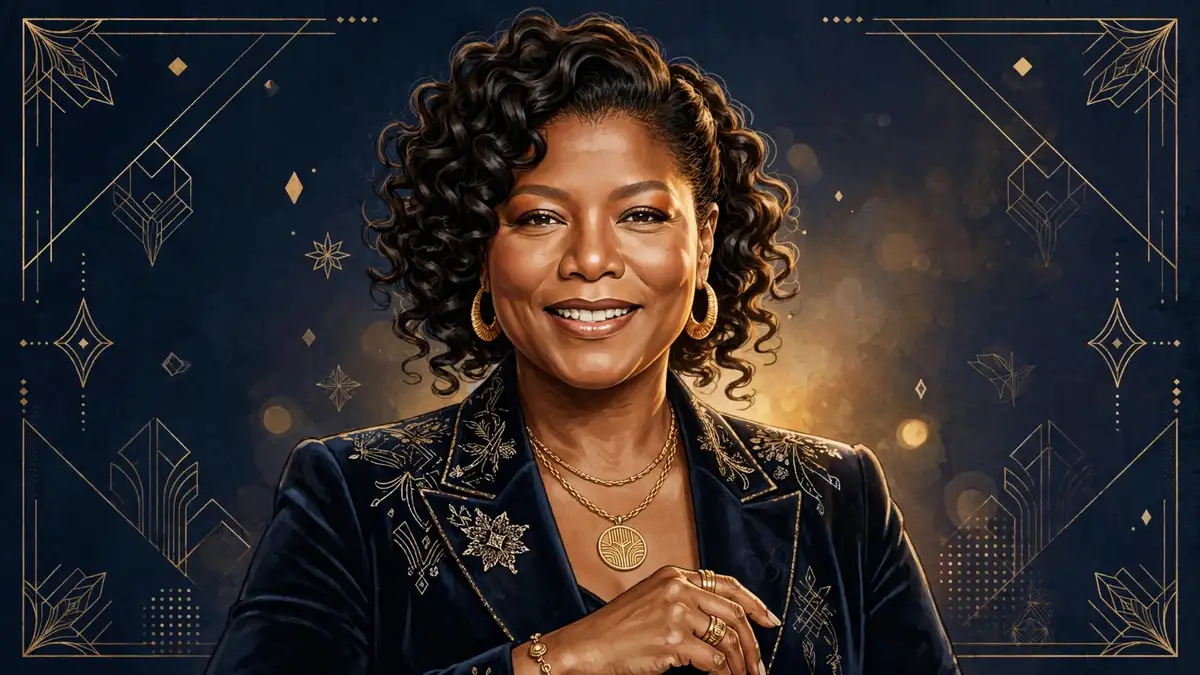
Queen Latifah‘s net worth is estimated at $60 million to $70 million as of November 2026. Celebrity Net Worth, the most widely cited tracker for entertainment figures, puts her at $60 million in its October 2026 snapshot, while Parade confirmed the same $60 million figure in September 2026 and most other publications land at $70 million. We anchor our estimate at $65 million, the middle of that range, and explain below why the two numbers differ — and why a $250 million figure floating around low-authority sites has no sourcing behind it.
Queen Latifah: Quick Facts
| Estimated net worth | $65 million (range: $60 million to $70 million) |
|---|---|
| Profession | Rapper, singer, actress, television host, producer, entrepreneur |
| Nationality | American |
| Born | March 18, 1970 (age 56) |
| Height | 5 feet 10 inches (178 cm) |
| Primary income sources | Television acting and producing, film salaries, music royalties, Flavor Unit Entertainment, endorsements, real estate development |
| Active years | 1988–present |
| Last reviewed | November 2026 |
- Early Life and Background
- Education
- Career Journey
- Rise to Fame
- Main Sources of Income
- Salary and Earnings
- Businesses and Investments
- Brand Deals and Sponsorships
- Houses, Cars and Other Assets
- Awards and Achievements
- Net Worth Growth Over the Years
- Social Media Presence
- Personal Life
- Sources & Reporting
- Frequently Asked Questions
- Final Thoughts
Early Life and Background
Dana Elaine Owens was born on March 18, 1970, in Newark, New Jersey, and grew up mostly in the neighboring city of East Orange. Her father, Lancelot Owens Sr., worked as a police officer. Her mother, Rita Owens, taught school. The two divorced when Latifah was ten, and she stayed close to her mother for the rest of Rita’s life — close enough that, decades later, Latifah would name a housing development after her.
Newark in the 1970s and 1980s was a hard place to grow up, and Latifah has never hidden that. She played basketball at school, standing 5 feet 10 inches tall and playing power forward, and she sang in school musical productions, including a turn in The Wiz. The stage name came in her teens: “Latifah” is Arabic for “delicate” or “kind,” a word she picked up through her interest in African and Islamic culture, and “Queen” went in front of it because, as she has put it in interviews since, she intended to carry herself like royalty from the start.
Her first group was Ladies Fresh, an all-female hip-hop crew in which she started out as a beatboxer before she started writing rhymes. A local DJ, Mark James, passed her demo to Fred Braithwaite, host of Yo! MTV Raps, and the tape started moving. Dante Ross of Tommy Boy Records helped her land a recording contract, and in 1988 she released her debut single, “Wrath of My Madness.”
Loss shaped her early adult years. Her older brother, Lancelot Owens Jr., died in a motorcycle accident in 1992, a death she has said left her depressed and struggling for a long stretch afterward. Her mother, Rita, died in March 2018 after a long struggle with a heart condition. Both losses show up in the way she talks about her work: family, home, and Newark keep reappearing as the reasons behind her business choices, from the production company she built with a childhood friend to the apartment buildings she is putting up on the streets where she grew up.
Education
Latifah attended Catholic school in Newark and Essex Catholic Girls’ High School in Irvington, New Jersey, before finishing at Irvington High School, where she played basketball and performed in school musicals. After high school she took classes at Borough of Manhattan Community College in New York.
She never finished a college degree, and that is part of the financial story. By the time she was 18 she had a single out, and by 19 she had a debut album. The classroom path ended because the recording career started. What she learned about the business side — owning masters where she could, producing instead of only performing, keeping a longtime business partner — came from three decades of deals rather than a degree, and it is the reason her money outlasted the chart runs of plenty of rappers who started beside her.
Career Journey
All Hail the Queen arrived in November 1989, with “Ladies First,” a collaboration with British rapper Monie Love, as its calling card. The song became an anthem about women demanding respect in hip-hop, and it set the tone for everything that followed: Latifah’s music argued a point. Her second album, Nature of a Sista’, followed in 1991. Then came Black Reign in 1993, which became the first album by a solo female rapper to earn a gold certification from the Recording Industry Association of America.
Black Reign carried “U.N.I.T.Y.,” the song that defines her music career. Written as a direct answer to misogyny, domestic violence and street disrespect toward women, it spent 20 weeks on the Billboard Hot 100 between 1993 and 1994 and peaked at No. 23. In 1995 it won her the Grammy Award for Best Rap Solo Performance, her first and only Grammy win. She released Order in the Court in 1998 through Motown Records, her fourth studio album.
Then she did something few rappers of her generation attempted: she changed genres without apology. The Dana Owens Album, released in 2004, was a jazz and soul standards record that earned a Grammy nomination for Best Jazz Vocal Album. Trav’lin’ Light followed in 2007 and picked up a nomination for Best Traditional Pop Vocal Album. She came back to hip-hop in 2009 with Persona, featuring collaborations with Mary J. Blige and Busta Rhymes, which reached No. 3 on Billboard‘s Top R&B/Hip-Hop Albums chart. Seven studio albums in all, across rap, jazz, soul and pop — a catalog that keeps paying royalties in four different lanes.
The catalog’s standing grew in 2023, when the Library of Congress selected All Hail the Queen for preservation in the National Recording Registry, the federal list of recordings judged culturally, historically or aesthetically significant. And the music story is not closed: in May 2026 she hinted at new music coming in 2026, ahead of her Rock & Roll Hall of Fame induction, according to WBLS. After 38 years in recording, she is still releasing, still touring the legacy, and still collecting on songs written when she was a teenager.
Acting ran alongside the music from the early 1990s. She made guest appearances on The Fresh Prince of Bel-Air and appeared in Spike Lee’s Jungle Fever in 1991, with supporting parts in House Party 2 and Juice following. The work was steady rather than star-making until television gave her a lead role of her own.
Rise to Fame
The breakthrough was Living Single. Cast as Khadijah James in 1993, Latifah led the Fox sitcom for all five seasons through 1998, playing a magazine editor holding together a circle of friends in Brooklyn. The show became one of the decade’s most popular sitcoms and proved she could carry a series — the skill that would pay her best money 25 years later. Parade notes that her salary for the role was never publicly disclosed, and no reliable figure has surfaced since.
Film gave her the dramatic credibility. In 1996 she played Cleo, a bank robber, in Set It Off alongside Jada Pinkett Smith, Vivica A. Fox and Kimberly Elise, a performance that drew serious critical praise and showed she could handle dark material. Then came Chicago in 2002. As Matron Mama Morton she sang, schemed and stole scenes in a film that grossed more than $300 million worldwide and won six Academy Awards, including Best Picture. Her performance earned an Academy Award nomination for Best Supporting Actress, making her one of the first hip-hop performers ever nominated for an acting Oscar.
The commercial run that followed turned the Oscar nomination into real money. Bringing Down the House (2003), opposite Steve Martin, grossed about $165 million worldwide. Taxi (2004), Barbershop 2: Back in Business (2004), Beauty Shop (2005), Last Holiday (2006) and Hairspray (2007) kept her on screens every year. She also started voicing Ellie the mammoth in the Ice Age franchise with Ice Age: The Meltdown in 2006, a family-film paycheck stream that ran across sequels for a decade.
Television kept pace. She hosted the syndicated daytime talk show The Queen Latifah Show from 1999 to 2001 and again from 2013 to 2015. In 2007 she starred in the HBO film Life Support as Ana Wallace, a woman living with HIV who becomes a community health advocate; the role won her a Golden Globe Award and a Screen Actors Guild Award. In 2015 she played blues singer Bessie Smith in HBO’s Bessie, a film she also executive produced, which won the Primetime Emmy Award for Outstanding Television Movie and earned her Emmy and Golden Globe nominations of her own.
The second act of her television career arrived in 2021, when CBS cast her as Robyn McCall in The Equalizer, a reimagining of the 1980s series. She starred and executive produced through Flavor Unit Entertainment for five seasons and 74 episodes before the show ended in May 2025. The run made her the face of a network procedural at an age when Hollywood usually stops calling actresses for leads — and it paid her as both star and producer, the two income streams that now dominate her fortune.
2026 added three more firsts. She hosted the 52nd American Music Awards on May 25, 2026, live from Las Vegas, returning to the ceremony 31 years after co-hosting it in 1995. In September 2026 she joined NBC’s The Voice as a coach for its 30th season, alongside Kelly Clarkson, Adam Levine and country singer Riley Green. And on November 14, 2026, she is inducted into the Rock & Roll Hall of Fame with the Early Influence Award, the ceremony taping at the Peacock Theater in Los Angeles before airing on ABC and Disney+ in December.
Main Sources of Income
Latifah’s money comes from six streams, and the mix is the point. A rapper who only ever had record royalties would have seen income fall off a cliff in the streaming era. A film actress who only ever took salaries would have been at the mercy of casting. Latifah layered the streams so that when one slowed, another carried the year.
Television is the largest stream today. The Equalizer paid her as lead actress and as executive producer for five seasons, and The Voice added a prime-time coaching salary in fall 2026. Film salaries form the second stream: a run of commercial comedies and dramas from 2002 onward, plus voice work in the Ice Age franchise, plus Netflix films Hustle (2022) and End of the Road (2022), the second of which she also produced. Music royalties are the third: seven studio albums, a Grammy-winning single, jazz records that sell steadily to an older audience, and a catalog that gained fresh prestige — and fresh licensing value — with the 2023 National Recording Registry selection.
The fourth stream is Flavor Unit Entertainment, the production company she co-owns with Shakim Compere. When she produces a project she stars in, she collects a producer fee and a share of the backend on top of her acting salary. When Flavor Unit produces projects she does not appear in, the company earns producing fees and development money on its own. The fifth stream is endorsements, led by CoverGirl, a relationship that has now run for 25 years across two separate deals. The sixth is real estate development through BlueSugar Corporation, the Newark housing project being the documented centerpiece.
| Income stream | How it pays | Share of the fortune (editorial estimate) |
|---|---|---|
| Television acting and producing | The Equalizer star + executive producer, The Voice coach, hosting | Largest single stream |
| Film salaries and voice work | Lead and supporting roles, Ice Age franchise, Netflix films | Large |
| Production company | Flavor Unit fees, backend, first-look and output deals | Large and growing |
| Music royalties and catalog | Seven albums, streaming, licensing, registry prestige | Steady, mid-sized |
| Endorsements and licensing | CoverGirl, Pizza Hut, Jenny Craig, fragrances, HSN fashion | Mid-sized |
| Real estate development | Rise Living, Newark — 76 units, rental income and asset value | Growing, long-term |
The shares above are our editorial estimates, built from the public record of her projects and deals. No filing or disclosure breaks out her income by stream, and any site that prints exact percentages is guessing. What the record does show is direction: the balance of her money has shifted over 35 years from record advances to television salaries to ownership — producer fees, company equity and property. That shift is why her net worth held at $60–70 million through years when she released no album at all.

Salary and Earnings
Here is where honesty matters more than a clean number. For most of Latifah’s biggest jobs, the salary was never disclosed, and the figures that circulate online come from entertainment salary trackers that do not show their sourcing. We print what is documented, label what is reported, and say plainly what nobody knows.
The Equalizer: undisclosed. Parade reported in September 2026 that it is not publicly known what Latifah took home for the CBS show, and Celebrity Net Worth says the same. She held two paid roles — lead actress and executive producer through Flavor Unit — so her per-season compensation combined an acting fee and producer fees, plus whatever backend participation the deal carried. Trade reporting on top CBS drama leads generally puts star salaries in the low-to-mid six figures per episode, and 74 episodes across five seasons would put that math in the millions per season. That is industry context, not her pay stub: nobody has published her per-episode number, and we will not invent one.
The Voice: undisclosed, with a benchmark. Her salary for joining NBC’s The Voice as a coach for Season 30 has not been publicly disclosed. Parade noted that The Sun reported in 2023 that coaches on the show usually start out making around $8 million for a first season — a useful benchmark for the scale of the job, and nothing more. If her deal sits anywhere near that range, one season of The Voice pays roughly what many film stars earn in a year. Her deal terms, like her Equalizer terms, stay private.
Film salaries: reported, unconfirmed. Entertainment salary trackers list her pay for Chicago (2002) at around $325,000 and her pay for Beauty Shop (2005) at around $10 million. Both figures appear in multiple tracker databases and neither has ever been confirmed by Latifah, a studio, or a trade paper, so treat them as reported rather than established. The direction of travel is credible even if the exact numbers are soft: her asking price jumped sharply after the Oscar nomination for Chicago, and Beauty Shop was built entirely around her name. Her pay for Living Single was never disclosed, and neither was her hosting pay for either run of The Queen Latifah Show.
The first big check. One salary story is documented in her own words. She told The Tonight Show in 2017 that after her first big paycheck — a $200,000 check from Sony — she and a friend spent $30,000 on a boat despite knowing nothing about boating. The boat ran out of gas near the Verrazano-Narrows Bridge, and her father had to come to the rescue. It is a small story, but it frames the arc: a teenager from Newark who blew her first windfall on a boat she could not sail went on to build a production company, a real estate portfolio and a fortune that survived four decades in entertainment.
The crew paycheck. When the second run of The Queen Latifah Show was cancelled in 2014, she announced she would use her own money to pay the production crew through the holiday season, writing on Facebook, in a post reported by Essence, that their “dedication and sacrifice was crucial to the entire team.” The amount was never disclosed. The gesture tells you something the numbers cannot: she treats the people who work for her as a cost she carries herself, and that reputation is part of why crews, networks and studios keep hiring her.
Businesses and Investments
Flavor Unit Entertainment is the business that changed her financial life. She co-founded it in 1995 with Shakim Compere, her longtime business partner, and the two have run it together ever since. The logic was simple: instead of taking a salary and going home, own the project. Flavor Unit has produced films and series she starred in — Bringing Down the House, Beauty Shop, Just Wright, Bessie and The Equalizer — and projects she never appeared in, earning producing fees, development money and distribution arrangements on work with her name nowhere on the poster.
The deal flow shows a company that kept finding new buyers. In February 2013, Flavor Unit announced a multiyear agreement with Netflix that gave the streaming service exclusive U.S. distribution rights to selected films the company produced — one of Netflix’s early deals with an established Hollywood producer as it built its originals business. In 2021, Flavor Unit signed a first-look development deal with Audible for audio-only stories, a move into a format where production costs are low and the audience is loyal. The company’s later work included the Lifetime films The Clark Sisters: First Ladies of Gospel and Salt-N-Pepa, and Netflix’s End of the Road. In March 2026, Lifetime announced another production agreement with Latifah and Compere under which Flavor Unit would executive produce three original television movies for the network. The financial terms of these deals have not been publicly disclosed, and that is normal for production agreements. What matters for her net worth is the structure: she owns a piece of the projects, not just a fee for showing up.
BlueSugar Corporation is her real estate development company, run with Compere as co-president, and it is the vehicle for the most concrete asset in her portfolio: the Rise Living project in Newark, covered in detail below. BlueSugar started with a bigger plan — two multifamily towers totaling 115 apartments — and scaled it back after being denied a Low Income Housing Tax Credit, according to Jersey Digs reporting cited by Bisnow. The revised project went ahead anyway, which says something about the commitment behind it: this was not a celebrity endorsement deal, it was a development she stayed with through a financing setback.
Books, fragrance and fashion fill out the business picture. She published Ladies First: Revelations of a Strong Woman in 1999 and Put on Your Crown: Life-Changing Moments on the Path to Queendom in 2010. She launched her first fragrance, “Queen,” in 2009, followed by “Queen of Hearts” in 2010. In 2011 she introduced a fashion collection through HSN that included handbags, apparel and accessories. None of these lines reports public revenue figures, and none of them is the engine of her fortune. Together they show the pattern: she licenses her name into categories where her audience already shops, collects the fee, and moves on.
What she does not do is also worth recording. Unlike some peers, Latifah has never launched a liquor brand, a beauty company of her own, or a crypto or tech venture that generated headlines. Her business record is entertainment production and Newark real estate — two things she understands from the inside — rather than a portfolio of startup bets. That restraint kept her away from the kind of failed endorsement that has dented other celebrity fortunes, and it is one reason the $60–70 million range has been stable for years.
Brand Deals and Sponsorships
CoverGirl is the endorsement that defines her. She first became a face of the cosmetics brand in 2001, and in 2006 she released the Queen Collection, a makeup line built around a wider selection of shades for women with darker skin tones. She told Essence in 2017 that becoming a CoverGirl mattered because she had never seen one who looked like her growing up. In 2022, twenty-one years after first joining the brand, she signed a new multi-year deal and returned as a CoverGirl, calling it a full-circle moment in a statement reported by Billboard. The amounts in both deals were never disclosed. The length of the relationship is the figure that counts: very few celebrity endorsements survive two decades, a cancellation-era gap, and a return on fresh terms.
The rest of the endorsement record is shorter but steady. She has appeared in advertising campaigns for Pizza Hut and Jenny Craig, among other consumer brands, according to Celebrity Net Worth. The Jenny Craig work tied into her public weight-loss story, and the Pizza Hut work put her in mainstream family advertising at the height of her film career. Like the CoverGirl deals, the fees were never disclosed, and none of these campaigns carried the kind of equity stake that turns an endorsement into a nine-figure windfall. They paid her as a spokesperson, reliably, over a long period.
That is the honest scale of her endorsement income. It is real money — multi-year beauty deals for a star of her profile run into seven figures — but it is not the main engine of her wealth. The main engine is television and production. Endorsements are the layer on top, and the CoverGirl relationship is the one that lasted long enough to matter for the net worth total.

Houses, Cars and Other Assets
The documented asset in Queen Latifah’s portfolio is not a mansion or a car collection. It is an apartment development in Newark, and it is worth understanding in detail because it is the clearest window into how she invests.
Rise Living sits in Newark’s South Ward, at the corner of Springfield Avenue and South 17th Street, near the Irvington border where she attended high school. Through BlueSugar Corporation, Latifah partnered with Life Assets Development and GonSosa Development on the project, which was announced with an estimated development cost of $14 million, according to reporting by NJ.com cited by Bisnow. The development holds 76 residential units, 16 of them designated as affordable housing for qualifying households, with the rest let at market rates initially advertised from about $1,800 a month. The site also includes about 1,900 square feet of ground-floor commercial space reserved for community nonprofits, plus a fitness center, a business center, electric-vehicle charging and parking.
Construction began in January 2022, and Latifah joined Newark Mayor Ras Baraka at a ceremonial groundbreaking in April 2022. The name carries the personal reason: RISE stands for “Rita Is Still Everywhere,” a tribute to her late mother. In November 2026 the story reaches television, when BET premieres the documentary You Can Go Home Again on Friday, November 27 at 10 p.m. Eastern, tracing her return to the neighborhood and the development at its center, directed by Muta’Ali and co-produced by Flavor Unit Entertainment and P&G Studios.
The exact percentage of the development owned by Latifah or BlueSugar has not been publicly disclosed, so we do not put a dollar value on her stake. What is documented is the scale of the project, her role as co-developer, and the rental income a 76-unit building generates over time. For a net worth estimate, Rise Living matters as a long-term, income-producing asset in a city she knows block by block — a different kind of holding from a house she lives in, and a more durable one.
As for homes and cars: Latifah keeps her private residences out of the press, and there is no verified public record of a car collection or a portfolio of personal homes with published values. We do not list property that cannot be traced to a public record or a named report. The one housing detail that has circulated — a shared home purchase reported years ago — rests on thin sourcing and is not repeated here. Readers who want a celebrity asset list will find this section short. It is short because the verifiable record is short, and padding it with guesses would make the article worse.
Awards and Achievements
The awards list reads like a map of her career, because she has won major honors in music, film and television — a combination almost nobody else in her generation holds.
In music, the Grammy Award for Best Rap Solo Performance in 1995 for “U.N.I.T.Y.” stands first, with further Grammy nominations across rap, jazz vocal and traditional pop vocal categories for The Dana Owens Album and Trav’lin’ Light. Black Reign gave her the first gold album by a solo female rapper. In 2023 the Library of Congress put All Hail the Queen in the National Recording Registry. In 2026 the Rock & Roll Hall of Fame named her a recipient of the Early Influence Award, with the induction ceremony set for November 14, 2026 at the Peacock Theater in Los Angeles, airing December 8 on ABC with next-day streaming on Hulu and Disney+. She was also awarded a star on the Hollywood Walk of Fame in 2006.
In film, the Academy Award nomination for Best Supporting Actress for Chicago in 2003 is the headline, alongside a Screen Actors Guild Award nomination as part of the film’s ensemble and the film’s six Oscar wins including Best Picture. In television, she won a Golden Globe Award and a Screen Actors Guild Award for Life Support in 2007, and as executive producer of Bessie she won the Primetime Emmy Award for Outstanding Television Movie in 2015, with Emmy and Golden Globe nominations for her performance in the same film.
The hosting honors round it out: she hosted the 52nd American Music Awards in May 2026, and her move to The Voice as a Season 30 coach put her in one of the four red chairs on American television’s biggest singing competition. Few performers collect a Grammy, an Oscar nomination, a Golden Globe, a SAG Award, an Emmy as a producer and a Rock Hall induction. That shelf is part of why networks keep paying her — the honors are a shorthand for bankability that shows up in every negotiation.
Net Worth Growth Over the Years
The most useful thing about Latifah’s net worth history is how little it has moved. Celebrity Net Worth has listed her at $60 million for years, and the $70 million figure that most other trackers print today is a recent upward revision, not the result of a single windfall. Her money grew the slow way: salary by salary, season by season, deal by deal. The table below shows the reported estimates by year, with the source of each figure. These are tracker estimates, not filings, and the flat stretches are the story — a fortune built on steady television work rather than one big sale.
| Year | Reported estimate | What drove it |
|---|---|---|
| 2015 | $60 million | Celebrity Net Worth longstanding figure; Bessie Emmy win, talk show and film work |
| 2018 | $60 million | Film and television steady; mother Rita’s death; no major new deal disclosed |
| 2020 | $60 million | Streaming residuals and catalog; pandemic-era production slowdown |
| 2022 | $60–70 million | The Equalizer seasons 1–2 as star and producer; Rise Living construction begins; CoverGirl return deal |
| 2024 | $60–70 million | The Equalizer seasons 3–4; Flavor Unit output steady |
| 2026 | $60–70 million, anchored $65 million | The Equalizer ends after 5 seasons; The Voice Season 30; AMAs host; Rock Hall induction; Lifetime 3-movie deal |
Two things stand out. First, the 2026 work — The Voice, the AMAs, the Rock Hall — arrived after the estimate range was already set, which means the next revision of the trackers may move before ours does. A first season on The Voice at anything near the reported $8 million benchmark for new coaches would be the largest single television paycheck of her recent career, and it lands in the same year as the Lifetime movie deal. Second, the range itself is honest: Celebrity Net Worth’s $60 million and the $70 million consensus disagree by $10 million, and no public document settles it. Our $65 million anchor splits the difference and says so.
One more correction belongs here. Some low-authority sites print a $250 million figure for Latifah. It has no sourcing, no named outlet behind it, and no deal in her public record that would support it — no company sale, no equity windfall, no catalog deal of that size has ever been reported. The $60–70 million range is what the sourced record supports, and the $250 million number should be treated as an error that other sites copied from each other.
Social Media Presence
Latifah’s social following is large without being the center of her business. Her Instagram account, @queenlatifah, stood at about 8.26 million followers in a July 2026 tracker snapshot from InstaStatistics, with roughly 5,800 accounts followed and around 1,400 posts published. Her X account, @iamqueenlatifah, is reported at around 8 million followers, and she keeps an active Facebook presence as well. Spotify data puts her at more than a million monthly listeners, with close to 300,000 followers on the platform — a respectable audience for an artist whose last studio album came out in 2009, and a sign that the catalog keeps finding new listeners through playlists.
She uses the accounts the way a working entertainer does: announcements, behind-the-scenes clips, and the occasional direct address to fans. In March 2026 she posted two Instagram reels to shut down a false rumor circulating on Facebook that she had died, telling followers she was “100 percent A-OK.” She attended the 68th Grammy Awards on February 1, 2026, and posted from the event. In May 2026 she used Instagram to promote her American Music Awards hosting gig, a video that Entertainment Now noted reached her 8.2 million followers there.
Social media is not a major income line for her, and that is worth saying plainly. She does not run a creator business, sell courses, or post sponsored content at the volume of a full-time influencer. Her following functions as distribution for the real business — it sells tickets, tunes viewers into The Voice, and keeps the catalog streaming — rather than as a product in itself. For the net worth total, the 8 million followers matter less than the 74 episodes of The Equalizer.
Personal Life
Latifah guards her private life more carefully than most stars of her stature, and the record reflects that. She has never married. Her longtime partner is choreographer Eboni Nichols, and the two have a son, Rebel, whom they brought to the American Music Awards in May 2026, according to WBLS and other press coverage of the event. She rarely discusses the family in interviews, and we do not go beyond what has been publicly reported.
The losses in her life are public because she has spoken about them. Her brother Lancelot Jr. died in a motorcycle accident in 1992, and she has described the depression that followed. Her mother Rita, the schoolteacher who encouraged her music from the start, died in March 2018 after a long heart condition. The Rise Living name — Rita Is Still Everywhere — is the most visible memorial she has built.
Her early brushes with the law are part of the public record, reported by Celebrity Net Worth among others. In July 1995 she was involved in an armed carjacking in New York City in which her bodyguard was shot and injured. In 1996 she was arrested in Los Angeles after police found marijuana and a loaded handgun in her vehicle during a traffic stop; she pleaded guilty to a misdemeanor weapons charge. In November 2002 she was arrested in Los Angeles on suspicion of driving under the influence, an incident that resulted in legal proceedings and probation. None of these episodes derailed her career, and she has spoken about them rarely since. They belong in a complete profile because readers ask about them, and they are stated here from the published record without embellishment.
Sources & Reporting
Celebrity Net Worth — the $60 million estimate (snapshot October 5, 2026), the Rise Living $14 million project detail, the Flavor Unit and endorsement record, the Equalizer run of five seasons and 74 episodes, the March 2026 Lifetime deal, and the personal-life record. Reporting window: profile updated through October 2026.
Parade — the $60 million estimate confirmed in September 2026, the Flavor Unit–Audible first-look deal, the Equalizer and Voice salary status (both undisclosed), the CoverGirl history, and the 2017 Tonight Show boat anecdote. Reporting window: September 2026.
Billboard — the “U.N.I.T.Y.” chart run (20 weeks on the Hot 100, peak No. 23) and the 2022 CoverGirl return announcement, both cited through Parade‘s reporting. Reporting window: 1993–1994 chart data; 2022 announcement.
Bisnow — the Rise Living development reporting, including the $14 million cost, the 76-unit plan, the 20-townhouse layout and the Low Income Housing Tax Credit denial that reshaped the project, drawing on NJ.com and Jersey Digs. Reporting window: February 2019, updated July 2026.
TV Insider — The Voice Season 30 preview, including the September 21, 2026 premiere date, the new Cut Week format, and the production team’s long-standing interest in Latifah as a coach. Reporting window: September 2026.
Entertainment Now — The Voice Season 30 details, the Rock & Roll Hall of Fame induction date of November 14, 2026, and her 8.2 million Instagram followers at the time of the AMAs. Reporting window: May–October 2026.
Rock & Roll Hall of Fame — the official 2026 inductee announcement naming Latifah for the Early Influence Award, the November 14, 2026 ceremony at the Peacock Theater in Los Angeles, and the December 8 ABC broadcast. Reporting window: April–November 2026.
Essence — the 2014 report that Latifah paid her talk-show crew from her own money after cancellation, and her 2017 reflections on the CoverGirl partnership. Reporting window: 2014–2017.
The Sun — the 2023 report, cited by Parade, that first-season coaches on The Voice usually start at around $8 million. Used here only as a benchmark for the scale of the job, not as her confirmed salary. Reporting window: 2023.
Wikipedia — biographical cross-checks (birth date and place, schooling, album chronology, Grammy nominations) against the reporting above. Reporting window: profile updated November 2026.
Figures that appear in tracker databases without a named outlet behind them — notably the reported $325,000 Chicago salary and the reported $10 million Beauty Shop salary — are labeled “reported” in the text and were not treated as confirmed. No figure in this article rests on a single unnamed source.
Frequently Asked Questions
What is Queen Latifah’s net worth in 2026?
Queen Latifah’s net worth is estimated at $60 million to $70 million as of November 2026, anchored at $65 million. Celebrity Net Worth puts her at $60 million in its October 2026 snapshot, Parade confirmed $60 million in September 2026, and most other publications land at $70 million. The range reflects the disagreement between trackers, and no public document settles it. A $250 million figure seen on some low-authority sites has no sourcing behind it.
How did Queen Latifah make her money?
Across six streams: television acting and producing (five seasons of The Equalizer as star and executive producer, plus The Voice in 2026), film salaries from Chicago through Girls Trip and Hustle, music royalties from seven studio albums, her Flavor Unit Entertainment production company, long-running endorsements led by CoverGirl, and real estate development through BlueSugar Corporation, including the $14 million Rise Living project in Newark.
How much did Queen Latifah make on The Equalizer?
Her salary was never publicly disclosed. She held two paid roles — lead actress and executive producer through Flavor Unit Entertainment — across five seasons and 74 episodes from 2021 to 2025. Top CBS drama leads generally command low-to-mid six figures per episode, which gives a sense of the scale, but her exact per-episode pay has never been published.
How much is Queen Latifah paid on The Voice?
Her Season 30 coaching salary has not been publicly disclosed. As a benchmark, The Sun reported in 2023 that first-season coaches on The Voice usually start at around $8 million per season, a figure Parade cited in September 2026. That is the going rate for the chair, not a confirmed figure for her deal.
What is Queen Latifah’s real name and how old is she?
Her real name is Dana Elaine Owens. She was born on March 18, 1970, in Newark, New Jersey, which makes her 56 years old as of November 2026. “Latifah” is Arabic for “delicate” or “kind,” a name she adopted as a teenager.
Is Queen Latifah married?
No, she has never married. Her longtime partner is choreographer Eboni Nichols, and they have a son, Rebel, who appeared with them at the American Music Awards in May 2026. She keeps her family life largely private and rarely discusses it in interviews.
How tall is Queen Latifah?
She is 5 feet 10 inches tall (178 cm). She played power forward on her high school basketball team in New Jersey.
What is Rise Living, Queen Latifah’s Newark housing project?
Rise Living is a $14 million residential development in Newark’s South Ward, built by her BlueSugar Corporation with Life Assets Development and GonSosa Development. It holds 76 homes, 16 of them affordable, with rents starting at about $1,800 a month. RISE stands for “Rita Is Still Everywhere,” after her late mother. Construction began in January 2022, and a BET documentary about the project, You Can Go Home Again, premieres November 27, 2026.
Final Thoughts
Queen Latifah’s $60–70 million fortune is the payoff for a career decision she made in 1995, when she and Shakim Compere founded Flavor Unit Entertainment instead of staying a hired performer. Everything after that — the Oscar-nominated film run, the five seasons of The Equalizer as star and producer, the Netflix and Audible and Lifetime deals, the Newark apartment buildings — follows from owning the work rather than renting out her talent by the job.
The 2026 chapter fits the same pattern. A coaching chair on The Voice, a Rock & Roll Hall of Fame induction, a return to hosting the American Music Awards: none of these is a comeback, because she never went away. They are the dividends of a 38-year career built on range — rap, jazz, sitcom, drama, hosting, producing, developing property — and on the discipline to keep the money in assets that outlast any single hit. The estimate will move when the next tracker revision lands. The structure behind it is unlikely to change.
Published on November 8, 2026. Last reviewed November 2026. Found an error? See our corrections policy.