
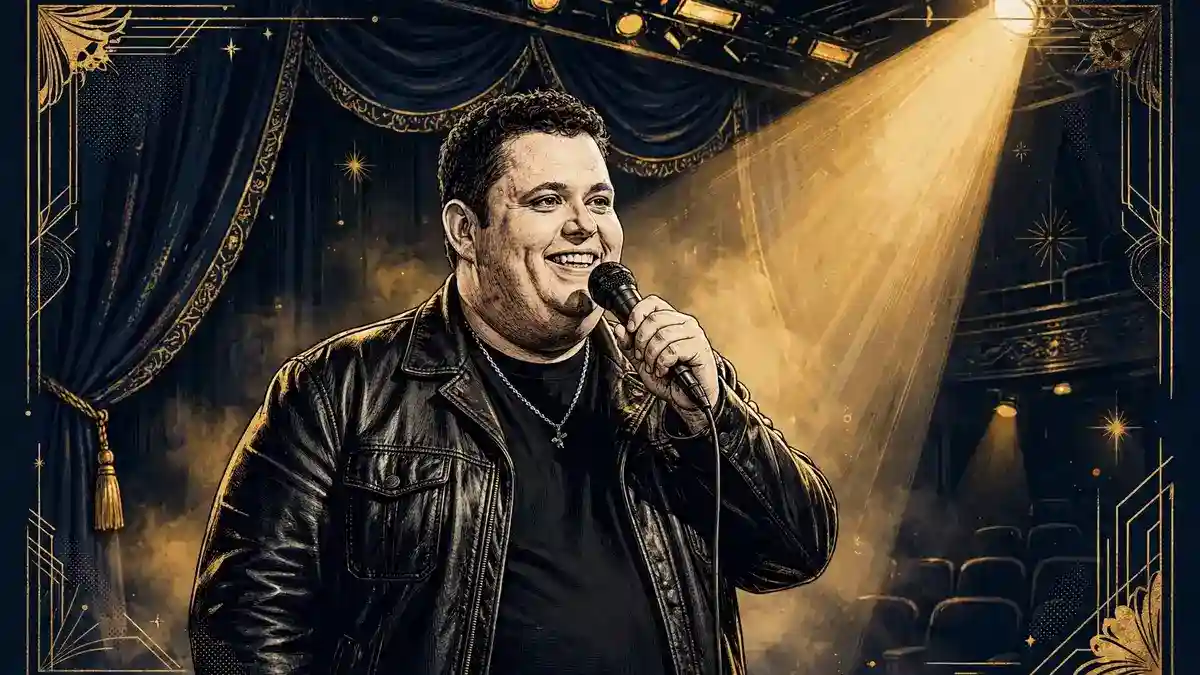
Ralphie May‘s net worth is estimated at $1.5 million to $2 million as of November 2026. The stand-up comedian, who finished second on the first season of NBC’s Last Comic Standing in 2003 and went on to record six comedy specials for Comedy Central and Netflix, died on October 6, 2017, at the age of 45 — and the fortune he left behind was far smaller than the inflated figures now circulating online. Celebrity Net Worth, the most widely cited source on his finances, puts his net worth at $2 million at the time of his death, while other outlets place it closer to $1.5 million. His money came the old-fashioned way for a road comic: hundreds of live shows a year, album and special sales, television appearances, and a Las Vegas residency that was still running in the final weeks of his life.
Ralphie May: Quick Facts
| Estimated net worth | $2 million at death (range: $1.5 million–$2 million) |
|---|---|
| Profession | Stand-up comedian, actor |
| Nationality | American |
| Born | February 17, 1972 (age 45 at death) |
| Height | 5 ft 9 in (175 cm) |
| Primary income sources | Stand-up touring, comedy specials and albums, television appearances, Las Vegas residency |
| Active years | 1989–2017 |
| Last reviewed | November 2026 |
- Early Life and Background
- Education
- Career Journey
- Rise to Fame
- Main Sources of Income
- Salary and Earnings
- Businesses and Investments
- Brand Deals and Sponsorships
- Houses, Cars and Other Assets
- Awards and Achievements
- Net Worth Growth Over the Years
- Social Media Presence
- Personal Life
- Sources & Reporting
- Frequently Asked Questions
Early Life and Background
Ralph Duren May was born on February 17, 1972, in Chattanooga, Tennessee, and raised in Clarksville, Arkansas, by a single mother. He was the youngest of five children, according to Wikipedia’s biography of the comedian; his official biography describes him as one of four children raised by his mother — one of several small discrepancies in the public record that follow a performer who was never the subject of a fully documented biography while he was alive. The Encyclopedia of Arkansas, the state’s reference work, lists his birth date as February 1, 1972, rather than February 17 — another detail on which sources disagree, and a reminder that even basic facts about May’s early life were not nailed down by the press until after his death.
What the record does agree on is that May wanted to be a comedian from childhood. The Encyclopedia of Arkansas reports that he decided on the career at age nine, after watching Johnny Carson host The Tonight Show and concluding — wrongly, as a child would — that Carson was bombing his jokes rather than delivering them deliberately. His early heroes were the comics his generation grew up on: Richard Pryor, Eddie Murphy, and Sam Kinison, whose confrontational, high-volume style shaped May’s own act more than any other single influence.
At 16, May was in a near-fatal car accident that left him in a coma and, by several accounts, broke dozens of bones. The accident became part of his stage material for the rest of his life — he joked about his weight, his health, and his body with a directness that audiences either loved or found uncomfortable, and the accident was the origin story he returned to whenever he explained how he ended up weighing hundreds of pounds as a teenager. His weight would define his act, his health, and ultimately his death, and he never pretended otherwise on stage.
At 17, May won a radio stand-up contest in Houston whose prize was opening for Sam Kinison, the idol he had grown up imitating. Kinison reportedly told the teenager it was the funniest thing he had ever seen, and when May turned 18, Kinison convinced him to move to Houston, where he fell in with a loose circle of comics that included Bill Hicks. The group was later nicknamed the “Houston comedy mafia,” and the move put May on the club circuit while he was still a teenager. It also meant he left school behind early: stand-up became his full-time work before he was old enough to drink legally, and he spent the next decade and a half grinding through clubs across the American South and Midwest.
His grandmother also looms large in the stories May told about his upbringing. His Facebook biography quoted him saying she taught him to crochet and quilt as a child, and that his act worked the same way — one-liners and dirty jokes stitched together with long stories that ran ten or twenty minutes, with laughs landing every eight seconds. It was a craftsman’s description of a job he treated as a trade, and it explains the sheer volume of his output: May was a working comic first and a television personality second, and his money followed that order.
Education
May graduated from the Kinder High School for the Performing and Visual Arts in Houston, Texas — the city’s magnet school for young performers, and the one formal credential in a biography that otherwise reads as an education in nightclubs. The school’s performing-arts training gave him stage discipline early, and Houston’s comedy scene gave him the rest: open mics, feature spots, and the Kinison connection that pulled him into professional work at 17.
He briefly attended the University of Arkansas in Fayetteville, according to the Encyclopedia of Arkansas, but the stay was short. The radio contest win and the move to Houston interrupted his studies, and he never went back. There is no record of a college degree, and none of his biographies claims one — a fact worth stating plainly, because several low-quality net-worth pages list formal credentials for May that do not exist. His education was the club circuit: by the time he was 20, he had logged more stage hours than most college graduates log in classrooms, and the touring schedule he kept for the rest of his life was built on that foundation.
The gap matters for understanding his money. May never had the kind of salaried television job — a sitcom deal, a late-night writing chair — that turns a comedian’s income into a steady, documented salary. His earnings were always tied to the road: ticket sales, merchandise tables, and the occasional special. That made his income lumpy and hard to track from the outside, which is one reason the published estimates of his net worth swing as widely as they do.
Career Journey
May’s professional career began in Houston’s clubs in the early 1990s, after the Kinison contest win. He worked the Southern circuit for most of the decade — feature spots, headlining weekends, and the kind of 300-show years that only road comics understand. By the late 1990s he had moved to Los Angeles, where the work shifted from clubs to television: in 2002 he worked as an actor, writer, and producer on ESPN’s Mohr Sports, starring Jay Mohr, and made his feature-film debut that same year in For da Love of Money, playing Otis. The film was a small independent comedy, not a payday, but it put him on screen and on a résumé.
The turning point came in 2003, when NBC chose May for the first season of Last Comic Standing. He finished second to Dat Phan, but the show did more for him than winning would have done for most contestants: his size, his Southern drawl, and his willingness to make his own body the punchline made him the season’s most memorable performer, and the exposure converted directly into touring demand. His official biography notes that after the show he was selling out multiple shows in venues of 1,500 to 3,000 seats — a jump from club weekends to theater runs that changed the economics of his career overnight. Variety named him one of its “10 Comics to Watch,” a trade-press stamp that promoters and bookers took seriously.
Television work followed the breakthrough. May appeared on The Wayne Brady Show and The Tonight Show with Jay Leno, and his official biography counts four appearances on CBS’s The Late Late Show with Craig Kilborn and eleven appearances on Jimmy Kimmel Live! — numbers that show how heavily late-night bookers leaned on him in the mid-2000s. He also appeared on Hollywood Squares, Celebrity Blackjack, and The Weakest Link, the game-show circuit that kept working comics visible between tours. In 2005 he was the only white comedian on The Big Black Comedy Show, alongside Mo’Nique and other Black comics — a booking that said something about how his act crossed over with audiences other comics could not reach, and one he cited as a point of pride.
The recorded specials came in a steady run. His first comedy album, Just Correct, was released in 2004 on the DreamWorks-associated label Melee as a CD/DVD; the Encyclopedia of Arkansas reports it later went platinum, the single biggest commercial credential of his recording career. The DVD included footage of May swimming in Saddam Hussein’s pool during a USO tour in Iraq — a detail that captures the strange reach of his touring life, which took him to military bases overseas as well as casinos and theaters at home. Four Comedy Central specials followed: Girth of a Nation in 2006, Prime Cut in 2007, Austin-tatious in 2008, and Too Big to Ignore in 2012. Two Netflix specials closed the run: Imperfectly Yours, filmed in 2013 and released in 2015, and Unruly in 2015, billed as his first Netflix original stand-up special.
Alongside the specials, May kept up the road schedule that had always paid his bills. His official biography describes a proven track record of selling out multiple shows in 1,500- to 3,000-seat venues, and contemporary profiles put his pace at more than 300 shows a year at his peak. That volume is the key to his finances: a theater comic doing 300 dates a year does not need a sitcom salary to build a seven-figure net worth, but the money arrives in small increments, after paying agents, managers, travel, and a touring crew — and it stops the moment the shows stop.
In 2013, May and his wife Lahna Turner started a podcast together, Perfect 10, which ran through the final years of his life and became the place where the couple announced their separation in 2015. The podcast never became a major income stream — podcasting in 2013 was a fraction of the business it is today — but it kept May connected to his audience between tours and gave him a platform that did not depend on a network. His memoir, This Might Get a Little Heavy, was published posthumously in December 2017, two months after his death, and a documentary about his final year, What’s Eating Ralphie May?, followed in 2019.
Rise to Fame
May’s rise was not a single breakout but a slow build that crested with Last Comic Standing. Before 2003 he was a respected road comic with a regional following; after the show, he was a national name with a touring business to match. The show’s format suited him: head-to-head stand-up rounds in front of a live audience, where his size and his voice made him impossible to ignore. He lost the final to Dat Phan, but the runner-up finish carried no stigma — several Last Comic Standing finalists, including May, went on to bigger careers than the winners, and May’s post-show touring numbers prove the point.
The Comedy Central specials cemented the fame. Girth of a Nation in 2006 was the first, and it arrived at the moment when Comedy Central specials were still the main way a stand-up reached a national audience — before streaming fragmented the market. Each special fed the next tour: the television exposure sold tickets, the ticket sales justified the next special, and the album sales added a revenue line that did not depend on being on the road. Just Correct going platinum showed the model worked; the four Comedy Central specials and two Netflix specials that followed showed it could be repeated for a decade.
What set May apart from other comics of his era was the honesty of the act. He talked about his weight, his health, his marriage, and his addictions on stage, in long stories rather than one-liners, and audiences trusted him because the material was plainly true. The trade-off was that his act was inseparable from his body — and his body was failing him for most of his career. The 2004 gastric bypass surgery, the Celebrity Fit Club appearance in 2005, the pneumonia that cost him 40 pounds in 2011: all of it was material, and all of it was also real. That candor built a loyal audience, but it also meant his brand had no second act if his health gave out. In the end, it did.
By 2017, May was in residence at Harrah’s casino in Las Vegas, a residency that gave him a steady home base after decades on the road. He had just won Casino Comedian of the Year at the Global Gaming Expo — an industry award, not a household name, but a sign that the casino business valued him enough to honor him in the final days of his life. He died in Las Vegas on October 6, 2017, hours after performing, with shows still on his calendar. The residency, the award, and the booked dates all point the same way: May was still working, still earning, and still in demand when he died.
Main Sources of Income
Touring was May’s largest income source by a wide margin. A comic playing 300 shows a year in theaters of 1,500 to 3,000 seats generates serious gross revenue even at modest ticket prices, and May’s official biography confirms both the volume and the venue size. The net figure is another matter: agents typically take 10 percent, managers another 10 to 15 percent, and travel, hotels, and a small touring crew eat further into the gross. No audited breakdown of May’s touring income exists, and we do not invent one. What the record supports is that touring — not television, not endorsements — was the engine of his wealth, and that it produced a comfortable but not extravagant living.
Recorded specials and albums were the second income stream. Just Correct went platinum, according to the Encyclopedia of Arkansas, which means it shipped more than a million units in the CD/DVD era — a genuine commercial success that would have paid May through advances and royalties for years. The four Comedy Central specials and two Netflix specials added further payments: Comedy Central paid comics for specials in the 2000s, Netflix paid for originals in the 2010s, and each release generated album and download sales on top. Streaming residuals in the Netflix era were smaller and less transparent than the old DVD economics, which is one reason May’s income likely peaked in the late 2000s rather than at the end of his life.
Television appearances added a third, smaller stream. Late-night spots, game shows, and the ESPN writing and producing work on Mohr Sports paid union scale or better, and the Big Black Comedy Show DVD added a credit with ongoing sales. None of these was a fortune on its own, but together they kept May visible between tours and gave him income in weeks when he was not on the road. His film work was thinner: For da Love of Money in 2002 was his feature debut, and he never landed a major film role after it — a gap that separates his career from comics like Kevin Hart and Adam Sandler, whose film salaries dwarfed their stand-up money. May’s money stayed on the stage.
Merchandise, the Perfect 10 podcast, and the posthumous memoir added smaller lines. Tour merchandise — CDs, DVDs, and shirts sold at the venue — is a high-margin business for a road comic, and May sold his albums at shows for years. The podcast, launched in 2013, predated the podcast advertising boom and likely earned modest sponsorship money at best. The memoir, published two months after his death, generates royalties for his estate, as do streaming plays of his specials — the income that continues after a performer’s death, and the reason his estate still has value nearly a decade later.

Salary and Earnings
No verified figure exists for what Ralphie May earned per show, per special, or per year. No salary was ever reported in the trade press, no contract leaked, and no court filing disclosed his touring income. Any article that prints a precise annual salary for May is guessing, and this one will not. What can be said honestly is this: a theater comic at his level in the 2000s and 2010s — selling out 1,500- to 3,000-seat venues, doing 300 dates a year — was grossing in the low seven figures annually at his peak, before the costs of touring and the cuts taken by agents and managers. The net figure that reached his bank account would have been substantially lower, and it varied year to year with his health and his schedule.
The specials are the one area where the money is partly documented. Just Correct‘s platinum certification is a matter of record, and platinum in the CD/DVD era meant real royalty income — though the exact split between May, his label Melee, and the distributors was never disclosed. Comedy Central specials in the 2000s typically paid established comics a flat fee plus backend participation, and Netflix’s 2015 deal for Unruly would have been a flat license fee rather than a royalty stream. None of the numbers were made public, so the honest accounting is to treat the specials as a meaningful but secondary income line behind touring.
The clearest evidence about May’s earning power comes from what happened when it stopped. His will, executed in 2010 and filed in Davidson County, Tennessee, left his entire estate to his wife Lahna Turner, and the estate was valued in reporting at around $2 million — the same figure Celebrity Net Worth publishes. That number is the net result of a 28-year career: gross earnings far higher, reduced by touring costs, taxes, a divorce that was never finalized, and the medical and personal costs of a life lived hard. It is a modest fortune by celebrity standards, and it is the most honest number in this article because it is the one tied to a legal document rather than a guess.
One claim deserves a direct correction. A wave of low-quality net-worth pages published since 2024 puts May’s net worth at $10 million to $15 million, with some claiming he earned $1 million to $2 million per Netflix special and owned a $2.5 million home in Los Angeles. None of that is sourced, and the pages themselves give the game away: several describe his “2023 tour” and his “growth trajectory” in the present tense, years after his death in 2017. A man who died in 2017 did not tour in 2023. Those figures are fabricated, and they are the reason this article anchors on the $1.5 million to $2 million range reported by outlets that were covering May while he was alive or at the time of his death.
Businesses and Investments
Ralphie May was not a businessman in the way modern celebrity wealth is usually built. He founded no company, launched no product line, took no equity in a startup, and left no record of stock or property investments. His business was himself: a touring act, a catalog of specials, and a name that sold tickets. That is worth stating because the net-worth pages that inflate his fortune to $10 million or more invariably invent a business portfolio to justify the number — property empires, commercial holdings, brand deals — for which no evidence exists anywhere in the credible record.
What he did own was his catalog. Six specials and an album, all recorded and released under deals with Melee, Jack Records, Comedy Central, and Netflix, generate ongoing royalties and streaming income for his estate. The memoir This Might Get a Little Heavy, published posthumously in December 2017, added a book royalty stream. The Perfect 10 podcast, co-hosted with Lahna Turner from 2013, was a small media property rather than a business, but it kept his name in front of his audience and generated whatever sponsorship revenue a mid-sized comedy podcast could command in the mid-2010s. None of these ventures made him rich. Together, they are the reason his estate continues to earn after his death — a slow royalty stream rather than a portfolio.
There is also no verified record of May owning significant real estate. His will left real estate to Lahna Turner — reporting on the will mentions a house in Tennessee among the assets — but no property records have been published showing a portfolio of homes, and the “$2.5 million Los Angeles home” claimed by the inflated net-worth pages appears nowhere in credible reporting. May lived in Nashville for much of his later life — his will was filed in Davidson County, Tennessee — and he died while in residence at Harrah’s in Las Vegas. The honest picture is a working comic who owned a home and a catalog, not a property investor.
The comparison with his peers is instructive. Comics like Dave Chappelle turned specials into nine-figure Netflix deals, and Kevin Hart built a production company and a film career on top of stand-up. May’s career stayed narrower: he was a road comic who recorded specials, and the specials fed the road. That narrower model produced a narrower fortune — $2 million rather than $200 million — and there is nothing wrong with saying so. It is the difference between a working entertainer and a media mogul, and May was firmly the former.
Brand Deals and Sponsorships
May had no major brand endorsement deals on record. He never fronted a national advertising campaign, held a product sponsorship, or lent his name to a consumer brand — the kind of deals that add millions to a modern celebrity’s net worth and that several inflated net-worth pages invent for him. His commercial relationships were with venues and casinos, not brands: the Harrah’s residency in Las Vegas, the Global Gaming Expo honor, and the theater promoters who booked his tours. Those relationships paid him as a performer, not as an endorser, and the money is already counted in his touring income.
The closest thing to a sponsorship in his career was the Celebrity Fit Club appearance on VH1 in 2005, a reality-show booking rather than a brand deal, and the USO tours that took him to Iraq — paid appearances for the military’s entertainment program, not commercial endorsements. The absence of brand money is itself informative: May’s audience was loyal but not the demographic advertisers paid a premium to reach in the 2000s, and his act — built on jokes about his weight, his marriage, and his appetites — did not lend itself to family-friendly product tie-ins. He made his money from people who bought tickets, not from companies that bought his image.
Houses, Cars and Other Assets
The assets Ralphie May left behind were modest and personal rather than a portfolio. His will, executed in 2010 and filed in Davidson County, Tennessee, left his entire estate to his wife Lahna Turner: real estate, comedy royalties, and personal property, including furniture, silver, paintings, automobiles, and clothing. The reporting on the will values the estate at around $2 million — the figure that anchors this article — but the will itself did not itemize values, and the exact contents of the estate were never made public. Turner was the sole beneficiary, and the will was uncontested.
The real estate in the estate included a house in Tennessee, according to reporting on the will. No address, purchase price, or current value has been published, and no other property has been credibly linked to May. He spent his final years based in Nashville — the Davidson County filing is consistent with a Tennessee residence — while working a residency in Las Vegas, where he died. The pattern is that of a performer who lived where the work was and kept one home, not a collector of properties.
His cars, furniture, and personal effects were the ordinary possessions of a working entertainer, and they passed to Turner along with the rest of the estate. There is no record of a luxury car collection, a watch collection, or any of the status assets that fill out the “assets” sections of most celebrity net-worth articles — and where other pages list them for May, they are inventing them. The one asset with lasting value was his catalog: six specials and an album that continue to stream, and a memoir that continues to sell. Royalties from that catalog are the estate’s ongoing income, and they are the reason his children still benefit from his work nearly a decade after his death.
One more correction belongs here. Several net-worth pages claim May owned multiple properties and a $2.5 million home in Los Angeles. No property record, interview, or credible report supports that claim, and May’s documented life — Nashville base, Las Vegas residency, will filed in Tennessee — points the other way. Readers should treat any list of May’s “properties” that includes a Los Angeles mansion as fabricated.
Awards and Achievements
May’s awards shelf was thin by the standards of the comedy establishment — he never won an Emmy or a Grammy — but the honors he did receive tracked his actual career: a road comic valued by the people who booked him. Variety named him one of its “10 Comics to Watch,” the trade paper’s annual list of rising stand-ups, and the citation stuck to his biography for the rest of his life because it was one of the few formal recognitions he ever received from the industry press.
The most concrete commercial achievement was the platinum certification of Just Correct, his 2004 debut album. Platinum in the CD/DVD era meant more than a million units shipped, and for a first album from a comic who had just come off a reality show, it was a genuine hit. The album’s success justified the four Comedy Central specials that followed and established May as a recording artist as well as a live act — a distinction that mattered when streaming later made live touring the only reliable income in comedy.
His final honor came in the last days of his life. In October 2017, days before his death, May won Casino Comedian of the Year at the Global Gaming Expo in Las Vegas, the casino industry’s trade show. It was an award from the people who booked his residency, and it arrived while he was still performing — a working comic being honored by his employers, rather than a lifetime-achievement award handed out after the fact. He died in Las Vegas on October 6, 2017, with the award fresh and shows still on his calendar.
The posthumous recognition has been quieter. The documentary What’s Eating Ralphie May?, released in 2019, examined the final year of his life and the weight and addiction struggles that defined it. His memoir, This Might Get a Little Heavy, published two months after his death, gave him the last word on a career he had spent three decades building. Neither made him rich; both kept his name in front of the audience that had loved him, and both continue to generate the royalties that support his family.
Net Worth Growth Over the Years
The table below is NetWorthCraft’s estimate, built from the career milestones in the public record and anchored on the $2 million estate figure reported at his death. No audited figures exist for any year of May’s life, and the numbers should be read as a shape — a slow rise through the 2000s, a peak around the Netflix specials, and a flat finish — rather than a ledger.
| Year | Estimated net worth | What drove it |
|---|---|---|
| 2003 | $250,000–$400,000 | Second place on Last Comic Standing; touring demand jumps |
| 2006 | $750,000–$1 million | Girth of a Nation; Just Correct goes platinum |
| 2008 | $1 million–$1.5 million | Third Comedy Central special; theater touring at full pace |
| 2012 | $1.5 million–$2 million | Too Big to Ignore; peak touring years |
| 2015 | $1.5 million–$2 million | Two Netflix specials; Perfect 10 podcast running |
| 2017 | $1.5 million–$2 million | Net worth at death; estate left to Lahna Turner |
The flat line from 2012 to 2017 is the honest shape of the story. May’s income peaked when his touring did, and by the mid-2010s his health was limiting how much he could work: shows cancelled in the final month of his life, pneumonia that had cost him 40 pounds in 2011, and a body that had been through gastric bypass surgery and years of strain. A comic’s net worth is a function of how many nights he can work, and May’s working nights were shrinking. The estate figure of $2 million is consistent with a career that earned far more in gross terms but spent heavily on the road, on taxes, and on living — and with a divorce filing in 2015 that, even though it was never finalized, would have divided assets had it gone through.
Compare that trajectory with the comics who shared his era. Chris Rock and Adam Sandler converted stand-up fame into film and television empires; Jim Carrey did the same a decade earlier. May’s path stayed on the stage, and the growth table shows what that choice cost in money and what it bought in independence: he never answered to a studio, but he also never collected a studio paycheck. The $2 million he left behind was earned one room at a time.
Social Media Presence
May was active on social media during his lifetime, and his accounts remain online as memorials rather than active channels. His Twitter/X account, @Ralphie_May, was where he promoted tour dates and argued with fans in the voice of his act; his Facebook page carried clips, tour posters, and the long-form posts in which he talked directly to his audience. Neither account has been updated by May since 2017, and the pages now function as archives of a working comic’s daily life on the road.
His YouTube presence is mostly unofficial: clips from his specials, television appearances, and interviews uploaded by fans and by the networks that own the footage. The specials themselves stream on Netflix and Comedy Central’s platforms, where they continue to find new viewers — the mechanism by which a dead comic keeps earning. Lahna Turner maintains her own YouTube channel, launched in 2007, where she has posted sketches, stand-up excerpts, and skits, and where some of May’s material survives alongside her own work.
Two things are worth noting about his social footprint. First, May died just before the era when comedians turned social media into a primary income stream — the TikTok and Instagram clip economy that made younger comics rich without touring did not exist for him, and his money was made the older way, in rooms. Second, the accounts are a target for the same misinformation that plagues his net-worth pages: fan pages and aggregator sites recycle the inflated $10 million to $15 million figures, and the numbers spread because they are copied from one page to the next without a source. The estate figure, tied to his will, is the one that survives scrutiny.
Personal Life
May married fellow comedian Lahna Turner on July 3, 2005. The couple had two children: daughter April June May, born September 5, 2007, and son August James May, born June 24, 2009. Turner, born in Ontario, Canada, in 1975 and raised in Houston, was a stand-up comic and actress in her own right, and the couple worked together — most visibly on the Perfect 10 podcast they launched in 2013 — as well as raising their children between tours.
In October 2015, after ten years of marriage, Turner filed for divorce, seeking joint custody of the children. The filing cited irreconcilable differences, and the separation that followed was difficult: Turner has spoken publicly about leaving to protect the children from May’s addiction, and the divorce proceedings turned bitter before they stalled. The divorce was never finalized. When May died in October 2017, he and Turner were still legally married — a fact that mattered enormously for the estate, because his 2010 will left everything to her, and as his widow she received the entire estate without a contest.
May struggled with obesity for his entire life. At his heaviest he weighed around 800 pounds, according to multiple reports, and in 2004 he underwent gastric bypass surgery, which brought his weight down to roughly 350 pounds. He appeared on VH1’s Celebrity Fit Club in 2005, losing 27 pounds on the show — one of the smallest totals in the program’s history, a fact the show’s coverage noted at the time. In October 2011, a bout of viral pneumonia contracted on a cruise cost him another 40 pounds, and his weight continued to fluctuate for the rest of his life. He regained much of what the surgery had taken off, and his health problems were a constant theme of his final years.
In 2016, May made the news for a different reason: at Spokane Airport in Washington, he performed the Heimlich maneuver on a choking child and was credited with saving the child’s life, a story picked up by local news and the airport’s own social media. It was a rare moment of May in the headlines for something other than his weight or his act, and it fits the picture of a man who was, by most accounts, generous and quick to help the people around him even as his own health failed.
His death came suddenly. On October 6, 2017, May went into cardiac arrest at a private residence in Las Vegas, where he had been in residence at Harrah’s casino. He was 45. The Clark County, Nevada, coroner’s office told TheWrap that he died of hypertensive cardiovascular disease. He had cancelled several shows in the final month of his life, and he had been battling pneumonia for weeks after contracting it on a cruise — the same pattern of respiratory illness that had cost him 40 pounds in 2011. A friend found him at the residence; he was survived by Turner, their two children, his mother, two sisters, a brother, a stepmother, and two stepsiblings. His memoir was published two months later, and the documentary about his final year followed in 2019.
Sources & Reporting
Celebrity Net Worth — the $2 million net-worth figure at death, the anchor for this article’s estimate; also the source for the October 6, 2017 death date and age 45.
Wikipedia — biographical spine: birth date and place, Clarksville upbringing, youngest of five children, the Sam Kinison contest at 17, Last Comic Standing second-place finish, marriage and divorce filing dates, children’s birth dates, gastric bypass surgery, and the coroner’s finding of hypertensive cardiovascular disease.
Ralphie May’s official website — career details from his own biography: the 1,500- to 3,000-seat sellouts, four appearances on The Late Late Show with Craig Kilborn, eleven on Jimmy Kimmel Live!, the Variety “10 Comics to Watch” citation, the Harrah’s residency, and the Casino Comedian of the Year award.
Encyclopedia of Arkansas — the February 1, 1972 birth-date variant, the University of Arkansas stay, the Just Correct platinum certification and its February 10, 2004 release date, the USO tour footage, and the Celebrity Fit Club 27-pound result.
TheWrap — the Clark County coroner’s cause of death, hypertensive cardiovascular disease, reported in the days after his death.
ABC News — reporting on the October 6, 2017 cardiac arrest in Las Vegas and the pneumonia that preceded it.
People — coverage of May’s death, his family, and the posthumous documentary and memoir.
Variety — the “10 Comics to Watch” recognition cited in May’s official biography.
Comedy Central — the four specials Girth of a Nation (2006), Prime Cut (2007), Austin-tatious (2008), and Too Big to Ignore (2012).
Netflix — Imperfectly Yours (2015) and Unruly (2015), the two Netflix specials.
Reporting window: sources published between 2003 and November 2026, with the financial estimates checked against reporting from the time of May’s death in October 2017 and the will and estate reporting that followed. Where sources disagree — the $1.5 million versus $2 million estimates, and the February 1 versus February 17 birth dates — this article publishes the disagreement rather than picking a winner. Figures of $10 million to $15 million appearing on net-worth aggregator pages since 2024 are unsourced, describe events after May’s death as though he were alive, and were excluded from this estimate.
Frequently Asked Questions
What was Ralphie May’s net worth when he died?
Ralphie May’s net worth was estimated at $2 million at the time of his death on October 6, 2017, according to Celebrity Net Worth. Other outlets put the figure closer to $1.5 million, so we publish a range of $1.5 million to $2 million. The estate he left behind — real estate, royalties, and personal property — went entirely to his wife, Lahna Turner, under a will he had executed in 2010.
How did Ralphie May die?
May died of cardiac arrest on October 6, 2017, at a private residence in Las Vegas, where he had been in residence at Harrah’s casino. He was 45. The Clark County, Nevada, coroner’s office told TheWrap that the cause was hypertensive cardiovascular disease. He had been battling pneumonia for several weeks and had cancelled a number of shows in the final month of his life.
Who inherited Ralphie May’s money?
His wife, Lahna Turner, inherited his entire estate. May’s will, executed in 2010 and filed in Davidson County, Tennessee, named Turner as the sole beneficiary, leaving her all of his assets — including real estate, comedy royalties, and personal property. The couple had filed for divorce in 2015, but the divorce was never finalized, so they were still legally married when he died, and the will was uncontested.
Who was Ralphie May’s wife?
May married comedian and actress Lahna Turner on July 3, 2005. Turner, born in Ontario, Canada, in 1975 and raised in Houston, was a stand-up comic in her own right, and the couple co-hosted the Perfect 10 podcast together from 2013. They had two children, April June May and August James May, before separating in 2015.
How old was Ralphie May when he died?
May was 45 years old when he died on October 6, 2017. He was born on February 17, 1972, in Chattanooga, Tennessee, and raised in Clarksville, Arkansas. He had been performing stand-up for 28 years, since winning a radio contest to open for Sam Kinison at age 17.
How tall was Ralphie May?
May was 5 feet 9 inches (175 cm) tall. His weight, rather than his height, was the physical fact that defined his act: at his heaviest he weighed around 800 pounds, and gastric bypass surgery in 2004 brought him down to roughly 350 pounds, though he regained much of the weight afterward.
How many comedy specials did Ralphie May make?
Six. He recorded four specials for Comedy Central — Girth of a Nation (2006), Prime Cut (2007), Austin-tatious (2008), and Too Big to Ignore (2012) — and two for Netflix, Imperfectly Yours and Unruly, both released in 2015. His first album, Just Correct, was released in 2004 and later went platinum.
What was Ralphie May famous for?
May was best known as the runner-up on the first season of NBC’s Last Comic Standing in 2003, and for a touring career that saw him play more than 300 shows a year in theaters of up to 3,000 seats. His act was built on long, honest stories about his weight, his Southern upbringing, his marriage, and his health — delivered in the high-energy style he learned from his idol, Sam Kinison.
Final Thoughts
Ralphie May’s net worth at death — $1.5 million to $2 million, anchored on Celebrity Net Worth’s $2 million figure and the estate his will left behind — tells the story of a working comic, not a celebrity mogul. He earned it one room at a time: 300 shows a year, six specials, a platinum album, and a Las Vegas residency that was still running when he died at 45. The money was real but modest, and the honest thing to say about it is that the road paid for a comfortable life and a family, not a fortune.
The inflated figures now circulating — $10 million, $15 million, a Los Angeles mansion, a 2023 tour for a man who died in 2017 — are a reminder to check the source before believing the number. May’s real legacy is not a dollar figure. It is the catalog he left his children, the audiences who still watch his specials, and the example of a comic who turned the hardest facts of his own life into material audiences trusted. That is worth more than any estimate, and it is the part of his story that no aggregator can fabricate.
Published on November 23, 2026. Last reviewed November 2026. Found an error? See our corrections policy.