
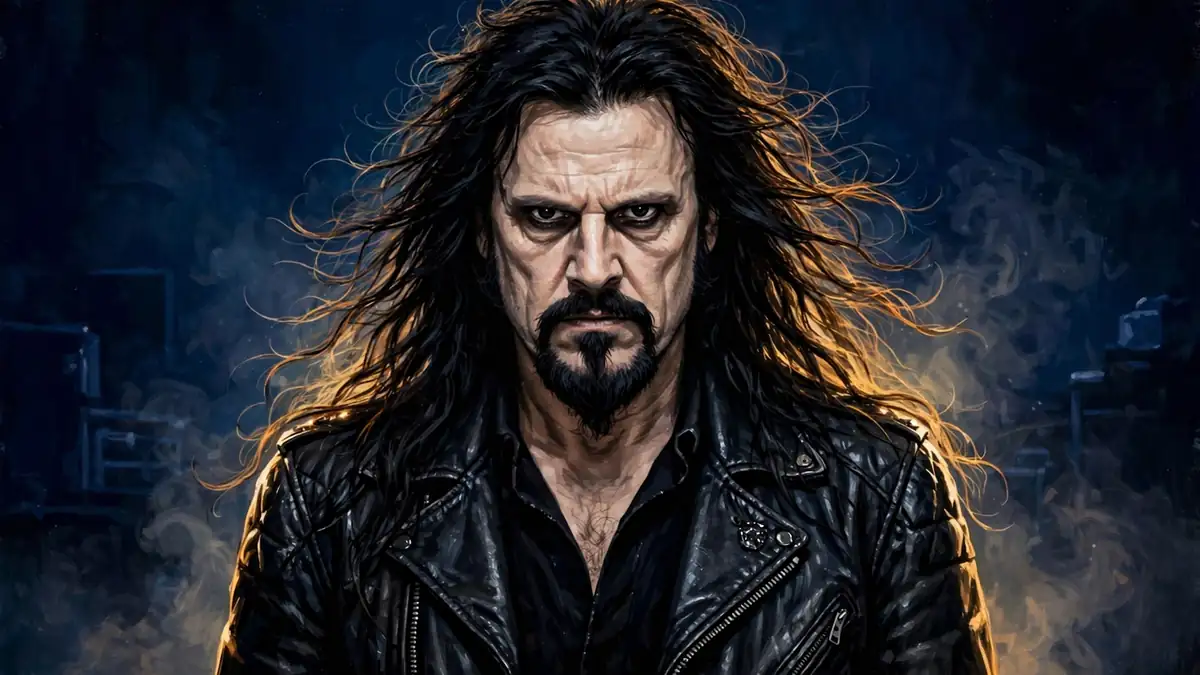
Rob Zombie‘s net worth is estimated at $45 million to $60 million as of November 2026. The figure sits on two careers that rarely share one person: a multi-platinum heavy metal catalog built with White Zombie and eight solo albums, and a horror filmography whose biggest hit, the 2007 remake of Halloween, grossed $80.4 million worldwide on a $15 million budget. Celebrity Net Worth, the most widely cited source on his wealth, puts the single-number estimate at $50 million, a figure it refreshed in May 2025 when Zombie and his wife listed their Hollywood Hills compound for $9 million. A new album, The Great Satan, arrived in February 2026, followed by a 21-date co-headlining tour with Marilyn Manson that closed in September 2026, so the estimate reflects an artist still earning at full pace at 61.
Rob Zombie: Quick Facts
| Estimated net worth | $50 million (range: $45 million to $60 million) |
|---|---|
| Profession | Musician, singer-songwriter, film director, screenwriter, producer |
| Nationality | American |
| Born | January 12, 1965 (age 61) |
| Height | 5 feet 10 inches (178 cm) |
| Primary income sources | Music royalties and catalog, touring, film directing and writing, merchandise and licensing, real estate |
| Active years | 1985–present |
| Last reviewed | November 2026 |
- Early Life and Background
- Education
- Career Journey
- Rise to Fame
- Main Sources of Income
- Salary and Earnings
- Businesses and Investments
- Brand Deals and Sponsorships
- Houses, Cars and Other Assets
- Awards and Achievements
- Net Worth Growth Over the Years
- Social Media Presence
- Personal Life
- Sources & Reporting
- Frequently Asked Questions
- Final Thoughts
Early Life and Background
Rob Zombie was born Robert Bartleh Cummings on January 12, 1965, in Haverhill, Massachusetts, a former mill town about 35 miles north of Boston. His parents worked in the carnival business, and the travelling-show world — the painted banners, the sideshow barkers, the grindhouse posters — stayed with him for life. It shows up in almost everything he has made since: the White Zombie stage show, the Firefly family films, the album covers he designs himself. His younger brother, Michael Cummings, took the same road into music as Spider One, frontman of the industrial rock band Powerman 5000, which scored its own late-1990s hits with “When Worlds Collide” and “Nobody’s Real.”
Haverhill in the 1970s was not a music-industry town, and Cummings has described his childhood as one spent absorbing horror films, comic books and B-movies on television. The band’s name came from the 1932 Bela Lugosi film White Zombie, a title he picked because it sounded like a band name already. That instinct — pulling a dusty piece of genre history into the present and making it loud — became the whole business model. By his late teens he had left Massachusetts for New York, where the rent was cheap in the parts of the city musicians could afford, and where a band could play seven nights a week if it could fill a room.
The early years were lean in the way early band years always are. White Zombie spent the second half of the 1980s as a noisy underground act on the New York club circuit, releasing records on the independent Caroline label and touring in vans. Nothing in that period paid like a career. The money story of Rob Zombie starts later, and it starts with a record label bet: Geffen Records signed the band in the early 1990s, and the 1992 album La Sexorcisto: Devil Music Vol. 1 turned a cult act into a platinum one. The catalog built in that decade — four White Zombie studio albums, then eight solo records — is still the foundation of the $50 million estimate, because catalogs pay for decades while tours pay for a summer.
Education
After high school in Haverhill, Cummings enrolled at Parsons School of Design in New York City, one of the country’s best-known art and design schools. He studied there in the mid-1980s and left before completing a degree, a decision that reads very differently in hindsight than it must have felt at the time. The design training did not go to waste: Zombie has art-directed his own album covers, stage sets, film posters and merchandise for forty years, and the visual side of his career is inseparable from the music.
While at Parsons and in the years just after, he worked in television production, including a stint as a production assistant on Pee-wee’s Playhouse, the children’s show whose handmade, slightly unhinged visual style was a clear influence on his later work. The job paid the rent while White Zombie rehearsed at night. It also taught him how a set is built, how a camera frames a gag, and how a small crew stretches a budget — lessons he carried straight into House of 1000 Corpses, a film he shot on a modest budget with a cast of horror veterans and friends.
There is no record of formal business or finance education, and none is needed to explain the career. Zombie’s education, in the practical sense, was Parsons plus the club circuit plus a television production floor. The design eye made the brand; the touring years taught him the economics of the road; the film work taught him how to turn a small budget into a large gross. Each of those skills shows up as a line item in the income sections below.
Career Journey
White Zombie formed in New York in 1985, with Cummings on vocals, Sean Yseult on bass, and a rotating cast around them that eventually settled with guitarist Jay Yuenger and drummer Ivan de Prume. The first two albums, Soul-Crusher (1987) and Make Them Die Slowly (1989), sold in the thousands, not the millions, and the band’s sound was still finding itself — part noise rock, part groove metal, part horror-movie sample collage. The Geffen deal changed the scale. La Sexorcisto arrived in March 1992, and its single “Thunder Kiss ’65” put the band on MTV and rock radio at the exact moment heavy music was crossing into the mainstream. The album went on to sell more than two million copies in the United States.
Astro-Creep: 2000 — Songs of Love, Destruction and Other Synthetic Delusions of the Electric Head followed in 1995 and did it again: more than two million copies in the United States, a top-ten debut on the Billboard 200, and “More Human than Human,” a Grammy-nominated single that became the band’s signature song. A remix album, Supersexy Swingin’ Sounds, arrived in 1996. Then, in 1998, White Zombie split. The break was not a collapse — the band was at its commercial peak — but Cummings had a solo record ready and a film career forming in his head, and the two did not fit inside one band’s schedule.
The solo debut, Hellbilly Deluxe: 13 Tales of Cadaverous Cavorting Inside the Spookshow International, landed in August 1998 and outsold the band that made it: it was certified triple platinum in the United States, debuted at number five on the Billboard 200, and gave Zombie “Dragula” and “Living Dead Girl,” two songs that still anchor his live set and his licensing income. Seven more solo studio albums followed over the next 28 years — The Sinister Urge (2001), Educated Horses (2006), Hellbilly Deluxe 2 (2010), Venomous Rat Regeneration Vendor (2013), The Electric Warlock Acid Witch Satanic Orgy Celebration Dispenser (2016), The Lunar Injection Kool Aid Eclipse Conspiracy (2021), and The Great Satan, released February 27, 2026, on Nuclear Blast. Across the White Zombie and solo catalogs, reported worldwide album sales stand at roughly 15 million, a figure Far Out Magazine repeats in its 2026 profile of the singer.
The film career ran in parallel from the start of the 2000s. Zombie wrote and directed House of 1000 Corpses (2003), a film Universal shelved for years before Lionsgate released it; it grossed about $16.8 million worldwide. The Devil’s Rejects (2005) did about $20 million worldwide and became the cult favorite of the two. Then came the studio job that changed his film economics: Dimension Films hired him to remake John Carpenter’s Halloween. The 2007 film cost $15 million and grossed $80.4 million worldwide, opening with $30.6 million over Labor Day weekend — a holiday record that stood for 14 years. Halloween II (2009) added $39.4 million. Later films — The Lords of Salem (2012), 31 (2016), 3 from Hell (2019) and The Munsters (2022) — were smaller, stranger and cheaper, made for the audience that had followed him since the beginning rather than for the opening-weekend chart.
Rise to Fame
Zombie’s rise happened twice, in two different industries, and the second rise is the one that explains the size of the fortune. The first came in 1992 and 1993, when “Thunder Kiss ’65” and “Black Sunshine” moved White Zombie from CBGB bills to arenas, including a slot on the 1990s festival circuit and tours with bands far bigger than they were. The second came in 1998, when Hellbilly Deluxe proved he did not need the band to sell records — and then again in 2007, when Halloween proved he did not need music at all to open a movie at number one.
What made the rise durable was that the two audiences overlapped almost perfectly. A White Zombie fan in 1995 was a horror fan by definition, and a horror fan in 2007 already owned the records. Zombie never had to build a second audience from scratch; he moved the same audience from the record store to the cinema and back to the arena. That is why the touring business still works for him in 2026: the Freaks on Parade tour, co-headlined with Marilyn Manson, ran 21 dates from August 20 to September 20, 2026, with The Hu and Orgy in support, and it sold the same double bill that had already toured with Mudvayne in 2022 and Alice Cooper in 2023 and 2024.
The fame also has a visual signature most musicians never develop. Zombie designs his own covers, directs his own videos — “Dragula,” “Living Dead Girl” and “Superbeast” all carry his horror-collage style — and art-directs his stage shows, which run on giant screens, B-movie clips and a band dressed like a travelling horror show. That control matters financially: when one person owns the visual identity, the merchandising, the videos and the film rights, fewer middlemen take a cut, and the brand stays consistent enough to license for thirty years.
Main Sources of Income
Zombie’s income comes from five streams, and the mix is what makes the estimate stable: no single stream has to carry the whole fortune, and three of the five pay whether he tours or not.
Music royalties and catalog. The White Zombie and solo catalogs — roughly 15 million albums sold worldwide, plus streaming — generate royalties every year. La Sexorcisto and Astro-Creep: 2000 each sold more than two million copies in the United States, and Hellbilly Deluxe was certified triple platinum. Catalog income is the quiet engine of this net worth: a song like “Dragula” earns from streams, radio, film and game licenses, and reissues long after the tour bus is parked. Zombie also writes his own material, which means publishing royalties sit beside recording royalties instead of flowing to a separate songwriter.
Touring and live performance. Touring is the biggest single-year earner and the most volatile. Zombie has toured almost every year of his career, often as a co-headliner, which splits production costs and doubles the draw. The 2026 Freaks on Parade run — 21 amphitheatre and arena dates in a month — is the current example, and the 2023 and 2024 runs with Alice Cooper used the same model. Festival headline slots, including a 2025 Boardwalk Rock appearance where he replaced Alice in Chains, pay festival fees on top of the tour routing. Gross ticket sales are not artist pay — promoters, venues, crew, transport and production take their shares first — so no honest article converts a tour gross into a personal salary, and this one does not.
Film directing, writing and producing. Zombie has written and directed eight feature films, and his directing fees, writing fees and backend participation on the successful ones form the second pillar. The economics are clearest on Halloween (2007): a $15 million budget, an $80.4 million worldwide gross, and a Labor Day opening record. A director in that position earns a fee plus, on a hit, a share of profits; on the smaller films the fees are smaller and the backend is thinner, which is why the catalog matters more than any single film. His films also earn for years after release through home video, streaming licenses and television rights, and the cult titles — House of 1000 Corpses, The Devil’s Rejects — have longer licensing tails than their opening weekends suggested.
Merchandise and licensing. The horror-metal visual brand licenses well: T-shirts, posters, vinyl reissues, collectibles, and song placements in films, games and commercials. “Dragula” alone has appeared in films and games for more than 25 years, and each placement pays a sync fee. Zombie’s control of his own artwork keeps the merchandise margin in-house instead of handing the design and the profit to a third party.
Real estate. Property is the most visible asset in the public record, and the numbers are real: a Los Angeles home bought for $1.8 million in 1999 and sold for $3.555 million in 2014, a Hollywood Hills purchase of $2.5 million in 2016, and a two-property compound listed at $9 million in May 2025. Property gains are not the same as net worth — a sale price is not profit, and a listing price is not a sale — but the pattern shows a habit of buying, holding and selling at a gain, and the Connecticut home the couple keeps gives the portfolio a second coast.
Salary and Earnings
There is no published salary for Rob Zombie, and any article that prints one is inventing it. Musicians of his type do not draw a salary; they earn in lumps — an album advance, a tour guarantee, a directing fee, a royalty statement — and the lumps vary wildly by year. What the public record does support is a picture of the earning power behind the $50 million estimate.
The record business paid first. In the 1990s, a platinum album on a major label typically earned the artist a royalty of roughly 12 to 15 percent of the retail price after recoupment of the advance and recording costs, which is why a two-million-selling album did not make anyone a millionaire overnight — and why four such albums, plus a triple-platinum solo debut, add up over time. Hellbilly Deluxe at triple platinum means three million units shipped in the United States, and the singles “Dragula” and “Living Dead Girl” still generate publishing and master income with every stream, radio spin and license.
The film business paid second, and it paid in a different shape. A director of Zombie’s standing on a $15 million studio horror film earns a directing fee in the high six figures to low seven figures, plus a writing fee where he holds the screenplay credit, plus backend points if the film profits. Halloween (2007) grossed $80.4 million worldwide — more than five times its budget — so the backend on that film was real money, though the exact participation was never disclosed. The sequel, Halloween II, grossed $39.4 million on a similar budget and would have paid a smaller backend. The smaller films — The Lords of Salem, 31, 3 from Hell, The Munsters — were made for far less and paid fees rather than fortunes, which is the trade Zombie has made repeatedly: creative control in exchange for a smaller cheque.
Touring pays third, and it pays in guarantees. A co-headlining amphitheatre act of Zombie’s size typically commands a five-figure guarantee per night before merchandise, with the best dates — festival headlines and the biggest sheds — paying more. Twenty-one dates in a month, as on the 2026 Freaks on Parade tour, is a strong month’s work, but the costs are heavy: a full band, a crew, trucks, staging and the horror-show production he insists on. The profit is real, and it is also the reason he can afford to take years off between albums.
One claim deserves a direct correction, because it circulates on low-quality sites: a handful of content-farm pages credit Forbes with a $100 million net worth for Zombie in 2025. No such Forbes profile or Forbes estimate exists, and the same pages contradict themselves within a few paragraphs, printing $35 million in one section and $100 million in another. The credible record is narrower and steadier: Celebrity Net Worth at $50 million, updated in May 2025, with other entertainment outlets publishing a $45 million to $60 million band for 2026. That is the range this article uses, and the $100 million figure should be treated as an error, not a competing estimate.
Businesses and Investments
Zombie has never built a consumer brand outside entertainment, and that restraint is part of the story. There is no tequila, no clothing line at scale, no restaurant chain. His business is the catalog, the films and the stage show, and his investments, as far as the public record shows, are concentrated in property and in his own productions.
His most concrete business vehicle is his work as a producer-director: he writes, directs and often produces his own films, which keeps the fees and the backend inside a small circle rather than spread across a studio slate. He also directed the animated film The Haunted World of El Superbeasto (2009), based on his own comic-book character, and has voiced characters in animation and games — a small but steady line of work that uses the same voice and persona as the records. His production work extends to music videos for other artists and to the stage design of his own tours, both of which are usually handled in-house.
On the investment side, the only documented positions are property. The Los Angeles purchase in 1999 at $1.8 million, sold in 2014 for $3.555 million, is a clean, documented gain of about $1.75 million before costs, taxes and improvements. The Hollywood Hills home bought in 2016 for $2.5 million, combined with a second parcel into the compound listed at $9 million in May 2025, is the larger position — and the listing, reported by Celebrity Net Worth in its May 2025 update, is the freshest property fact in the record. The couple also owns a 5,000-square-foot home in Woodbury, Connecticut, which functions as their quieter base away from Los Angeles. No stock portfolio, private-equity stake or startup investment has been reported for Zombie, and this article does not invent one.
That narrow focus is worth noting because it cuts both ways. A fortune built on a catalog and property is less exposed to a single bad year than a fortune built on endorsements or a startup, and it keeps earning while its owner is not working. It is also less diversified than the portfolios of musicians who moved into business early — compare Dave Grohl, whose Foo Fighters touring machine operates at a far larger scale, or Mick Jagger, whose Rolling Stones catalog and touring business sit in a different league entirely. Zombie’s fortune is a craftsman’s fortune: deep, durable and built from work he controls.
Brand Deals and Sponsorships
Endorsements are the smallest and least documented part of Zombie’s income, which is itself a useful fact. He has never been a pitchman in the way pop stars are, and his public partnerships have been narrow, genre-consistent and mostly reported secondhand rather than announced. Content-farm pages name Jack Daniel’s and Zippo as partners, but neither deal is documented in a press release or a trade report this article could verify, so they are not presented here as confirmed income.
What is documented is the licensing side of the brand: his songs in films, television and video games, his artwork on merchandise, and his name on horror-themed products and festival bills. The 2026 album The Great Satan arrived on Nuclear Blast, a metal label whose roster and distribution reach the exact audience Zombie has served since 1985 — a partnership that is a record deal, not a sponsorship, but one that carries the marketing and distribution weight a major label once provided. His tours are promoted by Live Nation, whose name appears on the 2026 Freaks on Parade announcement, and the tour’s sponsors and promoters handle the commercial side while Zombie handles the show.
The honest summary is that Zombie earns like a catalog artist and a film director, not like an influencer. There are no reported seven-figure endorsement contracts in his record, and the absence matters for the estimate: it means the $50 million figure rests on royalties, touring, film fees and property — income that can be checked against sales, grosses and deeds — rather than on a sponsorship portfolio that would be invisible to the public.
Houses, Cars and Other Assets
The property record is the most detailed part of Zombie’s asset picture, because deeds and listings are public. The Los Angeles home he bought in 1999 for $1.8 million and sold in 2014 for $3.555 million is the cleanest data point: a near-doubling over 15 years in a strong market. The Hollywood Hills purchase of $2.5 million in 2016 was the next step, and the two-property compound that grew around it was listed for a combined $9 million in May 2025, according to Celebrity Net Worth’s update of his profile that month. A listing is not a sale, and the $9 million figure is an asking price, not equity — the mortgages, taxes and costs behind it are private — but the listing itself is a fresh, verifiable marker of the portfolio’s scale.
The Woodbury, Connecticut home — a 5,000-square-foot house the couple has owned for years — is the other anchor. Connecticut gives them distance from Los Angeles and a base on the East Coast, where Zombie grew up. Together, the three properties describe a portfolio built the way his career was built: slowly, in places he actually lives, without the flipping and speculation that shows up in other celebrity property stories.
Cars are a thinner record. Zombie has been photographed with classic American muscle and custom vehicles, and his films and videos are full of them — the hearse imagery, the hot rods, the Firefly family cars — but no verified inventory of a car collection, with values, has been published. This article does not guess at one. The same restraint applies to art, instruments and memorabilia: Zombie is a known collector of horror posters, toys and B-movie artifacts, and his own artwork has value, but no appraisal or sale has been reported, so none is counted here.
The catalog is the asset that matters most and the one with no deed to cite. Fifteen million albums sold, eight solo records, four White Zombie records, a filmography of eight features and a publishing catalog he largely wrote himself: that is the portfolio, and it pays every quarter. A catalog of that age and size, with songs that still license, is the kind of asset that holds value even in a year with no tour and no film.
Awards and Achievements
Zombie’s trophy shelf is thinner than his sales figures, and that gap is part of his story: he has always been a commercial success first and a critics’ favorite second. White Zombie earned Grammy nominations for “Thunder Kiss ’65” and “More Human than Human,” and his solo work added further nominations in the metal and rock categories. He has never won a Grammy, a fact his competitors’ profiles sometimes skip and this one states plainly.
The achievements that matter more to the money story are the commercial ones. La Sexorcisto and Astro-Creep: 2000 are both multi-platinum in the United States. Hellbilly Deluxe is triple platinum. Halloween (2007) set a Labor Day weekend box-office record that stood for 14 years, until Shang-Chi and the Legend of the Ten Rings passed it in 2021, and it remains one of the highest-grossing films in the franchise. The Devil’s Rejects went from a modest opening to a cult classic with a long home-video life, the kind of film that earns for a decade after its theatrical run.
He has also been recognized inside the horror world he helped build: festival slots, retrospective screenings, and a permanent place in the conversation whenever a list of horror directors working in the 2000s is drawn up. His influence shows up in the careers of younger shock-rock and horror acts — including his 2026 tourmate Marilyn Manson, whose own career ran on a parallel track through the same decade — and in the way metal and horror are now marketed as one audience rather than two. The comparison with Ozzy Osbourne, the shock-rock originator whose fortune runs far larger, is the useful one: Zombie built a smaller version of the same model, and built it to last.
Net Worth Growth Over the Years
The growth table below uses published estimates, not a ledger. No one outside Zombie’s household has seen his accounts, so each year’s figure is the number entertainment outlets were publishing at the time, and the pattern — slow, steady growth, no sudden jump — is more informative than any single year.
| Year | Published estimate | What drove it |
|---|---|---|
| 2019 | About $40 million | Catalog royalties, touring, 3 from Hell in production |
| 2021 | About $45 million | The Lunar Injection Kool Aid Eclipse Conspiracy album and tour cycle |
| 2023 | About $50 million | Freaks on Parade tour with Alice Cooper; catalog and streaming growth |
| 2025 | $50 million | Celebrity Net Worth update; Hollywood Hills compound listed at $9 million in May |
| 2026 | $45 million to $60 million | The Great Satan album (February) and 21-date Freaks on Parade tour with Marilyn Manson |
Two things stand out. First, the estimate barely moved between 2023 and 2025, which fits a catalog artist in his late fifties: the income is steady, the spending is private, and the property market did the quiet work. Second, the 2026 range widens rather than narrows — $45 million to $60 million — because outlets disagree on how much a new album and a big tour add in a single year, and because the compound listing has not yet become a completed sale. The honest reading is that Zombie is worth about $50 million, that the number has grown slowly for a decade, and that the 2026 activity supports the top half of the range rather than proving it.
The peer table puts the figure in context. Ozzy Osbourne is reported at about $220 million, a fortune built over fifty years of Black Sabbath and solo work plus television. Alice Cooper, Zombie’s frequent tour partner, is reported at about $50 million — the same band as Zombie, built on the same shock-rock model over a longer career. Marilyn Manson is reported at about $25 million, a smaller figure that reflects a thinner catalog and a career interrupted by legal disputes. Dave Grohl, at a reported $330 million, shows what the same touring-and-catalog model looks like at arena-headliner scale. Zombie sits in the middle of that group: richer than the peers who lost momentum, poorer than the ones who never stopped headlining stadiums.
Social Media Presence
Zombie runs his public presence the way he runs his career: directly, visually, and without a management filter. His Instagram account, under his own name, is the main channel — a feed of tour photos, horror posters, behind-the-scenes film stills and new-release announcements, with millions of followers. His X account carries the same material in shorter form, and his Facebook page reaches the older part of the audience that bought the records in the 1990s. A YouTube channel hosts his music videos, including the 2026 clips for “Tarantula,” “Black Rat Coffin” and “Sir Lord Acid Wolfman,” the last of which premiered on Halloween 2026.
Social media is a marketing channel for Zombie, not a revenue line on its own. He does not sell sponsored posts, and his following converts into ticket sales and album pre-orders rather than into brand deals. The 2026 album rollout shows the pattern: singles announced on his own channels, videos premiered on YouTube, tour dates posted as graphics, and the Freaks on Parade routing shared directly with the audience that would buy the tickets. For an artist whose brand is visual, the feed is the poster wall — and it costs him nothing to keep it current.
Personal Life
Zombie married Sheri Moon on October 31, 2002 — Halloween, naturally — after a relationship that began in the early 1990s, when she appeared in his music videos and on White Zombie album artwork. Sheri Moon Zombie has since become a fixture of his films, playing Baby Firefly in House of 1000 Corpses, The Devil’s Rejects and 3 from Hell, and the title role’s wife in The Lords of Salem. The marriage is one of the longest and most stable in rock, and the couple have no children, a fact Zombie has discussed in interviews without making it a public issue.
The couple are vegans, and Zombie has spoken about animal rights in interviews over the years. They split their time between Los Angeles and Woodbury, Connecticut, where the pace is slower and the horror-movie collection has room to breathe. He is a dedicated collector of classic horror posters, comic books, toys and B-movie memorabilia, and much of that collection doubles as the raw material for his album art and stage design. He is also a comic-book creator in his own right, having written and drawn material that fed into The Haunted World of El Superbeasto.
Privacy is a deliberate choice. Unlike many musicians of his generation, Zombie does not discuss his finances, does not flaunt purchases, and does not give the kind of lifestyle interviews that would let an outlet itemize his spending. That privacy is the reason this article’s estimate is a range with a named anchor rather than a precise figure — and it is also the reason the range is honest.
Sources & Reporting
Celebrity Net Worth — the headline $50 million estimate, updated May 29, 2025; the Los Angeles property history ($1.8 million purchase in 1999, $3.555 million sale in 2014, $2.5 million Hollywood Hills purchase in 2016) and the $9 million compound listing in May 2025. Reporting window: profile published 2020, updated May 2025.
Box Office Mojo and The Numbers — box office figures for Halloween (2007): $80.4 million worldwide on a $15 million budget, $30.6 million Labor Day opening; Halloween II (2009): $39.4 million worldwide. Reporting window: theatrical runs 2007–2009, figures as listed in 2026.
Far Out Magazine — 2026 profile: age 61, height 5 feet 10 inches, roughly 15 million albums sold worldwide, and the February 2026 release of The Great Satan as his eighth solo album. Reporting window: 2026.
The Rock Revival — The Great Satan release date of February 27, 2026 on Nuclear Blast, and the 2026 Freaks on Parade tour announcement (21 dates, August 20 to September 20, 2026, with Marilyn Manson, The Hu and Orgy). Reporting window: October 2025 to January 2026.
Wikipedia — Freaks on Parade Tour dates and itinerary, filmography and discography dates, and the Halloween (2007) budget and gross. Reporting window: pages as updated in 2026.
JoBlo — Halloween (2007) production history, $80 million gross on a $15 million budget, and the 14-year Labor Day weekend record. Reporting window: 2021–2024.
Estimates from lower-quality outlets that publish a $100 million figure attributed to Forbes were checked and set aside: no Forbes profile or estimate for Zombie exists, and the same pages print contradictory figures within a single article. The $45 million to $60 million range used here comes from the outlets above and from entertainment-industry profiles published for 2026.
Frequently Asked Questions
What is Rob Zombie’s net worth in 2026?
Rob Zombie’s net worth is estimated at $45 million to $60 million in 2026, anchored on the widely cited $50 million figure published by Celebrity Net Worth and refreshed in May 2025. The estimate is not verified by any public filing, because his contracts, catalog ownership and property equity are private.
How did Rob Zombie make his money?
From two careers at once: a multi-platinum music catalog with White Zombie and eight solo albums (about 15 million albums sold worldwide), constant touring, and a film career as a writer-director whose 2007 remake of Halloween grossed $80.4 million on a $15 million budget. Merchandise, licensing and property gains add to the total.
How much did Rob Zombie’s Halloween make at the box office?
Halloween (2007) grossed $80.4 million worldwide against a $15 million production budget, opening with $30.6 million over Labor Day weekend — a holiday record that stood for 14 years. The sequel, Halloween II (2009), grossed $39.4 million. Box office gross is not the director’s pay; it is the film’s total ticket sales before distributors, theatres and financiers take their shares.
Is Rob Zombie still touring in 2026?
Yes. He co-headlined the Freaks on Parade tour with Marilyn Manson in 2026, playing 21 dates across North America from August 20 to September 20, with The Hu and Orgy as support. The tour promoted his eighth solo album, The Great Satan, released February 27, 2026.
Who is Rob Zombie’s wife?
Rob Zombie is married to Sheri Moon Zombie, an actress and model he married on October 31, 2002. She has appeared in his music videos and played Baby Firefly in House of 1000 Corpses, The Devil’s Rejects and 3 from Hell. The couple have no children.
What is Rob Zombie’s real name and how old is he?
His real name is Robert Bartleh Cummings. He was born on January 12, 1965, in Haverhill, Massachusetts, which makes him 61 years old in November 2026. He is 5 feet 10 inches tall.
How many albums has Rob Zombie sold?
About 15 million albums worldwide across White Zombie and his solo career, according to Far Out Magazine’s 2026 profile. La Sexorcisto and Astro-Creep: 2000 each sold more than two million copies in the United States, and his solo debut Hellbilly Deluxe was certified triple platinum.
Where does Rob Zombie live?
He splits his time between Los Angeles and Woodbury, Connecticut, where he and Sheri Moon Zombie own a 5,000-square-foot home. In May 2025 the couple listed their Hollywood Hills compound — two properties combined — for $9 million.
Final Thoughts
Rob Zombie’s $50 million estimate — inside a $45 million to $60 million range — is a catalog-and-camera fortune, built the slow way. Four White Zombie albums and eight solo records produced about 15 million sales and a stream of royalties that never stops; eight films produced one genuine box-office hit, Halloween at $80.4 million, and a shelf of cult titles that keep licensing; and a property habit of buying, holding and selling at a gain added the visible assets. The 2026 album The Great Satan and the 21-date Freaks on Parade tour show the machine still running at 61, which is the strongest reason to trust the top half of the range. What the number does not show is the discipline behind it: one visual identity, owned outright, carried across music, film and merchandise for forty years without a sell-out detour. That is a rarer achievement than the money, and it is why the money is likely to last.
Published on November 13, 2026. Last reviewed November 2026. Found an error? See our corrections policy.