
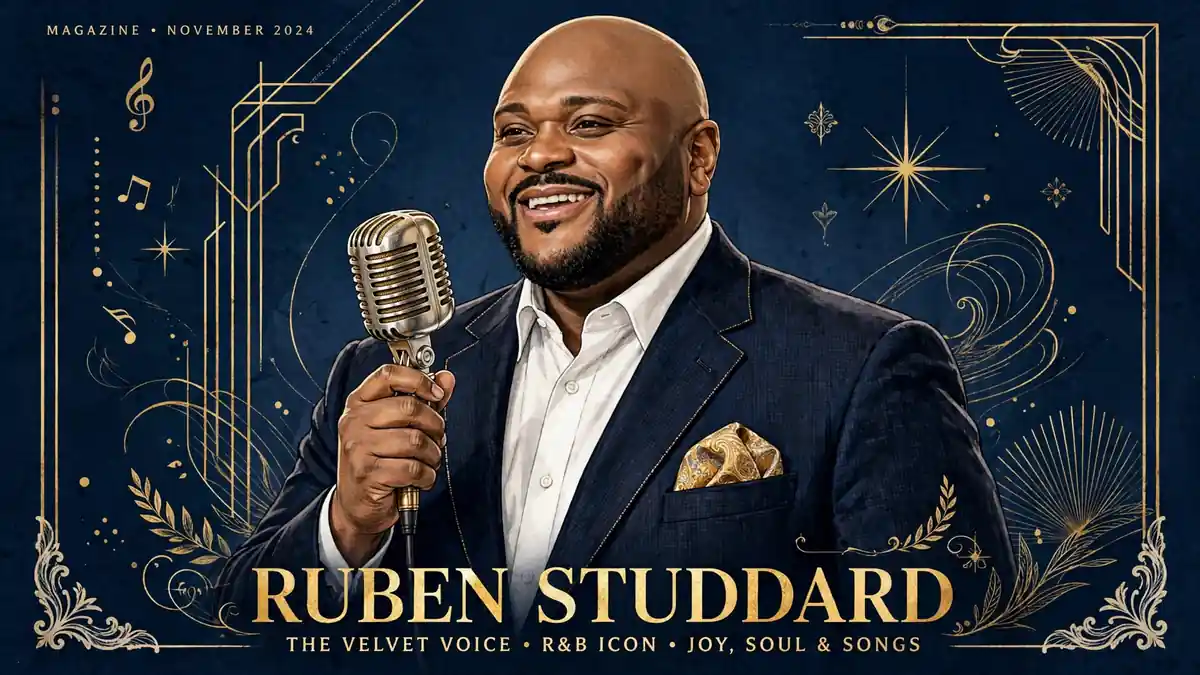
Ruben Studdard‘s net worth is estimated at $1.5 million to $3 million as of November 2026. The “Velvet Teddy Bear” won the second season of American Idol in 2003, turned a million advance orders for his debut album Soulful into a platinum career, survived a $200,000 tax lien in 2008, and rebuilt himself as a touring R&B singer, Broadway performer, and university music teacher. The best-sourced figure on the record is $1.5 million; the top of the range reflects broader web estimates that run to $3 million.
Ruben Studdard: Quick Facts
| Estimated net worth | $1.5 million – $3 million (range: $1.5 million – $3 million) |
|---|---|
| Profession | R&B, pop and gospel singer, actor, stage performer |
| Nationality | American |
| Born | September 12, 1978 (age 48) |
| Height | 6 feet 3 inches (1.91 m) |
| Primary income sources | Album sales and streaming royalties, touring, Broadway and stage work, television appearances, teaching |
| Active years | 2003–present |
| Last reviewed | November 2026 |
- Early Life and Background
- Education
- Career Journey
- Rise to Fame
- Main Sources of Income
- Salary and Earnings
- Businesses and Investments
- Brand Deals and Sponsorships
- Houses, Cars and Other Assets
- Awards and Achievements
- Net Worth Growth Over the Years
- Social Media Presence
- Personal Life
- Sources & Reporting
- Frequently Asked Questions
Early Life and Background
Christopher Theodore Ruben Studdard was born on September 12, 1978, in Frankfurt, West Germany, where his parents were stationed, and raised in Birmingham, Alabama. He was the youngest son of two teachers: his mother, Emily, taught in the Birmingham public school system, and his father, Kevin, taught auto body collision technology. Music filled the house from the start. His mother played Donny Hathaway records, and the family sang in church. Studdard sang in public for the first time at age three, at Birmingham’s Rising Star Baptist Church, and gospel stayed at the center of his voice for the rest of his career.
Birmingham shaped him in a second way. He grew up singing in church choirs and school ensembles, and by his teens he was a fixture of the city’s local music scene. The baritone that later won American Idol was trained the old-fashioned way: years of choir risers, church solos, and local gigs before any television camera found him. Friends and teachers from that period describe a quiet, laid-back teenager whose voice sounded far older than his years — the same calm confidence that later made him stand out on a loud reality show.
Before fame, Studdard worked ordinary jobs. He sang with Just a Few Cats, a Birmingham jazz and soul band, and picked up work where a working singer could find it. The path from church choir to national television ran through those small stages, and the money story of his life starts there too: a singer with no family fortune, no industry connections, and a degree in voice, betting everything on a televised audition he almost did not attend. He went to the American Idol audition in 2002 to accompany one of Just a Few Cats’ backup singers. He tried out himself, sang Stevie Wonder’s “Ribbon in the Sky,” and made the first round of cuts.
That detail matters to the net worth picture. Studdard did not arrive on Idol with a manager, a publishing deal, or a trust fund. He arrived as a working musician from Birmingham who had already spent years singing for modest pay. The fortune that followed — platinum sales, a Grammy nomination, two decades of touring — was built from a single televised break, and the size of the fortune reflects how narrow that break turned out to be. Unlike the show’s biggest earners, Studdard never had a second chart-topping era. His wealth is the wealth of a solid, durable mid-level music career: real money, honestly earned, and far smaller than the numbers some websites attach to his name.
Education
Studdard attended Huffman High School in Birmingham, where he stayed active in music throughout his school years. After graduation he enrolled at Alabama A&M University in Huntsville. He arrived on a football scholarship — a fact that surprises people who only know him as a singer — and then made the decision that set his life: he gave up football, switched his major, and studied voice. He graduated in 2000 with a bachelor’s degree in vocal studies.
The degree did more than train his voice. It gave him a fallback and a second income stream that surfaced twenty years later, when the University of Tennessee at Chattanooga hired him to teach master classes and music courses in 2022. Few Idol winners hold a music degree; fewer still return to a classroom. Studdard’s education is one reason his post-fame career looks different from the usual reality-show arc: when record sales slowed, he had stage work, teaching, and a foundation to fall back on.
His teachers remember a student who treated singing as a craft rather than a lottery ticket. That attitude shows in the career that followed. Studdard never chased trends, never tried to remake himself as a pop star, and never stopped working the rooms — churches, theaters, casinos, campuses — where a strong R&B voice still earns a living. The education section of his story is short because the schooling itself was straightforward. Its effect on his finances was not: a trained singer with a degree can teach, direct choirs, and lead master classes long after radio stops calling, and Studdard has used every one of those options.
Career Journey
Studdard’s professional career began in Birmingham’s clubs and churches with Just a Few Cats, the jazz and soul band where he sang before Idol. The band gave him stage hours and a local reputation, but no national profile. The 2002 American Idol audition changed that in a single season. Week after week, his renditions of “Superstar,” “A Whole New World,” and “Flying Without Wings” drew praise from music legends who appeared on the show, including Lionel Richie, Neil Sedaka, Robin Gibb, Luther Vandross, and Gladys Knight. Knight gave him the nickname that stuck for life: the “Velvet Teddy Bear.”
The finale in May 2003 came down to Studdard and Clay Aiken, and it ended in one of the closest votes in the show’s history: Studdard won by about 134,000 votes out of roughly 24 million cast. He became the second American Idol winner after Kelly Clarkson, and the show’s first male champion. Alabama governor Bob Riley declared March 11, 2003, Ruben Studdard Day in the state. The win carried a recording contract with J Records through 19 Entertainment, and the machinery moved fast. His debut single, a cover of Westlife’s “Flying Without Wings,” reached No. 2 on the Billboard Hot 100, and his debut album followed before the year ended.
Soulful arrived on December 9, 2003, and its numbers still anchor everything written about Studdard’s money. Advance orders topped one million copies before the record reached stores. It debuted at No. 1 on the Billboard 200, selling more than 400,000 copies in its first week — the second-highest first-week sales of any Idol winner at that point, and the highest ever by a debut male R&B act. The album was certified platinum by the RIAA and has sold about 1.8 million copies in the United States, according to Wikipedia’s discography data. Its second single, “Sorry 2004,” reached No. 9 on the Hot 100 and No. 1 on the R&B chart. For a debut artist, those are the numbers of a star. The problem, visible only in hindsight, is that Studdard never matched them again.
The gospel follow-up, I Need an Angel, came out on November 23, 2004. It sold more than 96,000 copies in its first week, entered the gospel chart at No. 1, opened at No. 20 on the Billboard 200, and went on to sell more than 500,000 copies, earning RIAA gold certification. The University of Tennessee at Chattanooga and the Chattanooga News Chronicle both describe it as the best-selling gospel album in the United States. The record proved Studdard could sell to the church audience that raised him, and it gave him a second lane when pop radio moved on.
The Return followed in 2006, with contributors including Ne-Yo and Scott Storch, and it sold far more modestly than the first two records. Love Is arrived in 2009 on Hickory Records, its songs shaped by his then-recent marriage. Letters from Birmingham came in 2012 on Shanachie, his first album for that label. In 2014 he signed to Verve Records and worked with the label’s chairman, David Foster, on Unconditional Love, released February 4, 2014 — the same night as The Biggest Loser finale that capped his weight-loss run. The album drew strong reviews as a return to form and sent him on tour with Lalah Hathaway.
In 2018 Studdard paid tribute to the singer he had been compared to since his Idol audition, releasing Ruben Sings Luther, an album of Luther Vandross covers, and launching his Always & Forever national tour. In 2023 he reunited with Clay Aiken for Twenty The Tour, a joint nationwide run marking twenty years since their Idol finale, and released his eighth studio album, The Way I Remember It. By the Encyclopedia of Alabama’s count he had released seven albums as of 2021; the 2023 record makes eight. The arc is steady rather than spectacular: a platinum peak, a gold gospel record, then two decades of touring, theater, and new music for a loyal audience.
Television kept him visible between records. He guest-starred on 8 Simple Rules, Eve, One on One, Life on a Stick, and All of Us, filmed a cameo for Scooby-Doo 2: Monsters Unleashed, and served as a judge on the gospel competition Sunday Best. He also appeared on Celebrity Fit Club before his longer reality run on The Biggest Loser. None of these roles paid like a hit record, but together they kept his name in circulation and his touring calendar full.
The stage became his most reliable second act. In 2008 he starred as Fats Waller in the 30th anniversary national tour revival of Ain’t Misbehavin’, and the cast recording earned a Grammy nomination for Best Musical Theater Album — a second Grammy-adjacent credit that most net worth pages about him never mention. He toured with Robin Givens in the play I Need a Hug. In December 2018 he and Clay Aiken opened Ruben & Clay’s First Annual Christmas Carol Family Fun Pageant Spectacular Reunion Show on Broadway at the Imperial Theatre, a limited holiday run that played on twenty years of audience affection for their rivalry-turned-friendship. Theater pays differently from pop: steadier nightly fees, longer runs, and a touring circuit that still books him today.
Rise to Fame
Studdard’s rise took about six months, from a local audition in 2002 to a national finale in May 2003, and it ran on a quality the show’s producers could not manufacture: calm. Where other contestants performed desperation, Studdard performed ease. Judges and guest mentors kept reaching for the same words — smooth, warm, effortless — and the audience rewarded him for it. Gladys Knight, one of the guest legends on the show, named him the “Velvet Teddy Bear,” and the nickname did more marketing work than any label campaign could have. It told audiences exactly what they were getting: a big, gentle soul singer.
The finale vote remains part of Idol lore. About 24 million votes were cast, and Studdard beat Simon Cowell‘s favorite, Clay Aiken, by roughly 134,000 — a margin of about half a percent. The closeness of the vote helped both men: Aiken’s debut album outsold Studdard’s at first, and the rivalry gave the two singers a shared story they have toured on twice, in 2018 and again on the 2023 Twenty The Tour. Studdard’s win also carried a symbolic weight. He was the show’s first male winner and its first Black winner, and his victory proved the Idol audience would crown a traditional R&B singer, not only a pop act.
The first year after the win was the richest of his life. Soulful sold a million copies before it hit shelves, and the American Idol tour, television appearances, and endorsement work stacked income on top of record royalties. But the same year carried the seed of the financial trouble that followed. In August 2008, the Internal Revenue Service and the Alabama Department of Revenue filed property liens against Studdard, claiming he owed nearly $200,000 in unpaid income taxes, mostly from 2003 — the very year the money flooded in. A young winner with a sudden seven-figure year and no seasoned tax planning is a familiar story in music, and Studdard lived it in public. The liens are a matter of record in Birmingham’s BhamWiki, and they explain part of why a platinum-selling winner’s net worth sits where it does today: the peak earnings were real, but so were the peak tax bills.
By July 2005 Studdard was the fourth-best-selling Idol performer, with more than 2 million albums sold in the United States. By June 2007 he ranked fifth, with more than 2.4 million albums sold. Those rankings measure a career that started at the top of the show’s sales chart and slid as newer winners arrived. Carrie Underwood, who won season 4, went on to sell tens of millions of albums and build a fortune an order of magnitude larger. Studdard’s fame never left him — he still tours on the Idol name — but his rise was a single steep climb followed by a long, level road.
Main Sources of Income
Record royalties form the base of Studdard’s income. Soulful alone sold about 1.8 million copies in the United States, and I Need an Angel passed 500,000. At standard royalty rates for a new artist on a major label in 2003 — typically a dollar or two per album after the label recouped recording, video, and promotion costs — the debut likely generated low-seven-figure royalty income spread across years, not a lump sum. Streaming added a smaller, steadier tail: his catalog earns from Spotify, Apple Music, and YouTube, where “Flying Without Wings” and “Sorry 2004” still draw plays from Idol nostalgia playlists. Songwriting royalties are a smaller line. Studdard is a singer first, and his biggest records were written by others, so publishing income plays a minor role in his totals.
Touring is the working heart of the career. Studdard has toured almost continuously since 2003: the Idol tour, solo R&B dates, gospel engagements, the Ruben Sings Luther tour, and the joint Clay Aiken runs in 2018 and 2023. Theater tours pay a nightly fee plus per diem, and a singer of his standing typically earns low-five figures per theater date before costs. Casino, festival, and church-concert bookings fill the gaps between formal tours. Nobody publishes his guarantees, and this article does not invent them, but the pattern is visible in the record: a performer who has stayed on the road for twenty-two years is earning his living from the road.
Television and stage work add a third stream. Guest roles on sitcoms, the Sunday Best judging seat, the Biggest Loser appearance fee, and the Broadway and touring theater runs each paid separately from music. The Ain’t Misbehavin’ tour ran for months, and Broadway’s Imperial Theatre run in 2018 paid Broadway-scale weekly salaries for a limited engagement. These are working-musician wages — comfortable, not extravagant — and they explain the shape of his wealth: accumulated slowly, year by year, rather than banked in one hit year.
Teaching is the newest stream. In 2022 the University of Tennessee at Chattanooga brought him in to lead master classes for performing arts majors, working with the UTC Singing Mocs, and he began teaching music business and performance courses in the fall semester. University teaching pays modestly next to a tour, but it pays steadily, carries prestige, and fits a singer in his late forties who still tours. It also signals how Studdard sees his own career: as a craft to pass on, not only a catalog to monetize.
His foundation, the Ruben Studdard Foundation for the Advancement of Children in the Music Arts, is a charitable vehicle rather than an income source, but it belongs in any honest account of his money. It runs music programs for children, and Studdard has promoted it through his concerts for years. Philanthropy on this scale costs time and money; it also keeps him connected to the Birmingham and Chattanooga communities that sustain his touring base.

Salary and Earnings
No public filing states Ruben Studdard’s annual salary, and any website that prints one as fact is guessing. What the record does support is a year-by-year shape, and it is worth laying out plainly because it corrects the inflated figures circulating on content-farm pages.
The peak year was 2003–2004. Soulful moved more than 400,000 copies in its first week and a million on advance orders, and the Idol tour, endorsements, and television work stacked on top. Gross income in that window likely ran into seven figures, before the label recouped its costs, before management and agent commissions of roughly 20–25 percent, and before taxes — the same taxes that produced the $200,000 lien in 2008. Net income from the peak was far smaller than the gross headlines suggested, and that gap is the single most important fact about his finances.
The middle years, 2005–2012, were steady working years. The Return and Love Is sold modestly, gospel dates and theater paid the bills, and the Ain’t Misbehavin’ tour ran through 2008–2009. Income in this period came in smaller, regular amounts rather than spikes. The 2011 divorce filing and 2012 divorce from Surata Zuri McCants added legal costs; a prenuptial agreement limited the financial settlement, according to reports at the time, which kept the divorce from becoming a second major wealth event.
The Biggest Loser years, 2013–2014, brought a reality-show fee, a surge of publicity, and the Unconditional Love album on Verve. Reality fees for a celebrity contestant on a network show are typically low-six figures, though NBC never disclosed the number and this article does not invent one. The publicity translated into touring dates, and the album’s strong reviews helped book them.
From 2015 to today, earnings have followed the touring-and-teaching pattern: theater runs, the 2018 Broadway Christmas show, the Ruben Sings Luther tour, the 2023 Twenty The Tour with Clay Aiken, new music in 2023, and the UTC teaching post from 2022. None of these pay like a platinum year. Together they support a comfortable life for a working singer with a family — and they explain why the credible net worth figure is $1.5 million to $3 million rather than the $8 million or $10 million printed by pages that pair his name with fabricated growth tables.
| Period | Main earnings driver | What the record shows |
|---|---|---|
| 2003–2004 | Soulful (platinum), Idol tour, TV | 1.8M US album sales; 400,000+ first week; peak earning years |
| 2004–2006 | I Need an Angel (gold), The Return | 500,000+ gospel album sales; best-selling gospel album in the US |
| 2008–2009 | Ain’t Misbehavin’ tour | Months of nightly theater fees; Grammy-nominated cast album |
| 2013–2014 | The Biggest Loser, Unconditional Love | Network reality fee; Verve album; tour bookings |
| 2018 | Ruben Sings Luther, Broadway Christmas show | National tour; limited Broadway run at the Imperial Theatre |
| 2022–present | UTC teaching, Twenty The Tour, new album | University courses; 2023 joint tour; The Way I Remember It |
Two claims about his money deserve direct correction. First, the $250,000 “recording contract” figure that floats around low-quality pages is not a salary and not a prize purse; the Idol win carried a record deal whose value depended on sales, and the real money came from the album, not the contract itself. Second, the monthly and yearly “salary” figures printed by some net worth sites — often $20,000 a month or $500,000 a year — have no source. Studdard’s income is lumpy by nature: tour years pay more than teaching years, and no single annual salary describes him.
Businesses and Investments
Studdard’s business record is thinner than his music record, and honesty requires saying so. He has no public company, no product line with reported revenue, and no startup portfolio. Low-quality net worth pages credit him with a clothing line called Ruben’s Closet, a production company called Soulful Symphony, and a real estate portfolio of rental and commercial properties. None of those claims traces to a named, checkable source in our research. The clothing line and production company appear only on content-farm pages that also print his net worth as $3 million, $4 million, and $5 million in different paragraphs. This article does not repeat them as fact.
What is documented is narrower and more credible. He founded the Ruben Studdard Foundation for the Advancement of Children in the Music Arts, a nonprofit that supports music education for children — a charitable commitment, not a business. He has worked as a university teacher since 2022, which is employment rather than investment. And he has kept his touring operation running for two decades, which is itself a small business: booking, band, travel, and merchandising managed year after year. A working singer’s touring company is not a venture-capital story, but it is the business that pays his bills, and Studdard has run his longer than most of his Idol classmates ran theirs.
Real estate is the one investment area where a concrete fact exists — and it cuts against the wealth narrative. In August 2008 the IRS and the Alabama Department of Revenue filed property liens against him for nearly $200,000 in unpaid income taxes, mostly from 2003. Property liens attach to real property, which tells us he owned property worth liening, and tells us the tax bill from his peak year caught up with him five years later. No public record in our research shows a portfolio of investment properties, a house flip, or a commercial holding. Readers should treat “real estate investor” descriptions of Studdard as unproven. The documented property story is a tax lien, not a portfolio.
The lesson for the net worth estimate is direct. A singer whose peak earnings arrived in a single year, whose later income came in steady touring increments, and who faced a six-figure tax lien in 2008 is unlikely to hold $8 million or $10 million in assets. The $1.5 million to $3 million range fits the documented facts: platinum and gold record sales with label recoupment, two decades of touring and theater fees, a teaching post, and no verified business windfall. If Studdard holds private investments, they are private; nothing in the public record supports the larger numbers.
Brand Deals and Sponsorships
Studdard’s endorsement record is modest, and the pages that list Pepsi and Burger King commercials for him recycle the claim without a date, a campaign name, or a source. He did appear in advertising around his Idol win, when every winner was offered commercial work, and his wholesome, family-friendly image suited mainstream brands. But no major long-term endorsement deal — no sneaker line, no beverage contract, no beauty partnership — is documented in reputable reporting, and his income has never depended on one.
That absence is itself informative. The Idol winners who built the largest fortunes paired music with durable brand work: Kelly Clarkson with talk-show and endorsement deals, Carrie Underwood with fitness and fashion lines. Studdard’s lane was different. He sold records, toured theaters, and sang gospel, and brands never became a pillar of his income. The Biggest Loser appearance in 2013 doubled as a brand moment — a weight-loss show is, in part, a health-brand platform — and it paid in publicity as much as in a fee. His later work with the University of Tennessee at Chattanooga is a reputational partnership of a different kind: a university lending its name to a singer, and a singer lending his name to a university.
For readers comparing him with other Idol alumni, the endorsement gap is the clearest explanation of the net worth gap. A platinum album pays once; a brand deal pays every year. Studdard earned the first and never landed the second at scale, and his fortune reflects that.

Houses, Cars and Other Assets
Public records offer little detail on Studdard’s homes and cars, and this article does not fill the gap with guesses. He has lived in Birmingham, Alabama, for most of his life, and his second marriage is based in Mobile, Alabama, where his wife Kristin works in real estate. The 2008 tax liens confirm he owned property in Alabama at that time. Beyond that, no verified property record, no reported home purchase price, and no car collection appears in reputable coverage. Pages that list his houses and cars with specific dollar values are inventing them.
What can be said with confidence is about scale. A net worth of $1.5 million to $3 million, built mostly from music royalties and touring fees, points to a comfortable home and reliable vehicles, not a property portfolio or a luxury garage. Studdard’s public life supports that reading: he is photographed at concerts, churches, and university events, not at car launches or real estate closings. His most valuable assets are almost certainly his music catalog — the royalties from Soulful and I Need an Angel — and his touring business, which is to say his voice and his name. Those are real assets, but they are hard to photograph, which is why they rarely appear on the pages that try to picture a celebrity’s wealth.
The divorce record adds one concrete asset detail. When his first marriage ended in 2012, reports at the time noted that a prenuptial agreement governed the split, and his former wife received personal belongings, a 2006 BMW, and a modest property settlement. The prenup matters to the net worth story: it kept a divorce from becoming a major division of assets, and it is one reason the fortune survived the marriage’s end intact.
Awards and Achievements
Studdard’s trophy shelf is short and distinguished. In December 2003 he earned a Grammy Award nomination for Best Male R&B Vocal Performance for his recording of “Superstar,” the Leon Russell and Bonnie Bramlett song he had performed on Idol. He lost the category to his idol, Luther Vandross — a defeat he has described with pride rather than disappointment, since sharing a nomination with Vandross was itself an honor. In March 2004 he won the NAACP Image Award for Outstanding New Artist.
His second Grammy-adjacent honor came from the stage. The cast recording of the 2008–2009 Ain’t Misbehavin’ tour, in which he starred as Fats Waller, was nominated for the Grammy Award for Best Musical Theater Album. It is a credit most short biographies omit, and it matters: it makes Studdard a two-time Grammy-nominated artist across two different disciplines, recording and theater.
The achievements that carry no trophy are just as real. Winning American Idol season 2 against 24 million votes. A debut album that entered the Billboard 200 at No. 1 with more than 400,000 first-week sales. A gospel album that became the best-selling gospel record in the country. A Broadway run at the Imperial Theatre. A teaching post at a public university. And a weight-loss story — 119 pounds shed after The Biggest Loser — that turned a health struggle into public inspiration. None of those comes with a check, but together they explain why promoters still book him twenty-three years after his win.
| Year | Honor | Detail |
|---|---|---|
| 2003 | American Idol winner, season 2 | Beat Clay Aiken by ~134,000 votes of ~24M cast |
| 2003 | Grammy nomination, Best Male R&B Vocal Performance | For “Superstar”; lost to Luther Vandross |
| 2003 | Ruben Studdard Day, Alabama | Declared March 11, 2003 by Governor Bob Riley |
| 2004 | NAACP Image Award, Outstanding New Artist | Won March 2004 |
| 2003 | RIAA Platinum, Soulful | ~1.8M US sales; No. 1 Billboard 200 debut |
| 2004 | RIAA Gold, I Need an Angel | 500,000+ copies; No. 1 gospel chart |
| 2009 | Grammy nomination, Best Musical Theater Album | Ain’t Misbehavin’ cast album |
| 2018 | Broadway debut, Imperial Theatre | Ruben & Clay’s Christmas Show |
Net Worth Growth Over the Years
Year-by-year net worth tables for Studdard circulate widely, and most of them are fiction — smooth upward lines from $1 million to $10 million with no source for any single year. The honest version is shorter, flatter, and more interesting: a fast rise, a tax-driven setback, and a long plateau.
In 2003 his net worth jumped from near zero to its peak trajectory on the strength of Soulful. But gross earnings are not net worth, and the 2008 tax liens show how much of the peak year was still owed five years later. Through the late 2000s his wealth likely dipped or stalled as touring income covered living costs and the tax bill. The 2010s added steady increments from theater, television, and touring, and the 2020s added teaching income and the reunion tours. The credible sources agree on the destination — $1.5 million, with broader estimates to $3 million — and they disagree only about how fast he got there. This article prints the range and the reasoning, not a fabricated annual ledger.
| Year | Estimated net worth | What drove it |
|---|---|---|
| 2003 | Under $1 million | Idol win; Soulful platinum; gross high, net reduced by label recoupment and taxes |
| 2005 | $1 million – $1.5 million | Two albums selling; 2M+ US albums sold; touring |
| 2008 | Setback year | ~$200,000 tax liens filed; touring and theater income |
| 2014 | $1.5 million | Unconditional Love; Biggest Loser publicity; Verve deal |
| 2018 | $1.5 million – $2 million | Ruben Sings Luther; Broadway Christmas run |
| 2023 | $1.5 million – $3 million | Twenty The Tour; eighth album; UTC teaching |
| 2026 | $1.5 million – $3 million | Celebrity Net Worth $1.5M; broader estimates to $3M |
How does he compare with his Idol peers? The gap is wide, and it is instructive. Kelly Clarkson, the season 1 winner, is reported at about $45 million by Celebrity Net Worth, built on music, a daytime talk show, and endorsements. Carrie Underwood, the season 4 winner, is reported near $140 million on music, touring, and brand lines. Clay Aiken, the man Studdard beat in 2003, is reported around $4 million — the closest peer to Studdard’s range, and a reminder that the finale vote decided fame, not fortune. Peabo Bryson, a fellow R&B balladeer a generation older, sits near $2.5 million in our own site’s estimate, a similar profile of durable touring income without a brand empire. Studdard’s place in that table is the middle of the Idol pack: far from the show’s richest winners, comfortably ahead of its one-season wonders.
Social Media Presence
Studdard keeps a working musician’s social media presence rather than an influencer’s. His Instagram account, under his own name, carries tour announcements, rehearsal clips, gospel performances, family moments, and tributes to Luther Vandross and Donny Hathaway — the singers who shaped him. His X and Facebook accounts serve the same purpose: dates, tickets, and gratitude to audiences. He is not a daily poster, and he does not monetize his accounts with sponsored content at any visible scale.
That restraint costs him money in the narrow sense — an influencer with his name recognition could charge for posts — and it fits the rest of his career. Studdard has always sold the voice, not the lifestyle. His most-shared moments online are performances: a “Superstar” clip from Idol, a gospel number from a church concert, a duet with Clay Aiken from the reunion tour. The audience that follows him is the audience that buys tickets, and the accounts function as a tour bulletin rather than a brand channel.
Personal Life
Studdard married Surata Zuri McCants on June 28, 2008, at Canterbury United Methodist Church in Mountain Brook, Alabama. The marriage ended when he filed for divorce in November 2011; the divorce was finalized in 2012. A prenuptial agreement governed the settlement, and reports at the time described a modest division, with his former wife receiving personal belongings, a vehicle, and a small property settlement. The couple had no children together.
In 2018 he married Kristin Moore-Studdard, a real estate agent from Mobile, Alabama. The couple keeps their relationship largely private, and they have two children: a son, Olivier, born June 10, 2020, named for Studdard’s late brother’s middle name, and a daughter, Henri, born March 21, 2024, whose arrival People magazine confirmed. Studdard has spoken about fatherhood as the center of his life now, and his touring schedule is built around it.
His weight has been public since The Biggest Loser. He entered the show’s fifteenth season in 2013 at 462 pounds — the heaviest starting weight and highest body mass index of the cast — and the show’s finale in February 2014 revealed he had lost 119 pounds in total, finishing at 343 pounds. He was the show’s first celebrity contestant, and his run drew attention to the health risks he had carried since his Idol years. He has kept much of the loss off and speaks about health as an ongoing project rather than a finished story.
Faith and family anchor the private picture. He still sings gospel, still credits the Birmingham church where he first sang at age three, and still works with the foundation he created for children in music. The personal life section of a net worth article usually exists to answer search queries, and the answers here are simple: married twice, divorced once, two young children, a health journey conducted in public, and a home life in Alabama far from the celebrity centers where his fortune was made.
Sources & Reporting
Every figure in this article traces to a named outlet. Celebrity Net Worth puts Studdard’s net worth at $1.5 million, updating its page on November 20, 2026 — the freshest figure on the record. ComingSoon agrees at $1.5 million for 2025, and Brit.co lists the same $1.5 million in its ranking of former Idol contestants. USA Magazine publishes a $1.5 million to $2 million range, and TheCityCeleb publishes $1.5 million to $3 million. The $4 million to $10 million figures on content-farm pages carry no sourcing and were not used.
Career facts come from the Encyclopedia of Alabama (Grammy nomination, platinum and gold certifications, Biggest Loser weight loss of 119 pounds, Broadway run), Wikipedia (Soulful sales of 1.8 million, chart positions, discography, UTC teaching), and AllMusic (biography, eight studio albums, Verve signing, 2023 album). The Chattanooga News Chronicle and the University of Tennessee at Chattanooga’s own news archive covered the 2022 teaching appointment in detail. BhamWiki documents the 2008 tax liens and the 2011 divorce filing. People confirmed the birth of his daughter Henri in March 2024. Reporting window: November 2026, with source material ranging from 2003 to 2026. Where sources disagree — most visibly on the net worth figure itself — this article prints the range and names who says what.
Frequently Asked Questions
What is Ruben Studdard’s net worth in 2026?
Ruben Studdard’s net worth is estimated at $1.5 million to $3 million as of November 2026. Celebrity Net Worth, which updated its page on November 20, 2026, puts the figure at $1.5 million, and ComingSoon and Brit.co agree. Broader web estimates run to $3 million. Higher figures of $4 million to $10 million appear only on unsourced content-farm pages and are not supported by the record.
How did Ruben Studdard make his money?
Mostly from music and touring. His debut album Soulful sold about 1.8 million copies in the United States and went platinum, and his gospel follow-up I Need an Angel sold more than 500,000 copies and went gold. Since then he has earned a living from touring, Broadway and theater work — including Ain’t Misbehavin’ and a 2018 Broadway Christmas show — television appearances, and since 2022, teaching music at the University of Tennessee at Chattanooga.
Did Ruben Studdard win American Idol?
Yes. Studdard won the second season of American Idol in May 2003, beating runner-up Clay Aiken by about 134,000 votes out of roughly 24 million cast. He was the show’s second winner after Kelly Clarkson and its first male winner. R&B legend Gladys Knight gave him the nickname “Velvet Teddy Bear” during the season.
How much did Ruben Studdard’s debut album Soulful sell?
Soulful sold about 1.8 million copies in the United States and was certified platinum by the RIAA. Advance orders topped one million copies before the album reached stores on December 9, 2003. It debuted at No. 1 on the Billboard 200, selling more than 400,000 copies in its first week, and its single “Sorry 2004” reached No. 9 on the Hot 100.
How much weight did Ruben Studdard lose on The Biggest Loser?
Studdard lost 119 pounds in total. He entered the fifteenth season of The Biggest Loser in 2013 at 462 pounds — the heaviest starting weight of the cast — and finished at 343 pounds at the finale in February 2014. He was the show’s first celebrity contestant.
Is Ruben Studdard married?
Yes. He has been married to Kristin Moore-Studdard, a real estate agent from Mobile, Alabama, since 2018. He was previously married to Surata Zuri McCants from 2008 to 2012; he filed for divorce in November 2011 and the divorce was finalized in 2012, with a prenuptial agreement governing the settlement.
Does Ruben Studdard have children?
Yes, two children with his wife Kristin: a son, Olivier, born June 10, 2020, named for Studdard’s late brother’s middle name, and a daughter, Henri, born March 21, 2024.
What is Ruben Studdard doing now?
He still tours as an R&B and gospel singer, including the 2023 Twenty The Tour reunion with Clay Aiken marking twenty years since their Idol finale. He released his eighth studio album, The Way I Remember It, in 2023, and he teaches music business and performance courses at the University of Tennessee at Chattanooga, where he began leading master classes in 2022.
Final Thoughts
Ruben Studdard’s fortune is the honest size of a durable music career: $1.5 million to $3 million, built on a platinum debut, a gold gospel record, twenty-two years of touring and theater, and now a university classroom. The number is smaller than the $8 million and $10 million figures that content farms attach to his name, and the gap between those numbers is the story. A single huge year in 2003, taxed hard enough to draw a $200,000 lien in 2008, never became a brand empire, because Studdard never built one. He built a working singer’s life instead — steady dates, loyal audiences, gospel roots, and a teaching post that keeps the craft moving to the next generation. That is a smaller fortune than the show’s biggest winners hold, and a more durable one than most reality-show careers ever produce.
Published on November 22, 2026. Last reviewed November 2026. Found an error? See our corrections policy.