
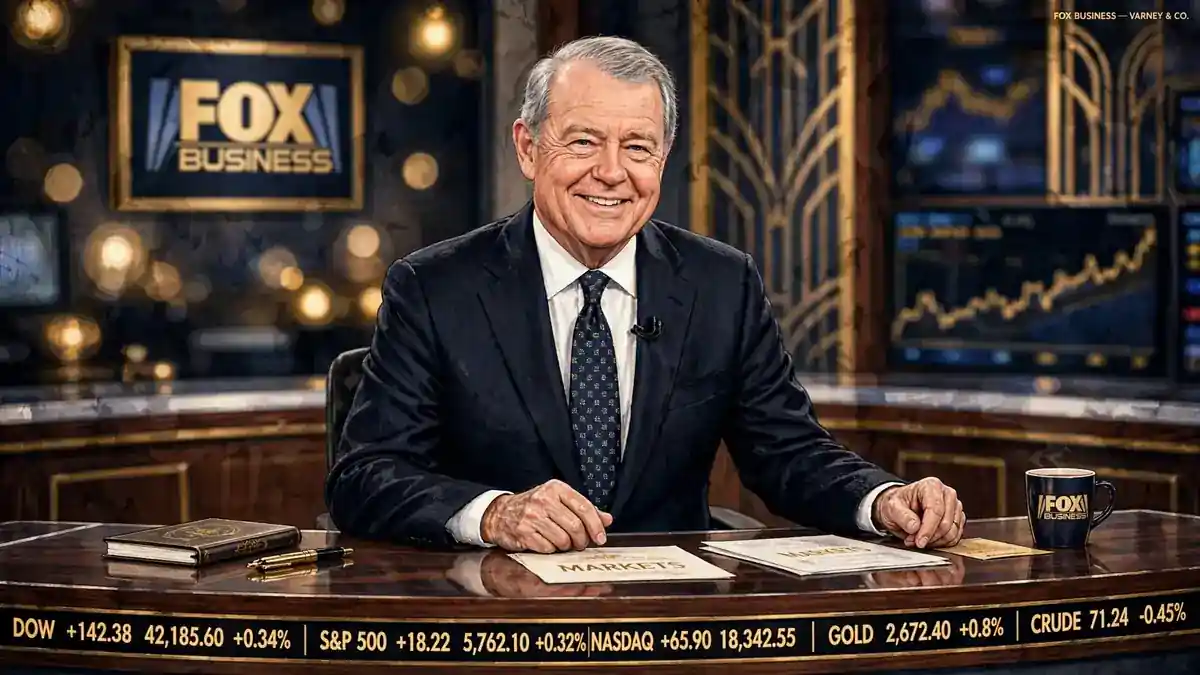
Stuart Varney‘s net worth is estimated at $10 million to $15 million as of November 2026. The British-American host of Varney & Co. on the Fox Business Network has spent more than four decades on American television — from helping launch CNN’s business coverage in 1980 to anchoring Fox Business since the network’s first day in 2007 — and Celebrity Net Worth, in its October 2026 update, puts his fortune at $14 million on a reported Fox salary of $4 million a year. A 1,000-acre hardwood tree farm in upstate New York, bought as a weekend retreat and run ever since as a working timber business, sits behind the salary as his most unusual asset.
Stuart Varney: Quick Facts
| Estimated net worth | $14 million (range: $10 million to $15 million) |
|---|---|
| Profession | Television host, business journalist, political commentator |
| Nationality | British-American (became a U.S. citizen in November 2015) |
| Born | July 7, 1948 (age 78) |
| Height | Not publicly disclosed |
| Primary income sources | Fox Business anchor salary, Fox News contributor work, Fox Nation hosting, timber revenue from his New York tree farm |
| Active years | 1970s–present |
| Last reviewed | November 2026 |
- Early Life and Background
- Education
- Career Journey
- Rise to Fame
- Main Sources of Income
- Salary and Earnings
- Businesses and Investments
- Brand Deals and Sponsorships
- Houses, Cars and Other Assets
- Awards and Achievements
- Net Worth Growth Over the Years
- Social Media Presence
- Personal Life
- Sources & Reporting
- Frequently Asked Questions
Early Life and Background
Stuart A. Varney was born on July 7, 1948, in Derby, Derbyshire, England. His father was a farmer and his mother taught at a local secondary school, a working background that later shaped both his on-air persona — the plain-spoken Englishman explaining American markets — and his private passion, a farm of his own. After secondary school he spent a year in Nairobi, Kenya, working for Voluntary Service Overseas, the British volunteer programme, before taking his degree in London. He then spent several years travelling the world, a wandering stretch that ended, almost by accident, in Hong Kong and in journalism.
The Hong Kong story is one Varney has told himself, and it is the best-known anecdote of his early life. He was working as the assistant manager of a bar when a fight broke out between American and British marines. Varney’s attempt to stop it went badly. Watching from the room were two Reuters correspondents, who introduced him to the man running Radio Hong Kong. He took a reporter’s test, passed it, and became a street reporter. He also picked up a short stint as a voice actor for a dubbing firm run by a fellow Radio Hong Kong broadcaster, Matthew Oram. Before all of that, he had worked as a bus conductor in England — the origin of his nickname “Reg,” borrowed from the comedian Reg Varney, who starred in a television show about bus conductors.
None of this resembled a conventional path into American network television. Varney arrived in the United States in 1975 with a British accent, an economics degree, and radio experience from Asia. American television at the time was not an obvious fit for any of those things. San Francisco gave him his first opening: a business anchor job at KEMO-TV, now KOFY-TV, where his economics training finally had a direct use. Five years later, a start-up cable network came calling, and Varney’s career changed for good.
Education
Varney studied economics at the London School of Economics, one of the world’s leading institutions for economics and political science, and graduated from there before his years of travel. The degree matters to the net worth story in a concrete way: it is the reason a radio reporter from Hong Kong could move into financial broadcasting at all, and it is the credential that has underpinned his authority on air for 45 years. Where many cable hosts lean on politics or personality, Varney’s pitch has always been that he understands the numbers — inflation data, Federal Reserve decisions, earnings reports — because he studied them.
His schooling also explains the shape of his career. The year with Voluntary Service Overseas in Nairobi came between secondary school and the London School of Economics, and the travel that followed the degree took him through Asia before he settled into reporting. By the time CNN recruited him in 1980, he had a rare combination for a television journalist: formal economics training, reporting experience on two continents, and a voice that stood out on American television. Competitors’ biographies tend to treat the degree as a line in a fact box. It deserves more weight than that, because it is the single qualification that connects the Derby schoolboy, the Hong Kong radio reporter, and the Fox Business anchor into one career.
One claim found in some online profiles should be set aside here: a handful of low-quality sites credit Varney with a Ph.D. in economics from UCLA. No reliable source supports that. His alma mater is the London School of Economics, and no doctorate appears in his Fox biography, his Wikipedia entry, or any reputable profile. The UCLA doctorate is an example of the invented credentials that circulate around television personalities, and it is worth naming because it appears in the same articles that publish the inflated net worth figures addressed below.
Career Journey
Varney’s broadcast career began at Radio Hong Kong, where he worked as a reporter after the bar-room encounter that launched him. In 1975 he moved to California and joined KEMO-TV in San Francisco as a business anchor, his first television job. The move put him in American local news at a moment when business coverage was a small corner of the broadcast, and it gave him five years of on-camera practice before the call that defined his career.
In 1980, Ted Turner’s new 24-hour news network, CNN, recruited Varney to its Manhattan bureau. He helped build CNN’s business news team from nothing and holds a small piece of broadcast history as the first person to report from CNN’s New York City studios when the network expanded there. Over the next two decades he hosted Business Day, Business Asia, and Your Money, and co-anchored Moneyline with Willow Bay. CNN was, in those years, inventing cable business news as it went, and Varney was one of the people doing the inventing. He stayed at CNN for more than 20 years, from 1980 to 2001, a tenure that gave him both a national audience and a reputation for calm, numbers-first market coverage.
In 2001 he left CNN for CNBC, where he hosted The Wall Street Journal Editorial Board with Stuart Varney. The CNBC stay was short — about three years — but it kept him in the top tier of American business television and put him in front of the Wall Street audience that would follow him to Fox. In January 2004 he joined the Fox News Channel’s business team as a contributor, appearing regularly on Your World with Neil Cavuto, Fox & Friends, and the Cost of Freedom business block. His early Fox years were spent as a guest and substitute host, including filling in on Your World, rather than as the anchor of his own show.
That changed when the Fox Business Network launched in October 2007. Varney was one of its founding anchors, and he has been there ever since — close to two decades at a single network, a run of stability that is rare in cable news. His own weekday morning programme, Varney & Co., airs from 9:00 a.m. to noon Eastern and covers the market open, company news, and economic policy with interviews and commentary. Fox describes it as the highest-rated market programme on television, a claim that reflects its position in the business-news morning slot rather than an audited ratings figure. Beyond the daily show, Varney hosts My Take with Stuart Varney on the Fox Nation streaming service and American Built, and he appears regularly as a business contributor on Fox News Channel programmes. He has also been a regular on Cashin’ In and has appeared on Fox & Friends since 2006, working alongside hosts including Steve Doocy, whose own Fox career spans decades.
The through-line of the career is worth stating plainly, because it is also the through-line of the fortune. Varney has never had a single windfall year. He has had a long, unbroken run at the top of a well-paid corner of television: 21 years at CNN, three at CNBC, and more than 22 years at Fox. That kind of tenure, at the salary levels cable news pays its established anchors, is how a working journalist reaches a net worth in the low tens of millions without ever founding a company, selling one, or signing a nine-figure contract.
Rise to Fame
Varney’s first moment of national recognition came at CNN, during the stock market crash of October 1987. His analysis and reporting of the crash contributed to CNN’s Peabody Award for excellence in journalism, the most prestigious honour in American broadcast news. The award is sometimes misreported as a personal Peabody for Varney; the record is that CNN won the Peabody for its coverage, with Varney’s market reporting a cited part of it. Either way, the 1987 crash established him as a journalist who could explain a market panic live, without notes and without panic of his own, and that skill has been the core of his appeal ever since.
His second rise came with Fox Business itself. When the network launched in 2007 it was a challenger to CNBC, and Varney’s British accent, dry humour, and willingness to argue about free markets gave it a recognisable morning voice. Varney & Co. became the network’s flagship morning programme, and Varney became, for a large audience of retail investors and small-business owners, the person who explained the opening bell each weekday. He is not a primetime star in the style of his former Fox colleague Tucker Carlson, whose net worth is estimated at $30 million. His fame is narrower and steadier: three hours every weekday morning, year after year, to an audience that watches markets for a living.
The most visible single assignment of his later career came outside the studio. On August 30, 2023, Fox Business announced that Varney would co-moderate the second Republican presidential primary debate, alongside Fox News anchor Dana Perino and Univision’s Ilia Calderón. The debate, held at the Ronald Reagan Presidential Library in California on September 27, 2023, drew about 9.5 million television viewers, taking Varney in front of an audience far larger than his usual morning crowd and underlining his standing as one of the network’s senior voices. Moderating a presidential debate is not a direct source of income — Fox does not pay a separate fee for it — but it is a marker of seniority that supports contract renewals, and contract renewals are where the money is.
Varney’s public profile also changed in a quieter way in November 2015, when he became an American citizen at the age of 67. He had lived in the United States since 1975, and the citizenship ceremony closed a 40-year story that began with a young Englishman travelling the world and ended with a naturalised American anchoring a network built around American capitalism. He has spoken about the moment with pride, and it is one of the few personal milestones he discusses on air.
Main Sources of Income
Varney’s income comes from four places, and the first of them dominates everything else. His Fox Business anchor salary is the engine of the fortune: a reported $4 million a year from Fox, according to Celebrity Net Worth’s October 2026 update, with other trackers putting the figure at $3 million. A second stream is his work beyond the daily show — contributor appearances on Fox News Channel programmes, hosting on Fox Nation, and American Built. Fox pays its established names for this extra work, though the amounts are not disclosed, and it is best treated as a supplement to the anchor salary rather than a separate fortune.
The third stream is the one no other cable host can match: timber. Varney’s 1,000-acre tree farm near Deposit, New York, is a working commercial forest, not a hobby property. It produces hardwood — maple, oak, and black cherry — harvested for high-end flooring and furniture, and it has done so for more than two decades under a professional forester’s management. Timber revenue is real, but it should not be overstated. A managed hardwood forest of this size generates meaningful income in harvest years and modest income in others; it is a six-figure business in a good year, not a second television salary. Its real contribution to the net worth is the land itself, which has appreciated over 20-plus years of ownership, and the trees standing on it.
A fourth stream, speaking engagements, is reported by several profiles but impossible to price. Varney is a known speaker on economics and markets, and former network anchors of his standing typically command five-figure fees per appearance. No schedule of his speaking fees is public, so this article counts speaking as a real but minor contributor and does not assign it a number. What is absent from the list matters as much as what is present: there is no public record of Varney owning equity in Fox Corporation, no book deal, no product line, and no business outside the farm. One low-authority site claims book royalties and syndication deals as income streams. No title, publisher, or syndication agreement is named anywhere, and Fox’s own biography lists none of them. They are not counted here.
The shape of the income explains the shape of the wealth. A salary of $3 million to $4 million a year, sustained for more than 20 years at Fox on top of 24 years at CNN and CNBC, produces a large lifetime gross. Taxes, agent fees, a divorce, and two decades of living costs take most of it. What remains — a low-eight-figure net worth — is exactly what the arithmetic predicts, and it is why the $10 million to $15 million range is credible while the $70 million and $120 million figures are not.

Salary and Earnings
The best-sourced salary figure for Stuart Varney is $4 million a year, reported by Celebrity Net Worth in its update of October 22, 2026. Other trackers publish lower numbers: several put the salary at $3 million, and one older profile puts it at $600,000, a figure that looks like a leftover from an earlier era of his career and is not consistent with his current role. The honest statement is a range: Varney’s Fox pay is reported at $3 million to $4 million a year, with $4 million the most recent and best-sourced figure. Fox Corporation does not disclose individual anchor contracts, so no figure can be confirmed from a primary document, and any site that states a salary as a fact without naming a source should be read with care.
The salary has to be understood against the length of the run. Varney joined Fox in January 2004 and has been a Fox Business anchor since October 2007. Twenty-two years at one employer, at a seven-figure salary, is the financial core of this profile. As an illustration rather than a reported figure, 22 years at $3 million to $4 million implies $66 million to $88 million in gross Fox pay alone, before tax, and that is before the 24 years at CNN and CNBC that preceded it. The point of the arithmetic is not to claim a total — nobody outside Fox and Varney’s accountant knows the contract history — but to show why a $10 million to $15 million net worth is a plausible remainder after federal and New York-area taxes, a divorce settlement in 2014, and the costs of a large family, and why a $120 million fortune is not. A $120 million net worth would require either a far larger salary, a major equity stake, or a business sale, and there is no evidence of any of the three.
How does Varney’s pay compare with his peers? The table below uses Celebrity Net Worth figures as reported by GOBankingRates and Parade in 2026, so the comparison is apples-to-apples — the same tracker, the same method — and it shows Varney sitting well below the top of the cable-news pay scale. That is not a surprise. Primetime opinion hosts and CNN’s highest-paid anchor earn more than a morning business host, and Varney’s fortune was built on duration rather than on a single peak contract.
| Host | Network | Reported net worth | Reported annual salary |
|---|---|---|---|
| Anderson Cooper | CNN | $60 million | $18 million |
| Tucker Carlson | Fox News (former) | $30 million | $6 million |
| Bret Baier | Fox News | $20 million | $7 million |
| Stuart Varney | Fox Business | $10–15 million | $3–4 million |
Two things stand out in that table. First, Anderson Cooper, whose net worth is estimated at $60 million, earns roughly four to five times Varney’s salary, which reflects both a primetime-adjacent role and a long 60 Minutes tenure; his fortune also includes bestselling books, which Varney does not have. Second, Bret Baier, the Fox News anchor of Special Report, earns about $7 million a year on a $20 million net worth — a similar salary-to-wealth ratio to Varney’s, and a useful reality check on the numbers. If Varney’s salary were really $5 million to $7 million, as some low-authority sites claim, his net worth after two decades would be expected to sit closer to Baier’s. It does not, which supports the $3 million to $4 million range.
One more earnings detail belongs here, because it is a figure that circulates widely and is wrong. Several older profiles list Varney’s salary at around $150,000 a year, a number that appears to date from his early Fox years or from a confused reading of a local-television salary. It is not consistent with any current reporting and should be ignored. The $3 million to $4 million range is the figure that appears in every recent tracker, and it is the one this article uses.
Businesses and Investments
Varney’s only known business outside television is the tree farm, and it deserves a full section because it is the most distinctive asset in any cable-news fortune — and the one most profiles get wrong on the details. He bought the land about two decades ago, near Deposit, New York, in the Catskills foothills roughly a two-hour drive from his home in northern New Jersey. The property is consistently described as about 1,000 acres, though some profiles say 1,100; the difference is likely a matter of rounding and later purchases, and this article uses 1,000 acres with the 1,100-acre figure noted as an alternative. He bought it, by his own account, as a place to go at weekends — a piece of forest within 100 miles of home — and only afterwards realised it could be a business. He hired a forester to manage it, and it has operated as a commercial hardwood forest ever since.
The farm’s scale is considerable. Profiles of the property report roughly 250,000 trees, mostly red oak, maple, and black cherry, and a harvest of about 1,000 trees a year, sold as hardwood for flooring and furniture. There are three houses on the property, and Varney has described driving its tracks in four-seat John Deere Gators. He has also said he wants the land to pass to his children and grandchildren, so they can grow up around open air and green surroundings — a statement that suggests the farm is held as a family asset rather than a property being prepared for sale.
What is the farm worth? No sale price, tax assessment, or appraisal is public, so any number would be a guess, and this article does not publish one. Two things can be said with confidence. The land was bought around 2002, when rural Broome and Delaware County acreage was far cheaper than it is today, so two decades of appreciation sit inside the asset. And a working forest of 1,000 acres with a quarter of a million standing trees is worth far more than bare land, because the timber itself has value. The farm is best understood as the second-largest component of Varney’s wealth after his accumulated salary savings: a real, income-producing, appreciating asset that most television hosts do not have, and the main reason the top of the $10 million to $15 million range is defensible.
Beyond the farm, Varney’s investments are private. There is no public record of stock holdings, property beyond the farm and his New Jersey home, or any stake in Fox Corporation or its parent companies. One site claims he holds stock options from Fox; it names no grant, no filing, and no amount, and Fox Corporation’s public filings do not list Varney among its executives or major shareholders. He is an on-air employee, not an executive, and on-air talent of his generation were typically paid in salary rather than equity. This article records the stock-option claim as unsupported and does not count it.
Brand Deals and Sponsorships
There are no publicly documented brand deals or sponsorships in Stuart Varney’s name, and that absence is normal for his role. Fox News and Fox Business anchors do not typically front outside products, and Varney’s public work outside the daily show is all inside the Fox ecosystem: My Take with Stuart Varney on Fox Nation, American Built, and contributor appearances on Fox News Channel programmes. None of those is a sponsorship in the usual sense; they are additional Fox assignments, paid as part of his overall relationship with the company.
Speaking engagements are the closest thing to a commercial sideline. Several profiles list speaking as an income source, and it is plausible — business audiences pay for a recognisable market commentator — but no bureau listing, fee, or schedule is public, so this article does not put a number on it. There is also no evidence of a book, a podcast deal, a product endorsement, or a paid social-media partnership. Readers who see claims of “syndication deals” and “book royalties” in Varney profiles should ask for the title and the publisher. None is ever named, because none exists in the public record. The honest version of this section is short: Varney’s commercial life is his Fox contract and his farm.

Houses, Cars and Other Assets
Varney’s known property consists of two places: a home in Franklin Lakes, New Jersey, and the tree farm near Deposit, New York. The Franklin Lakes house has been his long-time residence — the town is in Bergen County, about 30 miles northwest of Manhattan, and it is where he lived with his family during his marriage. No purchase price, current value, or mortgage record is public, and this article does not publish an estimate for the house. Bergen County is an expensive market, and a long-held family home there is a meaningful asset, but without a public record any figure would be invented.
The tree farm is the better-documented of the two properties, and its details are in the business section above: about 1,000 acres, roughly 250,000 trees, three houses on the land, and equipment including John Deere Gators for getting around the property. The three houses are working farm buildings rather than a portfolio of luxury homes, and they should not be read as three separate real-estate investments.
On cars, there is nothing to report beyond the Gators. No car collection, luxury vehicle, or classic car is documented in any profile, and Varney has never discussed cars publicly. That is consistent with the rest of his private life: he is not a collector in the public eye, and his visible spending is the farm. Readers looking for a garage full of supercars will not find one here, and the absence is itself a data point — Varney’s wealth is held in a salary history and a forest, not in display assets.
Awards and Achievements
Varney’s honours list is short, and the shortness is informative: he is a working journalist whose recognition has come from longevity and assignments rather than from a shelf of trophies. The headline honour is the Peabody Award won by CNN for its coverage of the October 1987 stock market crash, to which Varney’s market reporting contributed. The Peabody is the highest honour in American broadcast journalism, and the 1987 award remains the most prestigious single line on his record.
The achievements that matter more to the net worth story are institutional. He was part of the team that built CNN’s business news division in 1980, and the first person to broadcast from CNN’s New York studios. He hosted three CNN business programmes — Business Day, Business Asia, and Moneyline — across a 21-year tenure. He was a founding anchor of the Fox Business Network in October 2007 and has anchored its flagship morning programme for close to two decades. In September 2023 he co-moderated a Republican presidential primary debate, an assignment given to a network’s most trusted senior voices. None of these carries a cash prize. All of them support the contract renewals that produced the fortune, and together they are a stronger credential than any single award.
Net Worth Growth Over the Years
Published tracker estimates of Varney’s net worth have moved within a narrow band for years, which is itself a useful signal: when independent trackers agree within a few million dollars over a decade, the range is probably close to the truth. The table below collects those published estimates with their sources. They are tracker estimates, not audited figures, and the year-to-year movement reflects new reporting rather than a verified change in his bank balance.
| Year | Published estimate | Source | What changed |
|---|---|---|---|
| 2018 | $10 million | AffairPost | First widely cited tracker figure |
| 2021 | $12 million | Wealthy Persons | Salary estimates revised upward |
| 2022 | $10 million | Multiple trackers | Post-divorce, post-tax caution in estimates |
| 2024 | $15 million | The Most 10 | Higher salary assumptions |
| 2026 | $14 million (range $10–15 million) | Celebrity Net Worth, Oct 2026 | Most recent update; anchors this article |
The pattern to notice is the stability. Unlike entertainers whose fortunes swing with a single film or tour, a salaried anchor’s net worth grows in a straight line: a large pay cheque each year, minus tax and living costs, plus the slow appreciation of a property. The 2014 divorce is the one event that would have bent the line downward — a 21-year marriage ending in a Bergen County divorce typically involves a substantial division of marital assets — and the flat estimates of the early 2020s are consistent with a fortune that was split and then rebuilt. The farm, bought around 2002 and held through the divorce, would have been part of that division, though no public record describes the settlement.
Looking forward, the arithmetic points to slow growth rather than a jump. Varney is 78 and still anchoring three hours a day, five days a week. As long as the Fox contract continues, the salary keeps adding to the total. If he retires, the salary stops and the growth flattens to the farm’s timber income and the appreciation of the land. There is no catalyst on the horizon — no book, no business sale, no equity event — that would move the figure sharply in either direction. The most likely path is a gentle rise toward the top of the current range, which is why this article anchors at $14 million rather than at the $10 million floor that older trackers used.
Social Media Presence
Varney’s social media presence is modest and almost entirely professional. He does not run a large personal brand account in the style of younger hosts. His public presence is the show: clips from Varney & Co. circulate through Fox Business’s accounts on X, Facebook, and YouTube, where market moments and interviews are posted through the day. The show’s account on X posts under the Varney & Co. name, and Varney himself appears in Fox’s video clips far more than in personal posts.
That restraint is a generational fact as much as a choice. Varney built his audience over four decades of linear television, and his viewers find him at 9 a.m. on Fox Business, not through an algorithm. There is no verified personal Instagram account with a large following, and no public TikTok presence. This article does not publish follower counts, because the counts that circulate for his name mix the show’s accounts, Fox Business’s accounts, and unverified fan pages, and no single number can be sourced cleanly. The fair summary is that social media contributes nothing measurable to his income — there are no sponsored posts, no affiliate deals, and no creator revenue — and that his audience relationship is with the programme, not with a personal feed.
Personal Life
Varney married Deborah in 1993, and the couple had six children together. They lived in Franklin Lakes, New Jersey, and for two decades the marriage was a private matter that rarely surfaced in coverage of his career. That changed on October 29, 2014, when the New York Post reported that Deborah had served Varney with a divorce complaint after 21 years of marriage. The complaint, filed in Bergen County, alleged a nine-year affair with a woman from Orlando, Florida, named Jennifer Shibley, and claimed Varney had spent hundreds of thousands of dollars on the relationship. Varney denied the affair. The divorce was finalised after court proceedings, and the financial terms were not made public.
The divorce is covered here because it is a matter of public record with a direct bearing on the net worth estimate — a 21-year marriage ending in divorce in New Jersey typically involves a significant division of assets — and because it is the one part of Varney’s private life that was widely reported. Beyond it, Varney has kept his family life private. He has six children and eleven grandchildren. His daughter Jill Varney Meyer has been named in profiles, but his other children’s names and lives are not public, and this article does not publish them. Reports that he has remarried are not supported by any reliable source: one low-quality profile lists his marital status as “married” with a spouse “kept private,” while the better-sourced profiles list him as divorced. This article records him as divorced, with no public record of a remarriage.
Outside work, the farm is the centre of his private life. He has described the property as his piece of the American dream, a place he bought for the space and the quiet after growing up in crowded England, and he has said he wants it to pass to his children and grandchildren. He became an American citizen in November 2015, at 67, after 40 years in the country. He has lived in the United States since 1975, and the citizenship ceremony was, by his own account, a proud moment — the formal end of a journey that began with a year of voluntary service in Kenya, a degree in London, and a bar job in Hong Kong.
Sources & Reporting
Celebrity Net Worth — net worth of $14 million and Fox salary of $4 million a year, updated October 22, 2026; also the career timeline and the 2023 debate moderation detail. Wikipedia — birth date and place, London School of Economics degree, Voluntary Service Overseas year in Nairobi, Radio Hong Kong and KEMO-TV career start, CNN tenure and programmes, CNBC and Fox moves, citizenship in November 2015, six children and eleven grandchildren, and the 2014 divorce. Fox Business — Varney’s role as host of Varney & Co., weekday 9 a.m. to noon Eastern, and his Fox Nation and American Built hosting. New York Post — the October 29, 2014 report of the divorce complaint filed by Deborah Varney after 21 years of marriage. GOBankingRates — peer net worth and salary figures for Anderson Cooper, Tucker Carlson, and Bret Baier, and Varney’s Fox Nation and Cashin’ In roles. Parade — Anderson Cooper’s $60 million net worth and $18–20 million CNN salary, updated November 2026. City Lifestyle (Northern Highlands) — the 2021 interview covering the tree farm purchase, its size and management, the three houses, the John Deere Gators, and Varney’s citizenship. The Most 10 — the $15–18 million tracker estimates and the $3–5 million salary range. Alister & Paine — the 2011 interview with the Radio Hong Kong bar story, the bus conductor past, and the “Reg” nickname. Reporting window: October–November 2026. Figures are estimates built from public reporting, not audited statements; where sources disagree, this article publishes the range and names who says what.
Frequently Asked Questions
What is Stuart Varney’s net worth in 2026?
Stuart Varney’s net worth is estimated at $10 million to $15 million as of November 2026, anchored at $14 million by Celebrity Net Worth in its October 2026 update. The range reflects disagreement between trackers: some publish $10 million and others $15 million. Claims of $70 million or $120 million on low-authority sites have no named source and do not match his reported salary.
How much does Stuart Varney make a year?
Varney’s reported annual salary at Fox is $4 million, according to Celebrity Net Worth’s October 2026 update, with other trackers putting it at $3 million. The honest figure is a range of $3 million to $4 million a year. Fox does not disclose individual anchor contracts, so no salary figure can be confirmed from a primary document.
How old is Stuart Varney?
Stuart Varney is 78 years old. He was born on July 7, 1948, in Derby, Derbyshire, England. He became an American citizen in November 2015, at the age of 67, after living in the United States since 1975.
Is Stuart Varney married?
No. Varney was married to Deborah from 1993 until she filed for divorce in October 2014, after 21 years of marriage. The divorce was finalised after court proceedings. He has six children and eleven grandchildren. There is no reliable public record of a remarriage.
What is Stuart Varney’s tree farm?
Varney owns about 1,000 acres of managed hardwood forest near Deposit, New York, bought around 2002. The farm holds roughly 250,000 trees — mostly red oak, maple, and black cherry — and harvests about 1,000 trees a year for high-end flooring and furniture. There are three houses on the property. He has said he wants the land to pass to his children and grandchildren.
Where did Stuart Varney go to college?
Varney studied economics at the London School of Economics and graduated from there. He spent a year before university working for Voluntary Service Overseas in Nairobi, Kenya. Claims in some online profiles that he holds a Ph.D. from UCLA are not supported by any reliable source.
How long has Stuart Varney been at Fox Business?
Varney joined the Fox News Channel’s business team in January 2004 and became a founding anchor of the Fox Business Network when it launched in October 2007. He has hosted his weekday morning programme, Varney & Co., from 9 a.m. to noon Eastern ever since — more than 22 years at Fox in total.
Did Stuart Varney moderate a presidential debate?
Yes. On September 27, 2023, Varney co-moderated the second Republican presidential primary debate at the Ronald Reagan Presidential Library in California, alongside Dana Perino and Univision’s Ilia Calderón. The debate drew about 9.5 million television viewers.
Final Thoughts
Stuart Varney’s fortune is the least flashy kind of television wealth: no windfall, no equity event, no bestselling book. It is the product of a $3 million to $4 million salary held for more than two decades, preceded by 24 years at CNN and CNBC, plus a 1,000-acre forest that has been growing in value since 2002. The $10 million to $15 million range, anchored at $14 million, is the figure the evidence supports — and the $70 million and $120 million numbers that circulate online say more about the state of net worth content than they do about Varney’s bank balance. At 78, still live on air every weekday morning, he remains what he has been since 1980: the steady English voice explaining American markets, and the owner of a tree farm that may outlast the career that paid for it.
Published on November 16, 2026. Last reviewed November 2026. Found an error? See our corrections policy.