
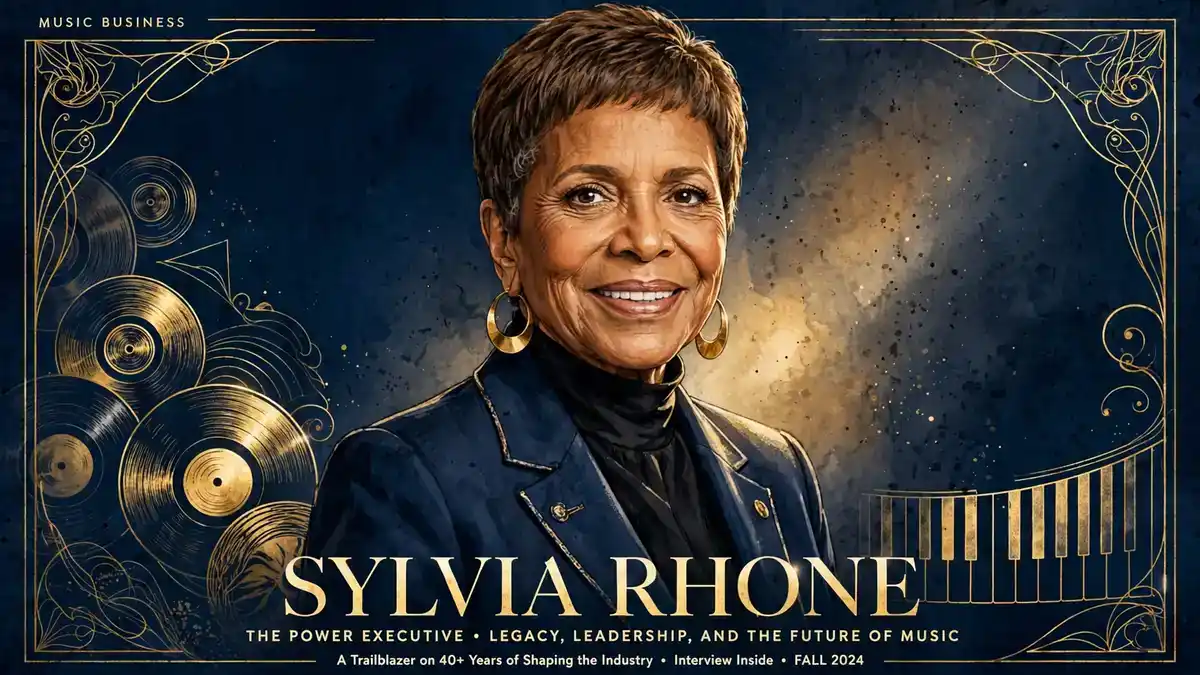
Sylvia Rhone‘s net worth is estimated at $20 million as of October 2026. She is the most senior Black woman in the history of the American recording industry — the first woman to hold the dual title of chairwoman and CEO at a major label — and her fortune was built across more than five decades of executive salaries, performance bonuses, and one record-label joint venture, rather than artist royalties or equity windfalls. A leaked 2014 Sony compensation memo put her Epic Records base salary at $1.4 million with an 80 percent target bonus, and she spent the last decade of her career running Epic, guiding the careers of Travis Scott, Future, 21 Savage, Camila Cabello, and Tyla before stepping down in October 2025. In June 2026, BET honored her with the Ultimate Icon Award, a capstone recognition for a career that began in 1974 as a secretary at Buddah Records.
Sylvia Rhone: Quick Facts
| Estimated net worth | $20 million, as reported by Celebrity Net Worth (range: reported flat at $20 million across outlets; no credible competing figure) |
|---|---|
| Profession | Music executive (former Chairwoman & CEO, Epic Records) |
| Nationality | American |
| Born | March 11, 1952 (age 74) |
| Height | Not publicly disclosed |
| Primary income sources | Major-label executive compensation (salary and bonuses); Vested in Culture label joint venture with Sony Music |
| Active years | 1974–2025 (51 years) |
| Last reviewed | October 2026 |
- Early Life and Background
- Education
- Career Journey
- Rise to Fame
- Main Sources of Income
- Salary and Earnings
- Businesses and Investments
- Brand Deals and Sponsorships
- Houses, Cars and Other Assets
- Awards and Achievements
- Net Worth Growth Over the Years
- Social Media Presence
- Personal Life
- Sources & Reporting
- Frequently Asked Questions
- Final Thoughts
Early Life and Background
Sylvia Rhone was born on March 11, 1952, in Philadelphia, Pennsylvania, and raised in Harlem, New York City, according to Celebrity Net Worth, TheRichest, and the Clio Awards’ executive biography. (A few low-quality aggregator pages list a June birth date; every reputable source, including her college’s own honors page, uses March 11, 1952.) Harlem in the 1950s and 1960s was the epicenter of Black American music culture, and Rhone has repeatedly credited her childhood exposure to R&B shows at the historic Apollo Theater with convincing her that music was a genuine force — not just entertainment. The Clio biography, published when she served as a 2015 Clio Music jury member, describes those Apollo nights as pivotal to her belief in music as an inspirational force, a conviction she carried into every boardroom she later ran.
Growing up Black and female in mid-century America meant the path Rhone eventually took simply did not exist as a template. There were no women running major record companies in the 1960s — and there would not be one for another three decades, until Rhone herself became the first. That context matters for understanding the net worth figure attached to her name: she built a $20 million fortune inside corporate structures, climbing ladder rungs one by one, in an era when the industry’s biggest paydays flowed to owners and artists, not to the executives who ran the machine.
Her parents’ names and occupations are not a matter of public record, and Rhone has kept her family life private throughout her career — an unusual discipline in an industry built on visibility. What is documented is that she grew up immersed in sound: gospel, R&B, soul, and the live-performance energy of Harlem’s theaters. That immersion became her credential before she had any credentials at all.
Education
Rhone was accepted to the Wharton School of the University of Pennsylvania, one of the most selective undergraduate business programs in the country, and graduated with a Bachelor of Science in Economics, according to Berklee College of Music’s honors announcement, the Clio biography, and Celebrity Net Worth. It was not an obvious route into the music business in the early 1970s — Wharton graduates went to Wall Street — but the finance training became one of her defining advantages. Record executives of her generation were often promoters or former DJs; Rhone arrived with an economist’s vocabulary, and it showed in the way she restructured labels and talked about diversity as a business model.
Her first job after graduation had nothing to do with music: she took a position at Bankers Trust in New York City, on a track toward international finance. She left it to become a secretary at Buddah Records in 1974 — a pay cut, a status cut, and one of the most consequential career pivots in industry history. The Wharton degree, which her banking colleagues would have seen as wasted, turned out to be the asset that separated her from every other assistant in the building.
Career Journey
Rhone’s career is the longest continuous executive run in modern record-industry history: 51 years, from 1974 to her 2025 retirement from Epic. The outline below follows her label by label, because each stop added a layer to both her reputation and her compensation.
The apprenticeship years: Buddah, ABC, Ariola (1974–1980)
She started at Buddah Records in 1974 as a secretary, according to the Clio biography and Berklee. Buddah was then a significant independent label — the home of Gladys Knight & the Pips — and Rhone used the secretarial desk as a classroom, learning how records were promoted, how radio worked, and how artists were developed. Over the next six years she collected promotions across ABC Records and Ariola Records, building the ground-level competence that would let her skip no steps later.
Elektra and the move to Atlantic (1980–1986)
In 1980 she rejoined the Elektra family as northeast regional promotion manager for special markets, then was promoted to director of national black music marketing at Atlantic Records. By 1986 she had risen to senior vice president and general manager of black music operations at Atlantic. The Clio biography credits her with helping realign Atlantic’s black-music business, and the results were measurable: Billboard named Atlantic the number-one Black Music Division in 1988. At Atlantic she managed or guided careers including En Vogue, The System, LeVert, Brandy, Yo Yo, The D.O.C., MC Lyte, Michel’le, Chuckii Booker, Miki Howard, Gerald Albright, and The Rude Boys — and even worked with rock acts Pantera and AC/DC as her responsibilities widened beyond R&B.
One underappreciated milestone from this period: Berklee’s honors page notes that under Rhone’s leadership, Atlantic became the first major label to invest seriously in hip-hop, most notably with female rappers J.J. Fad and MC Lyte. In 1986, hip-hop was still treated as a fad by most of the industry’s senior ranks. Rhone treated it as a market.
Chairman of East West America (1990)
Four years after the Atlantic promotion, the label launched East West Records America and made Rhone its chairman, according to Berklee — her first chief-executive title, and a dry run for what would follow.
Chair and CEO of Elektra Entertainment Group (1994–2004)
In 1994, Warner Music Group chairman Doug Morris hired Rhone as chairwoman and CEO of the Elektra Entertainment Group. The appointment made her the first Black woman — and the first woman of any background — to hold the dual chair/CEO title at a major label, a fact confirmed by the Clio biography, Wikipedia, and multiple industry profiles. She ran Elektra for a full decade and fused it with EastWest and Sire into one of Warner’s most eclectic and competitive labels.
The Elektra artist run under Rhone is one of the great executive track records of the CD era: she launched the careers of Missy Elliott (Supa Dupa Fly, 1997) and Busta Rhymes (The Coming, 1996), and worked with En Vogue, Tracy Chapman, Metallica, Natalie Merchant, Jason Mraz, Staind, Third Eye Blind, Fabolous, Gerald Levert, Yolanda Adams, and Ol’ Dirty Bastard. Elliott’s debut went platinum and redefined what a female rap star could look and sound like; Rhone had bet the label’s machinery on exactly that. The Los Angeles Times recognized the scale of what she was doing by calling her “the most powerful woman in the music business.”
President of Universal Motown (2004–2011)
In 2004 Rhone became president of Universal Motown Records and executive vice president of Universal Records, per Berklee. The roster she inherited and built included India.Arie, Akon, Erykah Badu, Kid Cudi, Nelly, Melanie Fiona, and Stevie Wonder — and, crucially, Universal Motown was the distribution partner for Cash Money Records, which put her operation adjacent to the commercial explosion of Lil Wayne, Nicki Minaj, and Drake. TheRichest’s profile of Rhone credits her directly with supervising that Cash Money-era roster, a period when Wayne, Minaj, and Drake were becoming three of the biggest commercial forces in music.
Vested in Culture and the Sony years (2012–2025)
After leaving Universal Motown in 2011, Rhone founded her own label, Vested in Culture (VIC), in 2012 under a distribution deal with Epic Records, a Sony Music label. The Clio biography describes VIC as her own imprint with a diverse roster of developing artists, including Latin pop singer-songwriter Kat Dahlia, rapper Casey Veggies, and Danish singer CoCo. In March 2012 she joined Sony Music Entertainment; two years later, in March 2014, she was appointed president of Epic Records, working alongside chairman and CEO Antonio “L.A.” Reid.
When Reid stepped down in 2017, Rhone took over the label’s operations, and in April 2019 Sony Music CEO Rob Stringer promoted her to chairwoman and CEO of Epic, as reported by Variety. Good Black News’ account of the announcement lists the roster she was charged with: Travis Scott, Future, Camila Cabello, 21 Savage, Meghan Trainor, DJ Khaled, and French Montana. The hits that followed were enormous. She oversaw Scott’s Astroworld (2018), Cabello’s debut album Camila and its smash single “Havana,” and music from Future, 21 Savage, and DJ Khaled. In 2024, Future earned three number-one albums within six months — a feat that matched a record previously held by the Beatles, according to reporting on her tenure — and Epic placed three artists in the US albums-chart top ten simultaneously on two separate occasions. Under her leadership, Epic’s workforce was 62 percent women and 57 percent people of color, a composition she treated as both a value and a strategy.
On October 10, 2025, the Women We Admire business publication reported that Rhone had stepped down as chair and CEO after roughly eleven years with Sony — six of them at the top of Epic. In her farewell note to staff, she wrote: “As I step away from this role that has defined so much of my journey, I am filled with pride in the extraordinary tapestry we’ve created together. Thank you for trusting me with your brilliance.” Sony’s Rob Stringer called her “a trailblazing executive with a distinguished background and unwavering commitment to supporting artists.” The outlet noted a telling consequence of her departure: there were no female CEOs left among the major record labels.
Rise to Fame
Rhone never sought celebrity, and she never got the tabloid version of fame. Her “fame” is institutional — she became famous inside the industry as the executive who kept breaking ceilings, and then famous outside it as the proof that the ceilings could be broken. The markers are well documented. The Los Angeles Times dubbed her “the most powerful woman in the music business.” In 2018, Billboard profiled her as “Sony Music’s Most Powerful African-American Woman.” She appeared on Billboard‘s annual Power 100 list in 2019 and again in 2025. In June 2019 she was inducted into the Midem Hall of Fame at the conference’s 53rd annual gathering in Cannes, where she also delivered the keynote address. On April 5, 2019, Berklee College of Music awarded her an honorary doctorate. She sits on the board of directors of the Rock and Roll Hall of Fame.
The capstone arrived after she left the day-to-day business. BET announced that Rhone would receive the Ultimate Icon Award at the BET Awards 2026, broadcast live from the Peacock Theater in Los Angeles on June 28, 2026, with Druski hosting. BET’s EVP of programming, Connie Orlando, said: “Sylvia Rhone’s influence extends far beyond the music business and into the culture itself. She championed artists and executives, shattered ceilings that had never been broken, and redefined what leadership looks like for women and people of color in every boardroom that followed.”
What made her rise distinctive was its genre blindness. Most executives of her era were identified with a single sound; Rhone ran hip-hop (Missy Elliott, Busta Rhymes, Travis Scott), R&B (En Vogue, Brandy, India.Arie), rock (Metallica, Pantera, AC/DC, Staind, Third Eye Blind), pop (Camila Cabello, Meghan Trainor), folk (Tracy Chapman), Latin pop (Kat Dahlia), and gospel-adjacent soul (Yolanda Adams). The diversity of the roster was the point — and it was the business argument she had been making since her Wharton days.
Main Sources of Income
Unlike the artists she spent her career developing, Rhone’s wealth was never tied to touring, streaming royalties, or a catalog sale. Her income comes from three corporate-era sources, and understanding them explains why $20 million is the right neighborhood rather than $200 million.
Executive salaries. For most of her career Rhone was a salaried corporate executive — first at Warner Music Group, then Universal Music Group, then Sony Music Entertainment. Major-label chief executives earn base salaries in the low single-digit millions plus performance bonuses, and Rhone held C-suite titles for over thirty years: East West chairman (1990), Elektra chair/CEO (1994–2004), Universal Motown president (2004–2011), Epic president (2014–2019), and Epic chair/CEO (2019–2025). Thirty years of seven-figure compensation is the engine of the fortune.
Performance bonuses. Label chiefs are paid against targets — market share, album sales, roster profitability. The one public window into Rhone’s bonus structure is the 2014 Sony internal compensation comparison (more below): a base salary of $1.4 million with a bonus target of 80 percent and a maximum of 120 percent. Epic’s commercial hot streak during her presidency — Astroworld, “Havana,” multiple chart-topping Future and Travis Scott releases — would have pushed those bonuses toward the top of their bands.
Vested in Culture. Her 2012 imprint, Vested in Culture, was structured as a 50/50 joint venture with Sony, according to the Clio biography and the leaked Sony compensation memo. Joint-venture label heads share in the profits of their imprint’s releases. VIC’s roster of developing artists — Kat Dahlia, Casey Veggies, CoCo — never produced a blockbuster on the scale of the flagship Epic acts, so the venture’s contribution to her wealth was likely meaningful but secondary, a single-digit-millions interest rather than a windfall.
What is absent from the record is as informative as what is present. There are no reported real estate empires, no venture-capital portfolios, no catalog acquisitions, and no book, speaking, or endorsement empires attached to her name. Her peers who are worth hundreds of millions — Clive Davis, L.A. Reid, Jimmy Iovine — got there through ownership: equity stakes in labels, publishing companies, or technology ventures. Rhone’s wealth is the wealth of an employee, albeit one of the highest-paid employees in the industry’s history.

Salary and Earnings
The most concrete salary figure in the public record comes from an unusual source: the 2014 Sony Pictures email leak, published in full by WikiLeaks in its Sony Archives. In a February 2014 internal comparison of Sony Music label executives — an email chain involving Sony executives Kazuo Hirai, Michael Lynton, and Nicole Seligman — Rhone’s compensation as incoming president of Epic Records was listed as an annual base salary of $1.4 million with a bonus target of 80 percent and a maximum of 120 percent. The same memo noted that her then-current compensation at Vested in Culture was a $950,000 base, meaning the Epic presidency represented roughly a 47 percent raise on base alone. For context, the memo listed RCA’s president/COO at a $1.1 million base and Columbia’s EVP/GM at $1.5 million — Rhone sat squarely in the top tier of Sony’s label leadership.
Doing the arithmetic on the bonus bands: at target, her total cash compensation in 2014 would have been about $2.5 million; at the 120 percent maximum, about $3.1 million. That was for the president’s role. When she was elevated to chairwoman and CEO in 2019 — a materially larger job — her package would reasonably have moved higher, though no figure has leaked for the CEO years. Her predecessor and Epic chairman L.A. Reid ran the label from 2012 to 2017; Rhone ran it for eleven years total, six of them at the top.
Earlier stops carry no public salary figures. TheRichest’s profile of Rhone discusses her Elektra decade and Universal Motown presidency without attaching compensation numbers, and neither Warner nor Universal has ever disclosed what they paid her. Industry practice of the era suggests Elektra’s chair/CEO package in the 1990s would have been in the $1–2 million range all-in, and Universal Motown’s president role in the 2000s somewhat higher — but those are benchmarks, not reported facts, and this article treats them as such.
One telling detail from the WikiLeaks memo: when Rhone’s contract was before Sony’s compensation committee, an executive wrote, “Under no circumstances should she receive a car and driver.” The perk request was denied, but the fact that a car and driver was even on the table says something about the altitude at which she was negotiating.
Putting it together as an illustrative build-up — clearly labeled as our estimate, not a reported figure — thirty-plus years of seven-figure executive compensation, even after taxes, lifestyle costs, and the absence of equity windfalls, lands in the high eight figures. That is consistent with the $20 million public estimate rather than with a dramatically higher number.
Businesses and Investments
Rhone’s business portfolio is thin by design — she was a corporate builder, not a serial founder — but it has one significant entry. Vested in Culture, founded in 2012, was her only entrepreneurial vehicle: a 50/50 joint venture with Sony Music Entertainment that operated as an Epic imprint. The model is standard for established executives who want creative control without leaving the corporate ecosystem: the major label funds and distributes; the executive-founder shares the profits of her own signings. VIC’s artists — Kat Dahlia, whose single “Gangsta” earned a 2013 MTV Video Music Award nomination; rapper Casey Veggies; and Danish singer CoCo, formerly of Quadron — were developing acts rather than established stars. The imprint continued inside Epic after Rhone became president, which suggests it functioned more as her personal A&R sandbox than as a standalone profit center.
Beyond VIC, no investments are documented in public reporting. She is not known to hold founder equity in any technology company, catalog fund, or consumer brand — the vehicles that turned peers like Jimmy Iovine (Beats) or Steve Stoute (UnitedMasters) into nine-figure fortunes. Her one institutional investment is her time: she serves on the board of directors of the Rock and Roll Hall of Fame, a nonprofit governance role rather than a paid one. For an executive of her stature, the absence of a side portfolio is itself a data point — it is the reason her net worth is best understood as the product of salaries and bonuses, not of ownership.
Brand Deals and Sponsorships
There are none to report, and that is worth stating plainly rather than padding around. Record executives do not sign endorsement deals, appear in fragrance campaigns, or front sneaker lines; their currency is reputation inside the industry, not consumer visibility. No brand partnership involving Rhone appears in any reputable trade press, and no sponsorship income is factored into the $20 million estimate.
What the section would otherwise contain is better described as institutional recognition: her seat on the Rock and Roll Hall of Fame board, her 2015 service as a Clio Music Awards jury member, her Midem keynote, and the parade of honors catalogued below. These are unpaid or honorarium-level engagements that burnish the legacy without moving the net worth needle. The one partial exception is the category of paid keynote and commencement addresses — the Midem keynote in 2019, for example — but no fees have ever been reported, and executive keynotes of this kind typically command five figures, not sums that alter a net worth estimate.

Houses, Cars and Other Assets
Public reporting attaches no property to Rhone’s name — no mansion profiles, no celebrity-real-estate transaction write-ups, no vehicle collections. For an executive who spent her career in New York and worked in Los Angeles, that silence is notable but not suspicious: unlike artists, label chiefs are rarely tracked by real-estate media, and Rhone has guarded her privacy more successfully than almost any peer of her rank. This article does not invent a house, a car, or a watch collection to fill the gap.
What can be said with confidence is structural rather than specific. A $20 million net worth built over fifty years of high compensation implies a conventional high-earner balance sheet: a primary residence in the New York area, retirement accounts, and liquid investments — the standard holdings of a corporate executive, not the trophy-asset portfolios of artist-moguls. If she held a Manhattan apartment or a Westchester home purchased decades ago, the appreciation alone could account for a meaningful share of the estimate — but no deed, listing, or report ties a property to her, so it stays out of the calculation. The estimate rests on compensation history, not on assets, because that is where the evidence is.
Awards and Achievements
Rhone has received more than three dozen honors, according to the Clio biography — an unusually large haul for someone who worked behind the glass rather than in front of the microphone. The most significant, in chronological order:
- Billboard recognition (1988 onward): Atlantic named the number-one Black Music Division under her leadership in 1988; she appeared on Billboard‘s annual Power 100 in 2019 and again in 2025; and in 2018 Billboard profiled her as “Sony Music’s Most Powerful African-American Woman.”
- Honorary doctorate, Berklee College of Music (April 5, 2019): awarded in recognition of her achievements as a leading female music executive who headed labels multiple times, per Berklee’s own announcement. Berklee students performed music from artists across her career — Missy Elliott, Camila Cabello, Tracy Chapman, J.J. Fad, Jason Mraz — at the ceremony.
- Midem Hall of Fame (June 2019): inducted at the 53rd annual Midem conference in Cannes, where she also delivered the keynote address.
- Rock and Roll Hall of Fame board: she serves on the board of directors, a governance role held by few executives.
- BET Ultimate Icon Award (June 28, 2026): presented at the BET Awards 2026 at the Peacock Theater in Los Angeles, honoring her five-decade contribution to music and culture.
The through-line of the honors is the “firsts”: first woman to hold the dual chair/CEO title at a major label (1994), first Black woman to chair a major-label imprint, first Black woman to reach the top of Epic. Awards for executives tend to arrive late — the industry honors its builders after the building is done — and Rhone’s 2026 BET award fits that pattern exactly.
Net Worth Growth Over the Years
No publication has tracked Rhone’s wealth year by year, so a growth chart built from reported figures would be fabrication. What the record does support is a phase-by-phase account of how the money accumulated — and, just as usefully, why it stopped where it did.
1974–1993: the climb. From secretary to senior vice president, Rhone was a working executive earning professional-manager money. These years built the reputation, not the fortune.
1994–2004: the Elektra decade. Ten years as chair and CEO of a Warner label, with C-suite compensation and the industry’s top perks. This is where the wealth base was poured — the first sustained period of seven-figure annual earnings.
2004–2011: Universal Motown. The president/EVP years at Universal, plus the commercial peak of the Cash Money distribution era. Compensation at this level, sustained for seven years, would have added several million dollars after tax.
2012–2025: the Sony years. The documented $1.4 million base plus bonus at Epic, rising to the CEO package in 2019. Thirteen years at Sony — eleven of them running Epic — is the longest single-company run of her career and the period in which the public $20 million estimate took shape.
To put $20 million in context, consider her peers — all figures as reported by Celebrity Net Worth, the same outlet behind Rhone’s number:
| Executive | Reported net worth | How the money was made |
|---|---|---|
| Sylvia Rhone | $20 million | Five decades of salaries and bonuses; one label joint venture |
| L.A. Reid | $300 million | LaFace Records sale ($100M reported), label presidencies, producing |
| Clive Davis | $600 million | Label ownership stakes (Arista, J Records), publishing, executive pay |
| Steve Stoute | $40 million | Translation agency, UnitedMasters founder equity |
The table tells the real story of executive wealth: Reid’s fortune came from selling half of LaFace to BMG; Davis’s from ownership stakes and publishing; Iovine’s (not shown, but the extreme case) from the Beats sale to Apple. Rhone never sold a company she owned, because she never owned one — she ran other people’s companies better than almost anyone alive. The $20 million figure is the honest ceiling of a career built on salary rather than equity.
A note on a bad number: one low-quality aggregator page puts Rhone’s net worth at $150 million. That page also credits her with a career at Def Jam Records — working with LL Cool J, Public Enemy, and the Beastie Boys — that never happened; she has no Def Jam tenure in any reputable biography. A figure attached to a fabricated career is not a competing estimate. It is noise, and this article excludes it.
Social Media Presence
Rhone keeps a deliberately low digital profile. She maintains a modest presence on major platforms, but she is not a content creator, does not run a personal brand account in the influencer sense, and has never monetized her following — there are no sponsored posts, no product lines launched from Instagram, no subscription products. Her public communications have historically come through trade-press interviews, keynote addresses, and institutional announcements rather than social channels. In an era when executives are expected to perform visibility, her restraint is consistent with a career built inside boardrooms rather than timelines. No social-media income is included in the net worth estimate.
Personal Life
Rhone is 74 years old, born March 11, 1952, in Philadelphia and raised in Harlem. Beyond that, the verified record goes quiet — and this article respects the quiet. No reputable publication has reported a spouse’s name, a marriage date, or details of her children; she has never discussed her family in the extensive trade-press interviews given across her career. A handful of low-quality aggregator pages claim specifics about her family, but none cite a source, and this article does not repeat them.
What is public is professional, not personal: the Wharton degree, the Bankers Trust detour, the five-decade climb, the 2025 retirement from Epic, and the 2026 BET honor. She spent her public life making other people famous while declining the machinery of fame for herself — no memoir, no reality television, no tell-all interviews. For a net-worth article, the relevant personal fact is that none of her wealth appears tied to a spouse’s assets, an inheritance, or a family business. It was earned, title by title, over fifty-one years.
Sources & Reporting
Celebrity Net Worth — the $20 million net worth estimate; birth date (March 11, 1952), birthplace, Wharton education, Buddah Records start, and the five-decade career summary including the 2025 Epic departure. Reporting window: page updated within the last year, crawled October 2026.
WikiLeaks (Sony Archives) — the February 2014 internal Sony compensation memo listing Rhone’s Epic president base salary at $1.4 million with an 80 percent target / 120 percent maximum bonus, her then-current Vested in Culture base of $950,000, and the “under no circumstances should she receive a car and driver” contract note. Primary-document evidence from the 2014 Sony Pictures email leak.
Berklee College of Music — honorary doctorate announcement (April 5, 2019): Wharton B.S. in Economics, Buddah Records 1974 start, Atlantic senior VP/GM of black music (1986), East West chairman (1990), Elektra chair/CEO (1994), Universal Motown president (2004), Epic president (2014) and operations head from 2017, roster highlights (En Vogue, Michel’le, Brandy, The D.O.C., Pantera, AC/DC, J.J. Fad, MC Lyte, Missy Elliott, Busta Rhymes, Tracy Chapman, Jason Mraz), and Atlantic as the first major label to invest in hip-hop.
The Clio Awards (juror biography, 2015) — Apollo Theater childhood influence, Wharton economics degree, Buddah/ABC/Ariola/Elektra/Atlantic progression, 1988 Billboard number-one Black Music Division, Vested in Culture founding (2012) and roster (Kat Dahlia, Casey Veggies, CoCo), “more than three dozen honors,” and the 1994 milestone as the first woman and first African-American to hold the chair/CEO dual title in the recording industry.
TheRichest — $20 million estimate; Bankers Trust first job; Elektra artist roster (Missy Elliott, Busta Rhymes, Tracy Chapman, Yolanda Adams, Metallica, Natalie Merchant, Gerald Levert, ODB, Fabolous, Jason Mraz, Third Eye Blind); Universal Motown Cash Money-era supervision (Lil Wayne, Nicki Minaj, Drake, Kid Cudi, Nelly, Melanie Fiona, Akon, Erykah Badu, Stevie Wonder).
Good Black News — Variety-reported April 2019 promotion to Epic chairwoman and CEO, with Rob Stringer quote and roster (Travis Scott, Future, Camila Cabello, 21 Savage, Meghan Trainor, DJ Khaled, French Montana); Astroworld and “Havana” highlights; Elektra 1994–2004 tenure.
The Women We Admire — October 10, 2025 report of her stepping down as Epic chair/CEO after eleven years with Sony; farewell-note quote; “no female CEOs among the major record labels” consequence; career recap (Elektra, Universal Motown, Atlantic).
Paramount Press Express — BET Awards 2026 Ultimate Icon Award announcement: June 28, 2026 ceremony at the Peacock Theater, Druski hosting, Connie Orlando statement.
RNB Philly / Radio One — BET Ultimate Icon coverage: age 74, five-decade career recap, Atlantic (Brandy, MC Lyte, Yo Yo, LeVert), Elektra (Missy Elliott, Busta Rhymes, En Vogue, Metallica, Natalie Merchant), Universal Motown (India.Arie, Akon, Kid Cudi, Erykah Badu; Cash Money distribution), Epic presidency from 2014 (Travis Scott, 21 Savage, Mariah the Scientist, Giveon, Future, Tyla).
Frequently Asked Questions
What is Sylvia Rhone’s net worth in 2026?
Sylvia Rhone’s net worth is estimated at $20 million. Celebrity Net Worth, TheRichest, and multiple industry biographies all converge on the same figure, and no reputable outlet has published a competing estimate. Her wealth comes from more than three decades of C-suite salaries and performance bonuses at Warner, Universal, and Sony Music — not from artist royalties or company ownership.
How did Sylvia Rhone make her money?
Rhone earned her fortune as a record executive. She held top corporate titles for over 30 years: chairman of East West (1990), chair and CEO of Elektra (1994–2004), president of Universal Motown (2004–2011), president of Epic Records (2014–2019), and chairwoman and CEO of Epic (2019–2025). A leaked 2014 Sony memo showed her Epic base salary at $1.4 million with an 80 percent target bonus. She also founded the Vested in Culture label imprint as a 50/50 joint venture with Sony.
Is Sylvia Rhone still the CEO of Epic Records?
No. Rhone stepped down as chairwoman and CEO of Epic Records in October 2025 after roughly eleven years with Sony Music. She had served as president from 2014 and as chair/CEO from 2019. In June 2026 she was honored with the BET Ultimate Icon Award for her five-decade career.
Which artists did Sylvia Rhone sign or develop?
Across her career, Rhone guided the careers of Missy Elliott and Busta Rhymes (launched at Elektra), En Vogue, Brandy, MC Lyte, and J.J. Fad (Atlantic), India.Arie, Akon, Kid Cudi, and Erykah Badu (Universal Motown), and Travis Scott, Future, 21 Savage, Camila Cabello, DJ Khaled, Tyla, French Montana, and GIVĒON (Epic). She also worked with rock acts including Metallica, Pantera, and AC/DC, and folk singer Tracy Chapman.
How old is Sylvia Rhone?
Sylvia Rhone was born on March 11, 1952, in Philadelphia, Pennsylvania, making her 74 years old as of October 2026. She was raised in Harlem, New York City, where childhood trips to the Apollo Theater shaped her lifelong belief in music’s power.
What was Sylvia Rhone’s education?
Rhone graduated from the Wharton School of the University of Pennsylvania with a Bachelor of Science in Economics. She briefly worked at Bankers Trust in New York City on a finance track before leaving to take a secretarial job at Buddah Records in 1974, the pivot that launched her music-industry career.
What was Sylvia Rhone’s salary at Epic Records?
A February 2014 internal Sony compensation memo, published by WikiLeaks from the Sony Pictures email leak, listed her annual base salary as incoming Epic Records president at $1.4 million, with a bonus target of 80 percent and a maximum of 120 percent, implying total cash compensation of roughly $2.5 to $3.1 million that year. Her subsequent CEO package from 2019 has not been disclosed.
Is Sylvia Rhone married? Does she have children?
Rhone has kept her family life private throughout her career, and no reputable publication has reported a spouse’s name or family details. Her public record is professional: the Wharton degree, the five-decade executive career, the 2025 Epic retirement, and the 2026 BET Ultimate Icon Award.
Final Thoughts
Sylvia Rhone’s $20 million net worth is, in a sense, the most honest number in the net-worth business. It contains no catalog-sale inflation, no equity fairy dust, no reality-TV side hustle. It is the compounded result of showing up to work, at the highest level, for fifty-one years — from a secretary’s desk at Buddah Records in 1974 to the chairwoman’s office at Epic Records in 2025, with a stop at nearly every major label that mattered in between.
The comparison that clarifies everything is her peers. L.A. Reid is worth $300 million because he sold LaFace. Clive Davis was worth $600 million because he owned pieces of the labels he ran. Rhone is worth $20 million because she ran other people’s labels — brilliantly, but as an employee. The industry’s economics reserve the nine-figure paydays for owners and artists; the people who build the machine get the salary, the bonus, and the plaque. Rhone got the biggest versions of all three that the business has ever offered a woman.
Her legacy was never going to be measured in dollars anyway. The BET Ultimate Icon Award in June 2026 recognized what the numbers cannot: she was the first woman to hold the dual chair/CEO title at a major label, the first Black woman to chair a major-label imprint, the executive who bet on Missy Elliott and Travis Scott before the consensus arrived, and the leader who left Epic with a workforce that was 62 percent women. When she stepped down in October 2025, there were no female CEOs left among the major labels. That statistic is her real epitaph — and the reason this article’s most important figure is not $20 million, but 51: the number of years she spent breaking ground so the next generation would not have to.
Published on 2026-10-23. Last reviewed October 2026. Found an error? See our corrections policy.