
Todd Graves‘s net worth is estimated at $17 billion–$22 billion as of October 2026. The range reflects how differently analysts value his roughly 92% stake in Raising Cane’s Chicken Fingers, the private chicken-finger empire he founded in 1996 after a college professor gave his business plan the worst grade in the class. Forbes’s most recent snapshot — the September 2026 Forbes 400 — anchors him at $20 billion, making Graves the richest person in Louisiana and the richest restaurateur in America. His peak was higher: late 2025 valuations touched $22.5 billion, and Forbes’s April 2026 world list had him at $22 billion and 115th globally.
Todd Graves: Quick Facts
| Estimated net worth | $20 billion (Forbes 400, September 2026) (range: $17–$22 billion) |
|---|---|
| Profession | Entrepreneur, restaurateur, co-founder and CEO of Raising Cane’s Chicken Fingers |
| Nationality | American |
| Born | 1972, New Orleans, Louisiana (age 54) |
| Height | Not publicly reported |
| Primary income sources | Ownership distributions and equity appreciation from a ~92% stake in Raising Cane’s; real estate |
| Active years | 1996–present |
| Last reviewed | October 2026 |
- Early Life and Background
- Education
- Career Journey
- Rise to Fame
- Main Sources of Income
- Salary and Earnings
- Businesses and Investments
- Brand Deals and Sponsorships
- Houses, Cars and Other Assets
- Awards and Achievements
- Net Worth Growth Over the Years
- Social Media Presence
- Personal Life
- Sources & Reporting
- Frequently Asked Questions
Early Life and Background
Todd Bartlett Graves was born in 1972 in New Orleans and raised in Baton Rouge, Louisiana, the city where he still lives, a few miles from the first restaurant he ever opened. His mother, Gay Graves, would later tell Forbes she “wasn’t too happy” about the salmon fishing, but that her son always called home — a small detail that captures the household he grew up in: conventional, supportive, and entirely unprepared for the path he took.
Graves attended the Episcopal School of Baton Rouge, a private college-preparatory school where he was an ordinary student by his own telling. Nothing in his childhood suggested a future as America’s richest restaurateur. The chicken-finger idea arrived in college, and the adults around him — professors, then bankers — responded with a unanimity that would follow him for years: nobody believed a restaurant selling only chicken fingers could work in Cajun country.
That unanimous disbelief became the engine of his fortune. Graves has said he treats every “no” as fuel, and the record of his twenties is essentially a catalog of people who told him the concept would fail, followed by him raising the money anyway.
Education
Graves earned a bachelor’s degree from the University of Georgia, where he studied telecommunications with a business minor. The more important classroom, though, was at Louisiana State University, where he and childhood friend Craig Silvey wrote the business plan for a chicken-finger-only restaurant as a course assignment. The working title was “Folly’s Fingers of LSU.”
The professor gave the plan the lowest grade in the class. One widely reported version of the story puts the mark at a B-minus — still the worst in the room — with the professor arguing that a single-item menu couldn’t survive in southern Louisiana and that the industry was moving toward variety, salads, and grilled options. Graves’s response, years later to Inc., was that he had “basically written the Bible on a chicken finger restaurant” and even knew what the aprons would cost.
The education that actually mattered came after graduation. Rejected by every Louisiana bank he approached, Graves went to work as a boilermaker in Los Angeles, welding at oil refineries on brutal schedules, and then flew to Bristol Bay, Alaska, to fish for sockeye salmon. He and Silvey pitched a tent by the highway, talked their way onto fishing vessels, and worked through days that Graves later described as dangerous — boats ramming boats, medical helicopters overhead. When the pair returned to Baton Rouge about a year later, they carried roughly $50,000 in hard-won savings, as Forbes India reconstructed it. That money — plus about $90,000 from a few local investors and a $50,000 Small Business Administration loan — was enough to lease a building just off LSU’s north gates. Graves installed the menu boards, the wood-paneled walls, and the bathroom plumbing himself, and the two drove around the South in a U-Haul collecting used kitchen equipment and restaurant booths.
Career Journey
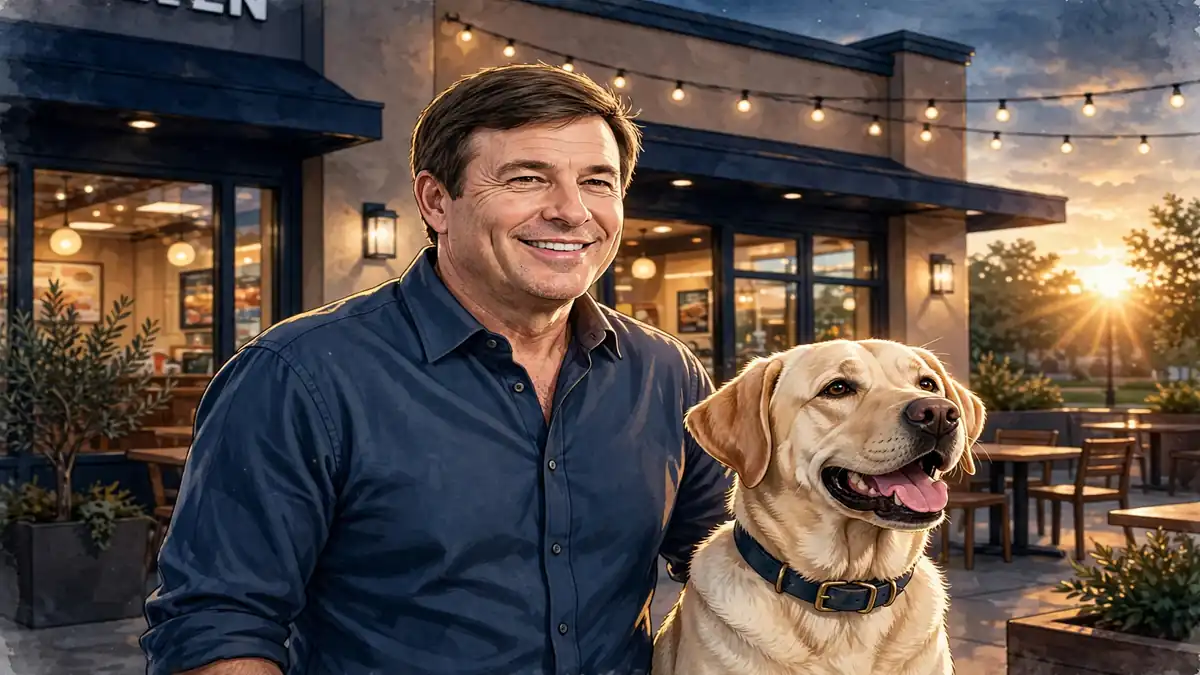
Raising Cane’s opened on August 28, 1996, near the North Gates of LSU on Highland Road, named after Raising Cane I, Graves’s yellow Labrador, who visited the construction site. The menu had exactly five things — chicken fingers, crinkle-cut fries, coleslaw, Texas toast, and Cane’s Sauce — and three decades later, it still does. That refusal to change is not stubbornness; it is the strategy. The chain has never run limited-time offers or chased value plays, betting that a customer walking in always knows exactly what to expect.
The early years nearly ended the story twice. In 2005, Hurricane Katrina nearly destroyed the business, but Cane’s reopened fast while competitors stayed dark — and gained market share from the disaster, a pattern that would repeat during the COVID-19 pandemic, which was simultaneously a crisis and a growth opportunity. Graves took no outside capital that would dilute him; he borrowed, including a reported $1 million loan to push toward ten locations by the early 2000s, and plowed earnings back into the company. He also steadily consolidated ownership: the chain is now described as roughly 92% his, an extraordinary concentration for a company of its size.
The menu itself was reverse-engineered with unusual care. Graves studied the chicken-finger specialists already operating in the South — most notably Guthrie’s — and decided their food was close but wrong in the details: their crinkle fries carried too much soft interior, their Texas toast wasn’t dense enough. He rebuilt both to his own spec, thickened the sauce, and locked the formula. That obsessive, almost fussy product work is the part of the story the “worst grade in the class” anecdote obscures: the business plan failed the class, but the food science was genuinely good.
Expansion ran in distinct gears. The footprint was about 500 locations in 2020 with systemwide revenue of $1.5 billion. Then the post-pandemic surge: 2023 sales hit a record $3.7 billion with 61 consecutive quarters of same-store sales growth — an industry rarity — and average unit volumes that more than doubled since 2015. In 2024 the company crossed $5.1 billion in sales, served 473 million customers, and opened more than 100 restaurants in a single year, a company record. Its New York Times Square flagship approached $25 million in annual sales, and a San Francisco Bay opening did $600,000 in its first week. Per-location sales of $6.6 million put Cane’s in a class with the most productive chains in the country.
The momentum carried into 2025 and 2026. TheStreet reported in August 2026 that sales had passed $5.7 billion with more than 500 million customer visits, average unit volumes of $6.7 million, and seven new openings that month alone — exactly thirty years after the first one. CNBC reported that Cane’s overtook KFC as the third-largest quick-serve chicken chain in the United States, behind only Chick-fil-A and Popeyes. By the 30th anniversary on August 28, 2026, the count stood at 1,000 restaurants across 43 states plus the Middle East and Canada, with the United Kingdom and Mexico on the 2026 map and a pace of about 100 new American restaurants a year. The company’s stated goal is top-10 U.S. restaurant brand by 2030, with 1,600 restaurants and $10 billion in sales. Graves shares the CEO title with AJ Kumaran as co-CEO.
Rise to Fame
For most of Raising Cane’s life, Todd Graves was anonymous outside the restaurant industry — a deliberate posture. He stayed in Baton Rouge, refused franchise sprawl, and grew the chain on operating fundamentals rather than celebrity. The fame arrived as a byproduct of the Forbes lists. When he debuted in 2024 at $9.5 billion, he was already Louisiana’s wealthiest resident, ahead of Saints and Pelicans owner Gayle Benson. The 2026 lists made him unavoidable: 115th richest person in the world at $22 billion in April, 57th on the Forbes 400 at $20 billion in September, and officially the richest restaurateur in America, ahead of the Chick-fil-A Cathy family members, who sit at $13.7 billion each.
Graves has cultivated a public persona that plays against the billionaire stereotype. He calls himself “CEO, Fry Cook, and Cashier of Raising Cane’s Chicken Fingers,” works restaurant shifts, and shows up at openings alongside celebrities — food critic Keith Lee joined the 30th birthday celebration in August 2026; Dodgers catcher Will Smith worked a Sunset Boulevard opening that came with a six-figure charity check. In the 2025–26 television season, Graves joined ABC’s Shark Tank as a guest shark, which made him the richest person to sit in those chairs. None of this is accidental: the brand’s power is parasocial, built on a founder who still acts like the fry cook he started as.
Main Sources of Income
Practically all of Todd Graves’s fortune is a single asset: his ~92% ownership of Raising Cane’s Restaurants, LLC. Forbes attributes the overwhelming majority of his wealth to this stake, valuing the private company with price-to-sales and price-to-earnings ratios drawn from comparable public chains — a methodology that explains why his estimated fortune moves in billion-dollar swings. With 2025 systemwide sales above $5.7 billion and average unit volumes near $6.7 million, the implied enterprise value runs into the tens of billions even at modest multiples, and Graves owns nearly all of it. He took no venture capital and sold no meaningful equity along the way, so three decades of compounding accrued to him almost entirely.
The remainder of the wealth picture is real estate. Graves holds commercial and residential property around Baton Rouge — some of it tied to restaurant sites, which produce rental-style returns — with property-focused outlets estimating the portfolio in the tens of millions. He draws no publicly reported salary from the company; as a majority owner of a private business, his cash comes from ownership distributions, the size of which he does not disclose. That opacity is precisely why every published net worth figure for him is an estimate rather than an accounting.
One public datapoint hints at how much cash the machine throws off: in 2022, Forbes reported that Cane’s was offering restaurant leaders “industry-leading” compensation with the chance to earn $1 million — meaning the company pays seven figures to individual operators while Graves, who owns the whole board, takes the residual. The chain has also run headline-grabbing crew stunts, like buying $100,000 in Mega Millions tickets for employees in 2022, a Washington Post-reported gesture that doubled as a retention strategy during the industry’s labor crunch.

Salary and Earnings
There is no public record of Todd Graves drawing a conventional salary, and for a founder who owns 92% of a private company, the question is nearly beside the point. His economics work like this: Raising Cane’s generates billions in systemwide sales each year at strong per-store volumes, the company reinvests most of it into roughly 100 new restaurants annually, and the residual value accrues to the equity — almost all of which is his. Forbes’s valuation math, not a paycheck, is what moved him from $9.5 billion in 2024 to a $22.5 billion peak in late 2025.
What can be said with confidence is that his early take was modest. In the first years, Graves paid himself little and redirected nearly everything into growth — a pattern he has described as standard founder behavior rather than sacrifice. The one public window into his cash economics is the 2026 philanthropy: $20 million from the Todd Graves Family Foundation to Re:wild plus Cane’s own $30 million commitment to pet welfare over ten years, $50 million in total giving announced at the 30th anniversary. Donations of that scale are consistent with distributions in the tens of millions per year, but the exact figure is undisclosed, and we publish it as unknown rather than invent one.
Businesses and Investments
Raising Cane’s is the business. It is also, in a real sense, the only business — Graves never diversified into a portfolio of startups, never took the company public, and never sold a meaningful slice. The company is headquartered in Baton Rouge, operates about 1,000 locations, and employs a crew that the company puts at more than 100 per restaurant, with 2026 reporting describing a workforce near 95,000. Domestic locations are company-owned; the Middle East presence (Bahrain, Kuwait, Qatar, Saudi Arabia, the UAE) runs through franchise-style arrangements, a rare exception to his no-franchise posture.
The long-term plan is the most revealing investment document he has: top-10 U.S. restaurant brand by 2030, 1,600 restaurants, $10 billion in sales, $8 million average unit volume. That target implies roughly doubling the business in under five years, which is why Forbes’s multiple-based valuation has such a wide range — the company is either fairly valued at $20 billion-plus or, if the growth stalls, worth materially less. Graves’s bet is entirely concentrated, and it is entirely on himself.
His other holdings are personal rather than financial. He is an avid collector: a 66-million-year-old triceratops skull loaned to the Louisiana Arts and Science Museum, the hearse that carried Martin Luther King Jr. loaned to exhibits around the country, Harrison Ford’s Raiders of the Lost Ark jacket, and a pair of Elvis Presley’s sunglasses. These are passions, not investments, though several carry genuine cultural value.
Brand Deals and Sponsorships
Graves doesn’t do endorsement deals in the celebrity sense — he is the brand. His partnerships run through the company and look like community theater with billionaire production values. In June 2026 he unveiled renderings for Raising Cane’s 9th Ward Stadium at LCMC Health Field in New Orleans, a naming-style sponsorship that plants the brand’s flag in his home state’s largest city. The company has committed $30 million over ten years to pet-welfare organizations, announced alongside Graves’s personal $20 million pledge to Leonardo DiCaprio’s Re:wild conservation group — philanthropy as brand strategy, timed to the 30th anniversary.
The celebrity collaborations are constant. Country star Luke Bryan is a genuine friend — the two met when Graves visited Bryan’s farm — and Graves committed $1 million (paid as $250,000 a year over four years) to Bryan’s Brett Boyer Foundation, which funds congenital heart defect research. Graves doubled a planned $50,000 donation to Dodgers catcher Will Smith’s Catching Hope Foundation to $100,000 on stage at a Sunset Boulevard opening. Snoop Dogg calls him family; Shaquille O’Neal has stayed at his estate. And his 2025–26 guest turn on Shark Tank — where he was the richest shark in the show’s history — doubled as the most-watched brand placement Cane’s has ever gotten. Cane’s reports it has worked with more than 1,000 pet organizations and donated more than $10 million to rescues, shelters, and dog parks over the years, on top of $140 million in total company giving.

Houses, Cars and Other Assets
Graves lives in Baton Rouge on a wooded, lakeside estate valued in property reporting at roughly $5–$7 million, a few miles from the original Highland Road restaurant. The property is less a mansion than a compound, and its centerpiece is genuinely unusual: a custom treehouse built by Pete Nelson’s team around a 100-foot live oak estimated to be a century old, with a sleeping pod, rope bridges, a slide, and a crow’s nest 35 feet up from which you can see LSU’s Tiger Stadium. One stained-glass window in the sleeping pod was salvaged from a New Orleans church destroyed by Hurricane Katrina.
The estate doubles as a museum of his own origin story. Graves rebuilt a replica of the 1996 apartment he lived in when Cane’s opened — down to the brown paisley bedspread, the cereal on top of the refrigerator, the VHS tapes, and the Rolodex. The 30th-anniversary pop-up museum in 2026 displayed “The Margaret Mae,” the actual boat tied to his money-earning days, alongside the first cash register and the first dollar the restaurant ever took. He is not a car collector in any public sense; the collecting budget goes to history, not horsepower.
Awards and Achievements
Graves’s trophy case is the Forbes list itself: debuting in 2024, he reached the top 50 of the Forbes 400 in 2025 and ranked #57 at $20 billion in September 2026 — the richest person in Louisiana for three straight years and America’s richest restaurateur. The company has collected the industry honors that matter more to him: repeated Top Workplace awards, record same-store sales streaks, and the industry’s most envied unit economics. Being named a guest shark on Shark Tank in its 2025–26 season, as the wealthiest panelist in the show’s history, was a different kind of recognition — pop culture ratifying a business story.
Net Worth Growth Over the Years
The defining feature of Todd Graves’s fortune is how late it became visible. He was a billionaire-in-waiting for years before Forbes’s methodology caught up with private-company valuations. The timeline, all figures from Forbes reporting unless noted:
| Year | Estimated net worth | What moved it |
|---|---|---|
| 2020 | Not yet listed | ~500 locations, $1.5B systemwide sales; pre-Forbes era |
| 2024 | $9.5 billion | Forbes-list debut; ~900 locations, $5.1B sales year |
| April 2025 | $9.5 billion | Forbes World’s Billionaires, #293 globally; second appearance |
| Late 2025 | ~$22.5 billion | Peak Forbes estimate; 2025 sales topped $5.7B, overtook KFC as #3 U.S. chicken chain (CNBC) |
| April 2026 | $22 billion | Forbes World’s Billionaires, #115; jumped 150+ spots; passed the Chick-fil-A Cathy siblings ($13.7B each) |
| September 2026 | $20 billion | Forbes 400, #57; down $2.5B from peak as multiples cooled |
The jump from $9.5 billion to $22.5 billion in roughly a year was not a change in the business — it was a change in how the business was valued, as Forbes applied richer multiples to a chain posting 15%-plus same-store growth. That is also the honest caveat on today’s $20 billion: it is a multiple of sales, not cash in a vault, and the next re-rating could move it by billions in either direction.
Social Media Presence
Graves is not a personal-brand influencer, but he is a natural on the platforms where his customers live. He appears constantly in Raising Cane’s own social content — working shifts, surprising crews, and appearing alongside collaborators like Keith Lee, whose August 2026 appearance at the 30th birthday celebration was built for TikTok. The company’s social operation is one of the most effective in fast food, converting opening-day lines and celebrity drop-ins into the kind of organic reach that paid media can’t buy. Graves’s own accounts are extensions of the brand: less lifestyle flexing, more fry-cook cosplay from a man who actually owns the fryers.
Personal Life
In 2000, Graves married Gwen Drain, a McDonald’s franchisee he had known since high school. They met properly during the construction of the first Cane’s, when she was running a nearby McDonald’s and he was hanging drywall; his reported opening line was asking how she salted her fries. Twenty-five years later, they have two daughters and live in Baton Rouge with their yellow Labrador, Raising Cane III — the third namesake dog of the empire. Graves is a devout Christian who has said he believes he was “made good at chicken fingers to help people,” and the giving record — $50 million in 2026 anniversary pledges alone — suggests he means it as a business model, not a slogan. The Advocate photographed him in December 2025 handing out bicycles with Gayle Benson at a Baton Rouge YMCA, a small scene that captures the two halves of his public life: Louisiana’s richest man, doing the local charity circuit like a parish councilman.
Sources & Reporting
Forbes — the anchor estimate: $20 billion, #57 on the September 2026 Forbes 400; the $22 billion / #115 April 2026 world ranking; the 2024 debut at $9.5 billion; the ~$22.5 billion late-2025 peak; the ~92% ownership stake; valuation methodology (revenue multiples of comparable public chains). Window: 2024–2026.
The Advocate (Shreveport-Bossier Advocate) — September 2026 Forbes 400 coverage: rank, the $2.5 billion year-over-year decline, third consecutive appearance, Louisiana’s richest person; December 2025 Graves interview on expansion pace; June 2026 9th Ward Stadium renderings at LCMC Health Field. Window: 2025–2026.
Forbes India — the founding-money reconstruction: boilermaker work in Los Angeles, Bristol Bay salmon fishing, ~$50,000 in savings, $90,000 from local investors, the $50,000 SBA loan, self-built first restaurant; Gay Graves quote. Window: 2024.
CNBC (via NACS) — Cane’s overtook KFC as the third-largest U.S. quick-serve chicken chain; footprint from 500 locations in 2020 to 900+; 118 openings in a year; $5.1 billion system sales, more than double 2021. Window: 2025.
TheStreet — August 2026: $5.7B+ in 2025 sales, 500M+ customer visits, $6.7M average unit volumes, seven August openings, unchanged five-item menu. Window: 2026.
Beacon Journal / Farmers Advance (Top Workplaces USA) — 2023 record $3.7B sales; 61 consecutive quarters of same-store growth; 15.4% Q1 2024 comp; 2024: $5.1B sales, 473M customers, 100+ openings, Times Square flagship ~$25M, SF Bay $600K first week, $6.6M AUV; 2030 goals (1,600 restaurants, $10B sales). Window: 2024–2025.
QSR Magazine — April 2025 report on Graves’s fortune at $7.6 billion, illustrating how fast the Forbes valuation moved that year. Window: 2025.
Wikipedia (Todd Graves; Raising Cane’s) — biographical backbone: birth year and place, Episcopal School, University of Georgia degree, August 28, 1996 founding date, Gwen Drain marriage (2000), two daughters, Raising Cane III, triceratops skull and MLK hearse loans, co-CEO structure, 2025 location and employee counts. Accessed October 2026; money figures cross-checked against Forbes.
Daily Citizen (Focus on the Family) — the “CEO, Fry Cook, and Cashier” self-title; the B-minus/lowest-grade business-plan account; Katrina and COVID as near-death events; the faith framing. Window: 2025.
Bossip / ClutchPoints — August 2026 30th-anniversary coverage: $30M pet-welfare commitment + $20M Re:wild pledge via the Todd Graves Family Foundation; Keith Lee appearance; “The Margaret Mae” boat and first-dollar exhibits; Tom Brady friendship. Bossip and ClutchPoints. Window: 2026.
Country Music Rocks / The Blast — the $1 million Brett Boyer Foundation commitment ($250K/year over four years) with Luke Bryan; the farm-friendship origin; $140M+ in total Cane’s giving. Window: 2025.
Roundtable — the $100,000 Catching Hope Foundation donation with Dodgers catcher Will Smith at the Sunset Boulevard opening (original pledge doubled on stage). Window: 2025.
InfoCelebs / Meaww — Graves as 2025–26 Shark Tank guest shark, the richest panelist in the show’s history. Window: 2025–2026.
Mansions Radar / Opino — property reporting: Baton Rouge lakeside estate ($5–$7M estimate), Pete Nelson-built treehouse around a century-old live oak, the 1996 apartment replica, crow’s-nest view of Tiger Stadium. Treated as approximate; not used for the net worth figure. Window: 2026.
Frequently Asked Questions
What is Todd Graves’ net worth in 2026?
Todd Graves’ net worth is estimated at $17 billion–$22 billion as of October 2026, anchored at $20 billion by the September 2026 Forbes 400, where he ranked 57th. That is down about $2.5 billion from his late-2025 peak of roughly $22.5 billion, when Forbes’s April 2026 world list had him at $22 billion and 115th globally. The range exists because Raising Cane’s is private — Forbes values his ~92% stake using sales multiples of comparable public chains, and those multiples move. Ignore stale aggregators still showing a few hundred million; those predate his 2024 Forbes-list debut.
Who owns Raising Cane’s? Does Todd Graves own 100%?
Todd Graves owns approximately 92% of Raising Cane’s, according to Forbes and ownership analyses — not 100%, but an extraordinary concentration for a 1,000-location chain. He co-founded the company with childhood friend Craig Silvey in 1996 and never took venture capital or sold meaningful equity, which is why three decades of growth accrued almost entirely to him. Domestic restaurants are company-owned; only the Middle East locations run through franchise-style arrangements.
How did Todd Graves become a billionaire?
By doing one thing for 30 years. After banks rejected his chicken-finger-only concept, Graves worked as a boilermaker at Los Angeles oil refineries and fished for salmon in Alaska to save about $50,000, added $90,000 from local investors and a $50,000 SBA loan, and opened the first Raising Cane’s near LSU in 1996. He kept ~92% ownership, never changed the five-item menu, survived Hurricane Katrina and COVID, and scaled to 1,000 locations doing $5.7 billion in 2025 sales. Forbes put him on its billionaire lists in 2024 at $9.5 billion; the valuation roughly doubled by 2026.
How much is Raising Cane’s worth as a company?
Raising Cane’s is private, so there is no market price — but Forbes’s math implies an enterprise value in the low tens of billions. Systemwide sales were $3.7 billion in 2023, $5.1 billion in 2024, and more than $5.7 billion in 2025, with average unit volumes near $6.7 million that rank among the industry’s best. At the multiples Forbes applies to comparable public chains, Graves’s ~92% stake alone is worth roughly $20 billion, which puts the whole company in the low-$20-billion range before debt.
Is Todd Graves the richest person in Louisiana?
Yes — for the third year running. Forbes’s September 2026 list has Graves at $20 billion, well ahead of Saints and Pelicans owner Gayle Benson at $7.9 billion and Sazerac chairman William Goldring at $6 billion. He is also America’s richest restaurateur, ahead of the Chick-fil-A Cathy siblings at $13.7 billion each, whom he passed on the 2026 world list.
Who is Todd Graves’ wife?
Todd Graves married Gwen Drain in 2000. She was a McDonald’s franchisee whom he had known since high school; they met properly while he was building the first Raising Cane’s near her McDonald’s, and his reported opening line was asking how she salted her fries. They have two daughters and live in Baton Rouge with their yellow Labrador, Raising Cane III — the third namesake dog of the chain.
Where does Todd Graves live?
In Baton Rouge, Louisiana, on a wooded lakeside estate a few miles from the original Highland Road restaurant. The property’s centerpiece is a custom treehouse built around a century-old, 100-foot live oak — with a sleeping pod, rope bridges, a slide, and a crow’s nest overlooking LSU’s Tiger Stadium — plus a painstaking replica of the 1996 apartment he lived in when Cane’s opened, down to the cereal on the refrigerator and the VHS tapes.
Was Todd Graves on Shark Tank?
Yes — Graves joined ABC’s Shark Tank as a guest shark in the 2025–26 season, making him the richest person ever to sit in those chairs at an estimated $20 billion-plus. The appearance doubled as brand theater for Raising Cane’s, which was celebrating its 30th anniversary the same year with 1,000 locations and record sales.
Final Thoughts
Todd Graves’ $20 billion fortune is the purest compounding story in American fast food: one menu, one owner, thirty years. The numbers that matter are almost absurdly simple — five items since 1996, roughly 92% ownership, 1,000 restaurants, $5.7 billion in 2025 sales — and the wealth is just those numbers run through three decades of reinvestment without dilution. Nobody gave him the idea a passing grade, no bank would fund it, and he built it anyway with a welding torch, a fishing boat, and a Small Business Administration loan.
The honest caveats travel with the headline. Twenty billion dollars is a Forbes multiple, not a bank balance; the same methodology that carried him from $9.5 billion to $22.5 billion in a year shaved $2.5 billion off in the next one. A private company valued on comparable sales is worth what the market says comparable sales are worth, and that can move fast. What can’t be re-rated is the structure underneath: the highest unit volumes in the industry, a menu that hasn’t changed in three decades, and an owner who still introduces himself as fry cook and cashier.
If there is a lesson competitors keep missing, it is that Graves never tried to be interesting. While every other chain chased limited-time offers, value menus, and delivery gimmicks, Cane’s sold chicken fingers and sauce to college towns and let alumni carry the brand wherever they moved. The $50 million in 2026 anniversary giving — $30 million for pet welfare, $20 million for wildlife through his family foundation — reads less like charity than like the operating system: feed people, hire their kids, give back in every town with a drive-thru. Thirty years in, the worst grade in the class is still the best investment anyone in that classroom ever made.
Published on October 8, 2026. Last reviewed October 2026. Found an error? See our corrections policy.