
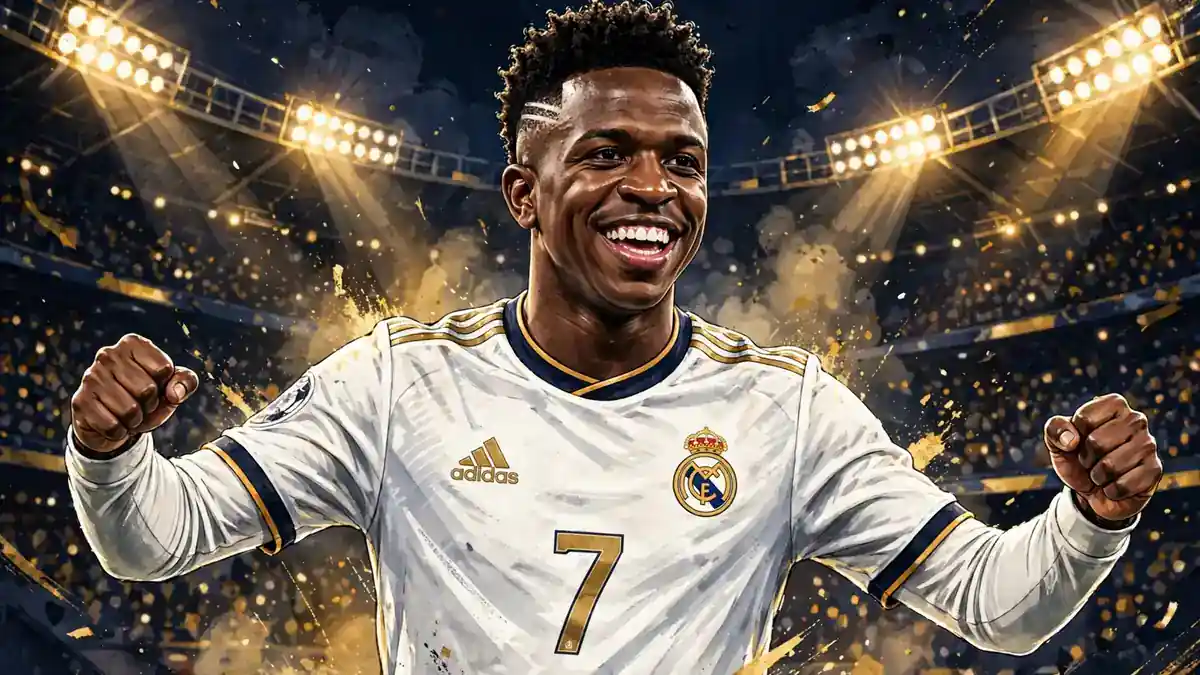
Vinicius Junior‘s net worth is estimated at $50–100 million in 2026, anchored around $80 million as of November 2026. The 26-year-old Brazilian winger earns his money from three places: a new Real Madrid contract that runs to 2032 and pays a reported €31.25 million a year gross, an endorsement portfolio Forbes values at about $20 million a year, and a growing stake in club ownership after his February 2025 purchase of Portuguese side FC Alverca. He turned down a reported €1 billion Saudi offer in 2024, finished second in the 2024 Ballon d’Or, then won The Best FIFA Men’s Player award two months later — and every one of those moments moved his market value.
Vinicius Junior: Quick Facts
| Estimated net worth | $80 million (range: $50–100 million) |
|---|---|
| Profession | Professional footballer — left winger, Real Madrid and Brazil |
| Nationality | Brazilian |
| Born | 12 July 2000 (age 26) |
| Height | 1.76 m (5 ft 9 in) |
| Primary income sources | Real Madrid salary, Nike and endorsement deals, club ownership |
| Active years | 2017–present |
| Last reviewed | November 2026 |
- Early Life and Background
- Education
- Career Journey
- Rise to Fame
- Main Sources of Income
- Salary and Earnings
- Businesses and Investments
- Brand Deals and Sponsorships
- Houses, Cars and Other Assets
- Awards and Achievements
- Net Worth Growth Over the Years
- Social Media Presence
- Personal Life
- Sources & Reporting
- Frequently Asked Questions
Early Life and Background
Vinícius José Paixão de Oliveira Júnior was born on 12 July 2000 in São Gonçalo, a working-class city across Guanabara Bay from Rio de Janeiro. He grew up in the neighbourhood of Mutuá, where football was played on concrete and dirt pitches, and his first organised games came through a futsal school run by Flamengo, the Rio giants who spotted him as a child. Flamengo’s academy took him in at ten years old, and from that point his path ran through one of Brazil’s most demanding youth systems.
The background matters to the money story because it explains the shape of his career. Vinicius Junior did not arrive in Europe as a finished product with a big transfer fee attached to a bidding war. Real Madrid agreed to buy him in May 2017, when he was still 16, for a reported €45 million — at the time a record fee for a player of that age — and then waited a year for him to turn 18 before he could move. That structure, a huge fee paid for potential rather than production, set the pattern for everything that followed: Madrid invested early, carried the risk, and then paid him like a star once he became one.
His family stayed close through the move. His father worked to support the household while Vinicius Junior trained, and the player has spoken in interviews about the sacrifices of those early years in São Gonçalo — long trips across Rio for training, tight money at home, and the pressure of being the family’s hope. That history also explains his later charity work: the Instituto Vini Jr, his education project, puts sports and technology into public schools in Brazil, aimed at children growing up in the same kind of neighbourhood he came from.
Flamengo gave him his senior debut in May 2017, weeks before his seventeenth birthday. He played 37 times for the club’s first team across 2017 and 2018, scoring seven goals, and by the time he boarded the flight to Madrid in the summer of 2018 he was already one of the most talked-about teenagers in world football. The fee Madrid had agreed a year earlier looked less like a gamble with every month that passed.
Education
There is no public record of Vinicius Junior completing formal higher education, and this article does not invent one. Like most Brazilian academy players, his schooling ran alongside full-time football training from childhood, with Flamengo’s youth setup providing the structure. His education in the professional sense came on the training pitch: futsal first, which built the close control and quick feet that still define his game, then Flamengo’s academy, then two seasons with Real Madrid Castilla, the club’s reserve side, where he learned European football after arriving in 2018.
The gap in formal schooling is part of why the Instituto Vini Jr matters to his public profile. The project, run through his own institute, funds sports and technology programmes in Brazilian public schools, and it gives him a social cause that sponsors and the club both point to when they talk about his value beyond goals. It is also a reminder that for a player who left school early to play football, education became something he funds for others rather than something he collected for himself.
Language is a small but real part of his professional education. He arrived in Madrid speaking Portuguese and learned Spanish quickly enough to handle press duties and dressing-room life, a practical skill that widened his commercial appeal in Spain and across Latin America. His English remains limited in public appearances, which is one reason his biggest endorsement work stays centred on football, fashion and lifestyle brands rather than English-language media.
Career Journey
Vinicius Junior’s career splits into four clear chapters, and each one raised his pay. Flamengo (2017–2018) made him a professional and a transfer target. Real Madrid Castilla and the first team (2018–2021) turned him from a raw prospect into a regular starter. The breakout years (2021–2024) made him one of the best attackers in Europe. And the 2024–2026 period made him one of the best-paid footballers on the planet, with a contract extension that runs to 2032.
His first season in Madrid was a lesson in patience. He played mostly for Castilla in Spain’s third tier and made 31 first-team appearances in 2018–19, scoring four goals. The talent was obvious — the dribbling, the acceleration, the willingness to take on defenders — but the finishing was not. For two seasons, critics in Spain questioned whether a player bought for €45 million would ever score enough goals to justify the fee. His salary at that stage reflected his status: a promising young player on a prospect’s wage, not a star’s.
The 2019–20 season brought his first La Liga title and his first big European night, a goal against Barcelona in the Clásico in March 2020. He finished that campaign with five goals in all competitions — modest numbers, but the direction was right. In 2020–21 he scored six goals, including two against Liverpool in a Champions League quarter-final, and started to look like a player Madrid could build around.
Then came the season that changed his finances. In 2021–22, under Carlo Ancelotti, Vinicius Junior scored 22 goals in all competitions and set up the winner in the Champions League final against Liverpool in Paris — the goal that won Madrid their 14th European Cup. He signed his first big-money extension in October 2023, running to June 2027 with a €1 billion release clause, and took the number 7 shirt for the 2023–24 season, the number worn by Cristiano Ronaldo and Raúl before him. The shirt was a statement: Madrid saw him as the face of the team.
His international career ran in parallel. He made his Brazil debut in September 2019, played at the 2022 World Cup in Qatar, and has been a regular starter for the Seleção since. Brazil’s attack is built around him now, and that status feeds directly into his endorsement value — a Brazilian star at Real Madrid is a commercial proposition that reaches two continents at once.
Rise to Fame
Three nights made Vinicius Junior famous, and each one is worth naming because each one moved his price. The first was the Champions League final in Paris on 28 May 2022, when his 59th-minute goal beat Liverpool 1–0 and won the trophy. The second was the 2023–24 season, when he scored 24 goals in 39 appearances, won La Liga and the Champions League again, scored in the final at Wembley against Borussia Dortmund, and finished as the Champions League’s player of the season. The third was the winter of 2024, when he finished second in the Ballon d’Or voting behind Manchester City’s Rodri and then won The Best FIFA Men’s Player award in December 2024 — the first time a Brazilian had won FIFA’s top individual prize since the award’s current format began.
The Ballon d’Or episode deserves a straight account, because it still shapes how his value is discussed. Vinicius Junior was the favourite for most of 2024, then lost to Rodri by a narrow margin. Real Madrid boycotted the Paris ceremony when the result leaked, and no club representative attended. Two months later, FIFA’s award went the other way: Vinicius Junior took 48 points to Rodri’s 43, with Jude Bellingham third on 37. He collected the trophy in Doha, where Madrid were playing the Intercontinental Cup final. The episode cost him nothing financially — if anything, the controversy raised his profile — but it left a mark on his relationship with football’s awards circuit.
By the summer of 2026 his standing at Madrid was beyond argument. When the club announced his new contract on 6 August 2026, the announcement listed the numbers like a balance sheet: 375 matches, 128 goals, 100 assists and 14 trophies since his arrival. Those are the figures of a player who has already had a great Madrid career, with six years of contract still to run. At 26, he is in the middle of his peak earning years, not at the end of them.
His rise also came with a fight that made him a public figure beyond football. After repeated racist abuse from crowds in Spain, most notoriously at Valencia’s Mestalla stadium in May 2023, he became the most prominent anti-racism voice in the sport. In June 2024, three Valencia supporters received prison sentences over the abuse — the first convictions of their kind in Spanish football. The campaign cost him energy and attention, and it also built a reputation that sponsors value: a player who stands for something is easier to put on a billboard than one who stands for nothing.
Main Sources of Income
Vinicius Junior’s money comes from four streams, and they are very different in size. The Real Madrid salary is the biggest single item. Endorsements are the second, worth about $20 million a year according to Forbes. Club ownership, through FC Alverca, is a smaller but growing asset. And prize money and bonuses — Champions League wins, La Liga titles, the Intercontinental Cup — add irregular lump sums on top of the base wage.
The salary dominates because of the 2026 extension. Capology, the salary database, prices the new deal at €31.25 million a year gross, or about €600,962 a week, before bonuses. That is roughly double the €20.83 million a year Capology listed under the old deal, and it puts him among the highest-paid players at the club. The reported net figure — what he actually keeps after Spain’s top tax rates — is around €22–24 million a year, according to reporting by ESPN, MARCA and Fabrizio Romano around the August 2026 announcement.
Endorsements are the second pillar. Forbes’s June 2026 ranking put his off-field earnings at $20 million over twelve months, and the portfolio behind that number is broad: Nike as the flagship boot deal, plus Pepsi, Gatorade, Visa, Unilever, EA Sports FC, Hugo Boss, Marriott, Rexona and Prada Eyewear, according to Forbes’s sponsor listings and 2026 profiles. The Nike deal alone is worth roughly $10 million a year, per reporting on the renegotiated contract.
Ownership is the newest stream. In February 2025 he led a consortium of Spanish and Brazilian investors — backed by Roc Nation Sports Brazil — that bought a 70–80% stake in FC Alverca, a Portuguese second-tier club, for a reported €8–10 million. Alverca won promotion to the Primeira Liga as runners-up in Liga Portugal 2 at the end of the 2024–25 season, which immediately raised the value of the stake. It is the same playbook his teammate Kylian Mbappé followed at Caen in France: buy a smaller club cheap, use your name and network to lift it, and hold an asset that grows while you keep playing.
What he does not have is a long list of side businesses. There is no restaurant chain, no fashion label, no public property empire. His wealth is concentrated in football: the wage, the boots, the club stake. That concentration is both a strength and a risk — the money is tied to his legs, and the contract to 2032 is the insurance policy against that risk.

Salary and Earnings
The honest way to talk about Vinicius Junior’s salary is to show the two contracts, because the number changed sharply in August 2026 and many older articles still show the old one. Under the deal he signed in October 2023, Capology listed his gross base salary at about €20.83 million a year, or roughly €400,577 a week, before bonuses. That was the figure most 2025 and early-2026 profiles quoted, and it is the reason some of them put his net worth lower.
The August 2026 extension replaced it. Real Madrid announced the six-year deal on 6 August 2026, running to 30 June 2032, and Capology’s data from early October 2026 prices it at €31.25 million a year gross — €600,962 a week. Reporting by ESPN, MARCA and Fabrizio Romano put the net figure at roughly €22 million a year in base pay, rising to €22–24 million with bonuses and the signing fee spread across the deal. The €1 billion release clause carried over unchanged from the 2023 contract.
Forbes gives the cleanest annual picture. In its June 2026 ranking of the highest-paid players at the World Cup, Forbes put Vinicius Junior’s total earnings at $60 million over the twelve months to May 2026 — $40 million on the field and $20 million off it — making him the fifth-highest-paid player at the tournament. That $40 million on-field figure covers salary plus bonuses, and it was measured before the new contract took effect, so the next Forbes ranking should show a higher on-field number.
Career earnings put the net worth figure in context. Capology’s salary history, cited by SureBets in July 2026, puts his gross career salary at about $124 million — the total of every club wage from Flamengo through the old Madrid deal, before tax, agent fees and spending. That number is the reason a net worth of $80 million is plausible: he has earned well over $100 million gross in wages alone, plus roughly $20 million a year in endorsements for several years, and he is 26 with six years of a top contract ahead of him.
Two cautions belong here. First, gross is not net. Spain’s top marginal tax rate runs to roughly 47%, and agent fees, image-rights structures and living costs all come out before anything is saved. Second, the €1 billion release clause is not money he owns. It is a deterrent — the price Madrid set so that no club could buy him without paying a world-record fee — and it says nothing about his bank balance. Readers who see the clause quoted next to his net worth are looking at two different kinds of number.
Businesses and Investments
FC Alverca is the investment that defines Vinicius Junior’s business profile. The deal closed in February 2025: a consortium led by Vinicius Junior and backed by Roc Nation Sports Brazil bought a 70–80% stake in the Portuguese club from previous owner Ricardo Vicintin. The price was reported at between €8 million and €10 million, with Fabrizio Romano reporting around €8 million and Forbes putting the deal near €10 million. Alverca, based in Alverca do Ribatejo about 30 kilometres from Lisbon, were second in Liga Portugal 2 at the time of the purchase and chasing promotion.
The investment paid off quickly on the pitch. Alverca finished as runners-up in Liga Portugal 2 in the 2024–25 season and won promotion to the Primeira Liga, Portugal’s top flight, for the first time in years. Promotion changes the economics of a club at once: bigger broadcast money, bigger crowds, higher player values. A stake bought in the second tier is worth more in the first tier, and the consortium’s timing — buying a club already second in the table — looks sharp in hindsight.
The Alverca deal also connects to a wider pattern. Kylian Mbappé bought a majority stake in Caen in 2024, and Vinicius Junior followed his teammate into ownership within months. The model is clear: active players with big names and big networks can add value to a small club simply by being involved, and the club becomes an asset that keeps working after the playing career ends. Roc Nation Sports Brazil’s involvement matters here too — the agency behind the deal is run by Jay-Z’s Roc Nation group, which also represents Vinicius Junior, so the commercial and sporting sides of his career now run through the same people.
Beyond Alverca, his investment record is thin in public. Reports in 2025 linked him to an interest in Athletic Club, a Brazilian side, but no completed deal has been confirmed in the reporting this article could verify, so it is noted here as an unconfirmed report rather than a fact. There are no verified public records of a property portfolio, a startup portfolio or a restaurant or fashion business. His charity, the Instituto Vini Jr, is a social investment rather than a commercial one, and it is the part of his off-field life he talks about most in interviews.
That thinness is worth stating plainly. Some net-worth profiles pad this section with businesses that do not exist. Vinicius Junior’s wealth is football wealth: a wage, a boot deal, a club stake. The Alverca purchase is real and well documented, and it is enough — it shows a player thinking about what comes after football while he is still at the top of the game.
Brand Deals and Sponsorships
Nike is the deal that everything else hangs from. The American brand has supplied Vinicius Junior’s boots since the early years of his career, and the relationship has survived a public fight. In December 2022 he filed a lawsuit seeking to end a deal reportedly worth £7 million a year, after disputes over boots and the terms of the contract. In February 2023 he played in blackout boots — no visible Nike branding — while the dispute ran. By the end of 2023 the two sides had settled on new terms, and reporting on the renegotiated deal puts its value at roughly $10 million a year, about half of his total endorsement income.
The rest of the portfolio is wide. Forbes’s sponsor listings connect him with Pepsi, Gatorade, Visa, Unilever, EA Sports FC, Hugo Boss, Marriott, Rexona and Prada Eyewear, and 2026 reporting adds Apple — SportsLeo reported in August 2026 that he became a face of AirPods Pro marketing in South America and Europe in June 2026. The total, per Forbes, is about $20 million a year in off-field earnings, a figure that has grown steadily as his on-field profile has risen.
Two things make the portfolio valuable. The first is geography: a Brazilian star at Real Madrid sells in Brazil, Spain and across Latin America at the same time, and brands pay for that reach. The second is image: his anti-racism campaigning, his charity work and his status as FIFA’s best player give sponsors a story that goes beyond goals. Nike’s decision to renegotiate rather than lose him in 2023 shows how much that story is worth — brands do not pay $10 million a year to a player they can replace.
Representation matters too. He is represented by Roc Nation Sports, the agency founded by Jay-Z, which handles his commercial deals and backed the Alverca purchase through its Brazilian arm. That relationship explains the shape of his portfolio: fewer, bigger deals with global brands, rather than a long list of small local sponsorships. It also explains the Apple link — Roc Nation’s network reaches well beyond football.
The one deal that never happened is also part of the story. In August 2024, Saudi Arabia’s Public Investment Fund, acting for Al Hilal and later linked to Al Ahli, approached his representatives with an offer reported by AS, Relevo and The Athletic at around €1 billion over five years — roughly €200 million a year, about six times his Madrid gross at the time. He did not take it. Saudi sources later denied that a formal offer had ever been made, so the record carries both versions: Spanish reporting that the offer existed and he said no, and Saudi-side denials that it reached his desk. Either way, Madrid read the episode as a threat and answered with the €1 billion release clause in his next deal.

Houses, Cars and Other Assets
Vinicius Junior’s property and car holdings are the least documented part of his wealth, and this section says so rather than filling the gap with guesswork. He lives in Madrid, where he has been based since 2018, and Spanish reporting has placed him in the La Finca area, the gated neighbourhood west of the city where several Madrid players live. No verified public record gives a purchase price for his home, and no property registry document has been published, so this article does not put a number on it.
His cars are better reported but still thin on confirmed prices. He has been photographed with high-end SUVs and sports cars, and his garage is routinely described in fan and lifestyle coverage as including Lamborghini and Audi models. Those descriptions are not backed by purchase records or insurance documents in the reporting this article could verify, so they are noted as reported rather than confirmed. What can be said with confidence is that cars are a small part of his wealth — a rounding error next to a €31.25 million annual wage.
The assets that matter are the ones with paperwork behind them. The Alverca stake is the largest verified asset outside football: a 70–80% holding in a club now playing in Portugal’s top flight, bought for €8–10 million. His image rights are the second: the commercial value of his name, face and number 7 shirt, which underpins the Nike deal and the rest of the endorsement portfolio. And his contract itself is an asset of a kind — six years of guaranteed top-tier wages, running to 2032, is the financial foundation everything else rests on.
What he does not appear to own is also worth noting. There is no verified record of a hotel, a restaurant chain, a fashion label or a property fund in his name. Compared with older stars who built business empires while still playing, Vinicius Junior’s asset list is short and football-shaped. At 26, with the Alverca purchase behind him and the Roc Nation network around him, that list is likely to grow — but the growth has not been documented yet.
Awards and Achievements
The trophy list is the strongest part of Vinicius Junior’s record, and it is also the part that drives his pay. With Real Madrid he has won the UEFA Champions League twice (2021–22 and 2023–24), La Liga three times (2019–20, 2021–22, 2023–24), the Copa del Rey once (2022–23), the Spanish Super Cup, the UEFA Super Cup and the FIFA Intercontinental Cup. The club’s own announcement of his 2026 extension counted 14 trophies in total across his Madrid career.
The individual honours are what separate him from other trophy winners. He was named Champions League Player of the Season for 2023–24, won The Best FIFA Men’s Player award in December 2024, and finished second in the 2024 Ballon d’Or. He scored in both Champions League finals he played in — the winner against Liverpool in Paris in 2022 and the sealing goal against Borussia Dortmund at Wembley in 2024 — becoming the youngest player to score in two Champions League finals. He has been named in the Champions League and La Liga teams of the season more than once.
For Brazil, the honours are thinner so far. He played at the 2022 World Cup, where Brazil reached the quarter-finals, and has been part of Copa América squads without yet winning a major international trophy. That gap is the one hole in his record, and it is also the reason the 2026 World Cup matters so much to his legacy — and to his commercial value, since a World Cup win would lift his endorsement earnings further. Forbes’s decision to rank him among the highest-paid players at the 2026 tournament shows that the market already treats him as a World Cup star, trophy or not.
The numbers behind the honours are worth keeping in one place. At the August 2026 contract announcement, Real Madrid credited him with 375 appearances, 128 goals and 100 assists for the club. In the 2023–24 season alone he scored 24 goals in 39 games, with six goals in the Champions League including a brace in the semi-final against Bayern Munich and the goal in the final. Those are the figures sponsors and salary negotiators actually look at — not the trophy count, but the goals that won the trophies.
Net Worth Growth Over the Years
Vinicius Junior’s wealth has grown in steps, and each step follows a contract or a trophy. The table below uses published estimates for each year, with the source named. The figures are estimates, not bank statements, and the range widens in years when sources disagreed.
| Year | Estimated net worth | What moved it |
|---|---|---|
| 2018 | $1–2 million | Joined Real Madrid from Flamengo on a prospect’s wage after the €45 million transfer |
| 2019 | $3–5 million | First La Liga title; Brazil debut; early Nike deal in place |
| 2020 | $5–8 million | Clásico goal against Barcelona; regular starter status |
| 2021 | $8–12 million | Champions League quarter-final goals against Liverpool |
| 2022 | $20–30 million | Champions League final winner; 22-goal season; La Liga and European double |
| 2023 | $30–50 million | New contract to 2027 with €1 billion clause; number 7 shirt; Nike renegotiation |
| 2024 | $50–80 million | Champions League and La Liga double; Ballon d’Or second place; FIFA Best award; Saudi offer rejected |
| 2025 | $55–90 million | Alverca purchase; Forbes $60 million annual earnings; promotion for Alverca |
| 2026 | $50–100 million (anchored ~$80 million) | Contract extension to 2032 at €31.25 million a year gross; Celebrity Net Worth $80 million |
The pattern is clear: the big jumps came after the two Champions League wins and the two contract signings, not gradually. Football wealth works that way — a player earns a prospect’s wage until he proves himself, then the pay doubles in a single negotiation. The 2026 extension is the biggest jump of all, and because it runs to 2032, the next five years should be the steepest part of the curve, provided he stays fit and in form.
For comparison, his peers show how much room there still is. Neymar, the Brazilian star he grew up watching, is estimated by Celebrity Net Worth at around $200 million after a longer career and a record transfer to Paris Saint-Germain. Erling Haaland, his generational rival at Manchester City, is estimated in the same region as Vinicius Junior or higher, depending on the outlet. Vinicius Junior is 26 with six years of a top contract ahead of him; the gap to the $200 million bracket is a matter of time and trophies, not talent.
Social Media Presence
Vinicius Junior is one of the most-followed footballers on the planet, and his social media presence is a commercial asset in its own right. His Instagram audience runs into the tens of millions, putting him in the top tier of footballers on the platform, behind only the sport’s two biggest names. That reach is the reason brands pay him $20 million a year off the field: a single post from his account reaches more people than most television adverts.
He uses the accounts the way modern stars do — match highlights, training clips, fashion and lifestyle posts, and messages about his charity and anti-racism work. The Instituto Vini Jr features regularly, and his posts about racist abuse in Spain have been shared worldwide, turning his feed into a platform for a cause as well as a shop window for sponsors. Nike and his other partners feature in the feed, but the account is not a billboard: the football and the personal posts come first, which is exactly why the sponsored posts land.
The commercial logic is simple. Forbes’s $20 million off-field figure is not paid for goals; it is paid for attention. Every follower is a person a brand can reach through him, and every viral moment — a Champions League final goal, a Ballon d’Or speech, a stand against racism — adds followers and raises the price of the next deal. His social media is, in that sense, part of his salary: the bigger the audience, the bigger the endorsement cheque.
Personal Life
Vinicius Junior keeps his private life out of the press more than most stars of his size. He is not married, and he does not parade relationships in public. His family remains central: his parents and siblings have been part of his life in Madrid since the move from Brazil, and his mother and father have spoken publicly about the sacrifices of the São Gonçalo years. He is close to his teammates, particularly the Brazilian group at Madrid, and his friendship with Rodrygo — the two arrived as teenagers a year apart — is one of the dressing room’s best-known bonds.
Faith and family shape his public image. He has spoken about his Christian faith in interviews and on social media, and his charity work through the Instituto Vini Jr is the most visible expression of it. The institute’s work in Brazilian public schools — sports, technology and education for children from neighbourhoods like the one he grew up in — is the project he returns to whenever he is asked what matters to him beyond football.
His life in Madrid is deliberately low-key for a player of his fame. He trains, he plays, he spends time with family and friends, and he avoids the nightclub headlines that have followed other young stars. That discipline shows in his career: he has stayed largely injury-free through his peak years, and his form has risen steadily rather than in bursts. The one public fight he has picked — against racism in Spanish football — he picked on principle, and it has defined his public standing as much as any goal.
Sources & Reporting
Forbes — June 2026 World Cup earnings ranking: $60 million total over twelve months to May 2026, split $40 million on-field and $20 million off-field; fifth-highest-paid player at the tournament; sponsor listings including Nike, Gatorade, Pepsi, Hugo Boss, Marriott, Visa and Unilever.
Celebrity Net Worth — $80 million net worth estimate (snapshot November 5, 2026); $60 million estimated annual earnings, split $40 million salary and bonuses and $20 million endorsements; 2023 extension to 2027 with €1 billion release clause.
Essentially Sports — $80 million net worth estimate, July 2026; contract and salary reporting (noting the pre-extension 2027 end date, now superseded by the August 2026 extension).
Capology — Salary data: €31.25 million a year gross (€600,962 a week) under the 2026 extension; €20.83 million a year gross under the old deal; approximately $124 million in gross career salary; €62.49 million remaining on the old deal through June 2027.
ESPN, MARCA and Fabrizio Romano — reporting on the August 2026 extension to June 2032 and the reported net figure of €22–24 million a year.
Real Madrid — Official announcement of the August 6, 2026 extension; career totals at announcement of 375 matches, 128 goals, 100 assists and 14 trophies; official 2023 renewal announcement confirming the contract to June 2027.
FIFA — The Best FIFA Men’s Player 2024 award, December 17, 2024 in Doha; 48 points to Rodri’s 43; voting period August 21, 2023 to August 10, 2024.
Britannica — Career record: Champions League final goals in 2022 and 2024, 24 goals in 39 appearances in 2023–24, La Liga titles, Ballon d’Or second place in 2024.
The Athletic — August 2024 reporting on the Saudi Public Investment Fund approach and the €1 billion offer; AS and Relevo reporting on the same approach and the €200 million-a-year figure.
SureBets — July 2026 estimate of $55–80 million, with Capology career salary and Forbes earnings figures cited.
Reporting window: June–November 2026, with historical contract and career facts drawn from 2017–2024 reporting. Where outlets disagree — the Alverca price (€8 million versus €10 million), the Saudi offer (reported by Spanish outlets, denied by Saudi sources), the 2023–24 assist total — this article gives both versions and says which is which.
Frequently Asked Questions
What is Vinicius Junior’s net worth in 2026?
Vinicius Junior’s net worth is estimated at $50–100 million in 2026, anchored around $80 million. Celebrity Net Worth puts the figure at $80 million (snapshot November 5, 2026), and Essentially Sports and SportsLeo agree on $80 million. The range exists because his salary changed sharply in August 2026, his assets are private, and outlets use different methods — but $80 million is the figure the freshest reporting supports.
How much does Vinicius Junior earn per year?
Forbes put his total earnings at $60 million over the twelve months to May 2026 — $40 million on the field and $20 million off it. His new Real Madrid contract, signed in August 2026, pays a reported €31.25 million a year gross (about €600,962 a week) according to Capology, with a reported net figure of €22–24 million a year after tax and bonuses. The Forbes figure was measured before the new contract took effect, so his next annual total should be higher.
How long is Vinicius Junior’s Real Madrid contract?
His current contract runs to 30 June 2032. Real Madrid announced the six-year extension on 6 August 2026. It replaced the deal he signed in October 2023, which ran to June 2027. Older articles that still show 2027 were written before the August 2026 announcement. The €1 billion release clause carried over unchanged into the new deal.
What is Vinicius Junior’s salary at Real Madrid?
Under the 2026 extension his gross base salary is a reported €31.25 million a year, or about €600,962 a week, per Capology’s data from early October 2026. After tax, reporting by ESPN, MARCA and Fabrizio Romano puts the net figure at roughly €22 million a year in base pay, rising to €22–24 million with bonuses and the signing fee. Under the old 2023 deal the gross figure was about €20.83 million a year.
Did Vinicius Junior reject a Saudi Arabia offer?
Spanish outlets including AS, Relevo and The Athletic reported in August 2024 that Saudi Arabia’s Public Investment Fund, acting for Al Hilal and later linked to Al Ahli, offered him around €1 billion over five years — roughly €200 million a year. He did not take it, and Real Madrid refused to negotiate. Saudi sources later denied that a formal offer had ever been made, so the record carries both versions. Either way, the episode ended with the €1 billion release clause in his next contract.
What brands endorse Vinicius Junior?
Nike is his flagship deal, worth roughly $10 million a year after a renegotiation in late 2023 that followed a public dispute in 2022. Forbes’s sponsor listings also connect him with Pepsi, Gatorade, Visa, Unilever, EA Sports FC, Hugo Boss, Marriott, Rexona and Prada Eyewear. SportsLeo reported in August 2026 that he became a face of Apple’s AirPods Pro marketing in June 2026. Forbes values his total off-field earnings at about $20 million a year.
Does Vinicius Junior own a football club?
Yes. In February 2025 he led a consortium backed by Roc Nation Sports Brazil that bought a 70–80% stake in FC Alverca, a Portuguese club, for a reported €8–10 million. Alverca won promotion to the Primeira Liga as runners-up in Liga Portugal 2 at the end of the 2024–25 season. It is the same ownership model his teammate Kylian Mbappé followed at Caen in France.
Did Vinicius Junior win the Ballon d’Or?
No. He finished second in the 2024 Ballon d’Or behind Manchester City midfielder Rodri, and Real Madrid boycotted the Paris ceremony when the result leaked. Two months later he won The Best FIFA Men’s Player award for 2024, taking 48 points to Rodri’s 43, after a season in which he scored 24 goals in 39 games and won La Liga and the Champions League with Real Madrid.
Final Thoughts
Vinicius Junior’s net worth — $50–100 million, anchored around $80 million — is the number of a player who has already earned his fortune and is about to earn a much bigger one. The August 2026 contract to 2032 pays a reported €31.25 million a year gross, the Nike deal brings in roughly $10 million a year, and the Alverca stake gives him an asset that grows while he plays. He turned down a reported €1 billion from Saudi Arabia to stay in Madrid, and Madrid answered by making him the face of the team and the highest-paid player in the squad.
The honest caveat is that the number is an estimate, not a bank balance. His assets are private, the tax bill on a Spanish salary is heavy, and the range between outlets — $50 million at the low end, $100 million at the high end — reflects real uncertainty about what he keeps versus what he earns. But the direction is not uncertain. At 26, with six years of a top contract ahead of him, a World Cup to play for Brazil, and a club of his own in Portugal’s top flight, his wealth has further to climb than most players his age. The $80 million figure is a snapshot of a career still rising.
Published on 8 November 2026. Last reviewed November 2026. Found an error? See our corrections policy.