
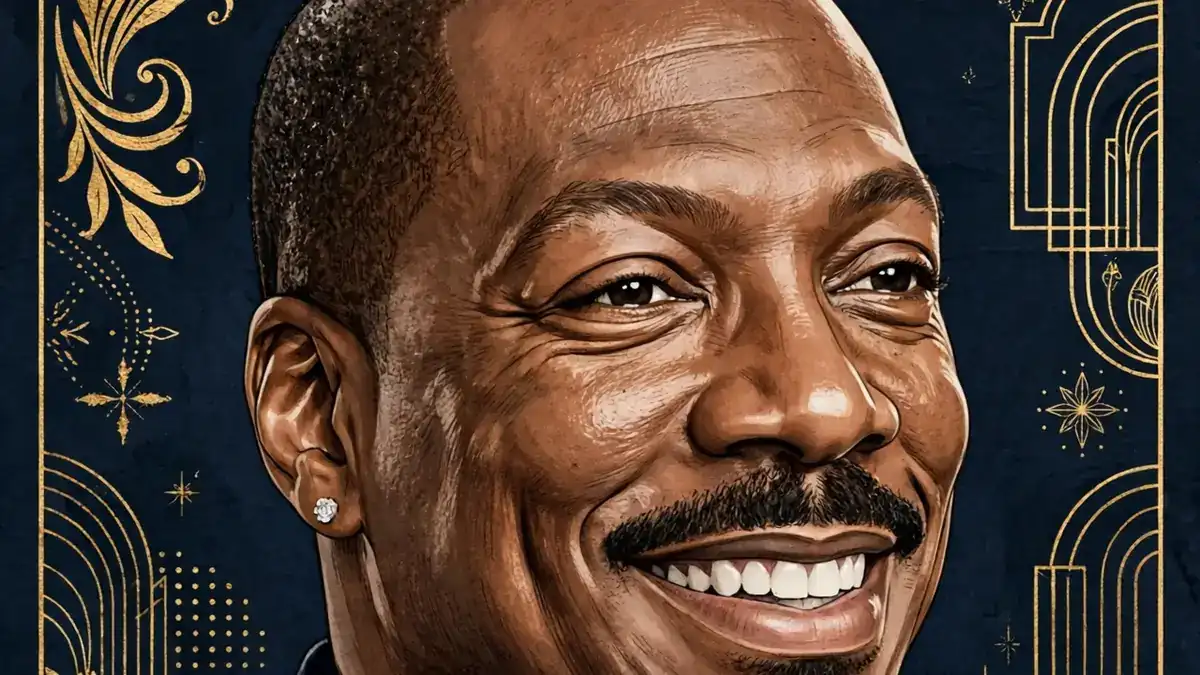
Eddie Murphy‘s net worth is estimated at $200 million to $250 million as of October 2026. The headline figure most outlets still print is $200 million, and that is the number this article anchors on — but one 2025 profile puts him at $250 million, so the honest answer is a range, not a single audited total. The money comes from a career that has now run for five decades: a record-breaking run as a teenage stand-up and Saturday Night Live star, a string of 1980s blockbusters that made him the highest-paid comic actor of his generation, a voice role as Donkey that still pays, and a streaming second act built on a reported $70 million Netflix deal. His films have grossed close to $7 billion worldwide, and reported career pay — salaries, backend points and deal proceeds — runs past $420 million. Taxes, two expensive family settlements, a long quiet stretch in the 2000s and 2010s, and a very large family explain why a man who has earned that much is worth $200 million rather than far more.
Eddie Murphy: Quick Facts
| Estimated net worth | $200 million (range: $200 million to $250 million) |
|---|---|
| Profession | Actor, comedian, producer, singer, voice actor |
| Nationality | American |
| Born | April 3, 1961 (age 65) |
| Height | 5 ft 9 in (1.75 m) |
| Primary income sources | Film salaries and backend points, Shrek voice work, Netflix streaming deals, stand-up specials, producing, music royalties, real estate |
| Active years | 1976–present |
| Last reviewed | October 2026 |
- Early Life and Background
- Education
- Career Journey
- Rise to Fame
- Main Sources of Income
- Salary and Earnings
- Businesses and Investments
- Brand Deals and Sponsorships
- Houses, Cars and Other Assets
- Awards and Achievements
- Net Worth Growth Over the Years
- Social Media Presence
- Personal Life
- Sources & Reporting
- Frequently Asked Questions
- Final Thoughts
Early Life and Background
Edward Regan Murphy was born on April 3, 1961, in Brooklyn, New York, to Lillian Murphy, a telephone operator, and Charles Edward Murphy, a transit police officer who performed comedy on the side. That second detail matters more than it looks: the household had both a steady public-service wage and a father who wanted a stage. Murphy’s parents divorced when he was three. His father died when Eddie was eight, and his mother fell seriously ill not long after. Eddie and his older brother Charlie spent a period in foster care while their mother recovered — an experience Murphy has described in interviews as formative, and one that shows up, in coded form, in the family material that runs through his stand-up and his films about large, chaotic households.
The family settled in Roosevelt, a working-class town on Long Island’s South Shore. Roosevelt gave Murphy two things that shaped his act: a room full of relatives and neighbours to imitate, and a youth centre stage. He has said he was doing impressions of relatives, teachers and television figures before he had any thought of a profession. Richard Pryor was the model he cited most often — Pryor proved a Black comic could fill rooms talking about his own life in his own language — and Murphy’s early act borrowed Pryor’s frankness while keeping Murphy’s own speed: rapid-fire voices, characters switched mid-sentence, and a laugh that became, for a time, as famous as the jokes.
Money was tight in Roosevelt, and Murphy has never hidden that. The contrast between that start and the Beverly Park estate he lives in now is the whole arc of the fortune: a kid from public housing in Brooklyn and a modest Long Island town who, by 23, was signing a multi-picture studio deal, and who by his mid-60s owns a house, an island and a filmography that still generates cheques. The early years also explain his later spending pattern. Unlike stars who collect cars or watches in public, Murphy’s big outlays have almost always been houses large enough for a family that kept growing — ten children, across four relationships — and privacy: gates, acreage, and distance from the street.
Education
Murphy attended school in Roosevelt, Long Island, where he was already performing stand-up by his mid-teens. His first credited stage appearance, at the Roosevelt Youth Center at 15, came while he was still at school, and the clubs followed quickly: by 16 and 17 he was working rooms in New York, learning the trade in front of live crowds rather than in a classroom. No university degree sits behind the career, and that is not a gap in the story — it is the story. Murphy turned professional as a teenager, and the education that mattered was stage time: hundreds of sets in clubs where a joke that died stayed dead and a character that worked got kept.
That apprenticeship explains the speed of everything that followed. When Saturday Night Live auditioned him at 19, he arrived with a fully formed act — voices, characters, timing — rather than raw potential a show would need to develop. It also explains why his later career choices sometimes read as a performer trusting instinct over coaching: the multi-character films, the decision to direct Harlem Nights (1989) himself, the long stand-up silence after Raw. He learned by doing, in public, and the pay cheques from age 19 onward reflect a performer who was already a finished product when television found him.
Career Journey
Murphy’s career falls into four clear acts, and the money follows the same shape. Act one, 1976 to 1984, is stand-up and television: clubs, then Saturday Night Live from 1980 to 1984, then two concert films that turned a stage act into box-office product. Act two, 1982 to the early 1990s, is the blockbuster run: 48 Hrs. (1982), Trading Places (1983), Beverly Hills Cop (1984), Coming to America (1988) and The Nutty Professor (1996), with pay climbing from under half a million dollars a film to $20 million a film. Act three, roughly 1997 to 2018, mixes family hits (Dr. Dolittle, Shrek, Daddy Day Care) with a long run of misses that cooled his asking price. Act four, 2019 to today, is the streaming comeback: Dolemite Is My Name, the $70 million Netflix arrangement, Coming 2 America for Amazon, Beverly Hills Cop: Axel F for Netflix, and a return to Donkey in Shrek 5, scheduled for 2027.
The through-line is ownership of characters. Axel Foley, Prince Akeem, Sherman Klump and the whole Klump family, Donkey — Murphy did more than star in franchises: he became the reason they existed. Studios paid for that twice: once as salary, once as backend points, and a third time when a streamer paid to revive a character only he could play. That is why Axel F could command a reported $150 million budget on Netflix in 2024, thirty years after the previous Beverly Hills Cop film, and why a Donkey spin-off is scheduled for 2028. Nobody else can be Axel Foley or Donkey, and in a business built on replaceable parts, that scarcity is the asset.
There is also a second, quieter career running underneath: producer. Murphy’s production company, Eddie Murphy Productions, has credits across his later films, including Axel F, where he is listed as a producer alongside Jerry Bruckheimer. Producing fees sit on top of acting pay and, on streaming deals, can be structured as a separate payment stream that does not show up in a headline salary figure. The public salary numbers in this article therefore understate the total deal value on his recent projects — a point worth keeping in mind when comparing a 1980s pay cheque with a 2020s streaming package.
Rise to Fame
Saturday Night Live was the launchpad, and the circumstances were close to accidental. Murphy auditioned in 1980 as a 19-year-old, was hired as a featured player, and within a season had become the show’s most popular cast member at a moment when the show itself was struggling after its original cast left. Characters like Mr. Robinson, Velvet Jones and his Gumby impression gave the show a centre again, and his pay reflected his bargaining power fast: a reported $4,500 per episode in his first season, rising to $30,000 per episode the next — an unusual jump for a newcomer, and a sign of how quickly NBC understood what it had.
Film stardom arrived almost at once. 48 Hrs. (1982), opposite Nick Nolte, cast him as a convict let out for two days to help catch a cop killer, and the film’s $78.9 million worldwide gross made a 21-year-old comic a credible leading man. Trading Places (1983) with Dan Aykroyd proved he could carry a comedy built on plot as well as personality. Then came Beverly Hills Cop (1984): $316 million worldwide on a $14 million budget, the highest-grossing film of 1984, and a character — Detroit detective Axel Foley, fast-talking his way into rooms he did not belong in — that Murphy would still be playing forty years later. The film’s reported return to Murphy himself, after a restructured deal, was about $14 million in salary and backend combined, according to The Richest — a figure that, if right, meant a single film paid him more than most stars earned in a decade.
Stand-up sealed the fame in parallel. Eddie Murphy Delirious (1983), filmed in Washington, D.C., and Eddie Murphy Raw (1987), filmed at the Felt Forum in Madison Square Garden, turned concert performance into cinema. Raw grossed $50.5 million in the United States and Canada on an $8 million budget and, as of December 2024, remains the highest-grossing stand-up concert film ever released. No stand-up special before or since has matched that theatrical number, and it helps explain why Netflix was willing, three decades later, to pay $70 million for Murphy to return to the form.
By the end of the 1980s, Murphy was famous on a scale that box-office arithmetic could measure: one of the most commercially successful American actors alive. Billionaires Africa, in a June 2026 profile, notes that his films had grossed nearly $7 billion worldwide and that he ranked sixth among American actors at the domestic box office in the mid-2010s. Fame of that kind is a financial instrument: it is what let him demand $15 million for Beverly Hills Cop III (1994) even as his commercial heat was cooling, and what let him walk away from stand-up for thirty years and still sell a comeback.
Main Sources of Income
Film salaries are still the largest single block. Celebrity Net Worth puts his movie salaries and profit participation past $300 million across his career, and Billionaires Africa counts at least $420 million in confirmed salary, backend royalties and deal proceeds once the Netflix arrangement and producing income are added. The gap between those two totals is itself instructive: the $300 million figure tracks acting pay, while the $420 million figure adds deals, and neither includes taxes, agent and manager fees (typically around 10 to 20 percent combined in Hollywood), or living costs across forty years. Gross career earnings and net worth are different numbers, and Murphy’s career is a clean illustration of why.
Voice work is the second pillar, and the most durable. Donkey in the Shrek franchise — four feature films from 2001 to 2010, plus shorts and specials — paid a reported $3 million for the first film and $10 million for Shrek 2 (2004), with total franchise earnings reported at $35 million or more once later films and backend are counted. The Shrek films grossed more than $3.5 billion worldwide as a series, and Shrek 2 alone took $919.8 million. Voice sessions are short, the character never ages, and the residuals keep arriving with every re-release, theme-park use and streaming window. With Shrek 5 dated June 30, 2027, and a Donkey spin-off reported for 2028, that income line is still open — a rare thing for a performer whose live-action peak was in the 1980s.
Streaming deals are the third pillar and the reason the net worth figure has held steady rather than sliding. The 2019 Netflix arrangement, reported at $70 million, covered comedy specials and feature films; Murphy’s 2019 Saturday Night Live hosting return — his first appearance on the show since 1984 — won him an Emmy and reset his market value in the same year. Dolemite Is My Name (2019) followed, then Coming 2 America (2021), which Amazon reportedly bought from Paramount for $125 million, with Murphy as star and producer taking a large, undisclosed share of that package. You People (2023) and Candy Cane Lane (2023) kept the streamer pipeline full, and Beverly Hills Cop: Axel F (2024) drew 41 million views in its first five days on Netflix, remaining number one in its second week with a further 22.2 million views. Streamers do not publish star pay, so the $15 million to $20 million reported range for Axel F — plus producing fees — is the best public estimate, not a confirmed salary.
Stand-up, music and producing fill out the picture. Raw alone grossed $50.5 million theatrically. Music added a genuine pop hit: “Party All the Time,” produced by Rick James and released in 1985, reached number two on the Billboard Hot 100, kept from the top spot only by Lionel Richie’s “Say You, Say Me,” and still earns as a catalogue track. Murphy released three albums — How Could It Be (1985), So Happy (1989) and Love’s Alright (1993) — plus a 2013 reggae single, “Red Light.” None of the later records matched the first single, and music is a footnote next to film pay, but the 1985 hit matters for a different reason: it proved Murphy could monetise a third medium, and it is still licensed, streamed and sampled today.
Real estate is a store of value rather than an income line, but it accounts for a large share of the $200 million estimate. The Beverly Park estate alone is valued at $30 million to $40 million by Celebrity Net Worth (other outlets print $20 million or, on older asking-price confusion, far higher — see the Assets section for why those numbers disagree). A private Bahamian island bought for a reported $15 million in 2007 adds a second large, illiquid holding. Together, property probably represents roughly a quarter of the headline net worth — which also means a quarter of it cannot be spent without selling a home.

Salary and Earnings
The salary arc reads like a chart of Hollywood’s own inflation. Murphy’s first Saturday Night Live season paid a reported $4,500 per episode; his second paid $30,000. His film debut, 48 Hrs., paid a reported $450,000. By 1984 he was paid $1 million for Best Defense in the same year Beverly Hills Cop returned him roughly $14 million in salary and backend combined. Beverly Hills Cop II (1987) paid a reported $8 million upfront, and Coming to America (1988) the same $8 million — about $18 million in today’s money for the sequel cheque alone, once inflation is applied, as Koimoi notes. Beverly Hills Cop III (1994) paid a reported $15 million even though the film took only $42 million domestically, a mismatch that FandomWire links to the film’s ballooning $70 million budget.
The 1990s peak was built on playing several people at once. The Nutty Professor (1996) and its sequel turned Murphy’s multi-character skill into a pay structure: a base salary plus a reported 20 percent share of gross receipts, which, for Nutty Professor II: The Klumps (2000), is reported to have taken his total for that film to around $60 million. That single-film total is one of the largest reported paydays for a comedy performance, and it is also the clearest example of backend points doing the heavy lifting: the upfront cheque was large, but the gross share is what pushed the total toward $60 million. Readers should treat that figure as reported, not studio-confirmed — Universal never published the split — but it is repeated by Celebrity Net Worth, Parade and Koimoi in substantially the same form.
Family films in the late 1990s and 2000s kept the rate at the top of the market. Dr. Dolittle (1998) and its sequel, Daddy Day Care (2003) and the Shrek sequels all sat in the $10 million to $20 million band that defined the era’s star salaries. Murphy’s peak asking price, a reported $20 million per film, held from the late 1980s into the 2000s — the same band as the biggest dramatic stars of the period, and a sign of how completely comedy had moved to the centre of Hollywood economics by then. The reported per-film band in recent years is $4 million to $20 million depending on the project, according to Parade, with streaming packages sitting at the top of that band once producing fees are added.
Two numbers frame the whole earnings story. First, the $420 million-plus total in confirmed salary, backend and deal proceeds counted by Billionaires Africa. Second, the $200 million net worth. The distance between them is not a mystery: federal and California taxes on four decades of top-bracket income, agent and manager commissions, the reported $15 million divorce settlement noted by Celebrity Net Worth, child support across a ten-child family, and the carrying costs of very large houses and an island. A star who earns $420 million gross and keeps $200 million net has kept roughly half — a normal ratio for a long American entertainment career, not evidence of extravagance or collapse.
| Project | Year | Reported pay | Note |
|---|---|---|---|
| Saturday Night Live | 1980–81 | $4,500 per episode, then $30,000 | Featured player to breakout star in one season |
| 48 Hrs. | 1982 | $450,000 | Film debut; $78.9 million worldwide gross |
| Beverly Hills Cop | 1984 | About $14 million incl. backend | $316 million worldwide on a $14 million budget |
| Beverly Hills Cop II | 1987 | $8 million | Plus an undisclosed backend share |
| Coming to America | 1988 | $8 million | $288 million worldwide gross |
| Beverly Hills Cop III | 1994 | $15 million | Film took only $42 million domestically |
| Nutty Professor II: The Klumps | 2000 | About $60 million incl. backend | Base salary plus a reported 20% gross share |
| Shrek / Shrek 2 | 2001 / 2004 | $3 million / $10 million | Franchise total reported at $35 million-plus |
| Netflix deal | 2019 | $70 million | Specials and films, as reported |
| Beverly Hills Cop: Axel F | 2024 | $15–20 million reported | Plus producing fees; 41 million views in five days |
A note on the Coming to America money that most net-worth roundups skip: the film became a textbook case in Hollywood accounting. Writer Art Buchwald sued Paramount, arguing the film was based on his idea, and the case exposed studio bookkeeping that showed a $288 million-grossing hit as unprofitable on paper. Murphy himself was paid his $8 million upfront regardless — backend points are only worth something if the books show a profit, which is exactly why his later deals leaned on gross shares rather than net-profit points. The lesson shaped his negotiating for the rest of his career, and it is one reason the Nutty Professor II gross-share structure mattered so much.
Businesses and Investments
Murphy has never built a consumer brand empire in the manner of some contemporaries — no tequila label, no clothing line doing nine-figure revenue — and that absence is itself a data point. His business activity has stayed close to the work: Eddie Murphy Productions, which produces his films and shares in their economics, and a television production arrangement early in his career, Eddie Murphy Television Enterprises, launched with a reported $15 million deal at Paramount Television in the late 1980s. The television deal is a reminder of how early his bargaining power arrived: he was 27, coming off Coming to America, and a studio was paying eight figures for a production shingle attached to his name.
Investment reporting on Murphy is thin, and this article does not fill the gap with guesses. No verified venture-capital portfolio, no disclosed stock holdings, and no confirmed startup stakes appear in reputable reporting. Outlets that list “investments and properties in a few different states” do so without naming a single holding, and that vagueness is a reason to discount it. What is documented is property, producing income, and catalogue: film residuals, voice-work residuals, music royalties from “Party All the Time” and his three albums, and licensing of characters he originated. Those four streams — residuals, royalties, producing fees and property value — are the investment portfolio in practice, even if they do not look like a fund statement.
The producing line deserves emphasis because it changes the recent math. On Axel F, Murphy is credited as a producer alongside Jerry Bruckheimer and Chad Oman, under Don Simpson/Jerry Bruckheimer Films and Eddie Murphy Productions. On Coming 2 America he was star and producer on a film Amazon bought for a reported $125 million. In both cases the public “salary” figure, if one is quoted at all, captures only part of what his companies received. Any net-worth estimate that counts only acting cheques will understate his streaming-era income — and any estimate that treats a $125 million studio sale price as personal income will overstate it wildly. The truth sits between, in undisclosed deal terms, which is why the range in this article is wide.
Brand Deals and Sponsorships
Endorsements have never been a headline income line for Murphy, and the record bears that out: no long-running sneaker deal, no watch ambassadorship, no fast-food campaign dominates his earnings history the way film pay does. His brand value was always the films themselves, and studios paid for it directly rather than through third-party sponsors. That pattern held across his peak years, when a $20 million film cheque dwarfed anything a single endorsement could offer a comic actor who rarely appeared in commercials.
What does exist in the endorsement column is smaller and older: promotional tie-ins around his films, voice and likeness licensing for Shrek merchandise and theme-park use, and the music catalogue. The Shrek licensing line is the most durable of these — Donkey’s voice and image appear on merchandise, games and park attractions, each generating a fee stream that is separate from film salary. Music licensing works the same way for “Party All the Time,” which has been used in films, adverts and compilations for forty years. Neither line is large enough to move the net worth figure on its own, but together they help explain why the figure stays flat rather than falling between film projects: the catalogue never fully stops paying.
The modern equivalent of an endorsement for Murphy is a streamer deal itself. Netflix’s $70 million arrangement and Amazon’s Coming 2 America acquisition function as brand partnerships: a platform pays a premium to associate its service with a name subscribers already trust. Axel F reaching number one in more than 90 countries in its first week is the return on that spend for Netflix, and it is why a fifth Beverly Hills Cop film was already confirmed in development by Murphy and Bruckheimer in June 2024. The deal, not a shoe contract, is the sponsorship.

Houses, Cars and Other Assets
The Beverly Park estate is the centrepiece, and the reporting on it is a case study in why celebrity property numbers disagree. The agreed facts: Murphy owns a large estate in North Beverly Park, the gated community above Beverly Hills, on land he bought for $10 million in 2001, with a custom-built mansion completed in the early 2000s, roughly 32,000 to 40,000 square feet depending on the source’s measurement, with 10 bedrooms and 17 bathrooms, a library, a pool, a tennis court and a bowling alley. Celebrity Net Worth values it at $30 million to $40 million. Realestate.com.au, citing the New York Post, prints $20 million. Some outlets print $85 million — but that figure belongs to a different house: the Moroccan-style estate Murphy bought from Cher in 1988 for a reported $5.9 million to $6.3 million (sources disagree on the exact price), which a later owner listed for $85 million in 2016. Confusing the Cher house’s asking price with the current Beverly Park house’s value is the single most common error in Murphy property coverage, and this article separates them deliberately.
The Cher house itself deserves a paragraph, because it shows how early the property story started. Murphy bought the 14-acre, 32,000-square-foot Moroccan-inspired compound — originally built for Cher — in 1988, the year Coming to America came out, when he was 27. He sold it years later, and it has since traded at much higher asking prices, most recently around $48 million after a cut from $85 million. The profit on that house, if any, is not public, but the purchase itself is telling: at an age when most stars rent, Murphy was buying 14 acres in Beverly Hills.
The second major holding is Rooster Cay, a 15-acre private island in the Bahamas, bought for a reported $15 million in 2007 according to Page Six reporting repeated by Celebrity Net Worth. Some coverage calls the island Long Cay, a nearby resort name, and some disputes whether the full island or a large parcel changed hands — but the $15 million purchase price is consistently reported. Add the Beverly Park estate at $30 million to $40 million and the island at $15 million, and property alone accounts for $45 million to $55 million of the $200 million estimate, before counting former holdings in Granite Bay near Sacramento (a large estate sold for around $6 million), New Jersey and Manhattan properties reported in passing. That concentration is normal for a star of his generation, and it is also a liquidity warning: selling a gated estate or an island takes months or years, not days.
Cars get less attention in Murphy coverage than houses, and for good reason: no verified supercar collection, no auction-record purchases, and no fleet that moves the net-worth needle appear in reputable reporting. A 1980s Beverly Hills Cop hero car is a prop, not an asset, and this article does not inflate a garage list from fan sites. The honest asset summary is houses, an island, producing-company interests, and catalogue rights — not cars, watches or art, none of which are documented at a scale that matters to a $200 million estimate.
Awards and Achievements
The awards record is long, and it matters financially because prestige extends a career’s earning life. Murphy has won a Golden Globe (Best Supporting Actor for Dreamgirls, 2007), a Grammy (for the comedy album Eddie Murphy: Comedian) and an Emmy (Outstanding Guest Actor in a Comedy Series for hosting Saturday Night Live in 2019). He has been nominated for one Academy Award — Best Supporting Actor for Dreamgirls, as soul singer James “Thunder” Early — and for a BAFTA for Shrek, a nomination that was notable as one of the first for a voice performance. He has six Golden Globe nominations in total, spanning 48 Hrs., Trading Places, Beverly Hills Cop, The Nutty Professor, Dreamgirls and Dolemite Is My Name.
The lifetime honours are the ones that now define the back half of the career. Murphy received the Mark Twain Prize for American Humor in 2015, the Cecil B. DeMille Award at the Golden Globes in 2023, and, on April 18, 2026, the 51st AFI Life Achievement Award at the Dolby Theatre in Los Angeles — the highest honour for a career in American film, presented by the American Film Institute. He is only the fourth Black artist to receive the AFI honour, after Sidney Poitier (1992), Morgan Freeman (2011) and Denzel Washington (2019). The AFI gala was followed by a televised special, The 51st AFI Life Achievement Award: A Tribute to Eddie Murphy, which premiered on Netflix on May 31, 2026 — a neat symbol of where his career now lives, with the industry’s highest honour distributed by the streamer that pays him.
Box-office achievements sit alongside the trophies. Beverly Hills Cop was the highest-grossing film of 1984. Raw remains the highest-grossing stand-up concert film ever released theatrically. Shrek 2 grossed $919.8 million. The Shrek series passed $3.5 billion worldwide. And Axel F‘s 41 million views in five days made it the number-one film on Netflix globally in its opening week — a streaming-era record that, for a 63-year-old star returning to a 40-year-old character, is arguably the most commercially improbable achievement on the list.
Net Worth Growth Over the Years
No audited year-by-year net worth series exists for Murphy, and this article does not invent one. What the public record does support is a period-by-period reconstruction from reported pay, which is what the table below shows. The pattern is a steep 1980s climb, a 1990s plateau at the top of the market, a 2000s and 2010s period in which selective work and family costs held the total roughly flat, and a streaming-era stabilisation that has kept the estimate at $200 million into 2026 rather than letting it drift down.
| Period | What happened | Financial shape |
|---|---|---|
| 1980–1984 | SNL breakout, 48 Hrs., Trading Places, Beverly Hills Cop | From $4,500 an episode to roughly $14 million from one film |
| 1985–1990 | Delirious, Raw, “Party All the Time,” Coming to America | $8 million-plus per film; concert and music income added |
| 1991–2000 | Boomerang, The Nutty Professor, Dr. Dolittle, Shrek begins | Peak $20 million band; Nutty Professor II backend to about $60 million |
| 2001–2010 | Shrek series, Daddy Day Care, Dreamgirls, Norbit | High voice-work and family-film pay; mixed live-action results |
| 2011–2018 | Selective output, Tower Heist, Mr. Church | Lower volume; property value carrying more of the total |
| 2019–2026 | Dolemite, Netflix deal, Coming 2 America, Axel F, AFI honour | $70 million Netflix deal; estimate holds at $200 million |
Why has the headline estimate stayed at $200 million for so long, across outlets and across years? Partly because celebrity-net-worth trackers update slowly and conservatively, and partly because Murphy’s recent income has replaced spending rather than adding a new tier of wealth. A $70 million streaming deal spread across several years, after tax and fees, does not double a $200 million fortune — it sustains it. The more interesting movement is underneath the headline: the share of the total held in property has grown as Beverly Hills values rose, while the share held in liquid earnings has been drawn on by a large family and by the long gaps between projects. The 2026 figure is best read as a plateau, not a peak: Shrek 5 and a fifth Beverly Hills Cop film are the two projects with the clearest potential to move it upward.
One more comparison helps put the plateau in context. Murphy’s films have grossed close to $7 billion, yet his net worth is $200 million — about 3 percent of the gross his films generated. That ratio is normal: box-office gross goes first to exhibitors, then to studios, then to distributors, and only then, in salary and backend form, to stars — and the star’s share is then taxed and spent over decades. Fans who wonder why a $7 billion box-office career is “only” worth $200 million are really asking about Hollywood’s revenue split, and the answer is that no actor keeps the gross.
Social Media Presence
Murphy keeps a notably low social-media profile for a star of his stature, and this section does not invent follower counts to fill the space. He has no high-volume personal posting habit of the kind that drives endorsement income for younger stars, and his public communication runs through studios, streamers and award bodies: Netflix announcements for Axel F and Being Eddie, Amazon for The Pickup (2025), and the American Film Institute for the 2026 Life Achievement Award. The 2025 Netflix documentary Being Eddie, released November 12, 2025, is the closest thing to a personal channel he maintains — a feature-length, on-camera account of his life and career, including the revelation, widely reported after its release, that he deliberately changed his famous laugh after realising audiences were laughing at the laugh rather than with him.
That low profile is a financial choice as much as a personal one. Murphy does not need social reach to sell a film: Axel F reached number one in more than 90 countries on the strength of the character and the platform, not a posting schedule. It also protects the scarcity that makes his returns valuable. A performer who is everywhere is easy to book and easy to discount; a performer who appears for a Netflix documentary, an AFI gala and a franchise return is an event. The trade-off is that he forgoes the direct endorsement income that social-first stars earn — but as the Brand Deals section notes, that income was never his model.
Personal Life
Murphy is a father of ten, and family size is not a footnote to his finances — it is one of the largest long-term claims on them. With Nicole Mitchell Murphy, whom he married on March 18, 1993, and divorced on April 17, 2006, he has five children: Bria, Myles, Shayne, Zola and Bella. The divorce settlement is reported by Celebrity Net Worth at $15 million. With Melanie Brown (Mel B of the Spice Girls), he has a daughter, Angel Iris Murphy Brown, born in 2007. With Paige Butcher, his partner since 2012, he has a daughter, Izzy Oona (born 2016), and a son, Max Charles (born 2018), whose middle name honours Murphy’s late brother Charlie, who died of leukaemia in 2017. Murphy and Butcher married in a private ceremony in Anguilla in July 2024. His two eldest children, Eric (born around 1989) and Christian (born around 1990), are from earlier relationships. A 2008 ceremony with producer Tracey Edmonds in Bora Bora was later described by the couple as a symbolic union, not a legal marriage.
The Beverly Park estate makes sense in this light: it is a house built for a family of this size, with a guest house, a library, a bowling alley and grounds that let ten children and their families gather in private. Murphy has said publicly, more than once, that fatherhood is the most important part of his life, and Billionaires Africa‘s 2026 profile frames the estate the same way — a compound built around family scale rather than display. That framing also explains the island: Rooster Cay is a place where a large family can be together without a public gaze.
Philanthropy is documented in smaller, specific gifts rather than a foundation with published accounts. Murphy has donated to the AIDS Healthcare Foundation, the Martin Luther King Jr. Center, and cancer, education and homeless charities, and gave $100,000 to the Screen Actors Guild’s strike relief fund. None of these gifts moves the net worth figure, but they are part of the spending picture that explains the gap between $420 million earned and $200 million kept — along with taxes, fees, settlements and houses.
Sources & Reporting
Celebrity Net Worth — the $200 million net-worth anchor; $300 million-plus in movie salaries and profit participation; $10 million 2001 Beverly Park land purchase and $30 million to $40 million estate valuation; $15 million Bahamas island purchase; $15 million divorce settlement. Reporting window: profile updated 2026.
Parade — repeats the $200 million 2026 figure; per-film band of $4 million to $20 million plus backend; $70 million Netflix deal. Reporting window: 2026.
Koimoi — $200 million 2026 figure; $8 million for Beverly Hills Cop II and Coming to America; $3 million for Shrek and $10 million for Shrek 2; $60 million Nutty Professor II backend total; AFI Life Achievement Award coverage. Reporting window: 2026.
Billionaires Africa — at least $420 million in confirmed salary, backend and deal proceeds; films grossing nearly $7 billion worldwide; $70 million Netflix deal; Axel F viewership (41 million views in five days, 22.2 million in week two) and $15 million to $20 million reported pay plus bonuses; fifth Beverly Hills Cop film in development. Reporting window: June 2026.
American Film Institute — 51st AFI Life Achievement Award announcement and April 18, 2026 gala at the Dolby Theatre; Murphy’s recent projects including Being Eddie, The Pickup, Candy Cane Lane and You People. Reporting window: November 2025 to 2026.
Realestate.com.au — Beverly Park estate history and $20 million valuation citing the New York Post; $15 million Rooster Cay purchase citing Page Six; Cher’s house bought by Murphy in 1988. Reporting window: 2025–2026.
The Richest — Beverly Hills Cop return of about $14 million in salary and backend; $4,500 then $30,000 per-episode SNL pay; Raw $50 million gross. Reporting window: 2023, figures repeated in 2026 coverage.
Wikipedia — birth date and full name, height listing, marriages and ten children, awards list including the 2026 AFI honour, Raw box-office record, and Shrek 5 dating. Used only where corroborated by the outlets above; Wikipedia is a finding aid here, not the sole source for any money figure.
Box Office Mojo — via reported grosses cited in coverage: Beverly Hills Cop $316 million worldwide, Coming to America $288 million, Shrek 2 $919.8 million, Beverly Hills Cop III $42 million domestic.
Where sources disagree — the $200 million versus $250 million net worth, the $20 million versus $30 million to $40 million Beverly Park valuation, the $5.9 million versus $6.3 million Cher-house price, and the $15 million versus $20 million Axel F pay — this article publishes the range and names the disagreement rather than picking a winner. Murphy has not publicly confirmed any total, and all figures here remain reported estimates.
Frequently Asked Questions
What is Eddie Murphy’s net worth in 2026?
Eddie Murphy’s net worth is estimated at $200 million in 2026, with a published range of $200 million to $250 million. Celebrity Net Worth, Parade and Koimoi all print $200 million; one 2025 profile puts him at $250 million. He has never confirmed a total publicly, so the figure remains a reported estimate, not an audited number.
Is Eddie Murphy a billionaire?
No. At an estimated $200 million, Murphy is wealthy but far from billionaire status. His films have grossed close to $7 billion worldwide, but box-office gross is split among exhibitors, studios and distributors before any share reaches a star, and his $420 million-plus in career pay was then taxed and spent over forty years.
How much does Eddie Murphy make per movie?
At his peak he commanded a reported $20 million per film, and recent reporting puts his per-film band at $4 million to $20 million depending on the project, plus backend points and producing fees. His reported pay for Beverly Hills Cop: Axel F (2024) was $15 million to $20 million plus producing fees and performance bonuses.
How much did Eddie Murphy make from Shrek?
Murphy reportedly earned $3 million for the first Shrek (2001) and $10 million for Shrek 2 (2004), with total franchise earnings reported at $35 million or more once later films and backend are counted. The Shrek series grossed more than $3.5 billion worldwide, and he returns as Donkey in Shrek 5, scheduled for June 30, 2027.
What was Eddie Murphy’s Netflix deal worth?
A reported $70 million, signed in 2019, covering comedy specials and feature films. The arrangement underpinned his comeback run, including Dolemite Is My Name (2019) and Beverly Hills Cop: Axel F (2024), which drew 41 million views in its first five days on Netflix.
Where does Eddie Murphy live?
His primary home is a custom-built estate in North Beverly Park, Beverly Hills, on land he bought for $10 million in 2001. The mansion has about 10 bedrooms and 17 bathrooms and is valued at $30 million to $40 million by Celebrity Net Worth. He also owns a 15-acre private island, Rooster Cay, in the Bahamas, bought for a reported $15 million in 2007.
How many children does Eddie Murphy have?
Ten. Five with his former wife Nicole Mitchell Murphy (married 1993, divorced 2006), two with his wife Paige Butcher (married July 2024), one daughter, Angel, with Melanie Brown, and two eldest sons, Eric and Christian, from earlier relationships.
What is Eddie Murphy doing next?
He returns as Donkey in Shrek 5, scheduled for June 30, 2027, with a Donkey spin-off reported for 2028, and a fifth Beverly Hills Cop film was confirmed in development by Murphy and producer Jerry Bruckheimer in June 2024. His Netflix documentary Being Eddie was released on November 12, 2025, and he received the 51st AFI Life Achievement Award on April 18, 2026.
Final Thoughts
Eddie Murphy’s $200 million fortune is best understood as the remainder of a much larger sum, carefully kept. He earned more than $420 million in reported pay and deals, turned three characters — Axel Foley, Prince Akeem and Donkey — into assets no one else can play, and converted a 1980s peak into a streaming-era second act that most stars of his generation never got. The Beverly Park estate and a Bahamian island hold a large share of the total, and a ten-child family, a $15 million divorce settlement and forty years of top-bracket tax explain the rest of the distance between gross earnings and net worth.
What could move the number next is already scheduled: Shrek 5 in 2027, a Donkey spin-off in 2028, and a fifth Beverly Hills Cop film in development. If those land the way Axel F did — number one on Netflix in more than 90 countries in its first week — the $200 million plateau will look like a floor, not a ceiling. If they do not, the figure will probably stay where it has stayed for years: $200 million, give or take the $50 million spread between the outlets that track it. Either way, the career behind it — Saturday Night Live at 19, the highest-grossing film of 1984, the highest-grossing stand-up concert film ever, and an AFI Life Achievement Award at 65 — is already settled, and no future cheque changes it.
Published on October 31, 2026. Last reviewed October 2026. Found an error? See our corrections policy.