
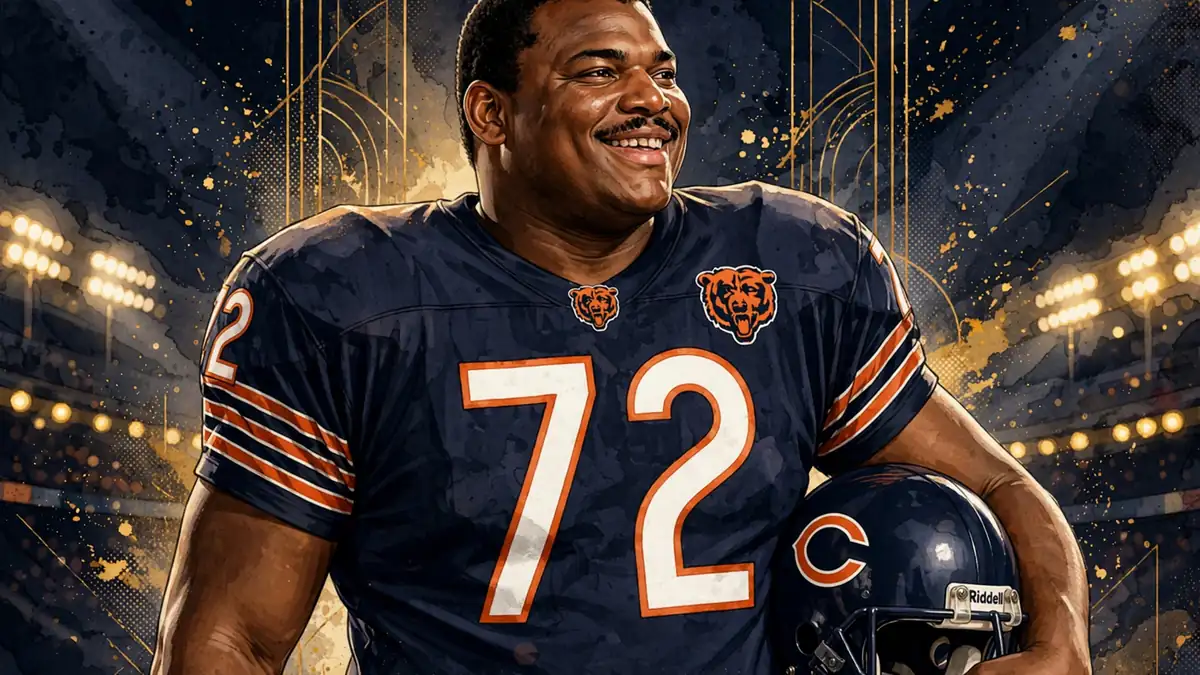
William Perry‘s net worth is estimated at $50,000 as of November 2026. The man the football world knows as “The Refrigerator” earned millions in a single year at the peak of his fame with the 1985 Chicago Bears, then watched almost all of it slip away through back taxes, medical bills, alcohol problems and a long decline in his health — a fall so steep that his size-25 Super Bowl ring, the largest ever made for a player, changed hands twice, once for $8,500 and once for $203,150.
William Perry: Quick Facts
| Estimated net worth | $50,000 (range: $50,000–$500,000) |
|---|---|
| Profession | Former NFL defensive tackle |
| Nationality | American |
| Born | December 16, 1962 (age 63) |
| Height | 6 ft 2 in (1.88 m) |
| Primary income sources | NFL salaries (1985–1994), 1986 endorsements, appearances, NFL pension |
| Active years | 1985–1994 (NFL); 1996 (London Monarchs) |
| Last reviewed | November 2026 |
- Early Life and Background
- Education
- Career Journey
- Rise to Fame
- Main Sources of Income
- Salary and Earnings
- Businesses and Investments
- Brand Deals and Sponsorships
- Houses, Cars and Other Assets
- Awards and Achievements
- Net Worth Growth Over the Years
- Social Media Presence
- Personal Life
- Sources & Reporting
- Frequently Asked Questions
- Final Thoughts
Early Life and Background
William Anthony Perry was born on December 16, 1962, in Aiken, South Carolina, and he was big from the first day of his life. He weighed 13 pounds at birth, a detail he repeated himself in later interviews with the line, “Even when I was little, I was big.” By sixth grade he weighed about 200 pounds. The numbers kept climbing through his school years, and by the time he reached South Aiken High School he was playing as a 295-pound nose guard — a teenager built like a grown professional lineman, yet quick enough to run on the school track team and to throw the shot put nearly 54 feet.
Aiken in the 1970s was a small South Carolina town, and Perry’s size made him impossible to miss. Coaches saw a defensive tackle. Classmates saw a gentle giant who liked to laugh. The nickname that would follow him for the rest of his life did not arrive until college, but the raw material was already there: a frame that filled doorways, hands that swallowed a football, and a surprising burst of speed for someone carrying that much weight. One account from his high school years claims he could complete a 360-degree dunk on a basketball court while weighing close to 300 pounds — a story that sounds like a tall tale until you remember that Perry’s whole career was built on doing things a man his size was not supposed to do.
Nothing in Perry’s early life pointed toward wealth. He came from a working-class home in Aiken, and football was the clearest route out. The sport gave him structure, a scholarship path and, within a few years, a national stage. It also gave him a body that would carry him to a Super Bowl and then, decades later, break down under the weight it had carried. Both halves of that story — the rise and the long, hard landing — start in Aiken, where a 13-pound baby grew into the most famous large man in American football.
The nickname “The Refrigerator” — shortened by fans to “The Fridge” — was born during his freshman year at Clemson in 1981. Perry was carrying laundry with a teammate when the two of them tried to squeeze into an elevator together. The teammate looked at Perry’s bulk blocking the doorway and joked that he was built like a refrigerator. The name stuck the way only a perfect nickname can: it was funny, it was visual, and it was true. Within four years it would be on lunchboxes, on a G.I. Joe action figure and in millions of American living rooms.
Education
Perry’s play at South Aiken High School earned him a full-ride scholarship to Clemson University, where he played for coach Danny Ford’s Tigers from 1981 to 1984. He arrived in 1981 just as Clemson was about to play one of the greatest seasons in the school’s history. As a freshman he was part of the Tigers team that won the national championship in 1981, a title run that put a small South Carolina program on the national map and gave Perry a championship ring before he had played a single NFL snap.
His college production was serious, not just a curiosity built on size. Perry was named an All-American three times between 1982 and 1984, earned consensus first-team All-American honours as a junior in 1983, and was first-team All-American again in 1984. That final college season he was named ACC Player of the Year, led the Atlantic Coast Conference with 27 tackles for loss, and piled up 100 tackles as a senior. Across his Clemson career he set a school record with 25 sacks and 60 total tackles for loss, numbers that still read like a misprint for a man who weighed more than 330 pounds.
The Clemson years also shaped the player the NFL would draft. Ford’s staff used Perry as a disruptive interior force who could collapse a pocket on his own, and his quickness off the ball surprised scouts who expected a plodding space-eater. By the end of the 1984 season he was one of the most talked-about defensive prospects in the country — and one of the most argued-about. Some scouts saw a rare athlete. Others saw a weight problem waiting to happen. Both camps turned out to be right, and the argument followed him into the draft room in 1985.
Perry left Clemson without a degree in hand at the time — football, not the classroom, was the reason he was there — but the university stayed part of his identity for life. South Carolina’s state tourism office still lists him among the state’s signature sports figures, and Clemson fans of a certain age can still describe the sight of number 66 in orange, a defensive tackle who moved like a much smaller man.
Career Journey
The Chicago Bears selected William Perry in the first round of the 1985 NFL Draft, 22nd overall, and the pick was controversial from the moment it was made. Head coach Mike Ditka had hand-picked Perry. Defensive coordinator Buddy Ryan, the architect of the Bears’ fearsome 46 defense, wanted nothing to do with him. Ryan called Perry a “wasted draft choice” after the rookie reported to training camp overweight, and the feud between Ditka and Ryan over Perry’s role became one of the running stories of the 1985 season.
Ditka’s answer to Ryan was to use Perry on offence. The Bears began lining their 330-pound defensive tackle up as a goal-line fullback, and the sight of him carrying the ball became the most talked-about wrinkle in the league. His first offensive touchdown came on a Monday night in October 1985 against the Green Bay Packers, and the crowd reaction told Ditka everything he needed to know: Perry was not just a player, he was a show. As a rookie he finished with five sacks, two fumble recoveries and three offensive touchdowns — two rushing and one receiving — while the Bears rolled to a 15-1 regular season and a championship.
Over the next few seasons Perry settled into real defensive work, and the record shows he was far better than the novelty act his fame suggested. He started all but one game over the two seasons after his rookie year and recorded 139 tackles and eight more sacks in that stretch. Across his nine seasons in Chicago he totalled 456 tackles and 28.5 sacks, with five fumble recoveries. His career totals, including a final season with the Philadelphia Eagles, were 138 games played, 29.5 sacks, five fumble recoveries returned for 71 yards, and three offensive touchdowns. Those are the numbers of a solid, durable NFL starter — the kind of career most first-round picks would be proud of — and they are routinely forgotten because the touchdown and the nickname swallowed everything else.
The weight was a constant battle. Perry’s target weight was usually set around 310 to 320 pounds, and he was fined more than once for reporting over it. His conditioning became a bigger issue in 1987 and 1988, and his snap counts and impact faded as the decade wore on. He stayed with the Bears through the 1993 season, then finished his NFL career with the Philadelphia Eagles in 1993–94, retiring after the 1994 season. In 1996 he made a brief comeback attempt with the London Monarchs of the World League of American Football, a short stint that closed the book on a ten-season professional career.
Looked at as a whole, Perry’s career journey runs in three acts: the Clemson star who arrived with a national title, the Chicago folk hero who scored in a Super Bowl, and the veteran lineman who hung on through weight fines and shrinking roles until the league moved on. The first two acts made him rich and famous. The third act, and everything after it, explains why so little of the money survived.
Rise to Fame
Perry’s rise to fame was the fastest in the NFL in 1985, and it happened because the Bears were the perfect stage. Chicago finished 15-1, fielded one of the great defences in league history, and carried a swagger that made the team a national story week after week. Perry, the rookie who looked like no other player in the league, became the most visible symbol of that swagger. He scored touchdowns, he smiled for the cameras, and he seemed to enjoy every second of it.
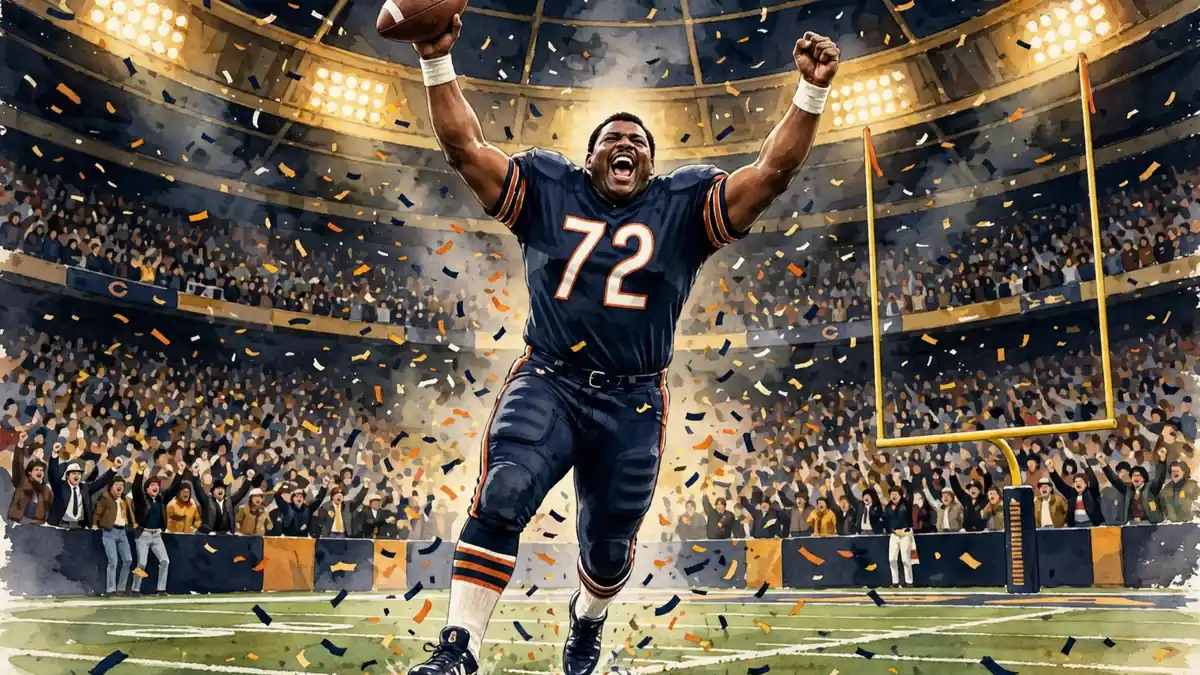
The peak came on January 26, 1986, in Super Bowl XX against the New England Patriots. The Bears won 46-10, and in the third quarter Ditka sent Perry in at fullback near the goal line. Perry took the handoff and powered in from a yard out for a touchdown, becoming the heaviest player ever to score in a Super Bowl at a listed 335 pounds — a record he still holds. The moment had a shadow: Walter Payton, the Bears’ greatest player and the running back who had carried the team for a decade, never scored in the game, and Ditka’s decision to give the goal-line carry to a defensive tackle instead of Payton is still argued about by Bears fans forty years later. Ditka himself later said he regretted not getting Payton a touchdown. For Perry, though, the play was pure joy, and the image of a 335-pound man spiking the ball in the end zone became one of the defining pictures of the decade.
Fame spilled far past football in the months that followed. Perry had a solo in the Bears’ “Super Bowl Shuffle,” the rap video recorded by the team in 1985 that went platinum and became a cultural event of its own. He and Payton recorded an anti-drug, pro-peace rap tune together. He appeared on the “Late Show with David Letterman” and “The Tonight Show,” took part in a Bob Hope Christmas special, and had a cameo on Mr. T’s “A-Team.” In 1986 he took part in a World Wrestling Federation battle royal at WrestleMania 2 in Rosemont, Illinois, standing in a ring next to Hulk Hogan. A 3.75-inch G.I. Joe action figure was made in his likeness — one of the few real people ever given that honour — and his face was on magazine covers across the country.
The scale of it is hard to overstate. In September 1986, a newspaper column syndicated that month reported that Perry had earned some $3 million from companies, advertisers and film producers since the Super Bowl, and quoted his agent projecting $10 million from off-field work over the next four years. A later profile put the figure at an estimated $4 million in endorsements in a single year, at a time when his football salary was about $203,000. For roughly eighteen months, a defensive tackle from Aiken, South Carolina was one of the most marketable athletes in America. No defensive lineman before him had ever been a pitchman on that scale, and few since have matched it.
The fame faded as fast as it had arrived. By 1987 the novelty was wearing thin, the weight fines were mounting, and the Bears were no longer the unbeatable story of the league. Perry kept playing, and kept playing well enough to hold a roster spot for nine seasons, but the commercials dried up and the talk shows stopped calling. The rise to fame is the part of his story everyone remembers. The long quiet after it is the part that explains his bank balance today.
Main Sources of Income
Perry’s money came from four places across his life, and the balance between them flipped completely between 1985 and 2026. During his playing career the largest single-year paydays came from endorsements, not football. After retirement the income narrowed to appearances, a small business venture and, eventually, his NFL pension and retirement funds — the modest, steady money that Celebrity Net Worth says he lives on today in a retirement home.
The first source was his NFL salary. Across ten seasons with the Bears and the Eagles, Perry’s reported annual pay ranged from roughly $203,000 early in his career to about $330,000 a year in his later Chicago seasons. Career-earnings estimates published by secondary trackers run from about $3 million to about $8 million in total, a spread that shows how little of the 1980s pay record is public. The honest statement is that his football pay, while large for its era, was small by modern standards: a top defensive tackle today earns in one season what Perry earned across his whole career.
The second source, and the one that made him briefly rich, was endorsements. In the year after Super Bowl XX, Perry’s off-field income dwarfed his salary. McDonald’s and Coca-Cola put him in national commercials, Frigidaire and Whirlpool signed him for the most natural fit imaginable — a man called The Refrigerator selling refrigerators — and True Value and a string of smaller brands followed. The contemporary newspaper account from September 1986 put his post-Super Bowl earnings at $3 million in under a year, and his agent’s projection of $10 million over four years shows how much the industry expected the run to last. It lasted about eighteen months.
The third source was entertainment and appearances: the “Super Bowl Shuffle” and the rap records, the WrestleMania 2 appearance, the “A-Team” cameo, talk-show spots, and later a Chef Tony rotisserie infomercial and a Boost Mobile commercial during Super Bowl XLIV in 2010, when the surviving 1985 Bears reunited to revive the Shuffle. These paid far less than the endorsement peak, but they kept small cheques coming in long after the big brands had moved on.
The fourth source was his own small business: a branded barbecue sauce he began marketing in 2006, more than a decade after his playing career ended. It was a modest venture, not a restaurant empire, and there is no public record of it producing serious money. Today, with no active business and no new endorsements, his income is his NFL pension and other retirement funds, plus support from family and from organisations such as the Gridiron Greats Assistance Fund, which helps retired players in need.
Salary and Earnings
The salary record for 1980s NFL players is patchy, and Perry’s is no exception. No official contract database publishes his year-by-year pay, so every figure here is reported rather than confirmed, and the honest range is wide. His first contract with the Bears was reported at about $1.35 million over four years, a large deal for a rookie lineman in 1985. One tracker puts his rookie-year pay at roughly $275,000, with annual salaries of $300,000 to $600,000 through his Chicago years and about $400,000 in his final season with Philadelphia. Other reports put his mid-career salary at about $330,000 a year, and a profile of his endorsement peak gives his football salary at that moment as $203,000. Those numbers do not all agree, and they should not be read as a single clean ledger. They agree on the shape: a few hundred thousand dollars a year, every year, for a decade.
That shape matters because it explains the trap Perry fell into. A player earning $300,000 a year in 1988 was well paid by the standards of the day, but he was not earning the kind of money that survives decades of medical bills, tax trouble and no second career. Total career earnings estimates from secondary sources range from roughly $3 million to roughly $8 million, with one Q&A site putting the figure at about $8 million and another tracker breaking it down as about $3 million from NFL contracts plus about $1 million from endorsements. Neither figure can be verified against a public filing, and the gap between them is itself the point: the record is thin, and trackers that print a single precise career-earnings number for Perry are guessing.
The endorsement year is better documented, because it happened in public. The September 1986 newspaper column that covered Perry’s post-Super Bowl income put it at $3 million earned since the championship game, paid by companies, advertising executives and movie producers. A later profile estimated $4 million in endorsements in a single year. Even taking the lower of the two, Perry earned roughly ten times his football salary from endorsements in 1986. That is the year his net worth peaked — and the year that later trackers seem to have frozen in place when they still publish $10 million or $5 million figures for him today. A peak year’s income is not a net worth, and Perry’s later life shows what happens when the peak year is treated as if it would last.
After 1994 the paydays stopped. There was no coaching job, no broadcasting contract and no front-office role. The London Monarchs stint in 1996 paid World League money, a fraction of NFL pay. The barbecue sauce venture in 2006 and the occasional appearance fee were small-scale. By the time his health collapsed in the late 2000s, there was no income stream left large enough to cover the bills, and the tax debt and medical costs began eating into whatever remained. That arc — a short, bright earnings peak followed by thirty years of low income — is the whole financial story of William Perry.
For readers comparing eras, the contrast is stark. Perry’s reported $330,000 peak salary would not cover a single game cheque for a star defensive tackle today. His entire estimated career earnings, at the top of the published range, are less than what a first-round defensive tackle signs for as a rookie in 2026. He played in the wrong decade to get rich from football alone, and the endorsement money that could have changed that arrived all at once, in a single year, when he was 23 years old.
Businesses and Investments
Perry never built a business portfolio of the kind modern athletes assemble, and that absence is a large part of why his wealth did not last. There is no record of him buying property as an investment, taking equity in a company, or building a brand beyond his own name. The one venture that carries his name is the barbecue sauce he began marketing in 2006, a small branded product line launched twelve years after he left the NFL. It fits the man — a big personality, a Southern background, a product built around food — but no sales figures, distribution deals or revenue numbers were ever published, and nothing suggests it grew beyond a modest sideline.
The endorsement deals of 1986 were not investments either. They were fees for his face and his nickname, paid once and spent. Frigidaire, Whirlpool, McDonald’s, Coca-Cola and True Value bought a moment, not a stake, and Perry took no reported equity in any of them. The G.I. Joe figure, the rap records and the television appearances were the same kind of income: one-off payments for a famous name at the height of its fame. When the fame faded, so did the payments, and there was no underlying asset left behind.
That pattern is common among athletes of Perry’s era. The 1980s NFL had no financial literacy programmes of the kind the league runs today, no rookie symposium on money, and no culture of players taking equity stakes. A 23-year-old who had never handled serious money was handed millions in endorsement fees in a single year, with an agent projecting $10 million more over four years. The projection did not come true, and there is no evidence Perry was advised to treat the windfall as a once-in-a-lifetime sum to be preserved rather than as the start of a permanent income.
On the investment side, the public record is simply empty: no property portfolio, no restaurant chain, no clothing line that shipped, no stake in a team or a start-up. Secondary trackers that credit Perry with “real estate investments” or “business ventures” worth millions are repeating each other without a source, and the documented facts point the other way — toward a man who nearly lost his house in the fall of 2014 and owed more than $26,000 in back taxes, as Sporting News reported in July 2015. A man with a property portfolio does not nearly lose his house over $26,000.
The honest summary is that Perry’s business life consists of one small sauce brand and a long list of endorsement fees that are now forty years old. He did not invest his way to wealth, and he did not lose wealth through a failed business bet. He earned a great deal of money very quickly, spent it, and then faced decades of low income and high medical costs with nothing behind him.
Brand Deals and Sponsorships
The brand deals are the most glamorous part of Perry’s money story, and they are also the part best documented by contemporary reporting. The list, as recorded by South Carolina’s state tourism office and by contemporary profiles, runs through the biggest names in American advertising in 1986: McDonald’s, Coca-Cola, True Value, Frigidaire and Whirlpool, plus athletic shoe deals and a string of smaller regional sponsors. He starred in a Coca-Cola commercial with his Bears teammate Jim McMahon, appeared in McDonald’s spots, and lent his nickname to the most on-the-nose product pairing in sports marketing history — The Refrigerator selling refrigerators.
The money behind those deals is where the reporting gets specific. The September 13, 1986 column that tallied his post-Super Bowl income put it at $3 million in the months since the championship, “all of it paid by companies, advertising executives and movie producers eager to get a piece of a wholesome, down-to-earth athlete that all of America can relate to.” His agent told the same columnist that Perry could make $10 million from off-field work over the next four years if his popularity held. A later profile estimated $4 million in endorsements in a single year. Whichever figure is closest, the ratio is the same: in 1986, Perry the pitchman earned roughly ten to twenty times what Perry the football player earned.
The deals were not only about money. They made him a fixture of American popular culture in a way no defensive tackle had been before. He was on the cover of Sports Illustrated, he had a solo in the “Super Bowl Shuffle,” he recorded two rap records in 1985 in addition to the Shuffle, and he and Walter Payton cut an anti-drug, pro-peace rap tune that was re-released in 1999 with part of the profits going to the Walter Payton Foundation. The Fat Boys recorded a twelve-inch single about him. He wrestled at WrestleMania 2, appeared on the “A-Team,” and turned up on Letterman, “The Tonight Show” and a Bob Hope Christmas special.
Later in life the brand work shrank to nostalgia. He appeared in a Chef Tony infomercial endorsing the My Rotisserie, playing poker with friends and praising the kitchen appliance, and in 2010 he joined other members of the 1985 Bears in a Boost Mobile commercial during Super Bowl XLIV that revived the “Super Bowl Shuffle” for a new generation. Those spots traded on memory, not on current fame, and they paid accordingly.
The sponsorship story carries a warning that runs through this whole article. Perry’s endorsement peak lasted about eighteen months, and it was built on a single season and a single play. When the Bears stopped being the story of the league, the brands stopped calling, and there was no second act — no coaching career to keep him visible, no broadcasting job, no product line of his own. The deals made him briefly rich. They did not make him lastingly wealthy, because nobody involved treated them as a windfall to be saved.

Houses, Cars and Other Assets
The asset side of Perry’s story is short, and it is mostly a story of things sold rather than things kept. The most famous asset he ever owned was his Super Bowl XX championship ring, a diamond-encrusted band made to size 25 — the largest Super Bowl ring ever made for a player, against an average adult male ring size of 10 to 12. It was also, in the end, an asset he could not hold on to.
The ring’s journey is documented in unusual detail. In April 2011, the ring surfaced for sale, and Cliff Forrest, a ten-year-old boy, bought it for $8,500 with his mother’s help and returned it to Perry, saying he wanted the former star to have his ring back. Perry got the ring back — and then lost it again. In July 2015, Sporting News reported that Perry, then 52, was selling the ring after nearly losing his house the previous fall, and that bidding at the National Sports Collectors Convention would open at $16,000, with the listing suggesting it could sell for as much as $1 million. The ring sold at Heritage Auctions on July 30, 2015 for $203,150. The crucial detail, reported by Sports Illustrated and repeated by FanBuzz, is that the ring was sold by the man Perry had sold it to years earlier — and Perry himself received nothing from the $203,150 sale.
The house is the second asset in the story, and it is a warning rather than a trophy. Sporting News reported in 2015 that Perry had nearly lost his house in the fall of 2014, in the same period that he owed more than $26,000 in back taxes. There is no public record of Perry owning a portfolio of properties, a luxury home, or a car collection. Secondary trackers that list cars and houses for him are guessing; the documented record shows a man fighting to keep one home, not collecting several.
What remains of his playing-days possessions is unclear. Celebrity Net Worth reports that his financial problems forced him to auction off many of his prized possessions, with the ring the best-known example. Memorabilia from the 1985 season — the G.I. Joe figure, Shuffle records, game-worn items — has value to collectors, but there is no public record of Perry holding a collection of it, and the ring saga suggests that when money was needed, the memorabilia went first.
Today his assets, as far as the public record shows, are modest: a pension, retirement funds, and the support of family and the Gridiron Greats Assistance Fund. That is the asset picture behind a $50,000 net worth estimate — not a portfolio, but a safety net. It is also why the $10 million figures still published by some trackers are so misleading: they describe a man who owned a moment, not a man who owns assets.
Awards and Achievements
Perry’s honours list is short, but every line on it was earned at the highest level of the sport. At Clemson he won a national championship as a freshman in 1981, was a three-time All-American from 1982 to 1984, was consensus first-team All-American in 1983 and first-team All-American again in 1984, and was named ACC Player of the Year in 1984. He left Clemson holding the school record for career sacks with 25 and career tackles for loss with 60, and he led the ACC with 27 tackles for loss in his final college season.
In the NFL the headline honour is the one that defines his career: Super Bowl champion, Super Bowl XX, January 26, 1986, Chicago Bears 46, New England Patriots 10. He was a first-round draft pick, 22nd overall in 1985, and he played ten seasons in the league, 138 games, with 29.5 sacks and three offensive touchdowns. He was never selected to a Pro Bowl and never named All-Pro, facts that some of the weaker trackers get wrong — one copied page claims two Pro Bowl appearances, a claim no record supports and one we do not repeat. His achievement was different: he was a first-round pick who became a champion, a durable starter for nine seasons in Chicago, and the owner of one of the most famous single plays in Super Bowl history.
The cultural honours are real too, even if they are not football awards. The G.I. Joe action figure made in his likeness in 1986 put him in a tiny group of real people immortalised as toys. The “Super Bowl Shuffle” went platinum. His touchdown made him the heaviest player ever to score in a Super Bowl, a record that still stands. And the size-25 ring remains the largest championship ring ever made for a football player — a piece of trivia that has outlasted almost everything else about his career, because the ring itself kept making news long after he stopped playing.
What Perry did not achieve matters to the money story as well. He never signed a second big contract, never became a coach or a broadcaster, and never turned his fame into a lasting business. The honours stop in 1986, and the rest of his career was solid, unglamorous professional work. That is not a criticism — 138 NFL games is a career most players would trade for — but it explains why the income stopped when the fame did.
Net Worth Growth Over the Years
Perry’s net worth did not grow in a straight line. It spiked, then fell for thirty years. The table below uses reported and estimated figures, and the labels matter: the 1986 number is income earned in a single year, not a measured net worth, and the 2026 number is Celebrity Net Worth’s refreshed estimate. Treat the early rows as the shape of a career, not as audited accounts.
| Year | Milestone | Estimated net worth / earnings |
|---|---|---|
| 1985 | Rookie season; Super Bowl XX champion; first contract reported at about $1.35 million over four years | Rising; rookie pay reported near $275,000 |
| 1986 | Endorsement peak after the Super Bowl; McDonald’s, Coca-Cola, Frigidaire deals | About $3 million earned in the year after the Super Bowl |
| 1994 | Retires after final season with the Philadelphia Eagles | Career earnings estimated at $3 million–$8 million in total |
| 1996 | Brief stint with the London Monarchs | Small World League pay; no material change |
| 2006 | Launches branded barbecue sauce | Modest sideline; no published revenue |
| 2011 | Super Bowl ring bought for $8,500 by a ten-year-old fan and returned to Perry | Declining; health and money problems public |
| 2015 | Ring auctioned for $203,150; Perry receives nothing from the sale; back taxes over $26,000 reported | Near zero in liquid assets by reporting |
| 2026 | Lives in assisted living in South Carolina on NFL pension and retirement funds | $50,000 (range $50,000–$500,000) |
The shape of that table is the article in miniature: a vertical spike in 1986, a long flat stretch, then a fall to almost nothing. Compare it with a modern star’s table, where the line climbs every year through a second contract, endorsements and investments, and the difference is the whole lesson of Perry’s finances. He earned his money before the NFL paid life-changing salaries, he earned most of it in one year, and he had no second career to replace it. The $10 million figures that some trackers still publish for him appear to take the agent’s 1986 projection — $10 million over four years — and print it as a current net worth. It was a projection, it did not come true, and it is forty years old.
There is also a peer comparison worth making, not in dollars but in trajectory. Plenty of 1980s stars earned similar money and kept it, usually because they moved into coaching, broadcasting or business. Perry did none of those things, and his health took away the option of physical work. The Gridiron Greats Assistance Fund exists precisely for players in his position — men whose bodies paid the price for a career that did not pay enough to cover the aftermath. Perry’s table is not unusual for his era. It is only unusually well documented, because his ring kept coming back into the news.
Social Media Presence
Perry has no verified, active social media presence as of November 2026, and fans searching for him should be careful: the same low profile that keeps him out of the spotlight also makes him an easy target for hoax accounts. In June 2026 a Facebook page called “True Bears Fans” falsely claimed that Perry had died, and the post spread widely enough that sports outlets had to publish corrections. EssentiallySports reported on June 27, 2026 that the death claim was completely fake, quoting the correction that Perry had not passed away, and noting that the rumour spread so fast because fans knew about his long-running health problems.
That hoax is the most recent social media event in Perry’s story, and it says something about where he stands in 2026: famous enough that a fake death notice travels around the world in hours, private enough that there was no official account to correct it in minutes. Some low-quality profile pages claim he posts regularly on Instagram and Twitter and lives in suburban Atlanta. Those claims conflict with the better-sourced reporting — Celebrity Net Worth, Sports Illustrated and EssentiallySports all place him in a retirement and assisted-living facility in his home state of South Carolina — and we do not repeat them as fact.
The practical advice for readers is simple. Do not trust an account claiming to be William Perry unless it carries a platform verification badge and is linked from a credible outlet. Do not send money to any account or fundraiser claiming to act for him. If you want to support retired players in his position, the Gridiron Greats Assistance Fund is the established organisation that helps former NFL players with medical and living costs, and it is the group named in reporting about Perry’s support network.
Personal Life
Perry has been married twice and has four children. His younger brother, Michael Dean Perry, was also an NFL defensive lineman, and the brothers’ lives have been linked since childhood: Michael was the one who found William bedridden and weighing 190 pounds during the worst of his illness, and in October 2014 Michael became William’s guardian and conservator for his affairs. That detail, reported by Wikipedia from contemporary coverage, is a measure of how far Perry’s health had declined — a former Super Bowl champion whose younger brother had to take legal charge of his care.
His health story is long and, by now, well documented. He was diagnosed with Guillain-Barré syndrome, a rare disorder in which the immune system attacks the nerves, in June 2007. On April 22, 2009 he was hospitalised in South Carolina in serious condition and spent about a month in hospital. The illness cost him more than 100 pounds. By June 2010 he was reported to be suffering from hearing loss, though it was improving, and his weight had rebounded to 330 pounds. In February 2011, ESPN ran a sombre piece about his ongoing health problems, his drinking and a weight that had reached 400 pounds, reporting that the Bears had arranged for him to enter a rehab facility during his playing career.
The years after that were the hardest. His weight climbed above 450 pounds at one point. In January 2016 he checked himself into hospital for diabetes treatment, weighing more than 425 pounds, with no feeling in his feet and in danger of having a leg amputated. In June 2016, Sports Illustrated reported that he was living in a retirement home, had financial difficulties, and continued to drink despite having publicly acknowledged his alcoholism in 2011. There was a brighter note in 2018, when he reported that he was moving around again and felt better than he had in a long time. As of 2026, the reporting places him in an assisted-living facility in South Carolina, using a wheelchair or a walker, supported by family and by the Gridiron Greats Assistance Fund.
Perry’s personal life is also the reason this article treats the net worth number with care. A $50,000 estimate for a Super Bowl champion is not a curiosity; it is the end of a chain that runs through illness, addiction, tax debt and a career that ended before the money in football became enormous. The man who scored the most famous touchdown of Super Bowl XX now lives modestly, on a pension, in a retirement home. That is not a punchline. It is the fact that makes the $10 million figures on other sites wrong and careless.
Sources & Reporting
Celebrity Net Worth — the $50,000 net worth estimate, updated January 20, 2026, plus the reporting on his IRS debt, the auction of his possessions, his retirement-home life and his NFL pension. The only major tracker to have refreshed its Perry figure in 2026.
Sporting News — the July 2015 report on the Super Bowl ring auction, the near-loss of his house in the fall of 2014, the $26,000-plus in back taxes, and the 2008 Guillain-Barré diagnosis and 100-pound weight loss.
ESPN — the 2011 reporting on Perry’s health, alcohol problems and weight, and the story of ten-year-old Cliff Forrest buying the Super Bowl ring for $8,500 and returning it to Perry.
Sports Illustrated — the June 2016 report, carried by FanBuzz, that Perry was living in a retirement home with financial difficulties, and that he received nothing from the $203,150 ring sale.
EssentiallySports — the June 27, 2026 debunk of the viral death hoax, confirming Perry is alive and living in assisted living in South Carolina.
Wikipedia — career statistics (138 games, 29.5 sacks, five fumble recoveries, three offensive touchdowns), draft position (1985, 1st round, 22nd overall), Clemson honours, health timeline and family details, cross-checked against Pro Football Reference figures cited there.
Pro Football History — Clemson career detail (three-time All-American, 100 tackles as a senior, 25 career sacks, 60 tackles for loss, 27 tackles for loss leading the ACC in 1984) and the nickname origin and early-life detail.
Discover South Carolina — the state tourism office profile listing Perry’s television and commercial appearances, including Letterman, “The Tonight Show,” the Bob Hope special, McDonald’s and Coca-Cola commercials and the “A-Team” cameo.
The Rock It Co. — the endorsement list (McDonald’s, Coca-Cola, True Value, Frigidaire, Whirlpool, G.I. Joe figure) and the estimate of $4 million in endorsements in a single year against a $203,000 salary.
University of Florida Libraries — the September 13, 1986 newspaper column archived in its digital collection, reporting $3 million earned since the Super Bowl and an agent projection of $10 million over four years.
FanBuzz — the “William Perry Now” report on his retirement struggles, the 450-pound weight peak, the diabetes diagnosis, the assisted-living facility and the ring sale.
Reporting window: career and college facts verified against records current to November 2026; the net worth anchor is Celebrity Net Worth’s January 20, 2026 update; the most recent news event covered is the June 2026 death-hoax correction. Figures from secondary net-worth trackers that publish $1 million to $10 million without a named source or a 2026 update were treated as stale and are reported here only to explain the disagreement.
Frequently Asked Questions
What is William Perry’s net worth in 2026?
William Perry’s net worth is estimated at $50,000 as of November 2026, with a range of $50,000 to $500,000. Celebrity Net Worth, the only major tracker to refresh its figure in 2026, puts him at $50,000 as of January 20, 2026, citing his IRS debt, medical costs and life in a retirement home on his NFL pension. Higher figures of $1 million to $10 million on other sites recycle his 1986 earning power and do not reflect his current assets.
How much did William Perry make in the NFL?
His reported annual salary ranged from about $203,000 early in his career to roughly $330,000 a year later on, and his first Bears contract was reported at about $1.35 million over four years. Total career-earnings estimates from secondary sources run from about $3 million to about $8 million, a wide spread that reflects how little 1980s pay data is public. His biggest single year was not football at all: he earned about $3 million from endorsements in the year after Super Bowl XX.
Did William Perry sell his Super Bowl ring?
Yes — twice, in effect. In 2011 his Super Bowl XX ring surfaced for sale and was bought for $8,500 by the family of ten-year-old Cliff Forrest, who returned it to Perry. The ring changed hands again, and on July 30, 2015 it sold at Heritage Auctions for $203,150. Sports Illustrated reported that the 2015 sale was made by the man Perry had sold the ring to years earlier, and Perry himself received nothing from it. The size-25 ring remains the largest Super Bowl ring ever made for a player.
Is William Perry still alive?
Yes. A Facebook page called ‘True Bears Fans’ falsely claimed in June 2026 that Perry had died, and the hoax spread widely before sports outlets corrected it. EssentiallySports confirmed on June 27, 2026 that Perry is alive. He lives in an assisted-living facility in South Carolina and uses a wheelchair or a walker.
What is William Perry doing now?
As of 2026 Perry lives in a retirement and assisted-living facility in his home state of South Carolina, where his health is monitored and he receives support from family and from the Gridiron Greats Assistance Fund. He lives modestly on his NFL pension and other retirement funds. He has no coaching, broadcasting or business role, and no verified active social media account.
How tall was William Perry and how much did he weigh?
Perry is listed at 6 feet 2 inches (1.88 m) and 335 pounds (152 kg) during his playing career, the weight at which he scored his Super Bowl touchdown. His weight moved a great deal over his life: he was fined more than once for reporting over his 310-to-320-pound target, his weight rose above 450 pounds in retirement, and Guillain-Barré syndrome cost him more than 100 pounds during his hospitalisation in 2009.
Why was William Perry called The Refrigerator?
He earned the nickname as a freshman at Clemson in 1981, when he was carrying laundry with a teammate and the two tried to squeeze into an elevator together. The teammate joked that Perry was built like a refrigerator. The name stuck, was shortened to ‘The Fridge’ by fans, and became one of the most famous nicknames in NFL history — famous enough that Frigidaire and Whirlpool later signed him to sell actual refrigerators.
Did William Perry score a touchdown in the Super Bowl?
Yes. In Super Bowl XX on January 26, 1986, Perry took a handoff at fullback and powered in from a yard out in the third quarter of the Bears’ 46-10 win over the New England Patriots. At a listed 335 pounds he remains the heaviest player ever to score a touchdown in a Super Bowl. It was one of three offensive touchdowns in his rookie season, alongside two rushing and one receiving score.
Final Thoughts
William Perry’s net worth in 2026 is estimated at $50,000, and the number only makes sense once you know the whole story. He was a first-round pick, a national champion at Clemson, a Super Bowl champion with the 1985 Bears, and for about eighteen months one of the most marketable athletes in America, earning roughly $3 million from endorsements in the year after Super Bowl XX. Then the fame faded, the football money of his era turned out to be far smaller than today’s, his health collapsed, and the tax bills and medical costs took what was left.
The $10 million figures still printed by some sites are not just out of date; they mistake a single great year for a fortune. The $50,000 figure, refreshed by Celebrity Net Worth in January 2026 and backed by named reporting on his debts, his ring auctions and his life in a retirement home, is the honest one — and the $50,000 to $500,000 range we publish keeps the uncertainty visible rather than hiding it behind a false precision. Perry’s legacy was never really about money. It is about a 335-pound defensive tackle scoring in a Super Bowl, a nickname that became a brand, and a team that still defines what a great defence looks like. The money came and went. The touchdown is still on film, and it still makes people smile.
Published on November 7, 2026. Last reviewed November 2026. Found an error? See our corrections policy.