
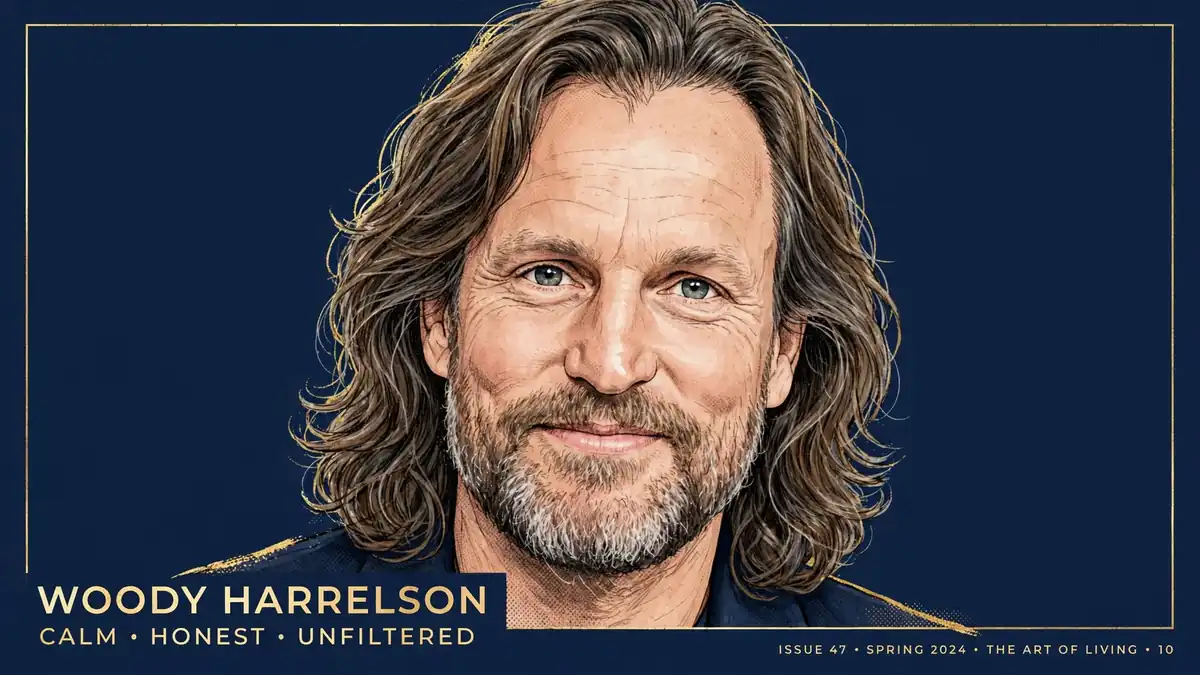
Woody Harrelson‘s net worth is estimated at $70 million to $80 million as of November 2026. The spread is not a rounding choice. Parade, publishing in January 2026, put the figure at $70 million and credited Celebrity Net Worth; Celebrity Net Worth’s own page now lists $80 million. Harrelson has never published a balance sheet, so the honest answer is a range bounded by those two publisher estimates, built on four decades of acting pay, franchise work, television residuals, a Maui estate bought for under $2 million in 1999, and a West Hollywood cannabis business he co-founded in 2022.
Woody Harrelson: Quick Facts
| Estimated net worth | $70 million to $80 million (range: $70 million to $80 million) |
|---|---|
| Profession | Actor, producer, playwright |
| Nationality | American |
| Born | July 23, 1961, Midland, Texas (age 65) |
| Height | 5 feet 10 inches (reported; some listings give 5 feet 9½ inches) |
| Primary income sources | Film and television acting, producing fees, residuals and profit participation, real estate, cannabis and sustainability ventures |
| Active years | 1978–present (screen breakthrough 1985) |
| Last reviewed | November 2026 |
- Early Life and Background
- Education
- Career Journey
- Rise to Fame
- Main Sources of Income
- Salary and Earnings
- Businesses and Investments
- Brand Deals and Sponsorships
- Houses, Cars and Other Assets
- Awards and Achievements
- Net Worth Growth Over the Years
- Social Media Presence
- Personal Life
- Sources & Reporting
- Frequently Asked Questions
- Final Thoughts
Early Life and Background
Woodrow Tracy Harrelson was born on July 23, 1961, in Midland, Texas, to Diane Lou Oswald, a secretary, and Charles Voyde Harrelson. The family story is the part of his biography that most net worth profiles rush past, yet it explains the shape of his career: a childhood split between Texas and Ohio, a father largely absent, and a mother raising three sons — Woody, Jordan, and Brett — in Lebanon, Ohio, her hometown. Harrelson moved to Lebanon with his mother in 1973 and attended Lebanon High School there.
His father, Charles Harrelson, was a contract killer who was arrested in 1979 and convicted for the murder of Federal Judge John H. Wood Jr. in San Antonio, Texas. He received a life sentence in 1982 and died in federal prison on March 15, 2007. Harrelson has spoken in interviews over the years about growing up with a father who was rarely present, and about building an adult life deliberately different from that inheritance. That context matters for a wealth story because Harrelson’s public spending and business choices run in the opposite direction from the usual celebrity playbook: an off-grid home in Hawaii, a straw-based paper company, a cannabis lounge designed as a garden, and a long record of environmental activism rather than a fleet of cars or a chain of restaurants.
Money was not abundant in the Lebanon years. Harrelson worked his way through the performing arts the slow way — school plays, regional theatre, and a move to New York after college with little financial cushion. No trust fund, no family business, and no early endorsement deal smoothed the path. The first real money in his life came from television, and it came eight years after he left college, when he was already in his mid-twenties. That late start, followed by an unusually long peak, is the central pattern of his finances: he did not get rich young and then fade, and he did not land one franchise payday that dwarfed everything else. He accumulated steadily, project by project, across four decades.
It is also worth stating plainly what Harrelson’s background did not give him. Unlike actors who arrive in Hollywood with family connections in the industry, Harrelson arrived with a surname that carried a criminal association he had to outrun in casting rooms. His early casting as Woody Boyd — a sweet, unworldly bartender from rural Indiana — worked in part because Harrelson himself projected an unguarded, small-town openness that audiences trusted. That trust became a commercial asset: directors kept casting him as the decent man in compromised situations, from Carson Wells in No Country for Old Men to Chief Willoughby in Three Billboards Outside Ebbing, Missouri, and those roles kept paying long after the sitcom money faded.
Education
Harrelson attended Hanover College in Hanover, Indiana, a small liberal arts college, where he studied theatre and English and graduated in 1983. He joined the Sigma Chi fraternity there, and one of his college friendships — with future Vice President Mike Pence — has become a recurring footnote in profiles, mostly because the two men’s later public lives diverged so sharply. The Hanover detail also fed directly into his breakthrough role: Woody Boyd, the character Harrelson played on Cheers, was written as a young man from Hanover, Indiana, mirroring the actor’s own college town.
College did not make Harrelson rich, and it did not give him an industry network of the kind that drama-school graduates in Los Angeles or New York sometimes inherit. What it gave him was stage training and a degree he could fall back on, and a few years of performing in productions where the pay was minimal and the discipline was real. After graduation he spent time in New York theatre, including regional and off-Broadway work, before television found him. That apprenticeship explains a durability that shows up in his earnings record: Harrelson can move between comedy, drama, stage, and voice work without a long gap, and that versatility has kept him employed in years when actors tied to a single genre go quiet.
The education section of most celebrity wealth profiles is filler. Here it carries a financial point: Harrelson’s Hanover years coincided with his father’s life sentence in 1982, handed down while Harrelson was still a student. He finished the degree anyway. The steadiness that later defined his career — eight seasons on one sitcom, four films in one franchise, a return to the same collaborators again and again — was already visible in that decision to complete what he started while his family story was at its darkest.
Career Journey
Harrelson’s screen career began in the late 1970s and early 1980s with small parts, but the honest starting line for his earnings is 1985. He joined the cast of NBC’s Cheers in its fourth season, replacing Nicholas Colasanto, who played Coach and died in February 1985. Harrelson stayed for the remaining eight seasons, through the show’s finale in 1993, appearing in roughly 200 episodes as Woody Boyd. He won the Primetime Emmy Award for Outstanding Supporting Actor in a Comedy Series in 1989, from five nominations for the role, and he returned to the character in guest appearances on the spin-off Frasier.
The film career built alongside and after Cheers in a sequence that reads like a deliberate refusal to be typecast. White Men Can’t Jump (1992) cast him as Billy Hoyle, a basketball hustler, and grossed more than $90 million worldwide. Indecent Proposal (1993) put him opposite Robert Redford and Demi Moore and grossed more than $260 million worldwide, with a domestic opening weekend of about $18 million. Natural Born Killers (1994), Oliver Stone’s violent media satire, pushed him into darker territory. The People vs. Larry Flynt (1996), directed by Miloš Forman, gave him his first Academy Award nomination, for Best Actor, playing the real-life Hustler publisher Larry Flynt.
The late 1990s and 2000s added prestige without a single franchise anchor. The Thin Red Line (1998), Terrence Malick’s war film, cast him among an ensemble of stars. No Country for Old Men (2007), the Coen brothers’ Oscar-winning crime thriller, gave him Carson Wells, a bounty hunter whose brief screen time became one of the film’s most quoted performances. The Messenger (2009) earned him a second Oscar nomination, for Best Supporting Actor, as a casualty notification officer. Zombieland (2009) gave him Tallahassee, a role that became a cult favourite and later a sequel, Zombieland: Double Tap (2019).
The franchise years arrived in his fifties. Harrelson played Haymitch Abernathy, the drunken mentor, in all four Hunger Games films from 2012 to 2015 — a series that grossed about $2.9 billion worldwide across its four instalments. He played Merritt McKinney, and later Merritt’s twin Chase, in the Now You See Me heist films, returning for Now You See Me: Now You Don’t, released in November 2025. He played Tobias Beckett in Solo: A Star Wars Story (2018), Colonel McCullough in War for the Planet of the Apes (2017), and Cletus Kasady, the villain Carnage, in Venom: Let There Be Carnage (2021), a film that grossed about $856 million worldwide.
Television kept pace with film. Game Change (2012), HBO’s film about the 2008 election, cast him as Republican strategist Steve Schmidt and earned him another Emmy nomination. True Detective (2014) cast him as Detective Marty Hart opposite Matthew McConaughey’s Rust Cohle, a pairing that became one of the decade’s defining television performances and earned him an Emmy nomination for Outstanding Lead Actor in a Drama Series. White House Plumbers (2023) cast him as E. Howard Hunt in HBO’s Watergate limited series. In September 2026 he returned to television comedy with McConaughey in Brothers on Apple TV, playing fictionalised versions of themselves — a reunion that, twelve years after True Detective, put both men back on a weekly series together.
Stage work has run through the whole career, including plays he wrote himself, and it pays far less than film but matters to his profile: theatre keeps his reputation as a serious actor intact between blockbusters, and that reputation is what lets him keep landing prestige parts in his sixties when many franchise actors are frozen out of them. The through-line of the career is range. Harrelson has played a sitcom bartender, a pornographer, a hitman, a president’s aide, a zombie killer, a mentor, and a villain, and the market has paid him for each version.
Rise to Fame
Harrelson’s rise was not overnight. He spent the first half of the 1980s in theatre and small screen roles, and Cheers was already a hit when he joined it — the show did not make him famous from nothing, it made him a household face inside an existing hit. That distinction matters financially: joining a successful show in season four meant stepping into an established syndication machine, a large audience, and a salary structure that rose with the show’s ratings, rather than gambling on a new series that might be cancelled in six episodes.
The Emmy win in 1989 confirmed the rise. By the early 1990s, Harrelson was no longer “the new bartender” but a film actor in his own right, and the one-two of White Men Can’t Jump and Indecent Proposal in 1992 and 1993 proved he could carry box office outside the bar set. The People vs. Larry Flynt in 1996 completed the transition: an Oscar nomination for Best Actor, for playing a real, divisive, litigious figure, removed any doubt that he was a sitcom actor trying films. He was a film actor who had started in a sitcom.
The second rise, in the 2010s, was quieter and more lucrative. The Hunger Games introduced him to a teenage audience that had never seen Cheers, and True Detective reintroduced him to prestige television audiences as a dramatic lead rather than a comic supporting player. Actors rarely get two separate peaks twenty years apart. Harrelson got one in network television, one in film, and one in prestige cable and streaming, and each peak added a new income stream — sitcom residuals, franchise backend, and streaming-era series fees — rather than replacing the last one.
Main Sources of Income
Acting fees remain the largest single source, and they come in three distinct forms. First, upfront salaries for film and television roles, negotiated per project. Second, residuals and syndication income from Cheers, which has aired in reruns and streaming for more than thirty years since its finale; no public figure exists for Harrelson’s personal residual cheques, and any article that prints one as fact is guessing. Third, profit participation — backend points or gross participation on selected films — which can dwarf an upfront fee when a film performs, and which is confirmed in Harrelson’s case for at least one major film, Indecent Proposal, where Paramount later acknowledged he received gross participation, though the percentage and the payout were never disclosed.
Producing fees form a second stream. Harrelson has served as executive producer on projects including True Detective, where he and McConaughey both held executive producer credits alongside their acting roles, and on Brothers, where both men are again executive producers. Producer credits typically carry a separate fee from the acting fee, and they also carry a share of the project’s downstream value. No figure for Harrelson’s producer fees has been published, so this article treats them as a real but unquantified contributor.
Real estate appreciation forms a third stream, and it is the easiest to document with hard numbers. A Beverly Hills property bought during the Cheers years for about $1.8 million, per Celebrity Net Worth, is now estimated at $5 million to $6 million. A Maui property bought for $1.95 million in 1999 has been assembled into an 8.5-acre estate that property reporting values at about $13.5 million. A separate Beverly Hills estate, bought in 1988 for about $1.5 million, was sold in 2017 for a reported $11 million. These are different properties, and the confusion between them in secondary coverage is addressed in the property section below.
Business ventures form a fourth stream, smaller and harder to value. Prairie Pulp and Paper, the Canadian company behind Step Forward Paper, a wheat-straw paper product, counts Harrelson as a co-founder and investor; no valuation of his stake has been published. The Woods, the West Hollywood cannabis dispensary and consumption lounge he co-founded in 2022, generates retail and lounge revenue, but the business is privately held, its ownership split among several partners including Bill Maher and John McEnroe, and no revenue or profit figure for Harrelson’s share has been disclosed. Both ventures are best understood as equity positions with unknown current value, not as cash income.
Endorsements, by contrast, are conspicuously absent. Unlike Matthew McConaughey, whose Lincoln car commercials became a cultural reference point, or Jennifer Lawrence, whose Dior partnership has run since 2012, Harrelson has no verified long-running endorsement deal of comparable scale in the public record. That absence is itself a finding: his fortune was built from acting and property, not from selling products, and it explains why his net worth sits below peers with similar filmographies but larger brand portfolios.

Salary and Earnings
This is the section where most Harrelson profiles fail, because they print a single tidy table of salaries that the public record does not support. The honest version is shorter and more useful: one salary is listed by Celebrity Net Worth, one contract is documented in the American Film Institute catalogue, one deal type is confirmed by a studio, and everything else is an estimate that must be labelled as one.
The one figure Celebrity Net Worth attaches to a specific film is $5.5 million for Money Train (1995). The site names no contract, filing, or contemporary trade report beneath the number, so it should be read as a secondary claim, not a verified ledger entry. It is, however, the only project-specific salary the leading tracker publishes for Harrelson, and it is consistent with the mid-1990s market for a rising film actor coming off Cheers and Indecent Proposal.
The documented contract comes from the AFI Catalogue. For Benny & Joon (1993), Harrelson was signed to a $1.25 million pay-or-play agreement with top billing — then left the film, with Johnny Depp and Mary Stuart Masterson ultimately starring. The surviving record shows the guarantee existed; it does not show whether Harrelson collected it, since pay-or-play terms turn on the circumstances of departure. That distinction — a signed guarantee versus a collected fee — is exactly the kind of detail that separates a careful estimate from a copied one, and it is why this article does not add $1.25 million to a running total.
The confirmed deal type comes from Indecent Proposal. Paramount later acknowledged, in litigation records summarised by the AFI Catalogue, that Harrelson received gross participation on the film. Gross points pay from a film’s gross receipts before many costs are deducted, so they can be far more valuable than net points, and Indecent Proposal grossed more than $260 million worldwide. Harrelson’s percentage was never disclosed, so no payout can be calculated. What can be said is that this was not a flat-fee-only deal: Harrelson shared in the film’s commercial success, and that structure likely recurred in later negotiations even where the terms stayed private.
For Cheers, no per-episode salary for Harrelson has ever been published. Secondary sites have guessed at figures from $500,000 per season to career totals of $18 million to $20 million including syndication, but none of those numbers traces to a contract or a trade report, and Parade — the most careful mainstream profile — states flatly that his Cheers salary information is not public. The defensible statement is qualitative: eight seasons on one of the most successful sitcoms in American television history, plus more than thirty years of reruns and streaming, produced a substantial and continuing income stream whose exact size is not public.
For True Detective, the same discipline applies. Harrelson’s per-episode fee was never reported. Parade notes a 2014 Forbes comparison to Claire Danes, who earned $110,000 per episode on Homeland at the time; at that rate, eight episodes would total $880,000. That is a benchmark, not Harrelson’s pay. Harrelson was also an executive producer on the series, which would have added a separate fee, and he was a bigger film name than Danes was a television name at that point, so the benchmark likely understates his total. It remains a benchmark, not a salary.
For The Hunger Games, secondary estimates diverge so widely that printing one number would mislead. One site puts his total across four films at $12 million to $15 million; another puts it at $20 million to $50 million; a third claims $10 million per film, or $40 million in total. None names a contract. The franchise grossed about $2.9 billion worldwide, and Haymitch was a major supporting role in every instalment, so a multi-million-dollar total across four films is plausible — but the spread between the published guesses, $12 million at the low end and $50 million at the high end, is itself the story. This article does not pick a point inside that spread and call it a salary.
For later films, the pattern repeats. Secondary sites claim $3 million for Zombieland, $2 million for Now You See Me, $1 million for No Country for Old Men, and $5 million to $6 million per film as a general late-career rate. None of those figures carries a named source, and the No Country figure in particular looks low for an actor of Harrelson’s standing in an Oscar-winning film — though supporting roles in prestige films often pay less than franchise roles, and Harrelson has repeatedly taken pay cuts for prestige parts. The responsible summary is that Harrelson’s career earnings from acting alone almost certainly run into the tens of millions of dollars before tax, fees, and expenses, and that the often-quoted $70 million to $80 million net worth figure is an estimate of what remains after decades of taxes, agent and manager commissions (typically 10 to 20 percent combined), living costs, and property purchases — not a sum of his gross salaries.
Taxes deserve a sentence because they are routinely ignored in net worth coverage. Harrelson has lived primarily in Hawaii and California, two high-tax states, and has worked in multiple jurisdictions. A gross career total, even if it could be reconstructed, would overstate his retained wealth by a large margin. That is one reason a $70 million to $80 million net worth can coexist with a career that includes billion-dollar franchises: the gross money was never his to keep in full.
Businesses and Investments
Prairie Pulp and Paper is Harrelson’s longest-running business association. The Canadian company, co-founded by Harrelson, developed Step Forward Paper, a product made from 80 percent wheat straw waste and 20 percent forest material, using only Forest Stewardship Council-certified wood fibre. The pitch, covered by Sustainable Brands in 2013, was that replacing two boxes of conventional paper with the straw-based product saved one tree, and the paper was sold through Staples. Harrelson’s role was co-founder and investor, not a hired endorser, and the venture grew directly from his environmental activism — he had lobbied against logging and promoted hemp and alternative fibres for years before the company launched. No current valuation of the company or of Harrelson’s stake is public, so its contribution to his net worth cannot be quantified. Its significance is strategic: it shows a pattern of putting money into ventures that match his activism, rather than into ventures chosen purely for return.
The Woods, opened in West Hollywood on May 13, 2022, is the more visible venture. Harrelson co-founded the dispensary and consumption lounge at 8271 Santa Monica Boulevard with ERBA co-founders Devon Wheeler and Jay Handal, political commentator Bill Maher, interior designer Thomas Schoos, and others. The 8,000-square-foot space sells premium organic, sun-grown California cannabis and offers a garden-style consumption lounge — the “Ganja Garden” — modelled in part on the Amsterdam coffeehouses Harrelson admired. The opening was a civic event: West Hollywood’s mayor presented a certificate of recognition, and Harrelson told the crowd he hoped to make “West Hollywood citizens a little bit higher.” In 2022 he also received the Emerald Cup’s Lifetime Achievement Award for his cannabis advocacy.
The Woods has also shown the risks of the sector. A smash-and-grab burglary at the store, reported by Fox News Digital, saw masked intruders steal an estimated $2,000 to $3,000 worth of merchandise, and the same group was reported to have targeted a related dispensary the following night. Harrelson and Maher have also complained publicly about California cannabis taxes — on Maher’s Club Random podcast, Harrelson described a combined tax burden of about 35 percent, more than double the rate on most other goods — a complaint that doubles as a window into the margins of the business. A cannabis lounge in West Hollywood is not a licence to print money; it is a heavily taxed, security-sensitive retail business in a competitive market, and Harrelson’s share of its value is private.
Hospitality property adds a third venture. In 2014 Harrelson acquired the Inn at the Black Olive, a hotel in Baltimore, Maryland, for a reported $4.5 million, and by 2017 it had been converted into apartments. That sequence — buy a small hotel, convert it to residential use — fits the same pattern as his Beverly Hills and Maui purchases: buy real assets, hold them, improve them, and let time do the work. No sale price for the Baltimore conversion has been published, so its profit cannot be stated.
What Harrelson has not done is equally informative. There is no public record of a venture capital portfolio, a production company with a major studio deal, a restaurant chain, a tequila brand, or any of the celebrity business vehicles that dominate other actors’ wealth stories. His investments are concentrated, personal, and tied to places he lives or causes he supports. That concentration limits upside — there is no billion-dollar exit lurking in his portfolio — and it also limits the kind of blow-up that has damaged other celebrity fortunes.
Brand Deals and Sponsorships
Harrelson has no verified long-term endorsement portfolio on the scale of his peers. He has appeared in advertising and promotional work over a forty-year career, and his face has sold films, but the public record contains no multi-year, multi-million-dollar brand ambassadorship of the kind that anchors many actors’ net worth profiles. Secondary sites that claim a Louis Vuitton or Toyota endorsement for Harrelson offer no contract, campaign, or trade report to support the claim, and this article does not repeat it.
The closest thing to a brand association in his record is not a paid endorsement at all: it is the alignment between his activism and his businesses. Step Forward Paper and The Woods both trade on Harrelson’s personal reputation — for environmentalism and for cannabis advocacy respectively — rather than on a fee paid by an outside brand. That is a different economic model from endorsement. In an endorsement, a company rents a celebrity’s image. In Harrelson’s ventures, he owns part of the company that uses his image, and he shares its risks.
The financial consequence is straightforward. Jennifer Lawrence’s Dior partnership, running since 2012, and Matthew McConaughey’s Lincoln commercials both added tens of millions of dollars to their fortunes on top of acting fees. Harrelson, without an equivalent deal, had to earn his comparable net worth almost entirely from acting, residuals, participation, and property. That he reached $70 million to $80 million without a major endorsement is a measure of how long and how consistently he has worked, not of a hidden brand income stream.

Houses, Cars and Other Assets
The Maui estate is the centrepiece. In 1999 Harrelson bought an oceanfront property near Hana, on Maui’s northeastern coast, for $1.95 million. The land had been part of a cattle ranch. Over the following years he bought neighbouring parcels, assembling an estate of about 8.5 acres in the Huelo area, with a main residence, guest accommodation, and landscaped grounds. Property reporting values the estate at about $13.5 million, and describes it as Hawaii’s largest fully off-grid home, powered by solar energy with rainwater collection, a chemical-free swimming pool, a greenhouse, and organic farming. Harrelson married Laura Louie at the Maui home in December 2008, and the family has spent much of its time there since.
The Beverly Hills record needs untangling, because secondary coverage conflates two different properties. Celebrity Net Worth describes a Beverly Hills home bought in June 1989 for $1.8 million — about 3,200 square feet, three bedrooms, four bathrooms — retained for decades and now estimated at $5 million to $6 million. Other property reporting describes a separate, larger Beverly Hills estate: a 2.5-acre Mediterranean-style property bought in 1988 for about $1.5 million, fitted with solar panels and water-saving systems, and sold in 2017 for a reported $11 million — a gain of about 633 percent on the purchase price. These cannot both be the same house: different sizes, different purchase years, different outcomes. The careful reading is that Harrelson owned more than one Beverly Hills property across the Cheers and post-Cheers years, sold at least one at a large profit in 2017, and may still hold another. Any profile that merges them into a single “Beverly Hills mansion, bought for $1.5 million, now worth $5 million” is mixing two records.
The Baltimore property, the Inn at the Black Olive, bought for a reported $4.5 million in 2014 and converted to apartments by 2017, adds a commercial asset to the portfolio, though its current status and value are not publicly documented. Reports have also linked Harrelson to property in Costa Rica at various points, but no purchase price, sale, or current holding has been verified, and this article does not count it.
On cars, the public record is thin, and this article will not invent a collection. Harrelson is not known as a car collector in the way some actors are, and no verified inventory of his vehicles — with makes, models, or values — exists in reputable reporting. His known lifestyle spending runs toward travel, his Maui property, and support for environmental and cannabis causes, rather than visible luxury goods. That restraint is consistent with the rest of his financial profile: the money went into land, houses, and mission-aligned businesses, not into depreciating assets that photograph well.
Taken together, the documented property story alone accounts for a substantial share of the net worth range. A Maui estate valued near $13.5 million, a retained Beverly Hills home valued at $5 million to $6 million, and a realised gain on a 2017 Beverly Hills sale of roughly $9.5 million over the 1988 purchase price, together represent tens of millions of dollars of value created or retained through real estate — before counting any acting income at all. Property did not make Harrelson wealthy on its own, but it converted acting income into durable wealth, and it did so without the heavy borrowing and speculation that have undone other celebrity property portfolios.
Awards and Achievements
Harrelson has won one Primetime Emmy Award, for Outstanding Supporting Actor in a Comedy Series for Cheers in 1989, from five nominations for that role. He has received seven Primetime Emmy nominations in total, including for Game Change and for True Detective. He has received three Academy Award nominations and no wins: Best Actor for The People vs. Larry Flynt (1996), Best Supporting Actor for The Messenger (2009), and Best Supporting Actor for Three Billboards Outside Ebbing, Missouri (2017). He has also been nominated for four Golden Globe Awards, a BAFTA Award, and seven Screen Actors Guild Awards, and has won two Screen Actors Guild Awards as part of ensembles.
Awards do not pay directly, but they pay indirectly, and Harrelson’s record shows how. The Cheers Emmy made him a proven television commodity. The Larry Flynt Oscar nomination made him a film actor who could be trusted with a difficult real-life figure. The Messenger and Three Billboards nominations, thirteen and twenty-one years later, kept him in the prestige conversation into his late fifties, when casting directors might otherwise have moved on. Each nomination renewed his asking price for the next negotiation, even though the nomination itself carried no cheque.
Beyond competitive awards, Harrelson received the Emerald Cup’s Lifetime Achievement Award in 2022 for cannabis advocacy — an honour that reflects his second career as an activist as much as his acting. He has also been recognised for environmental work, including his lobbying against logging and his promotion of hemp and sustainable paper. Those honours do not convert to dollars directly, but they underpin the credibility that made The Woods and Prairie Pulp viable businesses rather than celebrity novelties.
Net Worth Growth Over the Years
No audited annual net worth series exists for Harrelson, and this article does not invent one. What the public record supports is a growth story in phases, with the estimate range for each phase labelled by its source and its limits.
| Phase | Career marker | Financial picture |
|---|---|---|
| 1985–1993 | Cheers, eight seasons | First substantial income; Beverly Hills property bought in 1988–1989; wealth building from salary and early residuals |
| 1992–1996 | White Men Can’t Jump, Indecent Proposal, The People vs. Larry Flynt | Film salaries rise into the millions; gross participation on Indecent Proposal; $1.25 million pay-or-play guarantee signed for Benny & Joon (collection unconfirmed) |
| 1999–2009 | Maui purchase; No Country for Old Men; The Messenger | Property base established with the $1.95 million Maui purchase; prestige roles sustain fees without franchise dependence |
| 2012–2017 | Hunger Games franchise; True Detective; Three Billboards | Franchise and prestige-television peak; secondary estimates for Hunger Games pay range from $12 million to $50 million in total — the spread itself is the honest figure |
| 2022–2026 | The Woods opens; White House Plumbers; Brothers | Business equity added to acting income; Celebrity Net Worth estimate moves from $70 million (cited by Parade, January 2026) to $80 million (current page) |
The shape of that growth is the opposite of a lottery win. Harrelson’s wealth rose in steps, each step tied to a new income stream that kept paying after the step itself ended: Cheers residuals after 1993, franchise participation after 2015, property appreciation after 1999, and business equity after 2022. The $10 million upward revision in Celebrity Net Worth’s figure between the estimate Parade cited and the site’s current page may reflect the Brothers series, the 2025 Now You See Me return, continued property appreciation, or simply a model update — the site does not say. What it does not reflect is a single disclosed windfall, because no such windfall has been reported.
Peer comparison puts the range in context. Parade, citing Celebrity Net Worth, puts Harrelson’s Cheers co-stars Ted Danson and Kelsey Grammer at $80 million each — at the top of Harrelson’s own range. Jennifer Lawrence, his Hunger Games co-star, is estimated at $160 million, roughly double Harrelson’s figure, reflecting her larger franchise salary, her Dior partnership, and her position as the series’ lead. Matthew McConaughey, his True Detective and Brothers co-star, is estimated at $160 million by secondary trackers, again roughly double, reflecting his leading-man fees and endorsement income. Owen Wilson, a peer in age and career shape, sits at about $70 million, the bottom of Harrelson’s range. Harrelson sits, in other words, exactly where a long-career supporting and ensemble star with property and business interests but no mega-endorsement should sit: comfortable, wealthy, and well below the franchise leads.
Social Media Presence
Harrelson keeps a notably low personal social media profile for an actor of his stature. No verified personal Instagram, X, or TikTok account belonging to Harrelson himself was identified in this research, and fan accounts and impersonator profiles fill the gap — a reason to treat any “Woody Harrelson” account that is not linked from a verified source with scepticism. His public communication runs through interviews, film and television promotion, and his businesses.
The Woods maintains its own presence, including the Instagram account @thewoodsweho, which functions as the venture’s public face and a channel for its events and products. That account belongs to the business, not to Harrelson personally, and its follower count is not a measure of his personal brand value. For a net worth profile, the social media section carries a financial point: unlike actors who monetise millions of followers through sponsored posts, Harrelson earns nothing measurable from personal social media. His audience is reached through screens — cinema, television, and streaming — not through a feed, and his income reflects that.
Personal Life
Harrelson married Laura Louie, his former assistant, in December 2008 in an intimate ceremony at their home on Maui. They have three adult daughters: Deni, Zoe, and Makani. Louie co-founded the organic food delivery service Yoganics with Harrelson in earlier years, and the family has centred its life on Maui, where the children were raised in the off-grid estate’s orbit. Harrelson was previously married to Nancy Simon, daughter of playwright Neil Simon, from 1985 to 1986.
His personal choices are unusually visible in his finances. Harrelson follows a largely plant-based diet and has advocated for raw food, hemp legalisation, and environmental causes for decades — positions that predate their fashionability and that he has funded as well as spoken about. He is a long-time cannabis advocate, a position that cost him mainstream endorsement opportunities in earlier decades and that he later converted into The Woods. He has also been open about his father’s crimes and about his own past arrests for cannabis-related and environmental-protest offences in the 1990s and 2000s, none of which derailed his career.
The family dimension matters to the wealth story in a practical way: three adult daughters, a single long marriage since 2008, and a home base in Hawaii rather than Los Angeles suggest a financial life organised around stability rather than display. There is no public record of a divorce settlement affecting Harrelson’s wealth in his second marriage, and his first marriage ended in 1986, before his major earnings began. Estate planning for a property portfolio centred on Maui and a privately held cannabis business is a live question for a 65-year-old with adult children, but no public filing reveals its terms, and this article does not speculate about them.
Sources & Reporting
Celebrity Net Worth — current $80 million estimate; the $5.5 million Money Train salary listing; Beverly Hills purchase ($1.8 million, June 1989) and $5 million to $6 million current estimate; Maui purchase ($1.95 million, 1999) and 8.5-acre assembly; Baltimore hospitality investment. Reporting window: page updated within days of November 2026.
Parade — January 2026 profile citing Celebrity Net Worth at $70 million; statement that Harrelson’s Cheers and True Detective salaries are not public; the 2014 Forbes Claire Danes $110,000-per-episode benchmark and the $880,000 eight-episode arithmetic; Ted Danson and Kelsey Grammer at $80 million each. Reporting window: January 2026.
Forbes — 2014 comparison of True Detective pay to Claire Danes’ Homeland rate, as cited by Parade. Reporting window: 2014.
American Film Institute Catalogue — $1.25 million pay-or-play agreement and top billing for Benny & Joon (collection unconfirmed); Paramount’s acknowledgement of gross participation for Indecent Proposal (percentage and payout undisclosed). Reporting window: catalogue records for the 1992–1993 productions.
Apple TV — Brothers, eight-episode comedy starring Matthew McConaughey and Woody Harrelson as fictionalised versions of themselves, premiered September 23, 2026, with weekly episodes through November 4, 2026. Reporting window: September–November 2026.
Sustainable Brands — Prairie Pulp and Paper co-founded by Harrelson; Step Forward Paper made from 80 percent wheat straw waste and 20 percent forest material, sold through Staples. Reporting window: July 2013.
WEHO Times — The Woods grand opening, May 13, 2022, at 8271 Santa Monica Boulevard, West Hollywood, co-founded by Harrelson with Devon Wheeler, Jay Handal, Bill Maher, Thomas Schoos, and others; 8,000-square-foot dispensary and lounge. Reporting window: May 2022.
Marijuana Moment — Harrelson and Maher’s Club Random discussion of California cannabis taxes at about 35 percent, and their joint ownership of The Woods. Reporting window: 2026.
Fox News Digital, via Pubs and Clubs — smash-and-grab burglary at The Woods, with an estimated $2,000 to $3,000 of merchandise stolen, and a related dispensary targeted the following night. Reporting window: October 2026 report.
Wikipedia — biographical spine: born July 23, 1961, Midland, Texas; Hanover College, graduated 1983; Cheers 1985–1993, Emmy win 1989; three Academy Award nominations; True Detective, White House Plumbers, Brothers. Used only where corroborated by the outlets above; not a money source.
Secondary trackers (Concord P2C, MissTechy, Net-Worth.VIP, and others) — consulted for competitor coverage and for the spread of Hunger Games, Cheers, and Zombieland salary guesses. Their figures are reported in this article only as labelled, unsourced estimates, and several of their claims (including a claimed fashion endorsement) were checked and excluded for lack of a named source. Reporting window: 2025–2026.
Where this article could not verify a figure, it says so. No salary, property value, or business valuation in this article rests on a single secondary site without a label. Figures that appear only in secondary coverage are described as estimates or claims, never as confirmed pay.
Frequently Asked Questions
What is Woody Harrelson’s net worth in 2026?
An estimated $70 million to $80 million. Parade, in January 2026, cited Celebrity Net Worth at $70 million; Celebrity Net Worth’s current page lists $80 million. No audited balance sheet exists, so the range — not a single point — is the honest figure.
How much did Woody Harrelson make for Cheers?
His Cheers salary has never been published. Parade states this directly, and no contract or trade report gives a per-episode figure. He appeared in roughly 200 episodes across eight seasons (1985–1993), won an Emmy in 1989, and has earned residuals from more than thirty years of reruns and streaming — but the amount is not public, and secondary guesses should not be treated as salaries.
How much did Woody Harrelson make for True Detective?
His True Detective fee was never reported. A 2014 Forbes comparison, cited by Parade, noted Claire Danes earned $110,000 per episode on Homeland at the time — which would total $880,000 across eight episodes — but that is a benchmark for a different actor, not Harrelson’s pay. He was also an executive producer on the series, which would have added a separate fee.
How much did Woody Harrelson earn from The Hunger Games?
No verified figure exists. Secondary estimates range from $12 million to $15 million in total across four films at the low end to $20 million to $50 million at the high end, with one site claiming $10 million per film. None names a contract, so this article reports the spread rather than picking a number. The franchise grossed about $2.9 billion worldwide.
What is Woody Harrelson’s salary per movie?
There is no single answer. The only project-specific salary listed by Celebrity Net Worth is $5.5 million for Money Train (1995), and that listing names no underlying contract or trade report. Secondary sites claim a general late-career rate of $5 million to $6 million per film, but those claims are also unsourced. His pay has varied widely by project, with prestige roles often paying less than franchise roles.
Where does Woody Harrelson live?
Primarily on Maui, Hawaii. He bought an oceanfront property near Hana in 1999 for $1.95 million and assembled it into an 8.5-acre off-grid estate in Huelo, valued by property reporting at about $13.5 million. He married Laura Louie at the Maui home in December 2008.
Does Woody Harrelson own a cannabis business?
Yes. He co-founded The Woods, a dispensary and consumption lounge in West Hollywood that opened on May 13, 2022, with partners including Bill Maher, Devon Wheeler, and Jay Handal. The business is privately held, so the value of his stake is not public, and California cannabis taxes — which he has publicly described at about 35 percent — weigh heavily on its margins.
Who is Woody Harrelson’s wife?
Laura Louie, his former assistant, whom he married in December 2008 at their Maui home. They have three adult daughters: Deni, Zoe, and Makani. He was previously married to Nancy Simon from 1985 to 1986.
Final Thoughts
Woody Harrelson’s fortune is best understood as the reward for staying employable for forty years, not for a single negotiation. He joined a hit sitcom, left it for films that made him an Oscar nominee, survived the transition from network television to prestige cable to streaming, and converted acting income into land in Hawaii and California and into businesses that match his convictions. The $70 million to $80 million range reflects all of that — and it reflects the limits of the public record, too. His Cheers salary is unknown, his True Detective fee is unknown, his Hunger Games total is guessed at anywhere from $12 million to $50 million, and his business stakes are private. Any profile that hides those gaps behind a single confident number is selling certainty it does not have.
What is certain is the shape: a career with three separate peaks, a property portfolio that turned under-$2 million purchases into tens of millions in value, and a 2026 return to weekly television with his oldest collaborator, Matthew McConaughey, in Brothers. At 65, Harrelson is still adding income streams rather than living off old ones. That, more than any single salary, is why the estimate has moved up rather than down — from $70 million in Parade‘s January 2026 profile to $80 million on Celebrity Net Worth’s current page — and why the range, honestly stated, is the right headline for his wealth.
Published on November 2, 2026. Last reviewed November 2026. Found an error? See our corrections policy.