
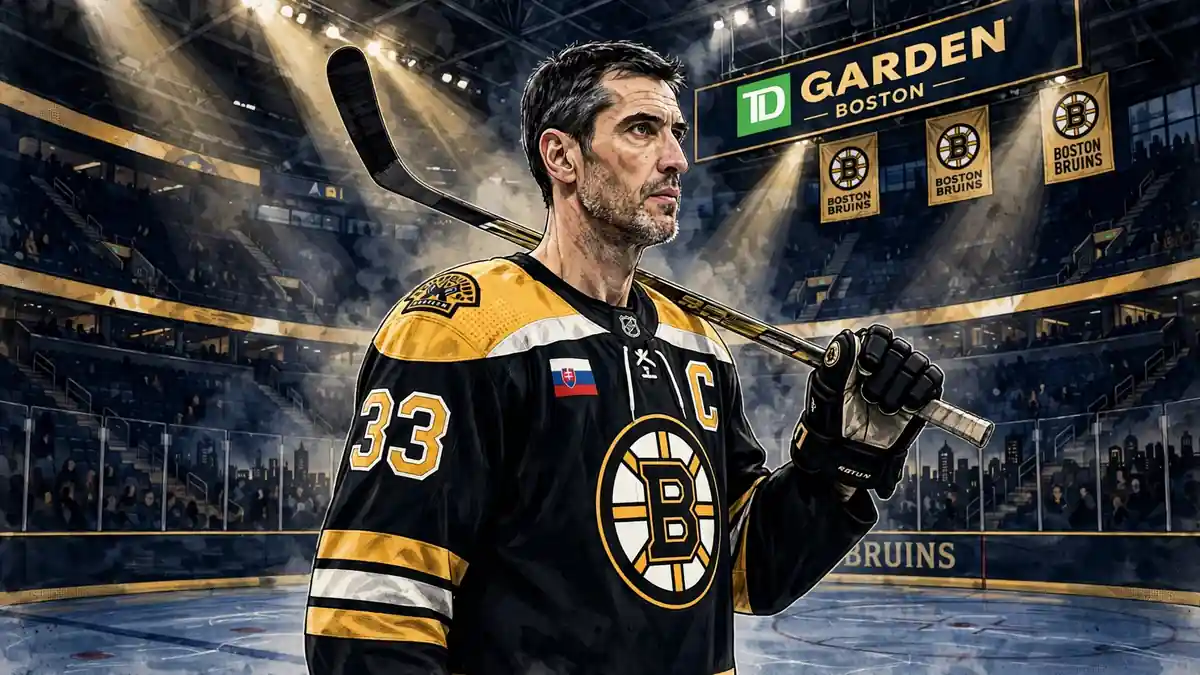
Zdeno Chára‘s net worth is estimated at $50 million to $123 million as of November 2026. The spread is wide because the two freshest published estimates use different methods: Celebrity Net Worth, updated November 20, 2026, puts him at $50 million, while Forbes Slovensko’s October 2026 list of the richest Slovaks puts him at €110 million, about $123 million. Between those poles sits the hard number both sides agree on — a 24-season NHL career that paid him roughly $95 million in salary and bonuses, built on two Boston contracts worth $83 million combined, a Stanley Cup as captain in 2011, and a Hockey Hall of Fame induction in 2025.
Zdeno Chára: Quick Facts
| Estimated net worth | $50 million – $123 million (range: $50 million to $123 million) |
|---|---|
| Profession | Former professional ice hockey defenceman; Boston Bruins hockey operations adviser and mentor |
| Nationality | Slovak |
| Born | 18 March 1977 (age 49) |
| Height | 6 ft 9 in (2.06 m) — the tallest player ever to play in the NHL |
| Primary income sources | NHL salaries and bonuses, performance incentives, endorsements, business ventures |
| Active years | 1996–2022 |
| Last reviewed | November 2026 |
- Early Life and Background
- Education
- Career Journey
- Rise to Fame
- Main Sources of Income
- Salary and Earnings
- Businesses and Investments
- Brand Deals and Sponsorships
- Houses, Cars and Other Assets
- Awards and Achievements
- Net Worth Growth Over the Years
- Social Media Presence
- Personal Life
- Sources & Reporting
- Frequently Asked Questions
Early Life and Background
Zdeno Chára was born on March 18, 1977, in Trenčín, Czechoslovakia — the town is in present-day Slovakia — to Zdeněk and Veronika Chára. His father was a Greco-Roman wrestler who represented Czechoslovakia at the 1976 Summer Olympics in Montreal and later coached the Slovak national team. That detail matters to the money story that follows, because Chára grew up in a household where elite sport was a discipline, not a dream. His father trained him with methods that sound almost comical until you see the results: a hockey stick set in a flower pot of hardened concrete, shoulder raises with buckets of water pumped from a 13-metre hand-dug well. Sports Illustrated recorded those details in a 2018 profile built around a folder in Chára’s home office — a blue folder holding handwritten logs of every offseason workout since his teens.
Chára’s first organised hockey came with his hometown club, HC Dukla Trenčín, where he played four seasons in the mid-1990s. He was tall from the start and kept growing; by the time he reached the NHL he stood 6 feet 9 inches and weighed 250 pounds, the tallest player ever to appear in an NHL game. Size alone never made a defenceman, and the early scouting reports were blunt about it: a giant who needed years of work on his skating and positioning. The work happened. What separated Chára from other big men who washed out was the training habit his father drilled into him — the same habit that later let him play until he was 45.
Slovakia had only become an independent country in 1993, four years before Chára left for North America, and its hockey infrastructure was thin. Chára’s path out ran through the 1996 NHL Entry Draft, where the New York Islanders took him in the third round, 56th overall. Four days later the Western Hockey League’s Prince George Cougars took him sixth overall in the CHL Import Draft. He crossed the Atlantic at 19, played a year of junior hockey in Prince George, British Columbia, and then turned professional. The Hockey Hall of Fame’s member file records the sequence plainly: one junior season, then assignment to the Kentucky Thoroughblades of the American Hockey League for 1997–98, three call-ups to the Islanders that season, a place in the AHL All-Star Classic, and a spot on the AHL All-Rookie Team.
Nothing about that start suggested a $95 million career. A third-round pick from a new hockey country, raw and still learning English, was a long shot. Chára’s edge was never talent alone. It was the combination of a frame no one else had and a work routine no one else kept — and, as the contract record shows, NHL teams eventually paid a premium for both.
Education
Chára never followed the North American college-hockey route. He came to Canada as a 19-year-old junior player and went straight into professional hockey, so there is no university degree on his record. The education that shows up in his post-playing life came later, in pieces, and it lines up with the financial-planning instincts that run through his career choices.
While playing for the Ottawa Senators, Chára earned a financial planning diploma from Algonquin College in Ottawa. The detail is easy to miss in the hockey biographies, but it is one of the more telling facts about how he handled money: a player in his twenties, already earning millions a season, spent his spare time studying how money is planned rather than how it is spent. In early 2015, while still captaining the Bruins, he received a licence to sell real estate in Massachusetts. No public record shows him working as a full-time agent — the licence reads more like a player learning the property market from the inside, at a point in his career when his Boston salary was $7 million a season and property was a natural place to put it.
After retirement he went back to school in a different way. ESPN reported in November 2025 that Chára had taken business courses at Harvard University and worked out of the Harvard Innovation Labs, known as i-Labs, where he met Peter Gladstone, the co-founder of the app venture he was preparing to launch. The Harvard stint was hands-on rather than academic: Chára told ESPN he went looking for practical experience in entrepreneurship, “the business side of things,” and built the idea for his Castable platform there over about three years.
Chára also speaks seven languages: Slovak, Czech, Polish, Swedish, Russian, German, and English. The Swedish came from his lockout season with Färjestad BK in 2004–05; the Russian and Polish from a childhood in central Europe and years in dressing rooms full of European players. For a player who later moved into mentoring and hockey operations, that range of languages is a working asset, not a party trick — it lets him talk to prospects from half the hockey world in their own tongue.
Career Journey
Chára became a full-time Islander in the 1998–99 season and spent four seasons on Long Island. The numbers from that stretch were modest — six goals and 28 points in 231 games, as Boardroom’s career retrospective records — but the Islanders saw a defenceman learning to use his reach, and the league saw a 6-foot-9 problem that forwards had to skate around. His entry-level contract, signed in August 1997, was three years at $875,000 a season, a total of $2.63 million. A one-year deal at $675,000 followed for 2000–01. Nobody on Long Island was getting rich off those numbers; the fortune came later, and it came because of what happened next.
On June 23, 2001, the Islanders traded Chára to the Ottawa Senators as part of the package for star centre Alexei Yashin. Trades like that are usually remembered for the star who moves. This one is remembered for the throw-in. In Ottawa, under a three-year, $5.25 million deal signed in August 2001, Chára turned into a first-pairing defenceman. The Senators won the Presidents’ Trophy in 2002–03 after finishing first in the regular-season standings, and Chára’s 2003–04 season — 16 goals, 41 points, a place on the NHL First All-Star Team, and a nomination for the Norris Trophy as the league’s best defenceman — announced him as one of the best at his position. His next contract, two years at $4.75 million a season signed in August 2004, paid him like it.
The 2004–05 NHL lockout wiped out a full season. Chára spent it with Färjestad BK in the Swedish Elitserien, staying sharp while the league and its players fought over money. When play resumed he matched his 16-goal total and set a career best with 43 points, earning Second All-Star Team honours. Then came the financial fork that shaped the rest of his career — and his bank balance. Ottawa had two elite defencemen, Chára and Wade Redden, and the money to keep only one. The Senators chose Redden. Chára reached unrestricted free agency at the end of the 2005–06 season, and on July 1, 2006, the first day of free agency, he signed a five-year, $37.5 million contract with the Boston Bruins and was named team captain the same day. The captain’s job had been vacant since Joe Thornton’s departure to San Jose during the 2005–06 season. Chára held it for all 14 of his seasons in Boston.
Boston was where the career became a legacy. In October 2010 he signed a seven-year, $45.5 million extension covering 2011–12 through 2017–18. The two big Boston deals had a combined face value of $83 million, and the extension’s cash payments ran $7.5 million, $6 million, $8 million, $7 million, $7 million, $5 million and $4 million across its seven seasons, with a $1 million signing bonus in its first year. By the time the extension ran out, Chára was 41 and taking one-year deals: $5 million in base salary for 2018–19 with up to $1.75 million in performance incentives, then $2 million in base salary for 2019–20 with the same incentive structure. Celebrity Net Worth reports he earned $3.5 million in gross salary and bonuses that 2019–20 season, before deductions.
The end of the Boston run came quietly. After the 2019–20 season Chára left for the Washington Capitals, signing a one-year deal on December 30, 2020, with a $795,000 base salary and up to $730,000 in performance bonuses; he played 55 of 56 games and, per Celebrity Net Worth, collected $480,000 of those bonuses. Then, in October 2021, he went back to where it started, signing a one-year, $750,000 deal with the New York Islanders at 44, with a further $750,000 available in performance bonuses. His last NHL game came on April 29, 2022, a 6–4 loss to Tampa Bay at UBS Arena in which he scored his second goal of the season. He announced his retirement on September 20, 2022, signing a one-day contract so he could retire as a Bruin.
The final line, from NHL.com and the Hockey Hall of Fame, reads: 1,680 regular-season games, 209 goals, 471 assists, 680 points, 2,085 penalty minutes, a plus-301 rating, and 200 playoff games with 18 goals and 52 assists. The games total is the record for a defenceman — he passed Chris Chelios in February 2022 and kept adding to it until September. He was the second-to-last active NHL player to have played in the 1990s, behind Joe Thornton.
Rise to Fame
Chára’s rise was slow, and that is the point most short profiles miss. He was not a teenage star. He was a project — a third-round pick who needed three professional seasons before he looked like an NHL regular, and four more before he looked like a star. The 2003–04 season in Ottawa was the turn: 16 goals from the blue line, a First All-Star Team selection, a Norris nomination, and the third-best plus-minus rating in the league, behind only Martin St. Louis and Marek Malík. From there the arc ran through Boston, where the captaincy, the Norris Trophy in 2009, and the Stanley Cup in 2011 made him one of the defining players of his era.
The 2009 Norris Trophy, awarded to the league’s best defenceman, made him the first Slovak player to win it and only the second European after Nicklas Lidström. It also mattered financially: the Norris put Chára in the small group of defencemen whose names alone moved a team’s marketability, and it arrived in the middle of the $37.5 million Boston contract, just before the $45.5 million extension. Awards do not appear as line items on a pay stub, but for a player of Chára’s profile they set the price of the next deal, and the next deal was the biggest of his life.
The 2011 Stanley Cup run sealed his standing in Boston. Chára captained the Bruins past Vancouver in seven games, becoming the second European captain to win the Cup and the first captain born and trained in the Eastern Bloc to do it. He led Boston to the Final again in 2013 and 2019, losing both times, which is why the 2011 win carries so much weight in his story: three Finals in nine years, one Cup, all with the same captain. The Cup also gave him the image that still defines him in Boston — the 6-foot-9 captain lifting 35 pounds of silver over his head, the hardest shot in the league, the player opponents had to game-plan around for 25 minutes a night.
Internationally, Chára carried Slovakia. He played in three Olympics — Turin 2006, Vancouver 2010, Sochi 2014 — captained the team at the last two, and carried the Slovak flag at the opening ceremony in Sochi. He played in seven World Championships and won silver in 2000 and again in 2012, captaining the 2012 side to what the IIHF called a “miracle silver.” After the medal ceremony in 2012 he took off his own sweater and put on the number 26 of Pavol Demitra, the longtime friend and teammate who had died the previous autumn in the Yaroslavl plane crash. He also played in two World Cups of Hockey, for Slovakia in 2004 and for Team Europe in 2016, winning silver with Team Europe. None of that paid NHL money, but it made him the most recognised Slovak athlete of his generation — and that recognition is the base of the Forbes Slovensko estimate that now anchors the top of his net worth range.
Fame, for Chára, arrived late and stayed long. He played his 1,652nd NHL game in 2022 to pass Chelios, played until 45, and was still the oldest player in the league when he retired. The Hockey Hall of Fame elected him in June 2025, in his first year of eligibility, and inducted him that November, alongside his IIHF Hall of Fame induction the same year. In January 2026 the Bruins raised his No. 33 to the rafters at TD Garden — the first European number the club has retired.
Main Sources of Income
Chára’s money came from one place above all: NHL pay. Contract salary and bonuses account for nearly all of the roughly $95 million he earned across 24 seasons, and every other income stream in his life is small beside it. That concentration is normal for a defenceman of his era — hockey players of the 2000s and 2010s did not have the endorsement market of basketball or soccer stars — but Chára’s case is extreme even by that standard, because his two Boston contracts alone were worth $83 million in face value, and his peak cash year, 2013–14, paid $8 million in base salary alone.
The second stream was performance bonuses, which mattered more late in his career than early. His 2018–19 and 2019–20 Boston deals each carried up to $1.75 million in incentives on top of base salaries of $5 million and $2 million. His Washington deal carried $730,000 in potential bonuses on a $795,000 base, and his final Islanders deal carried $750,000 in potential bonuses on a $750,000 base. Those late-career structures — low base, high bonus — are how teams pay a 43- and 44-year-old legend without breaking their salary cap, and Chára collected a real share of them: $3.5 million gross in 2019–20 and $480,000 in Washington bonuses, per Celebrity Net Worth.
Endorsements were the third stream, and the smallest. Chára’s public commercial ties were modest during his playing days: hockey equipment, including his famous 67-inch Warrior sticks, and the kind of local Boston appearances that come with being a team’s captain. The bigger commercial chapter opened after retirement, when Celebrity Net Worth reported him as an investor and brand ambassador for Specter Hockey, a Slovak hockey-equipment business whose Rezztek product offers an alternative to conventional stick tape. That is a small, early-stage venture, not a Nike deal, and it should be read that way: Chára putting his name and money behind a Slovak hockey product, not collecting a paycheque from a global brand.
The fourth stream is the one still forming. Since September 2025 Chára has worked for the Bruins as a hockey operations adviser and mentor, a salaried front-office role in which he visits prospects in the AHL, watches college games, and passes on what he learned in 25 professional seasons. The Bruins have not published the salary, and no figure should be attached to it. Alongside it sits Castable, the app venture he co-founded with Peter Gladstone through Harvard’s Innovation Labs, which ESPN reported in November 2025 as close to launch. Castable is a platform where users pay a small fee to listen to athletes, artists, and other well-known people talk over live events — the ManningCast, opened up to anyone. It has no published revenue yet, and it would be wrong to count it as income today. It counts as the direction of travel: a 48-year-old former player turning a playing fortune into a business, with Harvard coursework behind him and a co-founder beside him.
What Chára did not do is also part of the picture. There is no public record of a restaurant chain, a clothing line, a media contract, or a string of paid speaking tours. His off-ice money story is closer to a careful saver than a brand empire: a financial-planning diploma, a real-estate licence, a long career, and a late turn to entrepreneurship. That profile is exactly why the published net worth estimates disagree so much — and why the honest number is a range, not a point.
Salary and Earnings
The cleanest way to understand Chára’s fortune is to walk the contracts one by one, because the career splits into three pay eras: the cheap learning years, the Boston peak, and the low-base bonus years at the end. PuckPedia lists ten contracts across the career and puts estimated career earnings at $95.27 million. SalarySport, counting 19 seasons of cash payments, puts the total at $89,927,500. Boardroom, writing in 2021 before the final season, put estimated career earnings at $98.8 million including signing and performance bonuses. Those three numbers do not agree to the dollar because they count different things — base salary only, base plus bonuses actually paid, and base plus bonuses available — but they bracket the same truth: Chára’s gross NHL pay landed somewhere between $90 million and $99 million.
Here is the contract record, drawn from PuckPedia’s contract history and cross-checked against Celebrity Net Worth’s salary reporting:
| Seasons | Team | Deal | Value |
|---|---|---|---|
| 1997–2000 | New York Islanders | Entry-level, 3 years | $2.63 million |
| 2000–01 | New York Islanders | 1 year | $675,000 |
| 2001–04 | Ottawa Senators | 3 years | $5.25 million |
| 2004–06 | Ottawa Senators | 2 years | $9.5 million |
| 2006–11 | Boston Bruins | 5 years | $37.5 million |
| 2011–18 | Boston Bruins | 7 years | $45.5 million |
| 2018–19 | Boston Bruins | 1 year + incentives | $5 million base |
| 2019–20 | Boston Bruins | 1 year + incentives | $2 million base |
| 2020–21 | Washington Capitals | 1 year + bonuses | $795,000 base |
| 2021–22 | New York Islanders | 1 year + bonuses | $750,000 base |
The Boston peak deserves a closer look, because it is where the fortune was made. The 2006 deal paid $7.5 million a season for five years — $37.5 million in total — and made Chára one of the highest-paid defencemen in the league. The 2010 extension, seven years at $45.5 million, averaged $6.5 million a season in cap terms but paid uneven cash: $7.5 million in 2011–12 plus a $1 million signing bonus, $6 million, $8 million, $7 million, $7 million, $5 million and $4 million across the remaining seasons. The single biggest cash year was 2013–14, when the base salary alone was $8 million; SalarySport’s season-by-season table records 2011–12 as the best year overall at $8.5 million in cash, counting the signing bonus. For scale, SalarySport ranks Chára 59th of 1,084 players on its NHL all-time earnings list, with his $89.9 million representing about 0.3 percent of everything the league has ever paid its players.
Gross pay is not net worth, and the gap between the two is the whole argument of this article. A player earning $95 million over 24 seasons pays tax in the United States and Canada at top marginal rates, pays his agent a standard percentage, and lives for a quarter of a century — in Boston, one of America’s most expensive cities, raising three children. Celebrity Net Worth’s $50 million estimate is consistent with a player keeping roughly half of gross career pay after tax, fees, and living costs, with modest investment growth on top. That is the conservative reading, and it is the one most American net worth trackers land on.
Forbes Slovensko reads the same career differently. Its October 2026 list, reported by SME Sportnet on October 8, 2026, values Chára at €110 million — about $123 million at the October 23, 2026 exchange rate — the same figure as in 2025. The magazine says its athlete estimates start from the net money a player earned in his career, roughly half of gross salary for NHL players, and then add conservative growth on those savings, plus the value of any company stakes. On that method, Chára’s fortune sits beside the other three former athletes on the 2026 list — Marián Hossa, Marián Gáborík and Marek Hamšík — who together are worth €440 million, up from €410 million a year earlier. The tension in the Forbes Slovensko figure is plain: €110 million is more than Chára’s entire gross career pay, so the estimate depends heavily on investment growth and on stakes such as Specter Hockey being worth far more than the public record shows. Readers should know that. We publish the range because both numbers come from named, dated sources, and because pretending the disagreement does not exist would be less honest than showing it.
One more number anchors the story. DailyWikiBio, a lower-grade source, puts Chára at “around $100 million” as of 2025 — between the two poles, and close to the gross career earnings figure. We do not rely on it. It is worth a mention only because it shows how often the $100 million mark gets repeated: several outlets simply round career earnings up to a net worth, which is a mistake. Career earnings are what a player was paid. Net worth is what is left. They are different numbers, and this article keeps them apart.

Businesses and Investments
Chára’s business record is short, recent, and mostly ahead of him rather than behind him. During his playing career there were no public company launches, no franchise purchases, and no venture portfolio to itemise. The business story starts where the playing story ends, and it starts in two places: a Slovak equipment startup and a Harvard-built app.
The first is Specter Hockey. Celebrity Net Worth, in its November 2026 update, reports Chára as an investor and brand ambassador for the Slovak hockey-equipment business, whose Rezztek product offers an alternative to conventional hockey-stick tape. Rezztek is a grip material applied to the blade instead of tape, and Chára’s role is the classic athlete-investor one: money in, name on it, credibility with players who trust a Hall of Fame defenceman’s view of a stick blade. No valuation has been published for Specter Hockey, and no stake size for Chára, so no dollar figure belongs in his net worth from this holding today. What it does explain is part of the Forbes Slovensko method: the magazine says it values company stakes where they exist, and a stake in a growing Slovak sports business is the kind of asset that could push an estimate above a player’s retained salary. Whether it is worth a little or a lot is not public, and we do not guess.
The second venture is Castable, and it is the more substantial of the two. ESPN reported in November 2025 that Chára, after taking business courses at Harvard University, was preparing to launch his first app, built with co-founder Peter Gladstone, whom he met at the Harvard Innovation Labs. The idea had been in development for about three years. Castable is a platform for live-event commentary: users pay a small fee to listen as athletes, artists, and other well-known people — “Casters” — talk over a game, a concert, or a television event in real time. Chára described it to ESPN by pointing at the ManningCast, the alternate broadcast where Peyton and Eli Manning talk over Monday Night Football, and asking why that format should belong only to television networks. “Imagine: the ManningCast, in real time, and it will be accessible to many, many people,” he said. A Boston Globe report from the same period, quoted in fan coverage of the Hall of Fame induction, described Castable as an online broadcast-style platform inviting users to pay to listen as Casters comment on games and other live entertainment.
Castable has no published revenue, user numbers, or valuation, and it would be wrong to add a dollar value for it to Chára’s net worth. Early-stage apps are worth what someone will pay for them, and nobody has paid yet in public. What matters for the money story is the direction: Chára is putting time and, by his own account to ESPN, “obviously some money” into a business he co-founded, after three years of preparation and Harvard coursework. That is a different profile from the athlete who retires and lives off savings. It is also a risk profile — startups fail far more often than they pay — and any future revision of his net worth will depend in part on whether Castable finds paying users.
Behind both ventures sits the quieter investment story: the financial-planning diploma from Algonquin College and the Massachusetts real-estate licence from early 2015. Neither produced a public deal, but together they describe a player who studied how money works while he was earning it, rather than discovering the subject at retirement. His wife, Tatiana, worked as a financial planner for TD Bank when the couple lived in Ottawa, and later worked in economics and finance before the family settled in Boston. A household with two people trained in finance is a household more likely to keep its earnings than to spend them — which is consistent with the conservative end of the net worth range, and with a career in which the biggest financial decisions were the contracts themselves.
For comparison among his peers, the other Slovak stars on the Forbes Slovensko list show the same pattern: long careers, salaries banked, then business after hockey. Marián Gáborík, another Slovak winger of the same era, is listed by Celebrity Net Worth at $47 million, close to Chára’s $50 million on the same source — a useful check that the conservative estimate treats similar careers similarly. The Forbes Slovensko list groups all four of its former athletes together at €440 million, up from €410 million in 2025, which suggests the magazine’s method credits investment growth in a rising market rather than new earnings. Chára’s share of that group, €110 million, has not moved year on year.
Brand Deals and Sponsorships
Hockey has never paid its stars the endorsement money basketball or soccer pays, and Chára’s career shows it. There is no record of a national television campaign, a shoe deal, or a global brand ambassadorship during his playing days. His commercial value lived in Boston, in the arena, and in the equipment room — not on billboards.
The equipment relationship that mattered most was with Warrior, the maker of his sticks. Chára’s sticks were famous in their own right: 67 inches long, exempt from the league’s standard length rules, painted black and gold, and the source of the hardest shot ever measured at an NHL skills event — 108.8 miles per hour at the 2012 All-Star Game. Sports Illustrated’s 2018 profile lingered on those sticks as museum pieces of a singular career. A stick deal for a defenceman is a modest commercial arrangement beside a sneaker contract, but for Chára it was the natural one: the tallest player in the league, with the hardest shot, using a stick nobody else could swing.
Local Boston ties filled the rest of the commercial picture. As captain for 14 seasons, Chára was the face the Bruins put in front of sponsors, season-ticket holders, and community events. He hosted the Big Z Challenge, an annual charity event in Manchester, New Hampshire, where fans and families raised money for pediatric and cancer care at Elliot Health System. He bought $2,000 worth of pies from a local pastry shop each Thanksgiving and delivered them to Boston-area shelters, then helped raise more through fan participation. He led a shoe drive with Soles4Souls, donating $7,500 worth of New Balance shoes himself and collecting more than 2,000 pairs for underserved communities. He is an athletic ambassador for Right To Play, and in July 2008 he spent two weeks in Africa visiting Mozambique for the charity and climbing Mount Kilimanjaro with former NHL player Robyn Regehr. Charity work is not income, and this article does not count it as such — but sponsors notice it, and a captain who shows up for a shelter on Thanksgiving is a captain a team can put in front of a camera without worry.
The post-retirement commercial picture is clearer and smaller. The Specter Hockey investor-and-ambassador role, reported by Celebrity Net Worth, is his main public brand tie today: a Slovak equipment company, a product he can speak about from experience, and a market — Slovak and European hockey — where his name still opens doors. There is no published fee or equity figure for the role, so it enters the net worth story as a holding of unknown value, not as a salary line. Readers comparing Chára with a fellow NHL defenceman of his era will find a similar shape: Dion Phaneuf’s fortune was also built almost entirely on contracts, with endorsements a footnote. Hockey fortunes are salary fortunes, and Chára’s is the purest example of the type.

Houses, Cars and Other Assets
Chára’s property record is thin in public, and this section says so rather than filling the gap with guesses. No deed, purchase price, or listing has been published for a Chára home, and no reliable source puts a value on his property holdings. What the record does show is where the family lived, and how long they stayed.
For years the family home was in Boston’s North End, the neighbourhood Sports Illustrated described in 2018 when it visited the family’s combination office and playroom, with a dozen autographed jerseys on the wall — Lidström, Bobby Orr, Lance Armstrong, Tom Brady — and a desk lamp shaped like the Stanley Cup. The North End put Chára minutes from TD Garden and inside the city he captained. Later reporting around the Hall of Fame induction placed the family home in the western suburbs, the MetroWest area outside Boston, where the children could grow up with more space and where Chára trained for marathons on suburban roads. The move, from a city neighbourhood to the suburbs, matches the arc of a player becoming a father of three and then a retiree. No price is attached to either home in public reporting, and this article does not invent one.
The Massachusetts real-estate licence Chára obtained in early 2015 is the one hard property fact on the record. A player earning $7 million a season does not take a real-estate exam by accident; it suggests he was studying the market he was buying into, whether for his own homes or as a side interest. No transaction tied to the licence has been reported, so it stays a credential, not an asset line.
Cars are the same story. Chára is known in Boston for riding a bicycle around the city — Sports Illustrated noted a heavy-duty frame built to handle the cobblestones — rather than for a garage of supercars. No car collection, luxury vehicle purchase, or private jet has been reliably reported, and this article will not manufacture one. For a man 6 feet 9 inches tall, most production cars are an exercise in folding himself in; the bicycle, whatever its frame cost, was the practical choice, and the marathon running shoes that followed were cheaper still.
The assets that can be counted are the sporting ones, and they are considerable in kind if not in market price. A Norris Trophy, a Stanley Cup ring, six All-Star jerseys, the puck from a 108.8 mph slap shot, and the sweater he wore as captain for 14 seasons are the relics Sports Illustrated imagined in a future Chára exhibition. Their auction value is unknown and probably modest beside his salary — game-worn hockey memorabilia sells well, but not at the level of a $95 million career. The real asset, as the Forbes Slovensko method implies, is the savings from that career, invested over two decades. Its size is private. The published estimates — $50 million at the conservative end, €110 million at the generous end — are the market’s best guesses at it.
Awards and Achievements
Chára’s trophy record is the reason the money followed him, and it is unusually complete for a defenceman: the individual prize, the team prize, the international medals, and the two Hall of Fame inductions that closed the story in 2025. The Hockey Hall of Fame’s member file lists the honours in order, and the list is long enough to need a table rather than a paragraph.
| Honour | Year | Note |
|---|---|---|
| AHL All-Rookie Team | 1998 | With the Kentucky Thoroughblades |
| NHL First All-Star Team | 2004, 2009, 2014 | Three selections |
| NHL Second All-Star Team | 2006, 2008, 2011, 2012 | Four selections |
| NHL All-Star Game | 2003, 2007, 2008, 2009, 2011, 2012 | Six appearances |
| Hardest Shot, All-Star Skills Competition | 2007, 2008, 2009, 2011, 2012 | Five wins; 108.8 mph in 2012, an NHL record |
| James Norris Memorial Trophy | 2009 | First Slovak winner; second European after Lidström |
| Stanley Cup | 2011 | Captain of the Boston Bruins; Finals again 2013, 2019 |
| Mark Messier NHL Leadership Award | 2011 | For leadership on and off the ice |
| World Championship silver, Slovakia | 2000, 2012 | Captain in 2012 |
| World Cup of Hockey silver, Team Europe | 2016 | Alternate captain |
| NHL Quarter Century Team | 2025 | Players who began careers in the 1990s |
| IIHF Hall of Fame | 2025 | Inducted the same year as the Hockey Hall of Fame |
| Hockey Hall of Fame | 2025 | First year of eligibility |
| No. 33 retired, Boston Bruins | January 15, 2026 | First European number retired by the club |
Two of those lines deserve more than a row in a table. The Norris Trophy in 2009 was the individual peak: the league’s best defenceman, voted by the Professional Hockey Writers Association, and the first Slovak to win it. Chára had been a finalist in 2004, and the 2009 win confirmed what the 2003–04 season had promised. The Stanley Cup in 2011 was the team peak: seven games against Vancouver, a captain lifting the Cup, and a city that had waited 39 years. Chára is one of five European-born and raised captains to lead a team to the Cup, and the first born and trained in the Eastern Bloc — a line that matters in Slovakia, where his career is a national story as much as a Boston one.
The 2025 inductions closed the competitive story. The Hockey Hall of Fame elected him in June 2025 and inducted him that November, in his first year of eligibility; the IIHF Hall of Fame inducted him the same year. In September 2025, between the two honours, the Bruins brought him back as a hockey operations adviser and mentor. In January 2026 they retired his No. 33 before a game against the Seattle Kraken at TD Garden. He joined Eddie Shore, Bobby Orr, Dit Clapper, Lionel Hitchman, and Ray Bourque among the defencemen whose numbers hang in the rafters — company that explains, better than any salary table, why Boston paid him $83 million across two contracts.
For readers weighing Chára against other Cup-winning captains and defencemen of his era, the comparison that lands closest at home is T.J. Oshie’s Stanley Cup fortune: a fellow Cup winner whose wealth, like Chára’s, was built on a long career and a championship rather than on endorsements. The difference is scale — Chára played a decade longer, captained for 14 seasons, and earned roughly three times as much in salary — and that scale is the whole of the net worth gap between them.
Net Worth Growth Over the Years
No outlet has published a year-by-year net worth for Chára, so the table below is our modelled estimate, built from cumulative contract cash and labelled as such. It is not a quotation from any source. It shows how a fortune like this actually accumulates: slowly for years, then quickly once the big Boston contracts start paying, then flat once the paycheques stop and the money has to work on its own.
| Period | What changed | Modelled net worth |
|---|---|---|
| 1997–2001 | Entry-level Islanders deals; $2.63M + $675K gross | $1M – $2M |
| 2001–2006 | Ottawa deals worth $14.75M combined; first All-Star honours | $5M – $10M |
| 2006–2011 | Five-year, $37.5M Bruins deal; Norris Trophy; 2011 Stanley Cup | $15M – $30M |
| 2011–2018 | Seven-year, $45.5M extension; peak cash year $8.5M in 2011–12 | $30M – $50M |
| 2018–2022 | Short deals and bonuses; final seasons in Washington and New York | $45M – $60M |
| 2022–2026 | Retirement; advisory role; Castable; Hall of Fame; No. 33 retired | $50M – $123M |
The last row is the honest one to dwell on. Between 2022 and 2026 Chára earned no NHL salary, yet the published estimates for his wealth moved in opposite directions depending on who was counting: Celebrity Net Worth held him at $50 million, while Forbes Slovensko held him at €110 million. Both can be defended from the same career, because they answer different questions. The conservative answer asks what is left after tax and a life lived well. The generous answer asks what the career was worth before tax, grown by investing, and counts business stakes at full value. A reader who wants one number should use $50 million, the figure the most widely cited American tracker stands behind as of November 2026. A reader who wants the full picture should keep the range — and should know that the top of it depends on investments and stakes that have never been publicly valued.
Social Media Presence
Chára came late to social media and uses it the way he used the gym: as a training log. In 2019 he announced he was giving it a try, opening an Instagram account under the handle @zeechara33 and a Facebook page under the same name. The posts since have been mostly what a retired athlete with an endurance habit posts: marathon finish lines, Ironman bike legs, training rides around Boston, and the occasional look back at a Bruins night. No verified follower count is published in the sources we checked, so none is given here; inventing a number would add nothing but risk.
The endurance content is real, and it is the most active part of his public life after hockey. ESPN reported in November 2025 that Chára had completed his first Ironman triathlon that August in under five hours, after nine marathons in a 15-month span. The Hockey Beast reported that by the autumn of 2026 he had finished all six World Marathon Majors — Tokyo, Boston, London, Berlin, Chicago, and New York — the six-race set that is the marathon world’s version of a career Grand Slam. He has also raced triathlons and trained through the winters since retirement, dropping about 25 pounds from his 250-pound playing weight in the process. For a man who played 1,680 NHL games, the marathons are not a hobby taken up lightly; they are the same training habit, pointed at a new finish line.
Social media is not a money stream for Chára in any meaningful sense. He is not a creator with brand deals built on a following, and his accounts read as personal rather than commercial. That is consistent with everything else in his financial profile: the money came from the rink, and the public profile after the rink is about sport, not sales.
Personal Life
Chára married his longtime girlfriend, Tatiana Biskupicová, on July 14, 2007, in a Catholic church in Nemšová, Slovakia. Tatiana was born in Trenčín, like her husband, moved to Canada, and worked as an economics engineer before becoming a financial planner — she worked for TD Bank while the couple lived in Ottawa. They had dated for nearly a decade before marrying, having met while Chára was playing for the Islanders.
The couple have three children, all born in Boston: daughter Elliz Victoria Chára, born April 27, 2009, and twin sons Zack and Ben, born March 7, 2016. The family stayed in Boston when Chára left for Washington in the 2020–21 season — he lived near the Capitals alone that year, calling the separation the hardest part of the move, while Tatiana and the children stayed home so the children’s lives would not be disrupted. The 2020–21 season was played without fans in the arena because of the pandemic, and Chára’s most important Boston reunion that year, he told NHL.com, was simply seeing his family again.
Chára’s father, Zdeněk, the Olympic wrestler who built his son’s first training equipment from concrete and well water, shaped the career from its first day. Chára has spoken about his father’s influence throughout his career, and the discipline his father taught — log the work, every day, for decades — is visible in everything from the blue folder of workout logs to the 1,680 games. His mother, Veronika, has kept a lower public profile. The family keeps its private life largely out of the press: Tatiana has no public-facing social media accounts, and the children appear in public mainly at team family events, such as the family skate at Warrior Ice Arena in October 2018 that NHL.com photographed with Chára, Tatiana, Elliz, Zack, and Ben on the ice together.
Off the ice, Chára’s habits are well documented and plain: cycling around Boston, a plant-based diet adopted in the pandemic years and later set aside — he told the Boston Globe he was “back normal” and eating everything, including meat and fish, because the running demanded the calories — and the training logs that never stopped. He is a private man who became famous for being impossible to move, and retirement has not changed the shape of that: the same discipline, a different sport, the same city.
Sources & Reporting
Reporting window: October 2025 – November 2026, with career records reaching back to the 1996 draft. Celebrity Net Worth supplied the $50 million net worth figure and the contract-by-contract salary detail, updated November 20, 2026. Forbes Slovensko supplied the €110 million estimate from its October 2026 richest-Slovaks list, as reported by SME Sportnet on October 8, 2026; no homepage link is given for Forbes Slovensko because its exact publication URL was not verified in this run. PuckPedia supplied the ten-contract history and the $95.27 million estimated career earnings figure. SalarySport supplied the $89,927,500 cash-earnings total and the season-by-season payment table, including the $8.5 million best year in 2011–12. NHL.com supplied the career totals (1,680 games, 209 goals, 471 assists), the retirement and one-day-contract details, the September 2025 advisory-role appointment, and the January 15, 2026, No. 33 retirement date. The Hockey Hall of Fame supplied the member-file career record, the All-Star and awards list, and the 2025 induction. The IIHF supplied the World Championship silver-medal record and the 2012 Demitra tribute detail. ESPN supplied the November 2025 post-retirement reporting: the Ironman result, the nine marathons, the Harvard business courses, and the Castable app venture with Peter Gladstone. Sports Illustrated supplied the 2018 profile detail on the workout logs, the North End home, and the 67-inch sticks. Boardroom supplied the 2021 career retrospective, the $98.8 million earnings estimate, and the Islanders games and points totals. Wikipedia supplied the biographical spine — birth date and place, draft position, family dates, and international record — cross-checked against the Hall of Fame file and NHL.com. The Hockey Beast supplied the six World Marathon Majors detail. NBC Sports Boston and Heavy supplied family background on Tatiana Biskupicová and the children. Where sources disagreed — above all on the net worth itself — this article publishes the range and names who says what, rather than choosing a side.
Frequently Asked Questions
What is Zdeno Chára’s net worth in 2026?
Zdeno Chára’s net worth is estimated at $50 million to $123 million as of November 2026. Celebrity Net Worth puts him at $50 million, while Forbes Slovensko’s October 2026 list values him at €110 million, about $123 million. The gap comes from method: Celebrity Net Worth discounts his roughly $95 million in gross career pay for tax, agent fees, and living costs, while Forbes Slovensko counts net career money plus investment growth and company stakes.
How much did Zdeno Chára earn in his NHL career?
His gross NHL earnings were roughly $90 million to $99 million. PuckPedia estimates $95.27 million across ten contracts; SalarySport counts $89,927,500 in cash payments over 19 seasons; Boardroom put the figure at $98.8 million including bonuses before his final season. His two Boston contracts alone were worth $83 million in face value: five years at $37.5 million from 2006, then seven years at $45.5 million from 2011.
How tall is Zdeno Chára?
Zdeno Chára is 6 feet 9 inches tall (2.06 metres) and played at about 250 pounds, making him the tallest player ever to play in the NHL. His height shaped his whole game — his reach let him seal off the boards and hold forwards at arm’s length — and his stick, at 67 inches, was the longest in the league.
How old is Zdeno Chára?
Zdeno Chára was born on March 18, 1977, in Trenčín, Czechoslovakia (now Slovakia), which makes him 49 years old as of November 2026. He retired from the NHL at 45, after 24 seasons, as the second-to-last active player to have played in the 1990s.
Who is Zdeno Chára’s wife?
Zdeno Chára is married to Tatiana Biskupicová, his longtime girlfriend. They married on July 14, 2007, in a Catholic church in Nemšová, Slovakia. Tatiana worked as a financial planner, including for TD Bank while the couple lived in Ottawa. They have three children, all born in Boston: daughter Elliz Victoria, born in 2009, and twin sons Zack and Ben, born in 2016.
Did Zdeno Chára win a Stanley Cup?
Yes. Zdeno Chára captained the Boston Bruins to the Stanley Cup in 2011, beating Vancouver in seven games. He led Boston to the Stanley Cup Final three times — winning in 2011 and losing in 2013 and 2019 — and was the first captain born and trained in the Eastern Bloc to lift the Cup.
When did Zdeno Chára retire?
Zdeno Chára announced his retirement on September 20, 2022, signing a one-day contract so he could retire as a Bruin. His last NHL game was April 29, 2022, for the New York Islanders, the team that drafted him. He finished with 1,680 regular-season games, the record for a defenceman, plus 200 playoff games.
Is Zdeno Chára in the Hockey Hall of Fame?
Yes. Zdeno Chára was elected to the Hockey Hall of Fame in June 2025 and inducted that November, in his first year of eligibility. He was inducted into the IIHF Hall of Fame in the same year. In September 2025 the Bruins hired him as a hockey operations adviser and mentor, and on January 15, 2026, they retired his No. 33 — the first European number the club has retired.
Final Thoughts
Zdeno Chára’s fortune is the simplest kind of sports fortune to understand and the hardest to put a single number on. The career is fully documented: ten contracts, roughly $95 million in gross pay, two Boston deals worth $83 million, a Norris Trophy, a Stanley Cup as captain, and 1,680 games — the most ever by a defenceman. What is not documented is what stayed in the bank, and that is where the published estimates part company, from $50 million at Celebrity Net Worth to €110 million at Forbes Slovensko. The honest answer is the range, and the useful answer is the reason for it: tax, time, and the investments a careful, financially trained household made with a quarter-century of pay.
What happens next is more interesting than the number itself. Chára has not stopped working — he advises the Bruins, mentors prospects, runs marathons and Ironman races, and is building Castable, an app he spent three years developing at Harvard’s Innovation Labs. If the venture finds its audience, the next revision of his net worth may come from business, not hockey. If it does not, the $50 million floor still stands on one of the longest, best-paid careers the sport has ever seen. Either way, the foundation is the same: a third-round pick from Trenčín who logged every workout, played until he was 45, and got paid for it like almost no defenceman before him.
Published on 2026-11-23. Last reviewed November 2026. Found an error? See our corrections policy.