
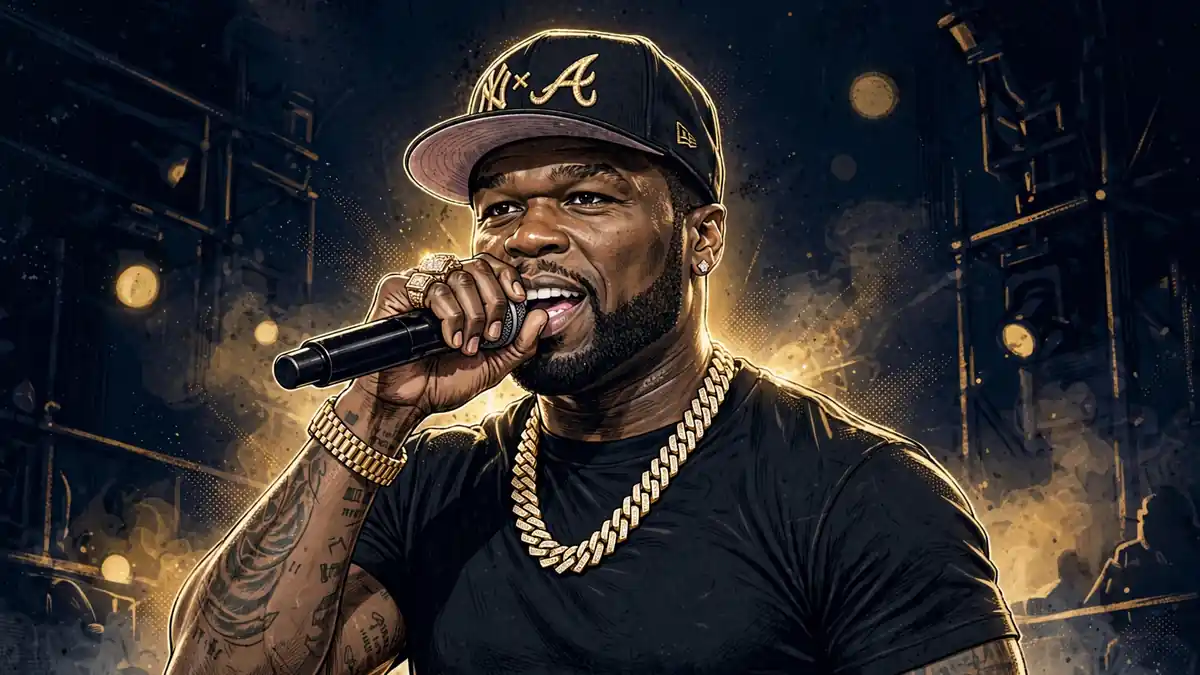
50 Cent‘s net worth is estimated at $100 million (range: $60–150 million) as of October 2026. The fortune behind that number reads like two different careers stacked on top of each other: a music-and-Vitamin-Water fortune that peaked at an estimated $155 million in 2015 and collapsed into Chapter 11 bankruptcy the same summer, and a rebuilt second fortune made in television, touring, and spirits. He took an estimated $100 million out of Coca-Cola’s $4.1 billion buyout of Glacéau, filed for bankruptcy protection with under $20 million in declared assets, then climbed back with a $150 million Starz production deal, a self-financed tour that grossed $103.6 million, and a film studio in Shreveport, Louisiana he leases for $2,400 a year.
50 Cent: Quick Facts
| Estimated net worth | $100 million (range: $60–150 million) |
|---|---|
| Profession | Rapper, actor, television producer, entrepreneur |
| Nationality | American |
| Born | July 6, 1975 (age 51) |
| Height | 6 ft 0 in (1.83 m) |
| Primary income sources | Television production (G-Unit Film & Television), touring, music catalog royalties, spirits (Sire Spirits) |
| Active years | 1996–present |
| Last reviewed | October 2026 |
- Quick Facts
- Early Life and Background
- Education
- Career Journey
- Rise to Fame
- Main Sources of Income
- Salary and Earnings
- Businesses and Investments
- Brand Deals and Sponsorships
- Houses, Cars and Other Assets
- Awards and Achievements
- Net Worth Growth Over the Years
- Social Media Presence
- Personal Life
- Sources & Reporting
- Frequently Asked Questions
Early Life and Background
Curtis James Jackson III was born on July 6, 1975, in South Jamaica, Queens, New York, to a teenage mother, Sabrina, who sold drugs and was murdered when he was eight. He was raised by his grandmother in a household that money never quite reached, and by his teens he was dealing crack on the same streets — a stretch that ended with arrests and, by his own later telling, the decision that he would either get out through music or not get out at all.
The first door that opened came from Jam Master Jay of Run-DMC, who took the teenage Jackson under his wing in 1996 and taught him how to structure songs, count bars, and record properly. It was a genuine mentorship, and its loss still shadows Jackson’s story: Jam Master Jay was murdered in a Queens recording studio in October 2002, just as Jackson’s career was igniting. Jackson has called him his first real music teacher in interviews ever since.
Education
Jackson attended Andrew Jackson High School in Queens but did not finish — the street economy pulled him out as a teenager, and music, not school, became the education he actually used. He has never positioned himself as formally educated, which is part of why the bankruptcy-era “strategic” framing lands so specifically with him: he treats courtrooms and boardrooms as rooms he learned to work by walking into them.
Career Journey
Jackson signed his first major deal with Columbia Records in 1999 and recorded an album called Power of the Dollar, led by the single “How to Rob” — a mischievous fantasy about robbing famous rappers that earned him real enemies and real attention. Then, on May 24, 2000, he was shot nine times at close range outside his grandmother’s house in South Jamaica: in the hand, arm, hip, legs, chest, and left cheek. He spent thirteen days in the hospital. Columbia shelved the album and dropped him while he recovered.
Blacklisted by the American industry, Jackson did the only thing left and did it at volume. He recorded a run of underground mixtapes — Guess Who’s Back? (2002) and 50 Cent Is the Future — pressing them through Canada to stay working. A copy of Guess Who’s Back? reached Eminem through Jackson’s attorney and Eminem’s manager, Paul Rosenberg. Eminem flew him to Los Angeles, put him in a room with Dr. Dre, and in 2002 Jackson signed to Shady Records, Aftermath Entertainment, and Interscope — the joint deal that made his career.
Rise to Fame
Get Rich or Die Tryin’ arrived on February 6, 2003, executive-produced by Eminem and Dr. Dre, and it detonated: 872,000 copies in its first week, number one on the Billboard 200, and eventually 9× platinum certification from the RIAA with more than 12 million copies sold worldwide — the best-selling album of 2003. “In Da Club” spent nine weeks atop the Billboard Hot 100; “21 Questions” with Nate Dogg hit number one as well. That same year he launched G-Unit Records, signing his crew — Lloyd Banks, Tony Yayo, and later Young Buck — turning a rap group into a label imprint.
The follow-up proved it wasn’t a fluke. The Massacre (March 2005) moved 1.14 million copies in four days — at the time the fastest-selling rap album opening after Eminem’s own — on the way to 6× platinum and the global hit “Candy Shop.” Around the same commercial peak he started the clothing line, the sneakers, the video game (50 Cent: Bulletproof, 2005), and the Vitamin Water equity stake — each one a rehearsal for the mogul phase that would eventually eclipse the music.
The third album, Curtis (September 2007), is remembered less for its music than for the bet attached to it: Jackson publicly wagered that if Kanye West’s Graduation outsold Curtis in their shared release week, he would retire from solo albums. West won decisively — about 957,000 first-week copies to roughly 691,000, per Nielsen SoundScan figures reported by Billboard — and Jackson didn’t retire, but the week marked the end of his undisputed reign at the top of rap sales. Before I Self Destruct (2009) and Animal Ambition (2014) did progressively smaller numbers as his attention moved to television. One late-career music moment still got everyone’s attention: his 2022 Super Bowl halftime appearance with Dr. Dre, Eminem, and Snoop Dogg, performing “In Da Club” hanging upside down from a ceiling.
Main Sources of Income
The 2026 version of 50 Cent’s income looks nothing like the 2005 version, and that is the whole story. Music royalties — streaming, sync licenses, the G-Unit catalog — still pay him every month, with “In Da Club” alone past two billion Spotify streams per ChartMasters data cited by industry trackers. But the catalog is now the smallest engine of the four that matter: television production (executive-producer fees, ownership positions, and licensing across the Power universe and BMF), touring (the self-financed 2023 Final Lap run grossed $103.6 million), and spirits (Sire Spirits, which he owns outright). Real estate plays — the Shreveport studio development and property around it — are the fifth engine, and the one he is betting the next decade on.
This ordering is deliberate. After the bankruptcy, Jackson stopped selling his name to other people’s companies and started owning the companies themselves. The Vitamin Water deal was the prototype — equity instead of an endorsement fee — and almost everything since follows it: his own cognac and champagne labels rather than a paid ambassador role, his own production company rather than a producer-for-hire credit, his own tour (self-financed) rather than a promoter’s guarantee.
Salary and Earnings
Forbes gives us the cleanest dated earnings prints in the file. In 2008, its Hip-Hop Cash Kings list credited Jackson with $150 million in a single year — the Vitamin Water payout plus music income — making him the highest-earning hip-hop artist in the world, ahead of Jay-Z’s $82 million. In May 2015, Forbes’s hip-hop wealth ranking estimated his net worth at $155 million, the peak number in the public record, printed two months before the bankruptcy filing.
The 2020s earnings are murkier because the biggest ones are private-company numbers. What is verifiable: the Final Lap Tour reported $103.6 million in box office to Billboard Boxscore across 83 shows and 1.05 million tickets sold — and fellow G-Unit member Tony Yayo has said Jackson self-financed the tour, which means he carried the risk and kept the upside a promoter would normally take. His career touring gross stands at $150.3 million, placing him eighth among rap acts in Boxscore history, behind only Drake among solo headliners to cross $100 million on a single tour.
Television pay is the least transparent line. Executive-producer fees, his acting salary for playing Kanan on Power, ownership stakes in the spinoffs, and the Starz overall deal’s discretionary fund were never itemized publicly — but the $150 million Starz pact itself, reported by Variety in October 2018, is the single largest contract number of his career, and the Power franchise ran for six seasons plus four spinoff series and BMF on Starz’s dime. Music earnings are the most mechanical: a 9× platinum debut and 6× platinum sophomore album generate catalog income every year, and the two-billion-plus Spotify streams of “In Da Club” keep compounding. His exact per-stream and per-sync figures are not public, so anyone quoting a precise music-earnings number for him is guessing. The catalog’s commercial afterlife is verifiable, though: the RIAA certified Get Rich or Die Tryin’ 9× platinum in February 2020, and Billboard reported a 62 percent sales-unit surge for the album in July 2024 — 13,000 equivalent units in a single week — driven by a “Many Men” streaming rally on social video. A twenty-year-old album moving five figures a week on catalog momentum alone is why music still belongs in the income mix, even if it no longer leads it.
Businesses and Investments
G-Unit Film & Television. Jackson’s production company is the crown of the second fortune. He co-created and executive-produced Power (2014–2020) with Courtney Kemp, starred in it as the villain Kanan, and turned one hit into a universe: Power Book II: Ghost, Power Book III: Raising Kanan, Power Book IV: Force, and the Big Meech crime drama BMF. In October 2018, Variety reported a four-year overall deal with Starz worth up to $150 million — a three-series commitment with a discretionary development fund — which Jackson at the time called the biggest deal in premium cable history. The pact expired around 2022 (“STARZ deal done, we had nothing but success, so no hard feelings… I’m out,” he posted), and he moved on to a Lusid Media partnership with an unscripted true-crime series set for Peacock.
G-Unit Records. The label Jackson founded in 2003 was a genuine business, not a vanity imprint — and at its mid-2000s peak it was one of the highest-grossing rap labels in the country. Lloyd Banks’s The Hunger for More (2004) debuted in the top five and went platinum; Young Buck’s Straight Outta Cashville (2004) also hit platinum; and The Game’s The Documentary (2005), released through G-Unit/Aftermath, moved roughly five million copies worldwide, earned a Grammy nomination for Best Rap Album, and spawned “Hate It or Love It.” The Game was fired from G-Unit later in 2005 in one of rap’s most public feuds, but the album’s royalties kept paying the label. G-Unit Records still exists as Jackson’s vehicle for his own later releases and catalog administration — a quieter income line now, but one that owns masters rather than renting them.
Sire Spirits. Founded in 2018 and named for his younger son, Sire Spirits is the company Jackson says he will hand to that son when he is old enough — and unlike the endorsement deals of his peers, he is the sole owner. The portfolio is Branson Cognac and Le Chemin du Roi (“The King’s Path”) champagne. He sourced the cognac and champagne in France himself, designed the bottles (the chess-piece-inspired champagne bottles, the genie-like Branson decanter), and prices run from about $49 for Branson Phantom V.S. up to $249 for Branson X.O. The brand has real industry credibility — Branson V.S.O.P. Royal took a Master medal at the 2022 Cognac Masters — and in October 2025 he unveiled a Lalique collaboration, the 505 Edition Branson Cognac: 505 hand-etched crystal decanters, invitation-only, beginning with a $5,000 donation to his G-Unity Foundation.
G-Unit Studios, Shreveport. In December 2023 Jackson announced he would open a film and television studio in Shreveport, Louisiana, leasing the city-owned former Millennium Studios for $2,400 a year on a 30-year lease (the city had bought the building for $3.8 million in 2021; the council later extended the lease to 99 years). The logic is Louisiana film tax credits and cheap operating costs versus Los Angeles — the Tyler Perry playbook, applied in a smaller market. In January 2026 he announced a $124 million development investment in the city; by July 2026 he was posting on Instagram that he was “pulling back” after tangling with local figures who, in his words, didn’t want things to get better. The studio itself continues; the larger development plan’s status is the open question.
The failures belong in the ledger too. SMS Audio, his 2011 headphone company, ended in a lawsuit from Sleek Audio that produced one of the judgments behind the bankruptcy — a reminder that his hardware foray cost him real money. The Street King energy drink (2011) fizzled. SMS Promotions, his boxing promotion company, folded. G-Unit Clothing, launched in 2003, had a real retail run but never became a lasting brand. The pattern: when the deal is equity in a product he can sell at scale (Vitamin Water, spirits), he wins; when it is a standalone company he has to operate (headphones, boxing, energy drinks), the record is mixed at best.
Brand Deals and Sponsorships
The defining brand deal of Jackson’s life is the one that wasn’t a brand deal at all. In 2004, instead of taking an endorsement fee from Glacéau, he took an equity stake and lent his name to the Formula 50 Vitamin Water flavor. When Coca-Cola bought Glacéau for $4.1 billion in June 2007, Forbes estimated his gain at roughly $100 million — the single most-cited celebrity equity deal in hip-hop history, and the template for everything he has done since.
A decade later he tried the playbook again with spirits. In 2014 he took a minority stake in Effen Vodka with Beam Suntory. In July 2017 he posted on Instagram — “I got the bag, EFFEN Vodka, can you say 60M’s” — and The Breakfast Club’s DJ Envy reported he had sold his stake for $60 million. Beam Suntory publicly denied any split, and Jackson clarified: “I’m still on the brand, I just got some cake out the deal.” The honest reading is that he cashed out part of his position, for a figure he himself put at $60 million, while the company insisted the partnership continued — messier than the clean “$60 million sale” most net-worth pages claim.
The earlier merchandise-era deals were conventional by comparison: the G-Unit by Reebok sneaker line in 2003, the G-Unit Clothing Company rollout, and the 50 Cent: Bulletproof video game with Vivendi in 2005. They paid, but none of them moved his net worth the way the two equity bets did.
Houses, Cars and Other Assets
The most famous asset is the one he finally got rid of. In 2003, at the height of the Get Rich or Die Tryin’ wave, Jackson bought the Farmington, Connecticut mansion from Mike Tyson for $4.1 million — a 50,000-plus-square-foot, 19-bedroom compound on 17 acres with a nightclub, indoor pool, basketball court, recording studio, and helicopter pad. The Hartford Courant reported he spent up to $6 million more renovating it. He first listed it in 2007 for $18.5 million and spent twelve years cutting the price, joking on Instagram after a 2017 burglary that he had forgotten he still owned it. The Wall Street Journal reported the sale in April 2019: $2.9 million, an 84 percent discount from the original ask. It was, by the numbers, one of the worst celebrity real estate exits on record — and he took the loss without flinching. The buyers later poured millions into renovations and relisted the estate for $9.9 million in 2025, per Realtor.com.
The mansion had one productive asset inside it: the recording studio where he cut The Massacre. Beyond that, his current property holdings are deliberately low-profile — reports place his base in Texas in recent years, and the Shreveport land and studio leases are the only real-estate positions with public numbers attached. He is widely photographed with a supercar collection — Rolls-Royces, Lamborghinis — but no audited inventory exists, so treat the car list on fan sites as exactly that: a fan list.
Awards and Achievements
Jackson has one Grammy win from thirteen career nominations: Best Rap Performance by a Duo or Group in 2010 for “Crack a Bottle” with Eminem and Dr. Dre. The debut itself was nominated for Best Rap Album at the 2004 Grammys (losing to OutKast’s Speakerboxxx/The Love Below), and he was a Best New Artist nominee that year — the rare year a rapper lost the category to Evanescence. Add a shelf of Billboard Music Awards and a World Music Award from the mid-2000s peak, plus a star on the Hollywood Walk of Fame unveiled in January 2020, and the trophy case is respectable without being the point. The business awards have arguably meant more to the fortune: the Starz deal he called the biggest in premium cable history, and the 2022 Cognac Masters medal that gave Sire Spirits legitimacy no endorsement could buy.
Net Worth Growth Over the Years
The trajectory is a boom, a crash, and a rebuild — the honest version has the bankruptcy in the middle, not edited out.
| Year | Estimated net worth | What drove it |
|---|---|---|
| 2003 | $2–5 million | Get Rich or Die Tryin’ debut: 872,000 first week, label advances, royalties beginning |
| 2007 | $100–150 million | Coca-Cola’s $4.1B Glacéau buyout; Forbes’s ~$100M gain estimate; $150M earnings year |
| 2015 | $155 million → bankruptcy | Forbes’s $155M wealth print in May; Chapter 11 filed in July, assets declared under $20M |
| 2017 | $40–50 million | Bankruptcy discharged after $22M+ paid; Power income steady; Effen cash-out |
| 2018 | $50–70 million | Variety reports the ~$150M Starz overall deal; Sire Spirits founded |
| 2023 | $70–80 million | Final Lap Tour grosses $103.6M; Shreveport studio announced |
| 2026 | $100 million | Celebrity Net Worth anchor; Lalique collaboration; Street Fighter film role |
The 2003 and 2017–2018 rows are reconstructed from dated earnings prints and deal reports, not rich-list entries — no outlet published a wealth number for him in those years. The 2015 row is the honest one: Forbes’s $155 million estimate and the bankruptcy filing’s sub-$20 million asset declaration describe the same man two months apart, which is why every serious estimate since treats him as a rebuild story rather than a straight-line fortune.
The peer comparison competitors usually skip: Jackson was never a billionaire and isn’t close. Forbes’s celebrity billionaire list puts Jay-Z in the multi-billion range and Dr. Dre at about $1 billion (March 2026). Celebrity Net Worth credits Eminem with roughly $300 million — a useful yardstick, since the two men’s careers are the same age and Jackson has earned a comparable lifetime gross. That Jackson’s estimated fortune sits at about $100 million against Eminem’s $300 million is mostly the difference between one man who bankrupted himself and rebuilt, and one who never had to.
Social Media Presence
Jackson runs one of the most combative feeds in entertainment: about 25 million Instagram followers on @50cent (tracked October 2026), plus large followings on X and Facebook, and he uses them as a weapon — trolling rivals, leaking business news before the trades get it, and marketing his shows directly. It is also a revenue line: spirits brands, tour announcements, and the Shreveport project all get pushed through the feed, and sponsored content at that scale pays. The 2026 feed has carried everything from the $124 million Shreveport announcement to the July “pulling back” reversal to the Street Fighter press cycle — which is why his social presence is closer to a wire service with jokes than a personal account.
Personal Life
Jackson has two sons: Marquise, born in 1996 to Shaniqua Tompkins, and Sire, born in 2012 to model Daphnique Joy. The relationship with Marquise has been publicly estranged for years — a feud that has played out in interviews and on social media, and one of the few subjects Jackson consistently refuses to turn into content. Sire, by contrast, is the namesake of the company Jackson calls his legacy: “I intend to keep that company for my son,” he told Haute Living of Sire Spirits. “I’ll be giving it to him when he’s old enough.”
The charitable arm is the G-Unity Foundation, which funds programs for underserved youth — the 2025 Lalique cognac launch was structured around it, with each decanter purchase beginning with a $5,000 donation. He has never married, keeps his romantic life out of the trades, and has described himself, in the Enthusiast Podcast interview in October 2026, as politically uninterested: “I’m purple. I’m with everybody.”
Sources & Reporting
- Celebrity Net Worth — the $100 million net worth anchor; detailed reporting on the February 2017 bankruptcy discharge ($22M+ paid) and the $18.1M Sleek Audio / $7M Leviston judgments; reporting window 2015–2026.
- Forbes — Hip-Hop Cash Kings 2008 ($150M earnings year, the Vitamin Water payout); the ~$100M Vitamin Water gain estimate; the May 2015 hip-hop wealth ranking ($155M); reporting window 2007–2015.
- Billboard — Boxscore data behind the Final Lap Tour’s $103.6M gross (83 shows, 1.05M tickets); Nielsen SoundScan first-week figures for the 2007 Kanye West sales showdown; reporting window 2003–2024.
- Black Enterprise — tour-gross reporting ($103.6M) and Tony Yayo’s statement that Jackson self-financed the Final Lap Tour; reporting window 2024.
- Variety — the October 2018 four-year Starz overall deal (~$150M, three-series commitment) and the 2022 Lusid Media/Peacock partnership after the Starz pact expired; reporting window 2018–2022.
- The Fader — contemporaneous reporting on the 2018 Starz deal (October 11, 2018).
- XXL — bankruptcy discharge reporting: $22M+ paid, $8.7M of Jackson’s own money plus $13.65M from a legal-malpractice settlement; 2026 Shreveport “pulling back” post; reporting window 2017–2026.
- The Wall Street Journal — the April 2019 Farmington mansion sale at $2.9M (via 6sqft’s reporting of the Journal’s coverage).
- Realtor.com — the 2025 $9.9M relisting of the former Farmington estate and the detail that The Massacre was recorded in its studio.
- The Spirits Business — Branson V.S.O.P. Royal’s 2022 Cognac Masters medal and the 2017 Effen Vodka reporting (Beam Suntory’s denial of the split); reporting window 2017–2023.
- Lalique — October 2025 press release for the 505 Edition Branson Cognac × Lalique collaboration (505 decanters, G-Unity Foundation donation structure).
- Haute Living — 2021 interview: sole ownership of Sire Spirits, pricing, and the plan to pass the company to his son Sire.
- Men’s Journal — 50 Cent as Balrog in Street Fighter (October 16, 2026 release; own stunts, Junior Olympics boxing background).
- Extra — October 2026 interview on Street Fighter prep and the Tupac-vocals theme “Ambitionz Az a Fighta.”
- RIAA — certification records: Get Rich or Die Tryin’ 9× platinum, The Massacre 6× platinum.
- HotNewHipHop — Get Rich or Die Tryin’ sales data (872K first week; 9M+ US, 12M+ worldwide).
- The Guardian — 2015 bankruptcy coverage (filing described by Jackson as “strategic” in the Reuters interview).
- Social Blade — Instagram follower tracking (~25M on @50cent, October 2026).
- Wikipedia — biographical spine: birth, the May 2000 shooting, Columbia/Shady/Aftermath chronology, discography and G-Unit Records founding.
Frequently Asked Questions
What is 50 Cent’s net worth in 2026?
50 Cent’s net worth is estimated at $100 million as of October 2026, anchored on Celebrity Net Worth’s figure. The honest range across outlets is $60–150 million: some estimators land at $60 million, NetWorthSpot’s model puts him near $117 million, and a few stretch to $150 million. Forbes’s last dated print was $155 million in May 2015 — two months before his bankruptcy filing — so current figures are rebuild-era estimates, not updates of that old number.
How much did 50 Cent make from Vitamin Water?
Forbes estimated his gain at roughly $100 million when Coca-Cola bought Glacéau for $4.1 billion in June 2007. He took an equity stake in 2004 — lending his name to the Formula 50 flavor — instead of an endorsement fee. Coca-Cola’s own filings never named him or disclosed his percentage, so the $100 million figure is a Forbes estimate, not a disclosed number; other outlets have claimed up to $150 million. The most careful figure remains Forbes’s ~$100 million.
Why did 50 Cent go bankrupt if he made so much money?
He filed for Chapter 11 in July 2015 with about $36 million in declared debts and under $20 million in declared assets, after two jury verdicts: roughly $18 million owed to headphone company Sleek Audio and $7 million to Lastonia Leviston in a privacy case. He called the filing “strategic” — a way to reorganize the debts rather than pay them outright — and bankruptcy documents the Daily Mail said it obtained suggested he still held significant assets during the case. In February 2017 he paid $22 million-plus to creditors, four years ahead of schedule, and the case was discharged.
How did 50 Cent recover from bankruptcy?
Three engines: television (the Power franchise and its four spinoffs plus BMF, under a Starz deal Variety reported at up to $150 million), touring (the self-financed 2023 Final Lap Tour grossed $103.6 million per Billboard Boxscore), and spirits (Sire Spirits, which he owns outright). He also cashed out part of his Effen Vodka stake — a figure he put at $60 million — and took the loss on the Connecticut mansion sale to clear the decks.
Is 50 Cent a billionaire?
No. He has never been a billionaire, and the estimates place him roughly ten to twenty times below that line. For scale, Forbes’s celebrity billionaire reporting puts Jay-Z in the multi-billion range and Dr. Dre at about $1 billion (March 2026), while Celebrity Net Worth credits Eminem — the closest career comparison — with roughly $300 million against 50 Cent’s estimated $100 million.
How much did 50 Cent sell his Connecticut mansion for?
He sold the 50,000-square-foot Farmington, Connecticut compound for $2.9 million in April 2019, per the Wall Street Journal — 84 percent below the $18.5 million he first asked in 2007. He had bought it from Mike Tyson for $4.1 million in 2003 and spent up to $6 million more renovating it. The buyers later renovated again and relisted it for $9.9 million in 2025.
What was 50 Cent’s biggest payday?
The Vitamin Water equity exit — an estimated $100 million from the 2007 Coca-Cola buyout — remains the single biggest check of his career. The $150 million Starz overall deal (2018) is the biggest contract number, but it was a four-year development pact, not a single payment. The self-financed Final Lap Tour’s $103.6 million gross (2023) is the biggest touring number, and the reported $60 million Effen Vodka cash-out is the second-biggest single deal.
Who is richer: 50 Cent or Jay-Z?
Jay-Z, by an enormous margin. Forbes’s celebrity billionaire reporting puts Jay-Z in the multi-billion range — built on music, the Roc Nation empire, and liquor exits including the reported $750 million-plus sale of his D’Ussé stake — while 50 Cent is estimated at about $100 million. They were once closer: in 2008, Forbes’s Hip-Hop Cash Kings had 50 Cent as the year’s top earner at $150 million versus Jay-Z’s $82 million. The trajectories diverged from there.
Final Thoughts
50 Cent’s $100 million is the most instructive fortune in hip-hop — not because of its size but because of its shape. He made a nine-figure sum on a flavored water bet, lost the paper version of that fortune in courtrooms, and rebuilt it as a producer, a tour promoter of himself, and the outright owner of two liquor labels. The first fortune came from being the product; the second came from owning the means of making the product. That is the entire thesis of his post-bankruptcy career, and it is why the Starz deal, the Shreveport studio, and Sire Spirits matter more to the number than any album he will ever make again.
The honest caveats stay on the table: no rich list has audited him since 2015, the current figures are triangulated from deals and filings, and the Shreveport development — the biggest swing of the third act — was wobbling as of July 2026. If it lands, $100 million is a waypoint. If it doesn’t, the television catalog and the spirits company still pay him every month. Either way, the man who filed for bankruptcy with the cameras rolling and walked out four years early has already written the ending he wanted: the comeback is the fortune.
Published on 2026-10-15. Last reviewed October 2026. Found an error? See our corrections policy.