
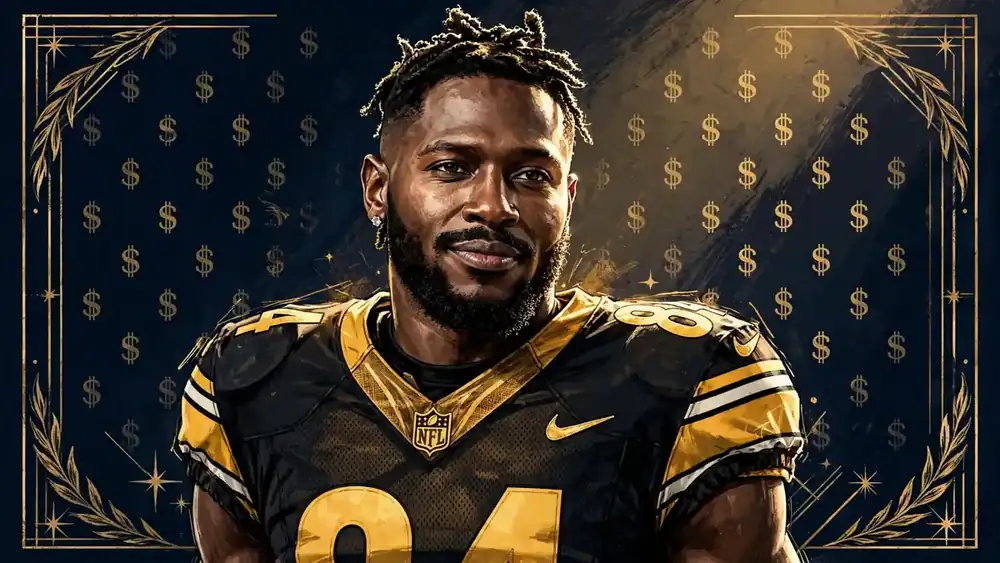
Antonio Brown‘s net worth is estimated at -$3 million as of October 2026. Yes, negative. The former All-Pro wide receiver banked $80.7 million in NFL cash across 12 seasons, signed two of the biggest receiver contracts of his era, and at his peak looked like a lock for the Hall of Fame. Then came the lost $30 million in Raiders guarantees, more than $338,000 in fines, a pile of lawsuits, and a May 2024 bankruptcy filing in which Brown told a federal court he had less than $50,000 in assets against roughly $3 million in debts. In July 2025 a judge converted the case to Chapter 7 liquidation, and by December 2025 Brown had agreed to surrender his Fort Lauderdale mansion so a trustee could sell it to pay creditors. This is the full accounting of how one of football’s great fortunes disappeared.
Antonio Brown: Quick Facts
| Estimated net worth | -$3 million (range: -$5M to $3M) |
|---|---|
| Profession | Former NFL Wide Receiver |
| Nationality | American |
| Born | July 10, 1988 (age 38) |
| Height | 5 ft 10 in (1.78 m) |
| Primary income sources | NFL salaries (2010–2021), endorsements, music, business ventures |
| Active years | 2010–2021 (NFL) |
| Last reviewed | October 2026 |
- Early Life and Background
- Education
- Career Journey
- Rise to Fame
- Main Sources of Income
- Salary and Earnings
- Businesses and Investments
- Brand Deals and Sponsorships
- Houses, Cars and Other Assets
- Awards and Achievements
- Net Worth Growth Over the Years
- Social Media Presence
- Personal Life
- Sources & Reporting
- Frequently Asked Questions
- Final Thoughts
Early Life and Background
Antonio Tavaris Brown Sr. was born on July 10, 1988, in Miami, Florida, into football royalty of a particular kind. His father, Eddie Brown — known across arena football as “Touchdown” Eddie Brown — was voted the greatest player in Arena Football League history in 2006 after starring for the Albany Firebirds from 1994 to 2001. The elder Brown’s legend would later loop back into his son’s story in an unlikely way, when Antonio bought an arena team in Albany, the city where he spent part of his childhood watching his father play.
The childhood itself was turbulent. Brown’s parents split, and his relationship with his mother, Adrianne Moss, was strained — he has spoken about being kicked out of the house as a teenager and bouncing between homes in the Miami area. Football became the stabilizing force. At Miami Norland High School, Brown played wide receiver, punt returner, and just about everything else the coaches asked of him, flashing the quickness and body control that would define his game. He wasn’t a blue-chip recruit — the major programs passed — which set up the chip-on-the-shoulder mentality that powered everything after.
That slight followed him into college. Central Michigan offered a path, and Brown took it, arriving in Mount Pleasant as an undersized return specialist with something to prove. What happened next turned a lightly recruited kid from Miami into one of the most decorated players in Mid-American Conference history, and set the stage for one of the great draft steals of the modern NFL.
Education
Brown played three seasons at Central Michigan University (2007–2009), and his résumé there reads like a misprint. As a freshman in 2007, he caught 102 passes for 1,003 yards and returned kicks, earning MAC Freshman of the Year honors. He followed with 93 catches for 998 yards in 2008 and 110 catches for 1,198 yards in 2009, finishing his college career with 305 receptions for 3,199 yards and 22 receiving touchdowns, plus 531 rushing yards.
The honors stacked up: two-time First-team All-American and two-time MAC Special Teams Player of the Year. He remains the only player in school history with that combination of receiving and return production. On January 7, 2010, Brown announced he would forgo his senior season and enter the NFL Draft — a decision that looked risky for a 5-foot-10 receiver from the MAC, and turned out to be the best financial call of his life.
The pre-draft process was unkind. Scouts projected him as a fifth- or sixth-round pick; NFLDraftScout.com ranked him the 37th-best receiver in the class. At the 2010 NFL Combine he ran the 40-yard dash in 4.48 seconds — respectable, not electric — then improved his times at Central Michigan’s Pro Day. When draft weekend arrived, 21 wide receivers heard their names called before his. Using a pick acquired in a trade with the Arizona Cardinals, the Pittsburgh Steelers finally took him 195th overall in the sixth round. He chose jersey number 84 for a reason he later explained: eight times four is 32, and 32 teams had passed on him — including the Steelers. Every Sunday was a reminder.
Career Journey
Brown’s NFL career breaks cleanly into two acts: nine seasons of brilliance in Pittsburgh, and a chaotic three-year tailspin through three more franchises that cost him tens of millions.
The Steelers Years (2010–2018)
As a rookie in 2010, Brown barely played on offense — 16 catches for 167 yards — but made the roster as a return man and earned a Super Bowl XLV trip (a loss to Green Bay). In 2011 he broke out: 69 catches, 1,108 yards, and a Pro Bowl nod as a return specialist. The Steelers saw enough to hand him a five-year, $42.5 million extension in July 2012, with an $8.5 million signing bonus. His cash earnings that year jumped to $9,040,000 — more than his first two seasons combined ten times over.
From 2013 to 2018, Brown was arguably the best receiver alive. He posted six straight 100-catch, 1,200-yard seasons, led the NFL in receptions twice and receiving yards twice, and made four consecutive First-team All-Pro teams. In February 2017 the Steelers tore up his deal and gave him a four-year, $68 million extension paying $17 million per year on average, with a $19 million signing bonus — making him the highest-paid wide receiver in NFL history at the time. His 2017 cash haul of $17,010,000 remains the biggest single-season payday of his career. Across nine Pittsburgh seasons he earned roughly $69.9 million in cash, per Spotrac’s accounting.
The ending was ugly. Late in the 2018 season Brown clashed with quarterback Ben Roethlisberger and head coach Mike Tomlin, skipped practices, and was benched for the finale. He demanded a trade. In March 2019 the Steelers obliged, shipping him to the Oakland Raiders — and Brown immediately signed a restructured three-year, $50 million deal with $30 million in guarantees. It would prove to be the most expensive contract he ever lost.
The Raiders Disaster (2019)
Brown never played a down for Oakland. First came a bizarre standoff over his helmet — the NFL had banned his old model, and Brown filed grievances to keep wearing it. Then came frostbitten feet from a cryotherapy mishap, missed practices, and a $54,000 fine from general manager Mike Mayock for unexcused absences. Brown posted the fine letter on Instagram. Days later, a heated confrontation with Mayock drew a $215,000 fine. On September 7, 2019, the Raiders released him and moved to void his $30 million in guarantees. In eleven days of chaos, Brown had flushed the biggest guaranteed payday of his life.
One Game in New England (2019)
Hours after his Raiders release, Brown signed a one-year, $15 million deal with the New England Patriots — $9 million signing bonus, $1 million base, $500,000 in roster bonuses, none of it guaranteed. He caught four passes for 56 yards and a touchdown in his lone Patriots appearance, a Week 2 win over Miami. Then a sexual assault lawsuit filed by his former trainer, Britney Taylor, became public. On September 20, 2019 — eleven days after signing — New England cut him. The $9 million signing bonus, payable in two installments, became the subject of a grievance fight; Brown’s actual 2019 Patriots earnings ended up a fraction of the headline number.
Tampa Bay and the Walk-Off (2020–2021)
After serving an eight-game suspension for violating the league’s personal-conduct policy, Brown reunited with Tom Brady — his former Patriots teammate, who lobbied hard for him — signing with the Tampa Bay Buccaneers in October 2020. The deal was modest: $1 million base salary plus $1.5 million in incentives. He contributed down the stretch as Tampa Bay won Super Bowl LV on February 7, 2021, earning his only championship ring.
In April 2021 he re-signed for one more year — a deal worth up to $6.5 million with incentives, including a $2 million signing bonus and $3.1 million guaranteed. Then came January 2, 2022. In the third quarter against the New York Jets, Brown stripped off his jersey, shoulder pads and undershirt, waved to the crowd, and jogged off the field mid-game. The Buccaneers released him days later. He has not played professional football since. In March 2023 he announced his retirement; in April 2023, characteristically, he unretired. No team called.
Rise to Fame
What made Brown’s peak so lucrative was its duration. Six consecutive seasons (2013–2018) with 100+ receptions had never been done before. His 2015 campaign — 136 catches for 1,834 yards — remains one of the great receiver seasons of the decade. Between 2013 and 2018 he piled up 9,145 receiving yards, more than any player in football over that span, and his 2014 and 2015 reception titles came back-to-back, another first.
The record book entries tell the story: first player in NFL history with 1,000 yards both receiving and returning in the same season; first with at least five catches and 50 yards in 35 straight games; first with consecutive 125-catch seasons. He was named AFC Offensive Co-Player of the Year, led the league in receiving yards in 2014 and 2017, and collected seven Pro Bowl selections. At his apex he wasn’t just the highest-paid receiver in the game — he was its most productive, and the endorsement market noticed.
Fame, for Brown, also meant friction. The Facebook Live broadcast from the Steelers’ locker room after the 2016 divisional playoff win — which caught Tomlin using profanity about the Patriots — drew a team rebuke and foreshadowed the discipline problems that would later detonate his career. The same defiance that made him uncoverable made him unmanageable, and the league’s patience ran out in 2019.
Main Sources of Income
Brown’s money came from four streams, and three of them dried up almost simultaneously.
NFL salaries were the foundation — $80,744,339 in career cash earnings per Spotrac, roughly $69.9 million of it from Pittsburgh. The 2017 extension ($17 million average annual value) and the voided Raiders guarantees ($30 million) bracket his earning arc: the peak and the cliff.
Endorsements were the second pillar. At his height Brown had deals with Nike, helmet maker Xenith, and Pizza Hut, among others. Footwear and apparel money for an All-Pro receiver runs into seven figures annually. All of it evaporated in 2019: Nike cut ties that September as the lawsuits piled up, and the rest followed. No major brand has touched him since.
Music and media became his post-football hustle. Brown reinvented himself as a rapper — releasing the album Paradigm and a string of singles under his “Business is boomin” brand — and built a large, combative social media presence, including his “CTESPN” alter ego on X. The income here is real but modest compared to NFL money: streaming royalties, appearances, and whatever his social following can monetize.
Business ventures round out the picture, mostly as cautionary tales. His 2023 purchase of a majority stake in the NAL’s Albany Empire ended with the team expelled from the league within months. Various LLCs and trusts tied to his Florida properties became central exhibits in his bankruptcy case rather than wealth vehicles.
Salary and Earnings
The definitive record of Brown’s NFL income is Spotrac’s cash-earnings ledger, which tracks actual money paid year by year — signing bonuses, base salaries, roster bonuses and restructures. The career total: $80,744,339. Note the 2019 row carefully: it shows what he actually collected ($5.15 million retained from the Raiders’ dead deal, $860,294 from New England) versus the $45 million in guarantees that were announced and then vaporized.
| Year | Team(s) | Cash earned | Cumulative |
|---|---|---|---|
| 2010 | Steelers | $393,075 | $393,075 |
| 2011 | Steelers | $450,000 | $843,075 |
| 2012 | Steelers | $9,040,000 | $9,883,075 |
| 2013 | Steelers | $7,000,000 | $16,883,075 |
| 2014 | Steelers | $6,000,000 | $22,883,075 |
| 2015 | Steelers | $3,024,795 | $25,907,870 |
| 2016 | Steelers | $10,250,000 | $36,157,870 |
| 2017 | Steelers | $17,010,000 | $53,167,870 |
| 2018 | Steelers | $16,775,000 | $69,942,870 |
| 2019 | Raiders / Patriots | $6,014,215 | $75,957,085 |
| 2020 | Patriots / Buccaneers | $1,500,000 | $77,457,085 |
| 2021 | Buccaneers | $3,287,254 | $80,744,339 |
A few things stand out. First, the Pittsburgh concentration: $69.9 million of $80.7 million — nearly 87 cents of every career dollar — came from the Steelers. Second, the 2015 dip ($3.0 million) reflects a restructure that pushed money forward, not a pay cut; the cash arrived in later years. Third, and most important for the net worth math: Brown himself has publicly claimed he earned more than $100 million in the NFL. The documented cash says $80.7 million. The gap between those numbers — paper contract values versus money actually received — is the entire story of his finances. Without the Raiders meltdown and the Patriots release, his career earnings would have cleared $100 million easily. Celebrity Net Worth’s reporting makes the same point: the controversies didn’t just cost him reputation; they cost him roughly $20 million in vanished guarantees.
Then there are the fines. Sportscasting’s tally of Brown’s career NFL fines exceeds $338,000 — starting with $10,000 in 2012 for backpedaling into the end zone, $8,200 for cleating a punter’s facemask, $11,576 for straddling a goalpost, $15,191 and $24,309 for celebration and equipment violations in 2016, and the two Raiders fines ($54,000 and $215,000) that remain the largest of his career. Fines alone didn’t sink him, but they were an early tell: money leaving for avoidable reasons.

Businesses and Investments
Brown’s most visible business venture was also his most chaotic. In March 2023 he joined the ownership group of the Albany Empire, a National Arena League indoor football team based in New York’s capital — the city where his father became an arena legend with the Firebirds. A month later he took a 94 percent majority stake. He promised to be hands-on: community events, youth outreach, a trophy.
It lasted about ten weeks. Brown paid the team’s April league assessment, then challenged the charge and had it credited back. He skipped the May 15 assessment entirely and refused to pay a $1,000 fine for conduct detrimental to the league over his public comments. His own accountant, Alex Gunaris, told the league it didn’t look like Brown would pay either. In June 2023 the NAL’s board of owners voted unanimously to terminate the Empire’s membership, canceling a home game against the Jacksonville Sharks and ending the season at 1–6. MVP Arena refunded tickets for the final three home games. Brown’s only comment was a post reading, “Major league not minors.” Notably, none of the Albany debts appear in his later bankruptcy filing — the Empire’s creditors were left with the league’s mess, not his.
His music career has been more durable, if not lucrative. Performing as a rapper under the “Business is boomin” banner, Brown released the album Paradigm plus singles and videos, leaning into his villain-era persona. Streaming economics being what they are, this is a five-figure-a-year business at best — cultural relevance, not wealth building. The same goes for his social media operation: the “CTESPN” account on X, where he posts a mix of football commentary, trolling and personal grievance, keeps his name in circulation but doesn’t replace an NFL paycheck.
On investments, the record is thin. Unlike peers who bought franchises, fund stakes or operating businesses, Brown’s wealth was concentrated in two things: his body of contracts and Florida real estate. When the contracts stopped and the real estate became bankruptcy exhibits, there was no diversified portfolio underneath.
Brand Deals and Sponsorships
At his 2017–2018 peak, Brown was one of the most marketable receivers in football. His endorsement portfolio included Nike — the crown jewel, a footwear and apparel deal befitting an All-Pro — along with helmet manufacturer Xenith and a Pizza Hut partnership, plus smaller appearance and licensing income. For an elite NFL skill player, this tier of endorsements typically adds $1–3 million a year on top of salary.
It all collapsed in September 2019. As the Raiders saga unfolded and the sexual assault lawsuit against him became public, Nike terminated the relationship — the industry’s standard morality-clause exit. The other partners followed within weeks. Brown has not held a major national endorsement since. The timing was brutal: the deals died in the same month his $30 million in Raiders guarantees did, meaning his two biggest non-salary income events of 2019 both went to zero within days of each other.
Since 2020, his commercial activity has been limited to self-directed ventures — music releases, social media, paid appearances — none of which approach endorsement money. For the net worth calculation, endorsements are now a historical contributor, not a current one: real money in 2014–2018, zero thereafter.

Houses, Cars and Other Assets
Brown’s real estate portfolio tells the same story as his career: big acquisitions, forced sales, and a final act playing out in bankruptcy court.
The centerpiece is the Fort Lauderdale mansion: 18,000 square feet, 12 bedrooms, 14 bathrooms, purchased in March 2016 for $6.6 million and later valued at $9–10 million. It was his primary residence and, crucially, his legal shield — Florida’s homestead exemption protects a primary home in bankruptcy regardless of value, as long as the owner has lived there more than 1,215 days on less than half an acre within a municipality. Brown’s May 2024 filing listed the mansion as his address and leaned on that protection.
The shield didn’t hold. After the case was converted to Chapter 7 in July 2025, trustee Leslie S. Osborne sued to unwind Brown’s June 2025 transfer of the property — valued at up to $9 million — to a business he controls, AB Brown Family LLLP, made without court permission (Bloomberg Law). The trustee also moved to hold Brown in contempt for failing to produce deeds and insurance records, seeking sanctions of up to $2,500 a day; Brown’s attorney then revealed that millions of dollars in Florida properties he owns were uninsured. In December 2025 Brown reached a settlement agreeing to surrender the mansion for liquidation, and in March 2026 it hit the market at $3.999 million — less than half its appraised value, and a number that tells you everything about distressed-asset pricing.
The rest of the portfolio: a home in the Pittsburgh suburb of Gibsonia bought in 2014 for $1.91 million and sold in 2021 for $1.4 million (a half-million loss); a newly built house in Alamo, California, bought during the Raiders stint in 2019 for $3.223 million and sold in February 2020 for $3 million; and the Odessa property on Lake Keystone near Tampa — bought in 2021 for $2.925 million, six bedrooms, eight bathrooms, an 11-car garage — whose ownership trail ran through a network of LLCs and trusts before the bankruptcy trustee forced its listing at roughly $4 million through Smith & Associates Real Estate. Court and county records value his three Florida properties (Fort Lauderdale, Tampa, Odessa) at more than $10 million combined — assets now largely earmarked for creditors.
On cars, Brown’s taste ran to the conspicuous: outlets have reported a McLaren 720S Spider, multiple Rolls-Royce Cullinans, a matte gold Rolls-Royce Ghost, a Mercedes-AMG E 53 and a vintage 1962 Cadillac Sedan DeVille in the collection at various times. Whether any remain in his possession through the bankruptcy is unclear — vehicles are non-exempt assets a Chapter 7 trustee can seize, and Brown’s own filing claimed under $50,000 in total assets.
Awards and Achievements
Strip away the chaos and the football résumé is inner-circle great:
- Super Bowl LV champion (Tampa Bay Buccaneers, 2020 season)
- 7× Pro Bowl selection (2011, 2013–2018)
- 4× First-team All-Pro (2014–2017) — the most by any receiver of the 2010s
- NFL receptions leader (2014, 2015) — back-to-back, a first in league history
- NFL receiving yards leader (2014, 2017)
- AFC Offensive Co-Player of the Year
- First player in NFL history with 1,000 yards receiving and 1,000 yards returning in the same season
- First player with five-plus catches and 50-plus yards in 35 consecutive games
- First player with back-to-back 125-reception seasons
- Six consecutive 100-catch seasons (2013–2018), an NFL record at the time
- Career totals: 146 games, 928 receptions, 12,291 yards, 83 receiving touchdowns
- College: 2× First-team All-American, 2× MAC Special Teams Player of the Year (Central Michigan)
The Hall of Fame case is the uncomfortable footnote. By production, Brown’s 2013–2018 run matches any receiver ever. By conduct — the suspensions, the lawsuits, the walk-off — voters have shown they hold grudges. His football achievements built the fortune; his behavior dismantled it.
Net Worth Growth Over the Years
Reconstructing Brown’s net worth year by year requires separating cash earned from wealth kept. The earnings are documented (Spotrac); the spending, taxes, agent fees, legal bills and debts are not — which is why honest estimates use ranges. This timeline reflects the consensus of court records and tracker reporting:
| Year | Estimated net worth | What moved it |
|---|---|---|
| 2010 | $0.2M | Rookie deal; $393,075 cash, most of it saved or spent establishing himself |
| 2011 | $0.6M | Breakout season; Pro Bowl as returner |
| 2012 | $5M | Five-year, $42.5M extension; $8.5M signing bonus lands |
| 2013 | $9M | First All-Pro season; endorsement income begins |
| 2014 | $14M | Receptions and yards titles; Gibsonia home purchased ($1.91M) |
| 2015 | $18M | 1,834-yard season; Nike and national deals at full value |
| 2016 | $25M | Fort Lauderdale mansion purchased ($6.6M); $10.25M cash year |
| 2017 | $35M | Four-year, $68M extension; highest-paid receiver in NFL history; $17M cash year |
| 2018 | $40M | Peak: $16.8M cash year; 15 touchdowns; wealth apex |
| 2019 | $25M | $30M in Raiders guarantees voided; $9M Patriots bonus disputed; Nike and endorsements terminated; $269K in fines |
| 2020 | $22M | Modest Bucs deal; eight-game suspension; legal bills mount |
| 2021 | $20M | Final season ($3.3M cash); January 2022 walk-off ends career; Alamo home sold at a loss |
| 2022 | $15M | No income; Dubai incident, Tampa DV warrant; child support orders |
| 2023 | $10M | Albany Empire fiasco; Shuki lawsuit filed ($1.095M); child support arrest orders |
| 2024 | -$3M | Chapter 11 filed May 23: <$50K assets, ~$3M debts to eight creditors |
| 2025 | -$3M | Converted to Chapter 7 (July); trustee sues over mansion transfer; Odessa home listed ~$4M |
| 2026 | -$3M | Dec 2025 settlement surrenders mansion; listed March 2026 at $3.999M for creditors |
The math behind the current estimate is straightforward and comes from Brown’s own court filings: roughly $3 million owed to at least eight creditors — including the $1.2 million truck-driver judgment, the $1.095 million Shuki jewelry judgment, credit card balances, and even a $296 plumber’s bill that made the creditor schedule — against less than $50,000 in claimed liquid assets. The Fort Lauderdale mansion, once the $9–10 million homestead shield, is now surrendered to the trustee and listed at $3.999 million, with proceeds earmarked for creditors. Until the bankruptcy resolves and the property sales close, negative-$3 million — Celebrity Net Worth’s updated figure — is the most defensible anchor. The stale $20 million estimates still carried by some aggregators date to before the May 2024 filing and should be ignored.
For context on how unusual this is: Brown’s $80.7 million in career cash puts him around the top 25 all-time among NFL wide receivers in earnings. Of that group, he is the only one to have filed for bankruptcy. A peer comparison makes the point:
| Receiver | Career cash (Spotrac) | Est. net worth 2026 |
|---|---|---|
| Antonio Brown | $80.7M | -$3M |
| Julio Jones | ~$147M | ~$50M |
| Odell Beckham Jr. | ~$105M | ~$40M |
| Mike Evans | ~$120M | ~$35M |
(Peer earnings approximate from Spotrac leaderboards; net worth figures are tracker estimates.) The gap between Brown’s earnings rank and his net worth rank is the cost of the 2019–2024 spiral, measured in dollars.
Social Media Presence
If Brown’s playing career ended in 2022, his second career as a professional provocateur never stopped. On X (formerly Twitter), his “CTESPN” account — a grotesque pun on the brain injury linked to football — mixes football commentary, trolling, and airing of grievances to a large following. It was on that account that he posted news of his own bankruptcy filing in May 2024, and where, in June 2025, he shared a screenshot of an account balance over $24 million captioned “Bankruptcy” — a post he later told the bankruptcy trustee was old and not reflective of his actual funds.
His Instagram remains active with a mix of training clips, music promotion and lifestyle posts, though the lifestyle content has become evidence as much as entertainment: at a creditor meeting, the trustee’s attorney questioned him about videos of him driving luxury sports cars, and Brown suggested some clips could have been manufactured with artificial intelligence, or accessed through promotional arrangements with rental companies. He joined one creditor meeting late, appearing from what looked like a hotel room in Dubai.
Snapchat suspended his account in January 2023 after he posted an explicit photo. The pattern across platforms is consistent: enormous reach, zero filter, and a steady stream of content that delights fans and alarms lawyers in equal measure. For net worth purposes, the social operation generates attention, not income — there are no brand deals attached to it, for obvious reasons.
Personal Life
Brown has six children: four sons and two daughters. His eldest son was born in 2007 with then-girlfriend Shameika Brailsford; a daughter followed in March 2008 with Wiltrice Jackson; and he has four children — three sons and a daughter — with longtime partner Chelsie Kyriss. Child support has been a recurring legal front: in April 2023 a Florida judge ordered his arrest over a missed $30,000 payment to Jackson (Brown paid before being taken into custody), and a second order followed in August 2023 over an apparent $15,000 missed payment.
The legal docket beyond family court is long. In October 2018 he was sued after allegedly throwing furniture from a balcony, nearly striking a toddler. A month later came a reckless-driving citation. In summer 2019 his former trainer Britney Taylor sued him for sexual assault — the lawsuit that ended his Patriots tenure; the parties settled in 2021. His personal chef sued over unpaid wages the same summer. In October 2022 he was accused of exposing himself to a woman at the Armani Hotel in Dubai; in December 2022 Tampa police issued a domestic-violence arrest warrant after he allegedly threw a shoe at his ex-fiancée.
Brown has repeatedly claimed he suffers from CTE (chronic traumatic encephalopathy), the degenerative brain disease linked to repeated head impacts — the claim behind his “CTESPN” branding. CTE can only be definitively diagnosed posthumously, so the claim sits in the realm of self-diagnosis, but Brown has cited it when discussing his behavior. He lives primarily in Florida, where his children and their mother occupy his properties, according to his bankruptcy attorney’s statements in court.
Sources & Reporting
Celebrity Net Worth — the updated -$3 million net worth figure, the full bankruptcy timeline (May 2024 filing through the March 2026 mansion listing), contract-by-contract career accounting (~$80.5M earnings), the 2019 lost-guarantees analysis, child support orders, the Shuki jewelry judgment, and all four real estate transactions with purchase/sale prices. Spotrac — the definitive year-by-year cash earnings ledger ($80,744,339 career total), contract structures, and the per-team earnings split. Bloomberg Law — the trustee’s lawsuit to unwind the unauthorized mansion transfer to AB Brown Family LLLP, the $2,500-per-day sanction motion, the uninsured-properties hearing before Judge Peter D. Russin, and the Chapter 11-to-Chapter 7 conversion. Florida Times-Union / USA Today network — the May 2024 filing details ($3M owed to eight creditors, <$50,000 in assets, the $1.2M truck-driver judgment). EssentiallySports — the Odessa/Lake Keystone property trail ($2.925M purchase, LLC ownership network, ~$4M listing via Smith & Associates). Gridiron Heroics (via TMZ Sports) — the December 2025 settlement surrendering the mansion. TSN, Sporting News, National Football Post — the Albany Empire NAL termination (unpaid assessments, the $1,000 fine, accountant Alex Gunaris). Sportscasting — the $338,000 career fines tally. StatMuse / FantasyPros — career statistics (928 receptions, 12,291 yards, 83 touchdowns). Tampa Bay Times (via court reporting) — the KCB Marketing commissions lawsuit. Reporting window: career coverage 2010–2021; bankruptcy and legal developments May 2024–March 2026.
Frequently Asked Questions
What is Antonio Brown’s net worth in 2026?
Antonio Brown’s net worth is estimated at -$3 million as of October 2026, with a range of -$5 million to $3 million. The negative figure follows the bankruptcy math: his May 2024 Chapter 11 filing (converted to Chapter 7 in July 2025) lists roughly $3 million owed to at least eight creditors against less than $50,000 in claimed liquid assets. His Fort Lauderdale mansion — once valued at $9–10 million — was surrendered to the bankruptcy trustee in a December 2025 settlement and listed for sale at $3.999 million in March 2026, with proceeds going to creditors. Older $20 million estimates on some sites predate the bankruptcy filing and are stale.
Why did Antonio Brown file for bankruptcy?
Brown filed for Chapter 11 bankruptcy in Florida federal court on May 23, 2024, after years of lawsuits, lost income and unpaid judgments caught up with him. Court documents reviewed by the Florida Times-Union showed he owed nearly $3 million to eight creditors, including a $1.2 million default judgment to a truck driver he allegedly assaulted in 2020, a $1.095 million jewelry judgment to celebrity jeweler Shuki, credit card balances, and even a $296 plumber’s bill. He claimed less than $50,000 in assets. In July 2025, after the U.S. Trustee accused him of bad-faith conduct and failing to disclose financial information, a judge converted the case to Chapter 7 liquidation — meaning a court-appointed trustee now sells his non-exempt assets to pay creditors.
How much money did Antonio Brown make in the NFL?
Antonio Brown earned $80,744,339 in NFL cash across 12 seasons (2010–2021), according to Spotrac’s year-by-year ledger — about $69.9 million of it with the Pittsburgh Steelers. His biggest single season was 2017 ($17,010,000) under the four-year, $68 million extension that briefly made him the highest-paid receiver in league history. He often claims he made over $100 million, but the documented cash says $80.7 million — the gap is money announced in contracts but never received, chiefly the $30 million in Raiders guarantees voided when Oakland released him in September 2019 and the disputed $9 million Patriots signing bonus.
Did Antonio Brown lose his mansion?
Effectively, yes. Brown bought the 18,000-square-foot Fort Lauderdale mansion in March 2016 for $6.6 million; it was later valued at $9–10 million and initially shielded by Florida’s homestead exemption. But after his bankruptcy was converted to Chapter 7, trustee Leslie S. Osborne sued to unwind Brown’s unauthorized June 2025 transfer of the property to a company he controls, AB Brown Family LLLP. In December 2025 Brown settled, agreeing to surrender the mansion for liquidation. It hit the market in March 2026 asking $3.999 million, with sale proceeds earmarked for his creditors. A second property near Tampa (Odessa), bought for $2.925 million in 2021, was also listed at roughly $4 million through the bankruptcy.
How much money did Antonio Brown lose with the Raiders?
Around $30 million in guarantees — the single costliest episode of his career. After the March 2019 trade from Pittsburgh, Brown signed a restructured three-year, $50 million Raiders deal built around a $30 million signing bonus. He never played a snap for Oakland: helmet grievances, a cryotherapy foot injury, missed practices, a $54,000 fine from GM Mike Mayock and then a $215,000 fine after a confrontation with Mayock led to his release on September 7, 2019, with the guarantees voided. He signed with New England hours later for $15 million (none guaranteed), played one game, and was cut amid the sexual assault lawsuit — turning $30 million guaranteed into a fraction of that within two weeks.
Why did Antonio Brown walk off the field in January 2022?
On January 2, 2022, during the third quarter of a Buccaneers game against the New York Jets, Brown removed his jersey, shoulder pads and undershirt, waved to the crowd, and jogged off the field and into the tunnel mid-game. Coach Bruce Arians said afterward Brown had refused to re-enter the game; Brown claimed an ankle injury and said the team tried to force him to play hurt. Tampa Bay released him days later. He forfeited an estimated $1 million in contract incentives with the walk-off, and he has not played professional football since. He announced his retirement in March 2023, then unretired a month later — no team signed him.
Will Antonio Brown make the Hall of Fame?
On production alone, the case is strong: seven Pro Bowls, four straight First-team All-Pros (2014–2017), back-to-back reception titles, six consecutive 100-catch seasons, a Super Bowl ring, and 12,291 career receiving yards — the most productive receiver of the 2010s. But Hall of Fame voters weigh conduct and character, and Brown’s résumé includes multiple suspensions, a personal-conduct ban, lawsuits, arrests, the mid-game walk-off and a bankruptcy marked by a bad-faith finding. As of 2026 he is not yet eligible (players must wait five years after retirement), and when his name reaches the ballot, the off-field record will be the entire debate.
What is Antonio Brown doing now?
As of 2026, Brown is not playing football and has no team affiliation. He works as a rapper (album Paradigm, singles under his “Business is boomin” brand), runs the combative “CTESPN” account on X, and makes paid appearances. His primary occupation, involuntarily, is his bankruptcy case: under Chapter 7, trustee Leslie S. Osborne is liquidating his non-exempt assets — including the Fort Lauderdale mansion listed at $3.999 million in March 2026 — to pay roughly $3 million owed to eight creditors. His 2023 arena-football ownership venture (the Albany Empire) ended within months when the league expelled the team over unpaid bills.
Final Thoughts
Antonio Brown’s financial story is the most extreme version of a familiar athlete trap: enormous earnings, zero margin for error, and a series of self-inflicted detonations. The $80.7 million in career cash was real. So were the $30 million in Raiders guarantees he set on fire in eleven days, the endorsement portfolio that died in a month, the $338,000 in fines, and the judgments — $1.2 million here, $1.095 million there — that stacked into a $3 million creditor pile. By the time he told a federal court in May 2024 that he had less than $50,000 to his name, the outcome had been building for five years.
What separates Brown from other broke-athlete stories is the paper trail. Most financial collapses happen in private; his happened in court filings, trustee lawsuits, and a December 2025 settlement that handed his mansion to creditors. That transparency is why the -$3 million estimate is unusually solid for a net worth figure: it’s arithmetic from sworn documents, not guesswork. The stale $20 million numbers still floating around aggregator sites aren’t just outdated — they describe a financial life that legally ended in a Tampa courtroom.
The open question isn’t whether the money is gone; it’s whether anything comes back. The mansion sale and remaining property liquidations will close the creditor ledger, and Brown at 38 still has earning options — media, music, appearances — if he can stay out of court. “Business is boomin” was always half joke, half aspiration. For now, the joke writes itself, and the aspiration is a long way off.
Published on October 6, 2026. Last reviewed October 2026. Found an error? See our corrections policy.