
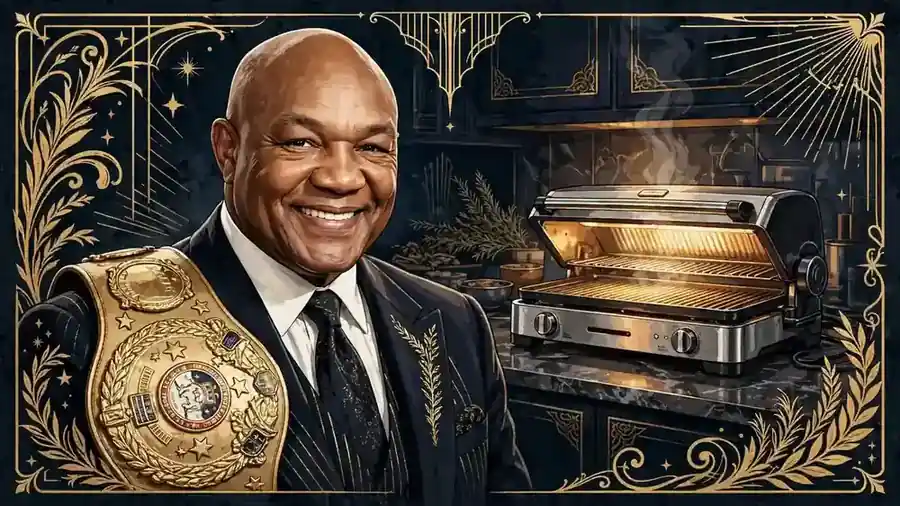
George Foreman‘s net worth was estimated at $300 million when he died on March 21, 2025, at age 76. The number stops most people cold — not because it is small, but because of where it came from. Boxing, the thing that made him famous, accounts for perhaps $50 million of it at most. The rest — well over $200 million by his own accounting — came from a squat little electric grill with his smiling face on the box. In 1999, Salton Inc. paid an aggregate $137.5 million for perpetual rights to his name, $110 million of it directly to Foreman, after he had already banked an estimated $50–$60 million on a 45 percent profit share. His estate entered probate in Harris County, Texas, and as of 2026 the administration continues, with the final probate value unconfirmed. This profile walks through every purse, every grill check, and the one nearly-broke year that made it all possible.
George Foreman: Quick Facts
| Estimated net worth | $300 million (third-party estimate; estate value unconfirmed) |
|---|---|
| Profession | Former professional boxer, entrepreneur, pitchman, minister |
| Nationality | American |
| Born | January 10, 1949, Marshall, Texas (died March 21, 2025, aged 76) |
| Height | 6 ft 3 in (191 cm) |
| Primary income sources | George Foreman Grill profit share and rights buyout, boxing purses, endorsements (Meineke, InventHelp), HBO broadcasting, books and appearances |
| Active years | 1969–1977, 1987–1997 (boxing); 1994–2025 (business) |
| Last reviewed | October 2026 |
- Early Life and Background
- Education
- Career Journey
- Rise to Fame
- Main Sources of Income
- Salary and Earnings
- Businesses and Investments
- Brand Deals and Sponsorships
- Houses, Cars and Other Assets
- Awards and Achievements
- Net Worth Growth Over the Years
- Social Media Presence
- Personal Life
- Sources & Reporting
- Frequently Asked Questions
- Final Thoughts
Early Life and Background
George Edward Foreman was born on January 10, 1949, in Marshall, Texas, and raised in Houston’s Fifth Ward, one of the city’s roughest neighborhoods. His mother raised seven children largely on her own, working multiple jobs, and money was scarce enough that hunger was a normal condition. Young George dropped out of school and drifted into the street life the Fifth Ward offered in the early 1960s — fighting, stealing, and, by his own later admission, heading toward prison or worse.
The intervention that redirected him arrived in 1965. At 16, Foreman joined the Job Corps, the federal anti-poverty program, which sent him first to California and then to Oregon. The discipline of the Corps gave him structure, and a counselor there — seeing a 6-foot-3 teenager with fists like cinder blocks — suggested he try boxing. Foreman started training seriously and entered the ring with something few amateurs possessed: genuine, frightening power. Within three years he had won the 1968 Olympic heavyweight gold medal in Mexico City, stopping Jonas Čepulis of the Soviet Union. He was 19 years old, a national hero, and a professional prospect with a puncher’s lottery ticket in his pocket.
Education
Foreman’s formal schooling ended early — he left school in Houston as a teenager and never attended college. His education, in the conventional sense, was thin, and he made no secret of it later in life. What the Job Corps gave him instead was the closest thing to an apprenticeship the boxing world offers: room, board, discipline, and a gym. He often credited the Corps with saving his life, and the gratitude ran deep enough that he spent decades funding youth programs modeled on the one that had pulled him off the street. After his 1977 retirement he became an ordained minister, and religious study became the second education of his adult life — the one that reshaped both his public character and, indirectly, his earning power.
Career Journey
Foreman turned professional in 1969 and tore through the heavyweight division like weather. By early 1973 he was 37-0 with 34 knockouts, and on January 22, 1973, in Kingston, Jamaica — the “Sunshine Showdown” — he faced champion Joe Frazier. What happened is still hard to believe on film: Foreman knocked Frazier down six times and stopped him in two rounds. The demolition was so complete that it reset the division’s hierarchy overnight. The new champion was 24, unbeaten, and widely described as the most intimidating heavyweight since Sonny Liston.
The first reign ended fourteen months later in the most famous fight of the century. On October 30, 1974, in Kinshasa, Zaire — the Rumble in the Jungle — Foreman met Muhammad Ali with each man guaranteed at least $5 million, an astronomical purse for the era. Ali absorbed rounds of punishment on the ropes — the rope-a-dope — and knocked out an exhausted Foreman in the eighth round. Foreman would later say the loss haunted him for years. He fought on, then walked away from boxing in 1977 after a stunning loss to Jimmy Young in Puerto Rico, an episode followed by a religious experience in the dressing room that he described as dying and being given another chance. He became an ordained minister, founded a church in Houston, and opened the George Foreman Youth and Community Center in 1984 with his brother. For a decade, boxing was over.
Rise to Fame
The fame that built the fortune began with a comeback nobody took seriously. In 1987, at 38, overweight and a decade out of the ring, Foreman started fighting again — openly admitting that financial pressure, including the costs of his ministry and youth programs, had helped push him back. The older Foreman was a different public figure: funny, self-deprecating, comfortable talking about food, surrounded by kids. America liked him in a way it had never liked the glowering young champion.
The comeback delivered its signature night on November 5, 1994. At 45, Foreman knocked out Michael Moorer in the tenth round to regain the heavyweight championship, becoming the oldest heavyweight champion in history — a record that still stands. The purse was a reported $5 million, but the real dividend was exposure: a beloved 45-year-old champion, grinning on every talk show in America, exactly when a small appliance company called Salton was looking for a face. The grill launched in the mid-1990s, the infomercials ran everywhere, and George Foreman — the Cooking Man, as one child reportedly called him in a Forbes interview — became a bigger commercial property than he had ever been as a fighter. His final record: 76 wins, 5 losses, 68 knockouts, and a 2003 induction into the International Boxing Hall of Fame.
Main Sources of Income
Foreman’s fortune rests on an unusual structure: one product deal so large it dwarfs everything else, layered over a long boxing career, a broadcasting stint, and a decade of pitchman work. The components, in rough order of importance:
First, the George Foreman Grill — roughly 45 percent of the grill’s profits in the early years, an estimated $50–$60 million banked before the 1999 buyout, then the buyout itself ($110 million personally) and later promotional payments. Foreman said the total grill take exceeded $200 million. Second, boxing purses: documented marquee paydays of at least $5 million (Ali, 1974), a reported $12.5 million (Holyfield, 1991), and about $5 million (Moorer, 1994), with a full career estimate in the $20–$50 million range. Third, endorsements: a long-running deal as Meineke’s spokesman, a pitchman role for InventHelp, and various food and consumer brands. Fourth, HBO boxing commentary through the 1980s and 1990s. Fifth, books, motivational and religious speaking, and appearance fees. Sixth, real estate and ranch holdings in Texas. The grill is the story; everything else is the supporting cast.
Salary and Earnings
Foreman’s boxing money came in two very different eras, and the numbers tell the story of how much the sport’s economics changed. In the 1970s he was rich by the standards of the day — the $5 million Ali guarantee was a fortune in 1974 — but his first career never produced the nine-figure paydays of the modern era. Celebrity Net Worth reports he earned roughly $5 million across his 1969–1977 career. The comeback years, when heavyweight purses had exploded, produced the big documented checks:
| Fight | Reported purse / guarantee | Notes |
|---|---|---|
| Muhammad Ali, Rumble in the Jungle (Oct 30, 1974) | At least $5 million | Each man guaranteed $5M by promoter Don King; Ali won by 8th-round KO in Kinshasa, Zaire |
| Evander Holyfield (Apr 19, 1991) | $12.5 million | Reported the day after the bout (UPI); Holyfield reportedly earned $20 million; Foreman lost by decision |
| Michael Moorer (Nov 5, 1994) | About $5 million | Regained the heavyweight title at 45; oldest champion in history |
| Other comeback-era bouts (1987–1997) | Undisclosed, multi-million | 21 fights in the comeback, including title bouts vs. Axel Schulz and Shannon Briggs |
| Career boxing estimate | $20–$50 million | Documented marquee purses plus comeback-era earnings; no official total exists |
Set those numbers beside the grill money and the conclusion is unavoidable. Even the generous end of the boxing estimate — $50 million — is a quarter or less of what the grill paid. BounceMojo’s 2026 profile reaches the same verdict with sharper math: career purses of $50–$60 million against well over $200 million from the appliance. The ring made him famous. The kitchen made him rich.
Businesses and Investments
The grill deal is one of the most studied celebrity licensing arrangements in business history, and its structure is the entire reason it made Foreman rich rather than merely paid. The appliance was invented by Michael Boehm, not by Foreman — a fact the record is clear on. Foreman was approached as the pitchman, and he did something unusual: instead of taking a flat appearance fee, he took a share of the profits — reportedly around 45 percent of every grill’s profit. At the peak, in the late 1990s, he was pulling in between $4.5 million and $8 million a month. By 1998, grill sales were running near $200 million a year and accounted for a large share of Salton’s entire revenue. The pre-buyout take: an estimated $50–$60 million.
Then came the signature. In 1999, Salton bought the perpetual worldwide rights to Foreman’s name on specified appliances for an aggregate $137.5 million — a figure disclosed in Salton’s SEC filings. The fine print matters: the aggregate covered Foreman and other participants. Foreman’s individual agreement specified $110 million payable directly to him — $100 million in cash and $10 million in Salton stock. A separate promotional and appearance agreement added roughly $2 million through 2007. Add the earlier royalties and Foreman himself put the lifetime total above $200 million — in a 2014 interview he said estimates of $200 million were actually too low.
One filing detail most profiles skip: the stock component of the 1999 deal did not end cleanly. Salton’s shares carried a price guarantee, and when it was triggered, Foreman returned 456,175 shares — with Salton paying him $18 million in cash in a 2001 settlement instead. The final installment of the acquisition was paid in July 2005, by which point Salton reported more than 70 million grills sold. A 2007 filing confirmed the worldwide perpetual appliance-name rights had been effective since July 1, 1999. The paper trail is unusually complete for a celebrity deal: profit share, buyout, share settlement, final installment, all in SEC filings. That is why the grill numbers in this article carry more confidence than almost any figure in the net-worth genre.
Two details make the deal worth studying. First, the grill nearly went to someone else: the widely repeated account is that inventor Boehm’s camp first offered the endorsement to wrestler Hulk Hogan, who passed — and Foreman took it. Second, the economics were aligned perfectly: Foreman had a reason to pitch enthusiastically on every infomercial because he owned a slice of every unit. More than 100 million grills sold worldwide, the product earned a place in the Smithsonian’s National Museum of American History, and the brand survived into 2026 inside Spectrum Brands’ Home and Personal Care portfolio — the company reported the segment’s fiscal Q1 2026 results in February 2026. The modern grill business no longer enriches Foreman’s estate; he sold the permanent rights in 1999. But the checks from the 1990s built the fortune that his estate now holds.
Outside the grill, Foreman’s ventures were smaller and mixed. He dabbled in boxing promotion and consumer-product licensing, kept cattle and horses on his Texas ranches, and made private investments that never matched the grill’s scale. He told interviewers the grill had taught him the only lesson that mattered in business: ownership beats appearance fees. The second act of his financial life was built entirely on that principle.
Brand Deals and Sponsorships
Long before influencer marketing existed, Foreman was the template for the trusted celebrity salesman. His most durable endorsement was Meineke Car Care Centers, for whom he served as national spokesman for years, appearing in a long-running series of television spots. He also pitched for InventHelp and a string of food, automotive-service, and consumer brands that traded on the same asset: a famous, friendly heavyweight who loved to eat and could sell anything he stood next to.
The second career behind the microphone mattered too. Foreman worked as an expert commentator for HBO’s World Championship Boxing, a steady broadcasting income that kept him close to the sport while the grill money accumulated. He wrote books on boxing, business, faith, and personal development, and commanded real fees on the motivational and religious speaking circuits. In 2023, Sony Pictures released Big George Foreman, a biographical film that moved to streaming and generated the usual residuals and licensing tail for his estate. None of these streams approached the grill’s scale — combined, the endorsements and media work account for perhaps low eight figures over his lifetime — but they kept his name in the culture between infomercial cycles, which was the whole point.

Houses, Cars and Other Assets
Foreman spent the back half of his life large, and mostly in Texas. His main residence was the Huffman compound northeast of Houston — 29310 Martelly Way, a 11,968-square-foot Mediterranean-style mansion built in 2001 on 13.49 acres (part of a roughly 28-acre holding), with five bedrooms, nine bathrooms, two kitchens, and its own personal touch: a kitchen island bearing his “G.F.” initials, the same kitchen where he filmed grill commercials. The property’s signature feature was an approximately 11,000-square-foot climate-controlled collector’s garage — the listing says 40 cars attached, the marketing agent told Homes.com it holds 50-plus — which once housed dozens of his prized vehicles.
That collection is now a matter of public record, and the numbers are precise. In November 2023, Hagerty Marketplace announced the George Foreman Collection: 52 vehicles, every one offered at no reserve, lots closing between December 11 and 21. The 48 lots with published prices totaled $2,887,220. The top lot was a 792-mile 2005 Ford GT at $385,200, followed by a 2000 BMW Z8 he had bought new ($251,450), a 1959 Chevrolet Impala Tri-Power convertible ($230,050), and a 1,600-mile 2002 Ferrari 360 Spider ($180,830). The cheapest lot was a 1948 Chevrolet chassis sold as a project for $2,400. Foreman, then 74, said in the announcement that the time had come “to share my cars.”
Then, in October 2026 — nineteen months after his death — the Huffman estate hit the market at $6 million (agent Evan Compean of Compean Group), with an additional 14.79 acres available separately. Back in his hometown of Marshall he kept a roughly 300-acre ranch stocked with horses and Black Angus cattle, where he ran his youth and community programs. A 2015 profile counted about 38 cars before the later collection grew and was sold. Assigning a 2026 value to the remaining holdings without estate appraisals would be speculative — the probate inventory, if it becomes public, will settle it. What is certain is the shape of the portfolio: Texas land, Texas property, and one of the most methodically liquidated car collections in celebrity history.
Awards and Achievements
The trophy case is the foundation the money story sits on. Foreman won Olympic heavyweight gold at Mexico City in 1968 at 19, became world heavyweight champion by destroying Joe Frazier in two rounds in 1973, and then — after a decade away — became the oldest heavyweight champion in history at 45 by knocking out Michael Moorer in 1994. He was named The Ring’s Fighter of the Year twice (1973, 1976), won the Sugar Ray Robinson Award, and was inducted into the International Boxing Hall of Fame in 2003 and the World Boxing Hall of Fame. His final professional record: 76 wins against 5 losses, with 68 knockouts — one of the highest KO ratios of any heavyweight champion. The grill, not the record, paid the bills, but the record is why the grill existed.
Net Worth Growth Over the Years
No audited figures exist for any year of Foreman’s life, so the honest version of this table is a reconstruction from reported earnings, documented transactions, and the consensus of trackers. The shape is what matters: a fighter’s fortune, a near-collapse, and a second fortune built on an appliance.
| Year | Estimated net worth | What was happening |
|---|---|---|
| 1974 | Several million | Rumble in the Jungle: $5M guarantee; peak of first career |
| 1977 | $5–$10 million | Retired; ministry and youth-center costs begin |
| 1987 | Near broke | Financial pressure helps trigger the comeback at 38 |
| 1994 | $15–$25 million | Regained the title at 45; grill royalties beginning to flow |
| 1998 | ~$60–$80 million | Peak royalty months of $4.5M–$8M; grill sales ~$200M/year |
| 1999 | ~$150–$200 million | $110M personal buyout lands ($100M cash + $10M stock) |
| 2015 | ~$250 million | Trackers converge higher; car collection profiled at 38 vehicles |
| 2023 | ~$300 million | Car collection auctioned ($2.9M); Big George Foreman biopic released |
| 2025 | ~$300 million (est.) | Died March 21; estate enters Harris County probate |
| 2026 | ~$300 million (est.) | Probate administration continues; Huffman estate listed at $6M |
For context on how unusual his outcome is, here is the heavyweight peer table — career ring earnings against the net-worth estimate at or near death:
| Fighter | Career ring earnings (approx) | Net worth at death (est.) |
|---|---|---|
| George Foreman | $20–$50 million | ~$300 million |
| Muhammad Ali | ~$50–$60 million | ~$50–$80 million at his 2016 passing |
| Mike Tyson | ~$300–$400 million | ~$10 million (2026 est.) |
| Evander Holyfield | ~$200–$230 million | ~$1 million (2026 est.) |
The gap between the rows is the lesson of the table. Tyson and Holyfield earned more in the ring and kept almost none of it. Ali kept a solid share. Foreman earned the least in the ring and finished with the most — because his fortune was never really a boxing fortune. It was a licensing fortune that happened to belong to a boxer.
Social Media Presence
Foreman maintained an active social media presence in his later years, and his accounts functioned as a warmth-and-family channel: grill jokes, grandkids, ministry reflections, and the occasional boxing memory. After his death, the same channels became the family’s voice — it was his Instagram account that carried the family’s March 21, 2025 announcement of his passing, a statement that news outlets around the world quoted within the hour. The George Foreman Grill brand maintains its own commercial social presence under Spectrum Brands. There is no posthumous content machine; the accounts serve as a memorial and a family noticeboard, not a business.
Personal Life
Foreman’s personal life was as full as his professional one. He was married five times; his final marriage, to Mary Joan Martelly, began in 1985 and lasted roughly forty years — the stability that defined the second half of his life after four earlier marriages. He had 12 children: seven daughters and five sons, two of the daughters adopted. In one of the most unusual naming decisions in public life, all five of his sons are named George Edward Foreman — distinguished by nicknames: Junior, Monk, Big Wheel, Red, and Little Joey. He explained that he wanted his sons to share something in common, and that if one succeeded, they all succeeded.
After his first retirement he became an ordained Christian minister and devoted himself to his church and the George Foreman Youth and Community Center in Houston, which he had founded with his brother in 1984 to give at-risk young people the structure the Job Corps had once given him. He died on March 21, 2025, in a Houston hospital, at 76; his brother told The New York Times the cause was not immediately clear, and the family did not release one. His will entered probate in Harris County, Texas, where court records show the will admitted, Letters Testamentary issued, and an extension granted for the inventory filing — administration continuing into 2026. The public record does not provide a reliable dollar-by-dollar breakdown of what each beneficiary received, and readers should treat websites claiming exact inheritance figures with skepticism unless they cite estate documents.
Sources & Reporting
Reporting window: 1974–1976 contemporary fight coverage, 1987–1999 business reporting on the grill and Salton filings, 2014–2015 interviews and profiles, March 2025 obituaries, and 2025–2026 estate and probate coverage. Every figure below is attributed to the outlet that published it.
- Celebrity Net Worth — the standing $300 million net-worth estimate used as the anchor; and the report that Foreman earned roughly $5 million across his 1969–1977 boxing career.
- Men’s Journal — the March 2025 report confirming the $300 million estimate at death via Celebrity Net Worth, the family Instagram death announcement, and Foreman’s “Cooking Man” remark to Forbes.
- The New York Times — obituary reporting: death in a Houston hospital on March 21, 2025, at 76; brother Roy Foreman’s statement that the cause was not yet clear.
- Associated Press — obituary coverage of Foreman’s death, career record (76-5, 68 knockouts), and biographical details cited by profile writers.
- UPI — the $12.5 million Holyfield purse reported the day after the April 1991 bout; and the ~$5 million Moorer purse reporting.
- U.S. Securities and Exchange Commission (SEC filings) — Salton’s acquisition filings: the $137.5 million aggregate three-party purchase price, Foreman’s $110 million individual agreement ($100 million cash, $10 million stock), the earlier 45% profit participation, and the separate ~$2 million appearance agreement through 2007.
- BounceMojo — the September 2026 profile: $50–$60 million in career purses vs. well over $200 million from the grill, peak months of $4.5–$8 million, and the year-by-year reconstruction through the near-broke 1987 period.
- TycoonStory — the 2026 deep dive on the Salton deal structure ($110 million personal vs. $137.5 million aggregate), the 100-million-unit sales figure, and the Harris County probate proceedings continuing into 2026.
- Realtor.com — the October 2026 report on the Huffman estate listing: $6 million, 11,968 square feet, 13.49 acres, the 11,000-square-foot collector’s garage, and the “G.F.” kitchen island.
- Hagerty — the November–December 2023 marketplace announcement and results for the 52-vehicle George Foreman Collection: $2,887,220 across 48 priced lots, led by the $385,200 2005 Ford GT.
- Homes.com — the listing agent’s statement that the Huffman garage holds 50-plus cars, carried with the October 2026 listing coverage.
- Smithsonian — the George Foreman Grill’s place in the National Museum of American History’s collection.
- Spectrum Brands — fiscal Q1 2026 results (February 2026) confirming the George Foreman brand’s continued place in its Home and Personal Care portfolio.
- Like Law Group — the estate-planning analysis noting the $300 million estimate at death, the 12 children, and the blended-family probate complexity.
Frequently Asked Questions
What was George Foreman’s net worth when he died?
George Foreman’s net worth was estimated at $300 million when he died on March 21, 2025, at age 76. The figure is a third-party estimate — widely reported by Celebrity Net Worth and echoed across business and sports press — not an audited probate valuation. His estate entered probate in Harris County, Texas, and the final probate value has not been publicly confirmed at $300 million.
How much money did George Foreman make from the grill?
Well over $200 million, by Foreman’s own accounting — in a 2014 interview he said estimates of $200 million were actually too low. The breakdown: roughly 45 percent of the grill’s profits in the early years (an estimated $50–$60 million banked before 1999, with peak months of $4.5–$8 million), then the 1999 buyout — $110 million paid directly to Foreman ($100 million cash plus $10 million in Salton stock) within an aggregate $137.5 million transaction — plus a separate $2 million promotional agreement. More than 100 million grills sold worldwide.
Did George Foreman invent the George Foreman Grill?
No. The appliance was invented by Michael Boehm; Foreman was the celebrity endorser and brand personality whose name became the product’s name. The widely repeated account is that Boehm’s camp first offered the endorsement to wrestler Hulk Hogan, who passed, and Foreman took it instead. Foreman’s contribution was commercial, not technical: his profit-share deal, his infomercial pitch, and a public persona consumers trusted.
Did George Foreman make more money from boxing or the grill?
The grill, by a wide margin. His documented marquee purses — at least $5 million against Muhammad Ali in 1974, a reported $12.5 million against Evander Holyfield in 1991, about $5 million against Michael Moorer in 1994 — put his full career boxing earnings in the $20–$50 million range. The grill paid him well over $200 million. He made roughly four to ten times more selling kitchen appliances than throwing punches.
How many George Foreman Grills were sold?
More than 100 million units worldwide, making it one of the best-selling kitchen appliances in history. The scale is part of why the deal worked: Foreman’s roughly 45 percent profit share meant his income rose with every profitable sales period. The product became such a cultural fixture that a grill entered the Smithsonian’s National Museum of American History, and the brand remained in Spectrum Brands’ portfolio in 2026.
Was George Foreman ever broke?
He came close. After retiring in 1977, investments, expenses, and the costs of his ministry and Houston youth programs drained much of his first fortune, and by 1987 he was reportedly near broke — a financial pressure he openly cited as one reason for his comeback at 38. The comeback rebuilt his fame, the fame landed the grill deal, and the grill built the $300 million fortune. The broke year of 1987 is the hinge of the whole story.
Who inherited George Foreman’s fortune?
Foreman was survived by his wife of roughly forty years, Mary Joan Martelly, and 12 children — seven daughters and five sons (all five sons are named George Edward Foreman). His will entered probate in Harris County, Texas, with the will admitted and Letters Testamentary issued; an extension was granted for the inventory filing, and administration continued into 2026. No public record provides a reliable dollar-by-dollar breakdown of what each beneficiary received, so claims of exact inheritance amounts should be treated skeptically unless they cite estate documents.
Who owns the George Foreman Grill now?
The brand is part of Spectrum Brands’ Home and Personal Care portfolio, which the company confirmed in its fiscal Q1 2026 results in February 2026. Foreman sold the perpetual worldwide rights to his name on specified appliances to Salton in 1999 for an aggregate $137.5 million ($110 million to him personally), so his estate does not own the brand and modern grill sales do not add to the estate. The rights sale was precisely what converted his endorsement into a nine-figure fortune.
Final Thoughts
George Foreman’s $300 million is the most instructive fortune in sports history, because it breaks the usual rules. He earned less in the ring than Muhammad Ali, far less than Mike Tyson, and finished with more than all of them — not by fighting better, but by structuring better. A 45 percent profit share instead of a flat fee. An equity position in a product he genuinely used. A nine-figure buyout when the buyer wanted the rights forever. Those three decisions, all made in the 1990s, account for roughly two-thirds of the final number.
The honest caveats stay attached to the headline. The $300 million is an estimate, not a probated fact, and the Harris County estate administration will eventually produce its own accounting. The boxing purses are documented only for the marquee fights. The exact split among his wife and twelve children is not public, and may never be. But the shape of the story is verified from SEC filings to auction results to a $6 million listing in October 2026: a kid from the Fifth Ward who was nearly broke at 38, and who understood — earlier than almost any athlete of his generation — that the real money was never in the game. It was in owning the thing with your name on it.
Published on October 19, 2026. Last reviewed October 2026. Found an error? See our corrections policy.