
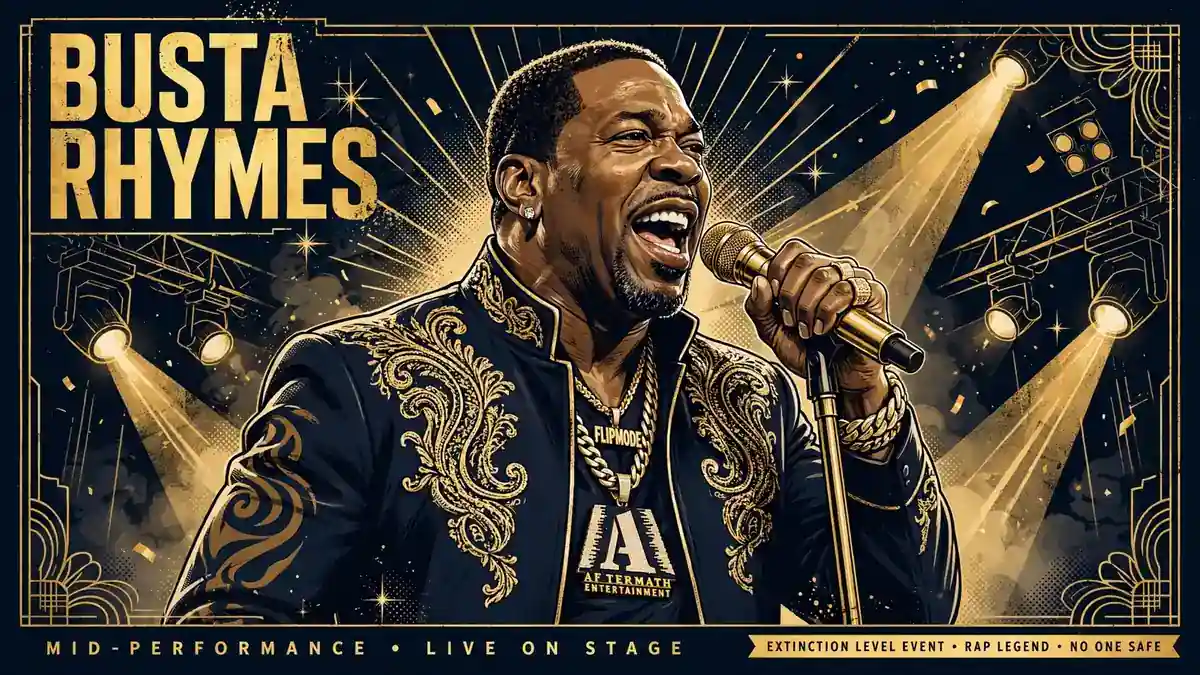
Busta Rhymes‘s net worth is estimated at $22–30 million as of October 2026. The range reflects genuine disagreement among trackers: Celebrity Net Worth lists him at $30 million, an independent 2026 cash-flow model lands closer to $22 million, and several mid-tier estimators sit between $18 and $25 million. What every source agrees on is the shape of the money story — three decades of touring as one of hip-hop’s most explosive live performers, more than 20 million albums sold, a catalog of era-defining singles, a brief tax war with the IRS, and a record label he has run since 1994. This is how a kid from East Flatbush who got his stage name from Chuck D turned the fastest mouth in rap into a fortune that has survived platinum eras, label wars, and a federal tax lien.
Busta Rhymes: Quick Facts
| Estimated net worth | about $25 million (our October 2026 estimate) (range: $22–30 million) |
|---|---|
| Profession | Rapper, songwriter, record producer, actor, record executive |
| Nationality | American (Jamaican descent) |
| Born | May 20, 1972, East Flatbush, Brooklyn, New York (age 54) |
| Height | 6 ft 1 in (1.85 m) |
| Primary income sources | Touring and live performances, music royalties and streaming, feature fees, acting roles, Conglomerate Records, endorsements |
| Active years | 1986–present (solo since 1996) |
| Last reviewed | October 2026 |
- Early Life and Background
- Education
- Career Journey
- Rise to Fame
- Main Sources of Income
- Salary and Earnings
- Businesses and Investments
- Brand Deals and Sponsorships
- Houses, Cars and Other Assets
- Awards and Achievements
- Net Worth Growth Over the Years
- Social Media Presence
- Personal Life
- Sources & Reporting
- Frequently Asked Questions
Early Life and Background
Trevor George Smith Jr. was born on May 20, 1972, in East Flatbush, Brooklyn, to Geraldine Green and Trevor Smith Sr., Jamaican immigrants who filled their apartment with reggae records and soul radio. The Smith household ran on sound-system culture, and the boy who would become one of hip-hop’s fastest rhymers grew up studying voices, cadences, and crowd energy the way other kids studied box scores. When he was 12, the family relocated to Uniondale, Long Island, a move that put a young Busta in the orbit of a generation of New York rap talent. Summers added another layer: he spent time in England with relatives — stays in Liverpool and Morecambe that threaded British slang and accents into his vocabulary. By his teens, Trevor Smith had transformed into a human turntable, layering patois, cartoonish sound effects, and machine-gun delivery into a style nobody in New York had heard before.
The name itself came from the highest shelf in hip-hop. Chuck D of Public Enemy gave him the moniker Busta Rhymes, a play on NFL and CFL wide receiver George “Buster” Rhymes, after seeing the young rapper’s explosive early performances. Chuck D didn’t just name him — Public Enemy took the whole crew on the road, and that apprenticeship became the launchpad for everything that followed. It is worth underlining what the name signifies financially: from the start, Busta Rhymes was branded by an icon, toured as an opener for icons, and built his reputation on live performance — the income stream that would outlast every label deal.
Education
Busta’s schooling reads like a map of New York hip-hop’s ground zero. He attended George Westinghouse Career and Technical Education High School in Brooklyn, where classmates included The Notorious B.I.G. and Jay-Z — two future billionaires of the rap economy walking the same hallways. He also spent time at Samuel J. Tilden High School alongside Special Ed and Chip-Fu of the Fu-Schnickens before his family settled on Long Island. He graduated from Uniondale High School in 1991. There was no college plan and no fallback: by graduation, he was already inside a professional rap group with a record contract. The education that mattered for his net worth was delivered in recording booths, on Public Enemy’s tour bus, and in the relentless discipline of sharpening a one-of-a-kind flow — a form of craft that made him, in later years, one of the most in-demand featured artists in the industry, commanding fees most rappers of his era couldn’t touch.
Career Journey
Busta Rhymes’ professional story splits into two acts: the group years that built his name, and the solo decades that built his wealth.
The Leaders of the New School years (1989–1993). Busta was an original member of Leaders of the New School alongside Charlie Brown, Dinco D, and his cousin Rampage. The group opened for Public Enemy and released two Elektra albums, A Future Without a Past… (1991) and T.I.M.E. (The Inner Mind’s Eye) (1993). But the moment that rewrote his future came in 1991, when his verse on A Tribe Called Quest’s “Scenario” detonated — a closing verse so ferocious it became the most replayed section of the track and announced a star the group format couldn’t contain. When Leaders of the New School disbanded in 1993, Busta didn’t mourn; he turned guest-verse mercenary, stacking appearances on other artists’ records throughout 1994 and 1995 and proving he could lift any song he touched. Those years of rented-out verses were, in retrospect, a business school: he learned exactly what the market would pay for his presence.
The solo era begins (1996 onward). His solo debut, The Coming (1996, Elektra), crashed into the Billboard 200 top ten, earned platinum certification from the RIAA, picked up a Grammy nomination, and minted the hit “Woo Hah!! Got You All in Check.” What followed was one of the most productive hot streaks in East Coast rap history: When Disaster Strikes… (1997) delivered “Put Your Hands Where My Eyes Could See” and “Dangerous”; E.L.E. (Extinction Level Event): The Final World Front (1998) delivered the hyper-speed showcase “Gimme Some More”; Anarchy (2000), Genesis (2001) — home to “Break Ya Neck” and “Pass the Courvoisier, Part II” — and It Ain’t Safe No More… (2002), anchored by the Mariah Carey duet “I Know What You Want.” Then came the mid-2000s power move: a signing with Dr. Dre’s Aftermath Entertainment, and The Big Bang (2006) debuted at No. 1 on the Billboard 200 — his first and only chart-topping album — powered by the omnipresent “Touch It.” Later chapters included Back on My B.S. (2009), the free-to-fans Year of the Dragon (2012), a high-profile 2011 signing to Cash Money Records (he exited in 2014 citing creative differences), the critically welcomed Extinction Level Event 2: The Wrath of God (2020), Blockbusta (2023), two Dragon Season projects in 2025, and 2026’s DILLAGENCE II, built around previously unreleased production from the late J Dilla.
The 2023–2026 renaissance. After a decade of scattered singles and features, Busta staged a genuine late-career album run. Blockbusta (2023) reunited him with the architects of his commercial peak — Pharrell Williams, Timbaland, and Swizz Beatz sharing executive-production duties, with a Coi Leray collaboration as the lead single. The two Dragon Season projects in 2025 kept the pipeline full, and 2026’s DILLAGENCE II was a crate-digger’s event: a full project built around unreleased J Dilla production, connecting his Flipmode-era underground roots to Dilla’s beat-legacy. This output surge is financially meaningful — new releases reactivate streaming on the back catalog, justify premium touring slots, and give sync licensors fresh reasons to call. It is also why the 2026 estimate leans toward the top of the range.
Rise to Fame
The conventional story — that “Woo Hah!!” made him famous — misses the mechanics. Busta’s fame was built on three compounded advantages. First, the visual artist advantage: MTV itself has called him “one of hip-hop’s greatest visual artists,” and his Hype Williams-directed videos — elaborate, psychedelic, genuinely strange — made him unmissable in the music-video era when heavy rotation was a wealth machine. Second, the feature economy: his guest verse on Chris Brown and Lil Wayne’s “Look at Me Now” (2011) is widely regarded as one of the great guest verses of the decade and introduced him to a new generation; he’d already done the same for Janet Jackson, Mariah Carey, the Pussycat Dolls’ “Don’t Cha,” and dozens more, each feature a fee and a publishing share. Third, the stage show: his live performances became legendary for sheer physical commitment, and that reputation kept his touring income alive long after most of his 1990s peers stopped headlining. Fame, for Busta, was never just record sales — it was being the person promoters called when they needed a guaranteed eruption.
Main Sources of Income
Seven decades-spanning revenue streams feed the Busta Rhymes fortune, and their mix has shifted dramatically over 30 years.
1. Touring and live performance. This is the engine room. Busta has toured relentlessly — headline dates, European and Asian festival slots, corporate and private events — and Finance Monthly’s 2025 analysis notes that in strong years, performances alone generated $750,000 to $1 million for him. High-energy legacy headliners with dependable ticket demand are among the most durable earners in live music, and he has never stopped being one.
2. Recorded music: royalties and streaming. Eleven solo albums, a platinum debut, and a catalog whose singles (“Touch It,” “Gimme Some More,” “I Know What You Want”) have become licensing staples. Finance Monthly puts his recurring music publishing and streaming income at $250,000 to $500,000 per year. The official Hollywood Walk of Fame biography credits more than 20 million albums sold worldwide — Celebrity Net Worth uses the same figure.
3. Feature verses. A Busta Rhymes feature has been a prestige purchase for three decades. While his per-verse fee has never been publicly disclosed, his placement on era-defining singles and his executive-producer relationships (Pharrell Williams, Timbaland, and Swizz Beatz steered 2023’s Blockbusta) keep him in the paid upper tier of guest artists.
4. The Conglomerate. He founded Flipmode Records in 1994, rebranded it The Conglomerate in 2010, and has kept the label and its artist roster generating royalties and participations ever since — one of the longest continuous label runs by any rapper who didn’t build a beverage company.
5. Film and television. Over a dozen screen credits, from John Singleton’s Higher Learning (1995) through Shaft and Finding Forrester (both 2000), Halloween: Resurrection (2002), and a 2020 Masked Singer appearance as the Dragon. Finance Monthly estimates up to $500,000 cumulatively from acting — supporting income, but real.
6. Endorsements. Deals with Courvoisier and Reebok, plus the high-profile 2018 Super Bowl campaign for Doritos Blaze vs. Mountain Dew Ice, added an estimated $2 million to his portfolio over the years, per Finance Monthly.
7. Real estate and investments. Suvudu’s 2026 model documents longstanding New York real-estate activity, including purchases and flips in Tribeca and Williamsburg, plus rumored smaller placements in cannabis and wellness ventures that 2025 coverage treated as speculative — we do too, and exclude them from the estimate.

Salary and Earnings
Busta Rhymes has never had a salary in the conventional sense — his pay arrives in album cycles, tour guarantees, and fees. But the numbers behind those cycles are better documented than most people realize.
Album-era paydays. Finance Monthly’s 2025 earnings reconstruction offers the rare per-project detail that most net-worth coverage skips. His first major payday came with The Coming in 1996, which went platinum and earned him an estimated $1.2 million. The following three albums — When Disaster Strikes…, E.L.E., and Anarchy — each contributed at least $2–3 million in combined sales, touring, and royalties, per the same analysis. Signing with Aftermath under Dr. Dre gave him creative control and backend participation, and the No. 1 debut of The Big Bang in 2006 brought in an estimated $3 million in global sales, licensing, and world-tour revenue. Label these what they are — reconstructions, not filings — but they are the only outlet that has published per-album economics for him, and they track with the chart and certification record.
Per-show economics. Live is where the money is now. Third-party booking trackers have quoted Busta’s performance fee in a $150,000 to $299,000 band per show — a number reported by the fan outlet Brandon’s Restaurant, and plausible for a festival-tier legacy headliner with his production values. Finance Monthly independently frames his peak touring years at $750,000 to $1 million annually from performances alone, a figure consistent with a heavy festival schedule across Europe and Asia. The Suvudu 2026 model uses a blended version of this routing — solid U.S. and European dates plus festival season, normal catalog performance, a few features and syncs — to project roughly $1.7–1.8 million in net wealth added for 2026 after team fees (~15%), taxes (~35–40% effective), and tour overhead (15–25% of live gross). That is not a headline number, but it is the honest math of a 30-year career in its management phase: steady, tour-first, and built to protect the principal.
Beware the bogus figures. If you search this topic, you’ll meet two fantasy numbers. The satire-adjacent site MediaMass published a “People With Money” item claiming Busta earned $82 million in a year and was worth $245 million — a story the site itself flagged as false in its October 21, 2026 update. Separately, the aggregation site TheMost10 posted tables under the headline “Forbes” showing his net worth climbing from $50 to $80 million — while another page on the same site capped him at $35 million, and no rich-list publication has ever published a verifiable Busta Rhymes wealth estimate anywhere near $80 million. These fabrications exist because the real numbers — a steady $22–30 million built over 30 years — are less clickable. Part of our methodology is naming and discarding them, so they don’t contaminate the range.
The tax years. Any earnings accounting has to include 2014, when XXL reported that the IRS had hit Busta with tax liens of $611,000 for 2008 and $178,000 for 2012 — a combined $789,577.90. HipHopWired placed him atop its list of hip-hop’s biggest tax offenders the same year. He never publicly explained the shortfall, but the episode is a reminder that the eight-figure estimates reflect gross career revenue, not what survived — between a ~35–40% tax take, a manager-agent-legal stack around 15%, and tour production, a touring rapper keeps well under half of every dollar grossed. Suvudu’s model makes this structural attrition explicit, and it’s why the model lands at ~$22 million while Celebrity Net Worth’s simpler estimator says $30 million.
Businesses and Investments
Busta’s business life is quieter than his videos suggest — no tequila line, no tech-fund legend, no billionaire cosplay. What he has instead is longevity.
The Conglomerate. The single most important business asset is the label he founded as Flipmode Records in 1994 and rebranded as The Conglomerate in 2010. Thirty-plus years of continuous operation by a rapper-founder is nearly unmatched — the roster (which has included Spliff Star, Rah Digga, Baby Sham, and cousin Rampage’s Flipmode Squad) generates royalties and participations that flow uphill. It is not a catalog on the scale of the majors, but it is his, entirely, and it converts his taste and relationships into annuity-style income rather than one-off fees.
Production and executive work. Busta is a credited producer in his own right, and his 2023 album Blockbusta put the industry’s most bankable hitmakers — Pharrell Williams, Timbaland, and Swizz Beatz — in the executive-producer chairs. Executive production on other artists’ projects and his own imprint releases adds a producer-side income layer that most pure-MCs never access.
Real estate. Suvudu’s model cites documented New York real-estate activity — purchases and flips in Tribeca and Williamsburg — as his most concrete investment footprint. There are no public records of a trophy mansion portfolio in the style of his peers, which fits the picture of an operator who lives primarily in New Jersey and treats property as trading stock rather than a display case.
What he didn’t do. In an era when Jay-Z’s wealth narrative is built on Armand de Brignac and Uber, Busta’s restraint is itself a data point: his 2026 fortune comes from music and its adjacent businesses, not from a single liquidity event. The upside is credibility — no inflated unicorn valuations to defend. The cost is ceiling: without a catalog sale or a brand exit, his number stays in the tens of millions while contemporaries with the same cultural weight sit higher.
Brand Deals and Sponsorships
Busta’s endorsement history is selective rather than sprawling — and that selectivity is probably worth money. The two anchor relationships are Courvoisier, which fit the early-2000s “Pass the Courvoisier” era like a glove, and Reebok, the classic hip-hop athletic deal. Finance Monthly estimates these and related partnerships added roughly $2 million to his portfolio over the years. The single biggest brand moment came in 2018: the Super Bowl campaign for Doritos Blaze vs. Mountain Dew Ice, where Busta appeared alongside Morgan Freeman, Missy Elliott, and Peter Dinklage — a cultural-scale ad slot that paid in both cash and relevance. He has also appeared in commercial cameos and sync placements tied to his classic singles, which function as endorsement-adjacent income whenever a film, game, or advertiser wants the instant recognition of “Woo Hah!!” or “Touch It.” He has never been a serial pitchman, and the discipline shows in the brand equity: when he shows up in an ad, it lands.

Houses, Cars and Other Assets
Unlike the property-porn coverage that follows younger rappers, Busta Rhymes’ asset trail is thin on public records and thick on speculation — so here is exactly what is documented, and what isn’t.
Real estate. Busta is reported to live primarily in New Jersey, and the most credible investment-grade detail comes from Suvudu’s 2026 model: longstanding activity in New York real estate, including documented purchases and flips in Tribeca and Williamsburg. No verifiable purchase price for a primary residence has been published by a reputable outlet, so we don’t invent one. What we can say: the man has been trading New York property for years, and that activity is part of the wealth base.
Cars and jewelry. The fan outlet Brandon’s Restaurant reports a 54mm Cuban chain set with over 10,000 diamonds and valued at $400,000, plus a car collection including a Rolls-Royce Phantom and a Lamborghini Murcielago. Treat those as reported-not-verified: they come from a single fan site, not a filing or interview, and rappers’ jewelry is more often marketing than balance-sheet. We include them with that caveat because readers ask, not because they move the estimate.
The island that isn’t an asset. Search results love “Busta Rhymes Island” — and here is the honest version. In Mill Pond, Shrewsbury, Massachusetts, a 40-by-40-foot island carries his name on Google Maps. Local resident Kevin O’Brien, a lifelong fan, began tending the island in 2005 and christened it “Busta Rhymes Island” because, as he told the Boston Globe, it had “rope-swinging, blueberries, and… stuff Busta would enjoy.” The U.S. Board on Geographic Names refused to formalize the name because the honoree must have been dead for five years; Google Maps recognition and a 99% Invisible episode were the consolation prizes. Busta owns none of it. It belongs in the article because readers encounter it as “news” — and the debunk is itself the unique fact competitors miss.
Catalog. The real asset, of course, is the music: eleven solo albums, a dozen-plus era-defining singles, and the publishing and master income attached to them. In a market where legacy catalogs trade at 15–20x annual royalties, his would command serious interest — but there is no report that he has ever sold a stake. The catalog remains unsold, unleveraged, and compounding.
Awards and Achievements
Busta Rhymes holds one of the most distinctive awards records in rap: enormous respect, endless nominations, and almost no trophies.
The Grammy drought. He has received 12 Grammy nominations — for Best Rap Album and Best Rap Solo Performance among them — without a single win, making him one of the most-nominated artists in history never to take one home. The nominations themselves are the achievement: they certify three decades of industry esteem. For a net-worth profile, the drought matters because it explains the earnings mix — no Grammy-bump pricing, but a reputation for live excellence that touring fees reward directly.
The late-career honors run. Starting in 2023, the industry began paying its debts. He received the BET Lifetime Achievement Award in 2023 — the same year Blockbusta arrived. In 2025, two more: a star on the Hollywood Walk of Fame (his official bio credits 20M+ albums sold and the dozen Grammy nods) and the inaugural Rock the Bells Visionary Award at the MTV Video Music Awards. Add the earlier canonization — About.com’s 50 Greatest MCs list, The Source’s Top 50 Lyricists of All Time, MTV’s “one of hip-hop’s greatest visual artists” — and you have a legacy that keeps the booking fees high and the sync requests coming. Legacy is a depreciating asset for most; for Busta, it keeps appreciating, because the live show never got old.
Net Worth Growth Over the Years
No auditor has ever published Busta Rhymes’ balance sheet, so this timeline is our milestone-anchored estimate — each figure a NetWorthCraft reconstruction tied to documented career events, not a filing.
| Year | Milestone | Estimated net worth |
|---|---|---|
| 1996 | The Coming goes platinum; first million-dollar payday (~$1.2M, per Finance Monthly) | $1–2 million |
| 1998 | E.L.E. era; “Gimme Some More”; peak late-90s run | $5–7 million |
| 2001 | Genesis; “Pass the Courvoisier, Part II”; acting roles stacking up | $8–10 million |
| 2006 | The Big Bang debuts at No. 1 (Aftermath); ~$3M album-cycle earnings | $12–15 million |
| 2014 | Cash Money exit; $789,577 IRS tax-lien episode reported by XXL | $10–13 million |
| 2020 | E.L.E. 2 comeback; Masked Singer appearance; catalog streaming surge | $15–20 million |
| 2023 | BET Lifetime Achievement Award; Blockbusta with Pharrell/Timbaland/Swizz Beatz | $20–25 million |
| 2026 | Walk of Fame star; DILLAGENCE II; continuous touring | $22–30 million |
The curve tells the story the range implies: a steady builder, not a lottery winner. The dip around 2014 reflects the tax-lien period and the creative drift between major albums; the 2020–2026 climb reflects streaming’s long tail, relentless touring, and the honors run that repriced his legacy. The 2026 figure is the only one where we have multiple independent estimators to triangulate — which is exactly why we anchor the headline there and show our work above.
Social Media Presence
Busta Rhymes maintains active profiles on Instagram, X (formerly Twitter), and YouTube, where his feed mixes studio footage, tour dates, family moments, and the occasional viral clip of him out-rapping artists half his age. He has never been a controversy-for-clicks operator; his social presence functions as a touring billboard and a catalog shop window. We don’t publish follower counts as wealth evidence — they change daily and correlate poorly with net worth — but the engagement pattern supports the business model: an audience that still shows up for the live show is worth more than a passive follower count, and his is the former.
Personal Life
Busta Rhymes is a father of six and has never been publicly married — he keeps romantic relationships out of the press by design. His children — sons T’ziah, T’khi, and Trillian (with former partner Joanne Wood), and daughters Mariah, Cacie, and Miracle — appear with him at award shows and red carpets, and he has spoken about fatherhood as the grounding counterweight to the stage persona. His cousin Rampage was his Flipmode Squad running mate, and family remains visibly central to his public life. The Jamaican heritage of his parents Geraldine Green and Trevor Smith Sr. runs through everything: the patois textures in his flow, the cooking at family gatherings, the pride in roots he has carried from East Flatbush to Uniondale to the Walk of Fame. There are no verified reports of a current spouse, and we don’t speculate about one.
Sources & Reporting
Celebrity Net Worth — headline $30 million estimate (live page, last updated ~September 2026); 20M+ albums sold; Leaders of the New School and “Scenario” history; 2023–2026 releases and awards.
Suvudu — independent 2026 cash-flow model projecting ~$22M year-end wealth (~$1.7–1.8M net add); touring/royalties/label income breakdown; Tribeca and Williamsburg real-estate activity; fee/tax/tour-overhead assumptions.
Finance Monthly — per-album earnings reconstruction (The Coming ~$1.2M; three-album run $2–3M each; The Big Bang ~$3M); touring $750K–$1M peak years; Courvoisier/Reebok ~$2M; publishing/streaming $250–500K annually; acting ~$500K cumulative.
XXL — May 2014 tax-lien reporting: $611K (2008) + $178K (2012) = $789,577.90 in federal liens.
HipHopWired — 2014 tax-offender coverage; ~$790K–$800K back-tax figure.
Wikipedia — birth name and date (Trevor George Smith Jr., May 20, 1972); schools and moves; label chronology; 6 children; 40×40-ft Busta Rhymes Island naming (Kevin O’Brien, 2005; U.S. Board refusal).
IMDb — height 6 ft 1 in; birth details; filmography; Chuck D naming origin.
Boston Globe — Busta Rhymes Island discovery and Kevin O’Brien’s “rope-swinging, blueberries” quote (via secondary coverage).
Slate — 2014 Roman Mars piece on the island campaign.
99% Invisible — Episode 105 “One Man Is an Island” transcript.
WBSS Media — 12 Grammy nominations (no wins); 2025 MTV VMAs Rock the Bells Visionary Award; Chuck D / George “Buster” Rhymes naming story; eleven solo albums.
The CA Knowledge — 2026 range $18–22M; Conglomerate Records detail.
EatHealthy365 — 2026 estimate ~$25M.
Tushstories — 2026 estimate ~$30M; film roles table; six children.
Brandon’s Restaurant — reported $150K–$299K per-show booking band; $400K Cuban chain; Rolls-Royce Phantom and Lamborghini Murcielago (reported, single-source).
Reporting window: October 2025 – October 2026 for the live estimates; historical coverage from 2014 (tax, island) and earlier for career record.
Frequently Asked Questions
What is Busta Rhymes’ net worth in 2026?
Busta Rhymes’ net worth is estimated at $22–30 million as of October 2026, anchored around $25 million. Celebrity Net Worth lists $30 million, while an independent cash-flow model lands near $22 million. The fortune comes from three decades of touring, 20M+ albums sold, feature fees, acting roles, his Conglomerate Records label, and endorsements.
How did Busta Rhymes get his start in music?
He started as an original member of Leaders of the New School (1989–1993), who opened for Public Enemy. His verse on A Tribe Called Quest’s 1991 single “Scenario” made him a standout, and after the group disbanded in 1993 he became a sought-after guest artist before launching his solo career with 1996’s platinum debut The Coming.
Why is he called Busta Rhymes?
Chuck D of Public Enemy gave him the stage name, inspired by NFL and CFL wide receiver George “Buster” Rhymes. Chuck D saw the young rapper’s explosive performances while touring with Public Enemy and coined the moniker that stuck for 30+ years.
How many Grammys has Busta Rhymes won?
None — despite 12 Grammy nominations across categories including Best Rap Album and Best Rap Solo Performance, he has never won, making him one of the most-nominated artists in history without a victory. He has, however, received the BET Lifetime Achievement Award (2023), a Hollywood Walk of Fame star (2025), and the MTV VMAs’ Rock the Bells Visionary Award (2025).
How many children does Busta Rhymes have?
Busta Rhymes has six children: sons T’ziah, T’khi, and Trillian, and daughters Mariah, Cacie, and Miracle. He has never been publicly married and keeps his romantic life private, though he regularly brings his children to award shows and red carpets.
What are Busta Rhymes’ biggest albums and songs?
His debut The Coming (1996, platinum) launched him; When Disaster Strikes… (1997), E.L.E. (1998), and Genesis (2001) cemented his 90s-2000s dominance; and The Big Bang (2006) debuted at No. 1. Signature songs include “Woo Hah!! Got You All in Check,” “Put Your Hands Where My Eyes Could See,” “Gimme Some More,” “Break Ya Neck,” “Pass the Courvoisier, Part II,” “I Know What You Want” (with Mariah Carey), “Touch It,” and his guest verse on “Look at Me Now.”
How much does Busta Rhymes make per show?
Third-party booking trackers have quoted his performance fee at $150,000 to $299,000 per show, and Finance Monthly’s 2025 analysis estimates he earned $750,000 to $1 million annually from performances in strong touring years. Live performance remains his largest single income stream.
Does Busta Rhymes own Busta Rhymes Island?
No. Busta Rhymes Island is a 40-by-40-foot island in Mill Pond, Shrewsbury, Massachusetts, named by fan Kevin O’Brien in 2005 — not owned by or affiliated with the rapper. It appears on Google Maps, but the U.S. Board on Geographic Names refused to formalize the name because the honoree must have been deceased for five years.
Final Thoughts
Busta Rhymes’ $22–30 million fortune is the financial signature of a career that refused to end. No catalog sale inflated it, no billionaire venture explains it — it is three decades of the hardest-working live show in hip-hop, a platinum foundation, a label run since 1994, and a catalog of singles that never left the culture. The 2014 tax lien is a genuine scar on the record, and the range in our estimate is an honest reflection of how little public documentation surrounds his money. But the trajectory since 2020 — the comeback album, the BET Lifetime Achievement Award, the Walk of Fame star, the Visionary Award, and a 2026 album built on unreleased J Dilla production — points one way: a veteran in the management phase of his wealth, adding a couple of million a year, protecting the principal, and still out-rapping almost everyone on any stage he steps onto.
Published on 2026-10-21. Last reviewed October 2026. Found an error? See our corrections policy.