
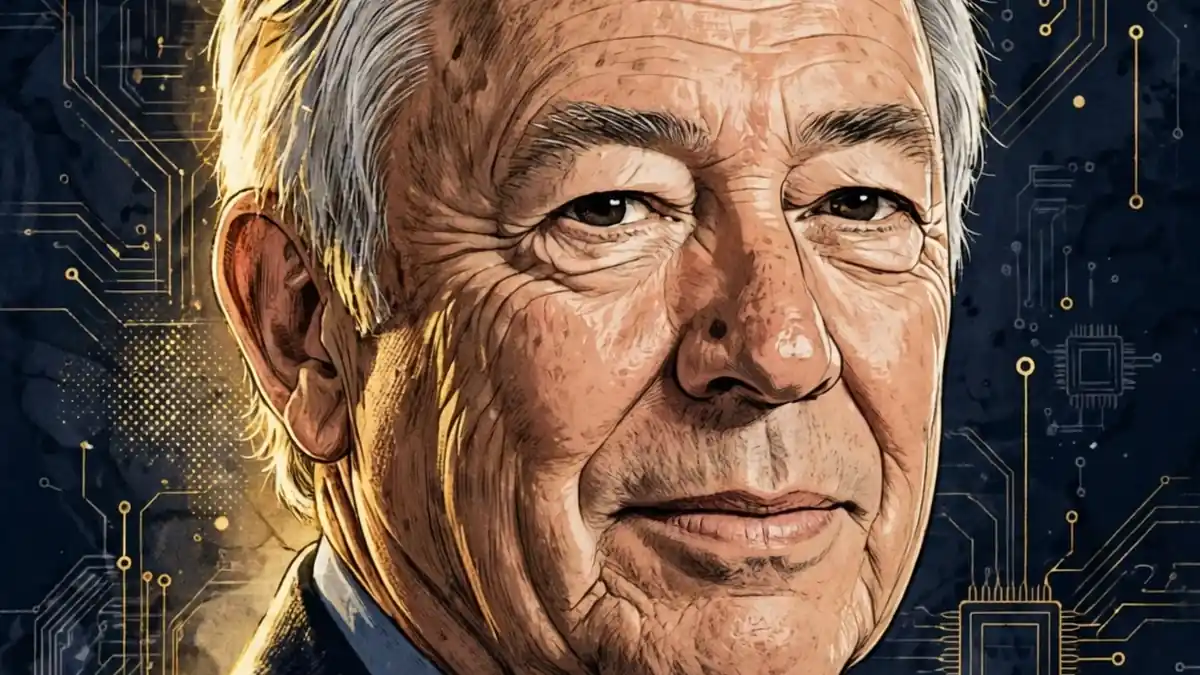
Mike Markkula‘s net worth is estimated at $1.1 billion to $1.5 billion as of October 2026. The number traces back to a single decision in January 1977: a $250,000 check that bought him a third of a two-man garage operation called Apple — a stake worth $203 million four years later at the IPO, and the foundation of a fortune he compounded across two decades on Apple’s board.
Mike Markkula: Quick Facts
| Estimated net worth | $1.2 billion (range: $1.1–$1.5 billion) |
|---|---|
| Profession | Engineer, investor, former Apple CEO and chairman |
| Nationality | American |
| Born | February 11, 1942 (age 84) |
| Height | Not publicly documented |
| Primary income sources | Apple equity appreciation, venture investments, real estate |
| Active years | 1960s–1997 (Apple board 1977–1997) |
| Last reviewed | October 2026 |
- Early Life and Background
- Education
- Career Journey: Fairchild, Intel, and an Early Retirement
- The Apple Bet: Two Hundred Fifty Thousand Dollars for a Third of Apple
- Main Sources of Income
- Salary and Earnings at Apple
- The Chairman Years: Twelve Years of Sorting Out Messes
- Businesses and Investments After Apple
- Brand Deals and Endorsements: The Spotlight He Never Wanted
- Houses, Cars and Other Assets: The Rana Creek Ranch
- Awards and Recognition
- Net Worth Growth Over the Years
- Social Media Presence
- Personal Life
- Sources & Reporting
- Frequently Asked Questions
- Final Thoughts
Early Life and Background
Mike Markkula was born Armas Clifford Markkula Jr. on February 11, 1942, in Los Angeles, California, according to California birth records cited on his Wikipedia biography. His name carries the family’s Finnish heritage: his great-grandfather, Isak Ferdinand Markkula, emigrated from Sievi, Finland to the United States in the late 19th century, and both “Armas” (meaning “dear” or “beloved” in Finnish) and “Markkula” are traditional Finnish names.
As a boy growing up in Southern California, Markkula disliked both of his given names and insisted on being called Mike — the name the world would eventually associate with Apple’s quietest founding fortune. An EBSCO research profile notes that he grew up in Southern California and set his sights early on two things: engineering and getting rich young enough to stop working.
Education
Markkula earned both his Bachelor of Science and Master of Science degrees in electrical engineering from the University of Southern California. Santa Clara University, which later became the home of the ethics center bearing his name, lists USC as his alma mater on his official biography page.
His USC years put him on the same technical track as many of the engineers who would build Silicon Valley: first a stint as a member of the technical staff in the research and development laboratory at Hughes Aircraft Company, then a move into the semiconductor industry that would change his life. At Fairchild Semiconductor he became marketing director for integrated circuits; when Robert Noyce and Gordon Moore left Fairchild to found Intel in 1968, Markkula followed them.
Career Journey: Fairchild, Intel, and an Early Retirement
Markkula worked at Intel from 1970 to 1974, where he guided development of the computer system used for processing customer orders and eventually became product marketing manager for memory chips. The money, though, came from the stock. Markkula had set himself a goal of becoming a millionaire by age 30, and buying Intel stock before it went public in 1971 made that possible. When a colleague was promoted over him to vice president of marketing, he walked away. At 32, in 1974, he was a self-described “small multimillionaire” who could live comfortably and never work again, per his New York Times profile of September 1997.
He spent the next few years as a Monday-only consultant to startups around Cupertino — free advice, one day a week — which is exactly where he was in 1976 when the phone rang. Venture capitalist Don Valentine, who had just turned down Steve Jobs’s request for funding, passed the two young men to Markkula instead. After meeting the unkempt Jobs, Valentine had asked Regis McKenna, “Why did you send me this renegade from the human race?” — then forwarded their details to the retired Intel marketer a few miles away.
The Apple Bet: Two Hundred Fifty Thousand Dollars for a Third of Apple
When Jobs and Wozniak showed Markkula the Apple II prototype, he saw what Valentine and McKenna had missed. In a 1992 interview with WGBH Boston, Markkula recalled: “I looked at it, and I said this is the first affordable useful computer for people.” He offered the two men a deal: write a business plan together. “If it comes out well, I’ll invest,” he said, “and if not, you’ve got a few weeks of my time for free.” Jobs began showing up at Markkula’s house in the evenings, talking through projections into the night. Walter Isaacson later recorded Jobs’s memory of that first meeting: Markkula arrived at the garage in a polished gold Corvette, looked past the fact that both young men needed a haircut — “You can always get a haircut” — and was amazed by what Wozniak had on the workbench.
The business plan convinced Markkula of his own thesis: this could be a Fortune 500 company in less than five years. In January 1977 he ended his retirement and put up the money. The exact shape of the investment varies by account — Celebrity Net Worth reports $80,000 as an equity investment and $170,000 as a loan, for $250,000 total; Leslie Berlin’s history Troublemakers, cited on his Wikipedia page, puts his personal check at $80,000–$92,000 alongside a $170,000–$250,000 Bank of America credit line he secured for the company; Owen Linzmayer’s Apple Confidential 2.0 says he invested $92,000 of his own money and secured the $250,000 line of credit. What every source agrees on is the headline: roughly a quarter-million dollars for roughly a third of Apple — 26% at incorporation, per his biography — and the title of employee number three.
Markkula then supplied what the Times called “adult supervision.” He wrote the company’s original business plan, authored the famous one-page “Apple Marketing Philosophy” memo, dated January 3, 1977 — the same day Apple incorporated. The memo laid down three principles that outlived his tenure: empathy (understand customer needs better than anyone), focus (say no to a thousand good ideas to do a few things well), and impute (people form opinions of a company from the signals it presents — its packaging, its advertising, its stores). Jobs quoted the memo for the rest of his career, and it became part of Apple’s internal onboarding. It may be the single most valuable page Markkula ever wrote: the $250,000 bought equity, but the memo bought the company’s identity. He also brought in his friend and former coworker Michael Scott as the company’s first president and CEO in early 1977. Wozniak has said plainly that Markkula deserves more credit for Apple’s success than he does himself. As a trained engineer, Markkula also stayed close to the product: he wrote several early Apple II programs, served as the startup’s primary bug-finder and product tester, and — in a story the New York Times profile preserves — motivated Wozniak to design the Disk II floppy drive by complaining that a checkbook-balancing program he had written loaded too slowly from a data cassette.
Main Sources of Income
Markkula’s fortune rests on four pillars, and the first dwarfs the rest.
Apple equity. The $250,000 investment returned $203 million at the December 12, 1980 IPO alone, when he owned seven million shares and Apple closed up 32% at $29 for a $1.778 billion valuation, per Cult of Mac‘s IPO history drawn from Wall Street Journal coverage. That was a 220,552% gain in four years, Celebrity Net Worth calculates. More importantly, Markkula did not cash out: he remained Apple’s largest individual shareholder for years, still holding “several million shares” into the mid-1990s, and sat on the board through Apple’s boom, its near-death mid-1990s slump, and the start of its recovery.
Intel-era stock options. His pre-IPO Intel and Fairchild holdings made him a multimillionaire by 32, giving him the cushion to bet $250,000 on two garage kids.
Venture and angel investing. After Apple he deployed capital through his own vehicles and direct investments, including the VC firm MDT Ventures and stakes in companies such as Crowd Technologies and Scotland-based LiveCode.
Real estate. The 2023 sale of his Rana Creek Ranch for $35 million was his largest known single liquidity event outside Apple stock.
He draws no salary from Apple today and has no known operating role — the money now comes from whatever diversified portfolio his six decades of compounding built.

Salary and Earnings at Apple
Markkula never took Apple for a salary play. When he joined in 1977 he was already independently wealthy, and his 1981–83 turn as the company’s second CEO — replacing Michael Scott, who left after the “Black Wednesday” layoffs of March 1981 — was a reluctant one. He had promised his wife, Linda, that he would spend no more than four years at the startup; he stayed nearly twenty. During the board meeting that confirmed him as CEO, he received a phone call that his father-in-law and best friend had died, a detail from Leslie Berlin’s Troublemakers that captures how little he relished the job.
His compensation was equity, and the equity did the work. Apple’s sales under his and Scott’s early stewardship tell the story: $773,000 in 1977, $7.86 million in 1978, $47.87 million in 1979, and $117 million in the IPO year of 1980, per Celebrity Net Worth’s company history. His seven million IPO shares at $203 million would have paid for several lifetimes of salaries. When he stepped down as CEO in 1983 he handed the reins to John Sculley, the PepsiCo executive he had recruited — then continued to accumulate influence, and equity value, as chairman.
The Chairman Years: Twelve Years of Sorting Out Messes
If the $250,000 bet made Markkula rich, the twelve years he spent as chairman made him durable. From 1985 to 1997, while CEOs came and went, Markkula was the constant — and Fortune was blunt about what that meant: “Apple CEOs have two things in common: They all get into big trouble; and Markkula always sorts out the mess.”
The record backs the line up. In 1979 he approved Jef Raskin’s plan for what became the Macintosh, then stopped Jobs from killing the project in favor of his own Lisa — twice, according to Apple folklore recorded at Folklore.org by Macintosh engineer Andy Hertzfeld. In 1985, when the board split between Jobs and the PepsiCo import John Sculley, Markkula sided with Sculley, and Jobs resigned. Eight years later, when Sculley himself had run out of answers, Markkula helped force him out too. He stayed through the company’s darkest stretch — by the mid-1990s Apple had lost $1.7 billion over four years and was, in Celebrity Net Worth’s phrase, “teetering on bankruptcy” — and in 1996 and 1997 he supported the return of the very man he had helped push out, then stepped off the board himself to make room for Jobs’s new regime.
For the net worth story, those chairman years matter more than most profiles admit. Markkula’s largest-individual-shareholder status ran straight through them, which means he held his Apple equity through the 1985–97 period when the stock was cheap — and, crucially, he was still positioned when the recovery began. The investors who sold in the mid-1990s despair locked in losses; the chairman who had spent a decade sorting out messes was still holding the paper. He left the board in 1997 with his fortune intact and, by all accounts, his privacy intact as well.
Businesses and Investments After Apple
Markkula stepped off Apple’s board in 1997 after supporting Steve Jobs’s return, and he never took another operating role in tech. Instead he built a portfolio of companies and investments that has received far less attention than it deserves.
His Wikipedia biography lists four companies he founded outside Apple: Echelon Corporation — the industrial networking and smart-grid company whose LonWorks technology went into building automation worldwide (Adesto Technologies acquired Echelon in 2018) — plus ACM Aviation, the San Jose Jet Center, and Rana Creek Habitat Restoration, tied to his Carmel Valley property. He also founded the venture capital firm MDT Ventures in 1985; CineNetWorth credits the firm with investments in Compaq, Logitech, and LSI Logic.
As an angel investor he backed Crowd Technologies, a startup developing the Piqqem web application that applied crowd wisdom to stock market predictions, and remains an investor in Scotland-based LiveCode Ltd, per Celebrity Net Worth and The Scotsman’s 2013 reporting on the company’s open-source pivot. None of these positions are publicly valued, which is one reason his net worth carries a wide range: the Apple-derived core is surrounded by a private portfolio nobody outside his family has fully mapped.
Brand Deals and Endorsements: The Spotlight He Never Wanted
Here is a section that is short by design: Mike Markkula has never taken an endorsement deal, appeared in an advertisement, or monetized his name. He is the inverse of the modern tech celebrity — no memoir, no speaking circuit fortune, no paid board seats at brand-name companies. Fortune‘s 1996 profile called him “the reclusive chairman who has always been the real power at Apple,” and reclusive is the operative word. Fortune‘s verdict on his chairman years: “Apple CEOs have two things in common: They all get into big trouble; and Markkula always sorts out the mess.”
That aversion to the spotlight has a direct bearing on his net worth estimate. Unlike Wozniak — who supplements his wealth with a steady speaking and appearances business — Markkula’s income has come almost entirely from capital: equity that appreciated and property that appreciated. There is no endorsement revenue to model and no lifestyle brand inflating the number.

Houses, Cars and Other Assets: The Rana Creek Ranch
For four decades, Markkula’s most visible asset was land. In 1982 he and Linda bought the original roughly 8,000-acre Rana Creek Ranch in Carmel Valley for about $8–9 million, and over the years added more than 6,000 acres until it reached 14,142 acres — the single largest private holding in Carmel Valley, some 22 square miles of oak savanna, meadows, and creeks, about 85 miles south of Silicon Valley.
The ranch carried the full gentleman-rancher apparatus: a 5,413-square-foot main house with a single bedroom (a covered walkway connects it to a two-bedroom guest wing), five additional homes, staff housing, a private lake, a riding arena, two barns, equipment storage, a greenhouse, a large office and conference center, a 2,900-foot landing strip, and a helipad. It operated as a working cattle ranch; the business, Markkula told the Wall Street Journal, “generates revenue to maintain the ranch.”
The sale saga was long. The Markkulas first listed it for $59.95 million in April 2013, cut it to $45 million in July 2016, took it off the market in February 2019, and relisted at $37.5 million in 2021 with Hall and Hall. Then came the buyer nobody expected: in July 2023, The Wildlands Conservancy acquired the ranch for $35 million to turn it into a nature preserve — a deal The Land Report named its Conservation Deal of the Year. The Esselen Tribe has since acquired 2,000 acres of it. In October 2026, the conservancy put the estate house and 160 surrounding acres on the market for $8.25 million, reporting that its focus is “restoring oaks and creeks and bringing back wildlife” rather than maintaining a mansion, per Monterey County Now. Conservancy CEO Frazier Haney told the paper the ideal buyer would share a conservation vision and “really get hands-on in the preserve” — the same ethos that made the Markkulas sell to conservationists in the first place.
His other known properties — a Lake Tahoe house and a Woodside mansion built during his first wave of wealth, per Walter Isaacson’s biography — are not publicly valued. Aviation assets (ACM Aviation, the San Jose Jet Center) are business holdings rather than toys, consistent with a man who has never shown interest in conspicuous consumption.
Awards and Recognition
Markkula’s honors are institutional rather than personal. Santa Clara University’s official biography page for “A.C. ‘Mike’ Markkula Jr.” records his service as chairman of the university’s board of trustees from 2003 to 2009, and the Markkula Center for Applied Ethics at Santa Clara carries his name — the most durable monument any Silicon Valley fortune has bought.
In popular culture he has been portrayed twice on screen: Jeffrey Nordling played him in the 1999 TNT film Pirates of Silicon Valley, and Dermot Mulroney played him in the 2013 film Jobs. AppleInsider‘s March 2026 “Apple at 50” profile argued his importance to the company matched Steve Jobs’s own — a judgment Wozniak himself has echoed for decades.
Net Worth Growth Over the Years
The table below reconstructs Markkula’s wealth trajectory from the public record. Figures outside the documented milestones are estimates and marked as such.
| Year | Estimated net worth | What happened |
|---|---|---|
| 1974 | $1–3 million (est.) | Retires from Intel at 32 as a “small multimillionaire” on Fairchild/Intel stock options |
| 1977 | $3–5 million (est.) | Invests $250,000 for a third of Apple; employee #3 |
| 1980 | $203 million | Apple IPO: 7 million shares at the closing price; a 220,552% return |
| 1985 | $300–500 million (est.) | Sides with John Sculley; becomes chairman; Apple’s largest individual shareholder |
| 1997 | $200–400 million (est.) | Leaves Apple’s board; Apple is near bankruptcy after losing $1.7 billion in four years |
| 2010 | $700 million–$1 billion (est.) | Assumed Apple equity retention compounds through the iPhone era |
| 2023 | $1–1.3 billion (est.) | Sells Rana Creek Ranch for $35 million to The Wildlands Conservancy |
| 2026 | $1.1–$1.5 billion | Trackers’ current range: CNW $1.2B, CineNetWorth $1.1B, NetWorthForum $1.5B |
The honest reading: Markkula’s fortune is the IPO stake compounded. The stock-split arithmetic shows why the estimates require judgment rather than math. Apple’s shares have split four times since the IPO — 2-for-1 in 1987, 2-for-1 in 2000, 2-for-1 in 2005, 7-for-1 in 2014, and 4-for-1 in 2020 — a cumulative 224-to-1 ratio. Seven million 1980 shares, held untouched through every split, would be roughly 1.57 billion shares today, worth something on the order of $400 billion at recent prices. Benzinga’s 2023 thought experiment reached a similar place from a different angle, calculating that his original one-third claim — before dilution, splits, and decades of sales — pointed toward a fortune approaching $900 billion. Neither number is real; both measure the same thing, which is how much compounding Markkula declined in exchange for liquidity, diversification, and philanthropy. What the $1.2 billion range assumes is that he kept a meaningful Apple position through the company’s 2000s–2010s bull run, diversified into ventures and land, and gave away a substantial — but not fortune-breaking — share.
Context helps. Apple’s founding generation finished in wildly different places, which is why the comparison below is instructive rather than decorative:
| Person | 1976–77 position | IPO-day outcome | Current estimate |
|---|---|---|---|
| Mike Markkula | $250,000 for ~1/3 of Apple | $203 million (7M shares) | $1.1–$1.5 billion |
| Steve Jobs | Co-founder | $256 million | ~$10 billion at his 2011 death, mostly from Pixar/Disney (Celebrity Net Worth) |
| Steve Wozniak | Co-founder | $116 million | ~$10 million per Celebrity Net Worth (updated 2026); other trackers say ~$100 million — he gave most of it away |
| Ronald Wayne | 10% stake, sold after 12 days | $800 buyout ($2,300 with a later settlement) | Modest; never a billionaire (Celebrity Net Worth) |
| Michael Scott | First CEO | $95.5 million (Cult of Mac/WSJ) | Not publicly estimated |
Markkula is the only one of the five whose wealth compounded upward for forty years after the IPO — because he stayed on the board for twenty of them and kept his equity working long after the others sold, gave away, or walked out.
Social Media Presence
Mike Markkula has no verified public social media accounts — no X, no Instagram, no LinkedIn under his name. In this he matches the rest of his biography: Fortune’s “reclusive chairman” never built a personal brand, and at 84 he shows no sign of starting. Any account claiming to be him should be treated as unverified.
Personal Life
Markkula married Linda Markkula, and the couple raised their family in the Bay Area. He promised her in 1977 that Apple would take no more than four years of his life; it took nearly twenty, and the Markkula family absorbed the cost — during the board meeting that confirmed him as CEO, he learned his father-in-law had died. The couple’s children were reportedly uninterested in taking over Rana Creek Ranch, one reason the property went on the market in 2013.
Before Apple, the retired 32-year-old’s life looked nothing like a future billionaire’s. The New York Times profile describes a family man content in his Cupertino home, building cabinets for his stereo system and strumming a guitar, dispensing startup advice one Monday a week. He never lost the reserve: colleagues remember a cautious, precise man — a former high school gymnast — who hated his own given names, loved order, and showed up to that first garage meeting in a polished gold Corvette, the one flash of flamboyance in a life otherwise defined by restraint.
His most documented personal trait is a moral seriousness that colleagues noticed early. Isaacson records Jobs’s first impression: “You could tell that if he could screw you, he wouldn’t. He had a real moral sense to him.” That sensibility found its public expression in the Markkula Center for Applied Ethics, which he and Linda seeded at Santa Clara University — first with a $3.5 million seed grant in 1986, per EBSCO, then with a $5 million endowment gift in the mid-1990s, per the Center’s own history. He chaired Santa Clara’s board of trustees from 2003 to 2009. The Center is now one of the largest university-based ethics centers in the world — and a meaningful, deliberate subtraction from the fortune this article estimates.
Sources & Reporting
Outlet-by-outlet sourcing for this article:
- Celebrity Net Worth — the $1.2 billion net worth anchor; the $80,000 equity + $170,000 loan investment breakdown; Apple’s 1977–80 sales figures; the 220,552% IPO return; Jobs’s ~$10 billion estate and Wozniak’s current figure used in the peer comparison. (Reporting window: 2024–2026)
- NetWorthForum — the $1.5 billion high-end estimate, updated October 2026.
- CineNetWorth — the $1.1 billion low-end estimate; MDT Ventures portfolio (Compaq, Logitech, LSI Logic).
- The New York Times — John Markoff’s September 1997 profile: “adult supervision,” Intel retirement as a “small multimillionaire” at 32, the Disk II checkbook story, the “several million shares” largest-shareholder detail.
- Fortune — the 1996 “reclusive chairman who has always been the real power at Apple” profile; the Sculley ouster context.
- Cult of Mac — Apple IPO history: $203 million Markkula return, $29 close, $1.778 billion valuation, $95.5 million Scott and $116 million Wozniak figures from Wall Street Journal coverage.
- AppleInsider — March 2026 “Apple at 50” profile: the $92,000 personal investment / $250,000 Bank of America credit line account.
- EBSCO — Research Starters biography: Finnish ancestry, USC degrees, Intel timeline, the $3.5 million Markkula Center seed grant.
- Santa Clara University — Markkula Center for Applied Ethics history: the $5 million mid-1990s endowment gift; his 2003–2009 trustees chairmanship.
- The Land Report — the July 2023 $35 million Rana Creek sale to The Wildlands Conservancy; Conservation Deal of the Year.
- Monterey County Now — the October 2026 $8.25 million estate-house listing.
- Hall and Hall — ranch listing history ($59.95M in 2013, $45M in 2016, $37.5M relist in 2021) and property details.
- Realtor.com — ranch amenities and listing-agent detail on the $37.5 million listing.
- Benzinga — the $900 billion diluted-stake thought experiment (2023).
- Wikipedia — career chronology (26% at incorporation, CEO 1981–83, chairman 1985–97, Macintosh/Lisa history, Echelon/ACM Aviation/San Jose Jet Center ventures, 2023 ranch sale), citing Berlin’s Troublemakers, Time‘s 1982 “Seeds of Success,” and the Markoff NYT profile.
Reporting window for this article: October 2026, with historical coverage spanning 1976–2026.
Frequently Asked Questions
What is Mike Markkula’s net worth in 2026?
Mike Markkula’s net worth is estimated at $1.2 billion as of October 2026, with trackers ranging from $1.1 billion (CineNetWorth) to $1.5 billion (NetWorthForum). No verified rich-list figure exists, so the number is triangulated from his IPO-day $203 million Apple holding, his years as Apple’s largest individual shareholder, the $35 million sale of his Carmel Valley ranch in 2023, and his documented philanthropy.
How did Mike Markkula make his money?
Markkula made his money in two stages. First, as a marketing manager at Fairchild Semiconductor and Intel, he bought pre-IPO stock that made him a multimillionaire by age 32, letting him retire in 1974. Second, in January 1977 he invested about $250,000 in Apple for roughly a third of the company; that stake was worth $203 million at the December 1980 IPO and compounded across his 20 years on Apple’s board.
How much did Mike Markkula invest in Apple?
About $250,000 in total. Celebrity Net Worth breaks it down as $80,000 in equity and $170,000 as a loan; Leslie Berlin’s history Troublemakers puts his personal check at $80,000–$92,000 plus a $170,000–$250,000 Bank of America credit line he secured for the company. The investment made him a one-third owner and employee number three.
Is Mike Markkula a billionaire?
By every public estimate, yes — his net worth sits in the low billions. But he appears on no verified rich list: neither Forbes nor Bloomberg publishes a figure for him, and his current holdings are private. The billionaire status comes from net-worth trackers’ estimates, not audited disclosures.
What was Mike Markkula’s role at Apple?
Markkula was Apple’s original angel investor, its first VP of marketing, its second CEO (1981–1983), and chairman of the board (1985–1997) — the longest-serving board member in company history at 20 years. He wrote the business plan and the “Apple Marketing Philosophy” memo, hired the first CEO Michael Scott, approved the Macintosh project, and sided with John Sculley in the 1985 dispute that pushed Steve Jobs out.
Is Mike Markkula still alive?
Yes. Born February 11, 1942, Mike Markkula is 84 years old as of October 2026. He lives privately in California with his wife, Linda, keeps no public social media presence, and stepped back from Apple’s board in 1997.
What happened to Mike Markkula’s Apple shares?
At the 1980 IPO he owned seven million shares worth $203 million. He remained Apple’s largest individual shareholder into the mid-1990s, holding “several million shares,” per the New York Times. He sold down over the following decades — had he kept everything through all the splits, the stake would be worth hundreds of billions — but retained enough equity through Apple’s revival to keep his fortune in the billions, supplemented by venture investments and the $35 million 2023 ranch sale.
How much did Mike Markkula donate to charity?
The documented figure centers on Santa Clara University: Markkula and his wife Linda provided a $3.5 million seed grant for the Markkula Center for Applied Ethics in 1986 and a $5 million endowment gift in the mid-1990s, per EBSCO and the Center’s own history. He also chaired the university’s board of trustees from 2003 to 2009, and sold his $35 million ranch to a conservation nonprofit rather than a private buyer. The full lifetime giving total is not publicly disclosed.
Final Thoughts
Every founder mythology has a figure the cameras skip, and in Apple’s story that figure is Mike Markkula. He supplied the one ingredient neither Jobs nor Wozniak had: the judgment of a man who had already gotten rich once and knew how companies were supposed to work. The $250,000 he risked in January 1977 — $80,000 of it his own equity, the rest a loan and a bank line he personally secured — became $203 million in four years and a fortune that outlasted almost every other Apple fortune of the era.
The estimate lands at $1.2 billion, inside a $1.1–$1.5 billion range, and the range is the honest part. Nobody has audited this money. What the record does show is a man who compounded patiently: he stayed on Apple’s board for twenty years, through the slump that nearly killed the company, and kept his capital working long after the garage generation cashed out. He gave real money away — millions to Santa Clara University’s ethics center, a 14,000-acre ranch to conservation — and never chased the spotlight that might have inflated his number.
The quietest founder built the most durable fortune. That is the whole story, and it needed no embellishment.
Published on October 24, 2026. Last reviewed October 2026. Found an error? See our corrections policy.