
JoJo Siwa‘s net worth is estimated at $20 million to $25 million as of November 2026. The central figure used by Celebrity Net Worth and most trackers is $20 million, built on a youth-merchandise empire that Forbes reporting put near $400 million in retail bow sales, a touring business whose first arena run grossed a reported $27 million, and a television career that ran from Dance Moms to a third-place finish on Celebrity Big Brother UK in 2025.
JoJo Siwa: Quick Facts
| Estimated net worth | $20 million (range: $20 million to $25 million) |
|---|---|
| Profession | Singer, dancer, actress, YouTuber and entrepreneur |
| Nationality | American |
| Born | May 19, 2003, Omaha, Nebraska (age 23) |
| Height | 5 feet 9 inches (175 cm) |
| Primary income sources | Merchandise licensing, touring, television, music royalties, YouTube and brand deals |
| Active years | 2013–present |
| Last reviewed | November 2026 |
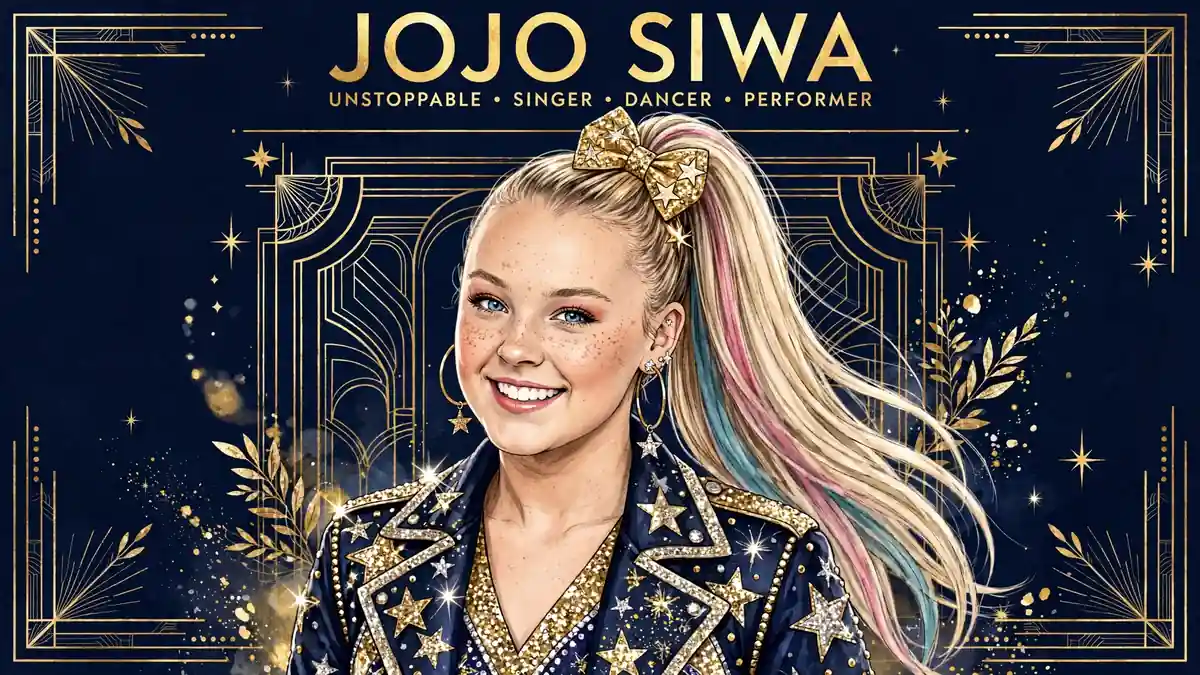
- Quick Facts
- Early Life and Background
- Education
- Career Journey
- Rise to Fame
- Main Sources of Income
- Salary and Earnings
- Businesses and Investments
- Brand Deals and Sponsorships
- Houses, Cars and Other Assets
- Awards and Achievements
- Net Worth Growth Over the Years
- Social Media Presence
- Personal Life
- Sources & Reporting
- Frequently Asked Questions
- Final Thoughts
Early Life and Background
Joelle Joanie Siwa was born on May 19, 2003, in Omaha, Nebraska, to Jessalynn Siwa, a dance instructor who ran her own studio, and Tom Siwa, a chiropractor. Dance was not a hobby she picked up later; it was the family business and the household routine. Her mother taught classes, her older brother Jayden danced, and JoJo grew up inside studios where choreography, competitions and costumes were everyday work rather than weekend activities.
That upbringing explains the speed of everything that followed. By the time most children are choosing an after-school activity, Siwa was already competing. Her mother, who would later manage her career and negotiate her biggest deals, understood the youth-dance economy from the inside: studio fees, competition circuits, and the way a standout child performer can draw attention far beyond a local stage. The family moved its focus to Los Angeles as her television career took off, a relocation that put her within reach of casting directors, record labels and licensing executives.
Siwa’s early public image — the oversized hair bow, the bright side ponytail, the high-energy delivery — was not an accident of styling. It was a deliberate, repeatable brand mark, the kind of visual shorthand that photographs well, reads clearly on a small phone screen, and translates directly onto a product. That bow would become the single most valuable asset of her career, and it started as a dance-competition accessory.
Education
Siwa’s schooling followed the pattern common to child performers: formal classroom education gave way to tutoring and flexible study as filming, touring and recording took over her schedule. She attended school in Nebraska in her early years, then moved to home-based and on-set tutoring once Abby’s Ultimate Dance Competition and Dance Moms made a conventional school timetable impossible.
Her real education, in business terms, happened inside the entertainment industry itself. By 13 she was sitting in meetings about licensing deals. By 16 she had bought a house. By 18 she had fronted a sold-out arena tour and built a product line sold in thousands of stores. Whatever she missed in a classroom, she gained in contract rooms, rehearsal halls and on tour buses — and the financial record reflects that trade. Nothing in this article treats her as a university graduate or claims academic credentials she does not hold; her expertise is commercial, built over a decade of working in dance, television and retail.
Career Journey
Siwa first reached a national audience in 2013 on Abby’s Ultimate Dance Competition, Abby Lee Miller’s Lifetime competition series, where she finished in the top five. The exposure led directly to Dance Moms, which she joined for seasons five and six, appearing from 2015 to 2016. Reality television paid modestly at that level — published estimates of her Dance Moms pay run from about $1,000 to about $2,000 per episode, and the two figures show why per-episode pay for that show should always be quoted as a range rather than a single number — but the show paid in audience, and audience was the currency that mattered.
In 2016 she released “Boomerang,” an anti-bullying pop single whose video has passed one billion views on YouTube. The song went platinum in the United States in 2017, according to the Recording Industry Association of America, and it remains her signature recording. The same year she signed a multi-platform talent deal with Nickelodeon, covering television, music, live events and consumer products. That deal, signed when she was 13, converted a reality-TV profile into a corporate partnership with a children’s entertainment giant.
Nickelodeon gave her shows (JoJo’s Juice, The JoJo & BowBow Show Show, Lip Sync Battle Shorties as co-host), a film (The J Team, released on Paramount+ in 2021), and, most importantly, a merchandising machine. Bows, dolls, bedding, clothing, shoes, backpacks and accessories poured into Claire’s, Walmart, Target and Amazon. In 2019 she launched D.R.E.A.M. The Tour, her first arena tour, which Billboard-linked reporting put at about $27 million in gross revenue. A second leg followed, and touring became the second pillar of her fortune after merchandise.
Television kept her visible between tours. She was a judge on So You Think You Can Dance season 17, competed on Dancing with the Stars season 30 in 2021, appeared on The Masked Singer in 2020, and fronted her own competition series, Siwa’s Dance Pop Revolution, in 2021. Each appearance carried a fee and kept her name in front of a new audience segment — dance fans, reality viewers, then adult reality audiences.
The Nickelodeon years also produced a publishing and screen catalog that still earns. She voiced characters in animated projects, published books aimed at her young audience, and starred in The J Team, a musical film built around her persona that premiered on Paramount+ in September 2021. None of those projects individually rivalled the bow line, but together they deepened the catalog that generates residuals: every rerun, stream and licensing renewal of a Nickelodeon-era project sends a small payment back, and catalogs of that size produce meaningful annual income even in years without a new release.
Her music output in the Nickelodeon era was steady rather than chart-dominant. After “Boomerang” came “Kid in a Candy Store,” “Hold the Drama,” “D.R.E.A.M.” and a run of singles and EPs that sold to her core audience and filled tour setlists. The commercial logic was circular and effective: songs promoted the tour, the tour sold merchandise, and merchandise kept children asking for the songs. Breaking that circle was the risk of the adult rebrand — and the reason the 2024 pivot mattered more for her long-term earnings than any single chart position.
That pivot continued into 2025 with a cover of Kim Carnes’ “Bette Davis Eyes,” a choice that signalled retro-pop ambition rather than a return to children’s music, and with the Celebrity Big Brother UK run that reintroduced her to a British audience of millions. The UK market matters to her balance sheet because her Nickelodeon shows aired widely there, her tours played there, and British reality television pays established names well. Her third-place finish, combined with the relationship storyline that dominated tabloid coverage for weeks, kept her in the news cycle for two months on a single booking — an efficient return on 19 days of work, whatever the exact fee was.
Rise to Fame
Three moments made Siwa famous rather than merely known. The first was Dance Moms, which put her personality — loud, confident, unbothered by the show’s manufactured conflicts — in front of millions of viewers who had never watched a dance competition. The second was “Boomerang,” which gave that personality a song children could sing back, with a video that still accumulates views years later. The third was the bow: a product so simple and so distinctive that a child could ask for it by sight, and a parent could find it in a mall.
Forbes recognized the scale of the operation early, and its reporting on the bow business — roughly $400 million in retail sales attributed to the bow line, with 40 million bows sold in 2018 alone according to some accounts and 80 million cumulatively by 2021 according to others — became the number every later profile quoted. The two bow-count figures are not a contradiction; they describe different windows, one year against a cumulative total. What matters for her net worth is the distinction drawn in the methodology box above: $400 million was retail value, not Siwa’s bank balance. Her share came as royalties and licensing fees, which is why a $400 million product line produces a $20 million personal fortune rather than a $400 million one.
By 2020 she was on Time magazine’s list of the 100 most influential people in the world, and in 2022 she made Forbes’ 30 Under 30 list for Hollywood and entertainment. She had become a millionaire before her 18th birthday, according to Celebrity Net Worth — a claim consistent with the timeline of her Nickelodeon deal and the peak bow years of 2017 to 2019.
Main Sources of Income
Merchandise licensing sits at the top of the list and has done since 2017. The bow line led, and hundreds of licensed products followed: dolls, clothing, bedding, shoes, accessories and party goods. A reported Walmart order for one million pairs of shoes shows the volume these deals reached. Even as the bow era faded, licensing income continued in residual form, because existing products kept selling and older deals kept paying royalties into the 2020s.
Touring is the second pillar. D.R.E.A.M. The Tour’s reported $27 million gross put her in rare company for a performer who started the decade as a child reality contestant. Arena tours carry heavy costs — production, staging, crew, travel — so gross is not profit, but even a conservative margin on that gross represents several million dollars of personal income across the tour’s runs.
Television and reality fees form the third stream: Dance Moms pay at the start, then materially larger fees for judging, competing and hosting as her profile grew. Music royalties form a fourth: “Boomerang” alone has more than a billion YouTube views and tens of millions of Spotify streams, and her catalog of singles and EPs earns steadily rather than spectacularly. YouTube advertising is a fifth: her main channel carries about 12 million subscribers and billions of total views, and published estimates of her peak YouTube ad income run to roughly $2.5 million to $3 million a year during her most active periods, according to Finance Monthly-linked reporting. Brand deals and social-media sponsorships form a sixth, and real estate — specifically the Tarzana house sale — produced a one-off gain in 2025.

Salary and Earnings
Siwa has no public salary in the conventional sense; she is not an employee with a paycheck. Her earnings arrive as deal income, and the figures below are the best-reported numbers for each stage, with their limits stated plainly.
Dance Moms (2015–2016): about $1,000 to $2,000 per episode, per published estimates. Over two seasons that amounts to a five-figure total — useful money for a teenager, trivial beside what followed, and important mainly because it bought her the audience.
Dancing with the Stars (2021): a reported sign-on fee of about $125,000, per reality-pay roundups, with additional weekly payments as she advanced to the final. She finished runner-up with professional partner Jenna Johnson, as the show’s first same-sex pairing — a historic casting decision that drew press coverage far beyond the dance audience. A similar sign-on figure has been reported for her 2020 Masked Singer appearance, though that number is less firmly sourced and is treated here as an estimate, not a fact.
Celebrity Big Brother UK (2025): unconfirmed tabloid roundups put her fee at about £400,000 for the 19-day run that ended in third place. No broadcaster or representative has confirmed that figure, so it is reported here only as an unconfirmed estimate — but even at half that amount, a three-week reality stint paying six figures shows how far her per-appearance price had travelled from the Dance Moms era.
Annual income today is estimated by trackers at roughly $1.8 million to $4 million a year, depending on touring, television and licensing activity in a given year. The wide range is honest: a year with a tour and a reality run looks very different from a year with only royalties and residuals. Music streaming adds a smaller, steadier layer — one 2025 estimate credited her with roughly $3 million in cumulative Spotify earnings, a figure that should be read as a lifetime estimate from streaming, not an annual salary.
Businesses and Investments
Siwa’s business structure has always been personal-brand licensing rather than company building. She did not found a startup or take venture funding; she licensed her name, face and bow to manufacturers and retailers, and kept the intellectual property close. Reports describe her operating through her own entertainment company, which gave her control of her brand assets rather than handing them outright to a studio or label.
The most concrete business venture beyond licensing is XOMG POP!, the girl group she formed with her mother Jessalynn through Siwa’s Dance Pop Revolution. The group built a large TikTok following and released music and merchandise, and it represents Siwa’s one attempt to turn her own fame into a talent pipeline. It also drew serious scrutiny: a February 2024 Rolling Stone investigation reported allegations from former members and parents about harsh treatment inside the group, including claims of physical and mental strain. Siwa and her mother have denied abuse allegations, and no court has ruled on the claims. The episode matters financially because it shows the risk side of the brand business: a group built on her name can generate both income and reputational cost, and the controversy coincided with her adult rebrand, complicating its reception.
Her 2024 move to Columbia Records for the Guilty Pleasure EP was a business decision as much as an artistic one. Leaving Nickelodeon’s children’s ecosystem meant leaving its merchandising machine, and signing with a major label for adult pop was a bet that her audience would follow her into a new demographic. Commercially the EP underperformed its hype — “Karma” peaked at No. 5 on Billboard’s Hot Dance/Electronic Songs chart and No. 22 on the Bubbling Under Hot 100, respectable for a rebrand single but far from her childhood chart footprint — yet it bought her something licensing could not: an adult identity she could build on.
On investments beyond her brand, Siwa has kept a low public profile. Trackers mention stock and property holdings in general terms, but no verified portfolio, startup stake or business acquisition is on the public record, and this article does not invent one. Her one documented investment-grade transaction is real estate, covered below.
One more distinction shapes how her fortune should be read. Wealth trackers that publish a single number for a celebrity blend very different kinds of money: cash in the bank, property equity, business value and expected future royalties. Siwa’s case shows why the blend matters. Her property equity was crystallised in the Tarzana sale, her business value sits mostly in a brand catalog whose worth depends on future licensing, and her cash position depends on how much of the tour and merchandise income survived taxes, agent commissions, management fees and production costs. Industry rules of thumb put those deductions at roughly half of gross entertainment income for a US-based performer, which is another reason a $400 million retail line and a $27 million tour gross compress into a $20 million personal estimate. The estimate is not a claim that she earned only $20 million in her life; it is a claim about what remains, after costs, in assets and holdings, as of November 2026.
Brand Deals and Sponsorships
Siwa’s brand deals have always been retail deals first and endorsement deals second. The Nickelodeon consumer-products program was itself the deal: manufacturers paid to put her name on their goods, and retailers paid for shelf space in the children’s aisle. Claire’s was the signature partner — bows in every mall in America — followed by Walmart, Target and Amazon distribution that made her products available far beyond specialty stores.
Named endorsement partners reported over the years include Pepsi and Skechers, alongside the long list of licensees behind her product lines. Published roundups credit her with roughly $1 million to $2 million a year from endorsements at peak, though that figure blends licensing royalties and pure endorsement fees and should be read as an order-of-magnitude estimate, not an audited line item.
Social media sponsorships now form a larger share of this income than they did during the bow peak. With tens of millions of followers across TikTok, Instagram and YouTube, a single sponsored post or short campaign pays at influencer rates for an audience of her size — five figures per post by standard industry benchmarks, though her exact rate card is private. The 2025 Celebrity Big Brother run also revived her UK commercial profile, where she had a large existing audience from Dance Moms broadcasts and her music catalog.

Houses, Cars and Other Assets
The Tarzana house is the best-documented asset of Siwa’s career, because both ends of the transaction are on the public record. In December 2019, at 16, she bought a Mediterranean-style estate in Tarzana, Los Angeles, for $3.425 million — usually rounded to $3.43 million in reporting. The house ran to about 6,462 square feet with six bedrooms and seven bathrooms, on more than half an acre, and it became famous in its own right: a candy room, a merchandise room, a home recording studio, a pool and a sports court, all featured across years of her videos.
In February 2025 she sold it for $4.1 million, about $110,000 above its $3.995 million asking price, in a sale listed by Chrishell Stause and Omar Abaza of The Oppenheim Group and featured on Netflix’s Selling Sunset. The headline gain is about $670,000 before renovation costs, agent fees and taxes — a real profit, but a modest one beside the purchase price, and a reminder that celebrity house flips rarely produce the windfalls headlines imply. She has not publicly confirmed a new main home since the sale, and reports of further property purchases in Los Angeles and Nevada remain unconfirmed.
Her car collection has been reported to include a Tesla Model X and a BMW 4 Series, plus a Lamborghini wrapped for the “Karma” era that drew attention in her videos. The most talked-about single purchase of her adult years was not a car or a house at all: in 2024 Entertainment Tonight reported she paid $50,000 for cosmetic dentistry in Beverly Hills, a figure she discussed herself on social media. It is a small number beside her fortune, but it captures her spending style — visible, shareable, and on-brand.
No yacht or private jet ownership is on the public record, and none is claimed here. Her asset profile is that of a working entertainer with one major property transaction, a car collection, and a brand catalog — not a billionaire’s portfolio, and not a modest one either.
Awards and Achievements
Siwa’s awards shelf reflects two careers: the children’s entertainer and the adult pop act. “Boomerang” earned platinum certification in the United States. She won Nickelodeon Kids’ Choice Awards during her peak children’s years, was named to Time’s 100 most influential people list in 2020, and made Forbes’ 30 Under 30 list for Hollywood and entertainment in 2022. Her Dancing with the Stars runner-up finish in 2021, as half of the show’s first same-sex pairing, is a cultural milestone that outlasts any trophy: it was a prime-time network first, covered by every major outlet, and it arrived months after she came out publicly in January 2021.
The “Karma” era produced a different kind of achievement — virality. The single’s video drew millions of views and millions of dislikes in its first weeks, was parodied by Chloe Fineman on Saturday Night Live on May 4, 2024, and still charted on Billboard’s dance charts. A parody on Saturday Night Live is, in its own way, a marker of arrival: the show only spoofs figures its audience already knows.
Net Worth Growth Over the Years
The table below uses published tracker estimates, not audited figures. Early years are the least certain; the direction and the inflection points — Nickelodeon deal, bow peak, tour, plateau — are consistent across every tracker that publishes a series.
| Year | Estimated net worth | What drove it |
|---|---|---|
| 2015 | Under $1 million | Dance Moms exposure; first YouTube growth |
| 2017 | About $3 million | Nickelodeon deal; “Boomerang”; bow line launches |
| 2019 | $10 million to $12 million | Bow peak; D.R.E.A.M. The Tour; Tarzana purchase |
| 2021 | About $15 million | Dancing with the Stars runner-up; judging and hosting fees |
| 2023 | About $18 million | Rebrand begins; residuals, licensing and social income |
| 2025 | About $20 million | Celebrity Big Brother UK; Tarzana sale at $4.1 million |
| 2026 | $20 million to $25 million | Adult-era music, television and licensing; top of range reflects optimistic trackers |
Two features of that series deserve emphasis. First, the growth is front-loaded: most of the fortune was made between 2017 and 2021, when she was still a teenager, and the last five years have been a plateau with a slow climb rather than a second surge. Second, the plateau is not a decline. A fortune that holds at $20 million through a full identity change — from children’s star to adult pop act — is a sign that the underlying income (licensing residuals, catalog royalties, television fees) is durable even when the cultural heat cools.
Peer comparison puts the figure in context. Among Dance Moms alumni, Siwa is the clear financial outlier: Maddie Ziegler, the show’s most prominent dancer after Siwa, is generally estimated at about $5 million — roughly a quarter of Siwa’s fortune. The gap is the merchandise business. Ziegler built an acting and dance career; Siwa built a product line. Products scale in a way that performances do not, and that single difference explains most of the distance between their balance sheets.
Social Media Presence
Siwa’s social footprint is the distribution system for everything else she sells. Her main YouTube channel carries about 12 million subscribers and billions of total views, with “Boomerang” alone past one billion views. Her TikTok audience runs into the tens of millions — 36 million followers with 1.2 billion likes was the figure reported in 2021, and her account has grown since — and her Instagram audience sits above 10 million. Those numbers matter commercially because they let her launch a single, a product or a television appearance to an audience without buying advertising.
Her social strategy changed with her rebrand. The children’s content — challenges, room tours, candy-filled vlogs — gave way to adult pop content, tour footage and personal posts, and in early 2026 she changed her social-media names to Joelle Siwa, signalling that the childhood stage name was being retired in favour of her given name. The move cost her some algorithmic familiarity and gained her a cleaner adult identity; whether it helps her commercially will be visible in her next music or television cycle.
Personal Life
Siwa came out publicly in January 2021, at 18, and has since described her identity in evolving terms — first as gay, then as pansexual, and later as queer, a label she reaffirmed during her 2025 Celebrity Big Brother UK appearance, where she said on air that she was “switching letters” from L to Q. She dated Kylie Prew, then a series of partners including Miranda Maleski and Kath Ebbs, the Australian influencer she was dating when she entered the Big Brother house in April 2025.
Inside that house she formed a close bond with Chris Hughes, the Love Island UK alumnus, and after leaving the show — where she finished third, behind winner Jack P. Shepherd and runner-up Danny Beard — she confirmed the relationship publicly in June 2025. The couple marked their first anniversary in May 2026, and by late 2026 were publicly discussing engagement-ring designs, with Siwa telling People at the Industry Dance Awards that she and Hughes had independently picked the same design. Her mother Jessalynn remains a central figure in her professional life, and her brother Jayden’s 2025 wedding was the occasion for some of her most widely shared family posts of the year.
Siwa has also been open about the costs of child fame, including the pressure of growing up on camera and the scrutiny that followed her rebrand. She has never disclosed her finances directly, and this article’s estimate rests on outside reporting rather than any statement from her.
Sources & Reporting
Celebrity Net Worth — the $20 million central estimate and the claim she became a millionaire before 18. Forbes — bow-business retail scale (about $400 million) and 30 Under 30 (2022). Billboard — D.R.E.A.M. The Tour gross of about $27 million and “Karma” chart positions (No. 5 Hot Dance/Electronic Songs, No. 22 Bubbling Under Hot 100). People — Celebrity Big Brother UK third-place finish, Hughes relationship timeline and first-anniversary coverage (2025–2026). Rolling Stone — February 2024 XOMG POP! investigation and Guilty Pleasure review coverage. Business Insider — 2019 reporting on her brand value as a teen entrepreneur. Entertainment Tonight — 2024 reporting on her $50,000 cosmetic dentistry. BBC — Celebrity Big Brother UK and Celebrity MasterChef coverage involving Hughes. Architectural Digest — Tarzana sale coverage linked to Selling Sunset. Reporting window: 2013–2026, with figures re-checked against 2025–2026 trackers for this November 2026 review. Where sources disagree (per-episode pay, bow counts, top-of-range estimates), the range is published and the disagreement is named in the text.
Frequently Asked Questions
What is JoJo Siwa’s net worth in 2026?
JoJo Siwa’s net worth is estimated at $20 million to $25 million as of November 2026, with $20 million the most widely cited figure, used by Celebrity Net Worth and most trackers.
How did JoJo Siwa make her money?
Mostly merchandise licensing. Her signature hair bows generated about $400 million in retail sales according to Forbes-linked reporting, and she earned royalties and licensing fees on that and hundreds of other products, plus touring, television fees, music royalties and YouTube advertising.
Is JoJo Siwa a billionaire?
No. She is a multimillionaire worth an estimated $20 million to $25 million. The billion-dollar figures sometimes quoted describe gross retail sales of her licensed products, not her personal fortune — she earns a royalty slice of each sale, not the full shelf price.
How much did JoJo Siwa’s house sell for?
She sold her Tarzana, Los Angeles mansion in February 2025 for $4.1 million, after buying it in December 2019 at age 16 for $3.425 million — a headline gain of about $670,000 before renovation costs, fees and taxes.
What was JoJo Siwa’s biggest song?
“Boomerang” (2016), an anti-bullying single that went platinum in the United States and whose video has passed one billion YouTube views. Her adult-era signature is “Karma” (2024), which reached No. 5 on Billboard’s Hot Dance/Electronic Songs chart.
Who is JoJo Siwa dating?
Chris Hughes, the Love Island UK alumnus she met on Celebrity Big Brother UK in April 2025. They confirmed their relationship in June 2025 and marked their first anniversary in May 2026.
How much did JoJo Siwa earn on Dance Moms?
Published estimates put her Dance Moms pay at about $1,000 to $2,000 per episode — modest beside her later earnings, but the show gave her the national audience her merchandise empire was built on.
Why did JoJo Siwa change her name to Joelle Siwa?
In early 2026 she changed her social-media names to Joelle Siwa, her given first name, as part of her adult rebrand — moving past the childhood “JoJo” stage persona toward an adult identity, following the 2024 Guilty Pleasure EP.
Final Thoughts
JoJo Siwa’s fortune is a case study in what a children’s brand is actually worth when the merchandise, not the performance, does the heavy lifting. The $20 million to $25 million estimate survives scrutiny precisely because it is modest beside the $400 million retail figure that dominates headlines: royalties, touring, television and residuals, taxed and fee’d along the way, produce a multimillionaire, not a billionaire.
The more interesting question is what comes next. The bow era is over, the Tarzana house is sold, and the adult rebrand has bought attention without yet producing a second commercial peak. If her next music or television cycle lands, the top of the range — $25 million and beyond — is reachable. If it does not, the existing income streams are durable enough that the fortune should hold. Either way, the foundation was laid before she could legally vote, and that is the part of the story no rebrand can rewrite.
Published on November 1, 2026. Last reviewed November 2026. Found an error? See our corrections policy.